×
Request Free Sample ×

Kindly complete the form below to receive a free sample of this Report

Leading companies partner with us for data-driven Insights

clients tt-cursor
Hero Background

Industrial Belt Tensioner Market

ID: MRFR/PCM/25636-HCR
111 Pages
Snehal Singh
October 2025

Industrial Belt Tensioner Market Research Report: By Product Type (Automatic Belt Tensioners, Manual Belt Tensioners, Pneumatic Belt Tensioners, Hydraulic Belt Tensioners, Electromagnetic Belt Tensioners), By Drive Type (Fixed Drive, Adjustable Drive, Variable Drive, Chain Drive, Belt Drive), By Application (Industrial Machinery, Automotive Industry, Textile Industry, Printing Industry, Packaging Industry, Food Processing Industry) and By Regional (North America, Europe, South America, Asia Pacific, Middle East and Africa) - Forecast to 2035.

Share:
Download PDF ×

We do not share your information with anyone. However, we may send you emails based on your report interest from time to time. You may contact us at any time to opt-out.

Industrial Belt Tensioner Market
 Infographic
Purchase Options

Industrial Belt Tensioner Market Summary

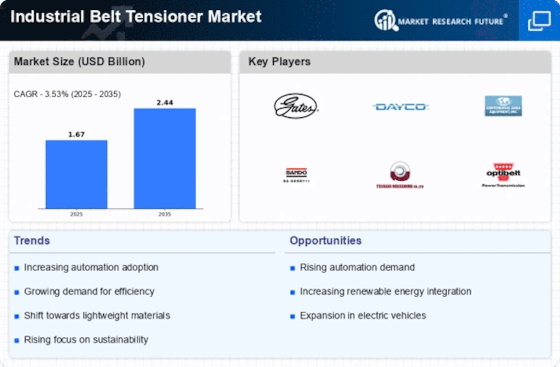
As per MRFR analysis, the Industrial Belt Tensioner Market Size was estimated at 1.665 USD Billion in 2024. The Industrial Belt Tensioner industry is projected to grow from 1.723 in 2025 to 2.439 by 2035, exhibiting a compound annual growth rate (CAGR) of 3.53 during the forecast period 2025 - 2035.

Key Market Trends & Highlights

The Industrial Belt Tensioner Market is poised for growth driven by technological advancements and increasing demand across various sectors.

  • North America remains the largest market for industrial belt tensioners, driven by robust manufacturing capabilities.
  • The Asia-Pacific region is emerging as the fastest-growing market, fueled by rapid industrialization and automation.
  • Automatic belt tensioners dominate the market, while manual belt tensioners are witnessing the fastest growth due to their cost-effectiveness.
  • Technological advancements in manufacturing and rising demand from the automotive sector are key drivers propelling market expansion.

Market Size & Forecast

2024 Market Size 1.665 (USD Billion)
2035 Market Size 2.439 (USD Billion)
CAGR (2025 - 2035) 3.53%

Major Players

Gates Corporation (US), Dayco Products LLC (US), Continental AG (DE), Bando Chemical Industries, Ltd. (JP), Tsubaki Nakashima Co., Ltd. (JP), Optibelt GmbH (DE), Mitsuboshi Belting Ltd. (JP), Fenner Precision (UK)

Industrial Belt Tensioner Market Trends

The Industrial Belt Tensioner Market is currently experiencing a dynamic evolution, driven by advancements in technology and increasing demand for efficient machinery. As industries strive for enhanced performance and reliability, the focus on belt tensioners has intensified. These components play a crucial role in maintaining optimal tension in belts, thereby ensuring smooth operation and longevity of equipment. The market appears to be influenced by various factors, including the growing emphasis on automation and the need for energy-efficient solutions. Furthermore, the integration of smart technologies into industrial applications suggests a shift towards more sophisticated tensioning systems that can adapt to varying operational conditions. In addition, the Industrial Belt Tensioner Market is likely to witness a surge in demand from sectors such as automotive, manufacturing, and renewable energy. As these industries continue to expand, the requirement for reliable and durable tensioning solutions becomes increasingly apparent. Moreover, the trend towards sustainability may drive innovations in materials and designs, potentially leading to more eco-friendly options. Overall, the market landscape seems poised for growth, with opportunities for manufacturers to develop advanced products that meet the evolving needs of diverse applications.

Technological Advancements

The Industrial Belt Tensioner Market is witnessing a notable shift towards the incorporation of advanced technologies. Innovations such as smart sensors and automated tensioning systems are becoming more prevalent, enhancing the efficiency and reliability of belt operations. This trend indicates a growing preference for solutions that not only improve performance but also reduce maintenance costs.

Sustainability Initiatives

There is an increasing focus on sustainability within the Industrial Belt Tensioner Market. Manufacturers are exploring eco-friendly materials and designs that minimize environmental impact. This trend reflects a broader industry movement towards greener practices, suggesting that companies are prioritizing sustainability alongside performance.

Rising Demand from Key Industries

The demand for industrial belt tensioners is on the rise, particularly in sectors such as automotive and renewable energy. As these industries expand, the need for reliable tensioning solutions becomes more pronounced. This trend highlights the importance of adaptability in product offerings to cater to the specific requirements of diverse applications.

Industrial Belt Tensioner Market Drivers

Focus on Energy Efficiency

Energy efficiency is becoming a critical focus within the Industrial Belt Tensioner Market, driven by the need to reduce operational costs and environmental impact. Industries are increasingly seeking solutions that not only enhance performance but also contribute to sustainability goals. Belt tensioners that optimize energy consumption can lead to substantial savings over time, making them attractive to manufacturers. According to recent studies, energy-efficient systems can reduce energy costs by up to 30%, which is a compelling incentive for industries to invest in advanced belt tensioning solutions. As a result, the emphasis on energy efficiency is likely to propel the growth of the Industrial Belt Tensioner Market.

Growth in Industrial Automation

The trend towards industrial automation is significantly influencing the Industrial Belt Tensioner Market. As industries adopt automated systems to enhance productivity and reduce labor costs, the demand for reliable and efficient belt tensioners is expected to rise. Automation technologies, including robotics and advanced control systems, require precise tensioning solutions to ensure optimal performance. The industrial automation market is projected to grow at a CAGR of approximately 10% over the next few years, which indicates a robust demand for components that support these systems. Consequently, the Industrial Belt Tensioner Market is likely to benefit from this trend, as manufacturers seek to integrate advanced tensioning solutions into their automated processes.

Expansion of Renewable Energy Sector

The expansion of the renewable energy sector is emerging as a significant driver for the Industrial Belt Tensioner Market. As the world shifts towards sustainable energy sources, there is an increasing demand for equipment that can efficiently manage power transmission in renewable energy systems, such as wind and solar power. Belt tensioners are crucial in ensuring the reliability and efficiency of these systems. The renewable energy market is expected to grow at a CAGR of around 8% in the coming years, indicating a strong potential for belt tensioners designed for this sector. This trend suggests that the Industrial Belt Tensioner Market will likely see increased opportunities as the renewable energy landscape evolves.

Rising Demand from Automotive Sector

The automotive sector plays a pivotal role in driving the Industrial Belt Tensioner Market. With the increasing production of vehicles, there is a corresponding rise in the need for efficient power transmission systems, where belt tensioners are essential components. The automotive industry is projected to witness a compound annual growth rate (CAGR) of approximately 4% over the next few years, which suggests a robust demand for high-performance belt tensioners. Furthermore, the shift towards electric vehicles (EVs) is likely to create new opportunities within the market, as these vehicles require specialized tensioning solutions. Consequently, the Industrial Belt Tensioner Market is expected to benefit significantly from the automotive sector's growth.

Technological Advancements in Manufacturing

The Industrial Belt Tensioner Market is experiencing a notable transformation due to rapid technological advancements in manufacturing processes. Automation and precision engineering are becoming increasingly prevalent, leading to enhanced efficiency and reduced operational costs. For instance, the integration of smart technologies, such as IoT and AI, allows for real-time monitoring and predictive maintenance of belt tensioners. This not only extends the lifespan of the equipment but also minimizes downtime, which is crucial for industries reliant on continuous operations. As manufacturers adopt these innovations, the demand for advanced belt tensioners is likely to rise, reflecting a shift towards more sophisticated and reliable solutions in the Industrial Belt Tensioner Market.


Market Segment Insights

By Product Type: Automatic Belt Tensioners (Largest) vs. Manual Belt Tensioners (Fastest-Growing)

The Industrial Belt Tensioner Market exhibits a diverse range of products, with automatic belt tensioners holding the largest share due to their efficiency and reliability in maintaining optimal belt tension. Manual belt tensioners, while traditionally popular, are seeing a notable surge in interest as more manufacturers aim for cost-effective solutions. Pneumatic, hydraulic, and electromagnetic belt tensioners hold smaller shares but serve essential roles in specific applications.

Automatic Belt Tensioners (Dominant) vs. Manual Belt Tensioners (Emerging)

Automatic belt tensioners are characterized by their self-adjusting capabilities, which save time and reduce manual labor. They are renowned for their durability and consistent performance, making them a preferred choice in industries with high operational uptime requirements. In contrast, manual belt tensioners, although less efficient, are gaining traction among small and medium enterprises seeking affordability and ease of maintenance. These emerging products appeal to cost-sensitive buyers, highlighting a shift in purchasing behavior as users weigh operational costs against initial investment.

By Drive Type: Fixed Drive (Largest) vs. Adjustable Drive (Fastest-Growing)

In the Industrial Belt Tensioner Market, the drive type segment showcases a diverse range of solutions, with the Fixed Drive holding the largest market share. This segment benefits from its reliability and lower maintenance needs, making it a preferred choice in various industrial applications. Adjustable Drive, on the other hand, has emerged as the fastest-growing segment, driven by the increasing demand for flexibility and efficiency in operations. Its ability to cater to varying load requirements positions it favorably in the market landscape. The growth trends in the drive type segment are significantly influenced by advancements in technology and the quest for operational efficiency among industries. As manufacturers seek to optimize performance, the Adjustable Drive segment is witnessing rapid adoption due to its dynamic capabilities. Additionally, the Variable Drive and Chain Drive segments are gaining traction among sectors looking for specialized applications, while Belt Drive remains a core solution due to its widespread use in traditional setups. The interplay between these segments highlights the evolving preferences of industries towards versatile and efficient solutions.

Fixed Drive (Dominant) vs. Adjustable Drive (Emerging)

The Fixed Drive segment stands out as the dominant force within the Industrial Belt Tensioner Market. Its design offers unparalleled stability and minimal adjustments, making it the go-to choice for applications requiring consistent performance. The durability and simplicity of Fixed Drives cater to industries that prioritize longevity and low maintenance overheads. Conversely, the Adjustable Drive segment is marked as an emerging contender, appealing to sectors that necessitate flexibility in their operations. Its adjustable mechanisms allow users to tailor tension settings according to specific needs, thereby enhancing efficiency. This adaptability makes Adjustable Drives particularly attractive in dynamic manufacturing environments where load conditions often vary. As industries continuously evolve, the balance between these two segments illustrates the broader trend towards optimized and responsive engineering solutions.
By Application: Industrial Machinery (Largest) vs. Automotive Industry (Fastest-Growing)

The Industrial Belt Tensioner Market is characterized by its diverse applications, with the Industrial Machinery segment holding the largest share. This segment benefits from widespread utilization in various machinery, ensuring optimal performance and reducing wear and tear. The Automotive Industry, although presently smaller in market share, is noted for its rapid growth, fueled by advancements in vehicle technology and the increasing adoption of tensioners in modern vehicles for improved efficiency and performance. Growth trends in the application segment reveal a distinct shift towards automation and enhanced productivity across industries. The Automotive Industry is driving this change, with manufacturers emphasizing innovative designs that integrate advanced belt tensioning systems for better reliability. Additionally, industrial machinery is experiencing steady demand due to ongoing infrastructure projects and the necessity for high-performance equipment in manufacturing processes, which propels the market further.

Industrial Machinery: Dominant vs. Automotive Industry: Emerging

The Industrial Machinery segment is a well-established and dominant force within the Industrial Belt Tensioner Market. It showcases a vast application range, from conveyors to heavy equipment, ensuring maximum durability and efficiency. This segment thrives on the demand for high-performance machinery, necessitating robust tensioning solutions that can withstand extreme operational conditions. Conversely, the Automotive Industry is emerging rapidly, reflecting the evolving landscape of transportation technologies. The push for electric vehicles and fuel-efficient designs leads to increased tensioner deployment in new models. With stringent regulations on emissions and efficiency, automotive manufacturers are investing in innovative belt tensioning technologies to enhance vehicle performance, highlighting the segment's growth potential.

Get more detailed insights about Industrial Belt Tensioner Market

Regional Insights

North America : Innovation and Demand Surge

The North American industrial belt tensioner market is driven by robust manufacturing activities and increasing automation across various sectors. The region holds the largest market share at approximately 40%, with the U.S. leading the demand due to its advanced industrial infrastructure and technological innovations. Regulatory support for manufacturing and sustainability initiatives further catalyzes market growth. Key players such as Gates Corporation and Dayco Products LLC dominate the landscape, leveraging their strong distribution networks and innovative product offerings. The competitive environment is characterized by continuous advancements in technology and a focus on enhancing product efficiency. Canada and Mexico also contribute significantly to the market, with growing investments in industrial automation and machinery.

Europe : Regulatory Framework and Growth

Europe's industrial belt tensioner market is characterized by stringent regulations aimed at enhancing product quality and sustainability. The region holds the second-largest market share at around 30%, with Germany and the UK being the primary contributors. The European Union's regulations on machinery safety and environmental standards are key drivers for market growth, fostering innovation and compliance among manufacturers. Leading companies like Continental AG and Optibelt GmbH are at the forefront, focusing on R&D to meet regulatory requirements and consumer demands. The competitive landscape is marked by collaborations and partnerships aimed at enhancing product offerings. The presence of a well-established automotive and manufacturing sector further supports the market's expansion, making Europe a pivotal region for industrial belt tensioners.

Asia-Pacific : Emerging Markets and Opportunities

The Asia-Pacific region is witnessing significant growth in the industrial belt tensioner market, driven by rapid industrialization and increasing demand for automation. This region is projected to hold a market share of approximately 25%, with China and Japan leading the way. Government initiatives to boost manufacturing capabilities and investments in infrastructure are key factors propelling market growth. Countries like India and South Korea are also emerging as important players, with a growing focus on enhancing production efficiency. The competitive landscape features key players such as Bando Chemical Industries and Tsubaki Nakashima, who are investing in innovative technologies to cater to the rising demand. The region's diverse industrial base and expanding automotive sector further contribute to the market's robust growth trajectory.

Middle East and Africa : Resource-Rich and Developing Markets

The Middle East and Africa region presents a unique opportunity for the industrial belt tensioner market, driven by resource-rich economies and increasing industrial activities. The market share is estimated at around 5%, with countries like South Africa and the UAE leading the demand. Government initiatives aimed at diversifying economies and enhancing manufacturing capabilities are key growth drivers in this region. The competitive landscape is evolving, with local and international players vying for market share. Companies are focusing on establishing partnerships and expanding their product offerings to meet the growing demand. The region's potential for growth is significant, particularly in sectors such as construction and automotive, which are expected to drive further market expansion.

Industrial Belt Tensioner Market
 Regional Image

Key Players and Competitive Insights

Top players operating in the Industrial Belt Tensioner Market industry are focusing on getting a competitive advantage through the introduction of innovative products and emphasis on international research and development. The leading players in the Industrial Belt Tensioner Market industry are engaged in developing advanced tensioner designs that are in compliance with the industry standards and able to meet continuously changing customer requirements. The industry of Industrial Belt Tensioner Market is characterized by established players as well as high potential new players.

The critical Industry developments are alliances, mergers and acquisitions and product introduction with an aim to enhance product performance and reliability. Gates Corporation is one of the leading companies in the industry, which is known for its extensive product offerings and presence. Gates Corporation offers an extensive range of belt tensioners which are designed to perform under severe conditions for power transmission in the automotive, agricultural, and manufacturing industries. Gates Corporation is engaged in international research and development activities and puts great emphasis on innovation.

ContiTech AG is an established player in the Industrial Belt Tensioner Market industry, which is known for its high quality products across the world. The online product offerings of the company include automatic belt tensioners, manual tensioners and idler pulleys. ContiTech AG is known for its subsidiary Continental, a leading automotive supplier and provides high-quality tensioners equipped with technical expertise and precision engineering for long-lasting performance.

Key Companies in the Industrial Belt Tensioner Market market include

Industry Developments

Increasing demand for industrial belts in various end-use industries, such as automotive, manufacturing, and mining, is driving market growth. The growing adoption of automated tensioning systems to improve efficiency and reduce maintenance costs is further contributing to market expansion.Recent developments in the market include the launch of innovative tensioners with advanced features, such as self-adjusting capabilities and remote monitoring systems. Key players are also focusing on developing sustainable tensioners made from lightweight materials and eco-friendly components.

Future Outlook

Industrial Belt Tensioner Market Future Outlook

The Industrial Belt Tensioner Market is projected to grow at a 3.53% CAGR from 2024 to 2035, driven by automation, increasing industrial activities, and demand for energy efficiency.

New opportunities lie in:

  • Development of smart tensioning systems with IoT integration
  • Expansion into emerging markets with tailored solutions
  • Partnerships for sustainable materials in manufacturing processes

By 2035, the market is expected to achieve robust growth, reflecting evolving industrial needs.

Market Segmentation

Industrial Belt Tensioner Market Drive Type Outlook

  • Fixed Drive
  • Adjustable Drive
  • Variable Drive
  • Chain Drive
  • Belt Drive

Industrial Belt Tensioner Market Application Outlook

  • Industrial Machinery
  • Automotive Industry
  • Textile Industry
  • Printing Industry
  • Packaging Industry
  • Food Processing Industry

Industrial Belt Tensioner Market Product Type Outlook

  • Automatic Belt Tensioners
  • Manual Belt Tensioners
  • Pneumatic Belt Tensioners
  • Hydraulic Belt Tensioners
  • Electromagnetic Belt Tensioners

Report Scope

MARKET SIZE 20241.665(USD Billion)
MARKET SIZE 20251.723(USD Billion)
MARKET SIZE 20352.439(USD Billion)
COMPOUND ANNUAL GROWTH RATE (CAGR)3.53% (2024 - 2035)
REPORT COVERAGERevenue Forecast, Competitive Landscape, Growth Factors, and Trends
BASE YEAR2024
Market Forecast Period2025 - 2035
Historical Data2019 - 2024
Market Forecast UnitsUSD Billion
Key Companies ProfiledMarket analysis in progress
Segments CoveredMarket segmentation analysis in progress
Key Market OpportunitiesIntegration of smart technologies enhances efficiency in the Industrial Belt Tensioner Market.
Key Market DynamicsRising demand for energy-efficient machinery drives innovation in Industrial Belt Tensioner technology and design.
Countries CoveredNorth America, Europe, APAC, South America, MEA

Leave a Comment

FAQs

What is the current valuation of the Industrial Belt Tensioner Market?

The Industrial Belt Tensioner Market was valued at 1.665 USD Billion in 2024.

What is the projected market size for the Industrial Belt Tensioner Market by 2035?

The market is projected to reach 2.439 USD Billion by 2035.

What is the expected CAGR for the Industrial Belt Tensioner Market during the forecast period 2025 - 2035?

The expected CAGR for the market during the forecast period is 3.53%.

Which product type segment is anticipated to have the highest valuation in 2025?

In 2025, Automatic Belt Tensioners are anticipated to have the highest valuation at approximately 0.724 USD Billion.

How does the valuation of Manual Belt Tensioners compare to that of Pneumatic Belt Tensioners in 2025?

In 2025, Manual Belt Tensioners are projected to be valued at 0.487 USD Billion, surpassing Pneumatic Belt Tensioners, which are expected to be valued at 0.388 USD Billion.

What are the leading applications for Industrial Belt Tensioners in 2025?

The leading applications in 2025 include Industrial Machinery, valued at 0.75 USD Billion, and the Automotive Industry, valued at 0.6 USD Billion.

Which company is a key player in the Industrial Belt Tensioner Market?

Gates Corporation is one of the key players in the Industrial Belt Tensioner Market.

What is the projected valuation for Adjustable Drive Belt Tensioners in 2025?

Adjustable Drive Belt Tensioners are projected to have a valuation of approximately 0.482 USD Billion in 2025.

How does the market for Hydraulic Belt Tensioners compare to that of Electromagnetic Belt Tensioners in 2025?

Both Hydraulic and Electromagnetic Belt Tensioners are projected to be valued at approximately 0.388 USD Billion in 2025.

What is the expected growth trend for the Textile Industry application of Industrial Belt Tensioners by 2035?

The Textile Industry application is expected to grow to a valuation of 0.4 USD Billion by 2035.

Download Free Sample

Kindly complete the form below to receive a free sample of this Report

Compare Licence

×
Features License Type
Single User Multiuser License Enterprise User
Price $4,950 $ $7,250
Maximum User Access Limit 1 User Upto 10 Users Unrestricted Access Throughout the Organization
Free Customization
Direct Access to Analyst
Deliverable Format
Platform Access
Discount on Next Purchase 10% 15% 15%
Printable Versions







