×
Hero Background
English
Chinese
French
Japanese
Korean
German
Spanish

Aviation Alternative Fuel Market Trends

ID: MRFR/CnM/2297-HCR
110 Pages
Chitranshi Jaiswal
October 2025

Aviation Alternative Fuel Market Research Report Information by Fuel Type {Biofuel [Hydroprocessed Esters and Fatty Acids (HEFA), Hydrogenated Pyrolysis Oils (HPO), Fischer-Tropsch (FT) and Synthesized Iso-Paraffinic (SIP)], CNG, LPG and Others}, Process (Coal Liquefaction and Gas Liquefaction), Application (Commercial and Military) and Region (North America, Europe, Asia-Pacific, Middle Eas Africa and Latin America) - Forecast till 2035

Share:
Download PDF ×

We do not share your information with anyone. However, we may send you emails based on your report interest from time to time. You may contact us at any time to opt-out.

Aviation Alternative Fuel Market Infographic
Purchase Options

Market Trends

Key Emerging Trends in the Aviation Alternative Fuel Market

The aviation alternative fuel market has witnessed significant trends in recent years, reflecting the aviation industry's commitment to sustainability and the need to reduce greenhouse gas emissions. As the aviation sector faces increasing pressure to address its environmental impact, alternative fuels have emerged as a key focus area. One significant trend shaping the market is the growing adoption of sustainable aviation fuels (SAFs). These fuels, derived from renewable sources such as biofuels, waste oils, and synthetic fuels, offer a promising solution to reduce the carbon footprint of aviation operations. Airlines and aircraft manufacturers are actively exploring SAFs as a means to achieve their sustainability goals and comply with regulatory initiatives aimed at curbing emissions from the aviation sector.

The push towards decarbonization in the aviation industry is driving investments and research into advanced alternative fuels. Sustainable aviation fuels, particularly those produced from feedstocks that do not compete with food crops, are gaining traction. Biojet fuels derived from algae, plant waste, and non-edible crops are being developed as environmentally friendly alternatives to traditional jet fuels. The goal is to create drop-in solutions that can be used in existing aircraft engines without requiring significant modifications, making the transition to alternative fuels more feasible for the aviation industry.

Collaborations and partnerships between airlines, fuel producers, and government bodies are playing a crucial role in shaping the aviation alternative fuel market. Stakeholders across the aviation value chain are joining forces to accelerate the development, production, and deployment of alternative fuels. These collaborations aim to create a supportive ecosystem that addresses the technical, economic, and regulatory challenges associated with the widespread adoption of aviation alternative fuels. Governments are providing incentives, policy support, and funding to encourage the aviation industry's transition to cleaner and more sustainable fuel options.

Technological advancements and innovation in fuel production processes are contributing to the growth of the aviation alternative fuel market. Advanced technologies, such as the Fischer-Tropsch process and hydroprocessing, are being employed to convert various feedstocks into high-quality aviation fuels. The focus is on improving the efficiency of production methods, enhancing fuel properties, and achieving cost competitiveness with traditional jet fuels. The development of synthetic fuels, produced through power-to-liquid processes using renewable energy, is also gaining attention as a viable alternative for reducing the carbon intensity of aviation.

Market trends indicate a growing interest in electrification and hybrid propulsion systems for aircraft, complementing the use of alternative fuels. Electric and hybrid-electric propulsion technologies are being explored as potential solutions for short-haul and regional flights. While these technologies are in the early stages of development and face challenges related to energy density and infrastructure, they represent a long-term vision for achieving zero-emission aviation. The integration of electric and hybrid technologies with alternative fuels aligns with the aviation industry's commitment to exploring diverse pathways to reduce its environmental impact.

The scalability and commercial availability of aviation alternative fuels are key challenges that the industry is actively addressing. Achieving economies of scale in the production of sustainable aviation fuels is essential to make them cost-competitive with traditional jet fuels. Investments in large-scale production facilities and advancements in feedstock availability and processing technologies are critical for overcoming these challenges. Additionally, establishing a robust supply chain and infrastructure for the distribution of alternative fuels at airports is essential for their widespread adoption.


Author
Chitranshi Jaiswal
Research Analyst Level I

In her 3 years of experience in the market research field, she has handled critical cross-domain projects. She has an in-depth knowledge of market estimation & analysis, problem-solving, primary as well as secondary research, and team management.She holds an engineering degree and is an MBA professional from a well-known university, capable of evaluating the market and competitive conditions. An exceptional strategist with excellent communication skills and a passion for delivering cutting-edge & practical insights for the market. Proficient in multi-tasking, and can successfully deal with competing demands, while maintaining complete confidentiality. Generated business through active client and project development, networking, and high-quality responses. Her knowledge and skills have helped in making solid business decisions, securing funding from investors, and avoiding business failures.

Leave a Comment

FAQs

What is the trajectory for the aviation alternative fuel market CAGR growth in the forecast period?

By 2035, a 10% CAGR is estimated to be seen in the market.

Who are companies supporting the aviation alternative fuel market progress?

TerraVia (U.S.), NXT Fuels Limited (New Zealand), and SWEDISH BIOFUELS AB (Sweden) are prominent companies in the market.

What valuation is projected for the aviation alternative fuel market by the conclusion of the forecast period?

An advantageous revenue level is predicted for the market in the forecast period.

What reason will broaden the development of the aviation alternative fuel market?

The mounting use of biofuels by significant airlines is estimated to stimulate the market.

Which region is the leader for change in the global aviation alternative fuel market?

The region of North America is estimated to have a sizeable stake in market development.

Market Summary

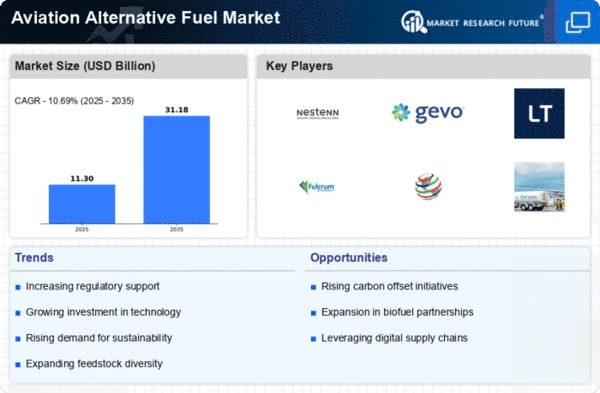
As per MRFR analysis, the Aviation Alternative Fuel Market Size was estimated at 10.21 USD Billion in 2024. The Aviation Alternative Fuel industry is projected to grow from 11.3 USD Billion in 2025 to 31.18 USD Billion by 2035, exhibiting a compound annual growth rate (CAGR) of 10.69 during the forecast period 2025 - 2035.

Key Market Trends & Highlights

The Aviation Alternative Fuel Market is poised for substantial growth driven by technological advancements and regulatory support.

  • Technological advancements in fuel production are enhancing the efficiency and sustainability of aviation fuels.
  • North America remains the largest market, while Asia-Pacific is emerging as the fastest-growing region in aviation alternative fuels.
  • The commercial aviation segment dominates the market, whereas military aviation is experiencing rapid growth due to increasing defense budgets.
  • Rising environmental concerns and government incentives are key drivers propelling the adoption of sustainable aviation fuels.

Market Size & Forecast

2024 Market Size 10.21 (USD Billion)
2035 Market Size 31.18 (USD Billion)
CAGR (2025 - 2035) 10.69%
Largest Regional Market Share in 2024 North America

Major Players

<p>Neste (FI), Gevo (US), LanzaTech (US), World Energy (US), Fulcrum BioEnergy (US), Sustainable Aviation Fuel (SAF) (US), Air BP (GB), Shell Aviation (GB), TotalEnergies (FR)</p>

Market Trends

The Aviation Alternative Fuel Market is currently experiencing a transformative phase, driven by a confluence of environmental concerns and regulatory pressures. Stakeholders across the aviation sector are increasingly recognizing the necessity of reducing greenhouse gas emissions and enhancing sustainability. This shift is prompting airlines and manufacturers to explore various alternative fuel options, including biofuels and synthetic fuels, which are perceived as viable substitutes for traditional jet fuels. The ongoing advancements in technology and production processes are likely to facilitate the broader adoption of these fuels, thereby reshaping the industry's landscape. Moreover, the Aviation Alternative Fuel Market appears to be influenced by collaborative efforts among governments, private entities, and research institutions. Initiatives aimed at developing infrastructure for fuel production and distribution are gaining momentum, suggesting a concerted approach to overcoming existing barriers. As the market evolves, it may witness increased investment in research and development, fostering innovation and potentially leading to more efficient and cost-effective fuel solutions. This collaborative environment could enhance the overall viability of alternative fuels, positioning them as a cornerstone of future aviation operations.

Technological Advancements in Fuel Production

Recent innovations in fuel production technologies are likely to enhance the efficiency and scalability of alternative fuels. These advancements may include improved methods for converting biomass and waste materials into jet fuel, which could lower production costs and increase supply.

Regulatory Support and Policy Frameworks

The Aviation Alternative Fuel Market is expected to benefit from supportive regulatory frameworks and policies aimed at promoting sustainable aviation practices. Governments may implement incentives and mandates that encourage the adoption of alternative fuels, thereby driving market growth.

Increased Collaboration Across the Industry

There appears to be a growing trend of collaboration among airlines, fuel producers, and research institutions. This cooperation may facilitate knowledge sharing and resource pooling, which could accelerate the development and deployment of alternative fuels in the aviation sector.

Aviation Alternative Fuel Market Market Drivers

Regulatory Support and Policy Frameworks

The Global Aviation Alternative Fuel Market Industry benefits from robust regulatory support and policy frameworks that promote the adoption of sustainable aviation fuels. Governments worldwide are implementing stringent emissions reduction targets, which necessitate a shift towards alternative fuels. For instance, the International Civil Aviation Organization has set a goal to achieve net-zero carbon emissions by 2050, driving investments in alternative fuel technologies. This regulatory environment not only incentivizes research and development but also encourages airlines to incorporate sustainable fuels into their operations, thereby enhancing the market's growth potential.

Market Segment Insights

By Application: Commercial Aviation (Largest) vs. Military Aviation (Fastest-Growing)

<p>The Aviation Alternative Fuel Market is notably characterized by its diverse application segments, among which Commercial Aviation commands the largest share. As airlines increasingly shift towards sustainable aviation fuels to meet regulatory requirements and enhance their environmental credibility, the adoption of alternative fuels in commercial operations has surged. Military Aviation, while comparatively smaller in market share, is witnessing rapid growth driven by the need for energy security and reduced emissions, especially in defense operations that demand high operational efficiencies. In terms of growth trends, the Commercial Aviation segment benefits from the rising global air traffic and stringent emission regulations that compel airlines to innovate their fuel sourcing. Military Aviation, on the other hand, is propelled by increasing investments in greener technologies, with governments and defense organizations emphasizing sustainability in their strategies. The shift towards alternative fuels in military operations reflects a broader commitment to reducing the overall carbon footprint of the aviation sector, making it an area of significant growth potential.</p>

<p>Commercial Aviation (Dominant) vs. Cargo Transport (Emerging)</p>

<p>Commercial Aviation remains the dominant application in the Aviation Alternative Fuel Market due to the substantial pressure from both regulatory bodies and public opinion to reduce emissions in air travel. Airlines are actively exploring a variety of alternative fuel sources, including biofuels and synthetic fuels, to shift away from conventional fossil fuels. In comparison, the Cargo Transport sector is emerging rapidly as businesses increasingly recognize the need for sustainable practices in logistics. This segment is characterized by a diverse range of operational needs that require tailored fuel solutions, offering a unique opportunity for innovations in alternative fuels. Both segments are critical for the long-term sustainability of aviation, with Commercial Aviation leading in adherence to sustainability goals and Cargo Transport gaining traction as logistics companies prioritize eco-friendliness.</p>

By Fuel Type: Sustainable Aviation Fuel (Largest) vs. Synthetic Fuel (Fastest-Growing)

<p>The Aviation Alternative Fuel Market is predominantly led by Sustainable Aviation Fuel (SAF), which has emerged as the largest segment due to its significant adoption by major airlines striving for carbon neutrality. This fuel type is derived from renewable resources and continues to gain traction across various aviation sectors. In contrast, Synthetic Fuel, while currently smaller in market share, is gaining rapid attention due to its potential for seamless integration into existing logistics and infrastructure, making it an attractive option for future growth.</p>

<p>Sustainable Aviation Fuel (Dominant) vs. Synthetic Fuel (Emerging)</p>

<p>Sustainable Aviation Fuel has established itself as the dominant force in the Aviation Alternative Fuel Market, appealing to environmentally conscious stakeholders and regulatory bodies. Its production process utilizes feedstocks like plant oils and waste fats, which significantly reduce greenhouse gas emissions compared to traditional jet fuels. Meanwhile, Synthetic Fuel is an emerging competitor, created through synthetic processes that convert hydrocarbons or carbon dioxide into fuel. Its growth is bolstered by technological advancements and increasing investment focus on sustainable energy solutions, making it a viable option for airlines looking to transition away from fossil fuels.</p>

By End Use: Airlines (Largest) vs. Private Jet Operators (Fastest-Growing)

<p>In the Aviation Alternative Fuel Market, the distribution among end-use segments reveals that airlines hold the largest share, driven by a high demand for sustainable energy solutions for commercial flights. This segment is increasingly adopting alternative fuels as regulatory measures and environmental concerns take precedence in the aviation industry. Freight carriers follow, capitalizing on the need for cost-efficient and environmentally friendly fuel options. On the other hand, private jet operators and government agencies represent smaller segments in comparison, but their influence is growing as the focus on sustainable aviation intensifies.</p>

<p>Airlines (Dominant) vs. Private Jet Operators (Emerging)</p>

<p>The airlines segment stands out as the dominant player in the Aviation Alternative Fuel Market, characterized by the extensive adoption of sustainable fuel sources across fleets to meet stringent emission regulations. Major airlines are increasingly committing to net-zero targets, leading to innovation and investment in alternative fuels. Conversely, private jet operators are emerging as a dynamic segment, fueled by rising interest in sustainability among affluent travelers. This group is increasingly selecting eco-friendly options, spurring suppliers to develop tailored solutions for smaller aircraft, thus enhancing market versatility.</p>

Get more detailed insights about Aviation Alternative Fuel Market Research Report - Global Forecast till 2035

Regional Insights

North America : Leading Market Innovators

North America is poised to maintain its leadership in the Aviation Alternative Fuel market, holding a significant market share of 5.5 in 2024. The region's growth is driven by increasing regulatory support for sustainable aviation initiatives and rising demand for eco-friendly fuel alternatives. Government policies aimed at reducing carbon emissions are catalyzing investments in research and development, further propelling market expansion. The competitive landscape is characterized by key players such as Neste, Gevo, and LanzaTech, who are at the forefront of innovation in sustainable aviation fuels. The U.S. leads the charge, supported by favorable regulations and a robust infrastructure for biofuel production. As airlines increasingly adopt alternative fuels, North America is set to solidify its position as a global leader in the aviation alternative fuel sector.

Europe : Sustainable Aviation Initiatives

Europe is emerging as a significant player in the Aviation Alternative Fuel market, with a market size of 3.0. The region's growth is fueled by stringent environmental regulations and ambitious targets for reducing greenhouse gas emissions. The European Union's commitment to sustainability is driving demand for alternative fuels, making it a key market for innovation and investment in aviation fuels. Leading countries such as Germany, France, and the UK are spearheading initiatives to promote sustainable aviation fuels. Major players like TotalEnergies and Air BP are actively involved in developing and supplying these fuels. The competitive landscape is evolving, with increasing collaboration between governments and private sectors to enhance the production and adoption of alternative fuels in aviation. "The European Green Deal aims to make Europe the first climate-neutral continent by 2050, which includes significant investments in sustainable aviation fuels."

Asia-Pacific : Emerging Market Potential

Asia-Pacific is witnessing a gradual rise in the Aviation Alternative Fuel market, currently valued at 1.5. The region's growth is driven by increasing air travel demand and a growing awareness of environmental sustainability. Governments are beginning to implement policies that encourage the use of alternative fuels, although the regulatory framework is still developing compared to North America and Europe. Countries like Japan and Australia are leading the charge in adopting sustainable aviation fuels, with initiatives aimed at reducing carbon footprints in the aviation sector. The competitive landscape includes emerging players and collaborations with established companies to enhance fuel production capabilities. As the region continues to develop its infrastructure for alternative fuels, it is expected to play a more significant role in the global market.

Middle East and Africa : Resource-Rich Opportunities

The Middle East and Africa region is in the nascent stages of developing its Aviation Alternative Fuel market, currently valued at 0.21. The growth potential is significant, driven by increasing investments in renewable energy and a focus on sustainability in aviation. Governments are beginning to recognize the importance of alternative fuels in achieving environmental goals, although the market is still largely untapped. Countries like the UAE and South Africa are exploring opportunities to invest in sustainable aviation fuels, with a focus on leveraging local resources. The competitive landscape is characterized by a mix of local and international players looking to establish a foothold in this emerging market. As awareness and regulatory support grow, the region is expected to see increased activity in the aviation alternative fuel sector.

Key Players and Competitive Insights

The Aviation Alternative Fuel Market is currently characterized by a dynamic competitive landscape, driven by increasing regulatory pressures and a global push towards sustainability. Key players are actively engaging in innovative strategies to enhance their market positioning. Neste (FI) has established itself as a leader through its commitment to producing sustainable aviation fuel (SAF) from waste and residues, focusing on expanding its production capacity. Gevo (US) is also making strides by emphasizing the development of its proprietary technology to convert renewable resources into high-quality jet fuel, thereby positioning itself as a pioneer in the biofuel sector. Meanwhile, LanzaTech (US) is leveraging its carbon capture technology to produce SAF, indicating a strong focus on circular economy principles. Collectively, these strategies not only enhance their competitive edge but also contribute to a more sustainable aviation industry.

In terms of business tactics, companies are increasingly localizing manufacturing and optimizing supply chains to reduce costs and improve efficiency. The market appears moderately fragmented, with several players vying for dominance. However, the collective influence of major companies like Neste, Gevo, and LanzaTech is shaping a more concentrated competitive structure, where innovation and sustainability are becoming key differentiators.

In November 2025, Neste (FI) announced the opening of a new SAF production facility in the Netherlands, which is expected to significantly increase its output capacity. This strategic move underscores Neste's commitment to meeting the growing demand for sustainable aviation fuel in Europe and aligns with the EU's ambitious climate goals. The facility is anticipated to produce up to 500,000 tons of SAF annually, thereby reinforcing Neste's position as a market leader.

In October 2025, Gevo (US) entered into a partnership with a major airline to supply SAF, marking a pivotal moment in its operational strategy. This collaboration not only enhances Gevo's market reach but also demonstrates the increasing acceptance of SAF among traditional aviation players. The partnership is likely to facilitate the airline's sustainability goals while providing Gevo with a stable revenue stream, thus solidifying its market presence.

In September 2025, LanzaTech (US) secured a significant investment from a consortium of investors to scale up its carbon capture technology for SAF production. This funding is expected to accelerate the commercialization of its innovative processes, potentially positioning LanzaTech as a frontrunner in the sustainable aviation fuel sector. The investment reflects growing confidence in LanzaTech's technology and its potential to transform waste into valuable fuel, aligning with global sustainability initiatives.

As of December 2025, the competitive trends in the Aviation Alternative Fuel Market are increasingly defined by digitalization, sustainability, and the integration of advanced technologies. Strategic alliances are becoming more prevalent, as companies recognize the need to collaborate to enhance their capabilities and market reach. The competitive differentiation is likely to evolve from traditional price-based competition to a focus on innovation, technological advancements, and supply chain reliability. This shift suggests that companies that prioritize sustainable practices and technological integration will be better positioned to thrive in the future.

Key Companies in the Aviation Alternative Fuel Market market include

Industry Developments

    • In June 2020, Amazon Air got up to 6 million gallons of manageable avionics fuel provided by Shell Aviation and created by World Energy. 
    • In December 2019, Nestle consented to an arrangement with KLM to supply its SAF for the departures from Amsterdam Airport Schiphol. This understanding permitted Neste to join KLM's corporate biofuel program that plans to decrease CO2 discharges of business travel on KLM trips by 100%. 
    • In December 2019, World Energy worked together with Shell and Air France to supply its SAF for the departures from San Francisco. This cooperation between Air France, World Energy, and Shell epitomizes the ascent popular for SAF.


Future Outlook

Aviation Alternative Fuel Market Future Outlook

<p>The Aviation Alternative Fuel Market is projected to grow at a 10.69% CAGR from 2024 to 2035, driven by regulatory support, technological advancements, and increasing environmental concerns.</p>

New opportunities lie in:

  • <p>Development of sustainable aviation fuel (SAF) supply chains</p>
  • <p>Investment in advanced biofuel production technologies</p>
  • <p>Partnerships with airlines for SAF adoption incentives</p>

<p>By 2035, the market is expected to be robust, driven by innovation and strategic collaborations.</p>

Market Segmentation

Aviation Alternative Fuel Market End Use Outlook

  • Airlines
  • Freight Carriers
  • Private Jet Operators
  • Government Agencies

Aviation Alternative Fuel Market Fuel Type Outlook

  • Sustainable Aviation Fuel
  • Biofuel
  • Synthetic Fuel
  • Hydrogen Fuel

Aviation Alternative Fuel Market Application Outlook

  • Commercial Aviation
  • Military Aviation
  • Cargo Transport
  • Private Aviation

Report Scope

MARKET SIZE 202410.21(USD Billion)
MARKET SIZE 202511.3(USD Billion)
MARKET SIZE 203531.18(USD Billion)
COMPOUND ANNUAL GROWTH RATE (CAGR)10.69% (2024 - 2035)
REPORT COVERAGERevenue Forecast, Competitive Landscape, Growth Factors, and Trends
BASE YEAR2024
Market Forecast Period2025 - 2035
Historical Data2019 - 2024
Market Forecast UnitsUSD Billion
Key Companies ProfiledNeste (FI), Gevo (US), LanzaTech (US), World Energy (US), Fulcrum BioEnergy (US), Sustainable Aviation Fuel (SAF) (US), Air BP (GB), Shell Aviation (GB), TotalEnergies (FR)
Segments CoveredApplication, Fuel Type, End Use
Key Market OpportunitiesGrowing regulatory support for sustainable aviation fuels drives innovation in the Aviation Alternative Fuel Market.
Key Market DynamicsRising regulatory pressures and technological advancements drive the adoption of sustainable aviation fuels in the aviation sector.
Countries CoveredNorth America, Europe, APAC, South America, MEA

FAQs

What is the trajectory for the aviation alternative fuel market CAGR growth in the forecast period?

By 2035, a 10% CAGR is estimated to be seen in the market.

Who are companies supporting the aviation alternative fuel market progress?

TerraVia (U.S.), NXT Fuels Limited (New Zealand), and SWEDISH BIOFUELS AB (Sweden) are prominent companies in the market.

What valuation is projected for the aviation alternative fuel market by the conclusion of the forecast period?

An advantageous revenue level is predicted for the market in the forecast period.

What reason will broaden the development of the aviation alternative fuel market?

The mounting use of biofuels by significant airlines is estimated to stimulate the market.

Which region is the leader for change in the global aviation alternative fuel market?

The region of North America is estimated to have a sizeable stake in market development.

  1. Executive Summary
    1. Market Attractiveness Analysis
      1. Global Aviation Alternative Fuel Market, by Process
      2. Global
  2. Aviation Alternative Fuel Market, by Fuel Type
  3. Global Aviation Alternative
  4. Fuel Market, by Application
    1. by Region
  5. Global Aviation Alternative Fuel Market,
  6. Market Introduction
    1. Market Definition
    2. Scope
    3. of the Study
    4. Market Structure
    5. Key Buying Criteria
    6. Market Factor Indicator Analysis
  7. Research Methodology
    1. Research
    2. Process
    3. Primary Research
    4. Secondary Research
    5. Market
    6. Size Estimation
    7. Forecast Model
    8. List of Assumptions
  8. Market
    1. Insights
  9. Market Dynamics
    1. Introduction
    2. Drivers
    3. Restraints
    4. Opportunities
    5. Challenges
    6. Market/Technological
    7. Trends
    8. Patent Trends
    9. Regulatory Landscape/Standards
    10. Market Factor Analysis
    11. Value Chain/Supply Chain Analysis
      1. R&D
      2. Manufacturing
      3. Distribution & Sales
      4. Post-Sales
    12. Monitoring
    13. Porter’s Five Forces Analysis
      1. Threat of New
      2. Bargaining Power of Buyers
      3. Threat of Substitutes
      4. Intensity of Rivalry
      5. Bargaining Power of Suppliers
    14. Entrants
  10. Global Aviation Alternative Fuel Market, by Process
    1. Introduction
      1. Market Estimates & Forecast, 2020-2030
    2. Coal Liquefaction
  11. Market Estimates & Forecast, by Region, 2020-2030
    1. Gas Liquefaction
      1. Market Estimates & Forecast, 2020-2030
      2. Market Estimates
    2. & Forecast, by Region, 2020-2030
  12. Global Aviation Alternative Fuel Market,
    1. by Fuel Type
    2. Introduction
    3. Biofuel
      1. Market Estimates
      2. Market Estimates & Forecast, by Region,
      3. Hydroprocessed Esters and Fatty Acids (HEFA)
      4. Hydrogenated Pyrolysis Oils (HPO)
      5. Fischer-Tropsch (FT)
      6. Synthesized Iso-Paraffinic (SIP)
    4. & Forecast, 2020-2030
    5. Market Estimates & Forecast, 2020-2030
    6. Forecast, by Region, 2020-2030
    7. & Forecast, by Region, 2020-2030
    8. Market Estimates & Forecast, 2020-2030
    9. Forecast, by Region, 2020-2030
    10. Market Estimates & Forecast, 2020-2030
    11. Forecast, by Region, 2020-2030
    12. CNG
      1. Market Estimates &
      2. Market Estimates & Forecast, by Region, 2020-2030
    13. Forecast, 2020-2030
    14. LPG
      1. Market Estimates & Forecast, 2020-2030
      2. Market
    15. Estimates & Forecast, by Region, 2020-2030
    16. Others
      1. Market
      2. Market Estimates & Forecast,
    17. Estimates & Forecast, 2020-2030
    18. by Region, 2020-2030
  13. Global Aviation Alternative Fuel Market, by Application
    1. Introduction
    2. Commercial
      1. Market Estimates & Forecast,
      2. Market Estimates & Forecast, by Region, 2020-2030
      3. Market Estimates & Forecast, 2020-2030
      4. Market
    3. Military
    4. Estimates & Forecast, by Region, 2020-2030
  14. Global Aviation Alternative
  15. Fuel Market, by Region
    1. Introduction
    2. North America
  16. Market Estimates & Forecast, by Country, 2020-2030
    1. & Forecast, by Process, 2020-2030
    2. by Fuel Type, 2020-2030
    3. Canada
  17. Market Estimates
  18. Market Estimates & Forecast,
  19. Market Estimates & Forecast, by Application,
  20. US
  21. Market Estimates & Forecast, by Process,
  22. Market Estimates & Forecast, by Fuel Type, 2020-2030
  23. Market Estimates & Forecast, by Application, 2020-2030
  24. Market Estimates & Forecast, by Process, 2020-2030
  25. Market Estimates & Forecast, by Fuel Type, 2020-2030
  26. Market Estimates & Forecast, by Application, 2020-2030
    1. Europe
      1. Market Estimates & Forecast, by Country, 2020-2030
      2. Market
      3. Market Estimates &
      4. Market Estimates & Forecast,
      5. UK
      6. Germany
      7. France
    2. Estimates & Forecast, by Process, 2020-2030
    3. Forecast, by Fuel Type, 2020-2030
    4. by Application, 2020-2030
    5. Forecast, by Process, 2020-2030
    6. by Fuel Type, 2020-2030
    7. Process, 2020-2030
  27. Market Estimates & Forecast, by Application, 2020-2030
  28. Italy
  29. Market Estimates & Forecast, by Process, 2020-2030
  30. Market Estimates & Forecast, by Fuel Type, 2020-2030
    1. & Forecast, by Application, 2020-2030
  31. Market Estimates
  32. Rest of Europe
  33. Market Estimates & Forecast, by Process, 2020-2030
    1. & Forecast, by Fuel Type, 2020-2030
    2. by Application, 2020-2030
    3. & Forecast, by Country, 2020-2030
    4. by Process, 2020-2030
  34. Market Estimates
  35. Market Estimates & Forecast,
    1. Asia-Pacific
      1. Market Estimates
      2. Market Estimates & Forecast,
      3. Market Estimates & Forecast, by Fuel Type,
      4. Market Estimates & Forecast, by Application, 2020-2030
      5. China
  36. Market Estimates & Forecast, by Application, 2020-2030
  37. Japan
  38. Market Estimates & Forecast, by Process, 2020-2030
  39. Market Estimates & Forecast, by Fuel Type, 2020-2030
    1. & Forecast, by Application, 2020-2030
    2. Estimates & Forecast, by Process, 2020-2030
    3. & Forecast, by Fuel Type, 2020-2030
    4. by Application, 2020-2030
    5. & Forecast, by Process, 2020-2030
    6. by Fuel Type, 2020-2030
    7. Forecast, by Process, 2020-2030
    8. by Fuel Type, 2020-2030
    9. Forecast, by Country, 2020-2030
    10. Process, 2020-2030
    11. UAE
  40. Market Estimates
  41. India
  42. Market
  43. Market Estimates
  44. Market Estimates & Forecast,
  45. Australia
  46. Market Estimates
  47. Market Estimates & Forecast,
  48. Market Estimates & Forecast, by Application,
  49. Rest of Asia-Pacific
  50. Market Estimates &
  51. Market Estimates & Forecast,
  52. Market Estimates & Forecast, by Application,
    1. Middle East & Africa
      1. Market Estimates &
      2. Market Estimates & Forecast, by
      3. Market Estimates & Forecast, by Fuel Type, 2020-2030
      4. Market Estimates & Forecast, by Application, 2020-2030
  53. Market Estimates & Forecast, by Fuel Type, 2020-2030
    1. & Forecast, by Application, 2020-2030
  54. Market Estimates
  55. Saudi Arabia
  56. Market Estimates & Forecast, by Process, 2020-2030
    1. & Forecast, by Fuel Type, 2020-2030
    2. by Application, 2020-2030
    3. Forecast, by Process, 2020-2030
    4. by Fuel Type, 2020-2030
    5. Estimates & Forecast, by Process, 2020-2030
    6. & Forecast, by Fuel Type, 2020-2030
    7. by Application, 2020-2030
    8. & Forecast, by Country, 2020-2030
    9. by Process, 2020-2030
  57. Market Estimates
  58. Market Estimates & Forecast,
  59. Israel
  60. Market Estimates &
  61. Market Estimates & Forecast,
  62. Market Estimates & Forecast, by Application,
  63. Rest of the Middle East & Africa
  64. Market
  65. Market Estimates
  66. Market Estimates & Forecast,
    1. Latin America
      1. Market Estimates
      2. Market Estimates & Forecast,
      3. Market Estimates & Forecast, by Fuel Type,
      4. Market Estimates & Forecast, by Application, 2020-2030
      5. Brazil
  67. Market Estimates & Forecast, by Application, 2020-2030
    1. Latin America
  68. Rest of
  69. Market Estimates & Forecast, by Process, 2020-2030
  70. Market Estimates & Forecast, by Fuel Type, 2020-2030
  71. Market Estimates & Forecast, by Application, 2020-2030
  72. Competitive
    1. Landscape
    2. Competitive Overview
    3. Competitor Dashboard
    4. Major Growth Strategies in the Global Aviation Alternative Fuel Market
    5. Competitive Benchmarking
    6. Market Share Analysis
    7. AeroVironment,
    8. Inc.: The Leading Player in Terms of Number of Developments in the Global Aviation
    9. Alternative Fuel Market
    10. Key Developments & Growth Strategies
      1. Mergers & Acquisitions
      2. Joint Ventures
    11. Fuel Type Launches/Service Deployments
  73. Company Profiles
    1. Air BP Limited
      1. Company Overview
      2. Products/Services Offered
      3. Financial
      4. Key Developments
      5. SWOT Analysis
      6. Key
    2. Overview
    3. Strategies
    4. Chevron Corporation
      1. Company Overview
      2. Financial Overview
      3. Key Developments
      4. SWOT Analysis
      5. Key Strategies
    5. Products/Services Offered
    6. Fulcrum BioEnergy
      1. Company Overview
      2. Products/Services Offered
      3. Financial
      4. Key Developments
      5. SWOT Analysis
      6. Key
    7. Overview
    8. Strategies
    9. Gevo Inc.
      1. Company Overview
      2. Products/Services
      3. Financial Overview
      4. Key Developments
      5. Key Strategies
    10. Offered
    11. SWOT Analysis
    12. Honeywell International Inc.
      1. Company Overview
      2. Products/Services Offered
      3. Financial
      4. Key Developments
      5. SWOT Analysis
      6. Key
    13. Overview
    14. Strategies
    15. LanzaTech
      1. Company Overview
      2. Products/Services
      3. Financial Overview
      4. Key Developments
      5. Key Strategies
    16. Offered
    17. SWOT Analysis
    18. Neste Oyj
      1. Company
      2. Products/Services Offered
      3. Financial Overview
      4. Key Developments
      5. SWOT Analysis
      6. Key Strategies
    19. Overview
    20. NXT Fuels Limited
      1. Company Overview
      2. Products/Services
      3. Financial Overview
      4. Key Developments
      5. Key Strategies
    21. Offered
    22. SWOT Analysis
    23. Renewable Energy Group, Inc.
      1. Company Overview
      2. Products/Services Offered
      3. Financial
      4. Key Developments
      5. SWOT Analysis
      6. Key
    24. Overview
    25. Strategies
    26. Red Rock Biofuels
      1. Company Overview
      2. Financial Overview
      3. Key Developments
      4. SWOT Analysis
      5. Key Strategies
    27. Products/Services Offered
    28. SG Preston Company
      1. Company Overview
      2. Products/Services Offered
      3. Key Developments
      4. SWOT Analysis
      5. Key Strategies
    29. Financial Overview
    30. Shell International BV
      1. Company
      2. Products/Services Offered
      3. Financial Overview
      4. Key Developments
      5. SWOT Analysis
      6. Key Strategies
    31. Overview
    32. SkyNRG
      1. Company Overview
      2. Products/Services Offered
      3. Financial Overview
      4. Key Developments
      5. SWOT
      6. Key Strategies
    33. Analysis
    34. SWEDISH BIOFUELS AB
      1. Products/Services Offered
      2. Financial
      3. Key Developments
      4. SWOT Analysis
    35. Company Overview
    36. Overview
    37. Key Strategies
    38. TerraVia
      1. Company Overview
      2. Financial Overview
      3. Key Developments
      4. SWOT Analysis
      5. Key Strategies
    39. Products/Services Offered
    40. Total
      1. Products/Services Offered
      2. Financial
      3. Key Developments
      4. SWOT Analysis
    41. Company Overview
    42. Overview
    43. Key Strategies
    44. World Energy
      1. Company Overview
      2. Financial Overview
      3. Key Developments
      4. SWOT Analysis
      5. Key Strategies
    45. Products/Services Offered
  74. Appendix
    1. References
    2. Related Reports
    3. List of Abbreviations
    4. Industry Insights
    5. Note: This table of contents is tentative and subject to
    6. change as the research progresses.
    7. List of Tables
  75. Global Aviation
  76. Alternative Fuel Market, by Region, 2020-2030
  77. North America: Aviation
  78. Alternative Fuel Market, by Country, 2020-2030
  79. Europe: Aviation Alternative
  80. Fuel Market, by Country, 2020-2030
  81. Asia-Pacific: Aviation Alternative
  82. Fuel Market, by Country, 2020-2030
  83. Middle East & Africa: Aviation
  84. Alternative Fuel Market, by Country, 2020-2030
  85. Latin America: Aviation
  86. Alternative Fuel Market, by Country, 2020-2030
  87. Global Aviation Alternative
  88. Fuel Market Size, by Region, 2020-2030
  89. North America: Aviation Alternative
  90. Fuel Market Size, by Country, 2020-2030
  91. Europe: Aviation Alternative
  92. Fuel Market Size, by Country, 2020-2030
  93. Asia-Pacific: Aviation Alternative
  94. Fuel Market Size, by Country, 2020-2030
  95. Middle East & Africa:
  96. Aviation Alternative Fuel Market Size, by Country, 2020-2030
  97. Latin
  98. America: Aviation Alternative Fuel Market Size, by Country, 2020-2030
    1. Table
  99. Global Aviation Alternative Fuel Process Market, by Region, 2020-2030
    1. Table
  100. North America: Aviation Alternative Fuel Process Market, by Country, 2020-2030
  101. Europe: Aviation Alternative Fuel Process Market, by Country, 2020-2030
  102. Asia-Pacific: Aviation Alternative Fuel Process Market, by Country, 2020-2030
  103. Middle East & Africa: Aviation Alternative Fuel Process Market, by
    1. Country, 2020-2030
  104. Latin America: Aviation Alternative Fuel Process
  105. Market, by Country, 2020-2030
  106. Global Aviation Alternative Fuel Market,
    1. by Fuel Type, by Region, 2020-2030
  107. North America: Aviation Alternative
  108. Fuel Market, by Fuel Type, by Country, 2020-2030
  109. Europe: Aviation
  110. Alternative Fuel Market, by Fuel Type, by Country, 2020-2030
  111. Asia-Pacific:
  112. Aviation Alternative Fuel Market, by Fuel Type, by Country, 2020-2030
    1. Table
  113. Middle East & Africa: Aviation Alternative Fuel Market, by Fuel Type, by
    1. Country, 2020-2030
  114. Latin America: Aviation Alternative Fuel Market,
    1. by Fuel Type, by Country, 2020-2030
  115. Global Aviation Alternative Fuel
  116. Application Market, by Region, 2020-2030
  117. North America: Aviation Alternative
  118. Fuel Application Market, by Country, 2020-2030
  119. Europe: Aviation Alternative
  120. Fuel Application Market, by Country, 2020-2030
  121. Asia-Pacific: Aviation
  122. Alternative Fuel Application Market, by Country, 2020-2030
  123. Middle
  124. East & Africa: Aviation Alternative Fuel Application Market, by Country, 2020-2030
  125. Latin America: Aviation Alternative Fuel Application Market, by Country,
  126. Global Aviation Alternative Fuel Market, by Region, 2020-2030
  127. Global Aviation Alternative Fuel Market, by Process, 2020-2030
    1. Table
  128. Global Aviation Alternative Fuel Market, by Fuel Type, 2020-2030
    1. Table 34
  129. Global Aviation Alternative Fuel Market, by Application, 2020-2030
    1. Table 35
  130. North America: Aviation Alternative Fuel Market, by Country, 2020-2030
    1. Table
  131. North America: Aviation Alternative Fuel Market, by Process, 2020-2030
    1. Table
  132. North America: Aviation Alternative Fuel Market, by Fuel Type, 2020-2030
    1. Table
  133. North America: Aviation Alternative Fuel Market, by Application, 2020-2030
  134. Europe: Aviation Alternative Fuel Market, by Country, 2020-2030
    1. Table
  135. Europe: Aviation Alternative Fuel Market, by Process, 2020-2030
    1. Table 41
  136. Europe: Aviation Alternative Fuel Market, by Fuel Type, 2020-2030
    1. Table 42
  137. Europe: Aviation Alternative Fuel Market, by Application, 2020-2030
    1. Table 43
  138. Asia-Pacific: Aviation Alternative Fuel Market, by Country, 2020-2030
    1. Table
  139. Asia-Pacific: Aviation Alternative Fuel Market, by Process, 2020-2030
    1. Table
  140. Asia-Pacific: Aviation Alternative Fuel Market, by Fuel Type, 2020-2030
    1. Table
  141. Asia-Pacific: Aviation Alternative Fuel Market, by Application, 2020-2030
  142. Middle East & Africa: Aviation Alternative Fuel Market, by Country,
  143. Middle East & Africa: Aviation Alternative Fuel Market,
    1. by Process, 2020-2030
  144. Middle East & Africa: Aviation Alternative
  145. Fuel Market, by Fuel Type, 2020-2030
  146. Middle East & Africa: Aviation
  147. Alternative Fuel Market, by Application, 2020-2030
  148. Latin America:
  149. Aviation Alternative Fuel Market, by Country, 2020-2030
  150. Latin America:
  151. Aviation Alternative Fuel Market, by Process, 2020-2030
  152. Latin America:
  153. Aviation Alternative Fuel Market, by Fuel Type, 2020-2030
  154. Latin America:
  155. Aviation Alternative Fuel Market, by Application, 2020-2030
    1. List of Figures
  156. Research Process of MRFR
  157. Top-Down and Bottom-Up Approaches
  158. Market Dynamics
  159. Impact Analysis: Market Drivers
    1. FIGURE
  160. Impact Analysis: Market Restraints
  161. Porter''s Five Forces Analysis
  162. Value Chain Analysis
  163. Global Aviation Alternative Fuel Market
    1. Share, by Process, 2020 (%)
  164. Global Aviation Alternative Fuel Market,
    1. by Process, 2020-2030 (USD Million)
  165. Global Aviation Alternative Fuel
  166. Market Share, by Fuel Type, 2020 (%)
  167. Global Aviation Alternative
  168. Fuel Market, by Fuel Type, 2020-2030 (USD Million)
  169. Global Aviation
  170. Alternative Fuel Market Share, by Application, 2020 (%)
  171. Global Aviation
  172. Alternative Fuel Market, by Application, 2020-2030 (USD Million)
    1. FIGURE 14
  173. Global Aviation Alternative Fuel Market Share (%), by Region, 2020
    1. FIGURE 15
  174. Global Aviation Alternative Fuel Market, by Region, 2020-2030 (USD Million)
    1. FIGURE
  175. North America: Aviation Alternative Fuel Market Share (%), 2020
    1. FIGURE 17
  176. North America: Aviation Alternative Fuel Market, by Country, 2020-2030 (USD Million)
  177. Europe: Aviation Alternative Fuel Market Share (%), 2020
    1. FIGURE
  178. Europe: Aviation Alternative Fuel Market, by Country, 2020-2030 (USD Million)
  179. Asia-Pacific: Aviation Alternative Fuel Market Share (%), 2020
    1. FIGURE
  180. Asia-Pacific: Aviation Alternative Fuel Market, by Country, 2020-2030 (USD Million)
  181. Middle East & Africa: Aviation Alternative Fuel Market Share (%),
  182. Middle East & Africa: Aviation Alternative Fuel Market,
    1. by Country, 2020-2030 (USD Million)
  183. Latin America: Aviation Alternative
    1. Fuel Market Share (%), 2020
  184. Latin America: Aviation Alternative Fuel
  185. Market, by Country, 2020-2030 (USD Million)

Aviation Alternative Fuel Market Segmentation

Market Segmentation Overview

  • Detailed segmentation data will be available in the full report
  • Comprehensive analysis by multiple parameters
  • Regional and country-level breakdowns
  • Market size forecasts by segment
Infographic

Free Sample Request

Kindly complete the form below to receive a free sample of this Report

Get Free Sample

Customer Strories

Compare Licence

×
Features License Type
Single User Multiuser License Enterprise User
Price $4,950 $5,950 $7,250
Maximum User Access Limit 1 User Upto 10 Users Unrestricted Access Throughout the Organization
Free Customization
Direct Access to Analyst
Deliverable Format
Platform Access
Discount on Next Purchase 10% 15% 15%
Printable Versions