
×
Hero Background
English
Chinese
French
Japanese
Korean
German
Spanish

Aviation Software Market Trends

ID: MRFR/AD/8140-HCR
168 Pages
Swapnil Palwe
October 2025

Aviation Software Market Research Report Information By Application (Airports and Airlines), By Software Type (Management Software, Analysis Software, Design Software, Simulation Software, and MRO Software), And By Region (North America, Europe, Asia-Pacific, And Rest Of The World) –Market Forecast Till 2035

Share:
Download PDF ×

We do not share your information with anyone. However, we may send you emails based on your report interest from time to time. You may contact us at any time to opt-out.

Aviation Software Market Infographic
Purchase Options

Market Trends

Key Emerging Trends in the Aviation Software Market

The Aviation Software Market is marked by transformational tendencies that demonstrate the ongoing digitalization within the aviation sector. One noticeable tendency is related to the promotion of cloud-based solutions for multiple aviation functions. Cloud computing provides airlines, airports and other key players in aviation with scalable and flexible platforms for storage of data, collaboration among stakeholders as well as analysis. Firstly, this trend advances the operational efficiency of aviation ecosystem beyond imagination but will allow real-time information sharing to eventually enable decision making on a more streamlined and collaborative basis. Aviation software solutions are starting to turn into integration of Artificial Intelligence AI and Machine Learning ML technologies. AI and ML algorithms are used by airlines to optimize operations, enhance predictive maintenance as well as improve passenger experience. From predictive analytics for flight scheduling to customized recommendations tailored to travelers, these technologies are transforming the ways in which aviation companies leverage data-driven innovation and efficiency. One distinctive trend observed in Aviation Software Market is an increased concentration on improving cybersecurity protection mechanisms. Since aviation systems are more and more integrated and dependent on digital technologies, the industry starts focusing on strong cybersecurity solutions to fight against cyber threats. New cybersecurity tools and protocols for safeguarding critical systems, flight data, passenger information are being developed by aviation software providers. This trend shows the industry’s focus on preserving integrity and security of aviation operations in an increasingly cyber risk scenario. Today we can observe that the demand for integrated and modular software package which provides universal solutions to various aviation processes is growing. Airlines, Airports and aviation service providers want to integrate their processes into comprehensive software platforms that can handle tasks such as passenger management, crew scheduling, aircraft maintenance or logistics. This trend demonstrates that the industry is trying to make its operations more streamlined and integrated, simplifying management of various software solutions better suited for coordinating every aspect of managing aviation. Increase In mobile applications and solutions is another notable trend in the Aviation Software Market. Airlines and airports are becoming more involved with mobile platforms to improve passenger experience, provide real time information, enable contactless services.


Author
Swapnil Palwe
Team Lead - Research

With a technical background as Bachelor's in Mechanical Engineering, with MBA in Operations Management , Swapnil has 6+ years of experience in market research, consulting and analytics with the tasks of data mining, analysis, and project execution. He is the POC for our clients, for their consulting projects running under the Automotive/A&D domain. Swapnil has worked on major projects in verticals such as Aerospace & Defense, Automotive and many other domain projects. He has worked on projects for fortune 500 companies' syndicate and consulting projects along with several government projects.

Leave a Comment

FAQs

How much is the aviation software market?

The aviation software market size was valued at USD 4.17 Billion in 2023.

What is the growth rate of the aviation software market?

The market is projected to grow at a CAGR of 9.15% during the forecast period, 2025-2034.

Which region held the largest market share in the aviation software market?

North America had the largest share of the market.

Who are the key players in the aviation software market?

The key players in the market are GE Aviation (U.S.), Rolls-Royce (U.K.), Pratt and Whitney (U.S.), Lufthansa Technik (Germany), Safran Aircraft Engines (Paris), SIA Engineering Company (Singapore), Air France Industries KLM Engineering and Maintenance (France), MTU Aero Engines (Germany), ST Aerospace (Singapore), Delta Tech-Ops (U.S.)

Which type led the aviation software market?

The MRO software category dominated the market in 2023.

Which application had the largest market share in the aviation software market?

The airlines category had the largest share of the market.

Market Summary

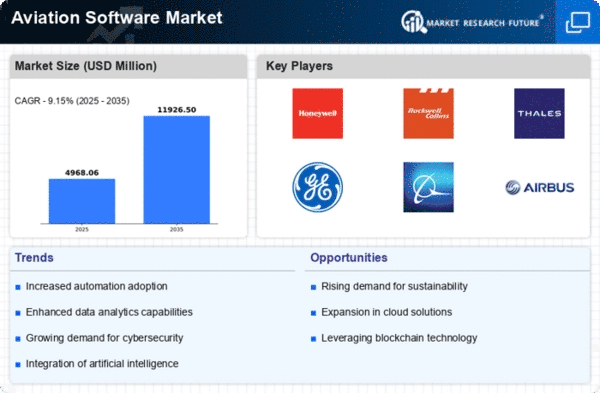
As per MRFR analysis, the Aviation Software Market Size was estimated at 4551.59 USD Million in 2024. The Aviation Software industry is projected to grow from 4968.16 USD Million in 2025 to 11926.5 USD Million by 2035, exhibiting a compound annual growth rate (CAGR) of 9.15 during the forecast period 2025 - 2035.

Key Market Trends & Highlights

The Aviation Software Market is experiencing robust growth driven by technological advancements and increasing operational demands.

  • The integration of Artificial Intelligence is transforming operational efficiencies in the Aviation Software Market.
  • North America remains the largest market, while Asia-Pacific is emerging as the fastest-growing region in aviation software solutions.
  • Flight Operations Management continues to dominate the market, whereas Maintenance Management is witnessing the fastest growth.
  • Increased demand for operational efficiency and regulatory compliance are key drivers propelling the market forward.

Market Size & Forecast

2024 Market Size 4551.59 (USD Million)
2035 Market Size 11926.5 (USD Million)
CAGR (2025 - 2035) 9.15%
Largest Regional Market Share in 2024 North America

Major Players

<p>Honeywell (US), Rockwell Collins (US), Thales Group (FR), General Electric (US), Boeing (US), Airbus (FR), SAP (DE), IBM (US), Northrop Grumman (US)</p>

Market Trends

The Aviation Software Market is currently experiencing a transformative phase, driven by advancements in technology and the increasing demand for efficiency in operations. As airlines and aviation companies seek to optimize their processes, software solutions that enhance flight operations, maintenance management, and passenger services are gaining traction. The integration of artificial intelligence and machine learning into aviation software is particularly noteworthy, as these technologies enable predictive analytics and automation, thereby improving decision-making and operational efficiency. Furthermore, the growing emphasis on safety and regulatory compliance is prompting organizations to invest in sophisticated software systems that ensure adherence to industry standards. In addition to technological advancements, the Aviation Software Market is influenced by the rising need for data analytics and real-time information sharing. Stakeholders are increasingly recognizing the value of data-driven insights in enhancing customer experiences and streamlining operations. This trend is likely to continue as the industry evolves, with software solutions becoming more interconnected and capable of providing comprehensive insights across various functions. As the Aviation Software Market progresses, it appears poised for sustained growth, with innovations that cater to the dynamic needs of the aviation sector.

Integration of Artificial Intelligence

The incorporation of artificial intelligence into aviation software is reshaping operational frameworks. AI-driven solutions facilitate predictive maintenance, optimize flight paths, and enhance customer service through personalized experiences. This trend indicates a shift towards more intelligent systems that can adapt to changing conditions and improve overall efficiency.

Emphasis on Data Analytics

The Aviation Software Market is witnessing a heightened focus on data analytics, enabling stakeholders to derive actionable insights from vast amounts of data. This trend suggests that organizations are prioritizing data-driven decision-making to enhance operational performance and customer satisfaction, thereby fostering a more agile and responsive aviation environment.

Cloud-Based Solutions

The adoption of cloud-based software solutions is becoming increasingly prevalent within the Aviation Software Market. These platforms offer scalability, flexibility, and cost-effectiveness, allowing organizations to access critical applications and data from anywhere. This trend indicates a move towards more collaborative and integrated systems that can support the evolving needs of the aviation industry.

Aviation Software Market Market Drivers

Increased Demand for Efficient Operations

The Global Aviation Software Market Industry experiences heightened demand for operational efficiency as airlines and aviation companies seek to optimize their processes. This trend is driven by the need to reduce operational costs and improve service delivery. For instance, the implementation of software solutions for flight planning and scheduling has shown to enhance efficiency significantly. In 2024, the market is valued at 4.55 USD Billion, reflecting the industry's focus on adopting advanced technologies. As companies increasingly prioritize efficiency, the Global Aviation Software Market Industry is poised for substantial growth.

Market Segment Insights

By Application: Flight Operations Management (Largest) vs. Maintenance Management (Fastest-Growing)

<p>In the Aviation Software Market, the application segment is diverse, with Flight Operations Management leading the market in terms of share. This segment includes various functionalities necessary for efficient flight scheduling, route management, and operational oversight. Meanwhile, Maintenance Management has emerged as the fastest-growing application, driven by increased emphasis on aircraft safety and regulatory compliance. The need for effective and timely maintenance operations is becoming increasingly paramount due to the rising number of aircraft in service. The growth trends within the Aviation Software Market indicate that Flight Operations Management is well-established and continues to evolve with technology, integrating advanced analytics and automation features. In contrast, Maintenance Management is experiencing rapid growth due to technological advancements and the adoption of predictive maintenance solutions. Airlines are prioritizing software solutions that can enhance maintenance tracking and reduce downtime, fueled by growing concerns around safety and operational efficiency.</p>

<p>Flight Operations Management (Dominant) vs. Crew Management (Emerging)</p>

<p>Flight Operations Management remains the dominant application in the Aviation Software Market due to its critical role in ensuring operational efficiency and compliance with aviation regulations. This segment is characterized by solutions that streamline flight planning, optimize payload management, and incorporate real-time weather data, which are essential for airlines aiming to maximize performance. On the other hand, Crew Management is emerging rapidly as a crucial area for airlines, focusing on optimizing crew scheduling, compliance with regulations, and enhancing crew productivity. The shift towards data-driven decision-making in crew assignments, coupled with the growing demand for improved work-life balance, positions Crew Management as a key area for investment and innovation in the overall aviation software landscape.</p>

By Deployment Type: Cloud-Based (Largest) vs. Hybrid (Fastest-Growing)

<p>In the Aviation Software Market, the deployment type segment is characterized by a significant presence of cloud-based solutions, which hold the largest market share. Cloud-based systems benefit from scalability, accessibility, and reduced infrastructure costs, making them a preferred choice among aviation companies in various operational contexts. On-premises and hybrid solutions also contribute to the landscape, with on-premises solutions favored for their security features but gradually being overshadowed by the growth of cloud-based options. The hybrid deployment type is rapidly gaining traction and is considered the fastest-growing segment within the aviation software market. Companies increasingly recognize the dual advantages of hybrid systems, which combine the robust security of on-premises solutions with the flexibility of cloud-based services. This trend is driven by the evolving needs of airlines and service providers to maintain operational efficiency while adapting to technological advancements and customer demands.</p>

<p>Cloud-Based (Dominant) vs. On-Premises (Emerging)</p>

<p>Cloud-based solutions stand out as the dominant deployment type in the aviation software market due to their unmatched flexibility, scalability, and lower upfront costs. These solutions allow airlines and aviation stakeholders to access and manage their software from any location, facilitating collaboration and efficiency. Conversely, on-premises systems, while still important, are often seen as emerging options because of their focus on security and regulatory compliance. Nevertheless, the high maintenance costs and less agility associated with on-premises solutions are leading to a shift towards cloud and hybrid models, making them increasingly relevant in the competitive landscape of aviation software.</p>

By End User: Airlines (Largest) vs. Government Agencies (Fastest-Growing)

<p>The Aviation Software Market exhibits a diverse distribution of market share across its end users. Airlines take the predominant share, leveraging software solutions to enhance operational efficiency, streamline ticketing systems, and improve customer experiences. Following airlines, aerospace manufacturers capitalize on aviation software for project management, compliance with regulations, and enhancing the design and manufacturing processes. Meanwhile, MRO service providers focus on maintenance software solutions that assist with regulatory compliance and efficient part tracking. Growth trends in the aviation software segment are being driven by technological advancements and increasing demands for system integration. Government agencies, especially, are expected to see the fastest growth as they upgrade their systems to enhance safety regulations and air traffic management. The surge in data analytics integration across user segments is promoting labor efficiency and facilitating better decision-making, paving the way for innovative software solutions in the market.</p>

<p>Airlines (Dominant) vs. MRO Service Providers (Emerging)</p>

<p>In the Aviation Software Market, Airlines hold a dominant position due to their extensive operational requirements and reliance on advanced software to manage ticketing, scheduling, and customer engagement. Their substantial investments in technology adoption enable continuous enhancements in performance and passenger services, thus fortifying their market presence. Conversely, MRO Service Providers represent an emerging segment, driven by the increasing need for regulatory compliance and efficiency in maintenance practices. The shift towards predictive maintenance powered by data analytics is opening avenues for MROs to adapt and leverage software solutions that enhance fleet reliability. As regulatory standards tighten, the demand for sophisticated MRO software is expected to rise, offering opportunities for service providers to innovate and expand their market share.</p>

By Functionality: Operational Efficiency (Largest) vs. Safety Management (Fastest-Growing)

<p>In the Aviation Software Market, Operational Efficiency holds the largest share among the various functionalities, reflecting the industry's focus on optimizing resources and streamlining processes. Safety Management follows closely, emerging as a crucial area of investment as airlines and operators prioritize risk mitigation and compliance with safety regulations. Both functionalities showcase the industry's commitment to leveraging technology for enhanced operational performance and safety assurance. Growth trends indicate a significant shift towards Safety Management solutions, driven by stringent regulatory requirements and increasing awareness of safety protocols. As incidents prompt new compliance measures, the demand for software that enhances safety management is accelerating. Meanwhile, Operational Efficiency continues to expand as airlines adopt advanced analytics and automation solutions, positioning them for improved performance in a competitive market.</p>

<p>Operational Efficiency: Dominant vs. Safety Management: Emerging</p>

<p>Operational Efficiency is characterized by software solutions that enhance resource management, scheduling, and performance monitoring within the aviation industry. These applications are essential for airlines to maximize throughput and minimize operational costs. On the other hand, Safety Management software represents an emerging trend with growing market significance, focusing on risk assessment, incident reporting, and compliance tracking. This functionality is increasingly indispensable as airlines navigate complex regulatory landscapes, underscoring the need for transparent, real-time safety data. Both functionalities are pivotal, with Operational Efficiency leading the way but Safety Management rapidly catching up as a priority in the industry.</p>

By Software Type: Enterprise Resource Planning (Largest) vs. Flight Scheduling Software (Fastest-Growing)

<p>The Aviation Software Market exhibits a diverse range of software types, each contributing uniquely to the operational efficiency of the aviation sector. Among these, Enterprise Resource Planning (ERP) software holds the largest market share, streamlining various processes and enhancing overall management. Flight Scheduling Software is rapidly gaining traction, driven by the need for optimized scheduling and resource allocation in today’s fast-paced aviation environment. Recent trends highlight a pronounced growth trajectory for Flight Scheduling Software, attributed to the increasing demand for enhanced operational efficiency and real-time analytics. Conversely, Enterprise Resource Planning remains foundational in enterprise management, enabling organizations to integrate core functions seamlessly. The push for digital transformation and automation within the aviation sector further fuels the adoption of these software solutions, ensuring sustained growth across the segment.</p>

<p>Enterprise Resource Planning (Dominant) vs. Maintenance Tracking Software (Emerging)</p>

<p>Enterprise Resource Planning (ERP) software acts as a centralized system for managing vital business functions, making it an indispensable tool for aviation industry players. It is characterized by its comprehensive approach, integrating finance, operations, and human resources, which enhances decision-making and operational efficiency. On the other hand, Maintenance Tracking Software, an emerging player in the market, focuses specifically on aircraft maintenance and compliance management. It provides functionalities for maintenance scheduling, tracking, and reporting, becoming increasingly critical as regulatory requirements tighten. As demand for safety and efficiency escalates in the aviation sector, these two software types occupy distinct yet complementary roles, guiding organizations toward operational excellence.</p>

Get more detailed insights about Aviation Software Market Research Report - Global Forecast till 2035

Regional Insights

North America : Market Leader in Aviation Software

North America continues to lead the aviation software market, holding a significant share of 2275.8 million in 2024. The region's growth is driven by increasing air traffic, advancements in technology, and stringent regulatory requirements aimed at enhancing safety and efficiency. The demand for innovative solutions, such as predictive maintenance and real-time data analytics, is also on the rise, further propelling market expansion. The competitive landscape is robust, with key players like Honeywell, Boeing, and General Electric dominating the market. The U.S. is the primary contributor, supported by a strong aerospace sector and substantial investments in R&D. The presence of major companies fosters innovation and collaboration, ensuring that North America remains at the forefront of aviation software development.

Europe : Emerging Aviation Software Hub

Europe's aviation software market is projected to reach 1300.0 million by 2025, driven by increasing demand for efficient air traffic management and regulatory compliance. The European Union's initiatives to enhance aviation safety and environmental sustainability are key growth catalysts. Additionally, the rise in low-cost carriers and the expansion of air travel are contributing to the market's upward trajectory. Leading countries in this region include Germany, France, and the UK, where companies like Airbus and Thales Group are pivotal. The competitive landscape is characterized by a mix of established players and innovative startups, fostering a dynamic environment. The European market is also witnessing collaborations aimed at developing next-generation aviation software solutions, enhancing operational efficiency and passenger experience.

Asia-Pacific : Rapid Growth in Aviation Software

The Asia-Pacific aviation software market is expected to grow significantly, reaching 800.0 million by 2025. This growth is fueled by rising air travel demand, increasing investments in airport infrastructure, and the adoption of advanced technologies. Governments in the region are also implementing regulations to enhance safety and efficiency, further driving market expansion. Countries like China, India, and Japan are leading the charge, with a growing number of airlines and airports investing in modern software solutions. The competitive landscape features both global players and regional firms, creating a diverse market. The presence of key companies such as IBM and SAP is instrumental in providing innovative solutions tailored to the unique needs of the region's aviation sector.

Middle East and Africa : Emerging Market with Potential

The Middle East and Africa aviation software market is projected to reach 175.79 million by 2025, driven by increasing air travel and investments in aviation infrastructure. The region is witnessing a surge in demand for software solutions that enhance operational efficiency and safety. Regulatory bodies are also focusing on improving aviation standards, which is expected to catalyze market growth. Leading countries in this region include the UAE and South Africa, where significant investments are being made in modernizing airport facilities and airline operations. The competitive landscape is evolving, with both local and international players vying for market share. The presence of key companies is fostering innovation, making the region an attractive market for aviation software solutions.

Key Players and Competitive Insights

The Aviation Software Market is currently characterized by a dynamic competitive landscape, driven by technological advancements and increasing demand for operational efficiency. Key players such as Honeywell (US), Rockwell Collins (US), and Thales Group (FR) are strategically positioned to leverage innovation and digital transformation. Honeywell (US) focuses on enhancing its software solutions for flight operations and maintenance, while Rockwell Collins (US) emphasizes integrated avionics systems that improve situational awareness. Thales Group (FR) is investing in cybersecurity measures to protect aviation software from emerging threats, collectively shaping a competitive environment that prioritizes safety and efficiency.

The market structure appears moderately fragmented, with several players vying for market share through various business tactics. Companies are localizing manufacturing to reduce costs and optimize supply chains, which is crucial in a sector where operational reliability is paramount. The collective influence of these key players fosters a competitive atmosphere that encourages innovation and collaboration, as they seek to address the evolving needs of the aviation industry.

In November 2025, Honeywell (US) announced a partnership with a leading airline to implement its advanced predictive maintenance software, which is expected to reduce aircraft downtime by 20%. This strategic move underscores Honeywell's commitment to enhancing operational efficiency and reflects a broader trend towards data-driven decision-making in aviation. The partnership not only strengthens Honeywell's market position but also highlights the growing importance of predictive analytics in aviation operations.

In October 2025, Rockwell Collins (US) unveiled a new suite of software solutions designed to enhance air traffic management systems. This launch is significant as it aligns with global efforts to modernize air traffic control infrastructure, potentially improving airspace efficiency by 15%. By focusing on innovative solutions that address critical industry challenges, Rockwell Collins is positioning itself as a leader in the aviation software sector.

In September 2025, Thales Group (FR) expanded its cybersecurity offerings by acquiring a cybersecurity firm specializing in aviation software protection. This acquisition is pivotal, as it not only enhances Thales's capabilities in safeguarding aviation systems but also reflects the increasing emphasis on cybersecurity in the industry. As cyber threats evolve, Thales's proactive approach may provide a competitive edge in a market where safety and security are paramount.

As of December 2025, current trends in the Aviation Software Market indicate a strong focus on digitalization, sustainability, and AI integration. Strategic alliances are increasingly shaping the competitive landscape, as companies collaborate to enhance their technological capabilities. The shift from price-based competition to a focus on innovation and supply chain reliability is evident, suggesting that future competitive differentiation will hinge on the ability to deliver cutting-edge solutions that meet the complex demands of the aviation sector.

Key Companies in the Aviation Software Market market include

Industry Developments

For Instance, March 2023 GE Aerospace has announced that the next generation of its Rotor Analysis Diagnostic System (RADS) has begun testing with civilian and military clients. By facilitating operators' completion of rotor track and balance procedures and diagnostics in fewer flights, the RADS-NG (next generation) will minimize pilot time and save fuel.

For Instance, March 2023 Pratt & Whitney Canada (P&WC), a division of Pratt & Whitney, announced that it had signed an agreement with helicopter distributor Rotortrade to increase the number of helicopter engines enrolled annually in the Certified Pre-Owned (CPO) Engine Program.

For Instance, January 2023 Lufthansa Technik uses Swiss Aviation Software Market (Swiss-AS) as part of a Digital Tech Ops Ecosystem to drive the digital transformation of the aviation industry's technical asset operation. In a recent deal, Lufthansa acquired Swiss International Air Lines' stake in Swiss-AS.

Future Outlook

Aviation Software Market Future Outlook

<p>The Aviation Software Market is projected to grow at a 9.15% CAGR from 2024 to 2035, driven by advancements in technology, increased air traffic, and regulatory compliance demands.</p>

New opportunities lie in:

  • <p>Development of AI-driven predictive maintenance solutions</p>
  • <p>Integration of blockchain for secure flight data management</p>
  • <p>Expansion of cloud-based software for real-time operational analytics</p>

<p>By 2035, the Aviation Software Market is expected to be robust, reflecting substantial growth and innovation.</p>

Market Segmentation

Aviation Software Market End User Outlook

  • Airlines
  • Aerospace Manufacturers
  • MRO Service Providers
  • Government Agencies

Aviation Software Market Application Outlook

  • Flight Operations Management
  • Maintenance Management
  • Crew Management
  • Passenger Services
  • Air Traffic Management

Aviation Software Market Functionality Outlook

  • Operational Efficiency
  • Safety Management
  • Regulatory Compliance
  • Data Analytics

Aviation Software Market Software Type Outlook

  • Enterprise Resource Planning
  • Flight Scheduling Software
  • Maintenance Tracking Software
  • Revenue Management Software

Aviation Software Market Deployment Type Outlook

  • On-Premises
  • Cloud-Based
  • Hybrid

Report Scope

MARKET SIZE 20244551.59(USD Million)
MARKET SIZE 20254968.16(USD Million)
MARKET SIZE 203511926.5(USD Million)
COMPOUND ANNUAL GROWTH RATE (CAGR)9.15% (2024 - 2035)
REPORT COVERAGERevenue Forecast, Competitive Landscape, Growth Factors, and Trends
BASE YEAR2024
Market Forecast Period2025 - 2035
Historical Data2019 - 2024
Market Forecast UnitsUSD Million
Key Companies ProfiledHoneywell (US), Rockwell Collins (US), Thales Group (FR), General Electric (US), Boeing (US), Airbus (FR), SAP (DE), IBM (US), Northrop Grumman (US)
Segments CoveredApplication, Deployment Type, End User, Functionality, Software Type
Key Market OpportunitiesIntegration of artificial intelligence for enhanced operational efficiency in the Aviation Software Market.
Key Market DynamicsRising demand for advanced analytics and automation in aviation software drives competitive innovation and regulatory compliance.
Countries CoveredNorth America, Europe, APAC, South America, MEA

FAQs

How much is the aviation software market?

The aviation software market size was valued at USD 4.17 Billion in 2023.

What is the growth rate of the aviation software market?

The market is projected to grow at a CAGR of 9.15% during the forecast period, 2025-2034.

Which region held the largest market share in the aviation software market?

North America had the largest share of the market.

Who are the key players in the aviation software market?

The key players in the market are GE Aviation (U.S.), Rolls-Royce (U.K.), Pratt and Whitney (U.S.), Lufthansa Technik (Germany), Safran Aircraft Engines (Paris), SIA Engineering Company (Singapore), Air France Industries KLM Engineering and Maintenance (France), MTU Aero Engines (Germany), ST Aerospace (Singapore), Delta Tech-Ops (U.S.)

Which type led the aviation software market?

The MRO software category dominated the market in 2023.

Which application had the largest market share in the aviation software market?

The airlines category had the largest share of the market.

  1. EXECUTIVE SUMMARY
    1. MARKET ATTRACTIVENESS ANALYSIS
      1. GLOBAL AVIATION SOFTWARE MARKET, BY APPLICATION
      2. GLOBAL AVIATION SOFTWARE MARKET, BY SOFTWARE TYPE
      3. GLOBAL AVIATION SOFTWARE MARKET, BY REGION
  2. MARKET INTRODUCTION
    1. MARKET DEFINITION
    2. SCOPE OF THE STUDY
    3. MARKET STRUCTURE
    4. KEY BUYING CRITERIA
    5. MARKET FACTOR INDICATOR ANALYSIS
  3. RESEARCH METHODOLOGY
    1. RESEARCH PROCESS
    2. PRIMARY RESEARCH
    3. SECONDARY RESEARCH
    4. MARKET SIZE ESTIMATION
    5. SOFTWARE MODEL
    6. LIST OF ASSUMPTIONS
  4. MARKET INSIGHTS
  5. MARKET DYNAMICS
    1. INTRODUCTION
    2. DRIVERS
      1. ADVANCEMENT IN TECHNOLOGY
      2. INCREASING DEMAND FOR DIGITAL AVIATION MAINTENANCE SOFTWARE
      3. INCREASE IN THE DEMAND FROM EMERGING ECONOMICS SUCH AS INDIA AND CHINA
      4. DRIVERS IMPACT ANALYSIS
    3. RESTRAINTS
      1. LIMITED BUDGET FOR THE ADOPTION OF THE INTEGRATED MRO SOFTWARE SUITE
      2. STRINGENT AVIATION REGULATIONS
      3. RESTRAINTS IMPACT ANALYSIS
    4. OPPORTUNITIES
    5. MARKET/TECHNOLOGICAL TRENDS
    6. PATENT TRENDS
    7. REGULATORY LANDSCAPE/STANDARDS
  6. MARKET FACTOR ANALYSIS
    1. SUPPLY CHAIN ANALYSIS
      1. R&D
      2. MANUFACTURING
      3. DISTRIBUTION & SALES
      4. POST-SALES MONITORING
    2. PORTER’S FIVE FORCES ANALYSIS
      1. THREAT OF NEW ENTRANTS
      2. BARGAINING POWER OF SUPPLIERS
      3. BARGAINING POWER OF BUYERS
      4. THREAT OF SUBSTITUTES
      5. INTENSITY OF RIVALRY
  7. GLOBAL AVIATION SOFTWARE MARKET, BY APPLICATION
    1. INTRODUCTION
    2. AIRPORTS
    3. AIRLINES
  8. GLOBAL AVIATION SOFTWARE MARKET, BY SOFTWARE TYPE
    1. INTRODUCTION
    2. MANAGEMENT SOFTWARE
    3. ANALYSIS SOFTWARE
    4. DESIGN SOFTWARE
    5. SIMULATION SOFTWARE
    6. MRO SOFTWARE
  9. GLOBAL AVIATION SOFTWARE MARKET, BY REGION
    1. INTRODUCTION
    2. NORTH AMERICA
      1. US
      2. CANADA
    3. EUROPE
      1. UK
      2. GERMANY
      3. FRANCE
      4. ITALY
      5. RUSSIA
      6. SPAIN
      7. REST OF EUROPE
    4. ASIA-PACIFIC
      1. CHINA
      2. INDIA
      3. JAPAN
      4. SOUTH KOREA
      5. REST OF ASIA-PACIFIC
    5. MIDDLE EAST AND AFRICA
      1. UAE
      2. SAUDI ARABIA
      3. EGYPT
      4. SOUTH AFRICA
      5. REST OF THE MIDDLE EAST AND AFRICA
    6. LATIN AMERICA
      1. BRAZIL
      2. REST OF THE LATIN AMERICA
  10. COMPETITIVE LANDSCAPE
    1. COMPETITIVE OVERVIEW
    2. COMPETITOR DASHBOARD
    3. MAJOR GROWTH STRATEGIES IN THE GLOBAL AVIATION SOFTWARE MARKET
    4. COMPETITIVE BENCHMARKING
    5. MARKET SHARE ANALYSIS
    6. LEADING PLAYER IN TERMS OF NUMBER OF DEVELOPMENTS IN THE GLOBAL AVIATION SOFTWARE MARKET
    7. KEY DEVELOPMENTS & GROWTH STRATEGIES
      1. PRODUCT LAUNCHES/SERVICE DEPLOYMENTS
      2. MERGERS&ACQUISITIONS
      3. JOINT VENTURES
  11. COMPANY PROFILES
    1. KEY MARKET PLAYERS
    2. (COMPANY OVERVIEW, PRODUCTS & SERVICES OFFERED, FINANCIAL OVERVIEW, KEY DEVELOPMENTS, SWOT ANALYSIS, AND KEY STRATEGIES TO BE COVERED FOR PUBLIC COMPANIES)
    3. SITA
    4. EPICOR SOFTWARE CORPORATION
    5. CAMP SYSTEMS INC. (US)
    6. SYSPRO (SOUTH AFRICA)
    7. HCL TECHNOLOGIES (INDIA)
    8. IBM CORPORATION (US)
    9. ORACLE CORPORATION (US)
    10. RAMCO SYSTEMS (INDIA)
    11. RUSADA (SWITZERLAND)
    12. HONEYWELL INTERNATIONAL, INC. (US)
    13. GE AVIATION (US)
  12. OTHER PROMINENT PLAYERS
    1. SAP SE
    2. SWISS AVIATION SOFTWARE LTD.
    3. TRAXXALL TECHNOLOGIES
    4. WIPRO LIMITED
    5. NAVBLUE
    6. RENISHAW PLC.
    7. WOODSTAR SOFTWARE LTD
    8. TRANSOFT SOLUTIONS
    9. CARGOFLASH INFOTECH
    10. BROCK SOLUTIONS
    11. J2 AIRCRAFT DYNAMICS
    12. INDRA
    13. DAMAREL SYSTEMS INTERNATIONAL
    14. ICTS EUROPE SYSTEMS
    15. IDS INGEGNERIA DEI SISTEMI
    16. DASSAULT SYSTEMES
  13. APPENDIX
    1. REFERENCES
    2. RELATED REPORTS
    3. LIST OF ABBREVIATIONS
  14. LIST OF TABLES
  15. LIST OF ASSUMPTIONS
  16. MAJOR PATENTS GRANTED FOR AVIATION SOFTWARE (2014–2024 )
  17. GLOBAL AVIATION SOFTWARE MARKET, BY APPLICATION, 2025-2034 (USD MILLION)
  18. GLOBAL AVIATION SOFTWARE MARKET, BY SOFTWARE TYPE, 2025-2034 (USD MILLION)
  19. GLOBAL AVIATION SOFTWARE MARKET, BY REGION, 2025-2034 (USD MILLION)
  20. NORTH AMERICA: AVIATION SOFTWARE MARKET, BY COUNTRY, 2023-2032(USD MILLION)
  21. NORTH AMERICA: AVIATION SOFTWARE MARKET, BY APPLICATION, 2025-2034 (USD MILLION)
  22. NORTH AMERICA: AVIATION SOFTWARE MARKET, BY SOFTWARE TYPE, 2025-2034 (USD MILLION)
  23. US: AVIATION SOFTWARE MARKET, BY APPLICATION, 2025-2034 (USD MILLION)
  24. US: AVIATION SOFTWARE MARKET, BY SOFTWARE TYPE, 2025-2034 (USD MILLION)
  25. CANADA: AVIATION SOFTWARE MARKET, BY APPLICATION, 2025-2034 (USD MILLION)
  26. CANADA: AVIATION SOFTWARE MARKET, BY SOFTWARE TYPE, 2025-2034 (USD MILLION)
  27. EUROPE: AVIATION SOFTWARE MARKET, BY COUNTRY, 2025-2034 (USD MILLION)
  28. EUROPE: AVIATION SOFTWARE MARKET, BY APPLICATION, 2025-2034 (USD MILLION)
  29. EUROPE: AVIATION SOFTWARE MARKET, BY SOFTWARE TYPE, 2025-2034 (USD MILLION)
  30. UK: AVIATION SOFTWARE MARKET, BY APPLICATION, 2025-2034 (USD MILLION)
  31. UK: AVIATION SOFTWARE MARKET, BY SOFTWARE TYPE, 2025-2034 (USD MILLION)
  32. GERMANY: AVIATION SOFTWARE MARKET, BY APPLICATION, 2025-2034 (USD MILLION)
  33. GERMANY: AVIATION SOFTWARE MARKET, BY SOFTWARE TYPE, 2025-2034 (USD MILLION)
  34. FRANCE: AVIATION SOFTWARE MARKET, BY APPLICATION, 2025-2034 (USD MILLION)
  35. FRANCE: AVIATION SOFTWARE MARKET, BY SOFTWARE TYPE, 2025-2034 (USD MILLION)
  36. ITALY: AVIATION SOFTWARE MARKET, BY APPLICATION, 2025-2034 (USD MILLION)
  37. ITALY: AVIATION SOFTWARE MARKET, BY SOFTWARE TYPE, 2025-2034 (USD MILLION)
  38. RUSSIA: AVIATION SOFTWARE MARKET, BY APPLICATION, 2025-2034 (USD MILLION)
  39. RUSSIA: AVIATION SOFTWARE MARKET, BY SOFTWARE TYPE, 2025-2034 (USD MILLION)
  40. SPAIN: AVIATION SOFTWARE MARKET, BY APPLICATION, 2025-2034 (USD MILLION)
  41. SPAIN: AVIATION SOFTWARE MARKET, BY SOFTWARE TYPE, 2025-2034 (USD MILLION)
  42. REST OF EUROPE: AVIATION SOFTWARE MARKET, BY APPLICATION, 2025-2034 (USD MILLION)
  43. REST OF EUROPE: AVIATION SOFTWARE MARKET, BY SOFTWARE TYPE, 2025-2034 (USD MILLION)
  44. ASIA-PACIFIC: AVIATION SOFTWARE MARKET, BY COUNTRY, 2025-2034 (USD MILLION)
  45. ASIA-PACIFIC: AVIATION SOFTWARE MARKET, BY APPLICATION, 2025-2034 (USD MILLION)
  46. ASIA-PACIFIC: AVIATION SOFTWARE MARKET, BY SOFTWARE TYPE, 2025-2034 (USD MILLION)
  47. CHINA: AVIATION SOFTWARE MARKET, BY APPLICATION, 2025-2034 (USD MILLION)
  48. CHINA: AVIATION SOFTWARE MARKET, BY SOFTWARE TYPE, 2025-2034 (USD MILLION)
  49. INDIA: AVIATION SOFTWARE MARKET, BY APPLICATION, 2025-2034 (USD MILLION)
  50. INDIA: AVIATION SOFTWARE MARKET, BY SOFTWARE TYPE, 2025-2034 (USD MILLION)
  51. JAPAN: AVIATION SOFTWARE MARKET, BY APPLICATION, 2025-2034 (USD MILLION)
  52. JAPAN: AVIATION SOFTWARE MARKET, BY SOFTWARE TYPE, 2025-2034 (USD MILLION)
  53. SOUTH KOREA: AVIATION SOFTWARE MARKET, BY APPLICATION, 2025-2034 (USD MILLION)
  54. SOUTH KOREA: AVIATION SOFTWARE MARKET, BY SOFTWARE TYPE, 2025-2034 (USD MILLION)
  55. REST OF ASIA-PACIFIC: AVIATION SOFTWARE MARKET, BY APPLICATION, 2025-2034 (USD MILLION)
  56. REST OF ASIA-PACIFIC: AVIATION SOFTWARE MARKET, BY SOFTWARE TYPE, 2025-2034 (USD MILLION)
  57. MIDDLE EAST AND AFRICA: AVIATION SOFTWARE MARKET, BY COUNTRY, 2025-2034 (USD MILLION)
  58. MIDDLE EAST AND AFRICA: AVIATION SOFTWARE MARKET, BY APPLICATION, 2025-2034 (USD MILLION)
  59. MIDDLE EAST AND AFRICA: AVIATION SOFTWARE MARKET, BY SOFTWARE TYPE, 2025-2034 (USD MILLION)
  60. UAE: AVIATION SOFTWARE MARKET, BY APPLICATION, 2025-2034 (USD MILLION)
  61. UAE: AVIATION SOFTWARE MARKET, BY SOFTWARE TYPE, 2025-2034 (USD MILLION)
  62. SAUDI ARABIA: AVIATION SOFTWARE MARKET, BY APPLICATION, 2025-2034 (USD MILLION)
  63. SAUDI ARABIA: AVIATION SOFTWARE MARKET, BY SOFTWARE TYPE, 2025-2034 (USD MILLION)
  64. EGYPT: AVIATION SOFTWARE MARKET, BY APPLICATION, 2025-2034 (USD MILLION)
  65. EGYPT: AVIATION SOFTWARE MARKET, BY SOFTWARE TYPE, 2025-2034 (USD MILLION)
  66. SOUTH AFRICA: AVIATION SOFTWARE MARKET, BY APPLICATION, 2025-2034 (USD MILLION)
  67. SOUTH AFRICA: AVIATION SOFTWARE MARKET, BY SOFTWARE TYPE, 2025-2034 (USD MILLION)
  68. REST OF THE MIDDLE EAST AND AFRICA: AVIATION SOFTWARE MARKET, BY APPLICATION, 2025-2034 (USD MILLION)
  69. REST OF THE MIDDLE EAST AND AFRICA: AVIATION SOFTWARE MARKET, BY SOFTWARE TYPE, 2025-2034 (USD MILLION)
  70. LATIN AMERICA: AVIATION SOFTWARE MARKET, BY COUNTRY, 2025-2034 (USD MILLION)
  71. LATIN AMERICA: AVIATION SOFTWARE MARKET, BY APPLICATION, 2025-2034 (USD MILLION)
  72. LATIN AMERICA: AVIATION SOFTWARE MARKET, BY SOFTWARE TYPE, 2025-2034 (USD MILLION)
  73. BRAZIL: AVIATION SOFTWARE MARKET, BY APPLICATION, 2025-2034 (USD MILLION)
  74. BRAZIL: AVIATION SOFTWARE MARKET, BY SOFTWARE TYPE, 2025-2034 (USD MILLION)
  75. REST OF THE LATIN AMERICA: AVIATION SOFTWARE MARKET, BY APPLICATION, 2025-2034 (USD MILLION)
  76. REST OF THE LATIN AMERICA: AVIATION SOFTWARE MARKET, BY SOFTWARE TYPE, 2025-2034 (USD MILLION)
  77. THE MOST ACTIVE PLAYERS IN THE GLOBAL AVIATION SOFTWARE MARKET
  78. CONTRACTS & AGREEMENTS
  79. MERGERS & ACQUISITIONS
  80. PRODUCT/SERVICE DEVELOPMENTS
  81. EXPANSIONS & INVESTMENTS
  82. JOINT VENTURES & PARTNERSHIPS
  83. LIST OF FIGURES
  84. MARKET SYNOPSIS
  85. GLOBAL AVIATION SOFTWARE MARKET: MARKET ATTRACTIVENESS ANALYSIS
  86. GLOBAL AVIATION SOFTWARE MARKET ANALYSIS, BY APPLICATION
  87. GLOBAL AVIATION SOFTWARE MARKET ANALYSIS, BY SOFTWARE TYPE
  88. GLOBAL AVIATION SOFTWARE MARKET ANALYSIS, BY REGION
  89. GLOBAL AVIATION SOFTWARE MARKET: MARKET STRUCTURE
  90. KEY BUYING CRITERIA FOR AVIATION SOFTWARE TECHNOLOGIES
  91. RESEARCH PROCESS OF MRFR
  92. NORTH AMERICA: MARKET SIZE & MARKET SHARE, BY COUNTRY, 2025 VS 2034
  93. EUROPE: MARKET SIZE & MARKET SHARE, BY COUNTRY, 2025 VS 2034
  94. ASIA-PACIFIC: MARKET SIZE & MARKET SHARE, BY COUNTRY, 2025 VS 2034
  95. MIDDLE EAST AND AFRICA: MARKET SIZE & MARKET SHARE, BY COUNTRY, 2025 VS 2034
  96. LATIN AMERICA: MARKET SIZE & MARKET SHARE, BY COUNTRY, 2025 VS 2034
  97. MARKET DYNAMICS OVERVIEW
  98. DRIVERS IMPACT ANALYSIS: GLOBAL AVIATION SOFTWARE MARKET
  99. RESTRAINTS IMPACT ANALYSIS: GLOBAL AVIATION SOFTWARE MARKET
  100. PORTER’S FIVE FORCES ANALYSIS OF THE GLOBAL AVIATION SOFTWARE MARKET
  101. SUPPLY CHAIN: GLOBAL AVIATION SOFTWARE MARKET
  102. GLOBAL AVIATION SOFTWARE MARKET SHARE, BY APPLICATION, 2024 (% SHARE)
  103. GLOBAL AVIATION SOFTWARE MARKET SHARE, BY SOFTWARE TYPE, 2024 (% SHARE)
  104. GLOBAL AVIATION SOFTWARE MARKET SHARE, BY REGION, 2024 (% SHARE)
  105. NORTH AMERICA: AVIATION SOFTWARE MARKET SHARE, BY COUNTRY, 2024 (% SHARE)
  106. EUROPE: AVIATION SOFTWARE MARKET SHARE, BY COUNTRY, 2024 (% SHARE)
  107. ASIA-PACIFIC: AVIATION SOFTWARE MARKET SHARE, BY COUNTRY, 2024 (% SHARE)
  108. MIDDLE EAST AND AFRICA: AVIATION SOFTWARE MARKET SHARE, BY COUNTRY, 2024 (% SHARE)
  109. LATIN AMERICA: AVIATION SOFTWARE MARKET SHARE, BY COUNTRY, 2024 (% SHARE)
  110. COMPETITOR DASHBOARD: GLOBAL AVIATION SOFTWARE MARKET
  111. CAPITAL MARKET RATIO AND FINANCIAL MATRIX
  112. CONTRACTS & AGREEMENTS: THE MAJOR STRATEGY ADOPTED BY KEY PLAYERS IN THE GLOBAL AVIATION SOFTWARE MARKET
  113. BENCHMARKING OF MAJOR COMPETITORS
  114. MAJOR SERVICE PROVIDERS’ MARKET SHARE ANALYSIS, 2024


Aviation Software Market Segmentation

Aviation Software Market Application Outlook (USD Billion, 2018-2032)

Airports

Airlines

Aviation Software Market Type Outlook (USD Billion, 2018-2032)

Management Software

Analysis Software

Design Software

Simulation Software

MRO Software

Aviation Software Market Regional Outlook (USD Billion, 2018-2032)

North America Outlook (USD Billion, 2018-2032)

North America Aviation Software Market by Application

Airports

Airlines

North America Aviation Software Market by Type

Management Software

Analysis Software

Design Software

Simulation Software

MRO Software

US Outlook (USD Billion, 2018-2032)

US Aviation Software Market by Application

Airports

Airlines

US Aviation Software Market by Type

Management Software

Analysis Software

Design Software

Simulation Software

MRO Software

CANADA Outlook (USD Billion, 2018-2032)

CANADA Aviation Software by Application

Airports

Airlines

CANADA Aviation Software Market by Type

Management Software

Analysis Software

Design Software

Simulation Software

MRO Software

Europe Outlook (USD Billion, 2018-2032)

Europe Aviation Software by Application

Airports

Airlines

Europe Aviation Software Market by Type

Management Software

Analysis Software

Design Software

Simulation Software

MRO Software

Germany Outlook (USD Billion, 2018-2032)

Germany Aviation Software by Application

Airports

Airlines

Germany Aviation Software Market by Type

Management Software

Analysis Software

Design Software

Simulation Software

MRO Software

France Outlook (USD Billion, 2018-2032)

France Aviation Software by Application

Airports

Airlines

France Aviation Software Market by Type

Management Software

Analysis Software

Design Software

Simulation Software

MRO Software

UK Outlook (USD Billion, 2018-2032)

UK Aviation Software by Application

Airports

Airlines

UK Aviation Software Market by Type

Management Software

Analysis Software

Design Software

Simulation Software

MRO Software

ITALY Outlook (USD Billion, 2018-2032)

ITALY Aviation Software by Application

Airports

Airlines

ITALY Aviation Software Market by Type

Management Software

Analysis Software

Design Software

Simulation Software

MRO Software

SPAIN Outlook (USD Billion, 2018-2032)

Spain Aviation Software by Application

Airports

Airlines

Spain Aviation Software Market by Type

Management Software

Analysis Software

Design Software

Simulation Software

MRO Software

Rest Of Europe Outlook (USD Billion, 2018-2032)

Rest Of Europe Aviation Software by Application

Airports

Airlines

REST OF EUROPE Aviation Software Market by Type

Management Software

Analysis Software

Design Software

Simulation Software

MRO Software

Asia-Pacific Outlook (USD Billion, 2018-2032)

Asia-Pacific Aviation Software by Application

Airports

Airlines

Asia-Pacific Aviation Software Market by Type

Management Software

Analysis Software

Design Software

Simulation Software

MRO Software

China Outlook (USD Billion, 2018-2032)

China Aviation Software by Application

Airports

Airlines

China Aviation Software Market by Type

Management Software

Analysis Software

Design Software

Simulation Software

MRO Software

Japan Outlook (USD Billion, 2018-2032)

Japan Aviation Software by Application

Airports

Airlines

Japan Aviation Software Market by Type

Management Software

Analysis Software

Design Software

Simulation Software

MRO Software

India Aviation Software by Application

Airports

Airlines

India Aviation Software Market by Type

Management Software

Analysis Software

Design Software

Simulation Software

MRO Software

Australia Outlook (USD Billion, 2018-2032)

Australia Aviation Software by Application

Airports

Airlines

Australia Aviation Software Market by Type

Management Software

Analysis Software

Design Software

Simulation Software

MRO Software

Rest of Asia-Pacific Outlook (USD Billion, 2018-2032)

Rest of Asia-Pacific Aviation Software by Application

Airports

Airlines

Rest of Asia-Pacific Aviation Software Market by Type

Management Software

Analysis Software

Design Software

Simulation Software

MRO Software

Rest of the World Outlook (USD Billion, 2018-2032)

Rest of the World Aviation Software by Application

Airports

Airlines

Rest of the World Aviation Software Market by Type

Management Software

Analysis Software

Design Software

Simulation Software

MRO Software

Middle East Outlook (USD Billion, 2018-2032)

Middle East Aviation Software by Application

Airports

Airlines

Middle East Aviation Software Market by Type

Management Software

Analysis Software

Design Software

Simulation Software

MRO Software

Africa Outlook (USD Billion, 2018-2032)

Africa Aviation Software by Application

Airports

Airlines

Africa Aviation Software Market by Type

Management Software

Analysis Software

Design Software

Simulation Software

MRO Software

Latin America Outlook (USD Billion, 2018-2032)

Latin America Aviation Software by Application

Airports

Airlines

Latin America Aviation Software Market by Type

Management Software

Analysis Software

Design Software

Simulation Software

MRO Software


Infographic

Free Sample Request

Kindly complete the form below to receive a free sample of this Report

Get Free Sample

Customer Strories

Compare Licence

×
Features License Type
Single User Multiuser License Enterprise User
Price $4,950 $5,950 $7,250
Maximum User Access Limit 1 User Upto 10 Users Unrestricted Access Throughout the Organization
Free Customization
Direct Access to Analyst
Deliverable Format
Platform Access
Discount on Next Purchase 10% 15% 15%
Printable Versions