Request Free Sample ×

Kindly complete the form below to receive a free sample of this Report

* Please use a valid business email

Leading companies partner with us for data-driven Insights

clients tt-cursor
Hero Background

Ayurveda Market

ID: MRFR/Pharma/4707-CR
429 Pages
Rahul Gotadki
Last Updated: June 01, 2026
Ayurveda Market Research Report Information by Product (Drugs, Skin Care Products, Hair Care Products, Health Care Products, Oral Care Products, and Others), by Form (Powder, Tablets, Capsules, Liquid and Others), by Application (Healthcare(Respiratory System, Gastrointestinal Care, Cardiovascular Health, Infectious Diseases, Orthopedic Health, Others) and Personal Care (Oral Care, Skin Care (Moisturizers, Lotions, Tablets, Capsules, Soaps & Bodywash, Facewash, Others), Hair Care(Hair Shampoo, Hair Masks, Tablets & Capsules, Hair Serums, Hair Conditioners, Others), Others)), by Distribution Channel (Business to Business (B2B) (Wholesalers, Pharmacies, Supermarkets, Others) and Business to Consumer (B2C)), and Region (North America, Europe, Asia-Pacific and Rest of the World) - Forecast till 2035
Download PDF ×

We do not share your information with anyone. However, we may send you emails based on your report interest from time to time. You may contact us at any time to opt-out.

  1. 1 Market Overview |
    1. 1.1 Study Assumptions & Market Definition |
    2. 1.2 Scope of the Study |
    3. 1.3 Research Methodology
  2. 2 Market Summary & Key Takeaways
  3. 3 Market Dynamics |
    1. 3.1 Market Drivers Analysis | |
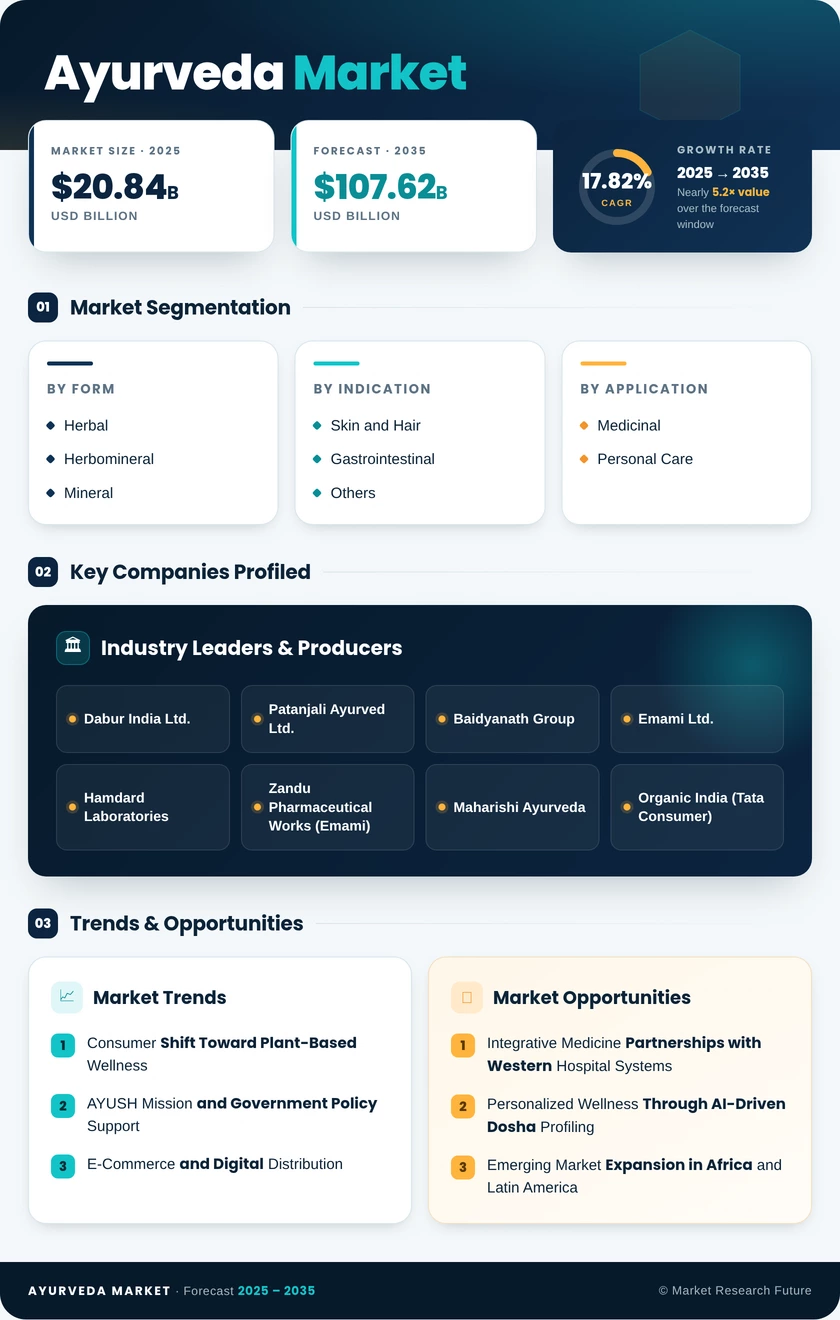
      1. 3.1.1 Rising Consumer Preference for Plant-Based Wellness | |
      2. 3.1.2 Government AYUSH Infrastructure Investment | |
      3. 3.1.3 E-Commerce Channel Penetration | |
      4. 3.1.4 Clinical Validation of Herbal Medicine Formulations | |
      5. 3.1.5 Insurance Coverage Expansion for Panchakarma Detox Therapy | |
      6. 3.1.6 Stricter GMP Standards Elevating Product Trust | |
      7. 3.1.7 Export Corridor Development for Traditional Indian Healing |
    2. 3.2 Market Restraints Analysis | |
      1. 3.2.1 Inconsistent Global Regulatory Frameworks | |
      2. 3.2.2 Quality Control and Adulteration Concerns | |
      3. 3.2.3 Limited Clinical Trial Data for Many Formulations | |
      4. 3.2.4 Reimbursement Exclusions by Major Insurers | |
      5. 3.2.5 Shortage of Qualified Ayurvedic Practitioners Outside India |
    3. 3.3 Market Opportunity Analysis | |
      1. 3.3.1 Integrative Medicine Partnerships with Western Hospital Systems | |
      2. 3.3.2 Personalized Wellness Through AI-Driven Dosha Profiling | |
      3. 3.3.3 Emerging Market Expansion in Africa and Latin America | |
      4. 3.3.4 Nutraceutical and Functional Food Convergence | |
      5. 3.3.5 Data Monetization Through Practitioner Platforms |
    4. 3.4 Industry Value Chain Analysis |
    5. 3.5 Porter's Five Forces Analysis
  4. 4 Global Ayurveda Market Size & Forecast (2021–2035) |
    1. 4.1 Historical Market Size (2021–2025) |
    2. 4.2 Current & Forecast Market Size (2026–2035) |
    3. 4.3 Market Size by Revenue (USD Billion) |
    4. 4.4 Year-over-Year Growth Analysis
  5. 5 Segmentation Analysis |
    1. 5.1 By Form | |
      1. 5.1.1 Herbal | |
      2. 5.1.2 Herbomineral | |
      3. 5.1.3 Mineral |
    2. 5.2 By Indication | |
      1. 5.2.1 Skin and Hair | |
      2. 5.2.2 Gastrointestinal | |
      3. 5.2.3 Others |
    3. 5.3 By Application | |
      1. 5.3.1 Medicinal | |
      2. 5.3.2 Personal Care
  6. 6 Regional Analysis |
    1. 6.1 North America | |
      1. 6.1.1 United States | |
      2. 6.1.2 Canada | |
      3. 6.1.3 Mexico |
    2. 6.2 Europe | |
      1. 6.2.1 Germany | |
      2. 6.2.2 United Kingdom | |
      3. 6.2.3 France | |
      4. 6.2.4 Italy | |
      5. 6.2.5 Spain | |
      6. 6.2.6 Nordic Countries | |
      7. 6.2.7 Russia | |
      8. 6.2.8 Rest of Europe |
    3. 6.3 Asia-Pacific | |
      1. 6.3.1 India | |
      2. 6.3.2 China | |
      3. 6.3.3 Japan | |
      4. 6.3.4 South Korea | |
      5. 6.3.5 ASEAN | |
      6. 6.3.6 Rest of Asia-Pacific |
    4. 6.4 South America | |
      1. 6.4.1 Brazil | |
      2. 6.4.2 Argentina | |
      3. 6.4.3 Rest of South America |
    5. 6.5 Middle East & Africa | |
      1. 6.5.1 Saudi Arabia | |
      2. 6.5.2 UAE | |
      3. 6.5.3 South Africa | |
      4. 6.5.4 Egypt | |
      5. 6.5.5 Rest of MEA
  7. 7 Competitive Landscape |
    1. 7.1 Market Share Analysis (2025) |
    2. 7.2 Competitive Benchmarking Matrix |
    3. 7.3 Company Profiles | |
      1. 7.3.1 Dabur India Ltd. | |
      2. 7.3.2 Patanjali Ayurved Ltd. | |
      3. 7.3.3 Himalaya Wellness Company | |
      4. 7.3.4 Baidyanath Group | |
      5. 7.3.5 Emami Ltd. | |
      6. 7.3.6 Hamdard Laboratories | |
      7. 7.3.7 Zandu Pharmaceutical Works | |
      8. 7.3.8 Maharishi Ayurveda | |
      9. 7.3.9 Organic India (Tata Consumer) | |
      10. 7.3.10 Mankind Pharma (Upakarma)
  8. 8 Future Outlook & Strategic Recommendations (2026–2035) |
    1. 8.1 AI-Enabled Personalization and Digital Therapeutics |
    2. 8.2 Sustainability and Regenerative Sourcing |
    3. 8.3 Insurance Integration and Value-Based Care |
    4. 8.4 Global Regulatory Harmonization
  9. 9 Recent Developments & News
  10. 10 Frequently Asked Questions (FAQs)
  11. 11 Report Scope & Methodology |
    1. 11.1 Study Period & Base Year |
    2. 11.2 Data Sources & Citations |
    3. 11.3 Abbreviations
  12. 12 LIST OF TABLES |
  13. TABLE 1 Global Ayurveda Market Size & Forecast, by Revenue (USD Billion), 2021–2035 |
  14. TABLE 2 Global Ayurveda Market – Year-over-Year Growth Analysis, 2021–2035 |
  15. TABLE 3 Global Ayurveda Market – Driver Impact Analysis |
  16. TABLE 4 Global Ayurveda Market – Restraint Impact Analysis |
  17. TABLE 5 Global Ayurveda Market Size, by Form, 2021–2035 (USD Billion) |
  18. TABLE 6 Global Ayurveda Market Size, by Indication, 2021–2035 (USD Billion) |
  19. TABLE 7 Global Ayurveda Market Size, by Application, 2021–2035 (USD Billion) |
  20. TABLE 8 Global Ayurveda Market Size, by Region, 2021–2035 (USD Billion) |
  21. TABLE 9 North America Ayurveda Market Size, by Country, 2021–2035 (USD Billion) |
  22. TABLE 10 Europe Ayurveda Market Size, by Country, 2021–2035 (USD Billion) |
  23. TABLE 11 Asia-Pacific Ayurveda Market Size, by Country, 2021–2035 (USD Billion) |
  24. TABLE 12 South America Ayurveda Market Size, by Country, 2021–2035 (USD Billion) |
  25. TABLE 13 Middle East & Africa Ayurveda Market Size, by Country, 2021–2035 (USD Billion) |
  26. TABLE 14 Competitive Benchmarking Matrix – Global Ayurveda Market, 2025 |
  27. TABLE 15 Company Profiles – Key Players, Global Ayurveda Market |
  28. TABLE 16 Recent Developments & Strategic Announcements, 2022–2025 |
  29. TABLE 17 Report Scope & Methodology Summary |
  30. TABLE 18 Detailed Sources and Citations
  31. 13 LIST OF FIGURES |
  32. FIGURE 1 Global Ayurveda Market Dynamics – Drivers, Restraints, and Opportunities |
  33. FIGURE 2 Industry Value Chain Analysis – Ayurveda Market |
  34. FIGURE 3 Porter's Five Forces Analysis – Ayurveda Market |
  35. FIGURE 4 Global Ayurveda Market Size Trend (USD Billion), 2021–2035 |
  36. FIGURE 5 Global Ayurveda Market Share, by Form, 2025 (%) |
  37. FIGURE 6 Global Ayurveda Market Share, by Indication, 2025 (%) |
  38. FIGURE 7 Global Ayurveda Market Share, by Application, 2025 (%) |
  39. FIGURE 8 Global Ayurveda Market Share, by Region, 2025 (%) |
  40. FIGURE 9 North America Ayurveda Market Share, by Country, 2025 (%) |
  41. FIGURE 10 Europe Ayurveda Market Share, by Country, 2025 (%) |
  42. FIGURE 11 Asia-Pacific Ayurveda Market Share, by Country, 2025 (%) |
  43. FIGURE 12 South America Ayurveda Market Share, by Country, 2025 (%) |
  44. FIGURE 13 Middle East & Africa Ayurveda Market Share, by Country, 2025 (%) |
  45. FIGURE 14 Competitive Landscape – Market Share Analysis, 2025 |
  46. FIGURE 15 Competitive Landscape – Company Positioning Matrix

Segmentation Quick Reference

Dimension Sub-Segments Dominant Segment Fastest Growing Segment
By Form Herbal, Herbomineral, Mineral Herbal Herbomineral
By Indication Skin and Hair, Gastrointestinal, Others Skin and Hair Gastrointestinal
By Application Medicinal, Personal Care Medicinal Personal Care
By Region North America, Europe, Asia-Pacific, South America, Middle East & Africa Asia-Pacific North America


Market Segmentation Overview

By Form

Sub-Segment Key Trend
Herbal Ashwagandha and turmeric formulations are leading the global herbal supplement demand.
Herbomineral Clinical studies validating synergistic mineral-herb bioavailability for chronic conditions
Mineral Bhasma-based preparations maintain niche demand in traditional South Asian practitioner channels.


The Form dimension reflects the foundational categorization of Ayurvedic products by their primary ingredient composition. Herbal formulations dominate due to broad consumer accessibility and alignment with clean-label trends, while herbomineral preparations represent the innovation frontier as clinical evidence strengthens.

By Indication

Sub-Segment Key Trend
Skin and Hair Clean-beauty convergence is driving neem, amla, and bhringraj ingredients into global cosmetic brands.
Gastrointestinal Triphala-based protocols and panchakarma detox therapy are gaining recognition in integrative gastroenterology.
Others Immunity, respiratory wellness, and adaptogenic stress management are expanding the addressable indication set.


Indication-based segmentation captures how consumers and practitioners deploy Ayurvedic products across therapeutic categories. Skin and hair care's dominance reflects the personal care industry's appetite for traditional Indian healing ingredients, while gastrointestinal applications are scaling through clinical validation pathways.

By Application

Sub-Segment Key Trend
Medicinal Integrative medicine clinics and AYUSH hospitals are anchoring prescription and OTC Ayurvedic demand.
Personal Care Multinational beauty brands sourcing Ayurvedic dietary practices ingredients for premium, sustainable product lines


Application segmentation distinguishes between therapeutic and cosmetic-wellness use cases. Medicinal applications carry higher per-unit value and longer purchase cycles, while personal care offers faster volume growth as dosha-based treatment principles permeate mainstream consumer goods categories.