×
Hero Background
English
Chinese
French
Japanese
Korean
German
Spanish

Bariatric Surgery Devices Market Share

ID: MRFR/MED/4649-CR
123 Pages
Rahul Gotadki
May 2020

Bariatric Surgery Devices Market Research Report By Type (Minimally Invasive Surgical Devices, Non-invasive Surgical Devices) By Procedure (Sleeve Gastrectomy, Gastric Bypass, Revision Surgery, Adjustable Gastric Band), By End User (Hospitals, Specialty Centers, Ambulatory Surgical Centers), and By Region (North America, Europe, Asia-Pacific, And Rest Of The World) – Market Forecast Till 2035

Share:
Download PDF ×

We do not share your information with anyone. However, we may send you emails based on your report interest from time to time. You may contact us at any time to opt-out.

Bariatric Surgery Devices Market Infographic
Purchase Options

Market Share

Bariatric Surgery Devices Market Share Analysis

The Nutrigenomics Market, on the intersection of nutrition and genomics, is swiftly gaining prominence as a personalized technique for health and well-being. Companies working on this subject install numerous market proportion positioning strategies to capitalize on the growing call for personalized nutrient answers. A fundamental strategy entails imparting genetic testing offerings that offer individuals insights into their genetic makeup related to vitamins. Companies leverage advanced genomic technologies to analyze genetic statistics, supporting people in understanding how their bodies respond to unique nutrients and tailoring their diets for this reason. Developing customized vitamin plans based on genetic records is a key marketplace positioning strategy. Nutrigenomics agencies use the insights received from genetic checking to create custom-designed dietary recommendations, thinking about factors together with metabolism, nutrient absorption, and character genetic versions for the most excellent health results. Educating clients about the concepts and blessings of nutrigenomics is a foundational strategy. Companies increase comprehensive academic tasks to elevate attention to the position of genetics in vitamins and health. Informed clients are more likely to be seeking nutrigenomic services, contributing to a market percentage boom. Adhering to regulatory requirements and ensuring strong facts and safety are non-negotiable in the nutrigenomics marketplace. Companies that prioritize compliance and put stringent data protection measures into effect gain the consideration of purchasers concerned about the privacy and security of their genetic records, strengthening marketplace positioning. Diversifying provider services beyond genetic trying out is a strategic approach. Companies increase their portfolios to consist of extra services, which include ongoing monitoring, lifestyle education, and supplementary products, creating complete solutions that cope with various components of personalized nutrients and well-being. Collaborating with company entities to provide nutrigenomic solutions as part of worker well-being applications is a strategic flow. Companies interact with organizations to promote team member fitness and productivity through personalized nutrition, fostering a company lifestyle that values men's or women's well-being. Expanding into worldwide markets is a significant method for groups within the nutrigenomics zone. Identifying areas with a developing hobby in personalized fitness and nutrition and setting up a sturdy international presence permits businesses to tap into various markets and broaden their customer base. Ensuring affordability and accessibility of nutrigenomic services is a key consideration in market positioning. Companies expand pricing fashions that cater to numerous earnings brackets and may offer installment plans, making customized vitamin insights more reachable to a much broader range of purchasers.

Author
Rahul Gotadki
Assistant Manager

He holds an experience of about 7+ years in Market Research and Business Consulting, working under the spectrum of Life Sciences and Healthcare domains. Rahul conceptualizes and implements a scalable business strategy and provides strategic leadership to the clients. His expertise lies in market estimation, competitive intelligence, pipeline analysis, customer assessment, etc. In addition to the above, his other responsibility includes strategic tracking of high growth markets & advising clients on the potential areas of focus they could direct their business initiatives

Leave a Comment

FAQs

What is the projected growth of the Bariatric Surgery Devices market?

The Bariatric Surgery Devices market is the expected increase in total market value of 4.75 USD billion over a defined forecast period 2025–2035. It is driven by factors such as demand trends, technological advances, regulatory changes, and geographic expansion.

What is the size of the Bariatric Surgery Devices market?

Bariatric Surgery Devices market size was valued at approximately 2.47 billion USD in 2024. This figure will reach 4.75 billion USD covering all regions (America, Europe, Asia, MEA and ROW), focusing its segments / services / distribution channels till 2035.

What is the CAGR of the Bariatric Surgery Devices market?

Bariatric Surgery Devices market is expected to grow at a CAGR of 6.12% between 2025 and 2035.

How much will the Bariatric Surgery Devices market be worth by 2035?

Bariatric Surgery Devices market is expected to be worth of 4.75 billion USD, reflecting growth driven by usage, technology and global demands by the end of 2035.

How will the Bariatric Surgery Devices market perform over the next 10 years?

Over the next 10 years the Bariatric Surgery Devices market is expected to shift from usd billion 2.47 to 4.75 billion USD, led by adoption of advanced tech, demographic trends, regulatory approvals, with potential headwinds from 2025 to 2035.

Which region held the largest market share in the Bariatric Surgery Devices market?

North America had the largest share in the market

Market Summary

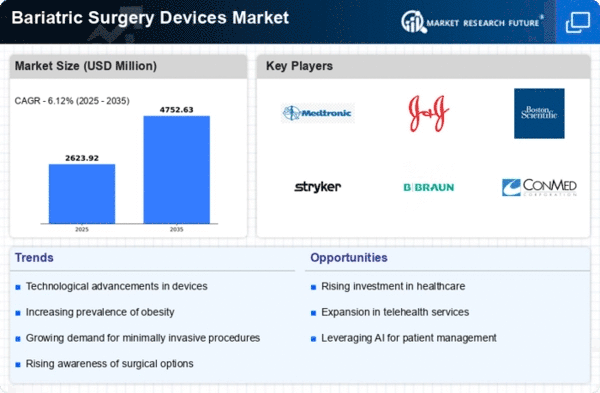
As per MRFR analysis, the Bariatric Surgery Devices Market was estimated at 2472.6 USD Million in 2024. The Bariatric Surgery Devices industry is projected to grow from 2623.93 USD Million in 2025 to 4752.63 USD Million by 2035, exhibiting a compound annual growth rate (CAGR) of 6.12 during the forecast period 2025 - 2035.

Key Market Trends & Highlights

The Bariatric Surgery Devices Market is experiencing robust growth driven by technological advancements and rising obesity rates.

  • Technological advancements in surgical devices are enhancing the efficacy and safety of bariatric procedures.
  • North America remains the largest market, while Asia-Pacific is emerging as the fastest-growing region for bariatric surgery devices.
  • Gastric bypass continues to dominate the market, whereas sleeve gastrectomy is witnessing the fastest growth in adoption.
  • The increasing prevalence of obesity and growing awareness of bariatric surgery are key drivers propelling market expansion.

Market Size & Forecast

2024 Market Size 2472.6 (USD Million)
2035 Market Size 4752.63 (USD Million)
CAGR (2025 - 2035) 6.12%
Largest Regional Market Share in 2024 North America

Major Players

<p>Medtronic (US), Johnson & Johnson (US), Boston Scientific (US), Stryker (US), B. Braun Melsungen AG (DE), Conmed Corporation (US), Intuitive Surgical (US), Hologic (US), Ethicon (US)</p>

Market Trends

The Bariatric Surgery Devices Market is currently experiencing a notable transformation, driven by increasing awareness of obesity-related health issues and the rising prevalence of obesity globally. This market encompasses a range of devices utilized in surgical procedures aimed at weight reduction, including gastric bands, gastric sleeves, and gastric bypass instruments. As healthcare providers and patients alike recognize the importance of effective weight management solutions, the demand for innovative surgical devices is likely to grow. Furthermore, advancements in technology are enhancing the efficacy and safety of these procedures, which may contribute to a more favorable perception of bariatric surgery among potential candidates. In addition to technological advancements, the Bariatric Surgery Devices Market is influenced by evolving regulatory frameworks and reimbursement policies. These factors can either facilitate or hinder market growth, depending on how they align with the needs of healthcare providers and patients. Moreover, the increasing focus on minimally invasive surgical techniques is reshaping the landscape of bariatric surgery, as these methods often result in shorter recovery times and reduced complications. Overall, the Bariatric Surgery Devices Market appears poised for continued expansion, driven by a combination of societal trends, technological innovations, and regulatory developments.

Technological Advancements

The Bariatric Surgery Devices Market is witnessing a surge in technological innovations, which enhance the precision and safety of surgical procedures. Newer devices are being developed with advanced materials and designs that improve patient outcomes and reduce recovery times. This trend suggests a shift towards more effective and less invasive options, appealing to both surgeons and patients.

Rising Obesity Rates

The increasing prevalence of obesity worldwide is a significant driver for the Bariatric Surgery Devices Market. As more individuals seek effective solutions for weight management, the demand for surgical interventions is likely to rise. This trend indicates a growing recognition of the health risks associated with obesity, prompting more patients to consider surgical options.

Regulatory Changes

Evolving regulatory frameworks are impacting the Bariatric Surgery Devices Market, as governments and health organizations adapt to the growing need for effective obesity treatments. Changes in reimbursement policies and approval processes for new devices may either facilitate market growth or present challenges, depending on how they align with healthcare providers' capabilities and patient needs.

Bariatric Surgery Devices Market Market Drivers

Rising Obesity Rates

The increasing prevalence of obesity globally serves as a primary driver for the Global Bariatric Surgery Devices Market Industry. According to the World Health Organization, obesity rates have nearly tripled since 1975, with more than 1.9 billion adults classified as overweight. This alarming trend necessitates effective weight management solutions, leading to a growing demand for bariatric surgery devices. In 2024, the market is projected to reach 2.47 USD Billion, reflecting the urgent need for surgical interventions to combat obesity-related health issues. As awareness of obesity's health implications rises, the market is likely to expand further.

Technological Advancements

Technological innovations in bariatric surgery devices significantly enhance their effectiveness and safety, thereby propelling the Global Bariatric Surgery Devices Market Industry. Minimally invasive techniques, such as laparoscopic surgery, have gained traction, resulting in shorter recovery times and reduced complications. The introduction of advanced surgical instruments and robotic-assisted systems has further improved surgical outcomes. These advancements not only attract more patients but also encourage healthcare providers to adopt these technologies. As a result, the market is expected to grow, with projections indicating a rise to 4.75 USD Billion by 2035, driven by ongoing technological improvements.

Growing Awareness and Acceptance

The rising awareness and acceptance of bariatric surgery as a viable treatment option for obesity significantly influence the Global Bariatric Surgery Devices Market Industry. Educational campaigns and advocacy efforts by health organizations have helped to destigmatize surgical weight loss, encouraging individuals to consider surgical options. This shift in perception is crucial, as it leads to increased patient inquiries and consultations regarding bariatric procedures. As more patients seek surgical interventions, the market is poised for growth, with an anticipated increase in demand for various bariatric devices. This trend underscores the importance of education in driving market expansion.

Increasing Healthcare Expenditure

Rising healthcare expenditure across various regions contributes to the growth of the Global Bariatric Surgery Devices Market Industry. Governments and private sectors are investing more in healthcare infrastructure, which includes funding for obesity treatment programs. This trend is particularly evident in developed nations, where healthcare budgets are expanding to accommodate advanced surgical procedures. As healthcare systems allocate more resources to combat obesity, the demand for bariatric surgery devices is likely to increase. This financial commitment may lead to a compound annual growth rate of 6.13% from 2025 to 2035, reflecting the growing recognition of obesity as a critical public health issue.

Regulatory Support and Guidelines

Regulatory support and the establishment of guidelines for bariatric surgery play a pivotal role in shaping the Global Bariatric Surgery Devices Market Industry. Health authorities are increasingly recognizing the necessity of surgical interventions for obesity management, leading to the development of standardized protocols and approval processes for bariatric devices. This regulatory framework not only ensures patient safety but also fosters innovation within the industry. As regulatory bodies continue to endorse bariatric surgery, the market is likely to experience sustained growth, driven by the introduction of new devices and techniques that meet established safety and efficacy standards.

Market Segment Insights

By Application: Gastric Bypass (Largest) vs. Sleeve Gastrectomy (Fastest-Growing)

<p>The Bariatric Surgery Devices Market is largely dominated by the Gastric Bypass application, which has consistently held the largest market share due to its established effectiveness in achieving significant weight loss and long-term sustainability. Sleeve Gastrectomy, while also a major player, has been rapidly gaining traction, appealing particularly to patients seeking less invasive procedures with shorter recovery times. Together, these two procedures encompass a significant portion of the market, influencing other surgical methods.</p>

<p>Surgery Techniques: Gastric Bypass (Dominant) vs. Sleeve Gastrectomy (Emerging)</p>

<p>Gastric Bypass remains the dominant procedure within the Bariatric Surgery Devices Market due to its long history and proven results in significant weight loss and improvement in obesity-related comorbidities. Meanwhile, Sleeve Gastrectomy is emerging rapidly as a preferred choice for both patients and surgeons, largely due to its minimally invasive nature and lower complication rates. This growing interest is driven by an increasing number of patients seeking effective solutions with fewer risks. As both techniques continue to evolve, their roles may shift in terms of prominence, depending on advancements in surgical methods and technology.</p>

By Device Type: Surgical Staplers (Largest) vs. Endoscopes (Fastest-Growing)

<p>The Bariatric Surgery Devices Market is diverse, with a notable distribution among key device types. Surgical staplers hold the largest market share, driven by their efficacy and reliability in enabling successful bariatric procedures. Endoscopes, however, have emerged as the fastest-growing segment due to advancements in minimally invasive techniques that bolster patient recovery and safety. Other categories such as surgical instruments and implantable devices also contribute significantly, although they trail behind in market share.</p>

<p>Surgical Staplers (Dominant) vs. Endoscopes (Emerging)</p>

<p>Surgical staplers are considered the dominant player in the Bariatric Surgery Devices Market, primarily due to their critical role in various surgical procedures. They offer precision and efficiency, essential for achieving optimal outcomes in weight-loss surgeries. On the other hand, endoscopes represent the emerging technology within this market segment, driven by innovations that enhance visualization and procedural effectiveness. Their ability to perform minimally invasive surgeries has revolutionized patient care, increasing demand significantly. As healthcare professionals continue to adopt cutting-edge technologies, both surgical staplers and endoscopes are expected to sustain their critical positions in the evolving landscape of bariatric surgery.</p>

By End User: Hospitals (Largest) vs. Ambulatory Surgical Centers (Fastest-Growing)

<p>The Bariatric Surgery Devices Market exhibits a notable distribution across its end-user segments, with hospitals holding the largest share due to their comprehensive facilities and specialized surgical teams. Ambulatory Surgical Centers (ASCs), meanwhile, are witnessing significant growth as they cater to outpatient procedures, leveraging innovations in minimally invasive techniques. As more patients seek surgical solutions in cost-effective environments, this shift in preference contributes to ASCs' rising prominence in the market.</p>

<p>Hospitals (Dominant) vs. Specialty Clinics (Emerging)</p>

<p>Hospitals remain the dominant end-user in the Bariatric Surgery Devices Market, driven by their ability to provide extensive surgical resources, multidisciplinary care teams, and postoperative support. Their established infrastructure supports complex cases, ensuring high patient recovery rates. Conversely, specialty clinics are emerging as important players, focusing on tailored weight-loss programs and personalized patient experiences. These clinics are appealing to patients seeking dedicated care and expertise in bariatric procedures, thus fostering an increasing demand for specialized surgical devices. As trends shift toward personalized healthcare, the growth potential for specialty clinics in this market will continue to rise.</p>

By Patient Demographics: Obese Adults (Largest) vs. Patients Seeking Weight Loss Solutions (Fastest-Growing)

<p>In the Bariatric Surgery Devices Market, the segment of Obese Adults holds the largest share, primarily due to the increasing prevalence of obesity in the adult population. This demographic, often defined as individuals with a Body Mass Index (BMI) of 30 or higher, is a major driver for demand as more adults seek surgical interventions to manage their weight. Following closely are Patients Seeking Weight Loss Solutions, who are showing a rapid increase in numbers as awareness and acceptance of bariatric surgery gain traction. This segment is effectively capitalizing on the burgeoning lifestyle and wellness trends, making it a significant contributor to the market landscape.</p>

<p>Obese Adults (Dominant) vs. Patients with Comorbidities (Emerging)</p>

<p>Obese Adults represent the dominant segment in the Bariatric Surgery Devices Market, characterized by a significant need for surgical interventions due to lifestyle-related conditions. This group typically experiences a range of health issues, including diabetes and hypertension, necessitating more aggressive weight management strategies. On the other hand, Patients with Comorbidities is an emerging segment that is gaining traction as healthcare providers recognize the urgent need to treat obesity-related diseases that may complicate other health conditions. This demographic often includes patients suffering from multiple comorbidities, thereby increasing the propensity for surgical solutions as part of comprehensive care strategies. Consequently, both segments reflect distinct yet intertwined trends influencing the overall market dynamics.</p>

By Surgical Technique: Laparoscopic Surgery (Largest) vs. Robotic Surgery (Fastest-Growing)

<p>In the Bariatric Surgery Devices Market, the surgical technique segment is predominantly characterized by Laparoscopic Surgery, holding the largest market share due to its minimally invasive approach, reduced recovery time, and overall patient satisfaction. Open Surgery, while significant, is gradually being outpaced by more advanced techniques like Laparoscopic and Robotic Surgery. Endoscopic Surgery is also present but represents a smaller portion of the market. The steady growth of Laparoscopic Surgery reflects the increasing preference for less invasive procedures among healthcare providers and patients.</p>

<p>Surgical Techniques: Laparoscopic Surgery (Dominant) vs. Robotic Surgery (Emerging)</p>

<p>Laparoscopic Surgery has established itself as the dominant surgical technique in the Bariatric Surgery Devices Market. Known for its minimally invasive nature, this technique results in shorter hospital stays, quicker recovery times, and reduced pain compared to traditional open surgery. Meanwhile, Robotic Surgery is emerging as a significant player, driven by advancements in technology and surgeon preference for enhanced precision and control. While Robotic Surgery currently occupies a smaller share of the market, its innovative approach and potential for greater surgical outcomes contribute to its rapid growth, appealing increasingly to both specialists and patients.</p>

Get more detailed insights about Bariatric Surgery Devices Market Research Report - Forecast till 2035

Regional Insights

North America : Market Leader in Innovation

North America is the largest market for bariatric surgery devices, holding a significant share of the global market at $1230.0M. The region's growth is driven by rising obesity rates, increasing awareness of weight management, and advancements in surgical technologies. Regulatory support from agencies like the FDA has also catalyzed market expansion, ensuring safety and efficacy in new devices. The competitive landscape is robust, with key players such as Medtronic, Johnson & Johnson, and Intuitive Surgical leading the charge. The U.S. remains the primary market, supported by a well-established healthcare infrastructure and high patient demand for innovative surgical solutions. The presence of major manufacturers enhances competition and drives technological advancements in the sector.

Europe : Emerging Market with Growth Potential

Europe's bariatric surgery devices market is valued at $750.0M, reflecting a growing demand driven by increasing obesity rates and a shift towards preventive healthcare. Regulatory frameworks across the EU are becoming more supportive, facilitating the introduction of innovative devices. Countries like Germany and France are leading in adoption, supported by favorable reimbursement policies and rising public health initiatives. The competitive landscape features key players such as B. Braun Melsungen AG and Ethicon, with a focus on enhancing surgical outcomes. The presence of advanced healthcare systems in Western Europe fosters innovation, while Eastern Europe shows potential for growth as awareness increases. The market is expected to expand as more countries adopt comprehensive obesity management strategies. "The European Commission emphasizes the need for effective obesity management strategies to improve public health outcomes."

Asia-Pacific : Rapidly Growing Market

The Asia-Pacific region is witnessing a burgeoning market for bariatric surgery devices, valued at $400.0M. Factors such as increasing obesity rates, urbanization, and changing lifestyles are driving demand. Governments are beginning to recognize obesity as a public health issue, leading to supportive policies and initiatives aimed at improving healthcare access and surgical options. Countries like Japan and Australia are at the forefront, with advanced healthcare systems and increasing patient awareness. The competitive landscape includes both global players and local manufacturers, enhancing market dynamics. As the region continues to develop, the demand for innovative and effective bariatric solutions is expected to rise significantly, supported by a growing focus on health and wellness.

Middle East and Africa : Emerging Market with Challenges

The Middle East and Africa region, with a market size of $92.6M, is gradually emerging in the bariatric surgery devices sector. The rising prevalence of obesity, coupled with increasing healthcare investments, is driving market growth. However, challenges such as limited access to advanced healthcare facilities and varying regulatory environments can hinder progress. Governments are beginning to implement health initiatives aimed at combating obesity, which may further stimulate market demand. Countries like South Africa and the UAE are leading the way, with growing awareness and acceptance of bariatric procedures. The competitive landscape is evolving, with both international and regional players vying for market share. As healthcare infrastructure improves, the potential for growth in this sector is significant, making it an area of interest for investors and manufacturers alike.

Key Players and Competitive Insights

The Bariatric Surgery Devices Market is currently characterized by a dynamic competitive landscape, driven by increasing obesity rates and a growing awareness of surgical options. Key players such as Medtronic (US), Johnson & Johnson (US), and Intuitive Surgical (US) are at the forefront, each adopting distinct strategies to enhance their market presence. Medtronic (US) focuses on innovation through advanced surgical technologies, while Johnson & Johnson (US) emphasizes strategic partnerships to expand its product offerings. Intuitive Surgical (US) is leveraging digital transformation to improve surgical outcomes, thereby shaping a competitive environment that prioritizes technological advancement and patient-centric solutions.

In terms of business tactics, companies are increasingly localizing manufacturing to reduce costs and enhance supply chain efficiency. The market appears moderately fragmented, with several players vying for dominance. However, the collective influence of major companies like Boston Scientific (US) and Stryker (US) suggests a trend towards consolidation, as these firms seek to optimize their operations and expand their geographical reach.

In November 2025, Medtronic (US) announced the launch of a new robotic-assisted surgical system designed specifically for bariatric procedures. This innovation is expected to enhance precision and reduce recovery times, positioning Medtronic (US) as a leader in the technological advancement of bariatric surgery. The strategic importance of this launch lies in its potential to attract a broader patient base and improve surgical outcomes, thereby reinforcing Medtronic's (US) competitive edge.

In October 2025, Johnson & Johnson (US) entered into a partnership with a leading telehealth provider to integrate remote patient monitoring into its bariatric surgery offerings. This move is indicative of a broader trend towards digital health solutions, which may enhance patient engagement and post-operative care. By embracing telehealth, Johnson & Johnson (US) not only expands its service portfolio but also positions itself as a forward-thinking player in the market.

In September 2025, Intuitive Surgical (US) reported a significant increase in its market share following the introduction of its AI-driven analytics platform for surgical procedures. This platform is designed to provide real-time data insights, which could potentially improve decision-making during surgeries. The strategic importance of this development lies in its ability to differentiate Intuitive Surgical (US) from competitors, as it aligns with the growing trend of integrating AI into healthcare solutions.

As of December 2025, the competitive trends in the Bariatric Surgery Devices Market are increasingly defined by digitalization, sustainability, and the integration of AI technologies. Strategic alliances are becoming more prevalent, as companies recognize the need to collaborate in order to enhance their technological capabilities. Looking ahead, competitive differentiation is likely to evolve from traditional price-based competition towards a focus on innovation, advanced technology, and reliable supply chains. This shift underscores the importance of adaptability and forward-thinking strategies in maintaining a competitive advantage.

Key Companies in the Bariatric Surgery Devices Market market include

Industry Developments

August 2022 As part of the agreement, Teleflex agreed to pay USD 170 million in cash up front and USD 130 million more if certain commercial targets were achieved.

January 2022 Apollo Hospital in Hyderabad claimed it had carried out the first Full Robotic Bariatric surgery in Telugu. Hibibo Abdulle Mohamed, a 40-year-old Somalian who weighed 180 kg and had several health issues, underwent the procedure.

Future Outlook

Bariatric Surgery Devices Market Future Outlook

<p>The Bariatric Surgery Devices Market is projected to grow at a 6.12% CAGR from 2024 to 2035, driven by rising obesity rates, technological advancements, and increasing healthcare expenditure.</p>

New opportunities lie in:

  • <p>Development of AI-driven surgical planning software</p>
  • <p>Expansion of telehealth services for pre- and post-operative care</p>
  • <p>Introduction of minimally invasive devices for outpatient procedures</p>

<p>By 2035, the market is expected to achieve substantial growth, reflecting evolving healthcare dynamics.</p>

Market Segmentation

Bariatric Surgery Devices Market End User Outlook

  • Hospitals
  • Ambulatory Surgical Centers
  • Specialty Clinics
  • Research Institutions

Bariatric Surgery Devices Market Application Outlook

  • Gastric Bypass
  • Sleeve Gastrectomy
  • Adjustable Gastric Banding
  • Biliopancreatic Diversion
  • Intragastric Balloon

Bariatric Surgery Devices Market Device Type Outlook

  • Surgical Staplers
  • Endoscopes
  • Surgical Instruments
  • Implantable Devices
  • Anesthesia Equipment

Bariatric Surgery Devices Market Surgical Technique Outlook

  • Open Surgery
  • Laparoscopic Surgery
  • Robotic Surgery
  • Endoscopic Surgery

Bariatric Surgery Devices Market Patient Demographics Outlook

  • Obese Adults
  • Adolescents
  • Patients with Comorbidities
  • Patients Seeking Weight Loss Solutions

Report Scope

MARKET SIZE 20242472.6(USD Million)
MARKET SIZE 20252623.93(USD Million)
MARKET SIZE 20354752.63(USD Million)
COMPOUND ANNUAL GROWTH RATE (CAGR)6.12% (2024 - 2035)
REPORT COVERAGERevenue Forecast, Competitive Landscape, Growth Factors, and Trends
BASE YEAR2024
Market Forecast Period2025 - 2035
Historical Data2019 - 2024
Market Forecast UnitsUSD Million
Key Companies ProfiledMedtronic (US), Johnson & Johnson (US), Boston Scientific (US), Stryker (US), B. Braun Melsungen AG (DE), Conmed Corporation (US), Intuitive Surgical (US), Hologic (US), Ethicon (US)
Segments CoveredApplication, Device Type, End User, Patient Demographics, Surgical Technique
Key Market OpportunitiesIntegration of advanced minimally invasive techniques enhances patient outcomes in the Bariatric Surgery Devices Market.
Key Market DynamicsRising demand for minimally invasive procedures drives innovation and competition in the bariatric surgery devices market.
Countries CoveredNorth America, Europe, APAC, South America, MEA

FAQs

What is the projected growth of the Bariatric Surgery Devices market?

The Bariatric Surgery Devices market is the expected increase in total market value of 4.75 USD billion over a defined forecast period 2025–2035. It is driven by factors such as demand trends, technological advances, regulatory changes, and geographic expansion.

What is the size of the Bariatric Surgery Devices market?

Bariatric Surgery Devices market size was valued at approximately 2.47 billion USD in 2024. This figure will reach 4.75 billion USD covering all regions (America, Europe, Asia, MEA and ROW), focusing its segments / services / distribution channels till 2035.

What is the CAGR of the Bariatric Surgery Devices market?

Bariatric Surgery Devices market is expected to grow at a CAGR of 6.12% between 2025 and 2035.

How much will the Bariatric Surgery Devices market be worth by 2035?

Bariatric Surgery Devices market is expected to be worth of 4.75 billion USD, reflecting growth driven by usage, technology and global demands by the end of 2035.

How will the Bariatric Surgery Devices market perform over the next 10 years?

Over the next 10 years the Bariatric Surgery Devices market is expected to shift from usd billion 2.47 to 4.75 billion USD, led by adoption of advanced tech, demographic trends, regulatory approvals, with potential headwinds from 2025 to 2035.

Which region held the largest market share in the Bariatric Surgery Devices market?

North America had the largest share in the market

  1. EXECUTIVE SUMMARY
    1. OVERVIEW 15
      1. MARKET SYNOPSIS 15
  2. MARKET INTRODUCTION
    1. SCOPE OF THE STUDY 16
    2. RESEARCH OBJECTIVE 16
    3. LIST OF ASSUMPTIONS 17
  3. RESEARCH METHODOLOGY
    1. OVERVIEW 18
    2. DATA MINING 18
    3. SECONDARY RESEARCH 19
    4. PRIMARY RESEARCH 20
      1. PRIMARY INTERVIEWS AND INFORMATION GATHERING PROCESS 20
      2. BREAKDOWN OF PRIMARY RESPONDENTS 21
    5. FORECASTING TECHNIQUES 21
    6. RESEARCH METHODOLOGY FOR MARKET SIZE ESTIMATION 22
      1. BOTTOM-UP APPROACH 23
      2. TOP-DOWN APPROACH 24
    7. DATA TRIANGULATION 24
    8. VALIDATION 25
  4. MARKET DYNAMICS
    1. OVERVIEW 26
    2. DRIVERS 27
      1. INCREASING PREVALENCE OF OBESITY 27
      2. RISING TECHNOLOGICAL ADVANCEMENTS 27
      3. GROWING NUMBER OF BARIATRIC AND METABOLIC SURGERIES 27
      4. INCREASING NUMBER OF REGULATORY APPROVALS FOR BARIATRIC SURGERY DEVICES 27
    3. RESTRAINTS 28
      1. RISING PRODUCT RECALLS IN THE INDUSTRY 28
      2. HIGH COST OF BARIATRIC SURGERIES 28
    4. OPPORTUNITIES 29
      1. EMERGING MARKETS WITH HIGH PREVALENCE OF OBESITY 29
  5. MARKET FACTOR ANALYSIS
    1. PORTER’S FIVE FORCES MODEL 30
      1. THREAT OF NEW ENTRANTS 30
      2. BARGAINING POWER OF SUPPLIERS 31
      3. THREAT OF SUBSTITUTES 31
      4. BARGAINING POWER OF BUYERS 31
      5. INTENSITY OF RIVALRY 31
    2. SUPPLY CHAIN ANALYSIS 32
      1. R&D AND DESIGNING 33
      2. MANUFACTURING 33
      3. DISTRIBUTION 33
      4. MARKETING & SALES 33
      5. POST-SALES MONITORING 33
    3. RECENT FDA APPROVALS 34
  6. BARIATRIC SURGERY DEVICES MARKET, BY TYPE
    1. OVERVIEW 35
    2. MINIMALLY INVASIVE SURGICAL DEVICES 36
      1. STAPLING DEVICES 37
      2. ENERGY/VESSEL SEALING DEVICES 37
      3. SUTURING DEVICES 38
      4. ACCESSORIES 38
    3. NON-INVASIVE SURGICAL DEVICES 39
  7. BARIATRIC SURGERY DEVICES MARKET, BY PROCEDURE
    1. OVERVIEW 40
    2. SLEEVE GASTRECTOMY 42
    3. GASTRIC BYPASS 42
    4. REVISION SURGERY 43
    5. ADJUSTABLE GASTRIC BAND 43
    6. OTHERS 44
  8. BARIATRIC SURGERY DEVICES MARKET, BY END USER
    1. OVERVIEW 45
    2. HOSPITALS 46
    3. SPECIALTY CENTRES 46
    4. AMBULATORY SURGICAL CENTERS 47
    5. OTHERS 47
  9. GLOBAL BARIATRIC SURGERY DEVICES MARKET, BY REGION
    1. OVERVIEW 48
    2. AMERICAS 49
  10. BARIATRIC SURGERY DEVICES MARKET, BY TYPE
  11. BARIATRIC SURGERY DEVICES MARKET, BY PROCEDURE
  12. BARIATRIC SURGERY DEVICES MARKET, BY END USER
  13. NORTH AMERICA 51
  14. BARIATRIC SURGERY DEVICES MARKET, BY TYPE
  15. BARIATRIC SURGERY DEVICES MARKET, BY PROCEDURE
  16. BARIATRIC SURGERY DEVICES MARKET, BY END USER
  17. US 52
  18. BARIATRIC SURGERY DEVICES MARKET, BY TYPE
  19. BARIATRIC SURGERY DEVICES MARKET, BY PROCEDURE
  20. BARIATRIC SURGERY DEVICES MARKET, BY END USER
  21. CANADA 54
  22. BARIATRIC SURGERY DEVICES MARKET, BY TYPE
  23. BARIATRIC SURGERY DEVICES MARKET, BY PROCEDURE
  24. BARIATRIC SURGERY DEVICES MARKET, BY END USER
  25. LATIN AMERICA 55
  26. BARIATRIC SURGERY DEVICES MARKET, BY TYPE
  27. BARIATRIC SURGERY DEVICES MARKET, BY PROCEDURE
  28. BARIATRIC SURGERY DEVICES MARKET, BY END USER
    1. EUROPE 57
  29. BARIATRIC SURGERY DEVICES MARKET, BY TYPE
  30. BARIATRIC SURGERY DEVICES MARKET, BY PROCEDURE
  31. BARIATRIC SURGERY DEVICES MARKET, BY END USER
  32. WESTERN EUROPE 59
  33. BARIATRIC SURGERY DEVICES MARKET, BY TYPE
  34. BARIATRIC SURGERY DEVICES MARKET, BY PROCEDURE
  35. BARIATRIC SURGERY DEVICES MARKET, BY END USER
  36. GERMANY 61
  37. BARIATRIC SURGERY DEVICES MARKET, BY TYPE
  38. BARIATRIC SURGERY DEVICES MARKET, BY PROCEDURE
  39. BARIATRIC SURGERY DEVICES MARKET, BY END USER
  40. FRANCE 62
  41. BARIATRIC SURGERY DEVICES MARKET, BY TYPE
  42. BARIATRIC SURGERY DEVICES MARKET, BY PROCEDURE
  43. BARIATRIC SURGERY DEVICES MARKET, BY END USER
  44. UK 63
  45. BARIATRIC SURGERY DEVICES MARKET, BY TYPE
  46. BARIATRIC SURGERY DEVICES MARKET, BY PROCEDURE
  47. BARIATRIC SURGERY DEVICES MARKET, BY END USER
  48. ITALY 65
  49. BARIATRIC SURGERY DEVICES MARKET, BY TYPE
  50. BARIATRIC SURGERY DEVICES MARKET, BY PROCEDURE
  51. BARIATRIC SURGERY DEVICES MARKET, BY END USER
  52. SPAIN 66
  53. BARIATRIC SURGERY DEVICES MARKET, BY TYPE
  54. BARIATRIC SURGERY DEVICES MARKET, BY PROCEDURE
  55. BARIATRIC SURGERY DEVICES MARKET, BY END USER
  56. REST OF WESTERN EUROPE 67
  57. BARIATRIC SURGERY DEVICES MARKET, BY TYPE
  58. BARIATRIC SURGERY DEVICES MARKET, BY PROCEDURE
  59. BARIATRIC SURGERY DEVICES MARKET, BY END USER
  60. EASTERN EUROPE 69
  61. BARIATRIC SURGERY DEVICES MARKET, BY TYPE
  62. BARIATRIC SURGERY DEVICES MARKET, BY PROCEDURE
  63. BARIATRIC SURGERY DEVICES MARKET, BY END USER
    1. ASIA-PACIFIC 71
  64. BARIATRIC SURGERY DEVICES MARKET, BY TYPE
  65. BARIATRIC SURGERY DEVICES MARKET, BY PROCEDURE
  66. BARIATRIC SURGERY DEVICES MARKET, BY END USER
  67. JAPAN 73
  68. BARIATRIC SURGERY DEVICES MARKET, BY TYPE
  69. BARIATRIC SURGERY DEVICES MARKET, BY PROCEDURE
  70. BARIATRIC SURGERY DEVICES MARKET, BY END USER
  71. CHINA 74
  72. BARIATRIC SURGERY DEVICES MARKET, BY TYPE
  73. BARIATRIC SURGERY DEVICES MARKET, BY PROCEDURE
  74. BARIATRIC SURGERY DEVICES MARKET, BY END USER
  75. INDIA 76
  76. BARIATRIC SURGERY DEVICES MARKET, BY TYPE
  77. BARIATRIC SURGERY DEVICES MARKET, BY PROCEDURE
  78. BARIATRIC SURGERY DEVICES MARKET, BY END USER
  79. AUSTRALIA 77
  80. BARIATRIC SURGERY DEVICES MARKET, BY TYPE
  81. BARIATRIC SURGERY DEVICES MARKET, BY PROCEDURE
  82. BARIATRIC SURGERY DEVICES MARKET, BY END USER
  83. SOUTH KOREA 78
  84. BARIATRIC SURGERY DEVICES MARKET, BY TYPE
  85. BARIATRIC SURGERY DEVICES MARKET, BY PROCEDURE
  86. BARIATRIC SURGERY DEVICES MARKET, BY END USER
  87. REST OF ASIA-PACIFIC 80
  88. BARIATRIC SURGERY DEVICES MARKET, BY TYPE
  89. BARIATRIC SURGERY DEVICES MARKET, BY PROCEDURE
  90. BARIATRIC SURGERY DEVICES MARKET, BY END USER
    1. MIDDLE EAST & AFRICA 82
  91. BARIATRIC SURGERY DEVICES MARKET, BY TYPE
  92. BARIATRIC SURGERY DEVICES MARKET, BY PROCEDURE
  93. BARIATRIC SURGERY DEVICES MARKET, BY END USER
  94. MIDDLE EAST 84
  95. BARIATRIC SURGERY DEVICES MARKET, BY TYPE
  96. BARIATRIC SURGERY DEVICES MARKET, BY PROCEDURE
  97. BARIATRIC SURGERY DEVICES MARKET, BY END USER
  98. AFRICA 85
  99. BARIATRIC SURGERY DEVICES MARKET, BY TYPE
  100. BARIATRIC SURGERY DEVICES MARKET, BY PROCEDURE
  101. BARIATRIC SURGERY DEVICES MARKET, BY END USER
  102. COMPETITIVE LANDSCAPE
    1. OVERVIEW 87
    2. COMPETITIVE ANALYSIS 87
    3. COMPETITOR DASHBOARD 88
    4. COMPETITIVE BENCHMARKING 89
    5. MAJOR GROWTH STRATEGY IN THE GLOBAL BARIATRIC SURGERY DEVICES MARKET 90
    6. LEADING PLAYERS IN TERMS OF NUMBER OF DEVELOPMENTS 90
    7. KEY DEVELOPMENTS AND GROWTH STRATEGIES 91
      1. AGREEMENTS 91
      2. EXPANSIONS 91
      3. ACQUISITIONS 92
      4. PRODUCT APPROVALS AND LAUNCHES 92
    8. MAJOR PLAYERS FINANCIAL MATRIX & MARKET RATIO 93
      1. SALES & OPERATING PROFIT MARGIN 93
      2. R&D EXPENDITURE 94
  103. COMPANY PROFILES
    1. MEDTRONIC 95
      1. COMPANY OVERVIEW 95
      2. FINANCIAL OVERVIEW 96
      3. PRODUCTS/SERVICES OFFERED 97
      4. KEY DEVELOPMENTS 97
      5. SWOT ANALYSIS 99
      6. KEY STRATEGIES 99
    2. APOLLO ENDOSURGERY, INC. 100
      1. COMPANY OVERVIEW 100
      2. FINANCIAL OVERVIEW 100
      3. PRODUCTS/SERVICES OFFERED 101
      4. KEY DEVELOPMENTS 101
      5. SWOT ANALYSIS 102
      6. KEY STRATEGIES 102
    3. INTUITIVE SURGICAL INC. 103
      1. COMPANY OVERVIEW 103
      2. FINANCIAL OVERVIEW 103
      3. PRODUCTS/SERVICES OFFERED 104
      4. KEY DEVELOPMENTS 104
      5. SWOT ANALYSIS 106
      6. KEY STRATEGIES 106
    4. JOHNSON & JOHNSON SERVICES INC. 107
      1. COMPANY OVERVIEW 107
      2. FINANCIAL OVERVIEW 107
      3. PRODUCTS/SERVICES OFFERED 108
      4. KEY DEVELOPMENTS 108
      5. SWOT ANALYSIS 109
      6. KEY STRATEGIES 109
    5. RESHAPE LIFESCIENCES, INC. 110
      1. COMPANY OVERVIEW 110
      2. FINANCIAL OVERVIEW 110
      3. PRODUCTS/SERVICES OFFERED 111
      4. KEY DEVELOPMENTS 111
      5. SWOT ANALYSIS 111
      6. KEY STRATEGIES 111
    6. OLYMPUS CORPORATION 112
      1. COMPANY OVERVIEW 112
      2. FINANCIAL OVERVIEW 112
      3. PRODUCTS/SERVICES OFFERED 113
      4. KEY DEVELOPMENTS 113
      5. SWOT ANALYSIS 114
      6. KEY STRATEGIES 114
    7. MEDIFLEX SURGICAL PRODUCTS 115
      1. COMPANY OVERVIEW 115
      2. FINANCIAL OVERVIEW 115
      3. PRODUCTS/SERVICES OFFERED 115
      4. KEY DEVELOPMENTS 115
      5. SWOT ANALYSIS 116
      6. KEY STRATEGIES 116
    8. TRANSENTERIX SURGICAL, INC. 117
      1. COMPANY OVERVIEW 117
      2. FINANCIAL OVERVIEW 117
      3. PRODUCTS/SERVICES OFFERED 118
      4. KEY DEVELOPMENTS 118
      5. SWOT ANALYSIS 118
      6. KEY STRATEGIES 118
    9. ASPIRE BARIATRICS 119
      1. COMPANY OVERVIEW 119
      2. FINANCIAL OVERVIEW 119
      3. PRODUCTS/SERVICES OFFERED 119
      4. KEY DEVELOPMENTS 119
      5. SWOT ANALYSIS 120
      6. KEY STRATEGIES 120
    10. SPATZ FGIA, INC. 121
      1. COMPANY OVERVIEW 121
      2. FINANCIAL OVERVIEW 121
      3. PRODUCTS/SERVICES OFFERED 121
      4. KEY DEVELOPMENTS 121
      5. SWOT ANALYSIS 122
      6. KEY STRATEGIES 122
  104. APPENDIX
    1. REFERENCES 123
    2. RELATED REPORTS 123
  105. LIST OF TABLES
  106. LIST OF ASSUMPTIONS 17
  107. GLOBAL BARIATRIC SURGERY DEVICES MARKET, BY TYPE 2020-2027 (USD MILLION) 36
  108. GLOBAL BARIATRIC SURGERY DEVICES MARKET, FOR MINIMALLY INVASIVE SURGICAL DEVICES, BY TYPE 2020-2027
    1. (USD MILLION) 36
  109. GLOBAL BARIATRIC SURGERY DEVICES MARKET, FOR MINIMALLY INVASIVE SURGICAL DEVICES, BY REGION 2020-2027
    1. (USD MILLION) 36
  110. GLOBAL BARIATRIC SURGERY DEVICES MARKET, FOR STAPLING DEVICES, BY TYPE 2020-2027 (USD MILLION) 37
  111. GLOBAL BARIATRIC SURGERY DEVICES MARKET, FOR ENERGY/VESSEL SEALING DEVICES, BY TYPE 2020-2027 (USD MILLION) 37
  112. GLOBAL BARIATRIC SURGERY DEVICES MARKET, FOR SUTURING DEVICES, BY TYPE 2020-2027 (USD MILLION) 38
  113. GLOBAL BARIATRIC SURGERY DEVICES MARKET, FOR ACCESSORIES, BY TYPE 2020-2027 (USD MILLION) 38
  114. GLOBAL BARIATRIC SURGERY DEVICES MARKET, FOR NON-INVASIVE SURGICAL DEVICES, BY REGION 2020-2027 (USD MILLION) 39
  115. GLOBAL BARIATRIC SURGERY DEVICES MARKET, BY PROCEDURE 2020-2027 (USD MILLION) 41
  116. GLOBAL BARIATRIC SURGERY DEVICES MARKET, FOR SLEEVE GASTRECTOMY, BY REGION 2020-2027 (USD MILLION) 42
  117. GLOBAL BARIATRIC SURGERY DEVICES MARKET, FOR GASTRIC BYPASS, BY REGION 2020-2027 (USD MILLION) 42
  118. GLOBAL BARIATRIC SURGERY DEVICES MARKET, FOR REVISION SURGERY, BY REGION 2020-2027 (USD MILLION) 43
  119. GLOBAL BARIATRIC SURGERY DEVICES MARKET, FOR ADJUSTABLE GASTRIC BAND, BY REGION 2020-2027 (USD MILLION) 43
  120. GLOBAL BARIATRIC SURGERY DEVICES MARKET, FOR OTHER PROCEDURES, BY REGION 2020-2027 (USD MILLION) 44
  121. GLOBAL BARIATRIC SURGERY DEVICES MARKET, BY END USER 2020-2027 (USD MILLION) 46
  122. GLOBAL BARIATRIC SURGERY DEVICES MARKET, FOR HOSPITALS, BY REGION 2020-2027 (USD MILLION) 46
  123. GLOBAL BARIATRIC SURGERY DEVICES MARKET, FOR SPECIALTY CENTRES, BY REGION 2020-2027 (USD MILLION) 46
  124. GLOBAL BARIATRIC SURGERY DEVICES MARKET, FOR AMBULATORY SURGICAL CENTERS, BY REGION 2020-2027 (USD MILLION) 47
  125. GLOBAL BARIATRIC SURGERY DEVICES MARKET, FOR OTHER END USERS, BY REGION 2020-2027 (USD MILLION) 47
  126. GLOBAL: BARIATRIC SURGERY DEVICES MARKET, BY REGION, 2020–2027 (USD MILLION) 48
  127. AMERICAS: BARIATRIC SURGERY DEVICES MARKET, BY REGION, 2020–2027 (USD MILLION) 49
  128. AMERICAS: BARIATRIC SURGERY DEVICES MARKET, BY TYPE, 2020–2027 (USD MILLION) 49
  129. AMERICAS: BARIATRIC SURGERY DEVICES MARKET, FOR MINIMALLY INVASIVE SURGICAL DEVICES, BY TYPE 2020-2027
    1. (USD MILLION) 50
  130. AMERICAS: BARIATRIC SURGERY DEVICES MARKET, BY PROCEDURE, 2020–2027 (USD MILLION) 50
  131. AMERICAS: BARIATRIC SURGERY DEVICES MARKET, BY END USER, 2020–2027 (USD MILLION) 50
  132. NORTH AMERICA: BARIATRIC SURGERY DEVICES MARKET, BY COUNTRY, 2020–2027 (USD MILLION) 51

Bariatric Surgery Market Segmentation

Bariatric Surgery Devices Type Outlook (USD Billion, 2019-2030)

  • Minimally Invasive Surgical Devices
  • Non-invasive Surgical Devices

Bariatric Surgery Devices Procedure Outlook (USD Billion, 2019-2030)

  • Sleeve Gastrectomy
  • Gastric Bypass
  • Revision Surgery
  • Adjustable Gastric Band

Bariatric Surgery Devices End-User Outlook (USD Billion, 2019-2030)

  • Hospitals
  • Specialty Centers
  • Ambulatory Surgical Centers

Bariatric Surgery Devices Regional Outlook (USD Billion, 2019-2030)

  • North America Outlook (USD Billion, 2019-2030)

    • North America Bariatric Surgery Devices by Type
      • Minimally Invasive Surgical Devices
      • Non-invasive Surgical Devices
    • North America Bariatric Surgery Devices by Procedure
      • Sleeve Gastrectomy
      • Gastric Bypass
      • Revision Surgery
      • Adjustable Gastric Band
    • North America Bariatric Surgery Devices by End-User
      • Hospitals
      • Specialty Centers
      • Ambulatory Surgical Centers
    • US Outlook (USD Billion, 2019-2030)

    • US Bariatric Surgery Devices by Type
      • Minimally Invasive Surgical Devices
      • Non-invasive Surgical Devices
    • US Bariatric Surgery Devices by Procedure
      • Sleeve Gastrectomy
      • Gastric Bypass
      • Revision Surgery
      • Adjustable Gastric Band
    • US Bariatric Surgery Devices by End-User
      • Hospitals
      • Specialty Centers
      • Ambulatory Surgical Centers
    • CANADA Outlook (USD Billion, 2019-2030)

    • CANADA Bariatric Surgery Devices by Type
      • Minimally Invasive Surgical Devices
      • Non-invasive Surgical Devices
    • CANADA Bariatric Surgery Devices by Procedure
      • Sleeve Gastrectomy
      • Gastric Bypass
      • Revision Surgery
      • Adjustable Gastric Band
    • CANADA Bariatric Surgery Devices by End-User
      • Hospitals
      • Specialty Centers
      • Ambulatory Surgical Centers
  • Europe Outlook (USD Billion, 2019-2030)

    • Europe Bariatric Surgery Devices by Type
      • Minimally Invasive Surgical Devices
      • Non-invasive Surgical Devices
    • Europe Bariatric Surgery Devices by Procedure
      • Sleeve Gastrectomy
      • Gastric Bypass
      • Revision Surgery
      • Adjustable Gastric Band
    • Europe Bariatric Surgery Devices by End-User
      • Hospitals
      • Specialty Centers
      • Ambulatory Surgical Centers
    • Germany Outlook (USD Billion, 2019-2030)

    • Germany Bariatric Surgery Devices by Type
      • Minimally Invasive Surgical Devices
      • Non-invasive Surgical Devices
    • Germany Bariatric Surgery Devices by Procedure
      • Sleeve Gastrectomy
      • Gastric Bypass
      • Revision Surgery
      • Adjustable Gastric Band
    • Germany Bariatric Surgery Devices by End-User
      • Hospitals
      • Specialty Centers
      • Ambulatory Surgical Centers
    • France Outlook (USD Billion, 2019-2030)

    • France Bariatric Surgery Devices by Type
      • Minimally Invasive Surgical Devices
      • Non-invasive Surgical Devices
    • France Bariatric Surgery Devices by Procedure
      • Sleeve Gastrectomy
      • Gastric Bypass
      • Revision Surgery
      • Adjustable Gastric Band
    • France Bariatric Surgery Devices by End-User
      • Hospitals
      • Specialty Centers
      • Ambulatory Surgical Centers
    • 9UK Outlook (USD Billion, 2019-2030)

    • UK Bariatric Surgery Devices by Type
      • Minimally Invasive Surgical Devices
      • Non-invasive Surgical Devices
    • UK Bariatric Surgery Devices by Procedure
      • Sleeve Gastrectomy
      • Gastric Bypass
      • Revision Surgery
      • Adjustable Gastric Band
    • UK Bariatric Surgery Devices by End-User
      • Hospitals
      • Specialty Centers
      • Ambulatory Surgical Centers
    • ITALY Outlook (USD Billion, 2019-2030)

    • ITALY Bariatric Surgery Devices by Type
      • Minimally Invasive Surgical Devices
      • Non-invasive Surgical Devices
    • ITALY Bariatric Surgery Devices by Procedure
      • Sleeve Gastrectomy
      • Gastric Bypass
      • Revision Surgery
      • Adjustable Gastric Band
    • ITALY Bariatric Surgery Devices by End-User
      • Hospitals
      • Specialty Centers
      • Ambulatory Surgical Centers
    • SPAIN Outlook (USD Billion, 2019-2030)

    • Spain Bariatric Surgery Devices by Type
      • Minimally Invasive Surgical Devices
      • Non-invasive Surgical Devices
    • Spain Bariatric Surgery Devices by Procedure
      • Sleeve Gastrectomy
      • Gastric Bypass
      • Revision Surgery
      • Adjustable Gastric Band
    • Spain Bariatric Surgery Devices by End-User
      • Hospitals
      • Specialty Centers
      • Ambulatory Surgical Centers
    • Rest Of Europe Outlook (USD Billion, 2019-2030)

    • Rest Of Europe Bariatric Surgery Devices by Type
      • Minimally Invasive Surgical Devices
      • Non-invasive Surgical Devices
    • REST OF EUROPE Bariatric Surgery Devices by Procedure
      • Sleeve Gastrectomy
      • Gastric Bypass
      • Revision Surgery
      • Adjustable Gastric Band
    • REST OF EUROPE Bariatric Surgery Devices by End-User
      • Hospitals
      • Specialty Centers
      • Ambulatory Surgical Centers
  • Asia-Pacific Outlook (USD Billion, 2019-2030)

    • Asia-Pacific Bariatric Surgery Devices by Type
      • Minimally Invasive Surgical Devices
      • Non-invasive Surgical Devices
    • Asia-Pacific Bariatric Surgery Devices by Procedure
      • Sleeve Gastrectomy
      • Gastric Bypass
      • Revision Surgery
      • Adjustable Gastric Band
    • Asia-Pacific Bariatric Surgery Devices by End-User
      • Hospitals
      • Specialty Centers
      • Ambulatory Surgical Centers
    • China Outlook (USD Billion, 2019-2030)

    • China Bariatric Surgery Devices by Type
      • Minimally Invasive Surgical Devices
      • Non-invasive Surgical Devices
    • China Bariatric Surgery Devices by Procedure
      • Sleeve Gastrectomy
      • Gastric Bypass
      • Revision Surgery
      • Adjustable Gastric Band
    • China Bariatric Surgery Devices by End-User
      • Hospitals
      • Specialty Centers
      • Ambulatory Surgical Centers
    • Japan Outlook (USD Billion, 2019-2030)

    • Japan Bariatric Surgery Devices by Type
      • Minimally Invasive Surgical Devices
      • Non-invasive Surgical Devices
    • Japan Bariatric Surgery Devices by Procedure
      • Sleeve Gastrectomy
      • Gastric Bypass
      • Revision Surgery
      • Adjustable Gastric Band
    • Japan Bariatric Surgery Devices by End-User
      • Hospitals
      • Specialty Centers
      • Ambulatory Surgical Centers
    • India Outlook (USD Billion, 2019-2030)

    • India Bariatric Surgery Devices by Type
      • Minimally Invasive Surgical Devices
      • Non-invasive Surgical Devices
    • India Bariatric Surgery Devices by Procedure
      • Sleeve Gastrectomy
      • Gastric Bypass
      • Revision Surgery
      • Adjustable Gastric Band
    • India Bariatric Surgery Devices by End-User
      • Hospitals
      • Specialty Centers
      • Ambulatory Surgical Centers
    • Australia Outlook (USD Billion, 2019-2030)

    • Australia Bariatric Surgery Devices by Type
      • Minimally Invasive Surgical Devices
      • Non-invasive Surgical Devices
    • Australia Bariatric Surgery Devices by Procedure
      • Sleeve Gastrectomy
      • Gastric Bypass
      • Revision Surgery
      • Adjustable Gastric Band
    • Australia Bariatric Surgery Devices by End-User
      • Hospitals
      • Specialty Centers
      • Ambulatory Surgical Centers
    • Rest of Asia-Pacific Outlook (USD Billion, 2019-2030)

    • Rest of Asia-Pacific Bariatric Surgery Devices by Type
      • Minimally Invasive Surgical Devices
      • Non-invasive Surgical Devices
    • Rest of Asia-Pacific Bariatric Surgery Devices by Procedure
      • Sleeve Gastrectomy
      • Gastric Bypass
      • Revision Surgery
      • Adjustable Gastric Band
    • Rest of Asia-Pacific Bariatric Surgery Devices by End-User
      • Hospitals
      • Specialty Centers
      • Ambulatory Surgical Centers
  • Rest of the World Outlook (USD Billion, 2019-2030)

    • Rest of the World Bariatric Surgery Devices by Type
      • Minimally Invasive Surgical Devices
      • Non-invasive Surgical Devices
    • Rest of the World Bariatric Surgery Devices by Procedure
      • Sleeve Gastrectomy
      • Gastric Bypass
      • Revision Surgery
      • Adjustable Gastric Band
    • Rest of the World Bariatric Surgery Devices by End-User
      • Hospitals
      • Specialty Centers
      • Ambulatory Surgical Centers
    • Middle East Outlook (USD Billion, 2019-2030)

    • Middle East Bariatric Surgery Devices by Type
      • Minimally Invasive Surgical Devices
      • Non-invasive Surgical Devices
    • Middle East Bariatric Surgery Devices by Procedure
      • Sleeve Gastrectomy
      • Gastric Bypass
      • Revision Surgery
      • Adjustable Gastric Band
    • Middle East Bariatric Surgery Devices by End-User
      • Hospitals
      • Specialty Centers
      • Ambulatory Surgical Centers
    • Africa Outlook (USD Billion, 2019-2030)

    • Africa Bariatric Surgery Devices by Type
      • Minimally Invasive Surgical Devices
      • Non-invasive Surgical Devices
    • Africa Bariatric Surgery Devices by Procedure
      • Sleeve Gastrectomy
      • Gastric Bypass
      • Revision Surgery
      • Adjustable Gastric Band
    • Africa Bariatric Surgery Devices by End-User
      • Hospitals
      • Specialty Centers
      • Ambulatory Surgical Centers
    • Latin America Outlook (USD Billion, 2019-2030)

    • Latin America Bariatric Surgery Devices by Type
      • Minimally Invasive Surgical Devices
      • Non-invasive Surgical Devices
    • Latin America Bariatric Surgery Devices by Procedure
      • Sleeve Gastrectomy
      • Gastric Bypass
      • Revision Surgery
      • Adjustable Gastric Band
    • Latin America Bariatric Surgery Devices by End-User
      • Hospitals
      • Specialty Centers
      • Ambulatory Surgical Centers
Infographic

Free Sample Request

Kindly complete the form below to receive a free sample of this Report

Get Free Sample

Customer Strories

Compare Licence

×
Features License Type
Single User Multiuser License Enterprise User
Price $4,950 $5,950 $7,250
Maximum User Access Limit 1 User Upto 10 Users Unrestricted Access Throughout the Organization
Free Customization
Direct Access to Analyst
Deliverable Format
Platform Access
Discount on Next Purchase 10% 15% 15%
Printable Versions