×
Request Free Sample ×

Kindly complete the form below to receive a free sample of this Report

* Please use a valid business email

Leading companies partner with us for data-driven Insights

clients tt-cursor
Hero Background

Barrier Systems Market

ID: MRFR/PCM/0905-HCR
111 Pages
Snehal Singh
October 2025

Barrier Systems Market Research Report By Application (Road Safety, Construction Safety, Traffic Management, Event Management), By Type (Temporary Barrier Systems, Permanent Barrier Systems, Mobile Barrier Systems), By Material (Concrete, Steel, Plastic, Composite), By End-use (Public Infrastructure, Commercial Properties, Residential Properties) and By Regional (North America, Europe, South America, Asia Pacific, Middle East and Africa) - Forecast to 2035

Share:
Download PDF ×

We do not share your information with anyone. However, we may send you emails based on your report interest from time to time. You may contact us at any time to opt-out.

Barrier Systems Market Infographic
Purchase Options

Barrier Systems Market Summary

As per MRFR analysis, the Barrier Systems Market Size was estimated at 22729.4 USD Billion in 2024. The Barrier Systems industry is projected to grow from 23524.93 USD Billion in 2025 to 33184.24 USD Billion by 2035, exhibiting a compound annual growth rate (CAGR) of 3.5 during the forecast period 2025 - 2035.

Key Market Trends & Highlights

The Barrier Systems Market is experiencing robust growth driven by urbanization and technological advancements.

  • North America remains the largest market for barrier systems, fueled by extensive infrastructure development.
  • The Asia-Pacific region is emerging as the fastest-growing market, driven by rapid urbanization and increasing safety concerns.
  • Traffic management continues to dominate the market, while the construction safety segment is witnessing the fastest growth due to heightened awareness of workplace safety.
  • Key market drivers include rising demand for smart barriers and increasing safety regulations, particularly in urban development initiatives.

Market Size & Forecast

2024 Market Size 22729.4 (USD Billion)
2035 Market Size 33184.24 (USD Billion)
CAGR (2025 - 2035) 3.5%

Major Players

Aegion Corporation (US), Balfour Beatty (GB), Caterpillar Inc. (US), Gerdau S.A. (BR), Jacobs Engineering Group (US), Kiewit Corporation (US), Skanska AB (SE), Tensar International Limited (GB), Vinci SA (FR)

Barrier Systems Market Trends

The Barrier Systems Market is currently experiencing a dynamic evolution, driven by various factors that influence its growth trajectory. Increasing urbanization and infrastructure development are pivotal in shaping demand for advanced barrier systems, which are essential for ensuring safety and security in both public and private spaces. Additionally, the rising awareness regarding safety regulations and standards has prompted industries to adopt more robust barrier solutions. This trend is particularly evident in sectors such as transportation, construction, and event management, where the need for effective crowd control and accident prevention is paramount. Moreover, technological advancements are playing a crucial role in the transformation of the Barrier Systems Market. Innovations in materials and design are leading to the development of more efficient and durable barrier solutions. The integration of smart technologies, such as sensors and automated systems, is enhancing the functionality of barriers, making them more adaptable to various environments. As the market continues to evolve, stakeholders are likely to focus on sustainability and eco-friendly materials, reflecting a broader commitment to environmental responsibility. Overall, the Barrier Systems Market appears poised for continued growth, driven by a combination of safety imperatives and technological progress.

Urbanization and Infrastructure Development

The ongoing trend of urbanization is significantly impacting the Barrier Systems Market. As cities expand, the demand for effective safety measures in public spaces increases, leading to a rise in barrier installations. This trend is particularly pronounced in areas experiencing rapid population growth, where infrastructure development is essential for maintaining order and security.

Technological Advancements

Innovations in technology are reshaping the Barrier Systems Market. The introduction of smart barriers equipped with sensors and automated features enhances their effectiveness in various applications. These advancements not only improve safety but also streamline operations, making barrier systems more versatile and user-friendly.

Sustainability Focus

There is a growing emphasis on sustainability within the Barrier Systems Market. Stakeholders are increasingly seeking eco-friendly materials and solutions that minimize environmental impact. This trend reflects a broader societal shift towards responsible consumption and production, influencing the design and manufacturing processes of barrier systems.

Barrier Systems Market Drivers

Growing Urbanization

The Global Barrier Systems Market Industry is significantly impacted by the ongoing trend of urbanization, which is driving the need for enhanced safety measures in densely populated areas. As cities expand, the risk of accidents and security breaches increases, prompting the installation of barrier systems in public spaces, residential areas, and commercial zones. This demand is reflected in the anticipated growth of the market, which is expected to reach 12.3 USD Billion by 2035. Urban planners and policymakers are increasingly recognizing the importance of barrier systems in creating safer environments, thereby contributing to the industry's expansion.

Market Growth Projections

The Global Barrier Systems Market Industry is poised for substantial growth, with projections indicating a market size of 7.16 USD Billion in 2024 and an anticipated increase to 12.3 USD Billion by 2035. This growth trajectory suggests a compound annual growth rate (CAGR) of 5.04% from 2025 to 2035, reflecting the increasing demand for barrier systems across various sectors. Factors contributing to this growth include infrastructure investments, safety regulations, and technological advancements. The market's expansion is indicative of a broader recognition of the importance of barrier systems in enhancing safety and security globally.

Rising Safety Regulations

The Global Barrier Systems Market Industry is influenced significantly by the introduction of stringent safety regulations across multiple sectors. Regulatory bodies are mandating the installation of barrier systems to mitigate risks associated with vehicular accidents and unauthorized access. For example, the implementation of these regulations in transportation and construction sectors has led to a notable increase in demand for advanced barrier technologies. As safety standards evolve, the market is likely to expand, with projections indicating a growth to 12.3 USD Billion by 2035. This trend underscores the critical role of compliance in driving market dynamics.

Technological Advancements

The Global Barrier Systems Market Industry is benefiting from rapid technological advancements that enhance the effectiveness and efficiency of barrier systems. Innovations such as smart barriers, which utilize sensors and automation, are becoming increasingly prevalent. These technologies not only improve safety but also offer real-time monitoring capabilities, appealing to sectors such as transportation and event management. The integration of advanced materials and designs is expected to further propel market growth, as stakeholders seek solutions that provide both durability and functionality. This trend aligns with the projected CAGR of 5.04% from 2025 to 2035, indicating a robust future for the industry.

Increasing Infrastructure Investments

The Global Barrier Systems Market Industry is experiencing a surge in demand due to heightened investments in infrastructure development across various regions. Governments are prioritizing the construction of roads, bridges, and tunnels, which necessitate the implementation of effective barrier systems to enhance safety and security. For instance, the global infrastructure spending is projected to reach approximately 7.16 USD Billion in 2024, reflecting a growing recognition of the importance of protective measures in public works. As urbanization accelerates, the need for robust barrier systems becomes increasingly evident, indicating a strong growth trajectory for the industry.

Environmental Concerns and Sustainability

The Global Barrier Systems Market Industry is increasingly shaped by environmental concerns and the push for sustainable practices. As awareness of ecological impacts grows, there is a shift towards barrier systems that utilize eco-friendly materials and designs. This trend is particularly relevant in construction and transportation sectors, where sustainable solutions are becoming a priority. The integration of green technologies not only addresses environmental issues but also meets the demands of regulatory frameworks aimed at reducing carbon footprints. Consequently, this focus on sustainability is likely to drive innovation and growth within the industry.
Market Segment Insights

By Application: Traffic Management (Largest) vs. Construction Safety (Fastest-Growing)

In the Barrier Systems Market, the application segments show a diverse distribution of market share. Traffic Management holds the largest share due to its critical role in ensuring road safety and managing vehicular flow. It is followed by Construction Safety and Industrial Safety, which serve significant functions in maintaining safety protocols on construction sites and manufacturing facilities, respectively. Event Management is also gaining traction but occupies a smaller market share as the niche for temporary safety barriers grows during public events.

Traffic Management (Dominant) vs. Construction Safety (Emerging)

Traffic Management has established itself as a dominant application within the Barrier Systems Market. Its wide deployment in urban infrastructure projects, road construction, and traffic control safeguards ensures that vehicular flow is managed effectively while enhancing safety for pedestrians. On the other hand, Construction Safety is emerging rapidly with increasing construction activity across various sectors. The demand for innovative safety barriers that safeguard workers and pedestrians alike is on the rise, driving growth. Both segments are crucial, but Traffic Management continues to lead, supported by stringent safety regulations and urban development policies.

By End Use: Transportation (Largest) vs. Public Events (Fastest-Growing)

Among the end-use segments of the Barrier Systems Market, Transportation holds the largest market share due to extensive applications in roadways, railways, and aviation. It significantly influences the design and implementation of safety measures that protect both infrastructure and human life. In contrast, the Construction segment also holds a substantial share, driven by the constant demand for safety barriers on job sites. Public Events, although smaller in market share, is emerging rapidly as outdoor festivals and sports events increasingly incorporate advanced barrier systems for crowd control and safety.

Construction (Dominant) vs. Manufacturing (Emerging)

The Construction sector stands out as a dominant end-use segment in the Barrier Systems Market, characterized by its high demand for durable and versatile solutions that meet safety regulations on various building sites. These barrier systems are crucial for ensuring public safety and project timelines. On the other hand, Manufacturing is an emerging segment, witnessing heightened interest due to the need for securing equipment and work areas within factories. With the rise of automation and stringent safety protocols, innovative barrier solutions in manufacturing are becoming vital, positioning this segment for significant growth and opportunity in the coming years.

By Material Type: Plastic (Largest) vs. Metal (Fastest-Growing)

The barrier systems market showcases varied material types, with plastic occupying the largest share due to its lightweight nature, cost-effectiveness, and versatility. It is commonly utilized across residential and commercial applications. In contrast, metal barriers are steadily gaining traction, promoted by their durability and strength, making them suitable for security and industrial uses. This dynamic creates a balanced environment between established plastic barriers and the emerging metal alternatives, reflecting a diverse market landscape. The growth trends within the 'Material Type' segment are primarily influenced by advancements in manufacturing technologies, which enhance the performance characteristics of barrier systems. Additionally, increasing safety regulations and urbanization drive demand for robust solutions, particularly in metal barriers. Manufacturers are vigorously investing in innovative materials and composite solutions, indicating a shift in consumer preferences towards more durable and sustainable options.

Plastic (Dominant) vs. Metal (Emerging)

Plastic barriers are characterized by their lightweight, flexible, and corrosion-resistant properties, making them ideal for various uses such as crowd control, on-site construction, and temporary applications. They are cost-effective and can be produced at scale, which maintains a significant presence in the barrier systems market. On the other hand, metal barriers represent an emerging choice, appreciated for their strength, longevity, and ability to withstand extreme weather conditions. Metal options, often used in industrial and perimeter security, are becoming increasingly favorable due to enhanced safety features and a growing emphasis on security. This shift denotes a transformative phase in the market, as consumers begin to prioritize material durability alongside cost.

By Barrier Type: Permanent Barriers (Largest) vs. Temporary Barriers (Fastest-Growing)

In the Barrier Systems Market, Permanent Barriers hold the largest market share, commonly preferred for their durability and long-term effectiveness. These barriers serve critical functions in various applications, from construction to event management, solidifying their demand across multiple sectors. On the other hand, Temporary Barriers have been rapidly gaining traction as the fastest-growing segment, primarily due to their flexibility and ease of installation, catering to a wide array of short-term projects and events where adaptability is essential.

Permanent Barriers (Dominant) vs. Temporary Barriers (Emerging)

Permanent Barriers are characterized by their robust design and are often used in permanent installations, providing security and demarcation in various environments such as highways, construction sites, and public venues. Their strength and longevity make them the preferred choice for long-term safety solutions. Conversely, Temporary Barriers are emerging as popular choices for events, construction sites, and public gatherings, where quick setup and mobility are crucial. They are lightweight and often reusable, appealing to clients looking for cost-effective and versatile solutions for short-term needs. This adaptability positions them well in an evolving market, alongside the well-established presence of Permanent Barriers.

By Technology: Smart Barrier Systems (Largest) vs. Modular Barrier Systems (Fastest-Growing)

In the Barrier Systems Market, the distribution of market share among various technologies showcases the diversification of preferences among consumers. Smart Barrier Systems currently hold the largest share due to their integration of advanced technologies, offering enhanced safety and automation. Traditional Barrier Systems still account for a significant portion of the market but are gradually being overshadowed by smarter alternatives. As modular solutions emerge, they are beginning to carve out a niche, appealing to consumers looking for flexibility and customization.

Technology: Smart Barrier Systems (Dominant) vs. Modular Barrier Systems (Emerging)

Smart Barrier Systems have solidified their position as the dominant technology in the Barrier Systems Market, offering features such as real-time monitoring and adaptive responses to environmental changes. Their ability to integrate with existing infrastructure and provide enhanced safety measures is a major draw for consumers. Conversely, Modular Barrier Systems are rapidly emerging as a flexible alternative, allowing for easy installation and customization. This adaptability meets the growing demand for dynamic solutions in safety applications, driving rapid adoption. Both technologies offer unique benefits but cater to different market needs, shaping the future landscape of barrier systems.

Get more detailed insights about Barrier Systems Market

Regional Insights

North America : Market Leader in Barrier Systems

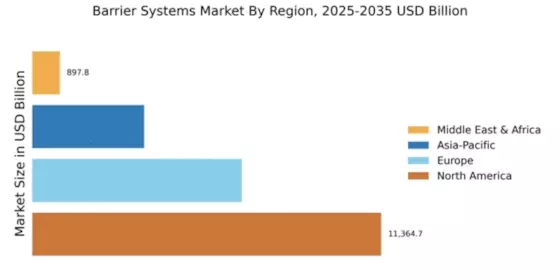
North America is poised to maintain its leadership in the Barrier Systems Market, holding a significant market share of $11,364.7 million in 2024. The region's growth is driven by increasing infrastructure investments, stringent safety regulations, and a rising demand for advanced barrier technologies. Government initiatives aimed at enhancing public safety and environmental sustainability further catalyze market expansion. The competitive landscape is characterized by key players such as Aegion Corporation, Caterpillar Inc., and Jacobs Engineering Group, which are actively innovating to meet the evolving needs of the market. The U.S. stands out as the leading country, supported by robust construction activities and a focus on smart city developments. This dynamic environment fosters collaboration among industry stakeholders, ensuring a steady flow of innovative solutions.

Europe : Growing Demand for Safety Solutions

Europe's Barrier Systems Market is experiencing robust growth, with a market size of $6,821.0 million projected for 2025. The region's expansion is fueled by increasing regulatory requirements for safety in construction and transportation sectors. Initiatives aimed at reducing accidents and enhancing public safety are driving demand for advanced barrier systems. Furthermore, the European Union's commitment to sustainable infrastructure development is a significant catalyst for market growth. Leading countries such as Germany, France, and the UK are at the forefront of this market, with companies like Balfour Beatty and Vinci SA playing pivotal roles. The competitive landscape is marked by innovation and collaboration among key players, ensuring the development of cutting-edge solutions tailored to meet regulatory standards. "The European market is increasingly prioritizing safety and sustainability in infrastructure projects," states a recent EU report.

Asia-Pacific : Emerging Market with High Potential

The Asia-Pacific region is emerging as a significant player in the Barrier Systems Market, with a projected market size of $3,645.0 million by 2025. The growth is driven by rapid urbanization, increasing infrastructure investments, and a rising focus on safety regulations. Countries like China and India are leading this trend, with substantial government spending on transportation and public safety initiatives. The demand for innovative barrier solutions is expected to surge as urban areas expand. China is the dominant market within the region, supported by its vast construction projects and infrastructure development plans. Key players such as Tensar International Limited are actively participating in this growth, focusing on providing advanced barrier technologies. The competitive landscape is evolving, with local and international firms vying for market share, ensuring a dynamic and innovative environment.

Middle East and Africa : Untapped Market Opportunities

The Middle East and Africa region presents untapped opportunities in the Barrier Systems Market, with a market size of $898.7 million anticipated by 2025. The growth is primarily driven by increasing investments in infrastructure development and a growing emphasis on safety regulations. Governments are prioritizing the enhancement of public safety measures, which is expected to boost demand for barrier systems across various sectors. Countries like the UAE and South Africa are leading the charge, with significant projects aimed at improving transportation safety and urban infrastructure. The competitive landscape includes key players such as Gerdau S.A. and Skanska AB, who are focusing on expanding their presence in this emerging market. The region's unique challenges and opportunities create a dynamic environment for innovation and growth.

Key Players and Competitive Insights

The Barrier Systems Market is currently characterized by a dynamic competitive landscape, driven by increasing infrastructure investments and a growing emphasis on safety and environmental sustainability. Key players such as Aegion Corporation (US), Balfour Beatty (GB), and Jacobs Engineering Group (US) are strategically positioning themselves through innovation and regional expansion. Aegion Corporation (US) focuses on advanced technologies for corrosion protection and rehabilitation, while Balfour Beatty (GB) emphasizes sustainable construction practices. Jacobs Engineering Group (US) is leveraging digital transformation to enhance project delivery and operational efficiency. Collectively, these strategies contribute to a competitive environment that prioritizes technological advancement and sustainability.

In terms of business tactics, companies are increasingly localizing manufacturing to reduce lead times and optimize supply chains. The market structure appears moderately fragmented, with several key players exerting influence over various segments. This fragmentation allows for niche players to thrive, while larger firms consolidate their market share through strategic partnerships and acquisitions.

In November 2025, Aegion Corporation (US) announced a partnership with a leading technology firm to develop smart barrier systems that integrate IoT capabilities. This strategic move is likely to enhance their product offerings, allowing for real-time monitoring and maintenance, which could significantly improve safety and operational efficiency in infrastructure projects.

In October 2025, Balfour Beatty (GB) launched a new initiative aimed at reducing carbon emissions in their construction processes by 30% by 2030. This initiative underscores their commitment to sustainability and positions them favorably in a market increasingly driven by environmental considerations. Such actions may not only enhance their brand reputation but also attract clients who prioritize eco-friendly practices.

In September 2025, Jacobs Engineering Group (US) expanded its operations in Asia by acquiring a local firm specializing in barrier systems. This acquisition is indicative of their strategy to penetrate emerging markets and diversify their service offerings. By integrating local expertise, Jacobs is likely to enhance its competitive edge in the region, aligning with global trends towards localized solutions.

As of December 2025, the competitive trends in the Barrier Systems Market are increasingly defined by digitalization, sustainability, and the integration of AI technologies. Strategic alliances are becoming more prevalent, as companies seek to leverage complementary strengths to enhance their market positions. The shift from price-based competition to a focus on innovation, technology, and supply chain reliability is evident, suggesting that future competitive differentiation will hinge on the ability to adapt to these evolving trends.

Key Companies in the Barrier Systems Market market include

Industry Developments

  • Q2 2024: Valtir LLC wins $30 million contract for highway safety barrier installation in Texas Valtir LLC secured a $30 million contract from the Texas Department of Transportation to supply and install advanced crash barrier systems along major highways, aiming to enhance roadway safety and reduce accident fatalities.
  • Q1 2024: Lindsay Corporation launches new Road Zipper movable barrier system for urban traffic management Lindsay Corporation announced the launch of its latest Road Zipper movable barrier system, designed to improve traffic flow and safety in congested urban areas, with initial deployments planned in several U.S. cities.
  • Q2 2024: Bekaert acquires majority stake in Italian road safety barrier manufacturer Bekaert expanded its European footprint by acquiring a majority stake in an Italian company specializing in road safety barriers, strengthening its position in the continental infrastructure market.
  • Q3 2024: Valmont Industries opens new manufacturing facility for crash barriers in Poland Valmont Industries inaugurated a new production facility in Poland dedicated to manufacturing crash barriers for European road and rail projects, increasing its capacity to meet rising regional demand.
  • Q1 2025: Tata Steel signs partnership with Indian government for smart highway barrier deployment Tata Steel entered a strategic partnership with the Indian Ministry of Road Transport to deploy smart, sensor-enabled highway barriers across major national routes, aiming to improve accident detection and response times.
  • Q2 2025: Bekaert unveils new eco-friendly steel barrier product line for European markets Bekaert launched a new line of eco-friendly steel barriers designed to meet stringent European sustainability standards, targeting infrastructure projects with a focus on reducing environmental impact.
  • Q2 2024: Valtir LLC appoints new CEO to drive innovation in barrier systems Valtir LLC announced the appointment of a new Chief Executive Officer, tasked with accelerating product innovation and expanding the company's market share in the global barrier systems sector.
  • Q3 2024: Lindsay Corporation secures contract for barrier systems in Australian rail infrastructure project Lindsay Corporation won a contract to supply and install barrier systems for a major rail infrastructure upgrade in Australia, marking its entry into the country's transportation safety market.
  • Q4 2024: Valmont Industries completes $100 million acquisition of U.S. crash barrier manufacturer Valmont Industries finalized the acquisition of a leading U.S. crash barrier manufacturer for $100 million, expanding its product portfolio and strengthening its position in the North American market.
  • Q1 2025: Tata Steel launches AI-powered traffic barrier monitoring system Tata Steel introduced an AI-powered monitoring system for its traffic barriers, enabling real-time data collection and predictive maintenance to improve safety and operational efficiency.
  • Q2 2025: Valtir LLC partners with European distributor for expansion into new markets Valtir LLC formed a partnership with a major European distributor to expand its reach into new markets, focusing on the deployment of advanced crash barrier technologies across the continent.
  • Q3 2025: Lindsay Corporation raises $75 million in new funding to accelerate barrier system R&D Lindsay Corporation secured $75 million in new funding to support research and development of next-generation barrier systems, with a focus on smart and sustainable infrastructure solutions.

Future Outlook

Barrier Systems Market Future Outlook

The Barrier Systems Market is projected to grow at a 3.5% CAGR from 2024 to 2035, driven by increasing infrastructure investments, safety regulations, and technological advancements.

New opportunities lie in:

  • Integration of smart technology in barrier systems
  • Expansion into emerging markets with tailored solutions
  • Development of eco-friendly barrier materials for sustainability

By 2035, the Barrier Systems Market is expected to achieve robust growth, reflecting evolving safety and infrastructure needs.

Market Segmentation

Barrier Systems Market End Use Outlook

  • Transportation
  • Construction
  • Manufacturing
  • Public Events

Barrier Systems Market Technology Outlook

  • Smart Barrier Systems
  • Traditional Barrier Systems
  • Modular Barrier Systems

Barrier Systems Market Application Outlook

  • Traffic Management
  • Construction Safety
  • Industrial Safety
  • Event Management

Barrier Systems Market Barrier Type Outlook

  • Temporary Barrier
  • Permanent Barrier
  • Retractable Barrier
  • Fencing

Barrier Systems Market Material Type Outlook

  • Plastic
  • Metal
  • Concrete
  • Wood

Report Scope

MARKET SIZE 202422729.4(USD Billion)
MARKET SIZE 202523524.93(USD Billion)
MARKET SIZE 203533184.24(USD Billion)
COMPOUND ANNUAL GROWTH RATE (CAGR)3.5% (2024 - 2035)
REPORT COVERAGERevenue Forecast, Competitive Landscape, Growth Factors, and Trends
BASE YEAR2024
Market Forecast Period2025 - 2035
Historical Data2019 - 2024
Market Forecast UnitsUSD Billion
Key Companies ProfiledAegion Corporation (US), Balfour Beatty (GB), Caterpillar Inc. (US), Gerdau S.A. (BR), Jacobs Engineering Group (US), Kiewit Corporation (US), Skanska AB (SE), Tensar International Limited (GB), Vinci SA (FR)
Segments CoveredApplication, End Use, Material Type, Barrier Type, Technology
Key Market OpportunitiesIntegration of smart technologies in Barrier Systems Market enhances safety and operational efficiency.
Key Market DynamicsRising demand for advanced safety features drives innovation and competition in the Barrier Systems Market.
Countries CoveredNorth America, Europe, APAC, South America, MEA

Market Highlights

Author
Snehal Singh
Assistant Manager - Research

High acumen in analyzing complex macro & micro markets with more than 6 years of work experience in the field of market research. By implementing her analytical skills in forecasting and estimation into market research reports, she has expertise in Packaging, Construction, and Equipment domains. She handles a team size of 20-25 resources and ensures smooth running of the projects, associated marketing activities, and client servicing.

Leave a Comment

FAQs

What was the market size of the Barrier Systems Market in 2024?

The Barrier Systems Market was valued at 7.16 USD Billion in 2024.

What is the expected CAGR for the Barrier Systems Market from 2025 to 2035?

Barrier Systems Market is expected to grow with a CAGR of 3.5% in the period 2025-2035

Which region held the largest market share in 2024?

North America dominated the market with a valuation of 2.5 USD Billion in 2024.

What will be the market size for Road Safety application by 2035?

The Road Safety segment is projected to be valued at 4.3 USD Billion by 2035.

What was the market size of the Construction Safety application in 2024?

The Construction Safety application was valued at 1.8 USD Billion in 2024.

Who are the key players in the Barrier Systems Market?

Major players in the market include companies like Zhejiang Shougang Long March Tyre and Louis Berger.

What was the market size for Traffic Management application in 2024?

The Traffic Management application was valued at 2.2 USD Billion in 2024.

What is the expected market size of the Asia Pacific region by 2035?

The Asia Pacific region is projected to reach a market size of 3.2 USD Billion by 2035.

What is the projected market size for Event Management application by 2035?

The Event Management application is expected to be valued at 1.1 USD Billion by 2035.

Download Free Sample

Kindly complete the form below to receive a free sample of this Report

Compare Licence

×
Features License Type
Single User Multiuser License Enterprise User
Price $4,950 $5,950 $7,250
Maximum User Access Limit 1 User Upto 10 Users Unrestricted Access Throughout the Organization
Free Customization
Direct Access to Analyst
Deliverable Format
Platform Access
Discount on Next Purchase 10% 15% 15%
Printable Versions