×
Request Free Sample ×

Kindly complete the form below to receive a free sample of this Report

* Please use a valid business email

Leading companies partner with us for data-driven Insights

clients tt-cursor
Hero Background

Bearing Market

ID: MRFR/Equip/1622-HCR
185 Pages
Tejas Chaudhary
October 2025

Bearing Market Research Report Information By Product Type (Plain Bearing, Ball Bearing, Roller Bearing, and Others), Application (Automotive, Electronics, Aerospace & Defense, Construction, and Others), And By Region (North America, Europe, Asia-Pacific, And Rest Of The World) – Market Forecast Till 2035

Share:
Download PDF ×

We do not share your information with anyone. However, we may send you emails based on your report interest from time to time. You may contact us at any time to opt-out.

Bearing Market Infographic
Purchase Options

Bearing Market Summary

As per Market Research Future analysis, the Global Bearing Market Size was estimated at 199200.4 USD Million in 2024. The Bearing industry is projected to grow from 216172.76 USD Million in 2025 to 489675.64 USD Million by 2035, exhibiting a compound annual growth rate (CAGR) of 8.52% during the forecast period 2025 - 2035.

Key Market Trends & Highlights

The Bearing Market is experiencing robust growth driven by technological advancements and increasing demand across various sectors.

  • Technological advancements are enhancing the performance and efficiency of bearings, particularly in the automotive sector.
  • Customization and specialization are becoming increasingly important as manufacturers seek to meet specific client needs in the industrial machinery segment.
  • Sustainability initiatives are gaining traction, with companies focusing on eco-friendly materials and processes in the manufacturing sector.
  • The rising demand in the automotive sector and industrial automation are key drivers propelling market growth, particularly in North America and the Asia-Pacific region.

Market Size & Forecast

2024 Market Size 199200.4 (USD Million)
2035 Market Size 489675.64 (USD Million)
CAGR (2025 - 2035) 8.52%

Major Players

SKF (SE), NSK (JP), FAG (DE), NTN (JP), Timken (US), JTEKT (JP), Schaeffler (DE), C&U (CN), ZKL (CZ)

Bearing Market Trends

The Bearing industry is currently experiencing a dynamic evolution, driven by various factors that influence demand and supply. Technological advancements play a pivotal role, as innovations in materials and manufacturing processes enhance the performance and durability of bearings. This evolution is further propelled by the increasing automation across industries, which necessitates high-quality bearings for efficient machinery operation. Additionally, the growing emphasis on sustainability and energy efficiency is prompting manufacturers to develop eco-friendly bearing solutions, aligning with global environmental goals. As industries continue to modernize, the Bearing Market is poised for substantial growth, reflecting the changing landscape of manufacturing and engineering. Moreover, the market landscape is characterized by a shift towards customization and specialized products. Companies are increasingly focusing on meeting specific customer requirements, leading to the development of tailored bearing solutions. This trend indicates a move away from one-size-fits-all products, as businesses seek to optimize performance in their unique applications. Furthermore, the rise of electric vehicles and renewable energy technologies is likely to create new opportunities within the Bearing Market, as these sectors demand innovative bearing designs that can withstand unique operational challenges. Overall, the Bearing Market appears to be on a trajectory of transformation, driven by technological progress and evolving consumer needs.

Technological Advancements

The Bearing Market is witnessing rapid technological advancements that enhance product performance. Innovations in materials and manufacturing techniques are leading to bearings that offer improved durability and efficiency. This trend is crucial as industries increasingly rely on high-performance components to optimize machinery operations.

Customization and Specialization

There is a noticeable shift towards customization within the Bearing Market. Bearing manufacturers are focusing on developing specialized products tailored to meet specific customer needs. This trend reflects a broader industry movement away from generic solutions, emphasizing the importance of performance optimization in diverse applications.

Sustainability Initiatives

Sustainability is becoming a central theme in the Bearing. Manufacturers are increasingly prioritizing eco-friendly materials and processes to align with global environmental standards. This trend not only addresses regulatory pressures but also caters to a growing consumer demand for sustainable products.

Bearing Market Drivers

Expansion of Emerging Markets

Emerging markets are becoming increasingly influential in the Bearing Industry. Rapid industrialization and urbanization in regions such as Asia-Pacific and Latin America are driving the demand for bearings across various sectors, including automotive, aerospace, and manufacturing. As these economies continue to grow, the need for infrastructure development and transportation solutions is expected to rise, further fueling the magnet bearing. Companies are strategically positioning themselves to capitalize on these opportunities by establishing manufacturing facilities and distribution networks in these regions, thereby enhancing their market presence and catering to local demands.

Market Trends and Projections

The Bearing Industry is projected to experience substantial growth over the next decade. With a market value of 199.2 USD Billion in 2024, it is anticipated to reach 488.8 USD Billion by 2035, reflecting a compound annual growth rate of 8.5% from 2025 to 2035. This growth trajectory indicates a robust demand across various sectors, driven by technological advancements, increasing industrial automation, and the expansion of emerging markets. The market dynamics suggest a favorable environment for manufacturers and suppliers of automotive bearings, as they adapt to evolving customer needs and invest in innovative bearing solutions.

Increasing Industrial Automation

The trend towards industrial automation is a critical driver of the Bearing Market. As manufacturers seek to enhance productivity and reduce operational costs, the integration of automated systems becomes essential. Bearings play a vital role in the smooth operation of machinery and equipment used in automated processes. The increasing adoption of robotics and automated guided vehicles in various industries, including manufacturing and logistics, is likely to propel the demand for high-performance bearings. This shift towards automation not only boosts efficiency but also necessitates the development of advanced bearing technologies that can withstand the rigors of continuous operation.

Growth in Renewable Energy Sector

The Bearing Industry is poised to benefit from the expanding renewable energy sector. As countries worldwide invest in wind and solar energy, the demand for specialized bearings that can operate efficiently in harsh environments is increasing. Steel Wind Tower, for instance, require robust bearings to ensure longevity and reliability. This sector's growth is likely to contribute significantly to the market's expansion, as renewable energy installations continue to proliferate. The emphasis on sustainability and reducing carbon footprints further drives the demand for efficient bearing solutions, aligning with global efforts to transition towards cleaner energy sources.

Rising Demand in Automotive Sector

The Bearing Market experiences a notable surge in demand driven by the automotive sector. As electric vehicles gain traction, the need for high-performance bearings that can withstand increased loads and temperatures becomes paramount. In 2024, the market is valued at 199.2 USD Billion, with projections indicating a growth trajectory that could see it reach 488.8 USD Billion by 2035. This growth is underpinned by a compound annual growth rate of 8.5% from 2025 to 2035. Manufacturers are increasingly focusing on developing specialized bearings that enhance efficiency and reduce friction, thereby supporting the automotive industry's transition towards sustainability.

Technological Advancements in Manufacturing

Technological innovations in manufacturing processes significantly influence the Bearing Market. Advanced techniques such as additive manufacturing and precision machining allow for the production of bearings with enhanced performance characteristics. These advancements not only improve the durability and reliability of bearings but also enable customization to meet specific application requirements. As industries increasingly adopt automation and smart manufacturing practices, the demand for high-quality bearings is expected to rise. This trend aligns with the overall market growth, as manufacturers strive to meet the evolving needs of various sectors, including aerospace, construction, and energy.
Market Segment Insights

By Application: Automotive (Largest) vs. Industrial Machinery (Fastest-Growing)

The Bearing is significantly driven by the Automotive application, which commands a substantial market share due to the increasing demand for high-performance vehicles. This segment's dominance is attributed to the ongoing advancements in automotive technologies and the growing emphasis on fuel efficiency and durability. On the other hand, the Industrial Machinery segment is witnessing rapid growth, fueled by the expansion of manufacturing activities and the increasing need for precision engineering in various industries. This dynamic is reflective of a shifting trend towards automation and enhanced productivity in industrial applications.

Automotive: Largest vs. Industrial Machinery: Fastest-Growing

The Automotive segment is characterized by its extensive use of bearings in various vehicle types, including passenger cars, trucks, and electric vehicles. This segment remains the largest due to its requirements for reliability and performance, driving innovation in bearing designs and materials. Meanwhile, the Industrial Machinery segment is emerging as the fastest-growing area, spurred by advancements in technology, increased industrialization, and a focus on reducing downtime through improved bearing solutions. Both segments demand high-quality, durable products that can withstand heavy loads and high-speed operations, leading to continuous innovation within the bearing.

By End Use: Manufacturing (Largest) vs. Transportation (Fastest-Growing)

The bearing market demonstrates a diverse distribution across various end-use segments, with manufacturing holding the largest share due to its extensive application in machines and equipment for industries such as automotive and aerospace. Following closely is the transportation sector, which has seen significant uptake in industrial bearings due to the rise in electric vehicle production and advancements in automotive technologies, thereby driving demand even further.

Manufacturing: Dominant vs. Transportation: Emerging

In the bearing, the manufacturing sector stands as a dominant force, primarily utilizing bearings in machinery and equipment that require reliable performance and durability. This sector benefits from continuous advancements in manufacturing processes and the need for more efficient machinery. Conversely, the transportation sector emerges as a faster-growing segment, propelled by technological innovations such as electric and autonomous vehicles. This growth is characterized by a shift towards lightweight materials and energy-efficient designs, leading to increased demand for high-performance bearings that enhance vehicle efficiency and longevity.

By Type: Ball Bearing (Largest) vs. Roller Bearing (Fastest-Growing)

In the Bearing Market, Ball Bearings currently hold the largest market share due to their versatility and widespread application across various industries, such as automotive and manufacturing. Roller Bearings are quickly gaining traction, especially in high-load and high-speed applications, leading to their position as the fastest-growing segment in the market. The successful adoption of these bearing types is driven by the increasing demand for efficient machinery and equipment, pushing manufacturers to innovate and enhance bearing performance. The growth of Roller Bearings can be attributed to their capability to handle heavy loads while maintaining efficiency, which is crucial in sectors like aerospace and construction. Furthermore, advancements in material technology and design are allowing for greater durability and reduced friction, thus appealing to users seeking to optimize performance and reduce energy consumption. As industries evolve, the demand dynamics are shifting, making Roller Bearings an essential focus for manufacturers aiming to cater to future market needs.

Ball Bearing (Dominant) vs. Magnetic Bearing (Emerging)

Ball Bearings, known for their ability to accommodate both radial and axial loads, are dominant in the Bearing Market due to their extensive application and reliability. They are commonly utilized in electric motors, household appliances, and industrial machines. With advancements in manufacturing technology, Ball Bearings have maintained a competitive edge by providing durability and efficiency. Conversely, Magnetic Bearings represent an emerging technology, utilizing magnetic fields to support moving parts without contact, minimizing wear and tear. This innovative approach makes them ideal for high-speed applications and environments requiring minimal maintenance. As industries increasingly focus on eco-friendly solutions and efficiency, the acceptance of Magnetic Bearings is likely to rise, driven by their potential to reduce operational costs and increase energy efficiency.

By Material: Steel (Largest) vs. Ceramic (Fastest-Growing)

In the Bearing, the material segment is characterized by a diverse portfolio, with steel emerging as the largest contender, dominating the market share due to its extensive use in traditional bearing applications. Its strength, durability, and cost-effectiveness provide it with a competitive edge. In contrast, ceramic bearings are gaining momentum, driven by their lightweight properties and resistance to wear, heat, and corrosion, marking them as a notable player in the segment.

Steel (Dominant) vs. Ceramic (Emerging)

Steel bearings have long been the backbone of the bearing market, known for their resilience and cost-effectiveness. Their robust characteristics make them suitable for a wide range of applications, from automotive to industrial machinery. On the other hand, ceramic bearings represent the emerging trend in the segment. They are lighter and possess superior thermal properties, making them ideal for high-speed and high-temperature applications. As industries increasingly adopt advanced materials to enhance performance and efficiency, ceramic bearings are witnessing rapid growth, appealing especially to sectors focused on innovation and reduced weight.

By Design: Single Row (Largest) vs. Double Row (Fastest-Growing)

In the bearing, the design segment is crucial for differentiating the various products available. Single Row bearings hold the largest market share, widely used in various applications due to their simplicity and effectiveness. On the other hand, Double Row bearings are gaining traction as they offer increased load capacity and stability, making them a preferred choice in certain industrial applications, highlighting their emergence in the market.

Bearings: Single Row (Dominant) vs. Double Row (Emerging)

Single Row bearings are renowned for their versatile applications and reliability, making them the go-to choice for many industries. Their dominant presence in the market is backed by their straightforward design, which allows easy installation and maintenance. In contrast, Double Row bearings are experiencing rapid growth as they cater to higher load demands and offer superior stiffness. Their design facilitates better alignment and reduced axial play, making them ideal for dynamic axial loads. As industries evolve and demand precision and durability, Double Row bearings are poised to become a key player in the market.

Get more detailed insights about Bearing Market

Regional Insights

North America : Established Market with Growth Potential

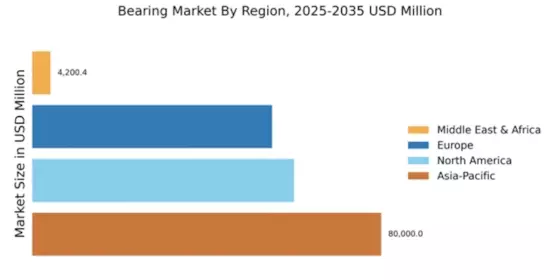
The North American bearing market, valued at $45,000.0 million, is driven by robust industrial activities and technological advancements. The demand for high-performance bearings in sectors like automotive and aerospace is increasing, supported by regulatory frameworks promoting innovation and sustainability. The region's focus on automation and smart manufacturing is expected to further boost market growth, making it a key player in the global landscape. Leading countries such as the US and Canada dominate the market, with major players like Timken and SKF establishing a strong presence. The competitive landscape is characterized by continuous innovation and strategic partnerships among key manufacturers. The emphasis on quality and reliability in bearing solutions is shaping the market dynamics, ensuring that North America remains a vital hub for bearing production and distribution.

Europe : Innovation and Sustainability Focus

Europe's bearing market, valued at $35,000.0 million, is characterized by a strong emphasis on innovation and sustainability. The region is witnessing a shift towards eco-friendly manufacturing processes and materials, driven by stringent regulations aimed at reducing environmental impact. This focus is expected to enhance market growth, as industries increasingly adopt advanced bearing technologies to improve efficiency and reduce emissions. Germany, France, and the UK are leading countries in this market, with key players like FAG and Schaeffler driving competitive dynamics. The presence of a well-established manufacturing base and a skilled workforce further strengthens the region's position. As Europe continues to invest in research and development, the bearing market is poised for significant advancements, ensuring its relevance in the global arena. "The European Union is committed to fostering innovation in manufacturing to achieve sustainability goals."

Asia-Pacific : Emerging Powerhouse in Bearings

The Asia-Pacific bearing market, leading with a valuation of $80,000.0 million, is driven by rapid industrialization and urbanization. Countries like China and Japan are at the forefront, with increasing demand for bearings in automotive, machinery, and electronics sectors. The region's growth is further supported by government initiatives aimed at enhancing manufacturing capabilities and attracting foreign investments, making it a critical player in the global market. China, Japan, and India are the leading countries, with major manufacturers such as NSK and NTN dominating the landscape. The competitive environment is marked by aggressive pricing strategies and a focus on technological advancements. As the region continues to expand its manufacturing base, the bearing market is expected to flourish, catering to both domestic and international demands.

Middle East and Africa : Resource-Rich Frontier for Bearings

The Middle East and Africa bearing market, valued at $39,200.4 million, is emerging as a resource-rich frontier with significant growth potential. The region is witnessing increased investments in infrastructure and industrial projects, driving demand for high-quality bearings. Regulatory support for manufacturing and trade is enhancing market dynamics, making it an attractive destination for global players looking to expand their footprint. Countries like South Africa and the UAE are leading the market, with a growing presence of key players such as C&U and ZKL. The competitive landscape is evolving, with local manufacturers gaining traction alongside established global brands. As the region continues to develop its industrial capabilities, the bearing market is set to experience substantial growth, driven by both local and international demand. "The Middle East is positioning itself as a hub for manufacturing and trade in the region."

Key Players and Competitive Insights

The Bearing is currently characterized by a dynamic competitive landscape, driven by technological advancements and increasing demand across various sectors, including automotive, aerospace, and industrial machinery. Key players such as SKF (SE), NSK (JP), and Timken (US) are strategically positioned to leverage innovation and operational efficiency. SKF (SE) focuses on digital transformation and sustainability, aiming to enhance product performance and reduce environmental impact. Meanwhile, NSK (JP) emphasizes regional expansion and partnerships to strengthen its market presence, particularly in Asia. Timken (US) is actively pursuing mergers and acquisitions to diversify its product offerings and enhance its competitive edge, collectively shaping a landscape that is increasingly focused on innovation and customer-centric solutions.

In terms of business tactics, companies are localizing manufacturing and optimizing supply chains to respond swiftly to market demands. The competitive structure of the Bearing Market appears moderately fragmented, with several key players exerting substantial influence. This fragmentation allows for a variety of strategies to coexist, fostering an environment where innovation and operational excellence are paramount.

In November 2025, NSK (JP) announced a strategic partnership with a leading electric vehicle manufacturer to develop specialized bearings tailored for electric drivetrains. This collaboration is significant as it positions NSK at the forefront of the burgeoning electric vehicle market, potentially enhancing its revenue streams and market share in a rapidly evolving sector. The partnership underscores NSK's commitment to innovation and responsiveness to emerging trends.

In October 2025, Timken (US) completed the acquisition of a European bearing manufacturer, which is expected to bolster its presence in the European market. This acquisition is strategically important as it not only expands Timken's product portfolio but also enhances its manufacturing capabilities, allowing for greater efficiency and responsiveness to customer needs. Such moves indicate a trend towards consolidation in the market, as companies seek to strengthen their competitive positions through strategic acquisitions.

In December 2025, SKF (SE) launched a new line of smart bearings equipped with IoT technology, aimed at improving predictive maintenance capabilities for industrial applications. This innovation reflects a broader trend towards digitalization within the industry, as companies increasingly integrate advanced technologies to enhance product performance and customer service. The introduction of smart bearings is likely to set SKF apart from competitors, emphasizing the importance of technology in driving competitive differentiation.

As of December 2025, the Bearing Market is witnessing a shift towards digitalization, sustainability, and AI integration, which are defining current competitive trends. Strategic alliances are becoming increasingly prevalent, as companies recognize the value of collaboration in navigating complex market dynamics. Looking ahead, competitive differentiation is expected to evolve, with a pronounced shift from price-based competition to a focus on innovation, technology, and supply chain reliability. This evolution suggests that companies that prioritize these aspects will likely emerge as leaders in the market.

Key Companies in the Bearing Market market include

Industry Developments

  • Q3 2025: Schaeffler Leads Tech Innovation with New Bearing Market Solutions Schaeffler hosted a product launch event in Nanjing, China, unveiling multiple innovative bearing products including high-performance C-series deep groove ball bearings, insulated bearings, and high-load cylindrical roller bearings for wind turbines, targeting enhanced reliability and efficiency for industrial applications.
  • Q3 2025: SKF Launches Explosion-Proof RecondOil Oil Recycler and High-Speed Seals for Robot Reducers SKF introduced an explosion-proof RecondOil oil recycler and high-speed seals for robot reducers, emphasizing sustainable solutions and precision engineering for industrial and robotics sectors.

Future Outlook

Bearing Market Future Outlook

The Bearing industry is projected to grow at an 8.52% CAGR from 2024 to 2035, driven by advancements in manufacturing technologies, increasing demand in automotive sectors, and rising industrial automation.

New opportunities lie in:

  • Development of smart bearings with IoT integration for predictive maintenance.
  • Expansion into renewable energy sectors, particularly wind turbine applications.
  • Investment in sustainable materials for bearing production to meet environmental regulations.

By 2035, the Market is expected to achieve substantial growth, driven by innovation and diversification.

Market Segmentation

Bearing Market Type Outlook

  • Ball Bearing
  • Roller Bearing
  • Magnetic Bearing
  • Fluid Bearing
  • Composite Bearing

Bearing Market Design Outlook

  • Single Row
  • Double Row
  • Self-Aligning
  • Thrust
  • Angular Contact

Bearing Market End Use Outlook

  • Manufacturing
  • Construction
  • Energy
  • Transportation
  • Agriculture

Bearing Market Material Outlook

  • Steel
  • Ceramic
  • Plastic
  • Bronze
  • Composite

Bearing Market Application Outlook

  • Automotive
  • Industrial Machinery
  • Aerospace
  • Railway
  • Marine

Report Scope

MARKET SIZE 2024 199200.4(USD Million)
MARKET SIZE 2025 216172.76(USD Million)
MARKET SIZE 2035 489675.64(USD Million)
COMPOUND ANNUAL GROWTH RATE (CAGR) 8.52% (2024 - 2035)
REPORT COVERAGE Revenue Forecast, Competitive Landscape, Growth Factors, and Trends
BASE YEAR 2024
Market Forecast Period 2025 - 2035
Historical Data 2019 - 2024
Market Forecast Units USD Million
Key Companies Profiled SKF (SE), NSK (JP), FAG (DE), NTN (JP), Timken (US), JTEKT (JP), Schaeffler (DE), C&U (CN), ZKL (CZ)
Segments Covered Application, End Use, Type, Material, Design
Key Market Opportunities Integration of smart technologies in the Bearing Market enhances performance and predictive maintenance capabilities.
Key Market Dynamics Technological advancements and sustainability initiatives drive innovation and competition in the bearing market.
Countries Covered North America, Europe, APAC, South America, MEA

Market Highlights

Author
Tejas Chaudhary
Research Analyst Level II

I have a degree in Engineering (Civil), with masters in Business Administration (Marketing). With more than 4 years of experience in market research and consulting, I am involved in end-to-end process of market research, proposals, project kickoffs and delivery. I have research knowledge and expertise in consumer goods/packaging domain. Also I have worked for various other domains like construction & equipment. Effectively managed and delivered more than 60 report studies for regional as well as global clientele.

Leave a Comment

FAQs

How much is the Bearing market?

The Bearing Market size was valued at USD 1,82,840.1 millionin 2023.

What is the growth rate of the Bearing market?

The global market is projected to grow at a CAGR of 8.5% during the forecast period, 2024-2032.

Which Region held the largest market share in the Bearing market?

Asia Pacific had the largest share of the global market

Who are the key players in the Bearing market?

The key players in the market areSvenska Kullagerfabriken AB (Sweden), NTN Corporation (Japan), Schaeffler Group (Germany), NSK Ltd. (Japan), The Timken Company (US), JTEKT Corporation (Japan), Robert Bosch GmbH (Japan), The Danaher Corporation (US), GKN plc. (UK), and Minebea Mitsumi, Inc. (Japan)

Which type led the Bearing market?

The roller Bearing category dominated the market in 2021.

Which application had the largest market share in the Bearing market?

The automobile had the largest share of the global market.

Download Free Sample

Kindly complete the form below to receive a free sample of this Report

Compare Licence

×
Features License Type
Single User Multiuser License Enterprise User
Price $4,950 $5,950 $7,250
Maximum User Access Limit 1 User Upto 10 Users Unrestricted Access Throughout the Organization
Free Customization
Direct Access to Analyst
Deliverable Format
Platform Access
Discount on Next Purchase 10% 15% 15%
Printable Versions