Download Free Sample
Kindly complete the form below to receive a free sample of this Report
Big Data in Healthcare Manufacturing Market Research Report By Type of Healthcare Data (Structured Data, Unstructured Data, Semi-Structured Data), By Application (Disease Diagnosis, Drug Discovery, Clinical Trials, Patient Management), By Deployment Model (On-Premise, Cloud-Based, Hybrid), By End-User (Pharmaceutical Companies, Medical Device Manufacturers, Healthcare Providers, Insurance Companies) and By Regional (North America, Europe, South America, Asia Pacific, Middle East and Africa) - Growth & Industry Forecast 2025 To 2035
As per Market Research Future analysis, the Big Data in Healthcare Manufacturing Market was estimated at 29.49 USD Billion in 2024. The Big Data in Healthcare Manufacturing industry is projected to grow from 33.6 USD Billion in 2025 to 123.7 USD Billion by 2035, exhibiting a compound annual growth rate (CAGR) of 13.92% during the forecast period 2025 - 2035
The Big Data in Healthcare Manufacturing Market is poised for substantial growth driven by technological advancements and evolving healthcare needs.
| 2024 Market Size | 29.49 (USD Billion) |
| 2035 Market Size | 123.7 (USD Billion) |
| CAGR (2025 - 2035) | 13.92% |
The Big Data in Healthcare Manufacturing Market is currently experiencing a transformative phase, driven by advancements in technology and the increasing need for data-driven decision-making. Organizations within this sector are leveraging vast amounts of data to enhance operational efficiency, improve patient outcomes, and streamline supply chain processes. The integration of big data analytics into manufacturing practices appears to facilitate better resource allocation and predictive maintenance, which may lead to reduced costs and improved product quality. Furthermore, the growing emphasis on personalized medicine and tailored healthcare solutions suggests that data analytics will play a crucial role in shaping future innovations in this field. In addition, regulatory frameworks and compliance requirements are evolving, prompting manufacturers to adopt more sophisticated data management strategies. The focus on data security and patient privacy is paramount, as stakeholders seek to balance innovation with ethical considerations. As the landscape continues to evolve, it seems likely that the Big Data in Healthcare Manufacturing Market will witness increased collaboration among various entities, including technology providers, healthcare institutions, and regulatory bodies. This collaborative approach may foster an environment conducive to innovation and growth, ultimately benefiting patients and healthcare providers alike.
The utilization of predictive analytics is becoming increasingly prevalent within the Big Data in Healthcare Manufacturing Market. By analyzing historical data, organizations can forecast trends and anticipate potential challenges, thereby enabling proactive decision-making. This trend suggests a shift towards more strategic planning and resource management, which may enhance overall operational efficiency.
The integration of Internet of Things (IoT) devices into healthcare manufacturing processes is gaining traction. These devices facilitate real-time data collection and monitoring, which can lead to improved product quality and patient safety. This trend indicates a move towards more interconnected systems that enhance data visibility and operational responsiveness.
As data breaches and privacy concerns become more pronounced, there is a growing emphasis on data security and compliance within the Big Data in Healthcare Manufacturing Market. Organizations are increasingly investing in robust security measures and adhering to regulatory standards to protect sensitive information. This trend highlights the importance of maintaining trust and integrity in data management practices.
The growing focus on operational efficiency is a significant driver in the Big Data in Healthcare Manufacturing Market. Manufacturers are increasingly recognizing the importance of streamlining operations to reduce costs and improve productivity. Big data analytics provides insights into manufacturing processes, enabling companies to identify bottlenecks and optimize resource allocation. This trend is underscored by market data indicating that organizations leveraging big data can achieve operational cost reductions of up to 30%. As manufacturers strive for greater efficiency, the adoption of big data solutions is likely to accelerate, further propelling market growth.
The rising demand for personalized medicine is a pivotal driver in the Big Data in Healthcare Manufacturing Market. As healthcare shifts towards tailored treatments, the need for extensive data analysis becomes paramount. Big data analytics enables manufacturers to process vast amounts of patient data, leading to the development of customized therapies. This trend is reflected in the market, where the personalized medicine segment is projected to grow significantly, with estimates suggesting a compound annual growth rate of over 10% in the coming years. By leveraging big data, manufacturers can enhance their product offerings, ensuring they meet the specific needs of diverse patient populations.
Technological advancements in data analytics are transforming the Big Data in Healthcare Manufacturing Market. Innovations such as machine learning and artificial intelligence are enabling more sophisticated data processing capabilities. These technologies allow manufacturers to analyze complex datasets efficiently, leading to improved decision-making and operational efficiencies. The market for data analytics in healthcare is expected to reach substantial figures, with projections indicating a growth rate of around 20% annually. As manufacturers adopt these advanced analytics tools, they can optimize production processes, reduce costs, and enhance product quality, thereby driving market growth.
Regulatory compliance and quality assurance are critical factors influencing the Big Data in Healthcare Manufacturing Market. Stringent regulations necessitate that manufacturers maintain high standards in product quality and safety. Big data analytics plays a crucial role in ensuring compliance by enabling real-time monitoring and reporting of manufacturing processes. This capability is essential for meeting the requirements set forth by regulatory bodies, which are increasingly focusing on data integrity and traceability. The market is witnessing a shift towards more robust compliance frameworks, with investments in big data solutions expected to rise as manufacturers seek to mitigate risks associated with non-compliance.
The emergence of telehealth and remote monitoring solutions is reshaping the Big Data in Healthcare Manufacturing Market. As healthcare delivery models evolve, there is an increasing reliance on data-driven insights to support remote patient management. Big data analytics facilitates the collection and analysis of patient data from various sources, including wearable devices and telehealth platforms. This trend is reflected in the market, where the telehealth segment is projected to grow at a rapid pace, with estimates suggesting a growth rate exceeding 25%. Manufacturers that harness big data to enhance telehealth solutions are likely to gain a competitive edge in this dynamic landscape.
In the Big Data in Healthcare Manufacturing Market, structured data holds the largest share due to its organized and easily analyzable nature. This data type includes information from electronic health records, lab reports, and billing systems, which facilitate streamlined operations and regulatory compliance. Conversely, unstructured data, comprising clinical notes, images, and other non-standardized data, is on track to become the fastest-growing segment. This surge is fueled by advancements in data processing technologies that can handle complex data forms, allowing healthcare manufacturers to extract valuable insights from previously underutilized information sources.
Data Type: Structured (Dominant) vs. Unstructured (Emerging)
Structured data, being the dominant force in the healthcare data segment, offers an advantage through its quantifiable nature, making it essential for efficient data management and reporting. Healthcare providers utilize structured data to enhance decision-making processes, improve patient outcomes, and ensure compliance with healthcare regulations. In contrast, unstructured data is emerging rapidly, driven by the growing prevalence of digital records and increased use of AI and machine learning technologies. While traditionally harder to analyze, unstructured data presents opportunities for more nuanced insights and personalized patient care, thus reshaping the future landscape of healthcare manufacturing. As such, organizations are prioritizing robust strategies to integrate both forms of data for comprehensive analytics.
The Big Data in Healthcare Manufacturing Market is increasingly segmented into applications, with 'Disease Diagnosis' capturing the largest market share. This application leverages vast datasets to improve accuracy and speed in identifying illnesses, leading to better patient outcomes. Meanwhile, 'Drug Discovery' emerges as a rapidly growing segment as pharmaceutical companies harness big data analytics to streamline the drug development process, enhancing the ability to bring new therapeutics to market swiftly. As the demand for personalized medicine increases, the applications of big data in healthcare expand with it. 'Clinical Trials' and 'Patient Management' also play crucial roles, albeit at a smaller market share. The convergence of artificial intelligence and machine learning within these applications catalyzes growth, paving the way for innovative healthcare solutions and improving patient care efficiency across the board.
Disease Diagnosis (Dominant) vs. Clinical Trials (Emerging)
In the realm of big data within healthcare, 'Disease Diagnosis' stands out as the dominant application, significantly influencing the precision and efficiency of healthcare delivery. This segment utilizes comprehensive data analysis to identify patterns in disease manifestation, thereby enabling early intervention and personalized treatment plans. Conversely, 'Clinical Trials' represent an emerging application where big data analytics are being increasingly adapted to improve the design, execution, and analysis of clinical studies. By employing advanced statistical techniques and real-time data monitoring, clinical trials now yield more robust results, thus expediting the approval process for new therapies and improving patient safety during studies. Both segments are interdependent, with advancements in one often facilitating enhancements in the other.
In the Big Data in Healthcare Manufacturing Market, the deployment model plays a crucial role in shaping the landscape. Currently, the cloud-based deployment model holds the largest market share, driven by its scalability, cost efficiency, and ease of access to various healthcare data analytics tools. On-premise deployments follow, providing organizations with more control over their data management processes, though they are less favored due to higher installation and maintenance costs. Hybrid models are gaining traction as they combine the benefits of both cloud and on-premise setups, appealing to organizations that desire flexibility and security in data handling.
Deployment Model: Cloud-Based (Dominant) vs. Hybrid (Emerging)
Cloud-based solutions in the Big Data in Healthcare Manufacturing Market are deemed dominant due to their widespread adoption and ability to offer on-demand resources for data storage and analysis. This model empowers healthcare providers with unlimited data accessibility and ease of integration with existing systems, facilitating real-time decision-making processes. Conversely, hybrid deployments are emerging as a promising alternative for businesses seeking a balanced approach. They allow organizations to manage sensitive data on-premise while leveraging the cloud for additional storage and computational power. This flexibility caters to varying regulatory requirements and data sensitivities, making hybrid solutions increasingly sought after in the pursuit of optimized healthcare manufacturing operations.
In the Big Data in Healthcare Manufacturing Market, the distribution of market share among end-users highlights the dominance of healthcare providers, who leverage data analytics for operational efficiencies and improved patient outcomes. This segment constitutes a significant portion of the market, driven by the need for enhanced data management in clinical settings. In contrast, pharmaceutical companies are emerging as the fastest-growing sector, fueled by their increasing reliance on data-driven insights for drug development processes and personalized medicine initiatives.
Healthcare Providers (Dominant) vs. Pharmaceutical Companies (Emerging)
Healthcare providers are at the forefront of utilizing big data, employing it to optimize patient care management, streamline operations, and enhance decision-making processes. This segment includes hospitals, clinics, and other healthcare entities that rely on data analytics for real-time insights. Conversely, pharmaceutical companies represent an emerging segment, focusing on big data to accelerate research and development, manage clinical trials, and identify market trends for effective drug delivery. Their growth is propelled by technological advancements and increasing demand for precision medicine, indicating a shift in how pharmaceuticals utilize data to gain competitive advantage.
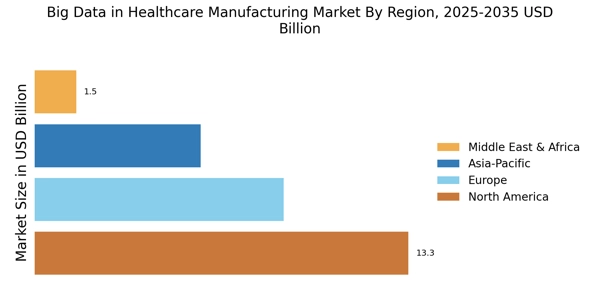
North America leads the Big Data in Healthcare Manufacturing market, holding approximately 45% of the global share. The region's growth is driven by advanced technological infrastructure, increasing healthcare expenditure, and a strong focus on data analytics for improved patient outcomes. Regulatory support, such as HIPAA, fosters a secure environment for data utilization, further propelling market demand. The United States is the largest market, followed by Canada, both showcasing a robust presence of key players like IBM, Oracle, and GE Healthcare. The competitive landscape is characterized by continuous innovation and strategic partnerships among these companies, enhancing their service offerings and market reach. The emphasis on cloud-based solutions and AI integration is also shaping the future of healthcare manufacturing in this region.
Europe is witnessing significant growth in the Big Data in Healthcare Manufacturing market, accounting for around 30% of the global share. The region's expansion is fueled by stringent regulations aimed at data protection, such as GDPR, which encourages healthcare organizations to adopt advanced data analytics solutions. The increasing demand for personalized medicine and efficient healthcare delivery systems further drives market growth. Leading countries in this region include Germany, the UK, and France, where major players like SAP and Siemens are actively investing in innovative technologies. The competitive landscape is marked by collaborations between healthcare providers and technology firms, enhancing the development of data-driven solutions. The focus on interoperability and data sharing is also pivotal in shaping the market dynamics in Europe.
Asia-Pacific is rapidly emerging as a significant player in the Big Data in Healthcare Manufacturing market, holding approximately 20% of the global share. The region's growth is driven by increasing investments in healthcare infrastructure, rising population health needs, and a growing emphasis on digital health solutions. Government initiatives aimed at enhancing healthcare delivery through technology are also pivotal in this growth trajectory. Countries like China, India, and Japan are leading the charge, with a notable presence of key players such as Philips and Cerner. The competitive landscape is characterized by a mix of local and international firms, fostering innovation and tailored solutions for diverse healthcare challenges. The increasing adoption of telemedicine and mobile health applications is further propelling market dynamics in this region.
The Middle East and Africa region is gradually emerging in the Big Data in Healthcare Manufacturing market, accounting for about 5% of the global share. The growth is primarily driven by increasing healthcare investments, a rising focus on improving healthcare quality, and the adoption of digital health technologies. Government initiatives aimed at enhancing healthcare systems are also contributing to market expansion. Leading countries in this region include South Africa, UAE, and Saudi Arabia, where there is a growing presence of both local and international players. The competitive landscape is evolving, with companies exploring partnerships and collaborations to leverage data analytics for better healthcare outcomes. The region's untapped potential presents significant opportunities for growth in the coming years.
The Big Data in Healthcare Manufacturing Market is currently characterized by a dynamic competitive landscape, driven by the increasing demand for data analytics to enhance operational efficiency and patient outcomes. Key players such as IBM (US), Oracle (US), and Siemens (DE) are strategically positioned to leverage their technological expertise and extensive resources. IBM (US) focuses on integrating artificial intelligence with big data analytics to provide predictive insights, while Oracle (US) emphasizes cloud-based solutions that facilitate real-time data processing. Siemens (DE) is investing heavily in digital transformation initiatives, aiming to streamline manufacturing processes and improve supply chain management. Collectively, these strategies not only enhance their competitive edge but also contribute to a more integrated and efficient healthcare manufacturing ecosystem.In terms of business tactics, companies are increasingly localizing manufacturing operations and optimizing supply chains to respond swiftly to market demands. The market structure appears moderately fragmented, with several players vying for dominance. However, the influence of major companies like GE Healthcare (US) and Philips (NL) is substantial, as they continue to innovate and expand their market presence. This competitive interplay fosters an environment where collaboration and strategic partnerships are essential for sustained growth.
In August IBM (US) announced a partnership with a leading healthcare provider to develop a new AI-driven analytics platform aimed at improving patient care through predictive modeling. This strategic move underscores IBM's commitment to enhancing healthcare outcomes by harnessing the power of big data, potentially setting a new standard for patient management systems. The collaboration is expected to yield significant advancements in personalized medicine, thereby reinforcing IBM's position as a leader in healthcare analytics.Similarly, in September 2025, Oracle (US) launched a new suite of cloud-based applications designed specifically for healthcare manufacturers. This initiative is indicative of Oracle's strategy to capitalize on the growing trend of digital transformation within the sector. By providing scalable solutions that enhance data accessibility and interoperability, Oracle aims to streamline operations and reduce costs for healthcare manufacturers, thereby solidifying its competitive stance in the market.
In October Siemens (DE) unveiled a new manufacturing facility equipped with advanced data analytics capabilities in Germany. This facility is expected to enhance Siemens' production efficiency and reduce lead times significantly. The establishment of this facility not only reflects Siemens' commitment to innovation but also highlights the importance of integrating big data into manufacturing processes to meet the evolving needs of the healthcare sector.
As of October the competitive trends in the Big Data in Healthcare Manufacturing Market are increasingly defined by digitalization, sustainability, and the integration of artificial intelligence. Strategic alliances are becoming more prevalent, as companies recognize the need to collaborate to enhance their technological capabilities and market reach. Looking ahead, it is likely that competitive differentiation will shift from traditional price-based strategies to a focus on innovation, technological advancement, and supply chain reliability, thereby reshaping the landscape of the healthcare manufacturing sector.





Key factors driving market growth include increasing adoption of big data analytics for personalized medicine, growing demand for predictive analytics to improve patient outcomes, and rising healthcare costs.
Recent developments in the market include partnerships between healthcare providers and technology companies to develop innovative big data solutions, increasing investments in precision medicine, and the emergence of cloud-based big data platforms. Key players in the market include IBM, Oracle, SAP, Microsoft, and Google.
The Big Data in Healthcare Manufacturing Market is projected to grow at a 13.92% CAGR from 2025 to 2035, driven by technological advancements, regulatory support, and increasing demand for personalized healthcare solutions.
New opportunities lie in:
By 2035, the market is expected to be robust, driven by innovation and strategic investments.
| MARKET SIZE 2024 | 29.49(USD Billion) |
| MARKET SIZE 2025 | 33.6(USD Billion) |
| MARKET SIZE 2035 | 123.7(USD Billion) |
| COMPOUND ANNUAL GROWTH RATE (CAGR) | 13.92% (2025 - 2035) |
| REPORT COVERAGE | Revenue Forecast, Competitive Landscape, Growth Factors, and Trends |
| BASE YEAR | 2024 |
| Market Forecast Period | 2025 - 2035 |
| Historical Data | 2019 - 2024 |
| Market Forecast Units | USD Billion |
| Key Companies Profiled | IBM (US), Oracle (US), SAP (DE), Microsoft (US), Siemens (DE), GE Healthcare (US), Philips (NL), Cerner (US), Medtronic (US) |
| Segments Covered | Type of Healthcare Data, Application, Deployment Model, End-User, Regional |
| Key Market Opportunities | Integration of artificial intelligence for predictive analytics in the Big Data in Healthcare Manufacturing Market. |
| Key Market Dynamics | Rising adoption of advanced analytics in healthcare manufacturing enhances operational efficiency and patient outcomes. |
| Countries Covered | North America, Europe, APAC, South America, MEA |
The projected market valuation is expected to reach 123.7 USD Billion by 2035.
The overall market valuation was 29.49 USD Billion in 2024.
The expected CAGR during the forecast period 2025 - 2035 is 13.92%.
Key players include IBM, Oracle, SAP, Microsoft, Siemens, GE Healthcare, Philips, Cerner, and Medtronic.
The main types of healthcare data segments are structured, unstructured, and semi-structured data.
The market for unstructured data is projected to grow to 52.15 USD Billion by 2035.
Key applications include disease diagnosis, drug discovery, clinical trials, and patient management.
The projected market size for drug discovery is expected to reach 40.0 USD Billion by 2035.
The deployment models include on-premise, cloud-based, and hybrid solutions.
The expected market size for healthcare providers is projected to be 35.0 USD Billion by 2035.


Kindly complete the form below to receive a free sample of this Report

“This is really good guys. Excellent work on a tight deadline. I will continue to use you going forward and recommend you to others. Nice job”


“Thanks. It’s been a pleasure working with you, please use me as reference with any other Intel employees.”


“Thanks for sending the report it gives us a good global view of the Betaïne market.”


“Thank you, this will be very helpful for OQS.”


“We found the report very insightful! we found your research firm very helpful. I'm sending this email to secure our future business.”


“I am very pleased with how market segments have been defined in a relevant way for my purposes (such as "Portable Freezers & refrigerators" and "last-mile"). In general the report is well structured. Thanks very much for your efforts.”


“I have been reading the first document or the study, ,the Global HVAC and FP market report 2021 till 2026. Must say, good info! I have not gone in depth at all parts, but got a good indication of the data inside!”


“We got the report in time, we really thank you for your support in this process. I also thank to all of your team as they did a great job.”


“The Automotive 48V ECU Components Procurement Intelligence Study” was a complex project, but the Market Research Future (MRFR) team handled it with quality, agility, and customer-centricity. They delivered all requested data on time and within the agreed scope. The team, including Shubhendra Anand and Rahul Gotadki, was always readily available to clarify questions and swiftly implement necessary adjustments, driving the project to a successful conclusion within a very demanding timeframe.
I would also like to specifically commend Akshay Agarwal for his responsiveness and support at every stage—from our initial inquiry on May 6th through to final delivery on June 18th. His dedication made the entire process seamless.”



