Download Free Sample
Kindly complete the form below to receive a free sample of this Report
Bio Imaging Technologies Market Research Report By Technology (Confocal Microscopy, Super-Resolution Microscopy, Electron Microscopy, Multiphoton Microscopy), By Application (Cell Biology, Neuroscience, Developmental Biology, Cancer Research), By Sample Type (Live Cells, Fixed Cells, Tissues, Three-Dimensional (3D) Samples), By End User (Academia, Pharmaceutical and Biotechnology, Medical Diagnostics, Industrial) and By Regional (North America, Europe, South America, Asia Pacific, Middle East and Africa) - Growth & Industry Forecast 2025 To 2035
As per Market Research Future analysis, the Bio Imaging Technologies Market Size was estimated at 6.18 USD Billion in 2024. The Bio Imaging Technologies industry is projected to grow from 6.533 USD Billion in 2025 to 11.39 USD Billion by 2035, exhibiting a compound annual growth rate (CAGR) of 5.71% during the forecast period 2025 - 2035
The Bio Imaging Technologies Market is poised for substantial growth driven by technological advancements and increasing demand for personalized medicine.
| 2024 Market Size | 6.18 (USD Billion) |
| 2035 Market Size | 11.39 (USD Billion) |
| CAGR (2025 - 2035) | 5.71% |
Siemens Healthineers (DE), GE Healthcare (US), Philips Healthcare (NL), Canon Medical Systems (JP), Fujifilm Holdings Corporation (JP), Bruker Corporation (US), Agfa-Gevaert Group (BE), Hitachi Medical Corporation (JP), Mindray Medical International Limited (CN), Hologic, Inc. (US)
Our Impact
Enabled $4.3B Revenue Impact for Fortune 500 and Leading Multinationals
Partnering with 2000+ Global Organizations Each Year
30K+ Citations by Top-Tier Firms in the Industry
The Bio Imaging Technologies Market is currently experiencing a dynamic evolution, driven by advancements in imaging modalities and increasing applications across various medical fields. Innovations in technologies such as magnetic resonance imaging, ultrasound, and computed tomography are enhancing diagnostic capabilities, thereby improving patient outcomes. Furthermore, the integration of artificial intelligence and machine learning into imaging processes is streamlining workflows and enabling more accurate interpretations of complex data. This convergence of technology and healthcare is fostering a more efficient and effective approach to disease detection and management. In addition to technological advancements, the Bio Imaging Technologies Market is witnessing a growing emphasis on personalized medicine. As healthcare shifts towards tailored treatment plans, imaging technologies are playing a crucial role in identifying specific patient needs and responses to therapies. This trend is likely to continue, as stakeholders recognize the value of precise imaging in guiding clinical decisions. Moreover, the increasing prevalence of chronic diseases and the aging population are propelling demand for advanced imaging solutions, suggesting a robust future for this market as it adapts to evolving healthcare landscapes.
The incorporation of artificial intelligence into bio imaging technologies is transforming the landscape of diagnostics. AI algorithms are enhancing image analysis, allowing for quicker and more accurate interpretations. This trend not only improves efficiency but also supports healthcare professionals in making informed decisions.
There is a notable shift towards personalized medicine within the bio imaging technologies market. Tailored imaging solutions are becoming essential for understanding individual patient profiles, which aids in developing customized treatment plans. This approach is likely to enhance patient care and outcomes.
The market is witnessing an increasing preference for non-invasive imaging techniques. Patients and healthcare providers alike are gravitating towards methods that minimize discomfort and risk. This trend reflects a broader movement towards safer, more patient-friendly diagnostic options.
The prevalence of chronic diseases such as cancer, cardiovascular disorders, and neurological conditions is on the rise, thereby propelling the Bio Imaging Technologies Market. According to recent statistics, chronic diseases account for nearly 70% of all deaths worldwide, underscoring the urgent need for effective diagnostic and monitoring tools. Imaging technologies are integral in the early detection and management of these conditions, facilitating timely interventions. The increasing burden of chronic diseases is expected to drive demand for advanced imaging solutions, as healthcare providers seek to improve patient care and outcomes. This trend suggests a robust growth trajectory for the Bio Imaging Technologies Market in the coming years.
There is a notable increase in awareness regarding preventive healthcare, which is influencing the Bio Imaging Technologies Market. Patients and healthcare providers are increasingly recognizing the importance of early detection and preventive measures in managing health. This shift in mindset is driving demand for imaging technologies that facilitate routine screenings and assessments. As a result, the market for imaging solutions is expected to expand, with a focus on technologies that promote preventive care. This trend suggests that the Bio Imaging Technologies Market will continue to thrive as more individuals seek proactive health management strategies.
The Bio Imaging Technologies Market is experiencing rapid advancements in imaging modalities, which significantly enhance diagnostic capabilities. Innovations such as high-resolution MRI, advanced CT scans, and PET imaging are becoming increasingly sophisticated. These technologies allow for earlier detection of diseases, which is crucial in improving patient outcomes. The market for imaging modalities is projected to grow at a compound annual growth rate of approximately 7.5% over the next few years. This growth is driven by the need for more accurate and efficient diagnostic tools, which are essential in the evolving landscape of healthcare. As these technologies continue to develop, they are likely to play a pivotal role in shaping the future of the Bio Imaging Technologies Market.
Investment in healthcare infrastructure is a critical driver for the Bio Imaging Technologies Market. Governments and private entities are allocating substantial resources to enhance healthcare facilities, particularly in developing regions. This investment often includes the acquisition of advanced imaging technologies, which are essential for modern diagnostics. For instance, the establishment of new hospitals and diagnostic centers is likely to increase the demand for imaging equipment. As healthcare systems evolve, the integration of state-of-the-art imaging technologies becomes paramount. This trend indicates a positive outlook for the Bio Imaging Technologies Market, as enhanced infrastructure supports the adoption of innovative imaging solutions.
Regulatory bodies are increasingly supporting the development and approval of advanced imaging technologies, which is beneficial for the Bio Imaging Technologies Market. Streamlined approval processes and favorable regulations encourage innovation and expedite the introduction of new imaging modalities. This regulatory environment fosters competition and drives technological advancements, ultimately benefiting healthcare providers and patients alike. As new imaging technologies receive regulatory backing, their adoption is likely to increase, further propelling the growth of the Bio Imaging Technologies Market. This supportive framework indicates a promising future for the sector.
The Bio Imaging Technologies Market exhibits a diverse segment distribution, with Confocal Microscopy holding a significant market share due to its established application in cellular imaging and diagnostics. Super-Resolution Microscopy, while smaller in 2024, is rapidly gaining traction due to advancements that allow researchers to visualize cellular structures beyond the diffraction limit, creating a competitive landscape where innovation drives market positioning.
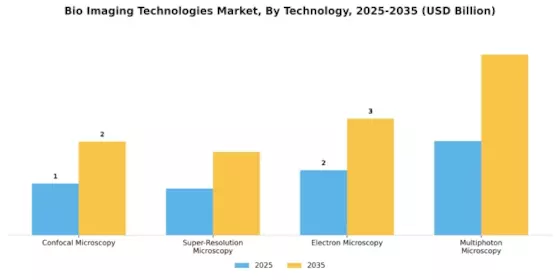
Technology: Confocal Microscopy (Dominant) vs. Super-Resolution Microscopy (Emerging)
Confocal Microscopy stands as the dominant technology in the Bio Imaging Technologies Market, recognized for its precision and versatility in imaging live specimens. On the other hand, Super-Resolution Microscopy is emerging rapidly, leveraging cutting-edge techniques to surpass traditional imaging limits. This technology is especially appealing for applications requiring detailed imaging of biological samples at the nanoscale, thus attracting significant research investments. As researchers seek more advanced imaging capabilities, Super-Resolution is witnessing a surge in adoption across various biological fields, illustrating its growing importance alongside the more established Confocal Microscopy.
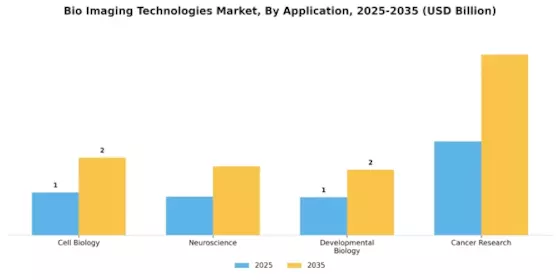
The Bio Imaging Technologies Market exhibits a diverse distribution of applications, with cell biology accounting for the largest share due to its critical importance in understanding cellular processes. Neuroscience and developmental biology also hold significant portions of the market, driven by increasing research activities and advancements in imaging technologies. Cancer research, while currently smaller, is rapidly gaining traction, reflecting the urgent need for innovative diagnostic and therapeutic solutions in oncology. As these applications evolve, their interplay shapes the trajectory of the bioimaging landscape.
Cell Biology: Dominant vs. Cancer Research: Emerging
Cell biology serves as the dominant application within the Bio Imaging Technologies Market, facilitating the exploration of cellular structures and functions. Its prominence stems from a strong integration of imaging techniques in both academic and clinical contexts, making it integral to numerous research initiatives. In contrast, cancer research is recognized as an emerging application, characterized by rapid advancements in imaging modalities that are tailored for tumor detection and monitoring. The increasing prevalence of cancer and the push for more precise, non-invasive diagnostic methods further bolster its growth. Together, these segments reflect the diverse and dynamic nature of the bioimaging field.
In the Bio Imaging Technologies Market, Live Cells command a significant portion of the market share due to their essential role in real-time imaging and studies of biological processes. Following close behind are Fixed Cells and Tissues, which are also fundamental for various applications in disease research and drug development. Although these segments have made considerable contributions, Live Cells remain the most prominent choice among researchers, reflecting their importance in ongoing scientific inquiries.
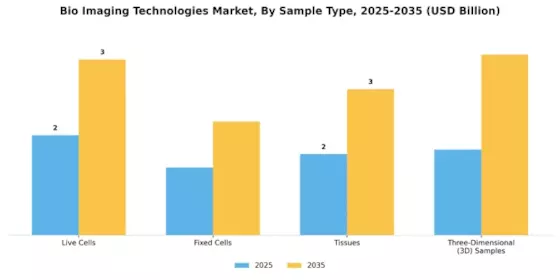
Live Cells (Dominant) vs. Three-Dimensional (3D) Samples (Emerging)
Live Cells serve as the dominant player in the Bio Imaging Technologies Market, favored for their ability to provide dynamic insights into cellular activities and interactions. Their applications span across pharmaceutical development and cellular biology, consolidating their market position. In contrast, Three-Dimensional (3D) Samples represent an emerging trend, gaining traction due to their capacity to offer more realistic models of tissue architecture and cellular environments. This segment is rapidly growing as researchers seek more accurate representations of biological systems, driving innovation in imaging technologies.
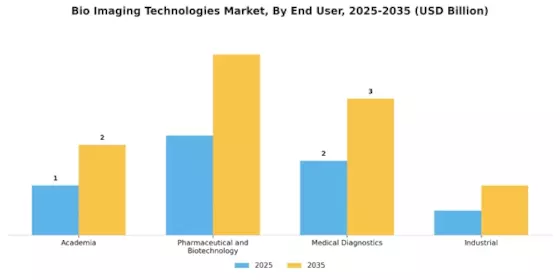
In the Bio Imaging Technologies Market, the end user segment is largely dominated by the Pharmaceutical and Biotechnology sector, which accounts for a significant portion of market activity due to extensive research and development in drug discovery and development. This sector's reliance on advanced imaging techniques for visualizing biological processes has solidified its leadership position, while sectors like Medical Diagnostics are gaining traction with increasing demand for non-invasive diagnostic procedures and imaging modalities.
Pharmaceutical and Biotechnology (Dominant) vs. Medical Diagnostics (Emerging)
The Pharmaceutical and Biotechnology sector emerges as the dominant player in the Bio Imaging Technologies Market, leveraging advanced imaging systems for both research and clinical applications. This sector benefits from significant investment in innovative technologies, ensuring its pivotal role in drug development and regulatory compliance. On the other hand, the Medical Diagnostics segment is showing rapid growth due to the rising prevalence of chronic diseases, improved healthcare infrastructure, and a shift towards early diagnosis and preventive healthcare. With increasing innovation in imaging technologies, the Medical Diagnostics segment is enriching its offerings and transforming patient care, hence establishing itself as an emerging powerhouse.
Get more detailed insights about Bio Imaging Technologies Market Request Free Sample
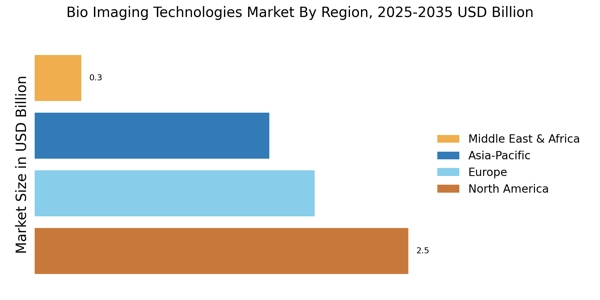
North America is the largest market for bio imaging technologies, holding approximately 40% of the global share. The region's growth is driven by advanced healthcare infrastructure, increasing prevalence of chronic diseases, and significant investments in research and development. Regulatory support from agencies like the FDA further catalyzes innovation and adoption of new technologies, enhancing market dynamics. The United States leads the North American market, with key players such as GE Healthcare and Siemens Healthineers dominating the landscape. The competitive environment is characterized by continuous technological advancements and strategic partnerships. Canada also contributes to the market, focusing on improving healthcare access and integrating advanced imaging solutions into clinical practices.
Europe is the second-largest market for bio imaging technologies, accounting for around 30% of the global market share. The region benefits from stringent regulatory frameworks that ensure high-quality standards in medical imaging. Countries like Germany and the UK are at the forefront, with increasing investments in healthcare technology and a growing aging population driving demand for advanced imaging solutions. Germany is a key player in the European market, hosting major companies like Siemens Healthineers and Philips Healthcare. The competitive landscape is marked by innovation and collaboration among industry stakeholders. The European Union's commitment to enhancing healthcare through technology adoption further supports market growth, fostering an environment conducive to advancements in bio imaging technologies.
Asia-Pacific is witnessing rapid growth in the bio imaging technologies market, projected to capture about 25% of the global share by 2025. The region's growth is fueled by increasing healthcare expenditure, rising awareness of early disease detection, and advancements in imaging technologies. Countries like China and India are leading this growth, supported by government initiatives aimed at enhancing healthcare infrastructure. China stands out as a significant player, with major investments in healthcare technology and a burgeoning demand for advanced imaging solutions. The competitive landscape includes both local and international companies, with firms like Canon Medical Systems and Fujifilm Holdings Corporation making substantial inroads. The region's focus on improving healthcare access and quality is expected to drive further adoption of bio imaging technologies.
The Middle East and Africa region is gradually emerging in the bio imaging technologies market, holding approximately 5% of the global share. The growth is driven by increasing healthcare investments, rising awareness of diagnostic imaging, and government initiatives aimed at improving healthcare infrastructure. Countries like South Africa and the UAE are leading the way, focusing on enhancing healthcare services and technology adoption. South Africa is a key player in the region, with a growing demand for advanced imaging solutions. The competitive landscape is characterized by a mix of local and international companies, with a focus on addressing healthcare challenges through innovative imaging technologies. The region's potential for growth is significant, although challenges such as regulatory hurdles and resource limitations remain.
The Bio Imaging Technologies Market is currently characterized by a dynamic competitive landscape, driven by rapid technological advancements and increasing demand for diagnostic imaging solutions. Key players such as Siemens Healthineers (Germany), GE Healthcare (US), and Philips Healthcare (Netherlands) are at the forefront, each adopting distinct strategies to enhance their market positioning. Siemens Healthineers (Germany) emphasizes innovation through its development of advanced imaging systems, while GE Healthcare (US) focuses on expanding its digital health solutions. Philips Healthcare (Netherlands) is actively pursuing partnerships to enhance its imaging capabilities, thereby shaping a competitive environment that prioritizes technological sophistication and collaborative growth.In terms of business tactics, companies are increasingly localizing manufacturing and optimizing supply chains to enhance operational efficiency. The market appears moderately fragmented, with a mix of established players and emerging companies vying for market share. This competitive structure allows for diverse offerings, yet the collective influence of major players like Fujifilm Holdings Corporation (Japan) and Canon Medical Systems (Japan) is significant, as they leverage their technological expertise to drive innovation and capture new market segments.
In August Siemens Healthineers (Germany) announced the launch of its latest MRI system, which integrates artificial intelligence to enhance imaging accuracy and patient comfort. This strategic move not only reinforces Siemens' commitment to innovation but also positions the company to meet the growing demand for advanced imaging solutions in clinical settings. The introduction of AI-driven technology is likely to set a new standard in the industry, potentially influencing competitors to accelerate their own technological advancements.
In September GE Healthcare (US) unveiled a new telehealth platform designed to streamline remote diagnostics and patient monitoring. This initiative reflects GE's strategic focus on digital transformation, enabling healthcare providers to deliver more efficient and accessible care. By integrating telehealth capabilities with traditional imaging services, GE Healthcare is poised to enhance its service offerings, thereby addressing the evolving needs of healthcare systems worldwide.
In July Philips Healthcare (Netherlands) entered into a strategic partnership with a leading AI firm to develop next-generation imaging solutions. This collaboration aims to leverage AI algorithms to improve diagnostic accuracy and workflow efficiency. Such partnerships are indicative of a broader trend within the industry, where companies are increasingly recognizing the value of integrating cutting-edge technologies to maintain competitive advantage.
As of October the Bio Imaging Technologies Market is witnessing a shift towards digitalization, sustainability, and AI integration. These trends are reshaping competitive dynamics, with strategic alliances becoming increasingly vital for innovation and market penetration. The focus appears to be shifting from price-based competition to differentiation through advanced technology and reliable supply chains. Looking ahead, companies that prioritize innovation and adaptability are likely to emerge as leaders in this evolving landscape.
Recent developments in the bio imaging technologies market showcase the industry's rapid growth and innovation. In 2023, the market was valued at USD 6.18 billion, and it is projected to reach USD 10.19 billion by 2032, exhibiting a CAGR of 5.71%.
Key factors driving this growth include rising demand for advanced imaging modalities, increasing prevalence of chronic diseases, and technological advancements in microscopy and image analysis.
The Bio Imaging Technologies Market is projected to grow at a 5.71% CAGR from 2025 to 2035, driven by technological advancements, increasing healthcare expenditure, and rising demand for early disease detection.
New opportunities lie in:
By 2035, the market is expected to achieve substantial growth, reflecting its critical role in healthcare innovation.
| MARKET SIZE 2024 | 6.18(USD Billion) |
| MARKET SIZE 2025 | 6.533(USD Billion) |
| MARKET SIZE 2035 | 11.39(USD Billion) |
| COMPOUND ANNUAL GROWTH RATE (CAGR) | 5.71% (2025 - 2035) |
| REPORT COVERAGE | Revenue Forecast, Competitive Landscape, Growth Factors, and Trends |
| BASE YEAR | 2024 |
| Market Forecast Period | 2025 - 2035 |
| Historical Data | 2019 - 2024 |
| Market Forecast Units | USD Billion |
| Key Companies Profiled | Siemens Healthineers (DE), GE Healthcare (US), Philips Healthcare (NL), Canon Medical Systems (JP), Fujifilm Holdings Corporation (JP), Bruker Corporation (US), Agfa-Gevaert Group (BE), Hitachi Medical Corporation (JP), Mindray Medical International Limited (CN), Hologic, Inc. (US) |
| Segments Covered | Technology, Application, Sample Type, End User, Regional |
| Key Market Opportunities | Advancements in artificial intelligence enhance diagnostic accuracy in the Bio Imaging Technologies Market. |
| Key Market Dynamics | Technological advancements drive innovation in bio imaging technologies, enhancing diagnostic capabilities and market competitiveness. |
| Countries Covered | North America, Europe, APAC, South America, MEA |
The projected market valuation for the Bio Imaging Technologies Market in 2035 is 11.39 USD Billion.
The market valuation for Bio Imaging Technologies in 2024 was 6.18 USD Billion.
The expected CAGR for the Bio Imaging Technologies Market during the forecast period 2025 - 2035 is 5.71%.
The Electron Microscopy segment is projected to grow from 1.56 USD Billion in 2024 to 2.8 USD Billion by 2035.
The Cancer Research application segment is expected to increase from 2.72 USD Billion in 2024 to 5.24 USD Billion by 2035.
Key players in the Bio Imaging Technologies Market include Siemens Healthineers, GE Healthcare, and Philips Healthcare, among others.
The Live Cells sample type segment is anticipated to grow from 1.85 USD Billion in 2024 to 3.25 USD Billion by 2035.
The Pharmaceutical and Biotechnology end user segment is projected to grow from 2.48 USD Billion in 2024 to 4.5 USD Billion by 2035.
The market valuation for the Super-Resolution Microscopy technology segment in 2024 was 1.12 USD Billion.
In 2035, the market for Fixed Cells is projected to reach 2.1 USD Billion, while Tissues are expected to grow to 2.7 USD Billion.



Kindly complete the form below to receive a free sample of this Report

“This is really good guys. Excellent work on a tight deadline. I will continue to use you going forward and recommend you to others. Nice job”


“Thanks. It’s been a pleasure working with you, please use me as reference with any other Intel employees.”


“Thanks for sending the report it gives us a good global view of the Betaïne market.”


“Thank you, this will be very helpful for OQS.”


“We found the report very insightful! we found your research firm very helpful. I'm sending this email to secure our future business.”


“I am very pleased with how market segments have been defined in a relevant way for my purposes (such as "Portable Freezers & refrigerators" and "last-mile"). In general the report is well structured. Thanks very much for your efforts.”


“I have been reading the first document or the study, ,the Global HVAC and FP market report 2021 till 2026. Must say, good info! I have not gone in depth at all parts, but got a good indication of the data inside!”


“We got the report in time, we really thank you for your support in this process. I also thank to all of your team as they did a great job.”


“The Automotive 48V ECU Components Procurement Intelligence Study” was a complex project, but the Market Research Future (MRFR) team handled it with quality, agility, and customer-centricity. They delivered all requested data on time and within the agreed scope. The team, including Shubhendra Anand and Rahul Gotadki, was always readily available to clarify questions and swiftly implement necessary adjustments, driving the project to a successful conclusion within a very demanding timeframe.
I would also like to specifically commend Akshay Agarwal for his responsiveness and support at every stage—from our initial inquiry on May 6th through to final delivery on June 18th. His dedication made the entire process seamless.”



