×
Request Free Sample ×

Kindly complete the form below to receive a free sample of this Report

* Please use a valid business email

Leading companies partner with us for data-driven Insights

clients tt-cursor
Hero Background

Biodegradable Chelating Agents Market

ID: MRFR/CnM/9376-HCR
100 Pages
Anshula Mandaokar
October 2025

Biodegradable Chelating Agents Market Research Report Information By Product Type (Citric, APCA (amino polycarboxylates), Organophosphates, Sodium Gluconate, Others) Application (Pulp & paper, Water treatment, Agrochemical, Health care, Food & beverages, Others) Forecast 2030

Share:
Download PDF ×

We do not share your information with anyone. However, we may send you emails based on your report interest from time to time. You may contact us at any time to opt-out.

Biodegradable Chelating Agents Market Infographic
Purchase Options

Biodegradable Chelating Agents Market Summary

As per MRFR analysis, the Biodegradable Chelating Agents Market Size was estimated at 15.51 USD Million in 2024. The Biodegradable Chelating Agents industry is projected to grow from 17.7 in 2025 to 66.02 by 2035, exhibiting a compound annual growth rate (CAGR) of 14.07 during the forecast period 2025 - 2035.

Key Market Trends & Highlights

The Biodegradable Chelating Agents Market is experiencing robust growth driven by sustainability and regulatory trends.

  • The market is witnessing a shift towards sustainable product development, particularly in North America, which remains the largest market.
  • In Asia-Pacific, the demand for biodegradable chelating agents is rapidly increasing, making it the fastest-growing region.
  • The agricultural sector continues to dominate the market, while the household cleaning segment is emerging as the fastest-growing area.
  • Key drivers include rising environmental awareness and regulatory support for eco-friendly chemicals, fueling innovations in biodegradable formulations.

Market Size & Forecast

2024 Market Size 15.51 (USD Million)
2035 Market Size 66.02 (USD Million)
CAGR (2025 - 2035) 14.07%

Major Players

BASF SE (DE), Dow Inc. (US), AkzoNobel N.V. (NL), FMC Corporation (US), Lanxess AG (DE), Nouryon (NL), Solvay S.A. (BE), Tate & Lyle PLC (GB), Wacker Chemie AG (DE)

Biodegradable Chelating Agents Market Trends

The Biodegradable Chelating Agents Market is currently experiencing a notable shift towards sustainable practices, driven by increasing environmental awareness and regulatory pressures. Industries such as agriculture, cleaning, and personal care are progressively adopting biodegradable alternatives to traditional chelating agents, which are often synthetic and environmentally harmful. This transition appears to be fueled by a growing consumer preference for eco-friendly products, as well as the need for compliance with stringent environmental regulations. As a result, manufacturers are investing in research and development to create innovative biodegradable formulations that meet both performance and sustainability criteria. Moreover, the market landscape is evolving with advancements in technology and production processes. Companies are exploring various natural sources for chelating agents, such as plant extracts and fermentation processes, which may offer enhanced biodegradability and lower toxicity. This trend suggests a potential for increased collaboration between chemical manufacturers and agricultural sectors to develop tailored solutions that address specific environmental challenges. Overall, the Biodegradable Chelating Agents Market is poised for growth, reflecting a broader commitment to sustainability and responsible consumption in various industries.

Sustainable Product Development

There is a growing emphasis on the development of sustainable products within the Biodegradable Chelating Agents Market. Manufacturers are increasingly focusing on creating formulations that not only meet performance standards but also align with environmental sustainability goals. This trend indicates a shift towards using renewable resources and minimizing ecological footprints.

Regulatory Compliance and Standards

The influence of regulatory frameworks is becoming more pronounced in the Biodegradable Chelating Agents Market. Stricter regulations regarding chemical usage and environmental impact are prompting companies to adopt biodegradable alternatives. This trend highlights the importance of compliance in driving market growth and innovation.

Consumer Demand for Eco-Friendly Solutions

There is a noticeable increase in consumer demand for eco-friendly solutions across various sectors, including cleaning and personal care. This trend is pushing manufacturers in the Biodegradable Chelating Agents Market to prioritize the development of biodegradable products that cater to environmentally conscious consumers, thereby enhancing market competitiveness.

Biodegradable Chelating Agents Market Drivers

Market Growth Projections

The Global Biodegradable Chelating Agents Market Industry is poised for substantial growth, with projections indicating a market size of 3500 USD Million by 2035. This growth is underpinned by a compound annual growth rate of 9.81% from 2025 to 2035, reflecting the increasing adoption of biodegradable solutions across various sectors. Factors such as rising environmental awareness, regulatory support, and technological advancements are contributing to this upward trajectory. The market's expansion is likely to be driven by innovations in product formulations and production processes, which will enhance the availability and effectiveness of biodegradable chelating agents.

Growing Demand in Agriculture

The agricultural sector's increasing reliance on sustainable practices is a key driver of the Global Biodegradable Chelating Agents Market Industry. Biodegradable chelating agents are gaining traction as they enhance nutrient availability and improve soil health without contributing to long-term environmental harm. This trend is particularly evident in organic farming, where the use of synthetic chemicals is minimized. As farmers seek effective and eco-friendly solutions, the demand for biodegradable chelating agents is expected to rise. This shift is anticipated to contribute to a compound annual growth rate of 9.81% from 2025 to 2035, reflecting the sector's commitment to sustainability.

Rising Environmental Awareness

The increasing global emphasis on sustainability and environmental protection drives the Global Biodegradable Chelating Agents Market Industry. Consumers and industries alike are becoming more conscious of the ecological impact of traditional chelating agents, which often contribute to pollution and environmental degradation. This shift in consumer behavior is prompting manufacturers to seek biodegradable alternatives that align with eco-friendly practices. As a result, the market is projected to reach 1250 USD Million in 2024, reflecting a growing demand for sustainable solutions. Companies are investing in research and development to create innovative biodegradable chelating agents that meet regulatory standards and consumer expectations.

Technological Advancements in Production

Innovations in the production processes of biodegradable chelating agents are propelling the Global Biodegradable Chelating Agents Market Industry forward. Advances in biotechnology and green chemistry are enabling manufacturers to develop more efficient and cost-effective methods for producing these agents. This not only enhances product quality but also reduces production costs, making biodegradable options more competitive against traditional chelating agents. As technology continues to evolve, the market is likely to experience accelerated growth, with projections suggesting a potential market size of 3500 USD Million by 2035. These advancements are crucial for meeting the rising demand for sustainable products across various industries.

Consumer Preference for Eco-Friendly Products

The shift in consumer preferences towards eco-friendly products is a significant driver of the Global Biodegradable Chelating Agents Market Industry. As awareness of environmental issues grows, consumers are increasingly opting for products that are not only effective but also sustainable. This trend is evident across various sectors, including personal care, cleaning, and agriculture, where biodegradable chelating agents are becoming preferred choices. Companies are responding to this demand by reformulating their products to include biodegradable ingredients, thereby enhancing their market appeal. This consumer-driven change is expected to contribute to the market's growth, with an anticipated increase to 1250 USD Million in 2024.

Regulatory Support for Biodegradable Solutions

Government regulations promoting the use of biodegradable materials significantly influence the Global Biodegradable Chelating Agents Market Industry. Many countries are implementing stricter environmental regulations that encourage the adoption of biodegradable alternatives in various applications, including agriculture, cleaning products, and industrial processes. These regulations not only aim to reduce environmental pollution but also support the development of green chemistry initiatives. As a result, the market is likely to expand, with projections indicating a growth trajectory that could see it reach 3500 USD Million by 2035. This regulatory landscape fosters innovation and investment in biodegradable chelating agents.
Market Segment Insights

By Application: Agriculture (Largest) vs. Household Cleaning (Fastest-Growing)

In the Biodegradable Chelating Agents Market, Agriculture holds the largest share, showcasing its significance in enhancing soil quality and nutrient availability. This application segment leads the market due to increasing demand for sustainable farming practices and organic crop production. Following closely is Household Cleaning, which is experiencing rapid growth as consumers shift towards eco-friendly cleaning solutions that are safe for both health and the environment. This trend indicates a broader acceptance of biodegradable products in everyday applications.

Agriculture: Dominant vs. Household Cleaning: Emerging

The Agriculture sector is dominant within the Biodegradable Chelating Agents Market, primarily due to its pivotal role in improving soil health and crop yields. Farmers and producers increasingly prefer biodegradable agents to traditional chemicals, aligning with the rising global demand for sustainable agriculture. On the other hand, the Household Cleaning segment is classified as emerging, fueled by a growing consumer preference for environmentally friendly cleaning solutions. This shift is driven by heightened awareness of health and environmental impact, positioning household cleaning products as a key growth driver for biodegradable chelating agents.

By End Use: Agricultural Sector (Largest) vs. Food and Beverage Industry (Fastest-Growing)

In the Biodegradable Chelating Agents Market, the distribution of market share among the end-use segments shows that the Agricultural Sector holds a significant position, driven by the increasing demand for sustainable agricultural practices. This segment's emphasis on eco-friendly fertilizers and crop protection agents enhances its dominance, reflecting a clear preference for biodegradable solutions. Conversely, the Food and Beverage Industry is witnessing rapid expansion, fueled by a growing focus on food safety and quality, leading to an increased utilization of biodegradable agents in food preservation and processing.

Agricultural Sector: Dominant vs. Food and Beverage Industry: Emerging

The Agricultural Sector remains the dominant player in the Biodegradable Chelating Agents Market due to its crucial role in improving soil quality and promoting sustainable farming practices. This sector benefits from a strong regulatory push towards environmentally friendly farming solutions that enhance crop yields without compromising soil health. In contrast, the Food and Beverage Industry is emerging rapidly as a key consumer of biodegradable chelating agents, driven by rising consumer awareness about health and sustainability. The industry is increasingly adopting these agents for various applications, including food processing and preservation, thereby significantly contributing to its growth and market dynamics.

By Type: Amino Acid Chelates (Largest) vs. Organic Chelates (Fastest-Growing)

The Biodegradable Chelating Agents Market showcases a diverse set of segment values, with Amino Acid Chelates leading the market dominance due to their extensive applications in agriculture and food industries. These chelates are favorable among manufacturers for their eco-friendly properties that enhance nutrient uptake in plants, making them a preferred choice. Following closely, Organic Chelates are experiencing significant growth, attributed to an increasing consumer preference for natural products and sustainable practices. This shift in consumer behavior is channeling investments towards organic chelating solutions, contributing to the widening market share in this segment.

Amino Acid Chelates (Dominant) vs. Organic Chelates (Emerging)

Amino Acid Chelates serve as the dominant category within the Biodegradable Chelating Agents Market, prized for their natural composition and efficacy in enhancing mineral absorption in crops. Their role in boosting agricultural productivity while minimizing environmental impact aligns with global sustainability trends. In contrast, Organic Chelates are viewed as an emerging segment that is rapidly gaining traction, driven by rising environmental concerns and the organic movement. These chelates, derived from plant sources, offer a sustainable alternative for various applications, including agriculture and water treatment, positioning them as a key segment reflecting consumer demand for greener solutions.

By Formulation: Liquid (Largest) vs. Powder (Fastest-Growing)

The formulation segment of the Biodegradable Chelating Agents Market showcases a diverse distribution among liquid, powder, and granular forms. Currently, the liquid formulation holds the largest market share, largely due to its versatility and ease of use in various applications, including agriculture and industrial cleaning. Meanwhile, the powder formulation is gaining traction, bolstered by its cost-effectiveness and convenience in storage and transportation. Granular formulations, while smaller in market share, display potential due to their utility in specific niche applications.

Liquid (Dominant) vs. Powder (Emerging)

In the formulation segment, liquid biodegradable chelating agents dominate the market due to their widespread application and formulation benefits. They are favored for their effectiveness and ability to dissolve in water quickly, making them suitable for various cleaning and agricultural applications. Conversely, powder formulations are emerging as a significant alternative, offering advantages such as longer shelf life and easier handling. These powders are particularly appealing to manufacturers looking to reduce shipping costs and improve storage efficiency. As environmental concerns drive innovation, both liquid and powder formulations are likely to see expanded roles in sustainable practices, catering to growing demands for eco-friendly products.

By Functionality: Metal Ion Sequestration (Largest) vs. pH Regulation (Fastest-Growing)

In the Biodegradable Chelating Agents Market, the functionality segment reveals a diverse range of applications. Metal Ion Sequestration stands as the largest segment, owing to its critical role in various industrial processes, including water treatment and agriculture. Following closely are Stabilization and Dispersing Agent functionalities, catering to specific needs in formulations, whereas pH Regulation is rapidly gaining traction due to its relevance in both consumer products and industrial applications. The growth trends within this functionality segment are primarily driven by increased environmental awareness and regulatory pressures pushing towards sustainable practices. Market players are focusing on developing innovative biodegradable chelating agents that not only serve their functional purposes but also conform to eco-friendly requirements. As industries pivot toward greener alternatives, the competition intensifies, particularly favoring segments like pH Regulation that are positioned for swift product development and adoption.

Metal Ion Sequestration (Dominant) vs. Stabilization (Emerging)

Metal Ion Sequestration represents the dominant functionality in the Biodegradable Chelating Agents Market, primarily due to its extensive use in various sectors such as agriculture, water treatment, and manufacturing. This segment excels in binding metal ions, which helps in mitigating toxicity and enhancing product stability. On the other hand, Stabilization is emerging as a significant segment, particularly in formulations where maintaining product performance is essential. It often works synergistically with other functionalities, providing added value by enhancing product lifespan and efficacy. As consumers and industries seek more environmentally friendly options, both segments are expected to evolve, with Metal Ion Sequestration leading the way while Stabilization carves out a notable niche in the market.

Get more detailed insights about Biodegradable Chelating Agents Market

Regional Insights

North America : Market Leader in Innovation

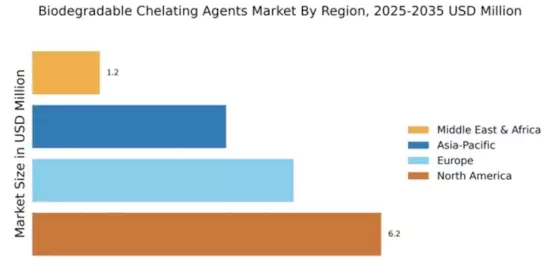
North America is poised to maintain its leadership in the Biodegradable Chelating Agents Market, holding a significant market share of 6.21 in 2024. The region's growth is driven by increasing environmental regulations and a shift towards sustainable practices across various industries. The demand for biodegradable solutions is further fueled by consumer awareness and corporate responsibility initiatives, making it a key player in the global market. The United States and Canada are the leading countries in this sector, with major companies like BASF SE, Dow Inc., and FMC Corporation driving innovation and market expansion. The competitive landscape is characterized by strategic partnerships and investments in R&D, ensuring a steady supply of advanced biodegradable products. This focus on sustainability positions North America as a hub for future growth in the chelating agents market.

Europe : Sustainability Focused Market

Europe is emerging as a strong contender in the Biodegradable Chelating Agents Market, with a market size of 4.65 in 2024. The region's growth is significantly influenced by stringent environmental regulations and a commitment to sustainability. The European Union's Green Deal and various national policies are catalyzing the demand for biodegradable solutions, aligning with the region's goals for a circular economy and reduced carbon footprint. Leading countries such as Germany, France, and the Netherlands are at the forefront of this market, supported by key players like AkzoNobel N.V. and Nouryon. The competitive landscape is marked by innovation and collaboration among companies to develop eco-friendly products. As the market evolves, Europe is expected to play a pivotal role in shaping global standards for biodegradable agents, ensuring compliance with regulatory frameworks.

Asia-Pacific : Emerging Market Potential

Asia-Pacific is witnessing rapid growth in the Biodegradable Chelating Agents Market, with a market size of 3.45 in 2024. The region's expansion is driven by increasing industrialization, urbanization, and a growing awareness of environmental issues. Governments are implementing policies to promote sustainable practices, which is further boosting the demand for biodegradable products across various sectors, including agriculture and manufacturing. Countries like China, India, and Japan are leading the charge, with significant investments from companies such as Lanxess AG and Solvay S.A. The competitive landscape is evolving, with local players emerging alongside established global firms. As the market matures, Asia-Pacific is expected to become a key player in The Biodegradable Chelating Agents, leveraging its manufacturing capabilities and innovation.

Middle East and Africa : Untapped Market Opportunities

The Middle East and Africa region is gradually emerging in the Biodegradable Chelating Agents Market, with a market size of 1.2 in 2024. The growth in this region is primarily driven by increasing awareness of environmental sustainability and the need for eco-friendly solutions in various industries. Governments are beginning to recognize the importance of biodegradable products, leading to a gradual shift in market dynamics towards sustainable alternatives. Countries such as South Africa and the UAE are taking the lead in adopting biodegradable solutions, supported by local and international players. The competitive landscape is still developing, with opportunities for growth as more companies enter the market. As awareness and regulatory frameworks improve, the Middle East and Africa are expected to see significant advancements in the biodegradable agents sector.

Key Players and Competitive Insights

The Biodegradable Chelating Agents Market is currently characterized by a dynamic competitive landscape, driven by increasing environmental regulations and a growing demand for sustainable products. Key players such as BASF SE (DE), Dow Inc. (US), and AkzoNobel N.V. (NL) are strategically positioning themselves through innovation and partnerships. For instance, BASF SE (DE) has focused on developing new biodegradable formulations that cater to the agricultural sector, while Dow Inc. (US) emphasizes its commitment to sustainability through the enhancement of its product portfolio. These strategies collectively shape a competitive environment that is increasingly focused on sustainability and innovation.

In terms of business tactics, companies are localizing manufacturing and optimizing supply chains to enhance efficiency and reduce costs. The market appears moderately fragmented, with several players vying for market share. The collective influence of these key players is significant, as they not only drive innovation but also set industry standards that smaller companies often follow.

In November 2025, FMC Corporation (US) announced a strategic partnership with a leading agricultural technology firm to develop advanced biodegradable chelating agents aimed at improving crop yield. This collaboration is likely to enhance FMC's market position by integrating cutting-edge technology into their product offerings, thereby addressing the increasing demand for sustainable agricultural solutions. The strategic importance of this partnership lies in its potential to leverage technological advancements, which could lead to a competitive edge in the market.

In October 2025, Solvay S.A. (BE) launched a new line of biodegradable chelating agents specifically designed for industrial applications. This product launch is significant as it reflects Solvay's commitment to expanding its product range in response to market demands for eco-friendly solutions. The introduction of these agents is expected to strengthen Solvay's foothold in the industrial sector, where sustainability is becoming a critical factor in purchasing decisions.

In September 2025, Lanxess AG (DE) completed the acquisition of a small but innovative company specializing in biodegradable chelating technologies. This acquisition is indicative of Lanxess's strategy to enhance its capabilities in sustainable chemistry. By integrating this new technology, Lanxess is likely to broaden its product offerings and improve its competitive positioning in the market.

As of December 2025, current competitive trends indicate a strong shift towards digitalization, sustainability, and the integration of AI technologies in product development. Strategic alliances are increasingly shaping the landscape, allowing companies to pool resources and expertise. The competitive differentiation is expected to evolve from traditional price-based competition to a focus on innovation, technology, and supply chain reliability, reflecting the industry's response to consumer preferences and regulatory pressures.

Key Companies in the Biodegradable Chelating Agents Market market include

Future Outlook

Biodegradable Chelating Agents Market Future Outlook

The Biodegradable Chelating Agents Market is projected to grow at a 14.07% CAGR from 2024 to 2035, driven by increasing environmental regulations and demand for sustainable products.

New opportunities lie in:

  • Development of innovative biodegradable formulations for industrial applications.
  • Expansion into emerging markets with tailored product offerings.
  • Partnerships with agricultural firms for eco-friendly chelating solutions.

By 2035, the market is poised for robust growth, reflecting a strong commitment to sustainability.

Market Segmentation

Biodegradable Chelating Agents Market Type Outlook

  • Amino Acid Chelates
  • Organic Chelates
  • Synthetic Chelates
  • Natural Chelates

Biodegradable Chelating Agents Market End Use Outlook

  • Agricultural Sector
  • Food and Beverage Industry
  • Pharmaceuticals
  • Cosmetics
  • Textiles

Biodegradable Chelating Agents Market Application Outlook

  • Agriculture
  • Household Cleaning
  • Industrial Cleaning
  • Personal Care
  • Water Treatment

Biodegradable Chelating Agents Market Formulation Outlook

  • Liquid
  • Powder
  • Granular

Biodegradable Chelating Agents Market Functionality Outlook

  • Metal Ion Sequestration
  • Stabilization
  • Dispersing Agent
  • pH Regulation

Report Scope

MARKET SIZE 202415.51(USD Million)
MARKET SIZE 202517.7(USD Million)
MARKET SIZE 203566.02(USD Million)
COMPOUND ANNUAL GROWTH RATE (CAGR)14.07% (2024 - 2035)
REPORT COVERAGERevenue Forecast, Competitive Landscape, Growth Factors, and Trends
BASE YEAR2024
Market Forecast Period2025 - 2035
Historical Data2019 - 2024
Market Forecast UnitsUSD Million
Key Companies ProfiledBASF SE (DE), Dow Inc. (US), AkzoNobel N.V. (NL), FMC Corporation (US), Lanxess AG (DE), Nouryon (NL), Solvay S.A. (BE), Tate & Lyle PLC (GB), Wacker Chemie AG (DE)
Segments CoveredApplication, End Use, Type, Formulation, Functionality
Key Market OpportunitiesGrowing demand for sustainable solutions drives innovation in the Biodegradable Chelating Agents Market.
Key Market DynamicsRising environmental regulations drive demand for biodegradable chelating agents in various industrial applications.
Countries CoveredNorth America, Europe, APAC, South America, MEA

Market Highlights

Author
Anshula Mandaokar
Team Lead - Research

Anshula Mandaokar holds an academic degree in Chemical Engineering and has been contributing to the field for more than 5 years. She has expertise in Market Research and Business Consulting and serves as a Team Lead for a reputed Market Research firm under the Chemicals and Materials domain spectrum. She has worked on multiple projects, generating explicit results in a quick turnaround time. Her understanding of data interpretation justifies her role as a leader.

Leave a Comment

FAQs

What growth rate will the global Biodegradable Chelating Agents Market register in the future?

The global Biodegradable Chelating Agents Market would register a growth of 4.5%.

How much is the global Biodegradable Chelating Agents Market worth in the future?

The global Biodegradable Chelating Agents market is projected to reach USD 7,70,384 millionby 2035

Who are the key players in Global Biodegradable Chelating Agents Market?

BASF SE, Akzo Nobel, DowDuPont, Nouryon, Mitsubishi Chemical Corporation, Zhonglan industry, Tosoh Corporation, ADM, Natural Ingredients Corp., Nouryon are the key players in Global Biodegradable Chelating Agents Market.

Which region has the highest growth in Global Biodegradable Chelating Agents Market?

The Asia-Pacific is growing at the highest growth in Global Biodegradable Chelating Agents Market

Which is the key factor driving the market?

The rising preference for liquid detergent over powder is another driving factor for the surfactant industry in the region.

Download Free Sample

Kindly complete the form below to receive a free sample of this Report

Compare Licence

×
Features License Type
Single User Multiuser License Enterprise User
Price $4,950 $5,950 $7,250
Maximum User Access Limit 1 User Upto 10 Users Unrestricted Access Throughout the Organization
Free Customization
Direct Access to Analyst
Deliverable Format
Platform Access
Discount on Next Purchase 10% 15% 15%
Printable Versions