×
Request Free Sample ×

Kindly complete the form below to receive a free sample of this Report

* Please use a valid business email

Leading companies partner with us for data-driven Insights

clients tt-cursor
Hero Background

Biodegradable Packaging Market

ID: MRFR/PCM/10123-CR
111 Pages
Snehal Singh
April 2024

Biodegradable Packaging Market Research Report: By Material (Polylactic Acid, Starch-Based, Polyhydroxyalkanoates, Cellulose, Mushroom Packaging), By Packaging Type (Flexible Packaging, Rigid Packaging, Food Service Packaging, Containers, Bags), By End Use (Food and Beverages, Electronics, Personal Care, Textiles, Healthcare), By Distribution Channel (Online Retail, Supermarkets, Convenience Stores, Specialty Stores, Wholesalers) andBy Regional (North America, Europe, South America, Asia Pacific, Middle East and Africa)- Forecast to 2035.

Share:
Download PDF ×

We do not share your information with anyone. However, we may send you emails based on your report interest from time to time. You may contact us at any time to opt-out.

Biodegradable Packaging Market Infographic
Purchase Options

Biodegradable Packaging Market Summary

As per MRFR analysis, the Biodegradable Packaging Market Size was estimated at 131820.8 USD Billion in 2024. The biodegradable packaging industry is projected to grow from 138678.15 USD Billion in 2025 to 230276.17 USD Billion by 2035, exhibiting a compound annual growth rate (CAGR) of 5.2 during the forecast period 2025 - 2035.

Key Market Trends & Highlights

The Biodegradable Packaging Market is experiencing robust growth driven by sustainability trends and regulatory support.

  • Consumer demand for sustainable packaging solutions is rising, particularly in North America, which remains the largest market.
  • Technological advancements in material science are facilitating the development of innovative biodegradable materials, especially in the Asia-Pacific region.
  • The food packaging segment continues to dominate the market, while the medical packaging segment is emerging as the fastest-growing area.
  • Rising environmental awareness and government regulations are key drivers propelling the adoption of biodegradable packaging solutions.

Market Size & Forecast

2024 Market Size 131820.8 (USD Billion)
2035 Market Size 230276.17 (USD Billion)
CAGR (2025 - 2035) 5.2%

Major Players

BASF SE (DE), Novamont S.p.A. (IT), NatureWorks LLC (US), Smurfit Kappa Group (IE), Mondi Group (GB), Sealed Air Corporation (US), Tetra Pak International S.A. (CH), Biopac Ltd (GB), BioBag International AS (NO)

Biodegradable Packaging Market Trends

The Biodegradable Packaging Market is currently experiencing a notable transformation driven by increasing environmental awareness and regulatory pressures. Consumers are becoming more conscious of their ecological footprint, leading to a rising demand for sustainable packaging solutions. This shift is prompting manufacturers to innovate and develop materials that decompose naturally, thereby reducing waste and pollution. Furthermore, governments across various regions are implementing stringent regulations aimed at curbing plastic usage, which is further propelling the adoption of biodegradable alternatives. As a result, companies are investing in research and development to enhance the performance and affordability of biodegradable materials, which could potentially reshape the packaging landscape. In addition to regulatory influences, the Biodegradable Packaging Market is also witnessing a surge in collaboration among stakeholders. Businesses are increasingly partnering with environmental organizations and research institutions to foster innovation and promote sustainable practices. This collaborative approach not only enhances product offerings but also strengthens brand reputation among eco-conscious consumers. Moreover, the rise of e-commerce and online shopping is creating new opportunities for biodegradable packaging solutions, as companies seek to meet the growing demand for sustainable shipping options. Overall, the market appears poised for continued growth as sustainability becomes a central tenet of packaging strategies.

Rising Consumer Demand for Sustainability

There is a growing trend among consumers who prioritize eco-friendly products, leading to increased interest in biodegradable packaging. This shift in consumer behavior is compelling brands to adopt sustainable practices and offer biodegradable options.

Regulatory Support and Initiatives

Governments worldwide are enacting policies that promote the use of biodegradable materials, creating a favorable environment for the Biodegradable Packaging Market. These regulations are designed to reduce plastic waste and encourage sustainable alternatives.

Technological Advancements in Material Science

Innovations in material science are driving the development of new biodegradable materials that offer improved performance and functionality. These advancements are likely to enhance the appeal of biodegradable packaging across various industries.

Biodegradable Packaging Market Drivers

Market Growth Projections

The Global Biodegradable Packaging Market Industry is poised for substantial growth, with projections indicating a market value of 20.5 USD Billion in 2024 and an anticipated increase to 45.3 USD Billion by 2035. This growth trajectory suggests a compound annual growth rate of 7.47% from 2025 to 2035. The increasing adoption of biodegradable materials across various sectors, including food and beverage, cosmetics, and consumer goods, is likely to drive this expansion. As businesses and consumers alike prioritize sustainability, the market is expected to evolve, presenting new opportunities for innovation and investment in biodegradable packaging solutions.

Rising Environmental Concerns

The Global Biodegradable Packaging Market Industry is experiencing a surge in demand driven by increasing environmental awareness among consumers and businesses. As plastic pollution continues to pose significant threats to ecosystems, stakeholders are actively seeking sustainable alternatives. This shift is evidenced by the projected market value of 20.5 USD Billion in 2024, reflecting a growing preference for biodegradable materials. Governments worldwide are implementing stricter regulations on plastic usage, further propelling the adoption of biodegradable packaging solutions. The emphasis on reducing carbon footprints and promoting circular economies is likely to enhance the industry's growth trajectory.

Government Regulations and Initiatives

Government policies and initiatives play a crucial role in shaping the Global Biodegradable Packaging Market Industry. Many countries are introducing regulations aimed at reducing plastic waste, which encourages manufacturers to adopt biodegradable alternatives. For instance, the European Union has set ambitious targets for reducing single-use plastics, which has led to increased investments in biodegradable packaging technologies. These regulatory frameworks not only foster innovation but also create a favorable environment for market growth. As a result, the industry is expected to witness a compound annual growth rate of 7.47% from 2025 to 2035, indicating a robust shift towards sustainable packaging solutions.

Market Expansion in Emerging Economies

Emerging economies are becoming pivotal players in the Global Biodegradable Packaging Market Industry. As these regions experience rapid economic growth, there is a corresponding increase in consumer spending and demand for packaged goods. Countries in Asia-Pacific and Latin America are witnessing a shift towards sustainable packaging solutions, driven by urbanization and changing lifestyles. This expansion is expected to contribute significantly to the market's projected growth, with estimates suggesting a market value of 45.3 USD Billion by 2035. The increasing availability of biodegradable packaging options in these regions is likely to further stimulate demand and foster industry development.

Technological Advancements in Materials

Innovations in material science are significantly influencing the Global Biodegradable Packaging Market Industry. The development of advanced biodegradable polymers and composites has expanded the range of applications for sustainable packaging. For example, materials derived from renewable resources, such as cornstarch and sugarcane, are gaining traction due to their eco-friendly properties. These advancements not only enhance the performance of biodegradable packaging but also reduce production costs, making them more accessible to manufacturers. As the market evolves, the integration of smart technologies in biodegradable packaging could further enhance functionality, thereby attracting a broader consumer base.

Consumer Demand for Sustainable Products

The growing consumer preference for sustainable products is a key driver of the Global Biodegradable Packaging Market Industry. As awareness of environmental issues rises, consumers are increasingly opting for products that align with their values. This trend is reflected in the packaging choices made by companies, which are now prioritizing biodegradable options to meet consumer expectations. The shift towards sustainability is not merely a passing trend; it is becoming a fundamental aspect of brand identity. Companies that embrace biodegradable packaging are likely to enhance their market position and appeal to environmentally conscious consumers, thereby driving industry growth.
Market Segment Insights

By Application: Food Packaging (Largest) vs. Medical Packaging (Fastest-Growing)

In the biodegradable packaging market, the application segment is primarily dominated by food packaging, which captures the largest share due to the increasing consumer preference for sustainable and eco-friendly products. This segment significantly benefits from the rising demand for on-the-go packaging solutions, especially in the food service industry. Additionally, consumer goods packaging plays a vital role as manufacturers strive to meet sustainability goals, thus enhancing its market presence. Medical packaging is emerging as the fastest-growing segment, driven by heightened awareness of environmental issues in healthcare. As hospitals and medical facilities increasingly seek sustainable options, demand for biodegradable materials in items such as surgical supplies, pharmaceutical packaging, and other medical applications is rising. This trend is bolstered by regulatory pressures and the healthcare industry's shift toward greener practices, supporting growth in this sector.

Food Packaging (Dominant) vs. Medical Packaging (Emerging)

Food packaging is characterized by a wide range of products including containers, wrappers, and films, made from biodegradable materials designed to maintain food freshness while minimizing environmental impact. This dominant segment benefits from evolving consumer preferences for sustainable practices, pushing brands to innovate and embrace eco-friendly solutions. On the other hand, medical packaging represents an emerging market that utilizes biodegradable materials for various applications such as sterilization wraps, IV bags, and prescription bottles, responding to increasing regulatory demands and sustainability initiatives in healthcare. While food packaging remains steadfast in its leadership, the medical packaging segment's growth is fueled by a critical need for environmentally responsible healthcare solutions.

By Material Type: Starch-based (Largest) vs. PLA (Fastest-Growing)

In the Biodegradable Packaging Market, the distribution of material types indicates that starch-based materials hold the largest share, primarily due to their wide availability and cost-effectiveness. Following closely is PLA, known for its superior properties, appealing to both manufacturers and consumers who prefer environmentally friendly options. The cellulose-based segment holds a niche market, while PHA, although lower in share, is gaining traction among innovative producers. The growth trends in this sector are driven by increasing consumer awareness of sustainability and the urgent need for alternatives to conventional plastics. Regulatory changes and corporate sustainability initiatives further push the demand for biodegradable solutions like PLA and PHA, with the latter witnessing rapid advancements in production technology, enhancing its growth potential in the coming years.

Starch-based (Dominant) vs. PHA (Emerging)

Starch-based materials dominate the Biodegradable Packaging Market due to their inherent accessibility, cost-effectiveness, and well-established supply chain. Used in various applications ranging from films to molded products, their physical properties provide a practical solution for a variety of packaging needs. On the other hand, PHA, regarded as an emerging material, showcases unique properties such as biodegradability in marine environments and potential in diverse applications. Although still developing, PHA's growth is spurred by innovations in biopolymer production, attracting investment and interest from companies looking to offer premium biodegradable packaging solutions.

By End Use: Retail (Largest) vs. Food Service (Fastest-Growing)

In the Biodegradable Packaging Market, the retail sector occupies the largest share, largely due to the growing consumer preference for sustainable packaging solutions at stores and supermarkets. This segment's dominance is fueled by retailers adopting eco-friendly practices to enhance their brand image and attract environmentally-conscious consumers. On the other hand, the food service sector, including restaurants and catering businesses, is witnessing rapid growth as more establishments shift towards biodegradable packaging to reduce plastic waste and align with sustainability initiatives. The shift towards eco-friendly takeout containers and utensils is making this segment increasingly significant in the market.

Retail (Dominant) vs. E-commerce (Emerging)

The retail segment is characterized by its established presence in the market, with major retailers investing heavily in biodegradable packaging options to align with consumer demands for sustainability. Retailers are leveraging biodegradable packaging not just as an eco-friendly choice but also as a marketing tool to draw in customers. In contrast, the e-commerce segment, while emerging, is rapidly gaining traction due to the boom in online shopping. E-commerce companies are exploring biodegradable packaging to minimize their environmental footprint amidst increasing regulatory pressures and consumer expectations. This segment, however, faces challenges with packaging demands, such as product integrity during transit, which must be carefully managed as they transition to more sustainable solutions.

By Form: Flexible Packaging (Largest) vs. Rigid Packaging (Fastest-Growing)

In the Biodegradable Packaging Market, the segment values represent a diverse range of options for sustainable packaging solutions. Flexible Packaging holds a significant market share, driven by its versatility and preference among consumers for lightweight and adaptable packaging solutions that meet various product needs. Rigid Packaging, while dominant in certain areas, is rapidly gaining traction as its applications expand, particularly in sectors that prioritize enhanced protection and product integrity. Growth trends within this segment are influenced by shifting consumer preferences towards sustainable products and increasing regulatory pressures to reduce plastic waste. Flexible Packaging continues to lead in terms of market presence, benefiting from innovations in materials and design. Meanwhile, Rigid Packaging is emerging as a preferred choice for brands focusing on consumer experience and product presentation, thus contributing to its status as the fastest-growing segment within biodegradable options.

Flexible Packaging (Dominant) vs. Containers (Emerging)

Flexible Packaging is the dominant player in the Biodegradable Packaging Market due to its adaptability and cost-effectiveness, appealing to a wide range of industries including food, beverages, and personal care. Its lightweight nature reduces transportation costs and its capacity for various shapes and sizes meets consumer demands for convenience. On the other hand, Containers are emerging as a vital component of the market, especially in sectors that require robust and protective packaging solutions. Their ability to enhance shelf life and protect products from spoilage places Containers in a favorable position as consumers increasingly seek sustainable alternatives. With advancements in biodegradable materials, Containers are expected to capture significant share as businesses adapt to sustainable practices.

By Distribution Channel: Online Retail (Largest) vs. Supermarkets (Fastest-Growing)

The biodegradable packaging market is witnessing significant traction across various distribution channels, with online retail commanding the largest share. This channel has gained popularity due to the increasing consumer preference for online shopping and the convenience it offers. Supermarkets are also emerging as vital players, capturing a notable market share by providing a range of biodegradable products appealing to environmentally conscious shoppers. The growth of the biodegradable packaging market is being driven by heightened awareness of sustainability and environmental impact among consumers. As more customers seek eco-friendly alternatives, supermarkets are expanding their selections of biodegradable products, while online retailers optimize their platforms for efficient distribution. This dual push reflects the changing landscape of consumer purchasing behavior, with online retail and grocery stores adapting to meet rising demands for sustainable packaging solutions.

Online Retail (Dominant) vs. Supermarkets (Emerging)

The online retail channel has established itself as a dominant force within the biodegradable packaging market, providing convenience and a wide selection of products for consumers. This channel caters to the growing trend of eco-conscious shopping, offering easy access to sustainable packaging options. With innovations in e-commerce logistics, online retailers can efficiently deliver biodegradable solutions to a broader audience. On the other hand, supermarkets are recognized as emerging players in this space, gradually enhancing their product lines to include biodegradable options. They have the advantage of immediate availability and a tangible shopping experience, allowing consumers to make environmentally friendly choices in-store. As both channels evolve, their roles in the market complement one another, meeting the diverse preferences of consumers seeking biodegradable packaging.

Get more detailed insights about Biodegradable Packaging Market

Regional Insights

North America : Market Leader in Sustainability

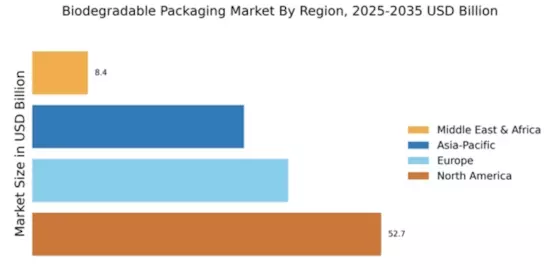
North America is poised to maintain its leadership in the biodegradable packaging market, holding a significant share of 52.73% in 2024. The region's growth is driven by increasing consumer awareness regarding environmental sustainability and stringent regulations promoting eco-friendly packaging solutions. Government initiatives and incentives are further catalyzing demand for biodegradable materials, making it a focal point for innovation in packaging technology. The competitive landscape in North America is robust, featuring key players such as NatureWorks LLC and BASF SE, which are at the forefront of developing advanced biodegradable materials. The U.S. and Canada are leading countries in this sector, with a growing number of startups and established companies investing in research and development. This dynamic environment is expected to foster further advancements and market expansion in the coming years.

Europe : Regulatory-Driven Market Growth

Europe is witnessing a significant shift towards biodegradable packaging, capturing a market share of 38.65% in 2024. This growth is largely attributed to stringent EU regulations aimed at reducing plastic waste and promoting sustainable practices. The European Green Deal and various national policies are driving demand for biodegradable alternatives, making the region a leader in eco-friendly packaging solutions. Countries like Germany, France, and Italy are at the forefront of this transition, with major companies such as Novamont S.p.A. and Smurfit Kappa Group leading the charge. The competitive landscape is characterized by innovation and collaboration among industry players, as they strive to meet regulatory requirements and consumer expectations for sustainable products. This trend is expected to continue, further solidifying Europe's position in the biodegradable packaging market.

Asia-Pacific : Emerging Market Potential

Asia-Pacific is emerging as a significant player in the biodegradable packaging market, with a market size of $32.0 million in 2024. The region's growth is driven by increasing urbanization, rising disposable incomes, and a growing awareness of environmental issues. Governments are also implementing policies to encourage the adoption of biodegradable materials, which is expected to boost market demand in the coming years. Leading countries in this region include China, Japan, and India, where companies are investing heavily in biodegradable packaging solutions. Key players like Tetra Pak International S.A. and Mondi Group are expanding their operations to cater to the growing demand. The competitive landscape is evolving, with both established firms and startups innovating to capture market share, making Asia-Pacific a vibrant hub for biodegradable packaging development.

Middle East and Africa : Untapped Market Opportunities

The Middle East and Africa region is gradually recognizing the potential of biodegradable packaging, with a market size of $8.4 million in 2024. The growth is primarily driven by increasing environmental awareness and the need for sustainable packaging solutions in various industries. Governments are beginning to implement regulations aimed at reducing plastic waste, which is expected to further stimulate market growth in the region. Countries like South Africa and the UAE are leading the charge, with local companies exploring biodegradable options to meet both regulatory requirements and consumer demand. The competitive landscape is still developing, with several key players, including Biopac Ltd and BioBag International AS, working to establish a foothold in this emerging market. As awareness and demand grow, the region is poised for significant advancements in biodegradable packaging solutions.

Key Players and Competitive Insights

The Biodegradable Packaging Market is currently characterized by a dynamic competitive landscape, driven by increasing consumer demand for sustainable solutions and regulatory pressures aimed at reducing plastic waste. Key players such as BASF SE (DE), Novamont S.p.A. (IT), and NatureWorks LLC (US) are strategically positioned to leverage innovation and sustainability in their operations. BASF SE (DE) focuses on developing advanced biopolymers, while Novamont S.p.A. (IT) emphasizes the integration of compostable materials into its product lines. NatureWorks LLC (US) is known for its Ingeo biopolymer, which is derived from renewable resources, indicating a collective industry shift towards eco-friendly alternatives that shape the competitive environment.

In terms of business tactics, companies are increasingly localizing manufacturing to reduce carbon footprints and optimize supply chains. The market structure appears moderately fragmented, with several players vying for market share, yet the influence of major companies is substantial. This competitive structure fosters innovation and encourages smaller firms to adopt sustainable practices, thereby enhancing the overall market dynamics.

In November 2025, BASF SE (DE) announced a partnership with a leading food packaging company to develop a new line of biodegradable food containers. This strategic move is significant as it not only expands BASF's product offerings but also aligns with the growing consumer preference for sustainable packaging solutions. The collaboration is expected to enhance market penetration and reinforce BASF's commitment to sustainability.

In October 2025, Novamont S.p.A. (IT) launched a new range of compostable packaging solutions aimed at the food service industry. This initiative is crucial as it addresses the increasing regulatory demands for compostable materials in food packaging, positioning Novamont as a leader in this niche market. The launch is likely to attract environmentally conscious consumers and strengthen Novamont's market presence.

In September 2025, NatureWorks LLC (US) secured a multi-million dollar investment to expand its production capacity for Ingeo biopolymers. This investment is pivotal as it not only enhances production efficiency but also meets the rising global demand for biodegradable materials. NatureWorks' expansion is expected to solidify its market leadership and drive further innovation in biopolymer technology.

As of December 2025, current competitive trends indicate a strong emphasis on digitalization, sustainability, and the integration of AI technologies within the Biodegradable Packaging Market. Strategic alliances are increasingly shaping the landscape, enabling companies to pool resources and expertise to innovate more effectively. Looking ahead, competitive differentiation is likely to evolve from traditional price-based competition to a focus on innovation, technological advancements, and supply chain reliability, reflecting a broader industry shift towards sustainable practices.

Key Companies in the Biodegradable Packaging Market market include

Industry Developments

In the Global Biodegradable Packaging Market, recent developments have highlighted a significant shift towards sustainable materials. Companies like Novamont, Amcor, and NatureWorks are increasing their investments in Research and Development to enhance biodegradable materials that meet regulatory and consumer demands.

As of September 2023, Smurfit Kappa announced a collaboration with various organizations to innovate in biodegradable solutions, aiming to minimize environmental impact. Furthermore, Berry Global reported positive growth in its biodegradable packaging segment, reinforcing the industry’s shift toward environmentally friendly options.

Current affairs include a continued emphasis on environmental policies in various regions pushing for regulations on single-use plastics, thus bolstering the biodegradable packaging market’s growth. In October 2023, BASF's acquisition of a smaller bioplastics company was confirmed, aiming at expanding their portfolio in biodegradable solutions.

In recent years, the market has also witnessed expansion, particularly notable in 2021 and 2022, where demand surged as more businesses committed to sustainability. This growth trajectory indicates a strong market valuation increase, contributing to a competitive landscape that encourages innovation among major companies including Dow, Tetra Pak, and Mondi Group.

Future Outlook

Biodegradable Packaging Market Future Outlook

The Biodegradable Packaging Market is projected to grow at a 5.2% CAGR from 2024 to 2035, driven by increasing environmental regulations, consumer demand for sustainable products, and technological advancements.

New opportunities lie in:

  • Expansion into emerging markets with tailored biodegradable solutions.
  • Development of innovative materials for enhanced product performance.
  • Partnerships with e-commerce platforms for sustainable packaging solutions.

By 2035, the market is expected to solidify its position as a leader in sustainable packaging solutions.

Market Segmentation

Biodegradable Packaging Market Form Outlook

  • Flexible Packaging
  • Rigid Packaging
  • Containers
  • Films

Biodegradable Packaging Market End Use Outlook

  • Retail
  • Food Service
  • Healthcare
  • E-commerce

Biodegradable Packaging Market Application Outlook

  • Food Packaging
  • Consumer Goods Packaging
  • Medical Packaging
  • Electronics Packaging

Biodegradable Packaging Market Material Type Outlook

  • Starch-based
  • PLA
  • PHA
  • Cellulose-based

Biodegradable Packaging Market Distribution Channel Outlook

  • Online Retail
  • Supermarkets
  • Convenience Stores
  • Specialty Stores

Report Scope

MARKET SIZE 2024131820.8(USD Billion)
MARKET SIZE 2025138678.15(USD Billion)
MARKET SIZE 2035230276.17(USD Billion)
COMPOUND ANNUAL GROWTH RATE (CAGR)5.2% (2024 - 2035)
REPORT COVERAGERevenue Forecast, Competitive Landscape, Growth Factors, and Trends
BASE YEAR2024
Market Forecast Period2025 - 2035
Historical Data2019 - 2024
Market Forecast UnitsUSD Billion
Key Companies ProfiledBASF SE (DE), Novamont S.p.A. (IT), NatureWorks LLC (US), Smurfit Kappa Group (IE), Mondi Group (GB), Sealed Air Corporation (US), Tetra Pak International S.A. (CH), Biopac Ltd (GB), BioBag International AS (NO)
Segments CoveredApplication, Material Type, End Use, Form, Distribution Channel
Key Market OpportunitiesGrowing consumer demand for sustainable solutions drives innovation in the Biodegradable Packaging Market.
Key Market DynamicsRising consumer demand for sustainable solutions drives innovation and competition in the biodegradable packaging sector.
Countries CoveredNorth America, Europe, APAC, South America, MEA

Market Highlights

Author
Snehal Singh
Assistant Manager - Research

High acumen in analyzing complex macro & micro markets with more than 6 years of work experience in the field of market research. By implementing her analytical skills in forecasting and estimation into market research reports, she has expertise in Packaging, Construction, and Equipment domains. She handles a team size of 20-25 resources and ensures smooth running of the projects, associated marketing activities, and client servicing.

Leave a Comment

FAQs

What is the size of the Global Biodegradable Packaging Market in 2024?

The Global Biodegradable Packaging Market is expected to be valued at 15.95 billion USD in 2024.

What is the expected CAGR for the Global Biodegradable Packaging Market from 2025 to 2035?

Biodegradable Packaging Market is expected to grow with a CAGR of 5.2% in the period 2025-2035

Which region is expected to hold the largest share of the market by 2035?

Europe is projected to hold the largest market share, expected to be valued at 12.0 billion USD by 2035.

What are the key applications and materials driving the Global Biodegradable Packaging Market?

Key applications include packaging solutions utilizing materials like polylactic acid, starch-based, polyhydroxyalkanoates, cellulose, and mushroom packaging.

Who are the major players in the Global Biodegradable Packaging Market?

Key players in the market include Novamont, Amcor, Plantic Technologies, NatureWorks, and Dow.

What is the expected market value for polylactic acid in 2024?

The market value for Polylactic Acid is expected to reach 5.0 billion USD in 2024.

How much is the biodegradable packaging market in North America projected to be worth in 2035?

North America is projected to be valued at 10.0 billion USD in the biodegradable packaging market by 2035.

What challenges might impact the growth of the Global Biodegradable Packaging Market?

Challenges include the need for greater bio-based material technologies and addressing consumer awareness of biodegradable options.

What is the market growth rate for starch-based biodegradable packaging from 2024 to 2035?

The starch-based segment is expected to grow from 3.5 billion USD in 2024 to 9.0 billion USD by 2035.

Download Free Sample

Kindly complete the form below to receive a free sample of this Report

Compare Licence

×
Features License Type
Single User Multiuser License Enterprise User
Price $4,950 $ $7,250
Maximum User Access Limit 1 User Upto 10 Users Unrestricted Access Throughout the Organization
Free Customization
Direct Access to Analyst
Deliverable Format
Platform Access
Discount on Next Purchase 10% 15% 15%
Printable Versions