Download Free Sample
Kindly complete the form below to receive a free sample of this Report
Biotechnological Plant Breeding And Crispr Plants Market Research Report: By Crop Type (Cereals, Fruits and Vegetables, Oilseeds and Pulses, Cash Crops, Biotechnological Plant Breeding And Crispr Plants Market), By Trait (Herbicide Resistance, Insect Resistance, Disease Resistance, Abiotic Stress Tolerance, Yield Improvement, Nutritional Enhancement), By Technology (Gene Editing (CRISPR-Cas9), Transgenics, Gene Silencing, Marker Assisted Selection), By Application (Agriculture, Food Production, Bioenergy, Pharmaceuticals), By End User (Farmers, Seed Companies, Food Processors, Consumers) and By Regional (North America, Europe, South America, Asia Pacific, Middle East and Africa) - Growth & Industry Forecast 2025 To 2035
As per Market Research Future analysis, the Biotechnological Plant Breeding and CRISPR Plants Market was estimated at 24.34 USD Billion in 2024. The market is projected to grow from 27.34 USD Billion in 2025 to 87.63 USD Billion by 2035, exhibiting a compound annual growth rate (CAGR) of 12.35% during the forecast period 2025 - 2035
The Biotechnological Plant Breeding and CRISPR Plants Market is experiencing robust growth driven by technological advancements and shifting consumer preferences.
| 2024 Market Size | 24.34 (USD Billion) |
| 2035 Market Size | 87.63 (USD Billion) |
| CAGR (2025 - 2035) | 12.35% |
The Biotechnological Plant Breeding And Crispr Plants Market is currently experiencing a transformative phase, driven by advancements in genetic engineering and increasing demand for sustainable agricultural practices. This market encompasses a range of innovative techniques aimed at enhancing crop resilience, yield, and nutritional value. As global populations continue to rise, the pressure on food production systems intensifies, prompting stakeholders to explore biotechnological solutions that can address these challenges. The integration of CRISPR technology into plant breeding offers unprecedented precision in modifying plant genomes, which may lead to the development of crops that can withstand environmental stresses and pests more effectively. Moreover, regulatory frameworks surrounding genetically modified organisms are evolving, which could influence market dynamics. As consumers become more aware of food sources and their impacts on health and the environment, there is a growing inclination towards products derived from biotechnological methods. This shift in consumer preferences may encourage agricultural producers to adopt innovative breeding techniques, thereby fostering a more sustainable food system. The Biotechnological Plant Breeding And Crispr Plants Market appears poised for growth, with potential collaborations between research institutions and agricultural enterprises likely to enhance the development and commercialization of CRISPR-modified crops.
The adoption of CRISPR technology in plant breeding is gaining momentum, as it allows for precise genetic modifications. This method enhances the ability to develop crops with desirable traits, such as improved resistance to diseases and environmental stressors. As research progresses, more agricultural producers are likely to integrate CRISPR techniques into their breeding programs.
There is a notable trend towards sustainable agricultural practices within the Biotechnological Plant Breeding And Crispr Plants Market. Stakeholders are increasingly prioritizing methods that reduce chemical inputs and enhance soil health. This focus aligns with global efforts to promote environmentally friendly farming, which may drive demand for biotechnologically improved crops.
The regulatory environment surrounding genetically modified organisms is evolving, which could impact the Biotechnological Plant Breeding And Crispr Plants Market. As governments and regulatory bodies reassess their policies, there may be opportunities for more streamlined approval processes for CRISPR-modified crops, potentially accelerating their entry into the market.
Government support and funding for biotechnological research are critical drivers of the Biotechnological Plant Breeding And Crispr Plants Market. Many governments recognize the importance of agricultural innovation in ensuring food security and sustainability. As a result, they are investing in research initiatives and providing grants to support the development of CRISPR technology and other biotechnological advancements. This financial backing is essential for fostering innovation and facilitating the commercialization of new plant varieties. Market data indicates that public funding for agricultural biotechnology has increased significantly, which is likely to enhance the competitiveness of the industry. Such support not only accelerates research but also encourages collaboration between academic institutions and private companies, further driving market growth.
The increasing global population has led to a heightened demand for food security, which is a primary driver for the Biotechnological Plant Breeding And Crispr Plants Market. As agricultural land becomes scarcer and climate change impacts crop yields, innovative solutions are necessary. The market is projected to grow significantly, with estimates suggesting a compound annual growth rate of over 10% in the coming years. This growth is largely attributed to the need for crops that can withstand environmental stresses and pests. Biotechnological plant breeding, particularly through CRISPR technology, offers the potential to enhance crop resilience and productivity, thereby addressing food security challenges. The integration of these advanced breeding techniques is likely to play a crucial role in meeting the food demands of an expanding population.
Technological advancements in genetic engineering are propelling the Biotechnological Plant Breeding And Crispr Plants Market forward. The development of CRISPR technology has revolutionized the ability to edit plant genomes with precision and efficiency. This has resulted in the creation of crops with desirable traits, such as improved nutritional content and resistance to diseases. Market data indicates that the investment in research and development for genetic engineering is increasing, with funding from both public and private sectors. This influx of resources is expected to accelerate the pace of innovation in plant breeding. As a result, the market is likely to witness a surge in the introduction of new CRISPR-modified crops, which could enhance agricultural productivity and sustainability.
The need for climate change adaptation strategies is becoming increasingly urgent, serving as a key driver for the Biotechnological Plant Breeding And Crispr Plants Market. As climate variability affects agricultural productivity, there is a pressing need for crops that can thrive in changing conditions. CRISPR technology offers the potential to develop plant varieties that are more resilient to drought, flooding, and temperature extremes. Market analysis suggests that the demand for climate-resilient crops is on the rise, with projections indicating a substantial increase in the adoption of biotechnological solutions. This trend is likely to encourage investment in research focused on developing crops that can withstand the challenges posed by climate change, thereby enhancing food security and sustainability in the agricultural sector.
There is a growing consumer preference for organic and sustainably produced food, which is influencing the Biotechnological Plant Breeding And Crispr Plants Market. As consumers become more health-conscious, they are increasingly seeking products that are free from synthetic pesticides and fertilizers. This trend is driving the demand for crops that can be cultivated using environmentally friendly practices. CRISPR technology enables the development of crops that require fewer chemical inputs, aligning with consumer desires for organic options. Market Research Future suggests that the organic food market is expanding rapidly, with projections indicating a potential doubling in size over the next decade. This shift in consumer behavior is likely to create new opportunities for biotechnological plant breeding, as producers seek to meet the demand for organic and sustainably sourced products.
In the Biotechnological Plant Breeding and CRISPR Plants Market, cereals represent the largest segment, capturing a substantial market share due to their integral role in global food security. They encompass a variety of staple crops, including wheat, rice, and maize, which are essential for feeding the growing population. Fruits and vegetables, though smaller in share, are rapidly gaining attention from both consumers and breeders, driven by increased demand for healthy diets and sustainable agricultural practices.
Cereals: Dominant vs. Fruits and Vegetables: Emerging
Cereals dominate the Biotechnological Plant Breeding and CRISPR Plants Market, thanks to their foundational importance in agriculture and food production. They benefit from extensive research and development efforts focused on enhancing yield, resilience, and disease resistance. In contrast, the segment of fruits and vegetables is emerging rapidly, fueled by trends towards organic produce and health-conscious consumption. This sector is seeing innovative breeding techniques to boost nutritional content and flavor, making it a key area for growth in the coming years.
In the Biotechnological Plant Breeding And Crispr Plants Market, the distribution of market share among the Trait segment values showcases Herbicide Resistance as the leading factor. This segment has gained significant traction among producers due to the increasing demand for cost-effective and efficient weed management solutions. Insect Resistance follows closely, emerging swiftly as a preferred attribute for various crops, responding to heightened global concerns about pest infestation management. The growth trends in this segment reflect substantial drivers influenced by environmental and economic factors. Herbicide Resistance is being propelled by regulatory support for sustainable farming practices, while Insect Resistance experiences rapid adoption due to rising pest resistance to conventional insecticides. As consumer demand for sustainably produced crops grows, further emphasis on these traits is expected to shape development and adoption rates in the coming years.
Herbicide Resistance: Dominant vs. Insect Resistance: Emerging
Herbicide Resistance stands out as a dominant trait in the market, primarily due to its direct benefits in enhancing crop management and yielding potential. This trait allows for the application of specific herbicides that target unwanted vegetation, thus enabling farmers to reduce yield losses from weeds. The growing reliance on genetically modified crops with herbicide resistance is a response to the challenges faced by traditional agriculture. Conversely, Insect Resistance represents an emerging trend rapidly gaining recognition. This trait enables plants to withstand pests, reducing reliance on chemical insecticides. As pest pressure continues to intensify globally, the need for insect-resistant crops becomes paramount, thereby fuelling innovation and investment in this area.
In the Biotechnological Plant Breeding and CRISPR Plants Market, Gene Editing (CRISPR-Cas9) holds the largest market share, dominating due to its precision and efficiency in modifying plant traits. Transgenics follows closely, facilitating the introduction of foreign genes into plants, which enhances resistance to pests and diseases. Gene Silencing and Marker Assisted Selection, while significant, occupy smaller niches within the overall landscape, showcasing the diverse methodologies employed in modern plant breeding.
Technology: Gene Editing (CRISPR-Cas9) (Dominant) vs. Transgenics (Emerging)
Gene Editing (CRISPR-Cas9) represents the dominant technology in the market, characterized by its ability to make precise edits to the plant genome, facilitating improved yields and sustainability. It offers significant advantages over traditional methods, such as greater accuracy, reduced time in development, and increased acceptance among regulatory bodies. In contrast, Transgenics, a rapidly emerging technology, involves the integration of foreign genetic material to impart desirable traits, leading to enhanced crop resilience. While transgenics face more scrutiny regarding regulatory requirements and public perception, its ongoing innovation allows it to adapt and grow in the dynamic market.
The Biotechnological Plant Breeding and CRISPR Plants Market is characterized by a diverse application landscape. Agriculture remains the largest segment, leveraging biotechnological advancements to enhance crop yields and resistance to pests and diseases. This segment holds a significant portion of the market share, driven by the increasing demand for sustainable farming practices and food security initiatives. In contrast, the pharmaceuticals segment, while smaller in size relative to agriculture, is recognized as the fastest-growing area. This growth is attributed to rising investments in biopharmaceuticals and gene editing technologies, which are revolutionizing drug development processes.
Agriculture: Dominant vs. Pharmaceuticals: Emerging
Agriculture serves as the dominant application in the Biotechnological Plant Breeding and CRISPR Plants Market, primarily due to its crucial role in ensuring global food security and sustainable agricultural practices. This segment capitalizes on innovative breeding techniques to produce high-yield and resilient plant varieties, thus meeting the growing global food demand. On the other hand, the pharmaceuticals segment is emerging rapidly, driven by technological advancements in CRISPR and gene editing, which enable precise modifications in plant traits for therapeutic uses. This segment is evolving with a focus on innovative solutions for disease management and health issues, attracting considerable investment and research interest as it endeavors to expand its market presence.
In the Biotechnological Plant Breeding and CRISPR Plants Market, the distribution of market share among the end users is largely dominated by farmers, who play a crucial role in the adoption of advanced breeding technologies. Their strong demand stems from the need for higher yield and pest-resistant crops. Seed companies, on the other hand, are rapidly gaining market share as they embrace CRISPR technology to innovate their product offerings and meet the evolving needs of farmers, thus positioning themselves as pivotal players in this ecosystem.
Farmers: Dominant vs. Seed Companies: Emerging
Farmers represent the dominant segment in the Biotechnological Plant Breeding and CRISPR Plants Market due to their direct influence on crop production and the necessity to enhance agricultural outcomes. They are increasingly adopting biotechnological solutions to overcome challenges such as climate change and food security. In contrast, seed companies are emerging as significant players by leveraging CRISPR technology to develop new seed varieties tailored for specific agricultural needs. Their role in facilitating access to biotechnological tools and innovations positions them as a critical emerging segment, driving transformation in crop production and sustainability.
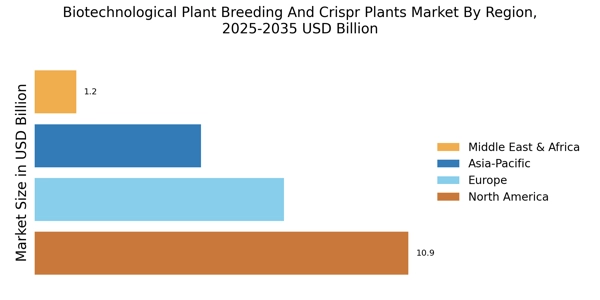
North America is the largest market for biotechnological plant breeding and CRISPR plants, holding approximately 45% of the global market share. The region benefits from robust investment in agricultural biotechnology, driven by increasing demand for sustainable farming practices and food security. Regulatory frameworks, such as the USDA's guidelines on genetically engineered organisms, further catalyze market growth by providing clear pathways for innovation. The United States and Canada are the leading countries in this sector, with major players like Corteva Agriscience and Monsanto Company driving advancements. The competitive landscape is characterized by significant R&D investments and collaborations among key stakeholders. The presence of established companies, along with emerging startups, fosters a dynamic environment for innovation and market expansion.
Europe is the second-largest market for biotechnological plant breeding and CRISPR plants, accounting for approximately 30% of the global market share. The region's growth is propelled by stringent regulations aimed at ensuring food safety and environmental sustainability. The European Commission's initiatives to promote innovative agricultural practices are crucial in shaping market dynamics and encouraging the adoption of biotechnological solutions. Leading countries in Europe include Germany, France, and the Netherlands, where companies like Bayer AG and BASF SE are at the forefront of innovation. The competitive landscape is marked by a strong emphasis on research and development, with significant investments in sustainable agricultural technologies. Collaborative efforts among industry players and research institutions further enhance the region's capabilities in biotechnological advancements.
Asia-Pacific is an emerging powerhouse in the biotechnological plant breeding and CRISPR plants market, holding approximately 20% of the global market share. The region's growth is driven by increasing agricultural demands, population growth, and the need for enhanced crop yields. Countries like China and India are investing heavily in biotechnology to address food security challenges, supported by favorable government policies and funding initiatives. China is the leading country in this region, with significant contributions from companies like Syngenta AG and local biotech firms. The competitive landscape is evolving, with a mix of established players and startups focusing on innovative solutions. The presence of research institutions and universities further bolsters the region's capabilities in advancing biotechnological applications in agriculture.
The Middle East and Africa represent a resource-rich frontier for biotechnological plant breeding and CRISPR plants, holding approximately 5% of the global market share. The region's growth is driven by the need for food security and sustainable agricultural practices, particularly in arid and semi-arid areas. Governments are increasingly recognizing the importance of biotechnology in enhancing crop resilience and productivity, leading to supportive policies and funding initiatives. Leading countries include South Africa and Kenya, where local companies and international players are collaborating to develop innovative agricultural solutions. The competitive landscape is characterized by a growing number of startups and research initiatives focused on biotechnology. The region's unique challenges present opportunities for tailored biotechnological applications that can significantly impact agricultural productivity.
Major players in Biotechnological Plant Breeding And Crispr Plants Market industry are constantly innovating and developing new technologies to gain a competitive edge. Leading Biotechnological Plant Breeding And Crispr Plants Market players are investing heavily in research and development to create improved varieties of crops that are more resistant to pests, diseases, and climate change. The Biotechnological Plant Breeding And Crispr Plants Market is also witnessing a growing number of partnerships and collaborations between companies to share knowledge and resources. These collaborations help accelerate the development of new technologies and products.
The competitive landscape of the Biotechnological Plant Breeding And Crispr Plants Market is expected to remain intense in the coming years as companies continue to compete for market share and develop new and innovative products.One of the leading companies in the Biotechnological Plant Breeding And Crispr Plants Market is Corteva Agriscience.
Corteva Agriscience is a global leader in the development and production of agricultural products, including seeds, crop protection products, and digital tools. The company has a strong presence in the Biotechnological Plant Breeding And Crispr Plants Market and offers a range of products and services to meet the needs of farmers around the world. Corteva Agriscience is committed to innovation and is constantly investing in research and development to create new and improved products.
The company has a team of experienced scientists and researchers who are working to develop new varieties of crops that are more resistant to pests, diseases, and climate change.
A major competitor in the Biotechnological Plant Breeding And Crispr Plants Market is Bayer Crop Science. Bayer Crop Science is a global leader in the development and production of agricultural products, including seeds, crop protection products, and digital tools. The company has a strong presence in the Biotechnological Plant Breeding And Crispr Plants Market and offers a range of products and services to meet the needs of farmers around the world. Bayer Crop Science is committed to innovation and is constantly investing in research and development to create new and improved products.
The company has a team of experienced scientists and researchers who are working to develop new varieties of crops that are more resistant to pests, diseases, and climate change.





The increasing demand for food production and the need to enhance crop yield and quality are the key factors driving the growth of the market. Technological advancements like gene editing and CRISPR-Cas systems have revolutionized plant breeding, allowing for precise and targeted modifications to improve crop traits. Governments and research institutions worldwide are actively supporting research and development in this field, contributing to the market's growth. Partnerships and collaborations between industry players and academic institutions are fostering innovation and accelerating the commercialization of CRISPR-based technologies.
The Biotechnological Plant Breeding and CRISPR Plants Market is projected to grow at a 12.35% CAGR from 2025 to 2035, driven by technological advancements, increasing demand for sustainable agriculture, and regulatory support.
New opportunities lie in:
By 2035, the market is expected to be robust, driven by innovation and strategic collaborations.
| MARKET SIZE 2024 | 24.34(USD Billion) |
| MARKET SIZE 2025 | 27.34(USD Billion) |
| MARKET SIZE 2035 | 87.63(USD Billion) |
| COMPOUND ANNUAL GROWTH RATE (CAGR) | 12.35% (2025 - 2035) |
| REPORT COVERAGE | Revenue Forecast, Competitive Landscape, Growth Factors, and Trends |
| BASE YEAR | 2024 |
| Market Forecast Period | 2025 - 2035 |
| Historical Data | 2019 - 2024 |
| Market Forecast Units | USD Billion |
| Key Companies Profiled | Bayer AG (DE), Corteva Agriscience (US), Syngenta AG (CH), BASF SE (DE), DuPont de Nemours Inc (US), Monsanto Company (US), Genective SAS (FR), KWS SAAT SE (DE), Limagrain (FR) |
| Segments Covered | Crop Type, Trait, Technology, Application, End User, Regional |
| Key Market Opportunities | Advancements in gene editing technologies enhance crop resilience and yield in the Biotechnological Plant Breeding And Crispr Plants Market. |
| Key Market Dynamics | Rising demand for sustainable agriculture drives innovation in biotechnological plant breeding and CRISPR technologies. |
| Countries Covered | North America, Europe, APAC, South America, MEA |
The projected market valuation for the Biotechnological Plant Breeding and CRISPR Plants Market is expected to reach 87.63 USD Billion by 2035.
The overall market valuation of the Biotechnological Plant Breeding and CRISPR Plants Market was 24.34 USD Billion in 2024.
The expected CAGR for the Biotechnological Plant Breeding and CRISPR Plants Market during the forecast period 2025 - 2035 is 12.35%.
The Cereals segment holds the highest valuation, with a projected value of 30.0 USD Billion by 2035.
Key traits driving growth include Yield Improvement, projected to reach 18.0 USD Billion by 2035, and Insect Resistance, expected to reach 14.75 USD Billion.
The Gene Editing (CRISPR-Cas9) technology segment is anticipated to dominate the market, with a projected valuation of 32.0 USD Billion by 2035.
Applications in Agriculture and Food Production are expected to see significant growth, with projected valuations of 30.0 USD Billion and 22.0 USD Billion, respectively, by 2035.
Key players in the market include Bayer AG, Corteva Agriscience, Syngenta AG, and BASF SE, among others.
The Farmers end-user segment is projected to have the highest market value, expected to reach 30.0 USD Billion by 2035.
The market for Nutritional Enhancement traits is projected to reach 14.38 USD Billion by 2035, indicating robust growth compared to other traits.


Kindly complete the form below to receive a free sample of this Report

“This is really good guys. Excellent work on a tight deadline. I will continue to use you going forward and recommend you to others. Nice job”


“Thanks. It’s been a pleasure working with you, please use me as reference with any other Intel employees.”


“Thanks for sending the report it gives us a good global view of the Betaïne market.”


“Thank you, this will be very helpful for OQS.”


“We found the report very insightful! we found your research firm very helpful. I'm sending this email to secure our future business.”


“I am very pleased with how market segments have been defined in a relevant way for my purposes (such as "Portable Freezers & refrigerators" and "last-mile"). In general the report is well structured. Thanks very much for your efforts.”


“I have been reading the first document or the study, ,the Global HVAC and FP market report 2021 till 2026. Must say, good info! I have not gone in depth at all parts, but got a good indication of the data inside!”


“We got the report in time, we really thank you for your support in this process. I also thank to all of your team as they did a great job.”


“The Automotive 48V ECU Components Procurement Intelligence Study” was a complex project, but the Market Research Future (MRFR) team handled it with quality, agility, and customer-centricity. They delivered all requested data on time and within the agreed scope. The team, including Shubhendra Anand and Rahul Gotadki, was always readily available to clarify questions and swiftly implement necessary adjustments, driving the project to a successful conclusion within a very demanding timeframe.
I would also like to specifically commend Akshay Agarwal for his responsiveness and support at every stage—from our initial inquiry on May 6th through to final delivery on June 18th. His dedication made the entire process seamless.”



