Bispecific Antibodies Market (2025 - 2035)

Bispecific Antibodies Market Research Report By Application (Cancer Treatment, Autoimmune Disorders, Infectious Diseases, Transplant Rejection), By Type (IgG-Based Bispecific Antibodies, ScFv-Based Bispecific Antibodies, Bispecific T-Cell Engager Antibodies), By Mechanism of Action (Direct Cell-Killing, Immune Modulation, Cytokine Release), By End User (Pharmaceutical Companies, Research Institutions, Clinical Research Organizations) and By Regional (North America, Europe, South America, Asia Pacific, Middle East and Africa) - Industry Forecast to 2035.
ID: MRFR/HC/20248-HCR
200 Pages
Nidhi Mandole, Rahul Gotadki
Last Updated: July 16, 2026
Bispecific Antibodies Market
Market Size
Forecast Period2025-2035
CAGR (2025-2035)19.2%
2025 Market SizeUSD 10.50 Billion
2035 Market SizeUSD 60.80 Billion
Key Players
Amgen
Roche / Genentech
Johnson & Johnson
AbbVie
Pfizer
Sanofi
Opportunities
  • Solid-Tumor Bispecific Programs
  • Bispecific Antibody-Drug Conjugates
  • Emerging-Market Access in Asia-Pacific and Latin America

Bispecific Antibodies Market Summary

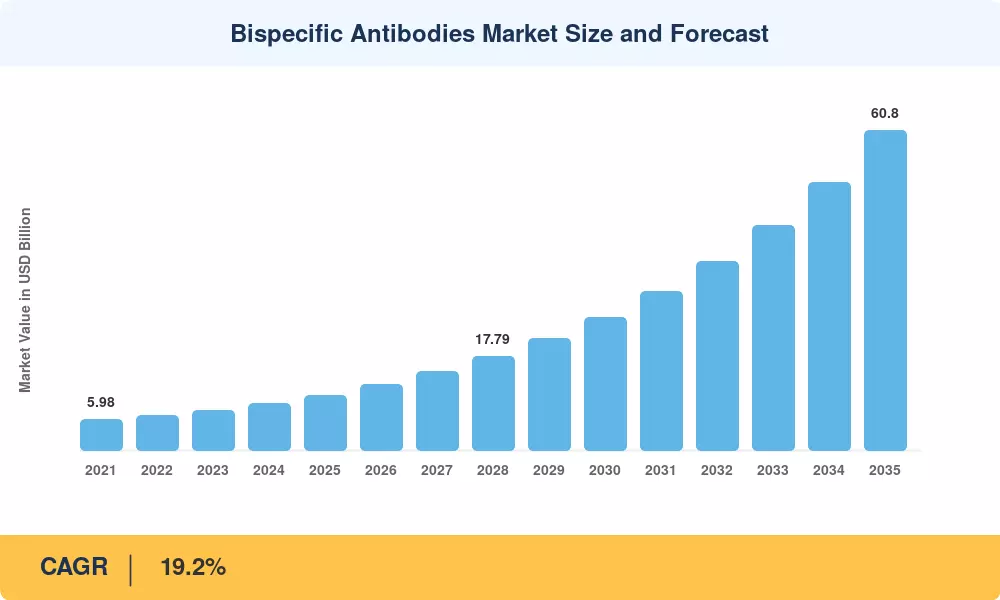
The Bispecific Antibodies Market reached an estimated USD 10.50 Billion in 2025, positioning it as one of the fastest-expanding segments within the broader biologics landscape. Projected to grow from USD 12.52 Billion in 2026 to USD 60.80 Billion by 2035 at a CAGR of 19.2%, the Bispecific Antibodies Market reflects intensifying clinical interest and accelerating regulatory approvals across major geographies. Two catalysts stand out: the FDA's renewed emphasis on expedited pathways for oncology biologics and a surge in venture funding that exceeded USD 4.8 billion across antibody-engineering startups in 2024 alone [2].

The therapeutic approach behind the Bispecific Antibodies Market is fundamentally reshaping how clinicians address complex diseases. Traditional monoclonal antibodies engage a single target, but bispecific constructs simultaneously bind two distinct epitopes—redirecting immune cells, blocking redundant signaling pathways, or delivering payloads with precision that monospecific formats cannot match. Platforms such as BiTE, CrossMab, and DuoBody have matured from laboratory curiosities into scalable manufacturing-ready architectures, and AI-driven protein design tools have compressed candidate optimization from years to months [3].

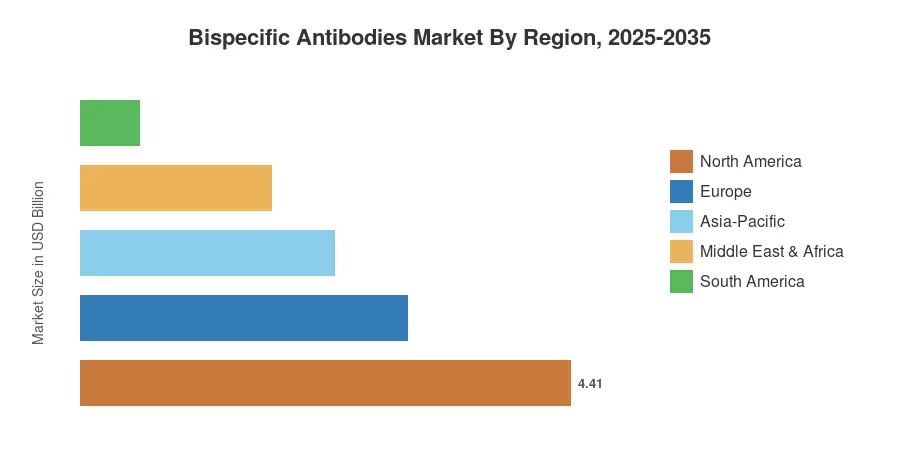
North America commands the largest share of the Bispecific Antibodies Market at roughly 42% of global revenue, anchored by robust FDA pipelines and deep payer infrastructure. Asia-Pacific is the fastest-growing region at an estimated 21.8% CAGR, powered by expanding clinical-trial capacity in China and India. Europe holds approximately 28% of the global Bispecific Antibodies Market, driven by EMA adaptive-licensing frameworks and collaborative academic–industry programs [4]. The decade ahead will be defined by portfolio diversification beyond oncology into autoimmune and infectious-disease indications.


Key Report Takeaways

• By Drug Type

  • Blinatumomab holds the largest revenue share in the Bispecific Antibodies Market, capturing approximately 38% of global sales in 2025.
  • The "Others" drug-type segment is forecast to register the highest CAGR through 2035 as novel constructs like glofitamab and teclistamab gain commercial traction.

• By Indication

  • Oncology accounts for over 72% of the Bispecific Antibodies Market by indication, reflecting deep pipeline concentration in hematologic and solid-tumor programs.
  • Autoimmune diseases represent the fastest-growing indication segment, driven by late-stage candidates targeting TNF and IL-17 dual pathways.

• By Region

  • North America leads the Bispecific Antibodies Market with a revenue base of approximately USD 4.41 Billion in 2025.
  • Asia-Pacific is projected to surpass USD 14.20 Billion by 2035, fueled by contract-development partnerships and favorable regulatory reforms in China.
  • Europe contributes roughly USD 2.94 billion to the global Bispecific Antibodies Market, with Germany and the UK as top contributors.


Bispecific Antibodies Market Size and Forecast (2021–2035)

Market sizing draws on primary interviews with pharmaceutical executives, triangulated against regulatory filings, prescriber audits, and company financial disclosures. Historical values reflect actual reported revenues; forecast values apply the calibrated 19.2% CAGR with adjustments for anticipated pipeline events and patent cliffs.
Bispecific Antibodies Market Size and Forecast
Our Impact
Enabled $4.3B Revenue Impact for Fortune 500 and Leading Multinationals
Partnering with 2000+ Global Organizations Each Year
30K+ Citations by Top-Tier Firms in the Industry

Driver Impact Analysis

Driver ~% Impact on CAGR Geographic Relevance Impact Timeline
Expanding oncology pipeline approvals +3.5% Global Short-term (≤2 yr)
AI-accelerated antibody engineering +2.8% North America, Europe Medium-term (2–4 yr)
Strategic pharma–biotech partnerships +2.4% Global Short-term (≤2 yr)
Rising autoimmune-indication R&D +2.1% North America, Asia-Pacific Medium-term (2–4 yr)
Regulatory pathway harmonization +1.8% Europe, Asia-Pacific Long-term (≥4 yr)
Manufacturing scale-up & CMO capacity +1.5% Global Medium-term (2–4 yr)
Combination-therapy clinical evidence +1.2% North America Long-term (≥4 yr)


Expanding Oncology Pipeline Approvals

Between 2022 and 2024, the FDA approved five new bispecific antibodies, a rate that is unparalleled for any single antibody format. As of early 2025, ClinicalTrials.gov lists more than 340 active bispecific programs, with approximately 60% of these programs focusing on hematologic malignancies and the remaining 40% on solid tumours [5]. This pipeline density ensures a consistent pace of commercial launches, which will support revenue growth in the Bispecific Antibodies Market until at least 2028.


AI-Accelerated Antibody Engineering

Computational protein-design platforms have cut lead-optimization timelines by an estimated 40–60%, according to a 2024 Nature Biotechnology analysis [3]. Companies such as Absci and Generate Biomedicines are applying generative AI to predict binding affinity and manufacturability simultaneously, reducing attrition rates in preclinical development. This efficiency gain lowers per-candidate costs by approximately USD 15–25 million, making the Bispecific Antibodies Market increasingly attractive to mid-cap pharmaceutical firms.

Strategic Pharma–Biotech Partnerships

Licensing deals in the bispecific space reached a cumulative value of USD 12.3 billion in upfront and milestone payments during 2023–2024 [6]. The January 2025 collaboration between Biohaven and Merus—focused on bispecific antibody-drug conjugates—illustrates how platform holders are monetizing their technology through co-development agreements. These partnerships accelerate clinical timelines and distribute financial risk across the Bispecific Antibodies Market value chain.

Rising Autoimmune-Indication R&D

The efficacy of dual-cytokine-blocking bispecific antibodies in rheumatoid arthritis and psoriasis has been statistically preferable to that of existing anti-TNF monotherapies in phase II readouts [8]. In 2024, Roche and AbbVie each disclosed autoimmune bispecific programs, indicating that the Bispecific Antibodies Market is expanding beyond its oncology origins. By 2032, analysts anticipate that autoimmune indications could generate 15–18% of the total bispecific revenue.


Restraints Impact Analysis

Restraint impact values are directional estimates of negative pressure on growth. They do not net directly against driver impacts and should be assessed qualitatively alongside the broader competitive environment.

Restraint ~% Impact on CAGR Geographic Relevance Impact Timeline
High manufacturing complexity & cost −2.5% Global Short-term (≤2 yr)
Safety & cytokine-release syndrome risk −1.8% Global Medium-term (2–4 yr)
Reimbursement & pricing pressure −1.5% Europe, Asia-Pacific Long-term (≥4 yr)
Limited real-world evidence for new constructs −1.2% North America, Europe Medium-term (2–4 yr)
Patent-cliff-driven biosimilar erosion −1.0% Global Long-term (≥4 yr)


High Manufacturing Complexity

Producing bispecific antibodies requires specialized cell-line engineering, proprietary purification trains, and stringent quality-control assays that conventional monoclonal antibody facilities cannot support without significant retooling. Industry estimates place cost-of-goods for bispecific products at 1.5–2.5× the cost of standard mAbs, compressing gross margins and limiting the number of CMOs capable of large-scale production. This constraint disproportionately affects smaller developers in the Bispecific Antibodies Market who lack internal manufacturing capacity.

Safety and Cytokine-Release Syndrome Risk

Cytokine-release syndrome (CRS) and neurotoxicity remain the most significant clinical safety concerns associated with bispecific T-cell engager formats. Step-up dosing protocols and tocilizumab premedication have mitigated severity, yet CRS incidence rates of 50–70% in pivotal lymphoma trials still give payers and physicians pause [15]. Addressing these safety signals is essential for the Bispecific Antibodies Market to penetrate community oncology settings where intensive monitoring infrastructure is limited.

Reimbursement and Pricing Pressure

Increasingly, European health-technology-assessment bodies, such as NICE and G-BA, have required head-to-head comparative data against established immunotherapies and CAR-T therapy prior to granting premium pricing. National formulary negotiations in China and South Korea have resulted in a 20–35% decrease in per-patient treatment costs in the Asia-Pacific region in comparison to US list prices [16]. The revenue outlook for the Bispecific Antibodies Market in price-sensitive geographies is influenced by these pricing dynamics.


Bispecific Antibodies Market Opportunities

Solid-Tumor Bispecific Programs

Hematologic malignancies have dominated the Bispecific Antibodies Market to date, but solid tumors represent a vastly larger addressable patient population. Phase I/II data for HER2×HER3 and EGFR×MET bispecific candidates reported at ASCO 2024 showed durable responses in treatment-refractory settings [17]. Success here could triple the commercial ceiling of the Bispecific Antibodies Market.

Bispecific Antibody-Drug Conjugates

Coupling bispecific targeting with cytotoxic payload delivery creates a differentiated modality that combines the selectivity of dual-epitope binding with the potency of ADC chemistry. Merus, Zymeworks, and Daiichi Sankyo all disclosed preclinical bispecific ADC programs during 2024 [6]. This convergence represents a high-value opportunity within the Bispecific Antibodies Market.

Emerging-Market Access in Asia-Pacific and Latin America

Regulatory reforms in China's NMPA and Brazil's ANVISA have shortened biologics approval timelines by 12–18 months compared with legacy processes [13]. Combined with growing healthcare expenditure—China's biologics spending grew 22% year-over-year in 2024—these markets offer significant greenfield opportunity for the Bispecific Antibodies Market.

Data-Driven Companion Diagnostics

Pairing bispecific therapies with biomarker-guided patient-selection tools enables precision prescribing and strengthens payer value propositions. Real-world-evidence platforms can generate post-market data that supports label expansions, creating a monetizable feedback loop for participants in the Bispecific Antibodies Market.

Subcutaneous Formulation Development

Transitioning bispecific antibodies from intravenous to subcutaneous delivery reduces administration burden and shifts treatment from hospital infusion centers to outpatient or home-based settings. Roche's subcutaneous glofitamab program demonstrated comparable pharmacokinetics in a 2024 Phase I extension study [18], opening patient-access pathways critical for the Bispecific Antibodies Market.


Bispecific Antibodies Market Future Outlook

AI-Driven Discovery and Autonomous Design

By 2028, machine-learning models that are capable of predicting the immunogenicity, polyspecificity, and developability of bispecific antibodies will be considered standard instruments. In 2024, an analysis predicted that AI could decrease the cost of biologics research and development by 25–35% over the next decade [3]. This would result in a reduction in the time from target identification to IND filing and a strengthening of the Bispecific Antibodies Market pipeline throughput.


Platform Convergence and Modular Formats

The proliferation of modular bispecific platforms—knobs-into-holes, strand-exchange, and trispecific extensions—will enable rapid format switching based on indication-specific pharmacology. This platform economy lowers barriers to entry and could increase the number of commercially viable bispecific products by 3–4× within the Bispecific Antibodies Market by 2032.

Off-the-Shelf and Outpatient Delivery Models

Subcutaneous formulations, fixed-duration regimens, and co-formulated bispecific-plus-checkpoint combinations will shift administration away from specialized infusion centers. The WHO projects that outpatient biologics delivery could reduce per-patient treatment costs by 30–40% in high-income countries by 2030 [18], a trend that will broaden accessibility within the Bispecific Antibodies Market.

ESG and Sustainable Biomanufacturing

Pharmaceutical companies face mounting pressure from ESG reporting frameworks to disclose the carbon intensity of biologics manufacturing. Continuous bioprocessing and single-use bioreactor systems can reduce water consumption by 50% and energy use by 30% compared with legacy stainless-steel facilities [22]. Manufacturers that invest in sustainable production will gain preferential procurement scoring in European and Japanese markets, influencing competitive dynamics across the Bispecific Antibodies Market.


Bispecific Antibodies Market Segmentation

By Drug Type

Segment Key Metric Primary Demand Driver
Blinatumomab ~38% share (2025) First-in-class BiTE with established formulary position
Catumaxomab CAGR 14.8% Re-emergence in Asian markets with reformulated product
Duligotumab USD 0.72 Billion (2025) HER2/HER3 dual targeting in solid tumors
Others CAGR 24.6% Glofitamab, teclistamab, mosunetuzumab pipeline momentum


Blinatumomab continues to anchor the Bispecific Antibodies Market drug-type landscape, having accumulated over a decade of real-world clinical use across acute lymphoblastic leukemia populations. Its established safety profile and widespread payer coverage create a durable revenue base even as newer constructs challenge its clinical positioning. The "Others" category—encompassing next-wave approvals like glofitamab (Roche) and teclistamab (Johnson & Johnson)—is expanding rapidly, reflecting the breadth of platforms now reaching commercial readiness across the Bispecific Antibodies Market.

By Indication

Segment Key Metric Primary Demand Driver
Oncology ~72% share (2025) Deep pipeline in hematologic and solid-tumor settings
Autoimmune Diseases CAGR 26.3% Dual-cytokine-blocking candidates in RA and psoriasis
Others USD 0.68 Billion (2025) Infectious disease and ophthalmology exploratory programs


Oncology dominates the Bispecific Antibodies Market by indication, reflecting over 250 active clinical programs targeting blood cancers and an increasing number of solid-tumor trials. Autoimmune diseases are the fastest-growing indication, propelled by clinical data showing that simultaneously neutralizing two inflammatory mediators delivers superior remission rates compared with sequential monotherapy approaches.

By Distribution Channel

Segment Key Metric Primary Demand Driver
Hospital Pharmacy ~65% share (2025) IV-administered products require infusion infrastructure
Retail Pharmacy CAGR 21.4% Subcutaneous formulations enabling community dispensing
Online Pharmacy USD 0.31 Billion (2025) Specialty e-pharmacy growth in chronic-disease management


Hospital pharmacies remain the primary distribution channel in the Bispecific Antibodies Market because most approved products require intravenous administration with CRS monitoring. As subcutaneous bispecific formulations gain approval, the retail and online channels will capture an increasing share, shifting the distribution center of gravity toward outpatient settings.


Regional Market Share Analysis

Region Key Metric Primary Investment Themes
North America ~42% share (2025) FDA accelerated pathways; payer adoption; biotech ecosystem
Europe ~28% share (2025) EMA adaptive licensing; academic collaborations
Asia-Pacific 21.8% CAGR (2026–2035) NMPA reforms; CRO/CDMO expansion; rising oncology burden
South America USD 0.53 Billion (2025) Biosimilar market entry; PAHO procurement programs
Middle East & Africa 16.4% CAGR (2026–2035) Gulf health-city investments; South Africa oncology capacity
Total USD 10.50 Billion (2025)

The Bispecific Antibodies Market displays pronounced regional asymmetry, with North America and Europe collectively accounting for approximately 70% of global revenue while Asia-Pacific drives the fastest growth trajectory.


North America

Country Key Metric Key Driver
US ~85% of regional share Deep payer infrastructure and FDA pipeline density
Canada CAGR 18.1% Pan-Canadian Pharmaceutical Alliance negotiations
Mexico USD 0.09 Billion (2025) Expanding specialty-pharmacy networks


The United States remains the anchor of the North American Bispecific Antibodies Market, generating the majority of global commercial revenues. The Inflation Reduction Act's provisions on Medicare drug negotiation have introduced pricing uncertainty, yet the law's exemption for small-molecule drugs relative to biologics means bispecific antibodies retain favorable reimbursement dynamics for at least six years post-launch [19].

Europe

Country Key Metric Key Driver
Germany ~24% of regional share G-BA benefit-assessment framework
UK CAGR 17.6% NICE managed-access agreements
France USD 0.41 Billion (2025) Early-access compassionate-use programs
Italy ~12% of regional share AIFA innovative-drug fund
Spain CAGR 16.8% Hospital-pharmacy specialty procurement
Nordic Countries USD 0.19 Billion (2025) Cross-border health-tech cooperation
Russia ~4% of regional share Domestic biologic manufacturing mandates
Rest of Europe CAGR 15.9% EU Pharmaceutical Strategy alignment


Europe's Bispecific Antibodies Market benefits from centralized EMA review procedures that enable simultaneous launch across 27 member states. Germany's AMNOG process and the UK's NICE Cancer Drugs Fund have been early adopters of bispecific reimbursement, creating template pricing corridors that other European payers reference [20].

Asia-Pacific

Country Key Metric Key Driver
China ~48% of regional share NMPA priority-review designations
India CAGR 23.5% Biosimilar manufacturing competence
Japan USD 0.42 Billion (2025) PMDA conditional-approval mechanism
South Korea ~11% of regional share MFDS expedited-review pathway
ASEAN CAGR 20.3% Growing specialist oncology centers
Rest of Asia-Pacific USD 0.10 Billion (2025) Healthcare infrastructure investments


China's Bispecific Antibodies Market has grown aggressively, driven by NMPA reforms that reduced biologics review timelines by nearly 40% since 2020 [10]. Domestic developers like Akeso and Alphamab are advancing PD-1/CTLA-4 and PD-1/VEGF bispecific constructs that directly compete with multinational products at significantly lower price points.

South America

Country Key Metric Key Driver
Brazil ~58% of regional share ANVISA biologics modernization
Argentina CAGR 17.2% Public-hospital oncology investment
Rest of South America USD 0.11 Billion (2025) PAHO technology-transfer agreements


Brazil's ANVISA has implemented a hybrid biologics pathway that balances innovation incentives with affordability goals, positioning the country as the gateway for the Bispecific Antibodies Market across Latin America [13].

Middle East & Africa

Country Key Metric Key Driver
Saudi Arabia ~32% of regional share Vision 2030 biopharma localization
UAE CAGR 18.5% Dubai and Abu Dhabi health-city programs
South Africa USD 0.08 Billion (2025) National Health Insurance oncology coverage
Egypt ~10% of regional share Generic-biologics regulatory framework
Rest of MEA CAGR 15.2% Pan-African pharmaceutical initiatives


Gulf Cooperation Council states are investing heavily in biopharma infrastructure as part of economic-diversification strategies. Saudi Arabia's NUPCO centralized procurement system has begun listing bispecific antibodies in specialty tenders, creating a structured entry point for the Bispecific Antibodies Market in the region [21].


Bispecific Antibodies Market By Region, 2025-2035

Competitive Benchmarking

The Bispecific Antibodies Market exhibits high concentration, with the top five players collectively commanding an estimated 55–65% of global revenue. The Herfindahl-Hirschman Index sits in the moderately concentrated range (~1,800–2,200), reflecting a market where a handful of large-cap pharmaceutical firms drive most commercial activity while a vibrant tier of biotech innovators expands the competitive perimeter.

Company Est. Revenue Share Range Key Offerings Strategic Positioning
Amgen ~14–18% Blinatumomab (Blincyto) First-mover in BiTE platform; deep oncology franchise
Roche / Genentech ~12–16% Glofitamab (Columvi), faricimab Broad bispecific portfolio spanning oncology and ophthalmology
Johnson & Johnson (Janssen) ~10–14% Teclistamab (Tecvayli) Strong hematology-oncology positioning
AbbVie ~5–8% ABBV-383, navicixizumab Pipeline-driven strategy with multiple Phase II assets
Pfizer ~4–7% Elranatamab (Elrexfio) Expanding into solid-tumor bispecifics
Sanofi ~3–6% Bispecific-ADC pipeline via partnerships Leveraging ADC conjugation expertise
AstraZeneca ~3–5% Early-stage bispecific oncology programs IO-combination-focused R&D strategy
Novartis ~2–4% Bispecific formats in immunology pipeline Diversification beyond checkpoint inhibitors
Akeso ~2–4% Cadonilimab (PD-1/CTLA-4 bispecific) Leading Chinese domestic bispecific developer
Merus N.V. ~1–3% Biclonics platform; zenocutuzumab Platform licensor with multiple partnership deals


Recent News & Developments


  • Johnson & Johnson (September 2024): Reported Phase III data showing teclistamab combination with daratumumab improved progression-free survival by 42% versus standard care in multiple myeloma [12].
  • Biohaven & Merus (January 2025): Entered a collaborative research and licensing agreement to co-develop three bispecific antibody-drug conjugates, combining Merus' Biclonics platform with Biohaven's conjugation technology [6].
  • Akeso (January 2024): Published positive Phase III results for cadonilimab (PD-1/CTLA-4 bispecific) in hepatocellular carcinoma, positioning the drug for NDA filing in China [10].


  • Amgen (June 2024): Expanded Blincyto label to include first-line consolidation in MRD-positive adult ALL patients following positive BLAST trial results [23].


Bispecific Antibodies Market Report Scope

Parameter Detail
Market Scope Global Bispecific Antibodies Market by Drug Type, Indication, Distribution Channel, and Geography
Study Period 2021–2035
CAGR (2026–2035) 19.2%
Market Size (2025) USD 10.50 Billion
Market Size (2035) USD 60.80 Billion
Fastest Growing Segment Others (Drug Type); Autoimmune Diseases (Indication); Online Pharmacy (Distribution Channel)
Companies Profiled Amgen, Roche, Johnson & Johnson, AbbVie, Pfizer, Sanofi, AstraZeneca, Novartis, Akeso, Merus N.V.
Valuation Currency USD Billion


FAQs

How do bispecific antibodies differ from CAR-T cell therapy in terms of logistics?
Bispecific antibodies are off-the-shelf biologics requiring no patient-specific manufacturing, enabling same-day treatment initiation. CAR-T demands weeks of autologous cell processing and specialized supply chains [15].
What intellectual-property considerations should investors evaluate in this space?
Platform patents covering knobs-into-holes and BiTE architectures expire between 2028 and 2031, potentially lowering licensing costs. Investors should assess freedom-to-operate risk for any construct built on these foundational technologies [9].
How are payers structuring value-based contracts for bispecific products?
Several US commercial payers have introduced outcomes-based rebates tied to complete-response rates at six months. European payers favor managed-access agreements with mandatory real-world data collection [16].
What role do companion diagnostics play in bispecific antibody prescribing?
Companion diagnostics remain underutilized; fewer than 20% of approved bispecific antibodies carry a required biomarker test. Expanding diagnostic co-development could improve patient selection and payer acceptance [11].
Which bispecific antibody formats show the strongest clinical-stage momentum?
BiTE and CrossMab platforms lead with the highest number of Phase III programs. Newer formats such as DuoBody and Biclonics are rapidly accumulating Phase I/II data across multiple tumor types [7].
How might biosimilar competition reshape the Bispecific Antibodies Market by 2030?
Early-wave bispecific patents begin expiring around 2029, but complex manufacturing and step-up dosing protocols create higher biosimilar development barriers than for standard monoclonal antibodies [9].
What manufacturing bottlenecks could constrain supply of bispecific antibodies?
Dual-chain expression, heterodimer purification, and CRS-related potency assays require specialized CDMO capabilities that remain scarce globally, limiting production scale-up speed [14].    
Author
Author
Author Profile
Nidhi Mandole LinkedIn
Senior Research Analyst
She is an extremely curious individual currently working in Healthcare and Medical Devices Domain. Nidhi is comfortably versed in data centric research backed by healthcare educational background. She leverages extensive data mining and analytics tools such as Primary and Secondary Research, Statistical Analysis, Machine Learning, Data Modelling. Her key role also involves Technical Sales Support, Client Interaction and Project management within the Healthcare team. Lastly, she showcases extensive affinity towards learning new skills and remain fascinated in implementing them.
Co-Author
Co-Author Profile
Rahul Gotadki LinkedIn
Research Manager
He holds an experience of about 9+ years in Market Research and Business Consulting, working under the spectrum of Life Sciences and Healthcare domains. Rahul conceptualizes and implements a scalable business strategy and provides strategic leadership to the clients. His expertise lies in market estimation, competitive intelligence, pipeline analysis, customer assessment, etc.
Download Free Sample

Kindly complete the form below to receive a free sample of this Report

Download PDF ×

We do not share your information with anyone. However, we may send you emails based on your report interest from time to time. You may contact us at any time to opt-out.
















