Black Start Generator Market (2026 - 2035)

Black Start Generator Market Size, Share & Growth Analysis Report By Fuel Type (Diesel, Natural Gas, Hybrid Battery-Diesel, Others), By Power Rating (Up to 1 MW, 1โ€“5 MW, Above 5 MW), By Starter Technology (Diesel Engine Start, Gas Turbine Start, Battery-Energy-Storage-Assisted, Compressed-Air / Pneumatic), By End-User (Power Utilities & T&D Operators, Data Centres & ICT Hubs, Industrial Facilities, Oil & Gas) and By Regional (North America, Europe, South America, Asia Pacific, Middle East and Africa) โ€“ Industry Growth & Forecast to 2035
ID: MRFR/EnP/28511-HCR
128 Pages
Priya Nagrale
Last Updated: July 10, 2026
Black Start Generator Market
Market Size
Forecast Period2026-2035
CAGR (2026-2035)5.6%
2025 Market SizeUSD 2.59 Billion
2035 Market SizeUSD 4.46 Billion
Key Players
Caterpillar Inc.
Cummins Inc.
GE Vernova
Generac Holdings
Rolls-Royce Power Systems
Siemens Energy
Opportunities
  • Hybrid Battery-Diesel Retrofit Programs
  • Emerging-Market Grid Buildout in Sub-Saharan Africa
  • Digital Twin and Predictive-Maintenance Platforms

Black Start Generator Market Summary

The black start generator market was valued at USD 2.59 billion in 2025 and is projected to reach USD 2.73 billion in 2026, climbing to USD 4.46 billion by 2035 at a CAGR of 5.6% during the forecast period. Tightening reliability mandates from NERC and FERC continue to compel transmission operators to maintain or upgrade their restart fleets, while the U.S. Department of Energy's Grid Resilience Innovation Partnership (GRIP) program โ€” allocating over USD 10.5 billion through 2026 โ€” is channeling fresh capital into restoration infrastructure [1][2].

A technology shift is underway within the black start generator market as legacy open-cycle diesel units give way to digitally controlled, hybrid battery-diesel platforms. Silicon-carbide power electronics and advanced alternator designs are reducing both start-up latency and emissions footprints. The European Commission's revised Trans-European Networks for Energy (TEN-E) regulation now explicitly includes black start assets in its cross-border infrastructure eligibility criteria, unlocking co-financing for operators modernizing aging gensets [3][4].

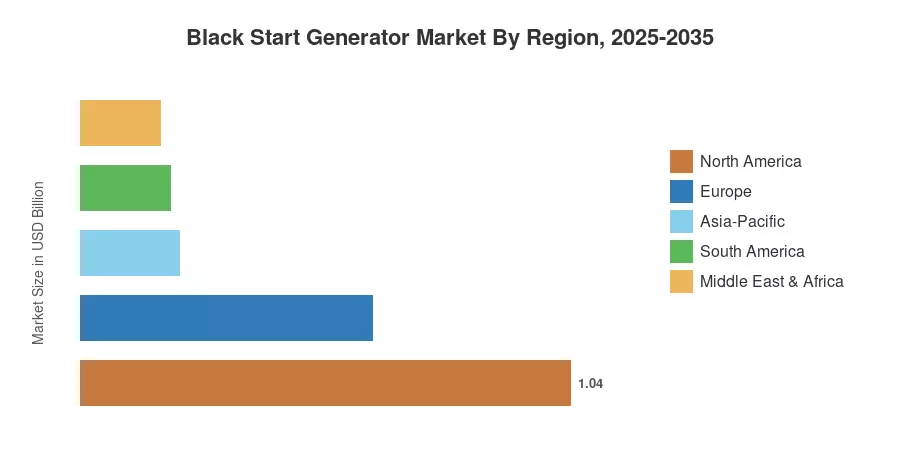
North America commanded roughly 40.0% of the black start generator market in 2025, anchored by mandatory NERC Standard EOP-005. Asia-Pacific is the fastest-growing region, expanding at approximately 8.0% CAGR as China's State Grid Corporation and India's Power Grid Corporation invest heavily in grid restoration capacity. Europe holds the second-largest position, driven by ENTSO-E harmonization of restoration codes across 35 transmission system operators. By 2035, the interplay of decarbonization targets and grid-stability regulations will keep this market on a sustained upward trajectory [5][6].

ย 

Key Report Takeaways

โ€ข By Fuel Type

  • Diesel accounted for approximately 57.0% of the black start generator market in 2025, reflecting its logistical simplicity and proven cold-start reliability across diverse climates.
  • Hybrid battery-diesel systems are the fastest-growing fuel segment, projected at a 9.7% CAGR through 2035.

โ€ข By Power Rating

  • Units rated up to 1 MW captured roughly 49.6% share of the black start generator market in 2025.
  • The 1โ€“5 MW class is expected to grow at an 8.7% CAGR, driven by utility-scale restoration needs.

โ€ข By End-User

  • Utilities and transmission operators held approximately 50.4% of the black start generator market in 2025.
  • Data centers are advancing at a 9.2% CAGR, fueled by hyperscale expansion and uptime SLAs.

โ€ข By Region

  • North America led with a 40.0% share of the black start generator market.
  • Asia-Pacific is the fastest-growing region at approximately 8.0% CAGR through 2035.

ย 

Market Size and Forecast (2021โ€“2035)

Market Research Future's sizing methodology triangulates top-down revenue analysis with bottom-up OEM shipment data and is validated through expert interviews across 14 countries. Historical figures (2021โ€“2024) reflect audited industry revenues; the 2025 base year is calibrated from preliminary shipment data; and the 2026โ€“2035 forecast applies a compound annual growth framework adjusted for cyclical capital-expenditure patterns in the power sector.
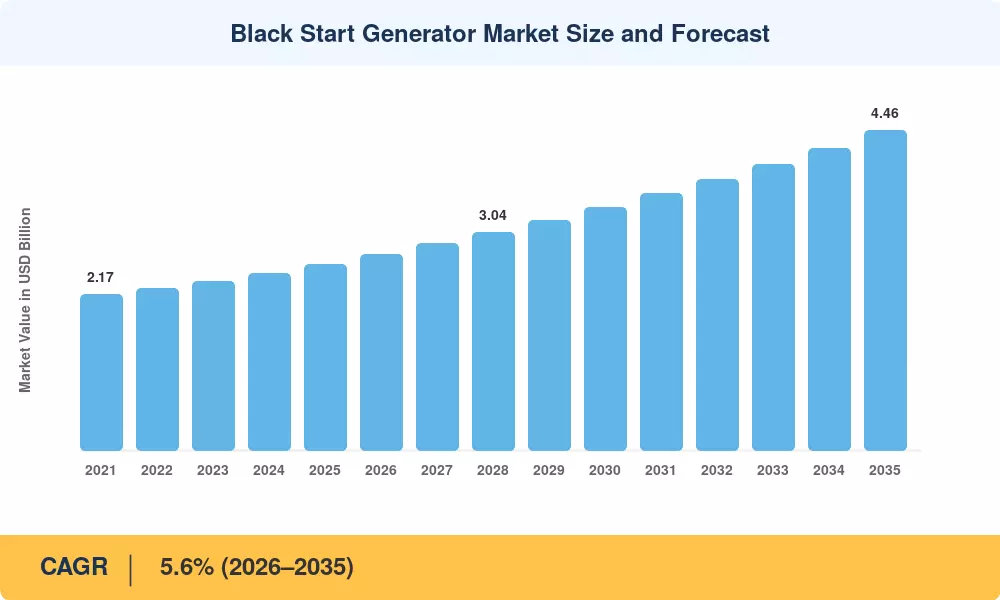
Black Start Generator Market Size and Forecast
Our Impact
Enabled $4.3B Revenue Impact for Fortune 500 and Leading Multinationals
Partnering with 2000+ Global Organizations Each Year
30K+ Citations by Top-Tier Firms in the Industry

Driver Impact Analysis

Driver ~% Impact on CAGR Geographic Relevance Impact Timeline
NERC/FERC reliability mandates ~18% North America Short-term (โ‰ค2 yr)
Extreme weather event frequency ~16% Global Medium-term (2โ€“4 yr)
Renewable integration & inverter-based resource growth ~15% Europe, Asia-Pacific Long-term (โ‰ฅ4 yr)
Hyperscale data-center expansion ~14% North America, Asia-Pacific Medium-term (2โ€“4 yr)
Grid modernization programs (China, India) ~13% Asia-Pacific Long-term (โ‰ฅ4 yr)
Hybrid battery-diesel technology maturation ~12% Europe, North America Medium-term (2โ€“4 yr)
Emission-reduction mandates for backup power ~10% Europe Long-term (โ‰ฅ4 yr)

ย 

Reliability Mandates Tighten Procurement Cycles

NERC Standard EOP-005-3 requires every transmission operator in North America to maintain a documented black start plan tested annually. FERC's 2023 Cold Weather Reliability Standards added winterization requirements that effectively mandate enclosed, heated genset enclosures โ€” a specification upgrade that is pulling forward replacement cycles. Operators who fail compliance audits face penalties up to USD 1.3 million per day, creating a non-discretionary demand floor for the black start generator market [2].

Extreme Weather Escalates Grid Vulnerability

According to NOAA's National Centers for Environmental Information, there were 102 weather-related incidents in the US alone between 2020 and 2024 that caused damages surpassing $1 billion. The February 2021 winter storm in Texas caused about USD 2.4 billion in grid hardening expenditures and left 4.5 million customers without power. Legislative and regulatory urgency around the black start generator industry is renewed with each significant outage incident, especially for utilities operating in hurricane and ice-storm corridors [9].

ย 

Hyperscale Data Centers Demand Backup Restoration

Global data-center capital expenditure surpassed USD 350 billion in 2024, per BloombergNEF estimates. Tier IV facilities require 2N redundancy, which means dedicated black start assets independent of the local grid. As AI-training clusters push single-campus power demand past 500 MW, operators increasingly specify on-site restoration capability as a procurement baseline โ€” directly expanding the addressable perimeter of the black start generator market [13].

Renewable Penetration Reduces System Inertia

By 2030, inverter-based renewable energy sources are expected to provide more than 35% of the world's electricity, according to the International Energy Agency. Because grids are more vulnerable to cascade failures due to lower rotational inertia, synchronous black start generators that can provide frequency reference during restoration sequences are strategically valuable. Synchronous machines must provide at least 30% of restoration capacity, according to ENTSO-E's 2024 System Defence Plan [5][6].

ย 

ย 

Restraints Impact Analysis

The restraint impacts below are directional estimates representing headwinds to CAGR growth. They do not sum algebraically with driver impacts and should be read as risk-weighting indicators.

Restraint ~% Negative Impact on CAGR Geographic Relevance Impact Timeline
Rare-earth metal supply constraints ~โ€“8% Global Medium-term (2โ€“4 yr)
Lengthy permitting & interconnection timelines ~โ€“6% Europe, North America Short-term (โ‰ค2 yr)
Competition from standalone BESS solutions ~โ€“5% North America, Europe Long-term (โ‰ฅ4 yr)
Diesel emission restrictions in urban zones ~โ€“4% Europe, Asia-Pacific Medium-term (2โ€“4 yr)
High capital cost for hybrid retrofits ~โ€“3% Global Short-term (โ‰ค2 yr)

ย 

Rare-Earth Metal Bottlenecks Pressure Alternator Supply

About 70% of the neodymium and dysprosium used in permanent-magnet alternators found in high-efficiency generator sets comes from China. Since 2022, export restrictions and quota changes have caused NdFeB magnet prices to fluctuate more than 40% annually. While silicon-carbide inverter-drive topologies and ferrite-magnet substitutes are developing, utility-grade equipment qualification processes last 18 to 24 months, which slows the changeover and limits short-term output capacity in the black start generator market [14].

ย 

Battery Energy Storage Encroaches on Traditional Use Cases

Standalone battery energy storage systems rated above 50 MW can now perform grid-forming functions previously exclusive to synchronous generators. ERCOT's pilot programs in Texas have demonstrated BESS-led black start restoration in controlled environments. Although battery duration limitations (typically 2โ€“4 hours) and fire-safety concerns restrict full substitution, the technology trajectory poses a structural long-term challenge to the conventional black start generator market [12].

Urban Emission Regulations Limit Diesel Deployment

Cities including London, Amsterdam, and Delhi have enacted or proposed low-emission zones that restrict the operation of diesel gensets above certain NOx and particulate thresholds. The EU's Medium Combustion Plant Directive requires new units between 1โ€“50 MW to meet tighter Tier 4 equivalent limits by 2030. Compliance adds 12โ€“18% to unit costs through selective catalytic reduction and diesel particulate filters, dampening the price competitiveness of diesel-dominant solutions [3].

ย 

Black Start Generator Market Opportunities

Hybrid Battery-Diesel Retrofit Programs

A significant installed base of aging diesel-only gensets โ€” estimated at over 12,000 units in NERC-registered fleets alone โ€” presents a retrofit opportunity. Adding lithium-ion battery modules and intelligent switchgear to existing platforms can reduce start-up time from 10โ€“15 minutes to under 90 seconds while cutting fuel consumption by 30%. OEMs offering turnkey retrofit kits stand to capture recurring revenue streams in the black start generator market.

Emerging-Market Grid Buildout in Sub-Saharan Africa

Sub-Saharan Africa's installed generation capacity is expected to double by 2035, per IRENA projections, yet interconnection infrastructure remains fragmented across 48 national grids. Each new independent power producer and regional interconnection hub requires dedicated black start capability. Development finance institutions, including the African Development Bank, have earmarked over USD 12 billion for power-sector modernization through 2032, creating a greenfield procurement pipeline for the black start generator market[15].

Digital Twin and Predictive-Maintenance Platforms

Continuous vibration, temperature, and fuel quality information from cloud-connected gensets can be fed into machine-learning models to anticipate breakdown events 48โ€“72 hours ahead of time. OEMs can diversify beyond hardware margins and strengthen customer lock-in throughout the black start generator industry by monetizing this data through subscription-based digital twin platforms, which charge USD 5,000โ€“15,000 per unit annually [13].

ย 

Compressed-Air and Pneumatic Start Technology Scale-Up

Compressed-air starting systems eliminate battery dependency and perform reliably in extreme cold (down to โ€“50ยฐC), making them attractive for Arctic and high-altitude installations. Current adoption sits below 8% of the market, but rising interest from Nordic utilities and Canadian operators could push this niche toward double-digit share by the early 2030s[16].

Microgrids and Islanded Industrial Complexes

The global microgrid market, projected to exceed USD 65 billion by 2032, inherently requires black start capability for autonomous operation. Mining sites, offshore platforms, and military forward-operating bases increasingly specify self-contained restoration packages. Integrating black start generators into turnkey microgrid solutions allows vendors to sell systems rather than standalone units[18].

ย 

Black Start Generator Market Future Outlook

AI-Optimized Restoration Sequencing

Artificial intelligence will reshape how restoration events are managed. Machine-learning algorithms trained on grid-topology data and historical outage patterns can reduce restoration time by 25โ€“40%, according to EPRI simulation studies. By 2030, expect the black start generator market to integrate autonomous dispatch protocols that coordinate multi-unit restart sequences without human intervention, cutting mean-time-to-restoration from hours to minutes [19].

Electrification Supercycle and Load Growth

The IEA projects global electricity demand will grow by 60% between 2025 and 2050, driven by electric vehicles, heat pumps, and industrial electrification. Higher peak loads translate directly into larger required restoration capacity. The black start generator market will need to scale rated output per unit while maintaining rapid start-up characteristics โ€” pushing OEMs toward modular, containerized designs deployable in parallel configurations [5].

Hydrogen and Low-Carbon Fuel Pathways

Natural gas gensets capable of blending 20โ€“30% green hydrogen are entering pilot programs at European utilities. The U.S. DOE's Hydrogen Shot initiative targets USD 1/kg hydrogen production by 2031, which could make hydrogen-blend black start generators cost-competitive with diesel by the mid-2030s. Early adopters in the black start generator market are already qualifying dual-fuel combustion chambers for hydrogen co-firing [20].

ESG Reporting and Scope 3 Emissions Pressure

Corporate sustainability reporting frameworks โ€” including the EU's Corporate Sustainability Reporting Directive and the SEC's climate disclosure rules โ€” are classifying backup generation emissions under Scope 2 or Scope 3 categories. Data-center operators and industrial end-users face increasing pressure to document and reduce emissions from their black start fleets. This regulatory trajectory will accelerate the transition from pure diesel toward hybrid and gas-fired solutions within the black start generator market [3][21].

ย 

Black Start Generator Market Segmentation

By Fuel Type

Segment Key Metric Primary Demand Driver
Diesel 57.0% share (2025) Proven reliability, simple fuel logistics
Natural Gas USD 0.49 Billion (2025) Emission compliance in urban zones
Hybrid Battery-Diesel 9.7% CAGR (2026โ€“2035) Rapid-start capability, reduced fuel use
Others USD 0.08 Billion (2025) Niche applications (biofuel, hydrogen blend)

ย 

Diesel remains the backbone of the black start generator market because it offers unmatched cold-start dependability and requires no pipeline infrastructure. Field operators in remote and Arctic locations prefer diesel for its storability and energy density. That said, hybrid battery-diesel platforms are gaining share rapidly โ€” integrating lithium-ion battery banks that handle the initial seconds of restoration before the diesel engine reaches rated speed. This architecture slashes start-up time and aligns with tightening emission regulations in North America and Europe.

Natural gas units are carving out a niche in urban and peri-urban installations where local air-quality ordinances restrict diesel operation. With LNG bunkering infrastructure expanding at ports and industrial hubs, gas-fired black start generators offer a viable mid-emission pathway between conventional diesel and emerging hydrogen-blend alternatives.

By Power Rating

Segment Key Metric Primary Demand Driver
Up to 1 MW 49.6% share (2025) Distribution-level restoration, small substations
1โ€“5 MW 8.7% CAGR (2026โ€“2035) Transmission-level restart, industrial campuses
Above 5 MW USD 0.31 Billion (2025) Bulk-system restoration, large power plants

ย 

Units rated up to 1 MW dominate the black start generator market because they serve the numerically largest fleet segment: distribution substations, telecom towers, and small industrial facilities. The 1โ€“5 MW segment, however, is expanding fastest as utilities upgrade from single-unit to modular multi-genset configurations at transmission substations. Above 5 MW, procurement is concentrated among large thermal power plants and pumped-storage facilities requiring high-inertia synchronous machines for bulk-system restoration.

By Starter Technology

Segment Key Metric Primary Demand Driver
Diesel Engine Start 57.0% share (2025) Mature installed base, low maintenance
Gas Turbine Start USD 0.28 Billion (2025) Combined-cycle plant restoration
Battery-Energy-Storage-Assisted 11.3% CAGR (2026โ€“2035) Sub-minute start-up, frequency support
Compressed-Air / Pneumatic 6.2% CAGR (2026โ€“2035) Extreme-cold reliability, no battery dependency

ย 

Diesel-engine start technology leads the black start generator market due to decades of field-proven performance and a deep aftermarket parts ecosystem. Battery-energy-storage-assisted start systems represent the technology frontier, enabling sub-60-second energization and providing synthetic inertia during the initial restoration window. EPRI testing has demonstrated that BESS-assisted starters reduce total restoration time by up to 45% compared with conventional cranking[19].

By End-User

Segment Key Metric Primary Demand Driver
Power Utilities & T&D Operators 50.4% share (2025) Regulatory compliance, system restoration
Data Centres & ICT Hubs 9.2% CAGR (2026โ€“2035) Uptime SLAs, Tier IV redundancy
Industrial Facilities USD 0.34 Billion (2025) Process continuity, safety-critical plants
Oil & Gas 4.9% CAGR (2026โ€“2035) Remote-site autonomy, offshore platforms

ย 

Power utilities and T&D operators represent the largest end-user class within the black start generator market, driven by non-discretionary regulatory requirements. Data centres are emerging as the fastest-growing segment because hyperscale operators now treat on-site restoration capability as a baseline design specification rather than an optional add-on. A single hour of downtime at a major cloud campus can cost USD 5โ€“10 million in SLA penalties and lost revenue, making the economics of black start investment straightforward[13].

ย 

Regional Market Share Analysis

Region Key Metric Primary Investment Themes
North America 40.0% share (2025) NERC compliance, data-center backup, hurricane hardening
Europe 24.0% share (2025) ENTSO-E restoration codes, emission zone compliance
Asia-Pacific 8.0% CAGR (2026โ€“2035) Grid modernization, renewable integration
South America USD 0.19 Billion (2025) Utility privatization, hydro-dependent restoration
Middle East & Africa USD 0.17 Billion (2025) Desalination-linked backup, oil & gas infrastructure
Total USD 2.59 Billion (2025) โ€”

The black start generator market spans five major regions, each shaped by distinct regulatory frameworks, grid architectures, and capital investment cycles.

ย 

North America

Country Key Metric Key Driver
US 72.5% of regional share FERC/NERC mandates, hyperscale data centers
Canada 5.8% CAGR Arctic infrastructure upgrades, hydro-grid restoration
Mexico USD 0.06 Billion (2025) CFE grid modernization, nearshoring industrial demand

ย 

The United States dominates the North American black start generator market because NERC Standard EOP-005 creates a compliance-driven procurement cycle that no operator can sidestep. Recent FERC orders tightening winterization and periodic testing requirements have compressed replacement timelines from 15 years to under 10. Canada's northern provinces are investing in compressed-air start units for extreme-cold installations, while Mexico's Comisiรณn Federal de Electricidad is tendering restoration packages as part of its USD 5.2 billion transmission reinforcement plan [1][2].

Europe

Country Key Metric Key Driver
Germany 22.0% of regional share Energiewende grid stability requirements
UK 5.4% CAGR National Grid ESO restoration tenders
France USD 0.07 Billion (2025) Nuclear fleet restart support
Italy 4.8% CAGR Terna interconnection resilience programs
Spain USD 0.04 Billion (2025) Renewable integration backup
Nordic Countries 5.9% CAGR Arctic-rated compressed-air systems
Russia USD 0.03 Billion (2025) Isolated grid backup for Eastern Siberia
Rest of Europe 4.5% CAGR ENTSO-E harmonization spillover

ย 

Europe's black start generator market is shaped by ENTSO-E's Network Code on Emergency and Restoration, which mandates cross-border coordination and regular restoration testing. Germany accounts for the largest national share, as the Energiewende's rapid renewable buildout has reduced system inertia and raised the premium on synchronous restart assets. The UK's National Grid ESO runs competitive tenders for black start services, awarding multi-year contracts that provide revenue certainty for OEMs and operators [3][6].

Asia-Pacific

Country Key Metric Key Driver
China 35.0% of regional share State Grid Corporation modernization
India 9.2% CAGR Power Grid Corporation ISTS expansion
Japan USD 0.05 Billion (2025) Post-Fukushima resilience mandates
South Korea 5.7% CAGR KEPCO smart-grid investments
ASEAN 7.8% CAGR Industrial zone backup requirements
Rest of Asia-Pacific USD 0.03 Billion (2025) Emerging grid infrastructure

ย 

Asia-Pacific is the fastest-growing region for the black start generator market, propelled by massive grid expansion programs in China and India. China's 14th Five-Year Plan allocated CNY 600 billion to transmission infrastructure upgrades, embedding black start specifications into every new 500 kV substation. India's Interstate Transmission System Phase III requires dedicated restoration assets at each pooling station, creating a procurement pipeline exceeding 800 units through 2030 [5][11].

South America

Country Key Metric Key Driver
Brazil 58.0% of regional share Hydro-dependent grid, drought vulnerability
Argentina 5.3% CAGR Vaca Muerta gas-linked power stations
Rest of South America USD 0.03 Billion (2025) Mining-sector backup demand

ย 

Brazil's heavy reliance on hydroelectric generation โ€” approximately 65% of installed capacity โ€” makes the black start generator market critical during drought-induced outages. The 2021 water crisis forced the national operator ONS to activate emergency thermal capacity, underscoring the need for pre-positioned restoration assets near load centers. Argentina's expanding gas-fired fleet in the Vaca Muerta basin also requires paired black start units [15].

Middle East & Africa

Country Key Metric Key Driver
Saudi Arabia 31.0% of regional share NEOM & Vision 2030 infrastructure
UAE 6.1% CAGR Data-center campus expansion
South Africa USD 0.03 Billion (2025) Eskom load-shedding mitigation
Egypt 5.5% CAGR New Administrative Capital grid setup
Rest of MEA USD 0.02 Billion (2025) Oil & gas facility backup

ย 

Saudi Arabia's Vision 2030 megaprojects, including NEOM and the Red Sea Development, require purpose-built power infrastructure with embedded restoration capability. South Africa's ongoing load-shedding crisis has pushed Eskom and independent power producers to procure mobile black start generator market solutions for rapid deployment. The UAE's emergence as a regional data-center hub in Dubai and Abu Dhabi is adding a new demand vector for high-reliability gensets [15][13].

ย 

Black Start Generator Market By Region, 2025-2035

Competitive Benchmarking

The black start generator market displays moderate concentration. The top five players command an estimated 45โ€“55% combined revenue share, while a long tail of regional assemblers and system integrators serves localized demand. The Herfindahl-Hirschman Index sits in the 800โ€“1,200 range, indicating a competitive but not fragmented landscape. Digital controls, remote monitoring, and low-carbon starter technologies are becoming the primary axes of differentiation.

Company Est. Revenue Share Range Key Offerings Strategic Positioning
Caterpillar Inc. ~12โ€“15% Cat Diesel & Gas Gensets, Cat Connect remote monitoring Broadest global dealer network, integrated service contracts
Cummins Inc. ~10โ€“13% QSK Series, PowerCommand digital controls Strong data-center channel, hybrid-ready platforms
GE Vernova ~8โ€“11% Jenbacher gas engines, aeroderivative turbines Combined-cycle restoration expertise, hydrogen-blend R&D
Generac Holdings ~6โ€“9% Industrial gensets, Mobile Link remote monitoring Growing utility segment after residential market leadership
Rolls-Royce Power Systems ~5โ€“8% MTU Series 4000, microgrid controllers Premium positioning, NATO-qualified defense applications
Siemens Energy ~4โ€“7% SGT-A05 aeroderivative turbine, grid-forming inverters Integrated T&D solutions, ENTSO-E restoration partnerships
Wรคrtsilรค Corporation ~3โ€“6% 34DF dual-fuel engines, GEMS energy management Flexible fuel capability, island-mode grid expertise
Mitsubishi Heavy Industries ~3โ€“5% MHIET gas engines, DIASYS Netmation controls Strong Asia-Pacific presence, nuclear-plant restart systems
KOHLER Power ~2โ€“4% KD Series, Decision-Maker paralleling controllers Data-center turnkey solutions, rapid-ship inventory model
ABB Ltd. ~2โ€“4% Ability Genix, MV/LV switchgear integration Automation-layer integration, substation control systems

ย 

ย 

Recent News & Developments

ย 

  • Cummins (January 2025): Announced a USD 180 million expansion of its Fridley, Minnesota facility to increase production capacity for 1โ€“5 MW black start generator platforms targeting data-center clients [13].
  • GE Vernova (October 2024): Completed pilot testing of a 30% hydrogen-blend Jenbacher black start engine at Uniper's Grain Power Station in the UK, achieving stable restoration performance [20].

ย 

  • Generac Holdings (June 2024): Acquired Grid Services Group, a UK-based provider of mobile black start units, for USD 95 million to expand its European utility footprint [22].
  • Siemens Energy (February 2024): Signed a five-year restoration services framework agreement with TenneT TSO covering 14 black start sites across the Netherlands and Germany [6].
  • NERC (November 2023): Published revised Standard EOP-005-4, incorporating mandatory winterization testing and fuel-supply resilience assessments for all registered black start resources [2].
  • Wรคrtsilรค (September 2023): Delivered four 34DF dual-fuel black start engines to PLN (Indonesia) for the Java-Bali grid restoration upgrade program [11].

ย 

Black Start Generator Market Report Scope

Parameter Detail
Market Scope Black start generator market โ€” hardware, integrated controls, and ancillary services
Study Period 2021โ€“2035
CAGR (Forecast) 5.6% (2026โ€“2035)
Base Year Market Size USD 2.59 Billion (2025)
Forecast Endpoint USD 4.46 Billion (2035)
Fastest Growing Segment Hybrid Battery-Diesel (by fuel type); Data Centres (by end-user)
Companies Profiled Caterpillar, Cummins, GE Vernova, Generac, Rolls-Royce, Siemens Energy, Wรคrtsilรค, Mitsubishi Heavy Industries, KOHLER, ABB
Valuation Currency USD Billion

ย 

ย 

FAQs

What maintenance interval should buyers expect for a typical black start genset?
Most OEMs recommend a 250-hour or annual service cycle, whichever comes first, covering oil changes, coolant testing, and battery-bank conditioning. Budgets should allocate approximately 2โ€“3% of asset value per year for scheduled maintenance [12].
How do battery-assisted start systems handle deep-discharge scenarios during prolonged outages?
Battery modules include charge-maintenance circuits that trickle-charge from station DC supplies. If DC power is lost for over 72 hours, integrated supercapacitor banks provide a backup cranking pulse [19].
What procurement lead times should utilities plan for when ordering 1โ€“5 MW units?
Lead times currently range from 26 to 40 weeks, depending on alternator configuration and emission-compliance tier. Buyers can shorten timelines by pre-qualifying standardized packages with major OEMs [22].
How does altitude affect black start generator performance specifications?
Diesel engines lose roughly 3.5% of rated output per 300 meters above 1,000 m elevation. High-altitude sites require turbocharger upgrades or oversized units to maintain restoration capacity [16].
What cybersecurity standards apply to digitally connected black start assets?
NERC CIP-002 through CIP-014 govern electronic security for bulk electric system assets, including remotely monitored gensets. Operators must implement encrypted SCADA links and multi-factor authentication [2].
Can a single black start generator service multiple substations simultaneously?
Technically, no โ€” each unit energizes one cranking path at a time. Modular multi-unit installations use automated sequencing controllers to restore parallel paths in staged succession [19].
How do lease-versus-buy economics compare for black start assets in the current interest-rate environment?
Operating leases spread cost over 7โ€“10 years and preserve capital for grid-hardening investments. At current rates, leasing adds roughly 8โ€“12% to lifetime cost versus outright purchase [18]. ย  ย 
Author
Author
Author Profile
Priya Nagrale LinkedIn
Senior Research Analyst
With an experience of over five years in market research industry (Chemicals & Materials domain), I gather and analyze market data from diverse sources to produce results, which are then presented back to a client. Also, provide recommendations based on the findings. As a Senior Research Analyst, I perform quality checks (QC) for market estimations, QC for reports, and handle queries and work extensively on client customizations. Also, handle the responsibilities of client proposals, report planning, report finalization, and execution
Download Free Sample

Kindly complete the form below to receive a free sample of this Report

Download PDF ×

We do not share your information with anyone. However, we may send you emails based on your report interest from time to time. You may contact us at any time to opt-out.
















