×
Request Free Sample ×

Kindly complete the form below to receive a free sample of this Report

* Please use a valid business email

Leading companies partner with us for data-driven Insights

clients tt-cursor
Hero Background

Blockchain in Energy Utilities Market

ID: MRFR/EnP/23753-HCR
128 Pages
Priya Nagrale
October 2025

Blockchain in Energy Utilities Market Research Report By Application (Energy Trading, Grid Management, Renewable Energy Integration, Smart Metering, Customer Engagement), By Energy Source (Solar, Wind, Hydroelectric, Thermal, Nuclear), By Deployment Model (Public Blockchain, Private Blockchain, Hybrid Blockchain) and By Regional (North America, Europe, South America, Asia Pacific, Middle East and Africa) - Forecast to 2035

Share:
Download PDF ×

We do not share your information with anyone. However, we may send you emails based on your report interest from time to time. You may contact us at any time to opt-out.

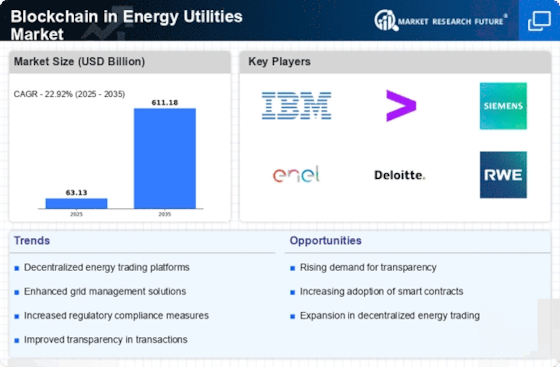
Blockchain Energy Utilities Market Infographic
Purchase Options

Blockchain in Energy Utilities Market Summary

As per MRFR analysis, the Blockchain in Energy Utilities Market was estimated at 63.13 USD Billion in 2024. The Blockchain in Energy Utilities industry is projected to grow from 77.6 USD Billion in 2025 to 611.18 USD Billion by 2035, exhibiting a compound annual growth rate (CAGR) of 22.92 during the forecast period 2025 - 2035.

Key Market Trends & Highlights

The Blockchain in Energy Utilities Market is poised for transformative growth driven by technological advancements and regulatory support.

  • Decentralized energy trading is emerging as a pivotal trend, particularly in North America, where market dynamics favor peer-to-peer transactions.
  • Enhanced data security measures are becoming increasingly critical as utilities seek to protect sensitive consumer information across both regions.
  • Integration with smart grids is gaining traction, especially in the Asia-Pacific region, facilitating more efficient energy distribution and management.
  • Key market drivers include regulatory support and increased consumer engagement, which are propelling the growth of energy trading and smart metering segments.

Market Size & Forecast

2024 Market Size 63.13 (USD Billion)
2035 Market Size 611.18 (USD Billion)
CAGR (2025 - 2035) 22.92%

Major Players

IBM (US), Accenture (US), Siemens (DE), Enel (IT), Deloitte (US), RWE (DE), Shell (GB), Exelon (US), IOTA Foundation (DE)

Blockchain in Energy Utilities Market Trends

The Blockchain in Energy Utilities Market is currently experiencing a transformative phase, driven by the increasing demand for transparency and efficiency in energy transactions. This technology offers a decentralized approach, enabling various stakeholders, including consumers, producers, and regulators, to engage in secure and transparent exchanges. The integration of blockchain solutions is likely to enhance operational efficiency, reduce costs, and facilitate the management of renewable energy sources. As energy systems evolve, the potential for blockchain to streamline processes and improve data integrity becomes increasingly apparent. Moreover, the rise of decentralized energy systems appears to be a significant factor influencing the Blockchain in Energy Utilities Market. With the growing emphasis on sustainability and the shift towards renewable energy, blockchain technology may play a crucial role in enabling peer-to-peer energy trading. This shift not only empowers consumers but also encourages the adoption of green energy solutions. As the market continues to mature, the collaboration between technology providers and energy companies is expected to foster innovative applications, further solidifying the role of blockchain in the energy sector.

Decentralized Energy Trading

The trend towards decentralized energy trading is gaining traction, as blockchain technology facilitates peer-to-peer transactions. This model allows consumers to buy and sell energy directly, bypassing traditional intermediaries. Such a shift could lead to more competitive pricing and increased consumer engagement in energy markets.

Enhanced Data Security

The implementation of blockchain in energy utilities is likely to bolster data security. By utilizing cryptographic techniques, blockchain can protect sensitive information from unauthorized access. This enhancement is particularly vital in an industry where data integrity and security are paramount.

Integration with Smart Grids

The convergence of blockchain technology with smart grid systems appears to be a promising trend. This integration may enable real-time monitoring and management of energy resources, optimizing energy distribution and consumption. As smart grids evolve, the synergy with blockchain could enhance operational efficiency.

Blockchain in Energy Utilities Market Drivers

Enhanced Data Security

Data security remains a paramount concern in the energy sector, and the Blockchain in Energy Utilities Market addresses this issue effectively. By utilizing blockchain technology, energy utilities can secure sensitive data against cyber threats and unauthorized access. The decentralized nature of blockchain ensures that data is not stored in a single location, making it less vulnerable to attacks. Reports indicate that energy companies implementing blockchain solutions have experienced a reduction in data breaches by approximately 40%. This enhanced security not only protects consumer information but also safeguards critical infrastructure. As the energy sector increasingly relies on digital solutions, the demand for secure data management through blockchain is expected to rise, further driving market growth.

Decentralized Energy Trading

The Blockchain in Energy Utilities Market is witnessing a shift towards decentralized energy trading platforms. These platforms enable peer-to-peer energy transactions, allowing consumers to buy and sell energy directly. This model reduces reliance on traditional utility companies and enhances market efficiency. According to recent studies, decentralized trading could potentially increase market participation by up to 30%, fostering competition and driving down prices. Furthermore, the transparency and traceability offered by blockchain technology ensure that transactions are secure and verifiable, which is crucial for building trust among participants. As more consumers adopt renewable energy sources, the demand for decentralized trading solutions is likely to grow, positioning blockchain as a key enabler in the energy sector.

Integration with Smart Grids

The integration of blockchain technology with smart grids is transforming the Blockchain in Energy Utilities Market. Smart grids facilitate real-time monitoring and management of energy consumption, while blockchain provides a secure and transparent framework for data exchange. This synergy allows for improved demand response and energy distribution, optimizing resource allocation. Market analysis suggests that the adoption of blockchain in smart grids could enhance operational efficiency by up to 25%. Additionally, this integration supports the proliferation of renewable energy sources, as it enables better tracking of energy generation and consumption. As utilities seek to modernize their infrastructure, the combination of blockchain and smart grids is likely to play a pivotal role in shaping the future of energy management.

Increased Consumer Engagement

Consumer engagement is a critical driver in the Blockchain in Energy Utilities Market, as blockchain technology empowers consumers to take control of their energy usage. With the rise of prosumers—individuals who both produce and consume energy—blockchain facilitates direct interactions between consumers and energy providers. This engagement is enhanced through transparent billing systems and real-time data access, allowing consumers to make informed decisions about their energy consumption. Market studies indicate that utilities adopting blockchain solutions have seen a 20% increase in customer satisfaction. As consumers become more environmentally conscious and seek sustainable energy options, the demand for blockchain-enabled solutions that promote engagement and transparency is likely to grow, further propelling market dynamics.

Regulatory Support and Compliance

Regulatory frameworks are evolving to accommodate the Blockchain in Energy Utilities Market, providing a conducive environment for innovation. Governments are increasingly recognizing the potential of blockchain to enhance transparency and accountability in energy transactions. For instance, regulatory bodies in various regions are developing guidelines that encourage the adoption of blockchain solutions for energy trading and grid management. This regulatory support not only fosters trust among stakeholders but also incentivizes investment in blockchain technologies. As compliance with these regulations becomes essential, energy utilities are likely to invest in blockchain solutions to ensure adherence, thereby driving market growth. The alignment of regulatory frameworks with technological advancements is expected to create new opportunities for blockchain in the energy sector.


Market Segment Insights

By Application: Energy Trading (Largest) vs. Smart Metering (Fastest-Growing)

In the Blockchain in Energy Utilities Market, Energy Trading holds the largest share, driven by its ability to streamline transactions and enhance security among stakeholders. The integration of blockchain technology into energy transactions has led to increased efficiencies, significant cost savings, and robust market access for various participants. Meanwhile, Smart Metering has rapidly gained traction, emerging as a key growth area within the sector, appealing to both utilities and consumers with its promise of transparency and real-time data sharing.

Smart Metering (Dominant) vs. Renewable Energy Integration (Emerging)

Smart Metering is dominating the application segment of the Blockchain in Energy Utilities Market, providing utilities with advanced data collection and management capabilities that foster efficiency in energy usage and grid management. It enables real-time monitoring and two-way communication between suppliers and consumers, paving the way for innovative pricing models and enhanced user engagement. On the other hand, Renewable Energy Integration is seen as an emerging force, leveraging blockchain to efficiently manage decentralized energy resources. This technology facilitates the verification and tracking of renewable energy generation and consumption, thereby promoting sustainability and regulatory compliance while attracting investments in clean energy.

By Energy Source: Solar (Largest) vs. Wind (Fastest-Growing)

In the Blockchain in Energy Utilities Market, the distribution of market share among energy sources showcases the increasing dominance of solar energy. Solar energy holds the largest share, leveraging advancements in photovoltaic technologies and decreasing installation costs. Wind energy follows closely, benefiting from government incentives and growing investment in renewable infrastructure, making it a vital player in the sector. The growth trends for this segment are primarily driven by the global push towards sustainable energy sources and digital transformation in the energy sector. Blockchain technology enhances transparency and efficiency in energy transactions, fostering innovation in solar and wind applications. This synergy between renewable energy sources and blockchain is expected to attract significant investments, further cementing the growing influence of these sectors in energy utilities.

Solar (Dominant) vs. Wind (Emerging)

Solar energy has established itself as the dominant force in the Blockchain in Energy Utilities Market due to its widespread adoption and technological advancements. The integration of blockchain technology enables solar energy producers to engage in peer-to-peer energy trading, improving efficiency and reliability. Meanwhile, wind energy is emerging rapidly as an essential complementary source, benefiting from technological innovations and cost reductions in turbine manufacturing. Wind farms are increasingly being equipped with blockchain solutions for enhanced operational management and real-time data sharing, positioning them as an attractive option for investors seeking sustainable energy projects.

By Deployment Model: Private Blockchain (Largest) vs. Public Blockchain (Fastest-Growing)

In the Blockchain in Energy Utilities Market, the deployment models are distinctly categorized into Public, Private, and Hybrid Blockchain. Among these, Private Blockchain has emerged as the largest segment, comprising a significant share due to its ability to offer enhanced security and privacy, which are crucial for energy companies handling sensitive data. Meanwhile, Public Blockchain, often viewed with skepticism due to security concerns, is quickly gaining traction as the fastest-growing segment. This shift indicates a robust interest among energy firms to leverage transparency and decentralization for enhanced operational efficiency. Growth trends in this segment reveal an increasing adoption of Blockchain technologies amidst a backdrop of rising demand for energy efficiency and sustainability. Factors driving this growth include regulatory support for energy decentralization, technological advancements enabling scalable and secure blockchain solutions, and the growing collaboration between industry players for energy trading and management. As companies look to innovate their operational frameworks, Hybrid Blockchains are also witnessing an uptick in interest, serving as a bridge between the security of Private solutions and the openness of Public Blockchains.

Private Blockchain (Dominant) vs. Public Blockchain (Emerging)

Private Blockchain is positioning itself as the dominant player in the Blockchain in Energy Utilities Market due to its superior capability of ensuring confidentiality, which is critical in the energy sector where sensitive operational data must be protected. By offering a controlled environment, it allows energy utilities to engage in secure transactions and data sharing among authorized parties. Meanwhile, Public Blockchain is fast becoming an emerging choice for energy companies advocating for transparency and accountability in transactions, with its capabilities to build trust among various stakeholders in the energy supply chain. Hybrid Blockchain also plays a significant role by merging the benefits of both Private and Public models, catering to diverse requirements from utility providers seeking flexible, agile, yet secure blockchain solutions.

Get more detailed insights about Blockchain in Energy Utilities Market

Regional Insights

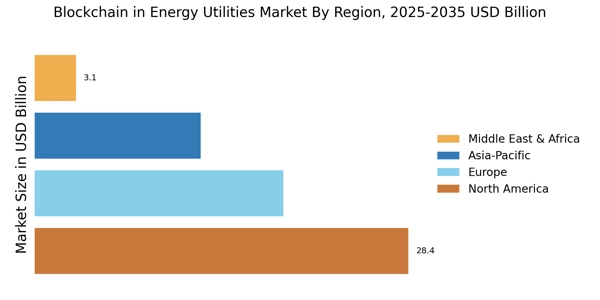
The Blockchain in Energy Utilities Market is segmented into North America, Europe, APAC, South America, and MEA. North America is expected to hold the largest market share due to the presence of major energy companies and the early adoption of blockchain technology. Europe is expected to be the second-largest market due to the increasing demand for renewable energy and the favorable regulatory environment. APAC is expected to be the fastest-growing market due to the growing energy demand and the increasing adoption of blockchain technology in the region.

South America and MEA are expected to be smaller markets but are expected to grow at a steady pace.

Blockchain in Energy Utilities Market Regional Image

Key Players and Competitive Insights

Key players in the Blockchain in Energy Utilities Market sector continue to invest in research and development to boost productivity and leverage a competitive edge. Moreover, acquiring start-ups and partnering with other major players in the market have been other strategies followed by key market players to increase business efficiency, robustness, and scale.

The market growth is mainly driven by factors such as rising awareness of the advantages of blockchain technology, increasing government funding and support, and surging demand for energy-efficient systems. However, lack of standardizing and inter-operability and related security concerns are key factors hindering market growth. As a vital player operating in the energy utilities market, IBM provides an extensive range of blockchain solutions containing DLT, smart contracts, energy trading platforms, etc. Partnering with renowned utilities like Enel, Shell, and BP has been their strategy to take advantage of such opportunities and increase the efficiency of their operations.

Major. Accenture is another prominent player operating in the energy utilities market. With a comprehensive range of consulting strategies, and blockchain and technical solutions, it is currently operating successfully across the worldwide market. From utilities’ operations to market structure, it covered a wide range of applications with its extensive offerings. The company’s main objective is to efficiently reduce costs with robust operational efficiency and client servicing. Key companies have been working as its clients, with examples like National Grid, Duke, and Iberdrola to help them implement blockchain energy solutions related to asset management, supplier, or customer billing.

Key Companies in the Blockchain in Energy Utilities Market market include

Industry Developments

  • Q2 2024: Siemens launches blockchain-based energy trading platform in Germany Siemens announced the launch of a blockchain-powered platform for peer-to-peer energy trading, enabling households and businesses to buy and sell renewable electricity directly. The initiative aims to increase grid efficiency and transparency.
  • Q2 2024: Shell invests in LO3 Energy to expand blockchain microgrid projects Shell Ventures led a funding round for LO3 Energy, supporting the expansion of its blockchain-enabled microgrid projects in the U.S. and Europe. The investment will accelerate the deployment of decentralized energy trading solutions.
  • Q3 2024: Power Ledger partners with Tata Power-DDL for blockchain energy trading in Delhi Power Ledger and Tata Power-DDL announced a partnership to implement blockchain-based peer-to-peer energy trading in North Delhi, allowing consumers to trade solar electricity and improve grid management.
  • Q3 2024: Energy Web launches blockchain platform for green hydrogen certification Energy Web unveiled a blockchain-based platform to certify green hydrogen production, enabling transparent tracking of renewable energy sources used in hydrogen generation for industrial clients.
  • Q4 2024: IBM and EDF sign agreement to deploy blockchain for smart grid management IBM and EDF announced a strategic agreement to deploy blockchain technology for smart grid automation and data exchange, aiming to enhance grid reliability and support renewable integration in France.
  • Q4 2024: Spanish utility Iberdrola launches blockchain pilot for renewable energy tracking Iberdrola launched a pilot project using blockchain to track the origin and consumption of renewable electricity, providing customers with verifiable data on their energy sources.
  • Q1 2025: Australian startup Power Ledger raises $20M Series B to scale blockchain energy platform Power Ledger secured $20 million in Series B funding to expand its blockchain-based energy trading platform across new markets in Asia-Pacific and Europe.
  • Q1 2025: Singapore grants regulatory approval for blockchain-based carbon credit exchange Singapore’s Monetary Authority granted regulatory approval for a blockchain-powered carbon credit trading platform, enabling verified carbon offset transactions for energy utilities and industrial clients.
  • Q2 2025: Siemens and Enel X announce partnership for blockchain-enabled demand response Siemens and Enel X formed a partnership to deploy blockchain technology for automated demand response programs, allowing real-time energy load adjustments and improved grid stability.
  • Q2 2025: National Grid UK pilots blockchain for electric vehicle charging settlements National Grid UK began a pilot project using blockchain to automate settlements for electric vehicle charging, aiming to streamline billing and support grid balancing.
  • Q3 2025: Energy Web and Engie launch blockchain platform for decentralized energy asset management Energy Web and Engie announced the launch of a blockchain-based platform to manage decentralized energy assets, enabling real-time data exchange and improved asset optimization.
  • Q3 2025: Enel Green Power acquires blockchain startup FlexiGrid to enhance renewable integration Enel Green Power acquired FlexiGrid, a blockchain technology startup, to strengthen its capabilities in integrating distributed renewable energy resources and automating grid operations.

Future Outlook

Blockchain in Energy Utilities Market Future Outlook

The Blockchain in Energy Utilities Market is projected to grow at a 22.92% CAGR from 2024 to 2035, driven by increased demand for transparency, efficiency, and decentralized energy solutions.

New opportunities lie in:

  • Development of decentralized energy trading platforms
  • Integration of blockchain for renewable energy certificates
  • Implementation of smart contracts for automated billing processes

By 2035, the market is expected to be robust, driven by innovative blockchain applications in energy utilities.

Market Segmentation

Blockchain Energy Utilities Market Application Outlook

  • Energy Trading
  • Grid Management
  • Renewable Energy Integration
  • Smart Metering
  • Customer Engagement

Blockchain Energy Utilities Market Energy Source Outlook

  • Solar
  • Wind
  • Hydroelectric
  • Thermal
  • Nuclear

Blockchain Energy Utilities Market Deployment Model Outlook

  • Public Blockchain
  • Private Blockchain
  • Hybrid Blockchain

Report Scope

MARKET SIZE 2024 63.13(USD Billion)
MARKET SIZE 2025 77.6(USD Billion)
MARKET SIZE 2035 611.18(USD Billion)
COMPOUND ANNUAL GROWTH RATE (CAGR) 22.92% (2024 - 2035)
REPORT COVERAGE Revenue Forecast, Competitive Landscape, Growth Factors, and Trends
BASE YEAR 2024
Market Forecast Period 2025 - 2035
Historical Data 2019 - 2024
Market Forecast Units USD Billion
Key Companies Profiled Market analysis in progress
Segments Covered Market segmentation analysis in progress
Key Market Opportunities Integration of decentralized energy trading platforms enhances efficiency in the Blockchain in Energy Utilities Market.
Key Market Dynamics Rising adoption of blockchain technology enhances transparency and efficiency in energy utility operations and transactions.
Countries Covered North America, Europe, APAC, South America, MEA

Leave a Comment

FAQs

What is the projected market valuation for the Blockchain in Energy Utilities Market by 2035?

The projected market valuation for the Blockchain in Energy Utilities Market by 2035 is 611.18 USD Billion.

What was the overall market valuation for the Blockchain in Energy Utilities Market in 2024?

The overall market valuation for the Blockchain in Energy Utilities Market in 2024 was 63.13 USD Billion.

What is the expected CAGR for the Blockchain in Energy Utilities Market during the forecast period 2025 - 2035?

The expected CAGR for the Blockchain in Energy Utilities Market during the forecast period 2025 - 2035 is 22.92%.

Which application segment has the highest valuation in the Blockchain in Energy Utilities Market?

The Customer Engagement application segment has the highest valuation, reaching 161.18 USD Billion.

What are the key players in the Blockchain in Energy Utilities Market?

Key players in the Blockchain in Energy Utilities Market include IBM, Accenture, Siemens, Enel, Deloitte, RWE, Shell, Exelon, and IOTA Foundation.

How does the valuation of the Private Blockchain segment compare to the Public Blockchain segment?

The valuation of the Private Blockchain segment is 250.0 USD Billion, significantly higher than the Public Blockchain segment at 150.0 USD Billion.

What is the valuation of the Thermal energy source segment in the Blockchain in Energy Utilities Market?

The valuation of the Thermal energy source segment is 180.0 USD Billion.

Which deployment model segment is projected to have the highest growth in the Blockchain in Energy Utilities Market?

The Private Blockchain deployment model segment is projected to have the highest growth, with a valuation of 250.0 USD Billion.

What is the valuation of the Renewable Energy Integration application segment?

The valuation of the Renewable Energy Integration application segment is 100.0 USD Billion.

How does the Grid Management application segment's valuation compare to the Smart Metering segment?

The Grid Management application segment's valuation is 120.0 USD Billion, which is higher than the Smart Metering segment at 80.0 USD Billion.

Download Free Sample

Kindly complete the form below to receive a free sample of this Report

Compare Licence

×
Features License Type
Single User Multiuser License Enterprise User
Price $4,950 $5,950 $7,250
Maximum User Access Limit 1 User Upto 10 Users Unrestricted Access Throughout the Organization
Free Customization
Direct Access to Analyst
Deliverable Format
Platform Access
Discount on Next Purchase 10% 15% 15%
Printable Versions