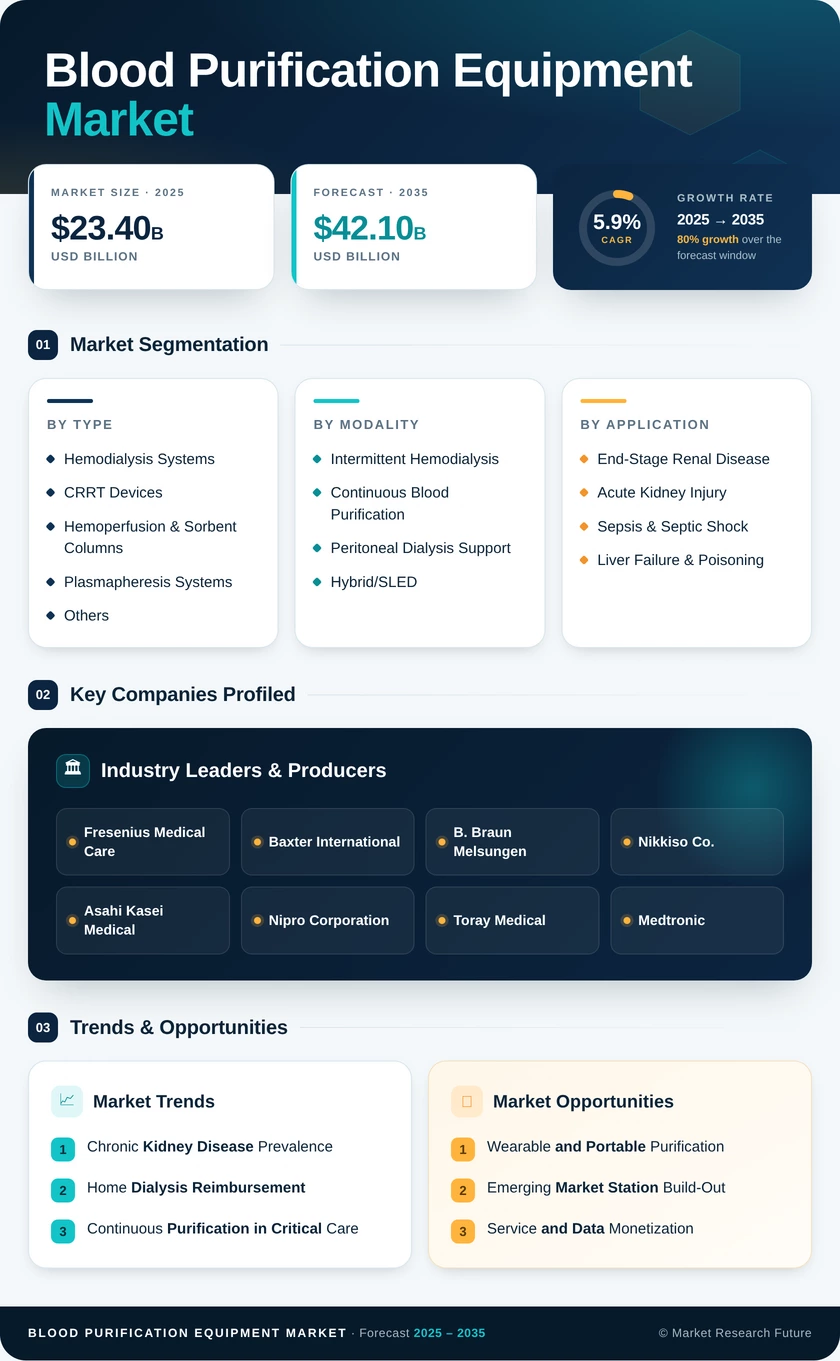
Blood Purification Equipment Market (2026 - 2035)

Blood Purification Equipment Market Research Report By Application (Dialysis, Hemoperfusion, Plasmapheresis, Filtration), By Blood Purification Type (Hemodialysis, Peritoneal Dialysis, Continuous Renal Replacement Therapy, Intermittent Hemodialysis), By Blood Filter Material (Polyarylethersulfone, Cellulose Cellulose Acetate, Polyethersulfone, Polysulfone), By End User (Hospitals, Dialysis Clinics, Ambulatory Care Centers, Home Use), By Portability (Portable, Non-Portable) and By Regional (North America, Europe, South America, Asia Pacific, Middle East and Africa) - Growth & Industry Forecast 2025 To 2035

Forecast Period
2026-2035
CAGR
5.9%
2025 Market Size
USD 23.4 Billion
2035 Market Size
USD 42.1 Billion
Medical Device ● Updated August 2026 Report ID: MRFR/MED/7566-HCR | Pages: 128 | Author: Satyendra Maurya, Rahul Gotadki
  1. 1 Market Summary |
    1. 1.1 Study Assumptions & Market Definition |
    2. 1.2 Scope of the Study |
    3. 1.3 Research Methodology
  2. 2 Key Report Takeaways |
    1. 2.1 By Product Type |
    2. 2.2 By Modality & End User |
    3. 2.3 By Geography
  3. 3 Market Size & Forecast (2021–2035) |
    1. 3.1 Historical Market Size (2021–2025) |
    2. 3.2 Current & Forecast Market Size (2026–2035) |
    3. 3.3 Year-over-Year Growth Analysis
  4. 4 Driver Impact Analysis |
    1. 4.1 Chronic Kidney Disease Prevalence |
    2. 4.2 Home Dialysis Reimbursement |
    3. 4.3 Continuous Purification in Critical Care |
    4. 4.4 Asia-Pacific Capacity Investment
  5. 5 Restraints Impact Analysis |
    1. 5.1 Supply-Chain Concentration |
    2. 5.2 Reimbursement Compression |
    3. 5.3 Workforce Shortages
  6. 6 Opportunities |
    1. 6.1 Wearable and Portable Purification |
    2. 6.2 Emerging Market Station Build-Out |
    3. 6.3 Service and Data Monetization |
    4. 6.4 Sepsis and Liver-Support Indications |
    5. 6.5 Membrane Innovation Licensing
  7. 7 Regional Market Share & Country-Level Analysis |
    1. 7.1 North America | |
      1. 7.1.1 US | |
      2. 7.1.2 Canada | |
      3. 7.1.3 Mexico |
    2. 7.2 Europe | |
      1. 7.2.1 Germany | |
      2. 7.2.2 UK | |
      3. 7.2.3 France | |
      4. 7.2.4 Italy | |
      5. 7.2.5 Spain | |
      6. 7.2.6 Nordic Countries | |
      7. 7.2.7 Russia | |
      8. 7.2.8 Rest of Europe |
    3. 7.3 Asia-Pacific | |
      1. 7.3.1 China | |
      2. 7.3.2 India | |
      3. 7.3.3 Japan | |
      4. 7.3.4 South Korea | |
      5. 7.3.5 ASEAN | |
      6. 7.3.6 Rest of Asia-Pacific |
    4. 7.4 South America | |
      1. 7.4.1 Brazil | |
      2. 7.4.2 Argentina | |
      3. 7.4.3 Rest of South America |
    5. 7.5 Middle East & Africa | |
      1. 7.5.1 Saudi Arabia | |
      2. 7.5.2 UAE | |
      3. 7.5.3 South Africa | |
      4. 7.5.4 Egypt | |
      5. 7.5.5 Rest of MEA
  8. 8 Future Outlook (2026–2035) |
    1. 8.1 Algorithmic Treatment Management |
    2. 8.2 Consumables as the Profit Center |
    3. 8.3 Decentralization of Care |
    4. 8.4 Environmental Accountability
  9. 9 Market Segmentation Analysis |
    1. 9.1 By Product Type | |
      1. 9.1.1 Hemodialysis Systems | |
      2. 9.1.2 CRRT Devices | |
      3. 9.1.3 Hemoperfusion & Sorbent Columns | |
      4. 9.1.4 Plasmapheresis Systems | |
      5. 9.1.5 Others |
    2. 9.2 By Modality | |
      1. 9.2.1 Intermittent Hemodialysis | |
      2. 9.2.2 Continuous Blood Purification | |
      3. 9.2.3 Peritoneal Dialysis Support | |
      4. 9.2.4 Hybrid/SLED |
    3. 9.3 By End User | |
      1. 9.3.1 Hospitals & Dialysis Centers | |
      2. 9.3.2 Home Care Settings | |
      3. 9.3.3 Ambulatory Surgical Centers | |
      4. 9.3.4 Others |
    4. 9.4 By Application | |
      1. 9.4.1 End-Stage Renal Disease | |
      2. 9.4.2 Acute Kidney Injury | |
      3. 9.4.3 Sepsis & Septic Shock | |
      4. 9.4.4 Liver Failure & Poisoning
  10. 10 Competitive Landscape |
    1. 10.1 Market Share Analysis (2026) |
    2. 10.2 Competitive Benchmarking Matrix |
    3. 10.3 Company Profiles
  11. 11 Recent News & Developments
  12. 12 Report Scope & Methodology
  13. 13 Detailed Sources & Citations
  14. 14 Frequently Asked Questions
  15. 15 LIST OF TABLES |
  16. TABLE 1 Global Blood Purification Equipment Market Size & Forecast, by Revenue (USD Billion), 2021–2035 |
  17. TABLE 2 Global Blood Purification Equipment Market – Year-over-Year Growth Analysis, 2021–2035 |
  18. TABLE 3 Driver Impact Analysis Matrix, 2026–2035 |
  19. TABLE 4 Restraint Impact Analysis Matrix, 2026–2035 |
  20. TABLE 5 Global Market Size, by Product Type, 2021–2035 (USD Billion) |
  21. TABLE 6 Global Market Size, by Modality, 2021–2035 (USD Billion) |
  22. TABLE 7 Global Market Size, by End User, 2021–2035 (USD Billion) |
  23. TABLE 8 Global Market Size, by Application, 2021–2035 (USD Billion) |
  24. TABLE 9 Global Market Size, by Region, 2021–2035 (USD Billion) |
  25. TABLE 10 North America Market Size, by Country, 2021–2035 (USD Billion) |
  26. TABLE 11 Europe Market Size, by Country, 2021–2035 (USD Billion) |
  27. TABLE 12 Asia-Pacific Market Size, by Country, 2021–2035 (USD Billion) |
  28. TABLE 13 South America Market Size, by Country, 2021–2035 (USD Billion) |
  29. TABLE 14 Middle East & Africa Market Size, by Country, 2021–2035 (USD Billion) |
  30. TABLE 15 North America Market Size, by Product Type, 2021–2035 (USD Billion) |
  31. TABLE 16 Europe Market Size, by Product Type, 2021–2035 (USD Billion) |
  32. TABLE 17 Asia-Pacific Market Size, by Product Type, 2021–2035 (USD Billion) |
  33. TABLE 18 South America Market Size, by Application, 2021–2035 (USD Billion) |
  34. TABLE 19 Middle East & Africa Market Size, by End User, 2021–2035 (USD Billion) |
  35. TABLE 20 Competitive Benchmarking Matrix, 2026 |
  36. TABLE 21 Company Profiles – Key Players |
  37. TABLE 22 Recent Developments & Strategic Announcements, 2023–2025 |
  38. TABLE 23 Report Scope & Methodology Summary |
  39. TABLE 24 Detailed Sources & Citations Index
  40. 16 LIST OF FIGURES |
  41. FIGURE 1 Market Dynamics – Drivers, Restraints & Opportunities Snapshot |
  42. FIGURE 2 Industry Value Chain Analysis |
  43. FIGURE 3 Porter's Five Forces Analysis |
  44. FIGURE 4 Global Market Size Trend, 2021–2035 (USD Billion) |
  45. FIGURE 5 Year-over-Year Growth Trajectory, 2022–2035 |
  46. FIGURE 6 Market Share by Product Type, 2025 vs 2035 |
  47. FIGURE 7 Market Share by Modality, 2025 vs 2035 |
  48. FIGURE 8 Market Share by End User, 2025 vs 2035 |
  49. FIGURE 9 Market Share by Application, 2025 vs 2035 |
  50. FIGURE 10 Regional Share Distribution, 2025 |
  51. FIGURE 11 Regional CAGR Comparison, 2026–2035 |
  52. FIGURE 12 Country-Level Contribution Heat Map |
  53. FIGURE 13 Competitive Landscape Positioning Matrix |
  54. FIGURE 14 Top-5 Vendor Revenue Share Concentration, 2026
Share::
Request Free Sample

Segmentation Quick Reference

DimensionSub-SegmentsDominant SegmentFastest Growing Segment
By Product TypeHemodialysis Systems; CRRT Devices; Hemoperfusion & Sorbent Columns; Plasmapheresis Systems; OthersHemodialysis SystemsHemoperfusion & Sorbent Columns
By ModalityIntermittent Hemodialysis; Continuous Blood Purification; Peritoneal Dialysis Support; Hybrid/SLEDIntermittent HemodialysisContinuous Blood Purification
By End UserHospitals & Dialysis Centers; Home Care Settings; Ambulatory Surgical Centers; OthersHospitals & Dialysis CentersHome Care Settings
By ApplicationEnd-Stage Renal Disease; Acute Kidney Injury; Sepsis & Septic Shock; Liver Failure & PoisoningEnd-Stage Renal DiseaseSepsis & Septic Shock
By GeographyNorth America; Europe; Asia-Pacific; South America; Middle East & AfricaNorth AmericaAsia-Pacific


Market Segmentation Overview

By Product Type

Sub-SegmentKey Trend
Hemodialysis SystemsFleet replacement cycles lengthening as operators defer capital spend
CRRT DevicesICU standardization on continuous therapy for unstable patients
Hemoperfusion & Sorbent ColumnsRegulatory clearances opening non-renal indications
Plasmapheresis SystemsAutoimmune and neurology protocols expanding usage
OthersSpecialty extracorporeal therapies serving narrow clinical niches


Product strategy is bifurcating. Vendors either defend scale in hemodialysis consoles and dialyzers or chase margin in adsorption cartridges where clinical differentiation still commands premium pricing.

By Modality

Sub-SegmentKey Trend
Intermittent HemodialysisSession efficiency gains through shorter, higher-flux protocols
Continuous Blood PurificationEvidence base broadening beyond classical renal indications
Peritoneal Dialysis SupportCycler automation supporting unattended overnight therapy
Hybrid/SLEDAdopted where continuous therapy staffing is unaffordable


Modality mix follows staffing economics as much as clinical guidance. Hospitals short on ICU nurses increasingly select hybrid protocols that deliver continuous-like tolerance within fixed treatment windows.

By End User

Sub-SegmentKey Trend
Hospitals & Dialysis CentersChain consolidation concentrating purchasing authority
Home Care SettingsReimbursement adjustments accelerating modality conversion
Ambulatory Surgical CentersOutpatient acute procedures expanding equipment demand
OthersMobile, military and disaster-response deployments


Buying power is consolidating upward even as care delivery decentralizes. That tension favors vendors capable of serving both large chain tenders and dispersed home-support logistics.

By Application

Sub-SegmentKey Trend
End-Stage Renal DiseasePrevalence growth sustaining predictable consumable demand
Acute Kidney InjuryRising ICU admission complexity driving CRRT utilization
Sepsis & Septic ShockCytokine adsorption evidence converting intensivist skepticism
Liver Failure & PoisoningEmergency toxin removal protocols gaining institutional adoption


Application breadth is the clearest strategic hedge available. Vendors anchored solely to chronic renal demand carry more reimbursement risk than those with acute-care and specialty indication exposure.




Share::
Request Free Sample
Download PDF ×

We do not share your information with anyone. However, we may send you emails based on your report interest from time to time. You may contact us at any time to opt-out.