Brain Tumor Treatment Market
Brain Tumor Treatment Market Summary
As per Market Research Future analysis, the Brain Tumor Treatment Market Size was estimated at 1.503 USD Billion in 2024. The Brain Tumor Treatment industry is projected to grow from 1.687 USD Billion in 2025 to 5.334 USD Billion by 2035, exhibiting a compound annual growth rate (CAGR) of 12.2% during the forecast period 2025 - 2035
Key Market Trends & Highlights
The Brain Tumor Treatment Market is experiencing dynamic growth driven by innovative therapies and increasing awareness.
- The market witnesses a rise in targeted therapies, particularly in North America, which remains the largest market.
- Advancements in immunotherapy are propelling growth in the Asia-Pacific region, recognized as the fastest-growing market.
- Integration of artificial intelligence is enhancing treatment precision and patient outcomes across various segments.
- The increasing incidence of brain tumors and growing investment in research and development are key drivers of market expansion.
Market Size & Forecast
| 2024 Market Size | 1.503 (USD Billion) |
| 2035 Market Size | 5.334 (USD Billion) |
| CAGR (2025 - 2035) | 12.2% |
Major Players
Roche (CH), Novartis (CH), Bristol-Myers Squibb (US), Merck & Co. (US), Eli Lilly and Company (US), Amgen (US), AstraZeneca (GB), Pfizer (US), Bayer (DE)
Brain Tumor Treatment Market Trends
The Brain Tumor Treatment Market is currently experiencing a dynamic evolution, driven by advancements in medical technology and an increasing understanding of tumor biology. Innovative therapies, including targeted treatments and immunotherapy, are gaining traction, offering new hope for patients. The integration of precision medicine is reshaping treatment protocols, allowing for more personalized approaches that cater to individual patient profiles. Furthermore, the growing emphasis on early diagnosis and intervention is likely to enhance patient outcomes, as healthcare providers increasingly adopt advanced imaging techniques and biomarker identification. In addition, the Brain Tumor Treatment Market is witnessing a surge in collaborative efforts among pharmaceutical companies, research institutions, and healthcare providers. These partnerships aim to accelerate the development of novel therapies and improve access to cutting-edge treatments. As the global population ages, the demand for effective brain tumor therapies is expected to rise, prompting further investment in research and development. Overall, the landscape of the Brain Tumor Treatment Market appears poised for significant transformation, with ongoing innovations and a focus on patient-centric care shaping its future.
Rise of Targeted Therapies
The Brain Tumor Treatment Market is increasingly leaning towards targeted therapies that focus on specific molecular characteristics of tumors. This approach aims to minimize damage to healthy cells while maximizing treatment efficacy. As research progresses, the identification of unique biomarkers is likely to enhance the precision of these therapies, leading to improved patient outcomes.
Advancements in Immunotherapy
Immunotherapy is emerging as a promising avenue within the Brain Tumor Treatment Market. By harnessing the body's immune system to combat tumors, this treatment modality offers a novel mechanism of action. Ongoing clinical trials and research efforts may further elucidate its potential, paving the way for new therapeutic options.
Integration of Artificial Intelligence
The incorporation of artificial intelligence in the Brain Tumor Treatment Market is transforming diagnostic and treatment processes. AI algorithms are being utilized to analyze imaging data and predict treatment responses, potentially leading to more accurate diagnoses and tailored treatment plans. This technological advancement could significantly enhance the efficiency of care delivery.
Brain Tumor Treatment Market Drivers
Increasing Incidence of Brain Tumors
The rising incidence of brain tumors is a primary driver for the Brain Tumor Treatment Market. According to recent statistics, the prevalence of brain tumors has been steadily increasing, with an estimated annual incidence rate of approximately 6.5 per 100,000 individuals. This trend is likely attributed to various factors, including environmental influences and improved diagnostic techniques. As awareness grows and screening becomes more prevalent, more cases are identified, necessitating advanced treatment options. Consequently, healthcare providers are compelled to invest in innovative therapies and technologies to address this growing patient population. The demand for effective treatment solutions is expected to propel the Brain Tumor Treatment Market forward, as stakeholders seek to enhance patient outcomes and improve survival rates.
Growing Investment in Research and Development
Investment in research and development (R&D) is a vital driver for the Brain Tumor Treatment Market. Pharmaceutical companies and research institutions are increasingly allocating resources to explore new treatment options, including novel drug formulations and combination therapies. In recent years, R&D spending in oncology has surged, with estimates suggesting that it accounts for over 20% of total pharmaceutical R&D expenditures. This focus on innovation is essential for addressing the unmet medical needs of brain tumor patients, as current treatment options may not be effective for all tumor types. The ongoing exploration of personalized medicine and biomarker-driven therapies is expected to yield promising results, further propelling the Brain Tumor Treatment Market. As breakthroughs emerge, they may lead to improved therapeutic strategies and enhanced patient care.
Aging Population and Associated Health Challenges
The aging population presents a significant driver for the Brain Tumor Treatment Market. As individuals age, the risk of developing brain tumors increases, with older adults being more susceptible to various types of tumors. Demographic data indicates that the population aged 65 and older is projected to grow substantially in the coming years, leading to a higher incidence of age-related health challenges, including brain tumors. This demographic shift necessitates the development of tailored treatment strategies that address the unique needs of older patients. Healthcare providers are likely to focus on optimizing treatment protocols to enhance the quality of life for this population. Consequently, the Brain Tumor Treatment Market is expected to expand as it adapts to the evolving landscape of patient demographics and their associated health concerns.
Technological Advancements in Treatment Modalities
Technological advancements play a crucial role in shaping the Brain Tumor Treatment Market. Innovations in surgical techniques, such as minimally invasive procedures and robotic-assisted surgeries, have transformed the landscape of brain tumor treatment. Furthermore, the development of advanced imaging technologies, including MRI and PET scans, has significantly improved diagnostic accuracy and treatment planning. These advancements not only enhance the precision of interventions but also contribute to better patient outcomes. The market is witnessing a surge in the adoption of novel therapies, such as stereotactic radiosurgery and targeted drug delivery systems, which are designed to minimize damage to healthy brain tissue. As these technologies continue to evolve, they are likely to drive growth in the Brain Tumor Treatment Market, attracting investments from both public and private sectors.
Rising Awareness and Advocacy for Brain Tumor Research
The increasing awareness and advocacy for brain tumor research significantly influence the Brain Tumor Treatment Market. Various organizations and patient advocacy groups are actively promoting education and awareness campaigns, which aim to inform the public about brain tumors and the importance of early detection. This heightened awareness is likely to lead to increased patient engagement and demand for treatment options. Additionally, fundraising efforts and partnerships between non-profit organizations and pharmaceutical companies are fostering research initiatives that focus on innovative therapies. As more individuals become informed about brain tumors, the pressure on healthcare systems to provide effective treatments intensifies. This trend is expected to stimulate growth in the Brain Tumor Treatment Market, as stakeholders respond to the evolving needs of patients and their families.
Market Segment Insights
By Therapy: Targeted Therapy (Largest) vs. Immunotherapy (Fastest-Growing)
The Brain Tumor Treatment Market shows a diverse array of therapies, with Targeted Therapy leading the way in market share among the available options. This segment has captured a significant portion of the market due to its effectiveness in identifying and eliminating specific cancer cells while sparing healthy tissue. Following closely are Chemotherapy and Immunotherapy, which also hold substantial shares but have been experiencing varied levels of adoption and acceptance in clinical settings. The 'Others' category consists of alternative treatment modalities that, while less prominent, provide additional options for patient care.
Targeted Therapy: Dominant vs. Immunotherapy: Emerging
Targeted Therapy represents the dominant approach in the Brain Tumor Treatment Market, characterized by its precision and reduced side effects compared to traditional methods. This therapy utilizes drugs that specifically attack cancer cell mutations, offering a tailored treatment experience. In contrast, Immunotherapy is emerging rapidly, leveraging the body's immune system to combat tumors more effectively. With increasing research supporting its efficacy and a growing number of clinical trials, Immunotherapy is gaining traction as a viable treatment option. The differentiation between these therapies lies in their mechanisms; while Targeted Therapy is mutation-focused, Immunotherapy aims to enhance the body’s immune response, thus presenting unique characteristics that appeal to varying patient demographics.
By Indication: Glioblastoma (Largest) vs. Meningioma (Fastest-Growing)
In the Brain Tumor Treatment Market, the indication segment presents a diverse landscape. Glioblastoma currently holds the largest market share due to its prevalence and aggressive nature, which demands innovative treatment solutions. Following closely, pituitary tumors and meningioma showcase significant shares, with meningioma emerging as a substantial focus area for research and treatment advancements. Collectively, these segments highlight the urgent need for specialized therapies to meet the unique challenges associated with each tumor type. The growth trends within the Brain Tumor Treatment Market are largely driven by advancements in diagnostic technologies, increasing awareness, and a heightened understanding of tumor biology. Meningioma is witnessing rapid growth as healthcare providers are developing new treatment protocols to address this prevalent tumor type. Additionally, the rise in clinical trials and drug approvals aimed at glioblastoma indicates a robust pipeline of therapies, reflecting the ongoing commitment to improving patient outcomes against these complex conditions.
Glioblastoma (Dominant) vs. Meningioma (Emerging)
Glioblastoma remains the dominant indication in the Brain Tumor Treatment Market, characterized by its aggressive growth and considerable resistance to existing treatments. This tumor type is associated with significant morbidity and mortality, leading to a continuous demand for innovative therapies. Furthermore, glioblastoma's complexity has catalyzed research into novel approaches, including targeted therapy and immunotherapy, to enhance treatment efficacy. In contrast, meningioma is considered an emerging segment with growing interest due to its favorable prognosis and increased detection rates. The evolving treatment landscape for meningioma is marked by the implementation of minimally invasive surgical techniques and radiation therapy, aimed at optimizing patient outcomes while reducing recovery times. This shift towards more patient-centric approaches signifies meningioma's rising importance in the market.
By Distribution Channel: Hospital Pharmacy (Largest) vs. Retail & Online Pharmacy (Fastest-Growing)
The distribution of brain tumor treatment products highlights the significant role hospital pharmacies play in delivering these critical therapies. Hospital pharmacies typically capture a substantial share of the market due to their direct access to patients undergoing treatment and the ability to provide specialized care. Retail and online pharmacies, while currently smaller in market share, are rapidly gaining traction as they cater to the increasing demand for convenient access to medications and broader geographic reach.
Hospital Pharmacy (Dominant) vs. Retail & Online Pharmacy (Emerging)
Hospital pharmacies serve as a cornerstone of the brain tumor treatment market, providing personalized medication management and a wide range of treatment options directly linked to specialized medical staff. Their established presence within healthcare systems ensures that they manage complex cases effectively, thereby solidifying their dominant status. On the other hand, retail and online pharmacies represent the emerging segment, capitalizing on the growing trend of home care and digital health solutions. These outlets appeal to patients seeking ease and accessibility for their prescriptions, particularly in non-emergency scenarios. The evolving preferences of patients, driven by the desire for convenience and remote consultations, position retail and online pharmacies as crucial players in the market's future growth.
Regional Insights
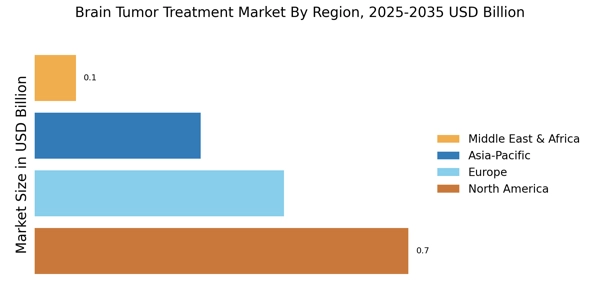
By region, the study provides the market insights into North America, Europe, Asia-Pacific, and the Rest of the World. The North American Brain Tumor Treatment Market area will dominate this market, owing to an advanced healthcare infrastructure and a robust research and development ecosystem that drives innovation in brain tumor diagnosis and treatment. In addition, the growing number of established health clubs and fitness facilities will boost market growth in this region.
Further, the major countries studied in the market report are The US, Canada, Germany, France, the UK, Italy, Spain, China, Japan, India, Australia, South Korea, and Brazil.
Figure 2: BRAIN TUMOR TREATMENT MARKET SHARE BY REGION 2022 (USD Billion)
Europe's Brain Tumor Treatment Market accounts for the second-largest market share due to the well-established healthcare infrastructure with advanced medical facilities and a skilled workforce specializing in neuro-oncology. Further, the German Brain Tumor Treatment Market held the largest market share, and the UK Brain Tumor Treatment Market was the fastest-growing market in the European region.
The Asia-Pacific Brain Tumor Treatment Market is expected to grow at the fastest CAGR from 2023 to 2032. This is due to the increasing disease burden that creates a significant demand for Brain Tumor Treatment Market options and therapies in the Asia-Pacific region. Moreover, China’s Brain Tumor Treatment Market held the largest market share, and the Indian Brain Tumor Treatment Market was the fastest-growing market in the Asia-Pacific region.
Key Players and Competitive Insights
Leading market players are investing heavily in research and development in order to expand their product lines, which will help the Brain Tumor Treatment Market grow even more. Market participants are also undertaking a variety of strategic activities to expand their global footprint, with important market developments including new product launches, contractual agreements, mergers and acquisitions, higher investments, and collaboration with other organizations. To expand and survive in a more competitive and rising market climate, the Brain Tumor Treatment industry must offer cost-effective items.Manufacturing locally to minimize operational costs is one of the key business tactics used by manufacturers in the Brain Tumor Treatment industry to benefit clients and increase the market sector. In recent years, the Brain Tumor Treatment industry has offered some of the most significant advantages. Major players in the Brain Tumor Treatment Market include F. Hoffmann-La Roche Ltd (U.S.), Novartis AG (Switzerland), Merck & Co. Inc. (U.S.), Pfizer Inc. (U.S.), Amneal Pharmaceuticals LLC. (U.S.), Amgen Inc. (U.S.), NextSource Pharmaceuticals, LLC (U.S.), Emcure Pharmaceuticals (India), Siemens Healthineers AG, Dr.Reddy’s Laboratories Ltd., and others are attempting to increase market demand by investing in research and development operations.Bristol Myers Squibb (BMS) is a global biopharmaceutical company headquartered in New York City, USA. Established in 1858, BMS has evolved into one of the world's leading pharmaceutical firms, dedicated to discovering, developing, and delivering innovative medicines to address significant unmet medical needs, particularly in oncology, immunology, cardiovascular, and fibrosis.
In June Bristol Myers Squibb and Turning Point Therapeutics, Inc. announced a definitive merger agreement under which Bristol Myers Squibb will acquire Turning Point Therapeutics for $76.00 per share.The transaction was unanimously approved by both the Bristol Myers Squibb and Turning Point Therapeutics Board of Directors and is anticipated to close during the third quarter of 2022.Pfizer Inc. is a leading American multinational pharmaceutical corporation headquartered in New York City, USA. Established in 1849, Pfizer has grown to become one of the largest pharmaceutical companies globally, with a diverse portfolio of prescription medicines, vaccines, and consumer healthcare products.
In August American drug maker Pfizer announced a deal to acquire Global Blood Therapeutics, makers of a recently approved treatment for sickle cell disease, for US$ 5.4 billion.
Key Companies in the Brain Tumor Treatment Market include
Industry Developments
- Q3 2024: Hope on the Horizon: Brain Cancer Advances in Awareness Month The FDA approved vorasidenib (Voranigo) in August 2024 for the treatment of IDH-mutant gliomas, marking a significant advance in targeted therapy for brain tumor patients.
- Q2 2024: Gene Therapy Is Halting Cancer. Can It Work Against Brain Tumors? UC San Francisco opened enrollment in April 2024 for a clinical trial using a novel CAR T gene therapy with synthetic notch (synNotch) technology to treat glioblastoma, with a second trial planned for 2025.
Future Outlook
Brain Tumor Treatment Market Future Outlook
The Brain Tumor Treatment Market is projected to grow at a 12.2% CAGR from 2025 to 2035, driven by advancements in technology, increasing incidence rates, and enhanced treatment options.
New opportunities lie in:
- Development of personalized medicine platforms for targeted therapies.
- Expansion of telemedicine services for remote patient monitoring.
- Investment in AI-driven diagnostic tools to improve treatment accuracy.
By 2035, the market is expected to be robust, reflecting substantial advancements and increased accessibility.
Market Segmentation
Brain Tumor Treatment Market Therapy Outlook
- Targeted Therapy
- Chemotherapy
- Immunotherapy
- Others
Brain Tumor Treatment Market Indication Outlook
- Pituitary Tumors
- Meningioma
- Glioblastoma
- Others
Brain Tumor Treatment Market Distribution Channel Outlook
- Hospital Pharmacy
- Retail & Online Pharmacy
Report Scope
| MARKET SIZE 2024 | 1.503(USD Billion) |
| MARKET SIZE 2025 | 1.687(USD Billion) |
| MARKET SIZE 2035 | 5.334(USD Billion) |
| COMPOUND ANNUAL GROWTH RATE (CAGR) | 12.2% (2025 - 2035) |
| REPORT COVERAGE | Revenue Forecast, Competitive Landscape, Growth Factors, and Trends |
| BASE YEAR | 2024 |
| Market Forecast Period | 2025 - 2035 |
| Historical Data | 2019 - 2024 |
| Market Forecast Units | USD Billion |
| Key Companies Profiled | Roche (CH), Novartis (CH), Bristol-Myers Squibb (US), Merck & Co. (US), Eli Lilly and Company (US), Amgen (US), AstraZeneca (GB), Pfizer (US), Bayer (DE) |
| Segments Covered | Therapy, Indication, Distribution Channel, Region |
| Key Market Opportunities | Advancements in personalized medicine and immunotherapy are reshaping the Brain Tumor Treatment Market. |
| Key Market Dynamics | Rising demand for innovative therapies drives competition and regulatory scrutiny in the brain tumor treatment landscape. |
| Countries Covered | North America, Europe, APAC, South America, MEA |
FAQs
What is the projected market valuation of the Brain Tumor Treatment Market by 2035?
The Brain Tumor Treatment Market is projected to reach a valuation of 5.334 USD Billion by 2035.
What was the market valuation of the Brain Tumor Treatment Market in 2024?
In 2024, the market valuation of the Brain Tumor Treatment Market was 1.503 USD Billion.
What is the expected CAGR for the Brain Tumor Treatment Market during the forecast period 2025 - 2035?
The expected CAGR for the Brain Tumor Treatment Market during the forecast period 2025 - 2035 is 12.2%.
Which therapy segment had the highest valuation in 2024?
In 2024, the Chemotherapy segment had the highest valuation at 0.602 USD Billion.
What is the projected valuation for the Immunotherapy segment by 2035?
The Immunotherapy segment is projected to reach a valuation of 1.267 USD Billion by 2035.
Which indication segment is expected to grow the most by 2035?
The Glioblastoma indication segment is expected to grow the most, reaching 2.2 USD Billion by 2035.
What distribution channel is anticipated to have the highest market share by 2035?
Who are the key players in the Brain Tumor Treatment Market?
What was the valuation of the Pituitary Tumors segment in 2024?
How does the market for targeted therapy compare to other therapies in 2024?
Research Approach
Secondary Research
The secondary research process involved comprehensive analysis of regulatory databases, peer-reviewed medical journals, clinical publications, and authoritative health organizations. Key sources included:
Regulatory & Government Authorities:
US Food & Drug Administration (FDA) - Oncology Division
European Medicines Agency (EMA) - Human Medicines
National Cancer Institute (NCI) - Brain Tumor Research
Centers for Disease Control and Prevention (CDC) - National Program of Cancer Registries
World Health Organization (WHO) - Cancer Statistics and Global Health Observatory
National Institutes of Health (NIH) - National Institute of Neurological Disorders and Stroke (NINDS)
Health Canada - Drug and Health Products
Pharmaceuticals and Medical Devices Agency (PMDA) - Japan
Central Drugs Standard Control Organization (CDSCO) - India
Clinical & Academic Sources:
National Center for Biotechnology Information (NCBI/PubMed)
American Society of Clinical Oncology (ASCO)
Society for Neuro-Oncology (SNO)
European Association of Neuro-Oncology (EANO)
American Brain Tumor Association (ABTA)
National Brain Tumor Society
ClinicalTrials.gov database
Cochrane Library - Systematic Reviews
Epidemiological & Statistical Databases:
Central Brain Tumor Registry of the United States (CBTRUS)
SEER (Surveillance, Epidemiology, and End Results) Program
GLOBOCAN - Global Cancer Observatory
EUROCAT - European Surveillance of Congenital Anomalies
OECD Health Statistics
EU Eurostat Health Database
Industry & Market Intelligence:
Evaluate Pharma - Pipeline and Market Analytics
IQVIA - Market Prognosis
Cortellis - Competitive Intelligence
Scrip Intelligence - Pharma News and Analysis
These sources were used to collect epidemiological data, treatment statistics, regulatory approval data, clinical trial outcomes, pricing benchmarks, and competitive landscape analysis for targeted therapies, chemotherapy agents, immunotherapy treatments, and other emerging modalities in brain tumor care.
Primary Research
Qualitative and quantitative insights were obtained by interviewing supply-side and demand-side stakeholders during the primary research process. From pharmaceutical manufacturers, biotechnology companies, and contract research organizations, supply-side sources encompassed Chief Executive Officers, Chief Medical Officers, Vice Presidents of Oncology Development, leaders of regulatory affairs, and commercial directors. Demand-side sources included procurement leads from academic medical centers, comprehensive cancer centers, community hospitals, and specialty oncology clinics, as well as neuro-oncologists, radiation oncologists, neurosurgeons, hospital pharmacy directors, and oncology center administrators. Market segmentation was validated, drug pipeline timelines were confirmed, and insights regarding clinical adoption patterns, pricing strategies, reimbursement dynamics, and treatment protocol evolution were obtained through primary research.
Primary Respondent Breakdown:
By Designation: C-level Primaries (32%), Director Level (31%), Others (37%)
By Region: North America (38%), Europe (29%), Asia-Pacific (25%), Rest of World (8%)
Market Size Estimation
Global market valuation was derived through revenue mapping and treatment volume analysis. The methodology included:
Identification of 50+ key manufacturers across North America, Europe, Asia-Pacific, and Latin America
Product mapping across targeted therapy, chemotherapy, immunotherapy, and other treatment categories
Analysis of reported and modeled annual revenues specific to brain tumor treatment portfolios
Coverage of manufacturers representing 75-80% of global market share in 2024
Extrapolation using bottom-up (treatment volume × ASP by country/region) and top-down (manufacturer revenue validation) approaches to derive segment-specific valuations
Kindly complete the form below to receive a free sample of this Report
Customer Stories
“This is really good guys. Excellent work on a tight deadline. I will continue to use you going forward and recommend you to others. Nice job”
“Thanks. It’s been a pleasure working with you, please use me as reference with any other Intel employees.”
“Thanks for sending the report it gives us a good global view of the Betaïne market.”
“Thank you, this will be very helpful for OQS.”
“We found the report very insightful! we found your research firm very helpful. I'm sending this email to secure our future business.”
“I am very pleased with how market segments have been defined in a relevant way for my purposes (such as "Portable Freezers & refrigerators" and "last-mile"). In general the report is well structured. Thanks very much for your efforts.”
“I have been reading the first document or the study, ,the Global HVAC and FP market report 2021 till 2026. Must say, good info! I have not gone in depth at all parts, but got a good indication of the data inside!”
“We got the report in time, we really thank you for your support in this process. I also thank to all of your team as they did a great job.”