×
Request Free Sample ×

Kindly complete the form below to receive a free sample of this Report

* Please use a valid business email

Leading companies partner with us for data-driven Insights

clients tt-cursor
Hero Background

Brazil Industrial AI Market

ID: MRFR/ICT/44863-HCR
200 Pages
Garvit Vyas
October 2025

Brazil Industrial AI Market Research Report By Offering (hardware, software, AI platform, AI solution), By Technology (computer vision, deep learning, natural language processing (NLP), context awareness), By Application (predictive maintenance and machinery inspection, material movement, production planning, field services, quality control, others) and By Industry (automobile, energy and power, pharmaceuticals, heavy metals and machine manufacturing, semiconductor electronics, food beverages, manufacturing, others)- Forecast to 2035

Share:
Download PDF ×

We do not share your information with anyone. However, we may send you emails based on your report interest from time to time. You may contact us at any time to opt-out.

Brazil Industrial AI Market Infographic
Purchase Options

Brazil Industrial AI Market Summary

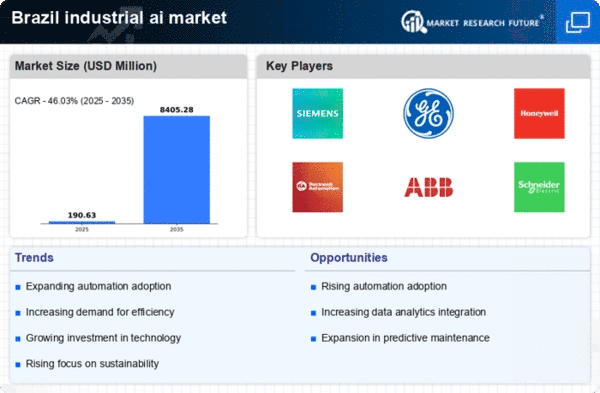
As per MRFR analysis, the Brazil industrial ai market Size was estimated at 130.54 USD Million in 2024. The Brazil industrial ai market is projected to grow from 190.63 USD Million in 2025 to 8405.28 USD Million by 2035, exhibiting a compound annual growth rate (CAGR) of 46.03% during the forecast period 2025 - 2035.

Key Market Trends & Highlights

The Brazil industrial AI market is poised for substantial growth driven by automation and data-centric strategies.

  • The market is witnessing increased automation adoption across various sectors, enhancing operational efficiency.
  • Data-driven decision making is becoming a focal point for industries aiming to optimize processes and outcomes.
  • Sustainability initiatives are gaining traction, reflecting a broader commitment to environmentally responsible practices.
  • Rising demand for operational efficiency and investment in smart manufacturing technologies are key drivers propelling market growth.

Market Size & Forecast

2024 Market Size 130.54 (USD Million)
2035 Market Size 8405.28 (USD Million)
CAGR (2025 - 2035) 46.03%

Major Players

Siemens (DE), General Electric (US), Honeywell (US), Rockwell Automation (US), ABB (CH), Schneider Electric (FR), IBM (US), Microsoft (US), Oracle (US)

Brazil Industrial AI Market Trends

The industrial ai market is experiencing notable growth, driven by advancements in technology and increasing demand for automation across various sectors. Companies are increasingly adopting artificial intelligence solutions to enhance operational efficiency, reduce costs, and improve decision-making processes. This trend is particularly evident in manufacturing, logistics, and energy sectors, where the integration of AI technologies is transforming traditional practices. Furthermore, the Brazilian government is actively promoting initiatives to foster innovation and digital transformation, which is likely to further stimulate the industrial ai market. As organizations seek to leverage data analytics and machine learning, the potential for enhanced productivity and competitiveness becomes apparent. In addition, the industrial ai market is witnessing a shift towards sustainable practices. Companies are exploring AI applications that not only optimize processes but also contribute to environmental sustainability. This includes energy management systems that utilize AI to minimize waste and improve resource allocation. The emphasis on sustainability aligns with global trends and reflects a growing awareness of corporate responsibility. Overall, the industrial ai market is poised for continued expansion, with a focus on innovation, efficiency, and sustainability as key drivers of growth.

Increased Automation Adoption

The industrial ai market is seeing a surge in automation adoption as businesses recognize the benefits of integrating AI technologies. This trend is characterized by the implementation of smart systems that enhance productivity and streamline operations. Companies are increasingly investing in AI-driven solutions to optimize manufacturing processes, reduce downtime, and improve overall efficiency.

Focus on Data-Driven Decision Making

There is a growing emphasis on data-driven decision making within the industrial ai market. Organizations are leveraging AI to analyze vast amounts of data, enabling them to make informed choices that enhance operational performance. This trend highlights the importance of data analytics in driving strategic initiatives and improving competitiveness.

Sustainability Initiatives

Sustainability initiatives are becoming a focal point in the industrial ai market. Companies are exploring AI applications that promote environmental responsibility, such as energy-efficient systems and waste reduction strategies. This trend reflects a broader commitment to sustainable practices and aligns with the increasing demand for corporate accountability in environmental matters.

Brazil Industrial AI Market Drivers

Focus on Workforce Skill Development

A focus on workforce skill development is emerging as a vital driver for the industrial ai market in Brazil. As AI technologies become more integrated into industrial processes, there is a pressing need for skilled professionals who can manage and operate these systems. Companies are investing in training programs to equip their workforce with the necessary skills to leverage AI effectively. This emphasis on skill development not only enhances employee capabilities but also contributes to the overall growth of the industrial ai market. By fostering a skilled workforce, Brazil can ensure that its industries remain competitive in the global market.

Government Support for AI Initiatives

Government support for AI initiatives plays a crucial role in shaping the industrial ai market in Brazil. The Brazilian government has launched various programs aimed at fostering innovation and technological advancement in industries. For instance, funding and incentives for AI research and development are being provided to encourage companies to adopt AI solutions. This support is expected to drive the growth of the industrial ai market, as businesses are more likely to invest in AI technologies when backed by governmental initiatives. The collaborative efforts between the public and private sectors may lead to a more robust AI ecosystem in Brazil.

Growing Need for Predictive Analytics

The growing need for predictive analytics is significantly influencing the industrial ai market in Brazil. Companies are increasingly recognizing the value of data-driven insights to anticipate market trends and optimize operations. Predictive analytics powered by AI can enhance decision-making processes, reduce operational risks, and improve customer satisfaction. In fact, studies suggest that organizations utilizing predictive analytics can experience a 20% increase in revenue. As businesses in Brazil continue to embrace data analytics, the industrial ai market is likely to expand, driven by the demand for advanced analytical capabilities.

Rising Demand for Operational Efficiency

The industrial ai market in Brazil is experiencing a notable surge in demand for operational efficiency. Companies are increasingly adopting AI technologies to streamline processes, reduce waste, and enhance productivity. According to recent data, organizations that implement AI-driven solutions can achieve efficiency improvements of up to 30%. This trend is particularly evident in manufacturing sectors, where automation and predictive maintenance are becoming essential. The industrial ai market is thus positioned to benefit from this growing emphasis on efficiency, as businesses seek to optimize their operations and remain competitive in a rapidly evolving landscape.

Investment in Smart Manufacturing Technologies

Investment in smart manufacturing technologies is a key driver for the industrial ai market in Brazil. As industries strive to modernize their production capabilities, the integration of AI into manufacturing processes is becoming increasingly prevalent. Reports indicate that the Brazilian manufacturing sector is projected to invest approximately $5 billion in AI technologies by 2026. This investment is expected to enhance production quality, reduce downtime, and facilitate real-time decision-making. Consequently, the industrial ai market is likely to see substantial growth as manufacturers leverage AI to transform their operations and improve overall competitiveness.


Market Segment Insights

By Offering: Software (Largest) vs. AI Platform (Fastest-Growing)

The Brazil industrial ai market showcases a diverse offering landscape with software leading in market share, driven by its essential role in enabling AI-driven initiatives across various industries. Hardware follows as a significant player, but the emphasis on software solutions reflects the increasing demand for integrated applications that facilitate data analytics and process automation. AI solutions and platforms also contribute to the market, albeit with smaller shares, highlighting the specialization required in these segments. Growth trends indicate a robust expansion, particularly in the AI platform segment, which is emerging as the fastest-growing area. This surge is propelled by the increasing reliance on scalable and flexible solutions that support machine learning and data integration. As more enterprises seek to enhance operational efficiencies through AI technologies, the demand for software and platform offerings will continue to accelerate, fostering innovation and competitive advantage within the market.

Software: Hardware (Dominant) vs. AI Solution (Emerging)

In the Brazil industrial ai market, software stands as the dominant offering due to its critical role in transforming operational capabilities across different sectors. It not only enhances data processing but also integrates various AI applications, making it indispensable for companies looking to innovate. In contrast, hardware remains a supporting element, essential for running AI applications but less central to the strategic direction of companies. On the other hand, AI solutions are an emerging segment, characterized by specialized applications that address specific business challenges. While still gaining traction, these solutions are increasingly recognized for their ability to leverage AI for tailored problem-solving, thus opening avenues for growth and development to complement the robust software market.

By Technology: Deep Learning (Largest) vs. Natural Language Processing (NLP) (Fastest-Growing)

Deep Learning currently holds the largest share in the market, driven by its extensive applications across industries, including manufacturing and data analytics. Followed by Computer Vision and Natural Language Processing, these segments together form a significant part of the technological landscape, with Computer Vision being crucial for visual data analysis and automation. The growth trends indicate a rise in demand for AI technologies, particularly in automation and data processing. Deep Learning is expected to continue its leading position due to advancements in algorithms and processing power. In contrast, the NLP segment is gaining traction as organizations increasingly focus on customer interaction and support through conversational AI, enhancing user experiences and operational efficiencies.

Technology: Deep Learning (Dominant) vs. Natural Language Processing (NLP) (Emerging)

Deep Learning is defined by its capability to analyze vast amounts of data through multilayered neural networks, enabling superior accuracy in predictions and classifications. Its applications span a variety of sectors, including healthcare, finance, and manufacturing, positioning it as the cornerstone of AI technologies in the market. In contrast, Natural Language Processing (NLP) is emerging as a critical player, facilitating better human-computer interaction through language understanding. With the rise of chatbots and other AI-driven communication tools, NLP is rapidly evolving, matching the demands for seamless, intelligent interfaces, thus indicating a robust growth trajectory in the Brazilian landscape.

By Application: Predictive maintenance and machinery inspection (Largest) vs. Quality Control (Fastest-Growing)

In the Brazil industrial ai market, predictive maintenance and machinery inspection hold a significant share due to the increasing demand for efficiency and the reduction of operational costs in manufacturing processes. These applications are utilized extensively across various industries, ensuring seamless operations and minimizing downtime. Meanwhile, quality control has emerged as a crucial segment, driven by stringent regulatory standards and consumer expectations for product quality and safety. Growth trends in these segments are primarily fueled by advancements in AI technology and integration into existing systems. As industries emphasize predictive analytics and real-time monitoring, the market for predictive maintenance is expanding rapidly. On the other hand, quality control is becoming prominent as organizations adopt AI solutions for defect detection and process optimization, providing a competitive edge in a rapidly evolving market landscape.

Predictive maintenance and machinery inspection (Dominant) vs. Quality Control (Emerging)

Predictive maintenance and machinery inspection are dominant in the Brazil industrial ai market, leveraging AI algorithms to analyze machinery performance and predict failures before they occur. This application enhances operational reliability and significantly cuts costs by reducing unplanned maintenance. The swift adoption of IoT technologies further supports its position. Conversely, quality control is an emerging segment that is gaining traction, as industries recognize the need for advanced solutions to ensure product integrity and compliance. Implementing AI in quality control processes helps businesses streamline inspections and improve accuracy, thereby adapting to a market that demands higher standards in quality assurance. These two segments highlight the dual focus on maintenance efficiency and product excellence within the market.

By Industry: Automobile (Largest) vs. Semiconductor & Electronics (Fastest-Growing)

In the Brazil industrial ai market, the industry segment is characterized by significant diversity, with various sectors showcasing unique market shares. The automobile sector stands out as the largest component, commanding a notable portion of the market share, primarily driven by advancements in AI technology and increased automation. Following closely are energy and power, pharmaceuticals, and heavy metals and machine manufacturing, each contributing to the market dynamics with varying shares, showcasing a rich tapestry of industrial applications. Looking towards growth trends, the semiconductor and electronics sector is emerging as the fastest-growing segment within the Brazil industrial ai market, spurred by rising demand for smart devices and IoT applications. Investment in AI technologies is booming across the food and beverages, and manufacturing sectors as well, indicating a robust transformation driven by the need for efficiency and innovation in production processes. The combined force of digital transformation and regulatory support is propelling these sectors forward, creating a fertile ground for AI integration.

Automobile (Dominant) vs. Semiconductor & Electronics (Emerging)

The automobile sector in the Brazil industrial ai market is renowned for its dominance, primarily fueled by the adoption of AI-driven technologies that enhance manufacturing processes, supply chain optimization, and vehicle automation. This segment has embraced innovations like predictive maintenance and advanced driver-assistance systems (ADAS), solidifying its position as a leader in the market. Conversely, the semiconductor and electronics segment is identified as an emerging powerhouse, driven by on-going technological advancements and an increasing focus on smart manufacturing. This sector leverages AI to accelerate production capabilities, optimize inventory management, and enhance product design, positioning itself as a key player that is likely to experience rapid growth. The juxtaposition of these two segments illustrates the dynamic landscape of industrial advancements in Brazil.

Get more detailed insights about Brazil Industrial AI Market

Key Players and Competitive Insights

The industrial AI market in Brazil is characterized by a dynamic competitive landscape, driven by rapid technological advancements and increasing demand for automation across various sectors. Key players such as Siemens (DE), General Electric (US), and Honeywell (US) are strategically positioned to leverage their extensive portfolios and expertise in AI-driven solutions. Siemens (DE) focuses on digital transformation initiatives, emphasizing smart manufacturing and predictive maintenance, which enhances operational efficiency. General Electric (US) is investing heavily in AI applications for energy management, aiming to optimize performance and reduce costs. Honeywell (US) is enhancing its offerings through strategic partnerships, particularly in the aerospace and building management sectors, thereby broadening its market reach and technological capabilities.

The business tactics employed by these companies include localizing manufacturing to better serve the Brazilian market and optimizing supply chains to enhance responsiveness. The competitive structure of the market appears moderately fragmented, with several players vying for market share. However, the collective influence of these key players is significant, as they drive innovation and set industry standards, thereby shaping the overall market dynamics.

In October 2025, Siemens (DE) announced a partnership with a leading Brazilian energy firm to develop AI solutions aimed at improving grid management and energy efficiency. This collaboration is strategically important as it not only enhances Siemens' footprint in the renewable energy sector but also aligns with Brazil's commitment to sustainable energy practices. The partnership is expected to yield innovative solutions that could significantly reduce operational costs for energy providers.

In September 2025, General Electric (US) launched a new AI-driven platform designed to optimize industrial operations in the oil and gas sector. This platform integrates advanced analytics and machine learning capabilities, allowing companies to predict equipment failures and minimize downtime. The introduction of this platform is likely to strengthen General Electric's position in a critical sector of the Brazilian economy, where operational efficiency is paramount.

In August 2025, Honeywell (US) expanded its AI capabilities by acquiring a Brazilian startup specializing in machine learning applications for manufacturing. This acquisition is indicative of Honeywell's strategy to enhance its technological prowess and offer more sophisticated solutions to its clients. By integrating the startup's innovations, Honeywell aims to provide cutting-edge tools that improve productivity and reduce waste in manufacturing processes.

As of November 2025, the competitive trends in the industrial AI market are increasingly defined by digitalization, sustainability, and the integration of AI technologies. Strategic alliances are becoming more prevalent, as companies recognize the need to collaborate to enhance their technological capabilities and market presence. Looking ahead, competitive differentiation is likely to evolve from traditional price-based competition to a focus on innovation, advanced technology, and supply chain reliability. This shift underscores the importance of agility and responsiveness in meeting the demands of a rapidly changing market.

Key Companies in the Brazil Industrial AI Market market include

Industry Developments

Recent developments in the Brazil Industrial AI Market indicate a robust growth trajectory driven by advancements in automation and efficiency technologies. Siemens has been focusing on digitalizing manufacturing processes, while SAP is enhancing its cloud solutions to better serve industrial customers in Brazil.Companies like Honeywell and Rockwell Automation are increasingly integrating AI into their operations, optimizing supply chains and predictive maintenance solutions. In recent months, Schneider Electric has announced initiatives to expand its AI capabilities within energy management, aligning with Brazil's sustainability goals.

Current affairs in the sector reflect a significant investment in AI, with local industries recognizing the potential of this technology to enhance productivity. Notably, in June 2022, IBM expanded its partnership with local companies to foster AI adoption within various sectors. Moreover, in August 2023, Cisco unveiled new AI-driven tools tailored for the Brazilian market to aid in smart city initiatives.The industrial landscape is evolving, with major players like NVIDIA and Emerson Electric also contributing to Brazil’s AI ecosystem through innovative applications and enterprise solutions.

As a result, the market valuation for Brazil's Industrial AI segment is increasingly becoming attractive for both local and international investments.

Future Outlook

Brazil Industrial AI Market Future Outlook

The Industrial AI Market in Brazil is projected to grow at a remarkable 46.03% CAGR from 2024 to 2035, driven by automation, data analytics, and enhanced operational efficiency.

New opportunities lie in:

  • Development of predictive maintenance solutions for manufacturing equipment.
  • Integration of AI-driven supply chain optimization tools.
  • Implementation of AI-based quality control systems in production lines.

By 2035, the industrial AI market is expected to be a cornerstone of Brazil's technological advancement.

Market Segmentation

Brazil Industrial AI Market Industry Outlook

  • Automobile
  • Energy and power
  • Pharmaceuticals
  • Heavy metals and machine Manufacturing
  • Semiconductor & Electronics
  • Food & beverages
  • Manufacturing
  • Others

Brazil Industrial AI Market Offering Outlook

  • Hardware
  • Software
  • AI platform
  • AI solution

Brazil Industrial AI Market Technology Outlook

  • Computer vision
  • Deep learning
  • Natural Language Processing (NLP)
  • Context Awareness

Brazil Industrial AI Market Application Outlook

  • Predictive maintenance and machinery inspection
  • Material movement
  • Production planning
  • Field Services
  • Quality Control
  • Others

Report Scope

MARKET SIZE 2024 130.54(USD Million)
MARKET SIZE 2025 190.63(USD Million)
MARKET SIZE 2035 8405.28(USD Million)
COMPOUND ANNUAL GROWTH RATE (CAGR) 46.03% (2024 - 2035)
REPORT COVERAGE Revenue Forecast, Competitive Landscape, Growth Factors, and Trends
BASE YEAR 2024
Market Forecast Period 2025 - 2035
Historical Data 2019 - 2024
Market Forecast Units USD Million
Key Companies Profiled Siemens (DE), General Electric (US), Honeywell (US), Rockwell Automation (US), ABB (CH), Schneider Electric (FR), IBM (US), Microsoft (US), Oracle (US)
Segments Covered Offering, Technology, Application, Industry
Key Market Opportunities Integration of advanced predictive maintenance solutions enhances operational efficiency in the industrial ai market.
Key Market Dynamics Rising demand for automation in manufacturing drives competitive innovation in Brazil's industrial AI market.
Countries Covered Brazil

Leave a Comment

FAQs

What is the expected market size of the Brazil Industrial AI Market in 2024?

The Brazil Industrial AI Market is expected to be valued at 100.0 USD Million in 2024.

What is the projected market size of the Brazil Industrial AI Market by 2035?

By 2035, the Brazil Industrial AI Market is projected to reach 620.0 USD Million.

What is the expected CAGR for the Brazil Industrial AI Market from 2025 to 2035?

The expected CAGR for the Brazil Industrial AI Market from 2025 to 2035 is 18.042%.

Which segment of the Brazil Industrial AI Market is estimated to have the largest value in 2035?

The software segment is estimated to have the largest value at 240.0 USD Million in 2035.

What will be the market size for hardware in the Brazil Industrial AI Market by 2035?

The hardware segment is expected to reach 185.0 USD Million by 2035.

Who are the key players in the Brazil Industrial AI Market?

Key players in the Brazil Industrial AI Market include Siemens, SAP, Honeywell, IBM, and Rockwell Automation.

What is the expected market value for AI solutions in the Brazil Industrial AI Market by 2035?

AI solutions are expected to reach a market value of 125.0 USD Million by 2035.

How is the AI platform segment expected to grow in the Brazil Industrial AI Market by 2035?

The AI platform segment is anticipated to grow to 70.0 USD Million by 2035.

What are the growth drivers for the Brazil Industrial AI Market?

Growth drivers for the Brazil Industrial AI Market include increasing adoption of AI technologies and demand for automation.

What challenges could impact the Brazil Industrial AI Market's growth?

Challenges that could impact growth include regulatory hurdles and the need for skilled workforce.

Download Free Sample

Kindly complete the form below to receive a free sample of this Report

Compare Licence

×
Features License Type
Single User Multiuser License Enterprise User
Price $4,950 $5,950 $7,250
Maximum User Access Limit 1 User Upto 10 Users Unrestricted Access Throughout the Organization
Free Customization
Direct Access to Analyst
Deliverable Format
Platform Access
Discount on Next Purchase 10% 15% 15%
Printable Versions