×
Request Free Sample ×

Kindly complete the form below to receive a free sample of this Report

* Please use a valid business email

Leading companies partner with us for data-driven Insights

clients tt-cursor
Hero Background

Brazil IoT Sensor Market

ID: MRFR/SEM/47408-HCR
200 Pages
Aarti Dhapte
October 2025

Brazil IoT Sensor Market Research Report By Type (Proximity, Acoustic, Temperature, Pressure, Flow, Humidity, Inertial, Image, Motion, CO2, Gyroscope, Occupancy, Magnetometer) and By Vertical (Consumers, Industrial, Commercial) - Forecast to 2035

Share:
Download PDF ×

We do not share your information with anyone. However, we may send you emails based on your report interest from time to time. You may contact us at any time to opt-out.

Brazil IoT Sensor Market Infographic
Purchase Options

Brazil IoT Sensor Market Summary

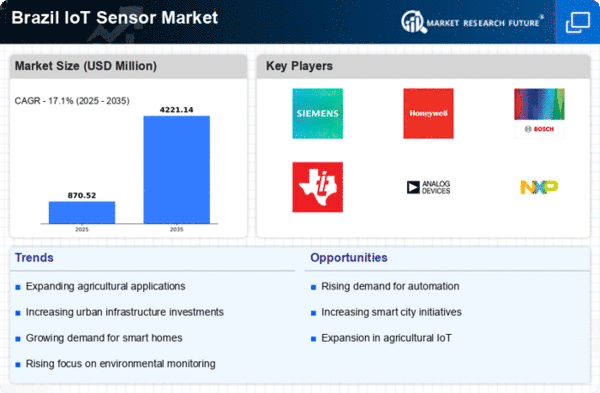
As per MRFR analysis, the Brazil IoT Sensor Market Size was estimated at 743.4 USD Million in 2024. The Brazil The IoT sensor market is projected to grow. from 870.52 USD Million in 2025 to 4221.14 USD Million by 2035, exhibiting a compound annual growth rate (CAGR) of 17.1% during the forecast period 2025 - 2035.

Key Market Trends & Highlights

The Brazil IoT sensor market is experiencing robust growth driven by technological advancements and increasing demand across various sectors.

  • The largest segment in the Brazil IoT sensor market is agriculture, which is witnessing increased adoption of smart farming technologies.
  • Smart city initiatives are rapidly gaining traction, positioning urban areas as a focal point for IoT sensor deployment.
  • Environmental monitoring is becoming a critical area of focus, reflecting a growing awareness of sustainability and climate change.
  • Key market drivers include rising demand for smart manufacturing and government initiatives for digital transformation.

Market Size & Forecast

2024 Market Size 743.4 (USD Million)
2035 Market Size 4221.14 (USD Million)
CAGR (2025 - 2035) 17.1%

Major Players

Siemens (DE), Honeywell (US), Bosch (DE), Texas Instruments (US), Analog Devices (US), NXP Semiconductors (NL), STMicroelectronics (CH), Qualcomm (US), Infineon Technologies (DE)

Brazil IoT Sensor Market Trends

The The IoT sensor market is experiencing robust growth. notable growth, driven by the increasing demand for automation and smart technologies across various sectors. Industries such as agriculture, healthcare, and manufacturing are adopting these sensors to enhance operational efficiency and improve data collection. The integration of advanced technologies, including artificial intelligence and machine learning, is further propelling the development of innovative sensor solutions. As a result, businesses are increasingly investing in iot sensors to gain a competitive edge and optimize their processes. In addition, the regulatory environment in Brazil is evolving to support the expansion of the iot sensor market. Government initiatives aimed at promoting digital transformation and smart city projects are likely to create new opportunities for sensor deployment. Furthermore, the growing awareness of environmental sustainability is encouraging the adoption of sensors that monitor resource usage and reduce waste. This trend suggests a promising future for the iot sensor market, as stakeholders recognize the value of data-driven decision-making in achieving their goals.

Increased Adoption in Agriculture

The agricultural sector is increasingly utilizing iot sensors to monitor soil conditions, crop health, and weather patterns. This trend indicates a shift towards precision farming, where data-driven insights enhance productivity and resource management.

Smart City Initiatives

Government-led smart city projects are fostering the integration of iot sensors in urban infrastructure. These initiatives aim to improve public services, traffic management, and energy efficiency, thereby enhancing the quality of life for residents.

Focus on Environmental Monitoring

There is a growing emphasis on using iot sensors for environmental monitoring. These devices help track air quality, water usage, and energy consumption, aligning with sustainability goals and regulatory compliance.

Brazil IoT Sensor Market Drivers

Growing Focus on Energy Efficiency

The growing focus on energy efficiency in Brazil is significantly impacting the iot sensor market. As industries and consumers alike seek to reduce energy consumption and lower costs, IoT sensors are being increasingly utilized to monitor and manage energy usage. In 2025, it is estimated that the energy sector will invest around $600 million in IoT solutions aimed at enhancing energy efficiency. These sensors provide real-time data on energy consumption patterns, enabling users to identify inefficiencies and implement corrective measures. Furthermore, the Brazilian government is promoting initiatives to support renewable energy sources, which often rely on IoT technologies for monitoring and management. This trend suggests that the iot sensor market will continue to expand as energy efficiency becomes a priority for both businesses and consumers.

Rising Demand for Smart Manufacturing

The iot sensor market in Brazil is experiencing a notable surge due to the increasing demand for smart manufacturing solutions. Industries are adopting IoT technologies to enhance operational efficiency and reduce costs. In 2025, the manufacturing sector is projected to invest approximately $1.5 billion in IoT technologies, with sensors playing a crucial role in real-time monitoring and automation. This trend indicates a shift towards Industry 4.0, where interconnected devices facilitate data-driven decision-making. The integration of IoT sensors allows manufacturers to optimize production processes, minimize downtime, and improve product quality. As Brazil's industrial landscape evolves, the The IoT sensor market will benefit. from this growing emphasis on smart manufacturing, positioning itself as a key player in the digital transformation of the sector.

Increased Investment in Smart Agriculture

In Brazil, the iot sensor market is witnessing increased investment in smart agriculture, driven by the need for enhanced productivity and sustainability. Farmers are adopting IoT sensors to monitor soil conditions, crop health, and weather patterns, leading to more informed decision-making. In 2025, it is projected that investments in agricultural IoT technologies will reach $500 million, reflecting a growing recognition of the benefits of precision agriculture. These sensors enable farmers to optimize resource usage, reduce waste, and improve yields. As Brazil continues to be a major player in global agriculture, the demand for IoT solutions is likely to rise, positioning the iot sensor market as a vital component in the evolution of the agricultural sector.

Expansion of Telecommunications Infrastructure

The expansion of telecommunications infrastructure in Brazil is a critical driver for the iot sensor market. With the rollout of 5G technology, connectivity is expected to improve significantly, enabling faster data transmission and more reliable communication between devices. By 2025, it is projected that 5G coverage will reach over 50% of urban areas, facilitating the deployment of IoT applications. This enhanced connectivity is likely to lead to increased adoption of IoT sensors across various industries, including logistics, healthcare, and smart cities. The ability to transmit large volumes of data in real-time will empower businesses to make informed decisions and optimize operations. As a result, the The IoT sensor market is expected to thrive., driven by the advancements in telecommunications infrastructure.

Government Initiatives for Digital Transformation

Brazilian government initiatives aimed at digital transformation are significantly influencing the iot sensor market. The government has launched various programs to promote the adoption of IoT technologies across multiple sectors, including healthcare, agriculture, and transportation. In 2025, it is estimated that public sector investments in IoT infrastructure will reach $800 million, fostering an environment conducive to innovation. These initiatives not only enhance connectivity but also encourage collaboration between public and private sectors. The focus on developing smart cities and improving public services is likely to drive the demand for IoT sensors, as they are essential for data collection and analysis. Consequently, the iot sensor market is poised for growth, supported by favorable policies and funding from the government.


Market Segment Insights

IoT Sensor Market Type Insights

The Brazil IoT Sensor Market is witnessing robust growth, driven by the increasing adoption of technology across various sectors, including agriculture, manufacturing, and smart cities. The Type segment within the market encompasses a diverse range of sensors such as Proximity, Acoustic, Temperature, Pressure, Flow, Humidity, Inertial, Image, Motion, CO2, Gyroscope, Occupancy, and Magnetometer, each playing a vital role in enhancing operational efficiency and decision-making processes. Proximity sensors are particularly significant for applications in automatic doors and safety systems, while Temperature sensors are essential for monitoring environmental conditions in various industries, including food and pharmaceuticals. 

The Acoustic sensors are gaining traction in areas such as structural health monitoring and wildlife tracking, providing real-time data critical for timely interventions. Humidity sensors are increasingly utilized in agriculture, ensuring optimal plant growth by maintaining ideal moisture levels. The Pressure and Flow sensors are utilized in oil and gas as well as water management, allowing for precise measurement and control of fluid dynamics. 

Occupancy sensors are prevalent in smart buildings, optimizing energy consumption and enhancing security. Furthermore, Motion sensors contribute significantly to enhanced security systems and automation solutions, detecting movements for alarm systems or lighting controls. The integration of CO2 sensors is becoming crucial for environmental monitoring, particularly in indoor situations, to ensure air quality.In addition, Inertial sensors, often used in consumer electronics and automotive applications, enable enhanced navigation and stability control. 

Gyroscope sensors aid in motion detection and control, proving beneficial in gaming and augmented reality applications. The Image sensors play a critical role in surveillance and quality assurance in manufacturing processes, allowing for visual data collection and analysis. The Magnetometer is important in navigation systems, providing orientation information that is vital in various technology applications.

Collectively, these various sensor categories within the Type segment are pivotal to the Brazil IoT Sensor Market, facilitating transformative developments across numerous industry verticals and exhibiting an impressive evolution in terms of capabilities and applications, thus contributing to the overall market growth and advancements in smart technology. 

IoT Sensor Market Vertical Insights

The Brazil IoT Sensor Market is significantly shaped by its Vertical segment, which encompasses various applications including Consumers, Industrial, and Commercial. Each of these segments plays a crucial role in driving the market's advancement; for instance, the Industrial sector benefits from the increasing adoption of smart manufacturing and automation technologies, enhancing operational efficiency and reducing downtime.

Additionally, the Commercial segment sees a growing trend in smart buildings, where IoT sensors optimize energy management and improve security systems, reflecting a shift towards more sustainable and intelligent infrastructures.Meanwhile, the Consumer segment is marked by the rising demand for connected devices, such as smart home products, which cater to convenience and lifestyle enhancements. 

Collectively, these segments contribute to the Brazil IoT Sensor Market revenue growth, influenced by favorable government initiatives promoting digital transformation, infrastructure development, and increased internet penetration. The market continues to evolve with emerging technologies like artificial intelligence and machine learning integrating into IoT applications, presenting numerous growth opportunities and creating a competitive landscape characterized by innovation and responsiveness to consumer needs.

Get more detailed insights about Brazil IoT Sensor Market

Key Players and Competitive Insights

The iot sensor market in Brazil is characterized by a dynamic competitive landscape, driven by rapid technological advancements and increasing demand for smart solutions across various sectors. Key players such as Siemens (DE), Honeywell (US), and Bosch (DE) are at the forefront, each adopting distinct strategies to enhance their market presence. Siemens (DE) focuses on innovation and digital transformation, leveraging its expertise in automation and smart infrastructure to develop advanced sensor technologies. Honeywell (US), on the other hand, emphasizes partnerships and collaborations, aiming to integrate its sensors into broader IoT ecosystems. Bosch (DE) is actively pursuing regional expansion, particularly in the automotive and industrial sectors, to capitalize on the growing need for connected devices.

The business tactics employed by these companies reflect a concerted effort to localize manufacturing and optimize supply chains, which is crucial in a moderately fragmented market. This competitive structure allows for a diverse range of offerings, with each player contributing to the overall growth of the market. The collective influence of these key players fosters an environment where innovation and responsiveness to market demands are paramount, shaping the competitive dynamics in Brazil.

In October 2025, Siemens (DE) announced the launch of a new line of IoT sensors designed specifically for smart cities, aimed at enhancing urban infrastructure management. This strategic move underscores Siemens' commitment to addressing the unique challenges faced by Brazilian cities, such as traffic congestion and energy efficiency. By focusing on smart city solutions, Siemens positions itself as a leader in the integration of IoT technologies into urban planning, potentially setting a benchmark for competitors.

In September 2025, Honeywell (US) expanded its partnership with a leading Brazilian telecommunications provider to enhance connectivity for its IoT sensor solutions. This collaboration is significant as it not only strengthens Honeywell's market position but also facilitates the deployment of its sensors in various applications, including building management and industrial automation. The partnership reflects a growing trend towards integrated solutions that leverage existing infrastructure to deliver enhanced value to customers.

In August 2025, Bosch (DE) unveiled a new manufacturing facility in Brazil dedicated to producing IoT sensors for the automotive sector. This investment highlights Bosch's strategic focus on regional production capabilities, which is likely to reduce lead times and improve supply chain efficiency. By establishing a local presence, Bosch aims to better serve the Brazilian market, responding swiftly to the increasing demand for connected automotive technologies.

As of November 2025, the competitive trends in the iot sensor market are increasingly defined by digitalization, sustainability, and the integration of artificial intelligence. Strategic alliances are becoming more prevalent, as companies recognize the need to collaborate to enhance their technological capabilities and market reach. Looking ahead, competitive differentiation is expected to evolve, with a shift from price-based competition towards innovation, technology, and supply chain reliability. This transition may redefine how companies position themselves in the market, emphasizing the importance of developing cutting-edge solutions that meet the evolving needs of consumers.

Key Companies in the Brazil IoT Sensor Market market include

Industry Developments

The Brazil IoT Sensor Market has seen significant developments recently, particularly with companies like Bosch, IBM, and Intel focusing on expanding their presence. In October 2023, Schneider Electric announced a collaboration with a Brazilian local startup to enhance smart building technologies using IoT sensors. This aims to improve efficiency and sustainability in urban environments. Texas Instruments has also been involved in partnerships to innovate IoT solutions tailored for agricultural applications, reflecting Brazil's strong agribusiness sector. 

In terms of market valuation, the IoT Sensor Market in Brazil has been projected to grow, driven by increased adoption in sectors like manufacturing and logistics, as companies strive for digital transformation. Notably, NXP Semiconductors completed the acquisition of a software firm, strengthening its IoT offerings in Brazil in August 2023. 

There's a rising trend in government support for IoT initiatives, with investments in smart cities enhancing the infrastructure for sensor deployment. The market trajectory continues to attract investments as the demand for connected devices across various sectors grows, highlighting Brazil’s strategic importance in the global IoT landscape.

Future Outlook

Brazil IoT Sensor Market Future Outlook

The IoT sensor market in Brazil is projected to grow at a 17.1% CAGR from 2024 to 2035, driven by advancements in smart technologies, increased connectivity, and demand for automation.

New opportunities lie in:

  • Development of smart agriculture solutions for precision farming.
  • Integration of IoT sensors in urban infrastructure for smart city initiatives.
  • Creation of advanced health monitoring systems using wearable IoT technology.

By 2035, the IoT sensor market is expected to be robust, driven by innovation and diverse applications.

Market Segmentation

Brazil IoT Sensor Market Type Outlook

  • Proximity
  • Acoustic
  • Temperature
  • Pressure
  • Flow
  • Humidity
  • Inertial
  • Image
  • Motion
  • CO2
  • Gyroscope
  • Occupancy
  • Magnetometer

Brazil IoT Sensor Market Vertical Outlook

  • Consumers
  • Industrial
  • Commercial

Report Scope

MARKET SIZE 2024 743.4(USD Million)
MARKET SIZE 2025 870.52(USD Million)
MARKET SIZE 2035 4221.14(USD Million)
COMPOUND ANNUAL GROWTH RATE (CAGR) 17.1% (2024 - 2035)
REPORT COVERAGE Revenue Forecast, Competitive Landscape, Growth Factors, and Trends
BASE YEAR 2024
Market Forecast Period 2025 - 2035
Historical Data 2019 - 2024
Market Forecast Units USD Million
Key Companies Profiled Siemens (DE), Honeywell (US), Bosch (DE), Texas Instruments (US), Analog Devices (US), NXP Semiconductors (NL), STMicroelectronics (CH), Qualcomm (US), Infineon Technologies (DE)
Segments Covered Type, Vertical
Key Market Opportunities Growing demand for smart agriculture solutions drives innovation in the iot sensor market.
Key Market Dynamics Rising demand for smart agriculture solutions drives innovation in the IoT sensor market in Brazil.
Countries Covered Brazil

Leave a Comment

FAQs

What is the expected market size of the Brazil IoT Sensor Market in 2024?

The Brazil IoT Sensor Market is expected to be valued at 1.06 billion USD in 2024.

What will be the market size of the Brazil IoT Sensor Market by 2035?

By 2035, the Brazil IoT Sensor Market is anticipated to reach a value of 4.5 billion USD.

What is the expected CAGR for the Brazil IoT Sensor Market from 2025 to 2035?

The market is projected to grow at a CAGR of 14.027% from 2025 to 2035.

Which type of IoT sensor will have the largest market share by 2035?

The Proximity type is forecasted to hold the largest market share, valued at 1.05 billion USD by 2035.

What are the key players in the Brazil IoT Sensor Market?

Major players include Bosch, IBM, Intel, SAP, Texas Instruments, and Qualcomm among others.

What is the expected market size for Temperature sensors in 2024?

Temperature sensors are expected to be valued at 0.3 billion USD in 2024.

How much is the Pressure sensor segment expected to grow by 2035?

The Pressure sensor segment is anticipated to reach 0.65 billion USD by 2035.

What growth opportunities exist in the Brazil IoT Sensor Market?

Opportunities include expanding applications in smart cities, industrial automation, and healthcare.

What are the projected values for Acoustic sensors in 2024 and 2035?

Acoustic sensors are projected to be valued at 0.2 billion USD in 2024, expanding to 0.85 billion USD by 2035.

What is the market growth rate for Flow sensors from 2025 to 2035?

The Flow sensor market is expected to grow significantly, reaching 0.95 billion USD by 2035.

Download Free Sample

Kindly complete the form below to receive a free sample of this Report

Compare Licence

×
Features License Type
Single User Multiuser License Enterprise User
Price $4,950 $5,950 $7,250
Maximum User Access Limit 1 User Upto 10 Users Unrestricted Access Throughout the Organization
Free Customization
Direct Access to Analyst
Deliverable Format
Platform Access
Discount on Next Purchase 10% 15% 15%
Printable Versions