Bronchitis Treatment Market

Bronchitis Treatment Market Research Report By Treatment Type (Medication, Therapy, Surgery), By Medication Type (Bronchodilators, Corticosteroids, Antibiotics, Mucolytics), By Patient Type (Acute Bronchitis, Chronic Bronchitis, Recurrent Bronchitis), By Route of Administration (Inhalation, Oral, Injection) and By Regional (North America, Europe, South America, Asia Pacific, Middle East and Africa) - Growth & Industry Forecast 2025 To 2035
ID: MRFR/LS/41621-HCR
200 Pages
Satyendra Maurya, Garvit Vyas
Last Updated: July 13, 2026
Bronchitis Treatment Market
Market Size
Forecast Period2025 - 2035
CAGR (2025 - 2035)3.78%
2024 Market Size$ 8.3 Billion
2025 Market Size$ 8.62 Billion
2035 Market Size$ 12.49 Billion
Key Players
Companies such as GlaxoSmithKline
Pfizer
Boehringer Ingelheim
AstraZeneca
Novartis
Teva Pharmaceutical Industries
Opportunities
  • Growth of Telehealth Services
  • Advancements in Pharmaceutical Research
  • Emergence of Over-the-Counter Treatments

Bronchitis Treatment Market Summary

According to Market Research Future analysis, the Bronchitis Treatment Market Size was valued at USD 8.302 Billion in 2024. The market is projected to grow from USD 8.616 Billion in 2025 to USD 12.49 Billion by 2035, registering a CAGR of 3.78% during the forecast 2025–2035. North America led the market with over 44.57% share, generating around USD 3.7 billion in revenue. 
 
The rising global burden of respiratory diseases, combined with increasing air pollution, smoking prevalence, and improved healthcare access, is accelerating demand for effective bronchitis therapies. Growing awareness of early diagnosis and treatment is further driving sustained expansion in the market.


According to the WHO, chronic respiratory diseases affect more than 450 million people worldwide and are responsible for approximately 4 million deaths annually. The increasing prevalence of respiratory illnesses, supported by expanding respiratory care programs and early diagnosis initiatives, continues to strengthen demand for bronchitis treatment solutions globally.

Key Market Trends & Highlights

The Bronchitis Treatment Market is experiencing a shift towards personalized and accessible treatment options.

  • Telemedicine adoption and expanding digital healthcare infrastructure continue improving patient adherence, enabling timely respiratory consultations and broader access to bronchitis treatment.
  • North America generated approximately USD 3.7 billion in 2024, supported by advanced healthcare infrastructure, strong respiratory research, and high treatment utilization.
  • North America held 44.57% of the global market revenue in 2024.

Market Size & Forecast

2024 Market Size 8.302 (USD Billion)
2035 Market Size 12.49 (USD Billion)
CAGR (2025 - 2035) 3.78%

Major Players

Companies such as GlaxoSmithKline (GB), Pfizer (US), Boehringer Ingelheim (DE), AstraZeneca (GB), Novartis (CH), Teva Pharmaceutical Industries (IL), Merck & Co. (US), Roche (CH), Sanofi (FR) are some of the major participants in the global market.

Bronchitis Treatment Market Drivers

Growth of Telehealth Services

The expansion of telehealth services is transforming the Bronchitis Treatment Industry. Telemedicine offers patients convenient access to healthcare providers, enabling timely consultations and treatment recommendations for bronchitis. This trend is particularly beneficial for individuals in remote or underserved areas, where access to traditional healthcare facilities may be limited.
 
The COVID-19 pandemic has accelerated the adoption of telehealth, and this shift appears to be enduring. As patients increasingly utilize virtual consultations, healthcare providers are adapting their practices to incorporate telehealth solutions, which may enhance patient adherence to treatment plans. Consequently, the market Industry is likely to experience growth as telehealth becomes a standard component of respiratory care.
 

  • According to the World Bank, global internet penetration exceeded 68% of the population in 2024, significantly expanding access to digital healthcare services. The continued growth of telehealth infrastructure enables faster respiratory consultations, improves treatment adherence, and enhances access to bronchitis care, particularly across rural and underserved communities.

Advancements in Pharmaceutical Research

Innovations in pharmaceutical research are significantly influencing the Bronchitis Treatment Industry. The development of new medications, including bronchodilators and anti-inflammatory drugs, has enhanced treatment efficacy for bronchitis patients. Recent studies suggest that targeted therapies may improve patient outcomes, leading to a shift in treatment paradigms.
 
The market is witnessing a surge in clinical trials aimed at evaluating novel compounds, which could potentially reshape the therapeutic landscape. Furthermore, the integration of personalized medicine approaches may allow for tailored treatments based on individual patient profiles, thereby increasing the effectiveness of bronchitis management.
 
As pharmaceutical companies continue to invest in research, the market Industry is poised for substantial growth.
 

  • According to PubMed, respiratory medicine remains one of the most active clinical research areas, with thousands of peer-reviewed studies and hundreds of ongoing clinical trials focused on bronchodilators, anti-inflammatory therapies, and biologics. Continuous pharmaceutical innovation is improving therapeutic efficacy and supporting the development of next-generation bronchitis treatment options.

Emergence of Over-the-Counter Treatments

The emergence of over-the-counter (OTC) treatments is reshaping the Bronchitis Treatment Industry. Patients are increasingly seeking accessible and convenient options for managing bronchitis symptoms without the need for a prescription.
 
The availability of OTC medications, such as cough suppressants and expectorants, has expanded the treatment landscape, allowing individuals to address their symptoms promptly. This trend is supported by consumer preferences for self-care and the desire for immediate relief.
 
As more patients opt for OTC solutions, the market Industry is likely to witness a shift in sales dynamics, with a growing segment of the market dedicated to non-prescription products. This evolution may also encourage pharmaceutical companies to innovate and diversify their product offerings.
 

  • According to the IHME, respiratory infections continue to account for millions of healthcare visits annually, encouraging greater adoption of accessible self-care solutions. Growing availability of OTC cough suppressants, expectorants, and combination therapies enables earlier symptom management while reducing unnecessary healthcare utilization, supporting sustained market expansion.

Rising Awareness and Education Initiatives

Increased awareness and education regarding respiratory health are pivotal drivers of the Bronchitis Treatment Industry. Public health campaigns aimed at educating individuals about the symptoms and risks associated with bronchitis have led to higher rates of diagnosis and treatment.
 
Health organizations are actively promoting the importance of early intervention, which is likely to enhance patient engagement in managing their conditions. This heightened awareness may result in a greater demand for treatment options, as individuals seek effective solutions for their respiratory issues.
 
Additionally, educational initiatives targeting healthcare professionals are expected to improve the quality of care provided to patients, further supporting the growth of the market Industry.

Increasing Prevalence of Respiratory Diseases

The rising incidence of respiratory diseases, including bronchitis, is a primary driver of the Bronchitis Treatment Industry. According to health statistics, respiratory conditions affect millions, with bronchitis being a common ailment.
 
The World Health Organization indicates that chronic respiratory diseases are among the leading causes of morbidity and mortality worldwide. This trend is likely to escalate the demand for effective treatment options, thereby propelling the market Industry.
 
As healthcare systems strive to address this growing burden, investments in research and development of innovative therapies are expected to increase, further stimulating market growth. The increasing awareness of respiratory health and the need for timely interventions may also contribute to the expansion of treatment options available in the market.

Market Segment Insights

By Treatment Type: Medication (Largest) vs. Therapy (Fastest-Growing)

The distribution of treatment types reveals that medication leads as the largest segment, capturing a significant 68% share of the Bronchitis Treatment Market. This is primarily driven by the widespread use of bronchodilators, corticosteroids, and expectorants, which form the cornerstone of bronchitis management. Therapy, on the other hand, is emerging as a crucial player, with innovative approaches such as pulmonary rehabilitation gaining traction. The lower share of surgery reflects its typically reserved application for severe cases requiring intervention.

AstraZeneca continues expanding its respiratory portfolio through innovative inhaled therapies and biologics for chronic airway diseases. The company has supported multiple global respiratory clinical programs, strengthening treatment accessibility and improving patient outcomes. Continuous investment in respiratory R&D reinforces medication as the leading treatment segment within the Bronchitis Treatment Market.

By Medication Type: Bronchodilators (Largest) vs. Corticosteroids (Fastest-Growing)

In the Bronchitis Treatment Market, bronchodilators hold the largest market share at 57% due to their critical role in alleviating respiratory distress and improving airflow for patients. They are typically the first-line treatment for bronchitis, contributing significantly to their dominance in this segment. Following closely are Corticosteroids, which have gained traction as more healthcare providers recognize their efficacy in reducing inflammation and managing exacerbations, thus capturing a growing share of the market.

Novartis continues advancing respiratory medicine through the development of innovative pulmonary therapies and lifecycle management initiatives. The company's sustained investment in respiratory research and strategic commercialization supports broader availability of bronchodilator treatments, reinforcing their position as the dominant medication class for bronchitis management worldwide.

By Patient Type: Acute Bronchitis (Largest) vs. Chronic Bronchitis (Fastest-Growing)

Acute Bronchitis holds the largest share of the Bronchitis Treatment Market at 62% due to its prevalence, often resulting from viral infections and environmental irritants. This form of bronchitis is typically short-term, with many patients seeking prompt treatment for symptomatic relief. Conversely, Chronic Bronchitis, although historically significant, is now rapidly growing in importance due to rising pollution levels and smoking rates, leading to increased diagnosis and treatment of long-term symptoms. The market for Recurrent Bronchitis, while smaller, is also noteworthy as emerging trends encourage research into preventative measures and management strategies. As awareness of respiratory illnesses increases, both patient engagement and educational initiatives are expected to drive further growth within this segment. The focus will likely remain on enhancing treatment options and patient compliance across these bronchitis types.

Teva Pharmaceutical Industries continues strengthening its respiratory portfolio through affordable inhalation products and generic respiratory medicines. The company's broad global manufacturing network improves patient access to essential bronchitis therapies, supporting the high treatment demand associated with acute bronchitis and reinforcing growth across respiratory healthcare markets.

By Route of Administration: Inhalation (Largest) vs. Oral (Fastest-Growing)

In the Bronchitis Treatment Market, the 'Route of Administration' segment presents a diverse distribution among various delivery methods. Inhalation is the largest segment, holding a 65% share, characterized by its efficiency in delivering medication directly to the lungs, which enhances therapeutic outcomes. In contrast, the oral route, though smaller in market share currently, has shown significant potential due to its convenience and patient compliance, making it a compelling choice for developing innovative treatments.

Roche continues investing in respiratory diagnostics and precision healthcare solutions that support earlier disease detection and optimized treatment selection. Integration of advanced diagnostic technologies with respiratory care enhances the effectiveness of inhalation therapies, strengthening their clinical adoption and maintaining inhalation as the preferred route of administration in bronchitis treatment.

Get more detailed insights about Bronchitis Treatment Market

Regional Insights

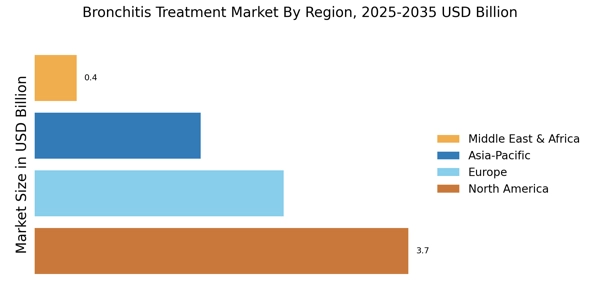
North America leads in the Bronchitis Treatment Market Size, accounting for over 44.57% of the global revenue in 2024. North America dominated the global market in 2024, reaching a market size of USD 3.49 Billion, marking it as a major player in the industry due to high healthcare expenditure and advanced treatment options.

Europe market was valued at USD 2.49 billion in 2024, making it the second-largest regional market with a 30% share, making it the second-largest regional market with a 30% share, and anticipated to reach 3.72 USD Billion by 2035, indicating its significant contribution to the Global market revenue through robust regulatory frameworks and extensive research activities.

The APAC region, valued at 1.77 USD Billion in 2024, with a rise to 2.55 USD Billion in 2035, reflected an increasing demand for effective treatments driven by rising pollution levels and healthcare improvement initiatives.

South America and MEA held comparatively smaller shares, valued at 0.42 USD Billion and 0.11 USD Billion, respectively, in 2024, with growth potential as the awareness of bronchitis management improved.

The market growth in these regions presents ample opportunities, driven by expanding healthcare access and initiatives aimed at improving treatment outcomes in respiratory diseases.

Bronchitis Treatment Market Regional Image

Key Players and Competitive Insights

The Global Bronchitis Treatment Market is characterized by intense competition, as numerous companies strive to establish and enhance their market positions through innovative therapies and effective treatment options. The increasing prevalence of bronchitis, driven by factors such as environmental pollution, smoking habits, and the rising incidence of respiratory diseases, has resulted in a growing demand for effective solutions. 
 
Companies are investing significantly in research and development to bring forth new pharmaceutical products and therapies, promising advancements in the treatment landscape. Competitive strategies often involve strategic partnerships, mergers, and acquisitions aimed at broadening product portfolios and expanding geographical reach, ensuring that companies can meet the diverse needs of patients worldwide. Roche has a significant presence in the Global market, primarily leveraging its robust portfolio of respiratory medications. 
 
The company is known for its strong commitment to research and innovation, allowing it to develop effective treatment options tailored to respiratory diseases, including bronchitis. Roche's strengths lie in its established brand reputation, extensive distribution channels, and strong financial backing, enabling it to conduct extensive clinical trials and deliver high-quality healthcare solutions.
 
Additionally, Roche's global reach allows it to access various markets and cater to a wide demographic, reinforcing its position as a key player in bronchitis treatment through consistent product availability and the introduction of novel therapies. Mylan, a notable competitor in the Global market, is recognized for its commitment to increasing access to affordable medications. The company specializes in the development and distribution of generic and specialty drugs, including treatments for respiratory conditions.
 
Mylan's strengths include its broad product portfolio, which features a range of formulations for bronchitis management, and its significant market presence across different regions. The company's focus on quality assurance and regulatory compliance ensures that its products meet stringent health standards, facilitating trust among healthcare providers and patients alike.
 
Mylan's strategic initiatives to expand its manufacturing capabilities and invest in innovative drug delivery systems position it well in the competitive landscape, allowing it to respond effectively to the evolving needs of the market.

Key Companies in the Bronchitis Treatment Market include

Industry Developments

Recent developments in the Global Bronchitis Treatment Market highlight significant advancements and challenges faced by key players. Roche is focusing on innovative therapies to enhance treatment efficacy. Mylan has introduced generic alternatives to increase affordability. Amgen recently expanded its research on biologics that target underlying inflammatory processes in bronchitis.

Johnson & Johnson and Merck & Co. are investing in collaborative research to develop new formulations that incorporate long-acting bronchodilators. Pfizer's latest pipeline includes treatments combining corticosteroids and bronchodilators to improve patient outcomes, while Teva Pharmaceutical Industries emphasizes cost-effective solutions.

In terms of mergers and acquisitions, no substantial activity has been reported recently involving the primary companies within this market. The valuation growth for companies like GlaxoSmithKline and AbbVie is driven by ongoing research and development alignments, which are proving crucial in addressing the increasing global burden of bronchitis.

Sanofi and Novartis are also enhancing their product portfolios, responding to rising demand for advanced treatment options. AstraZeneca and Gilead Sciences continue to innovate, fostering competitive dynamics that shape the market landscape significantly as they explore synergistic partnerships and new treatment avenues.

Future Outlook

Bronchitis Treatment Market Future Outlook

The Bronchitis Treatment Market size is projected to reach USD 12.49 Billion by 2035, growing at a CAGR of 3.7%, driven by increasing prevalence, advancements in treatment options, and rising healthcare expenditure.

New opportunities lie in:

  • Development of personalized medicine approaches for bronchitis treatment Expansion of telehealth services for remote patient monitoring Investment in innovative drug delivery systems for enhanced efficacy

By 2035, the market is expected to achieve substantial growth, reflecting evolving treatment paradigms.

Market Segmentation

Bronchitis Treatment Market Patient Type Outlook

  • Acute Bronchitis
  • Chronic Bronchitis
  • Recurrent Bronchitis

Bronchitis Treatment Market Treatment Type Outlook

  • Medication
  • Therapy
  • Surgery

Bronchitis Treatment Market Medication Type Outlook

  • Bronchodilators
  • Corticosteroids
  • Antibiotics
  • Mucolytics

Bronchitis Treatment Market Route of Administration Outlook

  • Inhalation
  • Oral
  • Injection

Report Scope

MARKET SIZE 2024 8.302(USD Billion)
MARKET SIZE 2025 8.616(USD Billion)
MARKET SIZE 2035 12.49(USD Billion)
COMPOUND ANNUAL GROWTH RATE (CAGR) 3.78% (2025 - 2035)
REPORT COVERAGE Revenue Forecast, Competitive Landscape, Growth Factors, and Trends
BASE YEAR 2024
Market Forecast Period 2025 - 2035
Historical Data 2019 - 2024
Market Forecast Units USD Billion
Key Companies Profiled GlaxoSmithKline (GB), Pfizer (US), Boehringer Ingelheim (DE), AstraZeneca (GB), Novartis (CH), Teva Pharmaceutical Industries (IL), Merck & Co. (US), Roche (CH), Sanofi (FR)
Segments Covered Treatment Type, Medication Type, Patient Type, Route of Administration, Regional
Key Market Opportunities Integration of telemedicine and digital health solutions enhances access to the market.
Key Market Dynamics Rising demand for innovative therapies drives competition and influences treatment protocols in the market.

Countries Covered North America, Europe, APAC, South America, MEA

FAQs

What is the current valuation of the Bronchitis Treatment Market as of 2024?

The Bronchitis Treatment Market was valued at 8.302 USD Billion in 2024.

What is the projected market valuation for the market in 2035?
The market is projected to reach 12.49 USD Billion by 2035.
What is the expected CAGR for the market during the forecast period 2025 - 2035?
The expected CAGR for the Bronchitis Treatment Market during 2025 - 2035 is 3.78%.
Which treatment types are included in the market segments?
The treatment types include Medication, Therapy, and Surgery, with valuations ranging from 2.3 to 5.5 USD Billion.
What are the leading medication types in the Bronchitis Treatment Market?

Leading medication types include Bronchodilators, Corticosteroids, Antibiotics, and Mucolytics, with values from 1.5 to 3.8 USD Billion.

How does the market segment by patient type for Bronchitis Treatment?

The market segments by patient type include Acute Bronchitis, Chronic Bronchitis, and Recurrent Bronchitis, with valuations from 2.3 to 5.2 USD Billion.

What routes of administration are utilized in the market?
Routes of administration include Inhalation, Oral, and Injection, with valuations ranging from 2.3 to 5.2 USD Billion.
Who are the key players in the Bronchitis Treatment Market?
Key players include GlaxoSmithKline, Pfizer, Boehringer Ingelheim, AstraZeneca, Novartis, Teva Pharmaceutical Industries, Merck & Co., Roche, and Sanofi.
What is the market performance of Chronic Bronchitis treatment compared to Acute Bronchitis?

Chronic Bronchitis treatment is projected to generate 3.5 to 5.2 USD Billion, outperforming Acute Bronchitis treatment, which ranges from 2.5 to 3.8 USD Billion.

What trends are anticipated in the market by 2035?
By 2035, the market is likely to experience growth driven by advancements in treatment types and an increasing focus on patient-specific therapies.
Author
Author
Author Profile
Satyendra Maurya LinkedIn
Research Analyst
An accomplished research analyst with high proficiency in market forecasting, data visualization, competitive benchmarking, and others. He holds a pronounced track record in research and consulting projects for sectors such as life sciences, medical devices, and healthcare IT. His capabilities in qualitative and quantitative analysis have resulted in positive client outcomes. Working on niche market trends, opportunities, sales, and forecasted value is part of his skill set.
Co-Author
Co-Author Profile
Garvit Vyas LinkedIn
Vice President - Operations
Garvit Vyas is a Research Analyst with experience in working across multiple industry domains in the market research sector. Over the past four years, he has been actively involved in analyzing diverse markets, gathering industry insights, and contributing to the development of comprehensive research reports. His work includes studying market trends, evaluating competitive landscapes, and supporting data-driven business insights. In the early phase of his career, Garvit worked on cross-domain research projects, which helped him build a strong foundation in market analysis, data interpretation, and industry intelligence across various sectors. Later, he transitioned into the Quality Control (QC) function, where he focuses on reviewing and refining research reports and marketing collaterals to ensure accuracy, consistency, and high editorial standards. His responsibilities include validating research data, improving report structure, and maintaining the overall quality of published content. Garvit is committed to maintaining strong research integrity and delivering reliable insights that support informed business decision-making.
Download Free Sample

Kindly complete the form below to receive a free sample of this Report

Download PDF ×

We do not share your information with anyone. However, we may send you emails based on your report interest from time to time. You may contact us at any time to opt-out.