
×
Hero Background
English
Chinese
French
Japanese
Korean
German
Spanish

Builder Hardware Market Share

ID: MRFR/PCM/6524-HCR
220 Pages
Varsha More
October 2025

Builder Hardware Market Research Report Information By Type (Cabinet Hardware, Doors, Hardware, Windows Hardware, Plumbing Hardware, others), By Application (Residential and Non-Residential), And By Region (North America, Europe, Asia-Pacific, And Rest Of The World) –Market Forecast Till 2035

Share:
Download PDF ×

We do not share your information with anyone. However, we may send you emails based on your report interest from time to time. You may contact us at any time to opt-out.

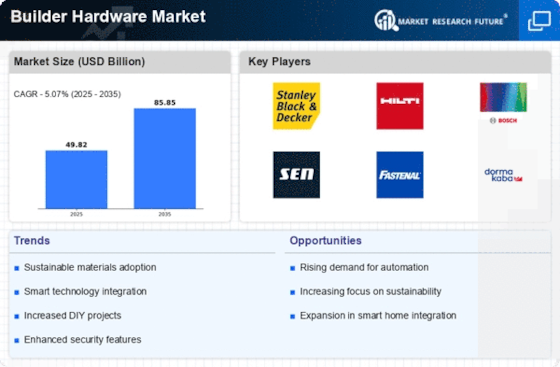
Builder Hardware Market Infographic
Purchase Options

Market Share

Builder Hardware Market Share Analysis

In the Builder Hardware Market, companies employ diverse strategies to position themselves effectively and secure a competitive advantage in terms of market share. Differentiation stands out as a prominent approach, with companies emphasizing unique features and qualities in their hardware products to set them apart from competitors. This could include innovative designs, superior materials, or specific functionalities, enabling companies to target distinct market segments. By offering products that stand out in the market, businesses aim to attract customers who value those particular attributes, helping them gain a significant share in specialized niches.

There exist several opportunities in the global builder hardware industry. One of the main opportunities arises due to the surge in the number of construction activities. It creates opportunities for business players to introduce new, improved and sustainable builder hardware solutions. There is also an opportunity to integrate innovation and advanced technology into the development of builder hardware solutions to offer more efficient and automated builder hardware equipment in the global market.

Cost leadership is another widely adopted strategy in the Builder Hardware Market, where companies focus on optimizing production processes and minimizing costs to offer their products at competitive prices. Efficiency improvements, economies of scale, and streamlined operations contribute to the ability to provide affordable yet reliable builder hardware. By adopting a cost leadership strategy, companies aim to appeal to price-sensitive customers, capturing a broad market share by offering cost-effective solutions without compromising on quality.

Market segmentation plays a crucial role in positioning strategies within the Builder Hardware Market. Companies divide the market into distinct segments based on factors such as geography, building types, or specific applications. Understanding the unique needs and preferences of each segment allows businesses to tailor their products and marketing efforts accordingly. This targeted approach enables companies to secure a larger market share within each segment, as customers perceive their builder hardware as more suitable for their specific requirements.

Strategic partnerships and collaborations are also instrumental in market share positioning. Builder hardware manufacturers often form alliances with distributors, retailers, or construction companies to enhance their market presence. These collaborations can lead to expanded distribution channels, increased brand visibility, and shared resources, all contributing to a broader market share. By partnering with complementary businesses, companies can tap into new markets and benefit from each other's strengths, creating mutually advantageous opportunities for growth.

Customer-centric strategies are paramount in the Builder Hardware Market, where understanding and addressing customer needs play a pivotal role. Investments in customer service, obtaining feedback, and continuous improvement based on customer preferences help build strong relationships. By prioritizing customer satisfaction, companies can enhance customer loyalty, leading to repeat business and positive word-of-mouth, ultimately contributing to an increased market share.

Innovation is a driving force in market share positioning within the Builder Hardware Market. Companies that invest in research and development to create innovative and technologically advanced hardware solutions gain a competitive edge. Innovative products that offer enhanced performance, durability, or energy efficiency are attractive to customers seeking cutting-edge solutions. Staying ahead of industry trends through innovation allows companies to capture a larger market share by meeting the evolving demands of customers and maintaining a reputation for forward-thinking solutions.


Author
Varsha More
Research Analyst

Experienced business professional with a demonstrated history of working in the CFnB industry. Skilled in market research, and market estimation. Strong professional with a Masters focused in marketing management.

Leave a Comment

FAQs

What is the current valuation of the Builder Hardware Market as of 2024?

The Builder Hardware Market was valued at 49.82 USD Billion in 2024.

What is the projected market valuation for the Builder Hardware Market in 2035?

The market is projected to reach 85.85 USD Billion by 2035.

What is the expected CAGR for the Builder Hardware Market during the forecast period 2025 - 2035?

The expected CAGR for the Builder Hardware Market during 2025 - 2035 is 5.07%.

Which segments are included in the Builder Hardware Market?

The segments include Cabinet Hardware, Doors Hardware, Windows Hardware, Plumbing Hardware, and Others.

What was the valuation of the Doors Hardware segment in 2024?

The Doors Hardware segment was valued at 12.0 USD Billion in 2024.

How much is the Cabinet Hardware segment projected to grow by 2035?

The Cabinet Hardware segment is projected to grow from 8.0 USD Billion in 2024 to 13.5 USD Billion by 2035.

Market Summary

As per MRFR analysis, the Builder Hardware Market Size was estimated at 49.82 USD Billion in 2024. The Builder Hardware industry is projected to grow from 52.35 USD Billion in 2025 to 85.85 USD Billion by 2035, exhibiting a compound annual growth rate (CAGR) of 5.07 during the forecast period 2025 - 2035.

Key Market Trends & Highlights

The Builder Hardware Market is currently experiencing a dynamic shift towards sustainability and technological integration.

  • Sustainability in product development is becoming a central focus among manufacturers in North America.
  • The integration of smart technology is reshaping consumer expectations, particularly in the Asia-Pacific region.
  • Customization and personalization trends are gaining traction, especially within the cabinet hardware segment.
  • Rising construction activities and sustainability initiatives are driving growth in both residential and plumbing hardware markets.

Market Size & Forecast

2024 Market Size 49.82 (USD Billion)
2035 Market Size 85.85 (USD Billion)
CAGR (2025 - 2035) 5.07%
Largest Regional Market Share in 2024 Asia Pacific

Major Players

<p>Stanley Black & Decker (US), Hilti (LI), BOSCH (DE), Senco (US), Fastenal (US), DormaKaba (CH), Allegion (IE), ASSA ABLOY (SE), Emtek (US)</p>

Market Trends

The Builder Hardware Market is currently experiencing a dynamic evolution, driven by various factors that influence consumer preferences and technological advancements. The increasing focus on sustainable building practices appears to be reshaping product offerings, as manufacturers strive to meet the growing demand for eco-friendly materials and energy-efficient solutions. Additionally, the rise of smart home technology seems to be integrating seamlessly with builder hardware, enhancing functionality and convenience for end-users. This convergence of traditional hardware with modern technology indicates a shift towards more innovative and user-centric designs. Moreover, the Builder Hardware Market is witnessing a notable trend towards customization and personalization. Consumers are increasingly seeking products that reflect their individual tastes and preferences, prompting manufacturers to offer a wider array of options. This trend not only caters to aesthetic desires but also addresses specific functional needs, thereby enhancing overall user satisfaction. As the market continues to evolve, it is likely that these trends will further shape the landscape, fostering a competitive environment that encourages continuous improvement and adaptation to consumer demands.

Sustainability in Product Development

The Builder Hardware Market is increasingly prioritizing sustainable practices, with manufacturers focusing on eco-friendly materials and energy-efficient solutions. This trend reflects a broader societal shift towards environmental responsibility, as consumers become more conscious of their choices.

Integration of Smart Technology

The incorporation of smart technology into builder hardware is gaining traction, as products become more interconnected and user-friendly. This trend enhances convenience and functionality, appealing to tech-savvy consumers who seek modern solutions for their homes.

Customization and Personalization

There is a growing demand for customized builder hardware, as consumers desire products that align with their personal style and specific needs. This trend encourages manufacturers to diversify their offerings, providing a range of options that cater to individual preferences.

Builder Hardware Market Market Drivers

Customization Trends

Customization trends are significantly influencing the Builder Hardware Market, as consumers increasingly seek personalized solutions that cater to their specific needs. This demand for tailored products is prompting manufacturers to offer a variety of customizable options, from finishes and colors to sizes and functionalities. The ability to personalize builder hardware not only enhances aesthetic appeal but also allows for improved compatibility with diverse architectural styles. Industry expert's indicates that the customization segment is projected to grow, driven by consumer preferences for unique and individualized products. As a result, the Builder Hardware Market is likely to see an expansion in offerings that meet these customization demands, fostering greater customer satisfaction and loyalty.

Sustainability Initiatives

Sustainability initiatives are becoming increasingly prominent within the Builder Hardware Market, as consumers and manufacturers alike prioritize eco-friendly practices. The demand for sustainable materials and products is on the rise, with many builders seeking hardware that minimizes environmental impact. This trend is reflected in the growing availability of products made from recycled materials or those that adhere to green building standards. Market data suggests that the sustainable building materials segment is expected to grow at a compound annual growth rate of around 7% over the next few years. Consequently, the Builder Hardware Market is adapting to these changes by offering a wider range of sustainable options, thereby appealing to environmentally conscious consumers.

Technological Advancements

Technological advancements are reshaping the Builder Hardware Market, leading to the introduction of innovative products that enhance functionality and efficiency. The integration of smart technology into builder hardware, such as smart locks and automated door systems, is gaining traction among consumers and builders alike. This shift towards technology-driven solutions is expected to drive market growth, as these products offer improved security and convenience. Furthermore, advancements in manufacturing processes, including automation and precision engineering, are likely to reduce production costs and improve product quality. As a result, the Builder Hardware Market is witnessing a transformation that aligns with modern consumer preferences and industry standards.

Rising Construction Activities

The Builder Hardware Market is experiencing a notable surge in construction activities across various sectors, including residential, commercial, and industrial. This increase is driven by urbanization and population growth, which necessitate the development of new infrastructure. According to recent data, construction spending has shown a steady upward trend, with estimates indicating a growth rate of approximately 5% annually. This expansion in construction projects directly correlates with heightened demand for builder hardware, as essential components such as locks, hinges, and fasteners are integral to any building process. As construction companies ramp up their operations to meet the growing needs of the market, the Builder Hardware Market is poised to benefit significantly from this trend.

Regulatory Compliance and Standards

Regulatory compliance and standards are critical drivers within the Builder Hardware Market, as governments and organizations implement stringent regulations to ensure safety and quality. Compliance with building codes and standards is essential for manufacturers, as failure to adhere can result in significant penalties and loss of market access. The increasing focus on safety and quality assurance is prompting manufacturers to invest in research and development to meet these regulatory requirements. This trend is expected to drive innovation within the Builder Hardware Market, as companies strive to develop products that not only comply with regulations but also exceed consumer expectations. Consequently, adherence to regulatory standards is likely to shape the future landscape of the builder hardware sector.

Market Segment Insights

Builder HardwareType Insights

The  Builder Hardware Market segmentation, based on type includes Cabinet Hardware, Doors, Hardware, Windows Hardware, Plumbing Hardware, and others. The cabinet hardware segment dominated the market;The cabinet hardware segment is projected to gain a significant market share in the forecast period. It encompasses various components like knobs, latches, hinges, and fasteners essential in cabinet construction. The increasing number of construction activities and projects is expected to boost the demand for cabinet hardware, driving the growth of this market segment.

Builder Hardware Market Application Insights

Based on application, the  Builder Hardware Market segmentation includes residential and non-residential. The residential segment dominated the market; The residential segment is anticipated to have a dominant position in the building hardware industry. This is driven by factors such as rapid urbanization in various regions and population growth. However, the non-residential segment is also expected to make a significant contribution to the overall performance of the building hardware industry during the forecast period.

Figure1: Builder Hardware Market, by Application, 2022 & 2032 (USD billion)

Source: Secondary Research, Primary Research, Market Research Future Database, and Analyst Review

Get more detailed insights about Builder Hardware Market Research Report - Global Forecast till 2035

Regional Insights

North America : Market Leader in Builder Hardware Market

North America is the largest market for builder hardware, holding approximately 40% of the global share. Key growth drivers include a booming construction sector, increased renovation activities, and stringent safety regulations. The U.S. and Canada are the primary contributors, with the U.S. alone accounting for about 35% of the market. Regulatory catalysts, such as updated building codes, further enhance demand for high-quality builder hardware. The competitive landscape is dominated by major players like Stanley Black & Decker, Hilti, and Senco, which have established strong brand recognition and distribution networks. The presence of these key players fosters innovation and quality improvements in the market. Additionally, the growing trend of smart home technologies is influencing product offerings, pushing companies to adapt and innovate to meet consumer demands.

Europe : Diverse Market Dynamics

Europe is a significant player in the builder hardware market, holding around 30% of the global share. The region benefits from a robust construction industry, driven by urbanization and sustainability initiatives. Germany and the UK are the largest markets, contributing approximately 25% and 20% respectively. Regulatory frameworks, such as the EU's Construction Products Regulation, are pivotal in shaping market dynamics and ensuring product quality and safety. Leading countries like Germany, France, and the UK showcase a competitive landscape with key players such as Bosch and DormaKaba. The market is characterized by a mix of established brands and innovative startups, focusing on sustainability and smart technologies. The presence of major trade fairs and exhibitions in the region also fosters networking and collaboration among industry stakeholders, enhancing market growth.

Asia-Pacific : Emerging Market Potential

Asia-Pacific is an emerging powerhouse in the builder hardware market, accounting for approximately 25% of the global share. The region's growth is fueled by rapid urbanization, increasing disposable incomes, and government initiatives to boost infrastructure development. China and India are the largest markets, holding about 15% and 5% respectively. Regulatory support for construction standards and safety is also a significant driver of market demand. The competitive landscape features a mix of local and international players, including ASSA ABLOY and Allegion. The presence of these key players is crucial for driving innovation and meeting the diverse needs of consumers. Additionally, the growing trend of smart homes and automation is influencing product offerings, pushing companies to adapt to changing consumer preferences and technological advancements.

Middle East and Africa : Untapped Market Opportunities

The Middle East and Africa region is witnessing a gradual increase in the builder hardware market, holding around 5% of the global share. Key growth drivers include urbanization, infrastructure projects, and a growing focus on safety regulations. Countries like the UAE and South Africa are leading the market, with the UAE accounting for approximately 3% of the share. Government initiatives aimed at enhancing construction standards are pivotal in driving market growth. The competitive landscape is characterized by a mix of local and international players, with companies like Emtek and Fastenal making significant inroads. The region's unique challenges, such as fluctuating economic conditions, require companies to be agile and innovative. The increasing demand for high-quality and durable builder hardware is pushing manufacturers to invest in research and development to meet evolving consumer needs.

Key Players and Competitive Insights

Leading market players are investing heavily in research and development to expand their product lines, which will help the builder hardware market grow even more. Market participants are also undertaking various strategic activities to expand their footprint, with important market developments including new product launches, contractual agreements, mergers and acquisitions, higher investments, and collaboration with other organizations. To expand and survive in a more competitive and rising market climate, the Builder Hardware industry must offer cost-effective items.

Manufacturing locally to minimize operational costs is one of the key business tactics manufacturers use in the  Builder Hardware industry to benefit clients and increase the market sector. The Builder Hardware industry has offered some of the most significant advantages in recent years. Major players in the Builder Hardware Market, includingASSA ABLOY (Sweden), Allegion plc (Ireland), Masco Corporation (US), dormakaba Group (Switzerland), Tyman plc (US), Roto (Germany), Siegenia (Germany), GUANGDONG KIN LONG HARDWARE PRODUCTS CO., LTD (China), and Sobinco (Belgium)., and others, are attempting to increase market demand by investing in research and development operations.

Assa Abloy AB, a Swedish conglomerate specializing in locks, doors, gates, and entrance automation, offers many products and services. These include access control systems utilizing keys, cards, tags, mobile devices, and biometric verification for controlling access and confirming identities. Assa Abloy collaborated with Allegion, a  provider of security products and solutions, to develop comprehensive access control solutions specifically designed for commercial buildings. ASSA ABLOY and Allegion: ASSA ABLOY, a leading provider of door-opening solutions, collaborated with Allegion, a  security products, and solutions provider, to develop integrated access control solutions for commercial buildings.

Stanley Black & Decker, Inc., previously known as The Stanley Works, is a well-established American company that manufactures industrial tools, household hardware, and security products.In a collaborative effort, Stanley Black & Decker joined forces with Schneider Electric, a multinational company specializing in energy management and automation, to create innovative smart home and building automation solutions. This partnership aims to integrate hardware and software technologies, providing advanced and efficient automation systems.

Key Companies in the Builder Hardware Market market include

Industry Developments

September 2021: ASSA ABLOY and Allegion: ASSA ABLOY, a leading provider of door-opening solutions, collaborated with Allegion, a  security products, and solutions provider, to develop integrated access control solutions for commercial buildings.

September 2020:Stanley Black & Decker and Schneider Electric: Stanley Black & Decker, a manufacturer of tools and security solutions, partnered with Schneider Electric, a multinational energy management and automation company, to develop smart home and building automation solutions, integrating hardware and software technologies.

October 2019: Masco Corporation, a prominent manufacturer of building and home improvement products, joined forces with Spectrum Brands, a  consumer products company, to create and distribute builder hardware products specifically designed for the residential market. These hardware products encompass a wide range of items such as door locks, handles, and other accessories, catering to the needs of homeowners and enhancing the functionality and aesthetics of residential spaces. This collaboration aims to leverage the expertise and resources of both companies to deliver high-quality and innovative builder hardware solutions.

May 2019: Dormakaba and MIWA Lock Company: Dormakaba, a provider of access control and security solutions, collaborated with MIWA Lock Company, a leading manufacturer of electronic locks, to develop advanced keyless entry systems for the hospitality industry, offering enhanced security and convenience.

Future Outlook

Builder Hardware Market Future Outlook

<p>The Builder Hardware Market is projected to grow at a 5.07% CAGR from 2024 to 2035, driven by urbanization, technological advancements, and increased construction activities.</p>

New opportunities lie in:

  • <p>Integration of smart technology in hardware products</p>
  • <p>Expansion into emerging markets with tailored solutions</p>
  • <p>Development of eco-friendly and sustainable building materials</p>

<p>By 2035, the Builder Hardware Market is expected to achieve robust growth and innovation.</p>

Market Segmentation

Builder Hardware Market Type Outlook

  • Cabinet Hardware
  • Doors Hardware
  • Windows Hardware
  • Plumbing Hardware
  • Others

Builder Hardware Market Application Outlook

  • Residential
  • Non-Residential

Report Scope

MARKET SIZE 202449.82(USD Billion)
MARKET SIZE 202552.35(USD Billion)
MARKET SIZE 203585.85(USD Billion)
COMPOUND ANNUAL GROWTH RATE (CAGR)5.07% (2024 - 2035)
REPORT COVERAGERevenue Forecast, Competitive Landscape, Growth Factors, and Trends
BASE YEAR2024
Market Forecast Period2025 - 2035
Historical Data2019 - 2024
Market Forecast UnitsUSD Billion
Key Companies ProfiledMarket analysis in progress
Segments CoveredMarket segmentation analysis in progress
Key Market OpportunitiesIntegration of smart technology in Builder Hardware Market enhances efficiency and consumer engagement.
Key Market DynamicsRising demand for sustainable materials drives innovation and competition in the Builder Hardware Market.
Countries CoveredNorth America, Europe, APAC, South America, MEA

FAQs

What is the current valuation of the Builder Hardware Market as of 2024?

The Builder Hardware Market was valued at 49.82 USD Billion in 2024.

What is the projected market valuation for the Builder Hardware Market in 2035?

The market is projected to reach 85.85 USD Billion by 2035.

What is the expected CAGR for the Builder Hardware Market during the forecast period 2025 - 2035?

The expected CAGR for the Builder Hardware Market during 2025 - 2035 is 5.07%.

Which segments are included in the Builder Hardware Market?

The segments include Cabinet Hardware, Doors Hardware, Windows Hardware, Plumbing Hardware, and Others.

What was the valuation of the Doors Hardware segment in 2024?

The Doors Hardware segment was valued at 12.0 USD Billion in 2024.

How much is the Cabinet Hardware segment projected to grow by 2035?

The Cabinet Hardware segment is projected to grow from 8.0 USD Billion in 2024 to 13.5 USD Billion by 2035.

  1. SECTION I: EXECUTIVE SUMMARY AND KEY HIGHLIGHTS
    1. EXECUTIVE SUMMARY
      1. Market Overview
      2. Key Findings
      3. Market Segmentation
      4. Competitive Landscape
      5. Challenges and Opportunities
      6. Future Outlook
  2. SECTION II: SCOPING, METHODOLOGY AND MARKET STRUCTURE
    1. MARKET INTRODUCTION
      1. Definition
      2. Scope of the study
    2. RESEARCH METHODOLOGY
      1. Overview
      2. Data Mining
      3. Secondary Research
      4. Primary Research
      5. Forecasting Model
      6. Market Size Estimation
      7. Data Triangulation
      8. Validation
  3. SECTION III: QUALITATIVE ANALYSIS
    1. MARKET DYNAMICS
      1. Overview
      2. Drivers
      3. Restraints
      4. Opportunities
    2. MARKET FACTOR ANALYSIS
      1. Value chain Analysis
      2. Porter's Five Forces Analysis
      3. COVID-19 Impact Analysis
  4. SECTION IV: QUANTITATIVE ANALYSIS
    1. Packaging & Transport, BY Type (USD Billion)
      1. Cabinet Hardware
      2. Doors Hardware
      3. Windows Hardware
      4. Plumbing Hardware
      5. Others
    2. Packaging & Transport, BY Application (USD Billion)
      1. Residential
      2. Non-Residential
    3. Packaging & Transport, BY Region (USD Billion)
      1. North America
      2. Europe
      3. APAC
      4. South America
      5. MEA
  5. SECTION V: COMPETITIVE ANALYSIS
    1. Competitive Landscape
      1. Overview
      2. Competitive Analysis
      3. Market share Analysis
      4. Major Growth Strategy in the Packaging & Transport
      5. Competitive Benchmarking
      6. Leading Players in Terms of Number of Developments in the Packaging & Transport
      7. Key developments and growth strategies
      8. Major Players Financial Matrix
    2. Company Profiles
      1. Stanley Black & Decker (US)
      2. Hilti (LI)
      3. BOSCH (DE)
      4. Senco (US)
      5. Fastenal (US)
      6. DormaKaba (CH)
      7. Allegion (IE)
      8. ASSA ABLOY (SE)
      9. Emtek (US)
    3. Appendix
      1. References
      2. Related Reports
  6. LIST OF FIGURES
    1. MARKET SYNOPSIS
    2. NORTH AMERICA MARKET ANALYSIS
    3. US MARKET ANALYSIS BY TYPE
    4. US MARKET ANALYSIS BY APPLICATION
    5. CANADA MARKET ANALYSIS BY TYPE
    6. CANADA MARKET ANALYSIS BY APPLICATION
    7. EUROPE MARKET ANALYSIS
    8. GERMANY MARKET ANALYSIS BY TYPE
    9. GERMANY MARKET ANALYSIS BY APPLICATION
    10. UK MARKET ANALYSIS BY TYPE
    11. UK MARKET ANALYSIS BY APPLICATION
    12. FRANCE MARKET ANALYSIS BY TYPE
    13. FRANCE MARKET ANALYSIS BY APPLICATION
    14. RUSSIA MARKET ANALYSIS BY TYPE
    15. RUSSIA MARKET ANALYSIS BY APPLICATION
    16. ITALY MARKET ANALYSIS BY TYPE
    17. ITALY MARKET ANALYSIS BY APPLICATION
    18. SPAIN MARKET ANALYSIS BY TYPE
    19. SPAIN MARKET ANALYSIS BY APPLICATION
    20. REST OF EUROPE MARKET ANALYSIS BY TYPE
    21. REST OF EUROPE MARKET ANALYSIS BY APPLICATION
    22. APAC MARKET ANALYSIS
    23. CHINA MARKET ANALYSIS BY TYPE
    24. CHINA MARKET ANALYSIS BY APPLICATION
    25. INDIA MARKET ANALYSIS BY TYPE
    26. INDIA MARKET ANALYSIS BY APPLICATION
    27. JAPAN MARKET ANALYSIS BY TYPE
    28. JAPAN MARKET ANALYSIS BY APPLICATION
    29. SOUTH KOREA MARKET ANALYSIS BY TYPE
    30. SOUTH KOREA MARKET ANALYSIS BY APPLICATION
    31. MALAYSIA MARKET ANALYSIS BY TYPE
    32. MALAYSIA MARKET ANALYSIS BY APPLICATION
    33. THAILAND MARKET ANALYSIS BY TYPE
    34. THAILAND MARKET ANALYSIS BY APPLICATION
    35. INDONESIA MARKET ANALYSIS BY TYPE
    36. INDONESIA MARKET ANALYSIS BY APPLICATION
    37. REST OF APAC MARKET ANALYSIS BY TYPE
    38. REST OF APAC MARKET ANALYSIS BY APPLICATION
    39. SOUTH AMERICA MARKET ANALYSIS
    40. BRAZIL MARKET ANALYSIS BY TYPE
    41. BRAZIL MARKET ANALYSIS BY APPLICATION
    42. MEXICO MARKET ANALYSIS BY TYPE
    43. MEXICO MARKET ANALYSIS BY APPLICATION
    44. ARGENTINA MARKET ANALYSIS BY TYPE
    45. ARGENTINA MARKET ANALYSIS BY APPLICATION
    46. REST OF SOUTH AMERICA MARKET ANALYSIS BY TYPE
    47. REST OF SOUTH AMERICA MARKET ANALYSIS BY APPLICATION
    48. MEA MARKET ANALYSIS
    49. GCC COUNTRIES MARKET ANALYSIS BY TYPE
    50. GCC COUNTRIES MARKET ANALYSIS BY APPLICATION
    51. SOUTH AFRICA MARKET ANALYSIS BY TYPE
    52. SOUTH AFRICA MARKET ANALYSIS BY APPLICATION
    53. REST OF MEA MARKET ANALYSIS BY TYPE
    54. REST OF MEA MARKET ANALYSIS BY APPLICATION
    55. KEY BUYING CRITERIA OF PACKAGING & TRANSPORT
    56. RESEARCH PROCESS OF MRFR
    57. DRO ANALYSIS OF PACKAGING & TRANSPORT
    58. DRIVERS IMPACT ANALYSIS: PACKAGING & TRANSPORT
    59. RESTRAINTS IMPACT ANALYSIS: PACKAGING & TRANSPORT
    60. SUPPLY / VALUE CHAIN: PACKAGING & TRANSPORT
    61. PACKAGING & TRANSPORT, BY TYPE, 2024 (% SHARE)
    62. PACKAGING & TRANSPORT, BY TYPE, 2024 TO 2035 (USD Billion)
    63. PACKAGING & TRANSPORT, BY APPLICATION, 2024 (% SHARE)
    64. PACKAGING & TRANSPORT, BY APPLICATION, 2024 TO 2035 (USD Billion)
    65. BENCHMARKING OF MAJOR COMPETITORS
  7. LIST OF TABLES
    1. LIST OF ASSUMPTIONS
    2. North America MARKET SIZE ESTIMATES; FORECAST
      1. BY TYPE, 2025-2035 (USD Billion)
      2. BY APPLICATION, 2025-2035 (USD Billion)
    3. US MARKET SIZE ESTIMATES; FORECAST
      1. BY TYPE, 2025-2035 (USD Billion)
      2. BY APPLICATION, 2025-2035 (USD Billion)
    4. Canada MARKET SIZE ESTIMATES; FORECAST
      1. BY TYPE, 2025-2035 (USD Billion)
      2. BY APPLICATION, 2025-2035 (USD Billion)
    5. Europe MARKET SIZE ESTIMATES; FORECAST
      1. BY TYPE, 2025-2035 (USD Billion)
      2. BY APPLICATION, 2025-2035 (USD Billion)
    6. Germany MARKET SIZE ESTIMATES; FORECAST
      1. BY TYPE, 2025-2035 (USD Billion)
      2. BY APPLICATION, 2025-2035 (USD Billion)
    7. UK MARKET SIZE ESTIMATES; FORECAST
      1. BY TYPE, 2025-2035 (USD Billion)
      2. BY APPLICATION, 2025-2035 (USD Billion)
    8. France MARKET SIZE ESTIMATES; FORECAST
      1. BY TYPE, 2025-2035 (USD Billion)
      2. BY APPLICATION, 2025-2035 (USD Billion)
    9. Russia MARKET SIZE ESTIMATES; FORECAST
      1. BY TYPE, 2025-2035 (USD Billion)
      2. BY APPLICATION, 2025-2035 (USD Billion)
    10. Italy MARKET SIZE ESTIMATES; FORECAST
      1. BY TYPE, 2025-2035 (USD Billion)
      2. BY APPLICATION, 2025-2035 (USD Billion)
    11. Spain MARKET SIZE ESTIMATES; FORECAST
      1. BY TYPE, 2025-2035 (USD Billion)
      2. BY APPLICATION, 2025-2035 (USD Billion)
    12. Rest of Europe MARKET SIZE ESTIMATES; FORECAST
      1. BY TYPE, 2025-2035 (USD Billion)
      2. BY APPLICATION, 2025-2035 (USD Billion)
    13. APAC MARKET SIZE ESTIMATES; FORECAST
      1. BY TYPE, 2025-2035 (USD Billion)
      2. BY APPLICATION, 2025-2035 (USD Billion)
    14. China MARKET SIZE ESTIMATES; FORECAST
      1. BY TYPE, 2025-2035 (USD Billion)
      2. BY APPLICATION, 2025-2035 (USD Billion)
    15. India MARKET SIZE ESTIMATES; FORECAST
      1. BY TYPE, 2025-2035 (USD Billion)
      2. BY APPLICATION, 2025-2035 (USD Billion)
    16. Japan MARKET SIZE ESTIMATES; FORECAST
      1. BY TYPE, 2025-2035 (USD Billion)
      2. BY APPLICATION, 2025-2035 (USD Billion)
    17. South Korea MARKET SIZE ESTIMATES; FORECAST
      1. BY TYPE, 2025-2035 (USD Billion)
      2. BY APPLICATION, 2025-2035 (USD Billion)
    18. Malaysia MARKET SIZE ESTIMATES; FORECAST
      1. BY TYPE, 2025-2035 (USD Billion)
      2. BY APPLICATION, 2025-2035 (USD Billion)
    19. Thailand MARKET SIZE ESTIMATES; FORECAST
      1. BY TYPE, 2025-2035 (USD Billion)
      2. BY APPLICATION, 2025-2035 (USD Billion)
    20. Indonesia MARKET SIZE ESTIMATES; FORECAST
      1. BY TYPE, 2025-2035 (USD Billion)
      2. BY APPLICATION, 2025-2035 (USD Billion)
    21. Rest of APAC MARKET SIZE ESTIMATES; FORECAST
      1. BY TYPE, 2025-2035 (USD Billion)
      2. BY APPLICATION, 2025-2035 (USD Billion)
    22. South America MARKET SIZE ESTIMATES; FORECAST
      1. BY TYPE, 2025-2035 (USD Billion)
      2. BY APPLICATION, 2025-2035 (USD Billion)
    23. Brazil MARKET SIZE ESTIMATES; FORECAST
      1. BY TYPE, 2025-2035 (USD Billion)
      2. BY APPLICATION, 2025-2035 (USD Billion)
    24. Mexico MARKET SIZE ESTIMATES; FORECAST
      1. BY TYPE, 2025-2035 (USD Billion)
      2. BY APPLICATION, 2025-2035 (USD Billion)
    25. Argentina MARKET SIZE ESTIMATES; FORECAST
      1. BY TYPE, 2025-2035 (USD Billion)
      2. BY APPLICATION, 2025-2035 (USD Billion)
    26. Rest of South America MARKET SIZE ESTIMATES; FORECAST
      1. BY TYPE, 2025-2035 (USD Billion)
      2. BY APPLICATION, 2025-2035 (USD Billion)
    27. MEA MARKET SIZE ESTIMATES; FORECAST
      1. BY TYPE, 2025-2035 (USD Billion)
      2. BY APPLICATION, 2025-2035 (USD Billion)
    28. GCC Countries MARKET SIZE ESTIMATES; FORECAST
      1. BY TYPE, 2025-2035 (USD Billion)
      2. BY APPLICATION, 2025-2035 (USD Billion)
    29. South Africa MARKET SIZE ESTIMATES; FORECAST
      1. BY TYPE, 2025-2035 (USD Billion)
      2. BY APPLICATION, 2025-2035 (USD Billion)
    30. Rest of MEA MARKET SIZE ESTIMATES; FORECAST
      1. BY TYPE, 2025-2035 (USD Billion)
      2. BY APPLICATION, 2025-2035 (USD Billion)
    31. PRODUCT LAUNCH/PRODUCT DEVELOPMENT/APPROVAL
    32. ACQUISITION/PARTNERSHIP

Builder Hardware Type Outlook (USD Billion, 2018-2032)

  • Cabinet Hardware
  • Doors
  • Hardware
  • Windows Hardware
  • Plumbing Hardware
  • Others

Builder Hardware Application Outlook (USD Billion, 2018-2032)

  • Residential
  • Non-Residential

Builder Hardware Regional Outlook (USD Billion, 2018-2032)

  • North AmericaOutlook (USD Billion, 2018-2032)

    • North America Builder Hardware by Type
      • Cabinet Hardware
      • Doors
      • Hardware
    • North America Builder Hardware by Application
      • Residential
      • Non-Residential
    • US Outlook (USD Billion, 2018-2032)

    • US Builder Hardware by Type
      • Cabinet Hardware
      • Doors
      • Hardware
      • Windows Hardware
      • Plumbing Hardware
      • others
    • US Builder Hardware by Application
      • Residential
      • Non-Residential
    • CANADAOutlook (USD Billion, 2018-2032)

    • CANADA Builder Hardware by Type
      • Cabinet Hardware
      • Doors
      • Hardware
      • Windows Hardware
      • Plumbing Hardware
      • others
    • CANADA Builder Hardware by Application
      • Residential
      • Non-Residential
  • Europe Outlook (USD Billion, 2018-2032)

    • Europe Builder Hardware by Type
      • Cabinet Hardware
      • Doors
      • Hardware
      • Windows Hardware
      • Plumbing Hardware
      • others
    • Europe Builder Hardware by Application
      • Residential
      • Non-Residential
    • Germany Outlook (USD Billion, 2018-2032)

    • Germany Builder Hardware by Type
      • Cabinet Hardware
      • Doors
      • Hardware
      • Windows Hardware
      • Plumbing Hardware
      • others
    • Germany Builder Hardware by Application
      • Residential
      • Non-Residential
    • FranceOutlook (USD Billion, 2018-2032)

    • France Builder Hardware by Type
      • Cabinet Hardware
      • Doors
      • Hardware
      • Windows Hardware
      • Plumbing Hardware
      • others
    • France Builder Hardware by Application
      • Residential
      • Non-Residential
    • UK Outlook (USD Billion, 2018-2032)

    • UK Builder Hardware by Type
      • Cabinet Hardware
      • Doors
      • Hardware
      • Windows Hardware
      • Plumbing Hardware
      • others
    • UK Builder Hardware by Application
      • Residential
      • Non-Residential
    • ITALY Outlook (USD Billion, 2018-2032)

    • ITALY Builder Hardware by Type
      • Cabinet Hardware
      • Doors
      • Hardware
      • Windows Hardware
      • Plumbing Hardware
      • others
    • ITALY Builder Hardware by Application
      • Residential
      • Non-Residential
    • SPAINOutlook (USD Billion, 2018-2032)

    • Spain Builder Hardware by Type
      • Cabinet Hardware
      • Doors
      • Hardware
      • Windows Hardware
      • Plumbing Hardware
      • others
    • Spain Builder Hardware by Application
      • Residential
      • Non-Residential
    • Rest Of Europe Outlook (USD Billion, 2018-2032)

    • Rest Of Europe Builder Hardware by Type
      • Cabinet Hardware
      • Doors
      • Hardware
      • Windows Hardware
      • Plumbing Hardware
      • others
    • REST OF EUROPE Builder Hardware by Application
      • Residential
      • Non-Residential
  • Asia-Pacific Outlook (USD Billion, 2018-2032)

    • Asia-Pacific Builder Hardware by Type
      • Cabinet Hardware
      • Doors
      • Hardware
      • Windows Hardware
      • Plumbing Hardware
      • others
    • Asia-Pacific Builder Hardware by Application
      • Residential
      • Non-Residential
    • China Outlook (USD Billion, 2018-2032)

    • China Builder Hardware by Type
      • Cabinet Hardware
      • Doors
      • Hardware
      • Windows Hardware
      • Plumbing Hardware
      • others
    • China Builder Hardware by Application
      • Residential
      • Non-Residential
    • Japan Outlook (USD Billion, 2018-2032)

    • Japan Builder Hardware by Type
      • Cabinet Hardware
      • Doors
      • Hardware Windows Hardware
      • Plumbing Hardware
      • others
    • Japan Builder Hardware by Application
      • Residential
      • Non-Residential
    • India Outlook (USD Billion, 2018-2032)

    • India Builder Hardware by Type
      • Cabinet Hardware
      • Doors
      • Hardware
      • Windows Hardware
      • Plumbing Hardware
      • others
    • India Builder Hardware by Application
      • Residential
      • Non-Residential
    • Australia Outlook (USD Billion, 2018-2032)

    • Australia Builder Hardware by Type
      • Cabinet Hardware
      • Doors
      • Windows Hardware
      • Plumbing Hardware
      • others
      • Hardware
    • Australia Builder Hardware by Application
      • Residential
      • Non-Residential
    • Rest of Asia-PacificOutlook (USD Billion, 2018-2032)

    • Rest of Asia-Pacific Builder Hardware by Type
      • Cabinet Hardware
      • Doors
      • Hardware
      • Windows Hardware
      • Plumbing Hardware
      • others
    • Rest of Asia-Pacific Builder Hardware by Application
      • Residential
      • Non-Residential
  • Rest of the WorldOutlook (USD Billion, 2018-2032)

    • Rest of the World Builder Hardware by Type
      • Cabinet Hardware
      • Doors
      • Hardware
      • Windows Hardware
      • Plumbing Hardware
      • others
    • Rest of the World Builder Hardware by Application
      • Residential
      • Non-Residential
    • Middle East Outlook (USD Billion, 2018-2032)

    • Middle East Builder Hardware by Type
      • Cabinet Hardware
      • Doors
      • Hardware
      • Windows Hardware
      • Plumbing Hardware
      • others
    • Middle East Builder Hardware by Application
      • Residential
      • Non-Residential
    • Africa Outlook (USD Billion, 2018-2032)

    • Africa Builder Hardware by Type
      • Cabinet Hardware
      • Doors
      • Hardware
      • Windows Hardware
      • Plumbing Hardware
      • others
    • Africa Builder Hardware by Application
      • Residential
      • Non-Residential
    • Latin America Outlook (USD Billion, 2018-2032)

    • Latin America Builder Hardware by Type
      • Cabinet Hardware
      • Doors
      • Hardware
      • Windows Hardware
      • Plumbing Hardware
      • others
    • Latin America Builder Hardware by Application
      • Residential
      • Non-Residential
Infographic

Free Sample Request

Kindly complete the form below to receive a free sample of this Report

Get Free Sample

Customer Strories

Compare Licence

×
Features License Type
Single User Multiuser License Enterprise User
Price $4,950 $5,950 $7,250
Maximum User Access Limit 1 User Upto 10 Users Unrestricted Access Throughout the Organization
Free Customization
Direct Access to Analyst
Deliverable Format
Platform Access
Discount on Next Purchase 10% 15% 15%
Printable Versions