×
Request Free Sample ×

Kindly complete the form below to receive a free sample of this Report

* Please use a valid business email

Leading companies partner with us for data-driven Insights

clients tt-cursor
Hero Background

Canada 5G IoT Market

ID: MRFR/ICT/56782-HCR
200 Pages
Aarti Dhapte
October 2025

Canada 5G IoT Market Research Report By Service (Enhanced Mobile Broadband, Ultra-Reliable Low Latency Communications, Massive Machine Type Communications), By Technology (5G New Radio Standalone Architecture, 5G New Radio Non-Standalone Architecture), By Type (Short-Range IoT Devices, Wide-Range IoT Devices) and By Vertical (Consumer Electronics, Automotive, Railway, Mining, Utilities, Healthcare, Agriculture, Manufacturing)-Forecast to 2035

Share:
Download PDF ×

We do not share your information with anyone. However, we may send you emails based on your report interest from time to time. You may contact us at any time to opt-out.

Canada 5G IoT Market Infographic
Purchase Options

Canada 5G IoT Market Summary

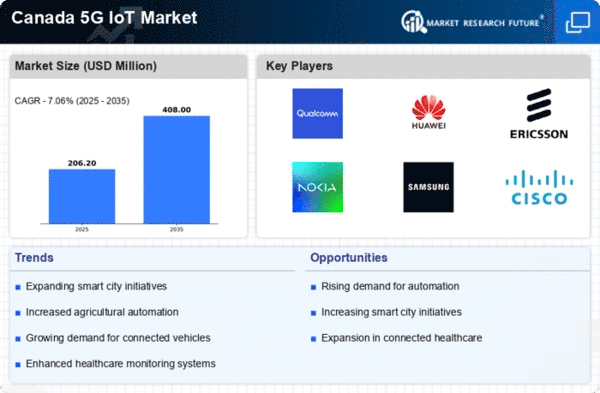
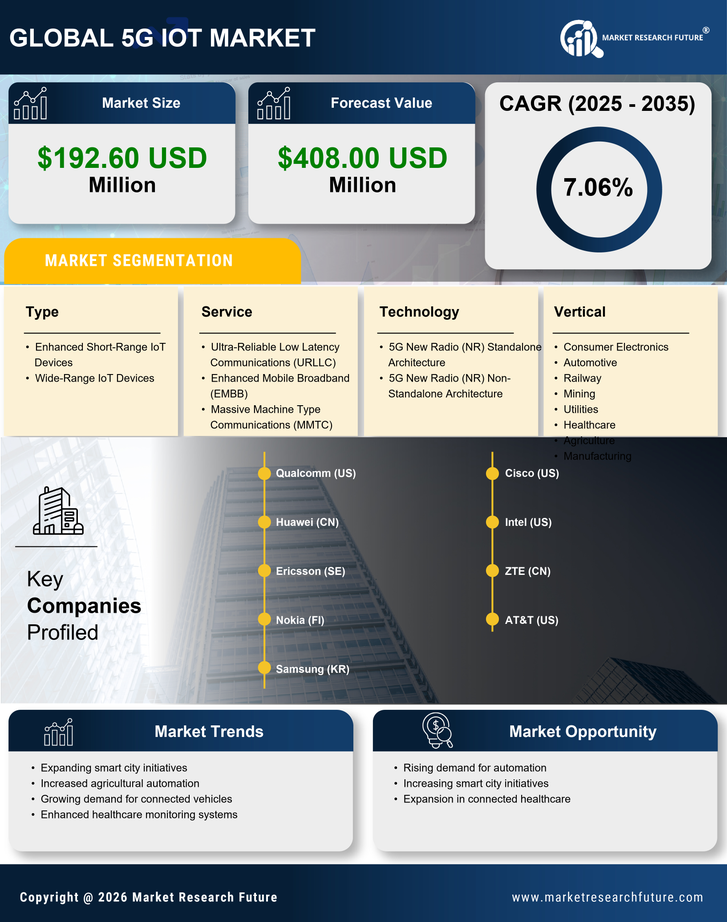
As per MRFR analysis, the 5G IoT Market Size was estimated at 192.6 USD Million in 2024. The 5G IoT Market is projected to grow from 206.2 USD Million in 2025 to 408.0 USD Million by 2035, exhibiting a compound annual growth rate (CAGR) of 7.06% during the forecast period 2025 - 2035.

Key Market Trends & Highlights

The Canada 5G IoT Market is poised for substantial growth driven by technological advancements and increasing consumer demand.

  • The market is witnessing an increased adoption of smart devices across various sectors.
  • Enhanced connectivity solutions are becoming essential for both urban and industrial applications.
  • Sustainable practices are gaining traction as companies seek to minimize their environmental impact.
  • The expansion of 5G infrastructure and rising demand for smart cities are key drivers propelling market growth.

Market Size & Forecast

2024 Market Size 192.6 (USD Million)
2035 Market Size 408.0 (USD Million)
CAGR (2025 - 2035) 7.06%

Major Players

Qualcomm (US), Huawei (CN), Ericsson (SE), Nokia (FI), Samsung (KR), Cisco (US), Intel (US), ZTE (CN), AT&T (US)

Canada 5G IoT Market Trends

The 5G IoT Market is currently experiencing a transformative phase, driven by advancements in connectivity and the increasing demand for smart devices. In Canada, the deployment of 5g networks is facilitating the integration of Internet of Things (IoT) technologies across various sectors, including healthcare, agriculture, and transportation. This enhanced connectivity is enabling real-time data exchange, which is crucial for optimizing operations and improving efficiency. As industries adopt these technologies, the potential for innovation appears boundless, suggesting a robust growth trajectory for the market. Moreover, the Canadian government is actively promoting initiatives to support the development of 5g infrastructure. Investments in research and development are likely to foster collaboration between public and private sectors, further accelerating the adoption of IoT solutions. The emphasis on smart cities and sustainable practices indicates a shift towards more connected and efficient urban environments. As the 5G IoT Market continues to evolve, it may play a pivotal role in shaping the future of technology and connectivity in Canada.

Increased Adoption of Smart Devices

The trend towards the adoption of smart devices is gaining momentum within the 5g iot market. As consumers and businesses recognize the benefits of connected technologies, the demand for smart home devices, wearables, and industrial IoT applications is likely to rise. This shift is expected to enhance user experiences and streamline operations across various sectors.

Enhanced Connectivity Solutions

The development of enhanced connectivity solutions is a key trend in the 5g iot market. With the rollout of advanced 5g networks, the ability to support a higher density of connected devices is becoming a reality. This improvement in connectivity is anticipated to facilitate the growth of IoT applications, enabling seamless communication and data transfer.

Focus on Sustainable Practices

A growing emphasis on sustainable practices is emerging within the 5g iot market. As organizations seek to reduce their environmental impact, IoT technologies are being leveraged to optimize resource usage and improve energy efficiency. This trend suggests a potential alignment between technological advancement and environmental stewardship.

Canada 5G IoT Market Drivers

Expansion of 5G Infrastructure

The ongoing expansion of 5G infrastructure in Canada is a pivotal driver for the 5G IoT Market. As telecommunications companies invest heavily in upgrading their networks, the availability of high-speed connectivity is set to increase significantly. This expansion is expected to enhance the performance of IoT devices, enabling real-time data processing and communication. According to recent estimates, the investment in 5G infrastructure could reach approximately $26 billion by 2026. This influx of capital is likely to facilitate the deployment of advanced IoT applications across various sectors, including healthcare, agriculture, and smart cities. Consequently, the growth of 5G infrastructure is anticipated to create a robust ecosystem for the 5g iot market, fostering innovation and driving adoption among businesses and consumers alike.

Rising Demand for Smart Cities

The increasing focus on developing smart cities in Canada is a crucial driver for the 5g iot market. Urban areas are experiencing rapid population growth, leading to a pressing need for efficient infrastructure and services. The integration of IoT technologies within smart city frameworks is expected to enhance urban management, improve public safety, and optimize resource allocation. For example, the implementation of smart traffic management systems can reduce congestion and improve air quality. As municipalities invest in these technologies, the demand for 5G connectivity to support real-time data transmission is likely to surge. This trend indicates a robust growth trajectory for the 5g iot market, as cities strive to become more sustainable and livable through advanced technological solutions.

Government Initiatives and Support

Government initiatives aimed at promoting the adoption of 5G technology are significantly influencing the 5g iot market. Canadian authorities have recognized the potential of 5G to drive economic growth and innovation. Programs designed to support research and development in IoT technologies are being implemented, with funding allocations reaching millions of dollars. For instance, the Canadian government has committed to investing in digital infrastructure, which is expected to bolster the 5g iot market. These initiatives not only provide financial backing but also create a favorable regulatory environment that encourages private sector investment. As a result, the synergy between government support and private innovation is likely to accelerate the deployment of IoT solutions, enhancing the overall market landscape.

Increased Focus on Industrial Automation

The shift towards industrial automation in Canada is driving the growth of the 5g iot market. Industries are increasingly adopting IoT solutions to enhance operational efficiency, reduce costs, and improve productivity. The ability of 5G networks to support a vast number of connected devices with low latency is particularly advantageous for manufacturing and logistics sectors. Reports suggest that the industrial IoT market could reach $1 trillion by 2025, with a significant portion attributed to 5G-enabled applications. This trend indicates that as industries embrace automation, the demand for reliable and high-speed connectivity will intensify, further propelling the 5g iot market forward.

Consumer Demand for Enhanced Connectivity

The growing consumer demand for enhanced connectivity is a notable driver of the 5g iot market. As Canadians increasingly rely on connected devices for daily activities, the need for seamless and fast internet access becomes paramount. The proliferation of smart home devices, wearables, and connected vehicles is pushing consumers to seek out 5G solutions that offer superior performance. Market analysis indicates that the number of connected devices in Canada is projected to exceed 100 million by 2025. This surge in demand is likely to encourage service providers to expand their 5G offerings, thereby stimulating growth in the 5g iot market. The interplay between consumer expectations and technological advancements is expected to shape the future landscape of connectivity in Canada.

Market Segment Insights

By Service: Enhanced Mobile Broadband (Largest) vs. Ultra-Reliable Low Latency Communications (Fastest-Growing)

In the Canada 5G IoT Market, the Service segment is primarily dominated by Enhanced Mobile Broadband (EMBB), which holds the largest share among its counterparts. EMBB benefits from rising consumer demand for high-speed internet and increased data consumption, which positions it as the frontrunner in this sector. Meanwhile, Ultra-Reliable Low Latency Communications (URLLC) is gaining traction swiftly, thanks to applications in critical sectors requiring minimal latency. Growth trends indicate that the demand for URLLC is accelerating due to innovative IoT applications, especially in industries like healthcare and automotive, that require reliable, instantaneous connectivity. Additionally, Massive Machine Type Communications (MMTC) is experiencing growth as various industries deploy IoT devices for automation and data collection, further driving the need for strong and versatile communication services in the Canada 5g iot market.

Enhanced Mobile Broadband (Dominant) vs. Massive Machine Type Communications (Emerging)

Enhanced Mobile Broadband (EMBB) stands out as the dominant service in the Canada 5g iot market, effectively supporting extensive data needs across various applications. EMBB is instrumental in providing high-capacity networks that facilitate a seamless user experience for video streaming, gaming, and smart devices. On the other hand, Massive Machine Type Communications (MMTC) is emerging as a significant player, designed to connect a vast number of devices efficiently. As industries increasingly integrate IoT solutions, MMTC supports a tremendous number of devices, enabling automation and data analytics while addressing the challenges of scale and connectivity.

By Technology: 5G New Radio (NR) Standalone Architecture (Largest) vs. 5G New Radio (NR) Non-Standalone Architecture (Fastest-Growing)

In the Canada 5G IoT Market, the 5G New Radio (NR) Standalone Architecture is the largest segment, capturing a significant market share due to its advanced capabilities and full utilization of the 5G network. In contrast, the 5G New Radio (NR) Non-Standalone Architecture is rapidly gaining traction among enterprises and service providers who prefer a transitional approach to 5G implementation. This segment, while currently smaller in market share, is set to expand rapidly as more businesses transition to full 5G capabilities. The growth trends in this segment are driven by increasing demand for enhanced connectivity, low latency, and higher capacity. With industries such as manufacturing, healthcare, and smart cities looking to leverage IoT technologies, the adoption of 5G NR Non-Standalone Architecture is being incentivized. Additionally, the ongoing investments in network infrastructure and the push towards digital transformation are further propelling the growth of both segment values, with a notable shift towards standalone architectures in the coming years.

Technology: 5G New Radio (NR) Standalone Architecture (Dominant) vs. 5G New Radio (NR) Non-Standalone Architecture (Emerging)

5G New Radio (NR) Standalone Architecture represents a dominant position in the Canada 5g iot market, characterized by its ability to deliver enhanced performance and efficiency essential for next-generation applications. This architecture operates independently of prior generations, offering full 5G capabilities that enable a broader range of services and use cases. Conversely, 5G New Radio (NR) Non-Standalone Architecture serves as an emerging solution, allowing businesses to integrate 5G with existing 4G infrastructure. This flexibility makes it attractive for organizations looking to gradually migrate to the full 5G experience without significant upfront investments. Together, these segment values highlight the critical balance in technology adoption, where immediate needs can be met while paving the way for future advancements.

By Type: Enhanced Short-Range IoT Devices (Largest) vs. Wide-Range IoT Devices (Fastest-Growing)

In the Canada 5G IoT Market, Enhanced Short-Range IoT Devices hold a significant share, dominating the landscape with their versatility and efficiency. These devices cater to various applications, particularly in smart homes and industries, establishing a robust foothold against competitors. Conversely, Wide-Range IoT Devices are experiencing rapid growth, thanks to increasing demand for applications that require longer connectivity ranges. This segment is becoming critical for sectors such as agriculture and transportation, where extensive coverage is paramount. The growth trajectory of Enhanced Short-Range IoT Devices is driven by their adaptability and integration with various technologies, making them a staple for both consumers and businesses alike. Meanwhile, Wide-Range IoT Devices are bolstered by technological advancements that enable longer battery life and broader coverage, addressing the demand for smart city applications and remote monitoring systems. This dynamic interplay signifies an evolving marketplace, emphasizing the need for innovations to meet diverse user requirements.

Enhanced Short-Range IoT Devices (Dominant) vs. Wide-Range IoT Devices (Emerging)

Enhanced Short-Range IoT Devices have solidified their position in the Canada 5g iot market as a dominant force, particularly due to their capability to support smart home technologies and industrial automation. Their strength lies in providing reliable connectivity and performance over short distances, appealing to a variety of consumer and enterprise applications. On the other hand, Wide-Range IoT Devices are emerging as a viable alternative, driven by the growing need for devices that can connect over greater distances without sacrificing functionality. As technological advancements continue, both segments are poised for further development; however, the former remains firmly established, while the latter shows promise for rapid expansion.

By Vertical: Utilities (Largest) vs. Healthcare (Fastest-Growing)

In the Canada 5G IoT Market, the distribution of market share among vertical segments reveals that Utilities account for the largest portion, driven by the increasing demand for smart grid solutions and enhanced energy management systems. Following Utilities, the Healthcare sector is significantly expanding, emphasizing remote patient monitoring and telehealth services, which utilize cutting-edge 5G technology to improve patient outcomes and operational efficiencies. The growth trends within these segments highlight a clear trajectory towards innovation and efficiency. Utilities are leveraging 5G to enhance grid reliability and integrate renewable energy sources. Conversely, Healthcare's rapid adoption of 5G is fueled by the need for real-time data transmission and improved connectivity, essential for telemedicine and advanced medical technologies, marking it as the fastest-growing vertical in the market.

Utilities: Dominant vs. Healthcare: Emerging

Utilities serve as the dominant vertical in the Canada 5g iot market, characterized by robust investments in infrastructure that support smart technology integration and energy efficiency optimization. The sector benefits from various applications, including smart metering and real-time data analytics, enabling proactive maintenance and resource conservation. On the other hand, Healthcare is positioned as an emerging segment, rapidly developing through innovations such as wearable health devices and remote diagnostics. This vertical is increasingly adopting 5G to facilitate high-speed data transfer and enhance patient care, reflecting a growing trend towards digital healthcare solutions that promise to revolutionize how medical services are delivered.

Get more detailed insights about Canada 5G IoT Market

Key Players and Competitive Insights

The competitive dynamics within the 5g iot market are characterized by rapid technological advancements and a growing emphasis on connectivity solutions. Key growth drivers include the increasing demand for smart devices, enhanced network capabilities, and the proliferation of IoT applications across various sectors. Major players such as Qualcomm (US), Huawei (CN), and Ericsson (SE) are strategically positioned to leverage their technological expertise and extensive portfolios. Qualcomm (US) focuses on innovation in semiconductor technology, while Huawei (CN) emphasizes its global reach and comprehensive solutions. Ericsson (SE) is committed to expanding its network infrastructure and services, thereby shaping a competitive environment that is increasingly reliant on technological differentiation and strategic partnerships.

Key business tactics employed by these companies include localizing manufacturing and optimizing supply chains to enhance operational efficiency. The market structure appears moderately fragmented, with several key players exerting considerable influence. This fragmentation allows for a diverse range of offerings, yet the collective impact of these major companies drives a competitive landscape that is both dynamic and challenging.

In October 2025, Qualcomm (US) announced a partnership with a leading Canadian telecommunications provider to enhance 5g connectivity in urban areas. This strategic move is likely to bolster Qualcomm's presence in the Canadian market, enabling it to capitalize on the growing demand for high-speed internet and IoT applications. The partnership underscores Qualcomm's commitment to innovation and its focus on expanding its operational footprint in key regions.

In September 2025, Huawei (CN) launched a new suite of IoT solutions tailored for smart cities, aiming to improve urban infrastructure and connectivity. This initiative reflects Huawei's strategic focus on digital transformation and its intent to position itself as a leader in the smart city domain. By addressing the specific needs of urban environments, Huawei is likely to enhance its competitive edge and foster long-term partnerships with municipal governments.

In August 2025, Ericsson (SE) unveiled a new 5g network slicing technology designed to optimize resource allocation for IoT applications. This innovation is significant as it allows for tailored connectivity solutions that can meet the diverse needs of various industries. Ericsson's focus on technological advancement positions it favorably in a market that increasingly values customized solutions and efficient resource management.

As of November 2025, current trends in the competitive landscape include a pronounced shift towards digitalization, sustainability, and the integration of AI technologies. Strategic alliances are becoming increasingly vital, as companies seek to enhance their capabilities and market reach. The competitive differentiation is likely to evolve from traditional price-based competition to a focus on innovation, technological advancements, and supply chain reliability. This shift suggests that companies that prioritize these aspects will be better positioned to thrive in the evolving 5g iot market.

Key Companies in the Canada 5G IoT Market market include

Industry Developments

Qualcomm has been enhancing its 5G technology offerings, focusing on improvements in connectivity solutions. Telus has announced multiple partnerships to facilitate the rollout of smart city initiatives utilizing 5G and IoT applications.

Meanwhile, Bell Canada continues to expand its 5G network across metropolitan areas, increasing high-speed access for urban consumers and businesses.

Additionally, in August 2023, Ericsson secured a contract with a Canadian telecommunications provider to enhance its 5G capabilities, signaling ongoing investments in infrastructure.

In terms of mergers and acquisitions, no major public activities have been reported in the last few months among the targeted companies. The Canadian government continues to emphasize 5G as a critical component of its digital economy strategy, propelled by initiatives aimed at improving connectivity in underserved regions.

Major players, including Huawei Technologies and Nokia, are also positioning themselves to benefit from growth in both public and private sectors, emphasizing the competitive landscape of the Canada 5G IoT Market. Overall, these movements reflect a rapidly evolving landscape critical to the implementation of digital innovations across Canada.


Future Outlook

Canada 5G IoT Market Future Outlook

The 5G IoT market in Canada is projected to grow at a 7.06% CAGR from 2024 to 2035, driven by advancements in connectivity, automation, and smart technologies.

New opportunities lie in:

  • Development of smart agriculture solutions leveraging IoT sensors for real-time data analysis.
  • Implementation of 5G-enabled telemedicine platforms to enhance remote healthcare services.
  • Creation of advanced logistics tracking systems utilizing IoT devices for supply chain optimization.

By 2035, the 5G IoT market is expected to be robust, driven by innovative applications and increased adoption.

Market Segmentation

Canada 5G IoT Market Type Outlook

  • Enhanced Short-Range IoT Devices
  • Wide-Range IoT Devices

Canada 5G IoT Market Service Outlook

  • Ultra-Reliable Low Latency Communications (URLLC)
  • Enhanced Mobile Broadband (EMBB)
  • Massive Machine Type Communications (MMTC)

Canada 5G IoT Market Vertical Outlook

  • Consumer Electronics
  • Automotive
  • Railway
  • Mining
  • Utilities
  • Healthcare
  • Agriculture
  • Manufacturing

Canada 5G IoT Market Technology Outlook

  • 5G New Radio (NR) Standalone Architecture
  • 5G New Radio (NR) Non-Standalone Architecture

Report Scope

MARKET SIZE 2024 192.6(USD Million)
MARKET SIZE 2025 206.2(USD Million)
MARKET SIZE 2035 408.0(USD Million)
COMPOUND ANNUAL GROWTH RATE (CAGR) 7.06% (2024 - 2035)
REPORT COVERAGE Revenue Forecast, Competitive Landscape, Growth Factors, and Trends
BASE YEAR 2024
Market Forecast Period 2025 - 2035
Historical Data 2019 - 2024
Market Forecast Units USD Million
Key Companies Profiled Qualcomm (US), Huawei (CN), Ericsson (SE), Nokia (FI), Samsung (KR), Cisco (US), Intel (US), ZTE (CN), AT&T (US)
Segments Covered Service, Technology, Type, Vertical
Key Market Opportunities Expansion of smart city initiatives drives demand in the 5g iot market.
Key Market Dynamics Rapid advancements in technology drive competitive forces in the 5G IoT market, enhancing connectivity and efficiency.
Countries Covered Canada

Leave a Comment

FAQs

What is the projected market size of the Canada 5G IoT Market in 2024?

In 2024, the Canada 5G IoT Market is expected to be valued at 192.6 million USD.

What is the expected market size for the Canada 5G IoT Market by 2035?

By 2035, the overall market is projected to reach 407.89 million USD.

What is the anticipated compound annual growth rate (CAGR) for the Canada 5G IoT Market from 2025 to 2035?

The Canada 5G IoT Market is expected to grow at a CAGR of 7.06 percent during the period from 2025 to 2035.

What are the key services driving the Canada 5G IoT Market?

The key services driving the market include Enhanced Mobile Broadband, Ultra-Reliable Low Latency Communications, and Massive Machine Type Communications.

What is the market value for Enhanced Mobile Broadband within the Canada 5G IoT Market in 2024?

In 2024, the market value for Enhanced Mobile Broadband is anticipated to be 76.56 million USD.

What is the projected market size for Ultra-Reliable Low Latency Communications by 2035?

By 2035, Ultra-Reliable Low Latency Communications is expected to grow to 102.25 million USD.

Which companies are recognized as major players in the Canada 5G IoT Market?

Major players in the market include Qualcomm, Samsung Electronics, Intel, and Bell Canada among others.

What is the market value for Massive Machine Type Communications in 2024?

In 2024, Massive Machine Type Communications is expected to be valued at 68.46 million USD.

How does the market for the Canada 5G IoT Market vary between segments by 2035?

By 2035, Enhanced Mobile Broadband is projected to reach 162.39 million USD, reflecting significant growth compared to other segments.

What challenges might impact the growth of the Canada 5G IoT Market?

Challenges in the market may include regulatory hurdles, technology integration complexities, and competition among major players.

Download Free Sample

Kindly complete the form below to receive a free sample of this Report

Compare Licence

×
Features License Type
Single User Multiuser License Enterprise User
Price $4,950 $5,950 $7,250
Maximum User Access Limit 1 User Upto 10 Users Unrestricted Access Throughout the Organization
Free Customization
Direct Access to Analyst
Deliverable Format
Platform Access
Discount on Next Purchase 10% 15% 15%
Printable Versions