×
Request Free Sample ×

Kindly complete the form below to receive a free sample of this Report

* Please use a valid business email

Leading companies partner with us for data-driven Insights

clients tt-cursor
Hero Background

Canada Industrial AI Market

ID: MRFR/ICT/44857-HCR
200 Pages
Garvit Vyas
October 2025

Canada Industrial AI Market Research Report By Offering (hardware, software, AI platform, AI solution), By Technology (computer vision, deep learning, natural language processing (NLP), context awareness), By Application (predictive maintenance and machinery inspection, material movement, production planning, field services, quality control, others) and By Industry (automobile, energy and power, pharmaceuticals, heavy metals and machine manufacturing, semiconductor electronics, food beverages, manufacturing, others)- Forecast to 2035

Share:
Download PDF ×

We do not share your information with anyone. However, we may send you emails based on your report interest from time to time. You may contact us at any time to opt-out.

Canada Industrial AI Market Infographic
Purchase Options

Canada Industrial AI Market Summary

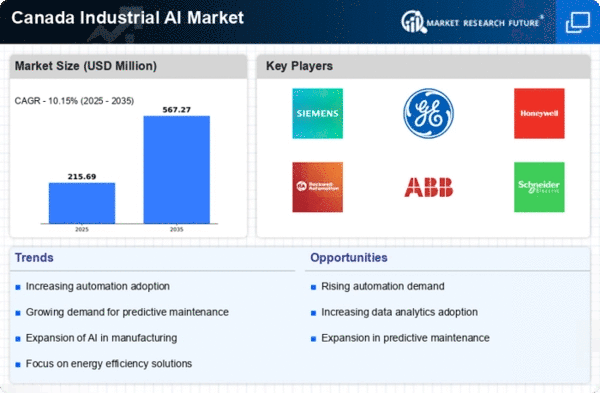
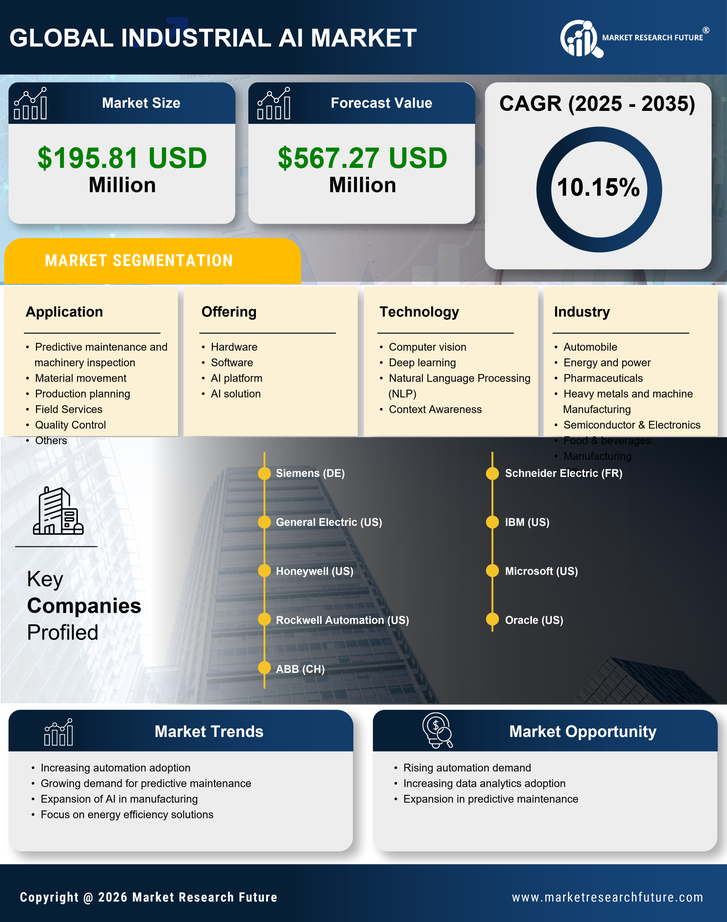
As per MRFR analysis, the Canada industrial AI market size was estimated at 195.81 USD Million in 2024. The Canada industrial ai market is projected to grow from 215.69 USD Million in 2025 to 567.27 USD Million by 2035, exhibiting a compound annual growth rate (CAGR) of 10.15% during the forecast period 2025 - 2035.

Key Market Trends & Highlights

The Canada industrial AI market is experiencing robust growth driven by automation and advanced analytics.

  • The largest segment in the Canada industrial AI market is predictive maintenance, reflecting a strong focus on operational efficiency.
  • Automation adoption is increasing across various industries, indicating a shift towards more intelligent manufacturing processes.
  • The fastest-growing segment is sustainability and resource optimization, highlighting the industry's commitment to environmental responsibility.
  • Key market drivers include rising demand for operational efficiency and government initiatives supporting advanced analytics integration.

Market Size & Forecast

2024 Market Size 195.81 (USD Million)
2035 Market Size 567.27 (USD Million)
CAGR (2025 - 2035) 10.15%

Major Players

Siemens (DE), General Electric (US), Honeywell (US), Rockwell Automation (US), ABB (CH), Schneider Electric (FR), IBM (US), Microsoft (US), Oracle (US)

Canada Industrial AI Market Trends

The industrial AI market is experiencing notable growth., driven by advancements in technology and increasing demand for automation across various sectors. Companies are increasingly adopting artificial intelligence solutions to enhance operational efficiency, reduce costs, and improve decision-making processes. This trend is particularly evident in manufacturing, where predictive maintenance and quality control applications are becoming commonplace. Furthermore, the integration of machine learning algorithms into existing systems is enabling organizations to harness vast amounts of data, leading to more informed strategies and competitive advantages. In addition, the regulatory environment in Canada is evolving to support the adoption of industrial ai technologies. Government initiatives aimed at fostering innovation and research in artificial intelligence are likely to encourage investment in this sector. As businesses recognize the potential of ai to transform their operations, The market is poised for continued expansion. The focus on sustainability and reducing environmental impact is also influencing the development of ai solutions, as companies seek to optimize resource usage and minimize waste. Overall, The market appears to be on a trajectory of robust growth, with numerous opportunities for stakeholders.

Increased Automation Adoption

Organizations are increasingly integrating automation technologies powered by artificial intelligence into their operations. This trend is driven by the need for enhanced productivity and efficiency, as businesses seek to streamline processes and reduce human error. The industrial ai market is witnessing a surge in demand for solutions that facilitate real-time data analysis and decision-making, allowing companies to respond swiftly to market changes.

Focus on Predictive Maintenance

Predictive maintenance is emerging as a key application within the industrial ai market. By leveraging machine learning algorithms, companies can anticipate equipment failures before they occur, thereby minimizing downtime and maintenance costs. This proactive approach not only enhances operational efficiency but also extends the lifespan of machinery, making it a valuable strategy for organizations aiming to optimize their resources.

Sustainability and Resource Optimization

The industrial ai market is increasingly aligning with sustainability goals as organizations strive to reduce their environmental footprint. Artificial intelligence solutions are being developed to optimize resource usage, minimize waste, and improve energy efficiency. This trend reflects a growing awareness of the importance of sustainable practices in industrial operations, as companies seek to balance profitability with environmental responsibility.

Canada Industrial AI Market Drivers

Focus on Workforce Upskilling

The emphasis on workforce upskilling is emerging as a crucial driver in the industrial ai market. As AI technologies become more prevalent, there is a growing recognition of the need for skilled personnel who can effectively implement and manage these systems. Companies are investing in training programs to equip their workforce with the necessary skills to thrive in an AI-driven environment. This trend is particularly relevant in sectors such as manufacturing and logistics, where the integration of AI can lead to significant operational improvements. By prioritizing workforce development, the industrial ai market is likely to see enhanced adoption rates and successful implementation of AI solutions.

Increased Focus on Cybersecurity

The increasing focus on cybersecurity is becoming a vital driver for the industrial ai market in Canada. As organizations adopt AI technologies, the need to protect sensitive data and systems from cyber threats is paramount. Companies are investing in robust cybersecurity measures to safeguard their operations, which in turn drives demand for AI solutions that enhance security protocols. The market is likely to benefit from this trend, as businesses seek AI-driven tools that can detect and mitigate potential threats in real-time. This heightened awareness of cybersecurity risks is expected to shape the future landscape of the industrial ai market.

Integration of Advanced Analytics

The integration of advanced analytics into the industrial ai market is becoming a critical driver for growth in Canada. Organizations are leveraging data analytics to gain insights into their operations, enabling them to make informed decisions. This trend is particularly evident in sectors like energy and manufacturing, where data-driven strategies can lead to enhanced performance. Reports indicate that companies utilizing advanced analytics can see a revenue increase of approximately 20%. As businesses recognize the value of data in driving efficiency and innovation, the industrial ai market is poised for substantial growth, with investments in analytics technologies expected to rise.

Government Initiatives and Support

Government initiatives and support play a pivotal role in shaping the industrial ai market in Canada. Various programs and funding opportunities are being introduced to encourage the adoption of AI technologies across industries. For instance, the Canadian government has allocated significant resources to promote research and development in AI, which is expected to bolster the industrial ai market. This support not only facilitates innovation but also helps businesses overcome barriers to entry. As a result, The market is likely to benefit from increased investment and collaboration between public and private sectors, fostering a conducive environment for growth.

Rising Demand for Operational Efficiency

The industrial ai market in Canada is experiencing a notable surge in demand for operational efficiency. Companies are increasingly seeking to optimize their processes, reduce waste, and enhance productivity. This trend is driven by the need to remain competitive in a rapidly evolving landscape. According to recent data, organizations that implement AI-driven solutions can achieve efficiency improvements of up to 30%. This is particularly relevant in sectors such as manufacturing and logistics, where operational costs can be significantly reduced. As a result, The market is likely to expand as businesses invest in technologies that streamline operations and improve overall performance.

Market Segment Insights

By Offering: Software (Largest) vs. AI platform (Fastest-Growing)

In the Canada industrial ai market, the distribution of market share among the offerings reveals a significant dominance of the software segment, which stands out due to its wide-ranging applications and comprehensive solutions across various industries. Hardware follows as a strong contender, but its share is notably less compared to software. AI solutions and platforms are also important; however, their shares are more nascent as the industry evolves, indicating a competitive landscape eager for innovation and integration. The growth trends within the offering segment are heavily influenced by the increasing demand for intelligent automation and advanced analytics capabilities across sectors. Software remains the key driver, enabling businesses to enhance operational efficiencies and decision-making processes. The emergence of AI platforms is noteworthy, as they are becoming integral for organizations seeking to deploy AI at scale, marking them as the fastest-growing segment in the landscape. This growth is fueled by investments in infrastructure and a focus on data-driven strategies, positioning AI platforms to become crucial competition players.

Hardware (Dominant) vs. AI solution (Emerging)

The hardware segment in the Canada industrial ai market plays a dominant role due to its foundational importance in supporting AI technologies. Its resilience stems from ongoing investments in robust infrastructure necessary for the deployment of AI applications, with a focus on high-performance computing and real-time data processing. Conversely, AI solutions serve as an emerging segment, characterized by tailored offerings that integrate various AI capabilities into specific business processes. This segment is gaining traction as organizations increasingly recognize the need for actionable insights and customized AI systems, thus bridging the gap between theoretical AI concepts and practical implementations. As companies aim to harness the potential of AI, both segments will continue to shape the market dynamically.

By Technology: Deep Learning (Largest) vs. Computer Vision (Fastest-Growing)

In the Canada industrial ai market, the technology segment is prominently led by Deep Learning, making up a substantial share of the overall market landscape. Computer Vision follows closely, capturing a significant portion of the market as well. Natural Language Processing (NLP) and Context Awareness, while critical components of AI solutions, currently hold smaller shares. The distribution illustrates a competitive environment where Deep Learning maintains dominance due to its versatility across various applications. The growth trends within this segment reveal an accelerating demand for innovative AI technologies. Factors such as increasing automation across industries and advancements in machine learning algorithms are driving this surge. Computer Vision is emerging rapidly, fueled by advancements in image processing capabilities and applications in areas like retail and security. As organizations strive for efficiency, both Deep Learning and Computer Vision will likely continue to evolve, reshaping the operational landscape.

Technology: Deep Learning (Dominant) vs. Computer Vision (Emerging)

Deep Learning stands out as the dominant technology in the Canada industrial ai market, characterized by its extensive application across sectors such as healthcare, finance, and manufacturing. This technology's ability to analyze vast amounts of data and improve predictive analytics positions it as a critical driver of innovation. On the other hand, Computer Vision represents the emerging frontier within this segment, with its potential being unleashed in numerous fields including surveillance, quality control, and autonomous vehicles. As organizations increasingly adopt AI-driven solutions, Computer Vision is expected to gain momentum, capitalizing on enhanced imaging technologies and integration with other AI frameworks, further enriching the marketplace.

By Application: Predictive Maintenance and Machinery Inspection (Largest) vs. Material Movement (Fastest-Growing)

The application segment of the Canada industrial ai market showcases a diverse distribution among its various applications. Predictive maintenance and machinery inspection holds the largest share, as industries prioritize operational efficiency and downtime reduction. Material movement, meanwhile, is gaining momentum, catering to the increasing demand for automation in logistics and supply chains, positioning it as a key player in the evolving landscape. As more industries adopt AI technologies, the growth trends indicate a shift towards smart manufacturing and enhanced operational capabilities. Factors such as the need for real-time data analytics, cost reduction, and improved safety measures drive the expansion of the segment. Predictive maintenance continues to dominate due to its critical role in preventing equipment failures, while material movement benefits from advancements in robotics and AI-driven solutions, highlighting shifts in operational priorities across sectors.

Predictive Maintenance and Machinery Inspection (Dominant) vs. Quality Control (Emerging)

In the Canada industrial ai market, predictive maintenance and machinery inspection stand out as the dominant force, leveraging advanced analytics and machine learning to foresee equipment failures and optimize maintenance schedules. This approach not only reduces downtime but also significantly cuts costs associated with unplanned maintenance. As industries increasingly embrace automation and data-driven strategies, this segment reinforces its leadership. In contrast, quality control is emerging as a vital application, utilizing AI to enhance inspection processes and ensure product quality. With the rise in consumer expectations and regulatory requirements, the focus on quality enhancements through AI-driven solutions is set to grow, making it a significant player in the overall application landscape.

By Industry: Automobile (Largest) vs. Semiconductor & Electronics (Fastest-Growing)

The Canada industrial ai market exhibits a diverse distribution of market share among key industry segments. The automobile sector holds the largest share, driven by the increasing adoption of AI technologies for autonomous driving, manufacturing efficiencies, and enhanced consumer experiences. Other sectors like pharmaceuticals and energy also contribute significantly, but with smaller shares compared to automobiles. Conversely, sectors such as semiconductors and electronics are experiencing robust growth, attributed to heightened demand for AI applications in smart devices and automation processes. Growth trends in the Canada industrial ai market are predominantly influenced by technological advancements and a rising emphasis on operational efficiency. Enhanced data analytics capabilities and automation are key drivers, enabling industries to streamline processes and reduce costs. Additionally, regulatory support and increased investments in AI research and development are accelerating growth, particularly in emerging sectors like semiconductor & electronics. As AI continues to evolve, its integration into various industries is expected to amplify, pushing the boundaries of innovation and efficiency.

Automobile: Dominant vs. Semiconductor & Electronics: Emerging

The automobile segment stands as a dominant force in the Canada industrial ai market, primarily due to its extensive use of AI in autonomous vehicles, smart manufacturing, and customer engagement strategies. This sector leverages advanced machine learning algorithms to optimize supply chains and enhance vehicle performance. Meanwhile, the semiconductor & electronics sector is an emerging powerhouse, driven by the surge in demand for smart technologies and IoT devices. This segment is rapidly adopting AI to improve manufacturing processes, yield efficiency, and reduce time-to-market for new products. The interplay between these two segments highlights the dynamic nature of the Canada industrial ai market, where traditional industries adapt to and integrate cutting-edge technologies.

Get more detailed insights about Canada Industrial AI Market

Key Players and Competitive Insights

The industrial AI market in Canada is characterized by a dynamic competitive landscape, driven by rapid technological advancements and increasing demand for automation across various sectors. Key players such as Siemens (DE), General Electric (US), and Honeywell (US) are at the forefront, each adopting distinct strategies to enhance their market positioning. Siemens (DE) emphasizes innovation through its digital twin technology, which allows for real-time simulations and optimizations in manufacturing processes. General Electric (US) focuses on integrating AI with its existing industrial solutions, thereby enhancing operational efficiency and predictive maintenance capabilities. Honeywell (US) is leveraging partnerships with tech firms to bolster its AI offerings, particularly in smart building technologies, which reflects a broader trend of collaboration within the industry.

The business tactics employed by these companies include localizing manufacturing to reduce costs and optimize supply chains, which is particularly relevant in the context of fluctuating global trade dynamics. The market structure appears moderately fragmented, with a mix of established players and emerging startups, each contributing to a competitive environment that fosters innovation and technological advancement. The collective influence of these key players shapes the market, as they continuously adapt to evolving customer needs and technological trends.

In September 2025, Siemens (DE) announced a strategic partnership with a leading Canadian AI startup to enhance its digital manufacturing solutions. This collaboration aims to integrate advanced machine learning algorithms into Siemens' existing platforms, potentially revolutionizing production efficiency and reducing downtime. The strategic importance of this partnership lies in Siemens' commitment to staying ahead in the competitive landscape by harnessing local innovation.

In October 2025, General Electric (US) unveiled a new AI-driven analytics platform designed specifically for the Canadian energy sector. This platform aims to optimize energy consumption and reduce operational costs for utilities. The introduction of this platform signifies GE's focus on sector-specific solutions, which may enhance its competitive edge by addressing the unique challenges faced by Canadian energy providers.

In August 2025, Honeywell (US) expanded its AI capabilities by acquiring a Canadian software firm specializing in predictive analytics for industrial applications. This acquisition is likely to strengthen Honeywell's portfolio, enabling it to offer more comprehensive solutions that integrate AI with existing industrial systems. The strategic move underscores Honeywell's intent to enhance its technological capabilities and market share in the industrial AI sector.

As of November 2025, current trends in the industrial AI market include a pronounced shift towards digitalization, sustainability, and the integration of AI technologies across various sectors. Strategic alliances are increasingly shaping the competitive landscape, as companies recognize the value of collaboration in driving innovation. Looking ahead, competitive differentiation is expected to evolve, with a greater emphasis on technological innovation and supply chain reliability, rather than solely on price. This shift indicates a maturation of the market, where companies that prioritize advanced technologies and sustainable practices are likely to emerge as leaders.

Key Companies in the Canada Industrial AI Market market include

Industry Developments

Recent developments in the Canada Industrial AI Market have been marked by significant advancements and partnerships among major companies. Unity Technologies is enhancing its simulation capabilities for industrial applications, while Samsung has launched new AI-driven solutions for manufacturing processes. Siemens has made strides in digital twin technologies, optimizing operations for Canadian manufacturers.In October 2023, IBM introduced a new AI platform aimed at enhancing supply chain transparency and efficiency tailored for the Canadian market. Moreover, Honeywell announced an expansion of its AI solutions for industrial safety and efficiency, increasing its footprint in Canada.

In terms of mergers and acquisitions, Rockwell Automation acquired a Canadian data analytics startup in September 2023 to enhance its AI services. Additionally, NVIDIA has been focusing on expanding its partnerships within Canada to boost applications in industrial automation and smart manufacturing.The growth of the Canada Industrial AI Market continues to accelerate, with companies like General Electric and Oracle investing heavily in local AI projects, reflecting the increasing demand for automation and intelligent systems. Overall, the market dynamics are evolving rapidly, showcasing a robust environment for innovation and collaboration among the leading firms.

Canada Industrial AI Market Segmentation Insights

    • Industrial AI Market Offering Outlook
      • hardware
      • software
      • AI platform
      • AI solution
    • Industrial AI Market Technology Outlook
      • computer vision
      • deep learning
      • natural language processing (NLP)
      • context awareness
    • Industrial AI Market Application Outlook
      • predictive maintenance and machinery inspection
      • material movement
      • production planning
      • field services
      • quality control
      • others
    • Industrial AI MarketOutlook
      • automobile
      • energy and power
      • pharmaceuticals
      • heavy metals and machine manufacturing
      • semiconductorelectronics
      • foodbeverages
      • manufacturing
      • others

Future Outlook

Canada Industrial AI Market Future Outlook

The Industrial AI Market in Canada is projected to grow at a 10.15% CAGR from 2024 to 2035, driven by automation, data analytics, and enhanced operational efficiency.

New opportunities lie in:

  • Development of predictive maintenance solutions for manufacturing equipment.
  • Integration of AI-driven supply chain optimization tools.
  • Creation of customized AI platforms for energy management in industrial settings.

By 2035, the industrial AI market is expected to achieve substantial growth and innovation.

Market Segmentation

Canada Industrial AI Market Industry Outlook

  • Automobile
  • Energy and power
  • Pharmaceuticals
  • Heavy metals and machine Manufacturing
  • Semiconductor & Electronics
  • Food & beverages
  • Manufacturing
  • Others

Canada Industrial AI Market Offering Outlook

  • Hardware
  • Software
  • AI platform
  • AI solution

Canada Industrial AI Market Technology Outlook

  • Computer vision
  • Deep learning
  • Natural Language Processing (NLP)
  • Context Awareness

Canada Industrial AI Market Application Outlook

  • Predictive maintenance and machinery inspection
  • Material movement
  • Production planning
  • Field Services
  • Quality Control
  • Others

Report Scope

MARKET SIZE 2024 195.81(USD Million)
MARKET SIZE 2025 215.69(USD Million)
MARKET SIZE 2035 567.27(USD Million)
COMPOUND ANNUAL GROWTH RATE (CAGR) 10.15% (2024 - 2035)
REPORT COVERAGE Revenue Forecast, Competitive Landscape, Growth Factors, and Trends
BASE YEAR 2024
Market Forecast Period 2025 - 2035
Historical Data 2019 - 2024
Market Forecast Units USD Million
Key Companies Profiled Siemens (DE), General Electric (US), Honeywell (US), Rockwell Automation (US), ABB (CH), Schneider Electric (FR), IBM (US), Microsoft (US), Oracle (US)
Segments Covered Offering, Technology, Application, Industry
Key Market Opportunities Integration of advanced predictive maintenance solutions enhances operational efficiency in the industrial ai market.
Key Market Dynamics Growing demand for automation drives innovation in industrial AI applications across various sectors in Canada.
Countries Covered Canada

Leave a Comment

FAQs

What is the projected market size of the Canada Industrial AI Market by 2024?

The Canada Industrial AI Market is expected to be valued at approximately 195.3 million USD by 2024.

How much is the Canada Industrial AI Market expected to grow by 2035?

By 2035, the market is projected to reach around 1200.0 million USD.

What is the expected CAGR for the Canada Industrial AI Market from 2025 to 2035?

The market is anticipated to experience a CAGR of 17.945% from 2025 to 2035.

Which segment of the Canada Industrial AI Market is predicted to have the highest value in 2035?

The software segment is forecasted to lead with a value of 350.0 million USD by 2035.

What is the estimated value of the hardware segment of the Canada Industrial AI Market in 2024?

The hardware segment is expected to be valued at 40.0 million USD in 2024.

Who are the major players in the Canada Industrial AI Market?

Key players include Unity Technologies, Siemens, IBM, Honeywell, and Microsoft.

What is the projected size of the AI solutions segment by 2035?

The AI solutions segment is expected to reach an estimated value of 310.0 million USD by 2035.

How much is the AI platform segment expected to be valued by 2035?

The AI platform segment is projected to be valued at around 300.0 million USD in 2035.

What are the main growth drivers for the Canada Industrial AI Market?

Growth drivers include increased automation, demand for predictive analytics, and technological advancements.

What challenges could impact the growth of the Canada Industrial AI Market?

Potential challenges include data privacy concerns, high implementation costs, and a shortage of skilled workforce.

Download Free Sample

Kindly complete the form below to receive a free sample of this Report

Compare Licence

×
Features License Type
Single User Multiuser License Enterprise User
Price $4,950 $5,950 $7,250
Maximum User Access Limit 1 User Upto 10 Users Unrestricted Access Throughout the Organization
Free Customization
Direct Access to Analyst
Deliverable Format
Platform Access
Discount on Next Purchase 10% 15% 15%
Printable Versions