×
Request Free Sample ×

Kindly complete the form below to receive a free sample of this Report

* Please use a valid business email

Leading companies partner with us for data-driven Insights

clients tt-cursor
Hero Background

Canada Operational Intelligence Market

ID: MRFR/ICT/59443-HCR
200 Pages
Aarti Dhapte
October 2025

Canada Operational Intelligence Market Research Report By Type (Enterprise Manufacturing, Enterprise Operational Intelligence Software, IT Service Intelligence, Enterprise Security) and By Application (Smart Meter Analysis)-Forecast to 2035

Share:
Download PDF ×

We do not share your information with anyone. However, we may send you emails based on your report interest from time to time. You may contact us at any time to opt-out.

Canada Operational Intelligence Market Infographic
Purchase Options

Canada Operational Intelligence Market Summary

As per analysis, the Canada operational intelligence market is projected to grow from USD 259.0 Million in 2024 to USD 283.07 Million in 2025, exhibiting a compound annual growth rate (CAGR) of 10.34% during the forecast period (2025 - 2035).

Key Market Trends & Highlights

The Canada operational intelligence market is experiencing robust growth driven by technological advancements and evolving consumer demands.

  • The Data Analytics segment remains the largest contributor to the operational intelligence market in Canada, reflecting a strong demand for data-driven decision-making.
  • Real-time Monitoring is the fastest-growing segment, indicating a shift towards immediate insights and responsiveness in operations.
  • Cloud-based solutions dominate the market, while Hybrid models are emerging rapidly, showcasing a trend towards flexible deployment options.
  • Key market drivers include the growing demand for real-time analytics and government initiatives supporting technological innovation.

Market Size & Forecast

2024 Market Size 259.0 (USD Million)
2035 Market Size 764.4 (USD Million)
CAGR (2025 - 2035) 10.34%

Major Players

IBM (CA), SAP (CA), Microsoft (CA), Oracle (CA), SAS (CA), Tableau (CA), Qlik (CA), TIBCO Software (CA), MicroStrategy (CA)

Canada Operational Intelligence Market Trends

The Canada operational intelligence market is currently experiencing a notable evolution, driven by advancements in technology and an increasing demand for data-driven decision-making. Organizations across various sectors are recognizing the value of operational intelligence in enhancing efficiency, improving customer experiences, and optimizing resource allocation. This trend is particularly evident in industries such as manufacturing, healthcare, and finance, where real-time data analysis is becoming essential for maintaining competitiveness. Furthermore, the Canadian government is actively promoting digital transformation initiatives, which further supports the growth of this market. As businesses seek to harness the power of data, the integration of artificial intelligence and machine learning into operational intelligence solutions is becoming more prevalent, suggesting a shift towards more sophisticated analytical capabilities. In addition to technological advancements, the regulatory landscape in Canada is evolving to accommodate the growing importance of data analytics. Privacy regulations and data governance frameworks are being established to ensure that organizations can leverage operational intelligence while maintaining compliance with legal standards. This regulatory environment may influence how companies approach data collection and analysis, potentially leading to more responsible and ethical practices. Overall, the Canada operational intelligence market appears poised for continued growth, driven by both technological innovation and a supportive regulatory framework that encourages responsible data usage.

Increased Adoption of AI and Machine Learning

Organizations in the Canada operational intelligence market are increasingly integrating artificial intelligence and machine learning technologies into their operations. This trend enables businesses to analyze vast amounts of data more efficiently, leading to improved decision-making and operational efficiency. As these technologies become more accessible, companies are likely to invest in advanced analytics tools to gain a competitive edge.

Focus on Data Privacy and Compliance

With the rise of data-driven strategies, there is a growing emphasis on data privacy and compliance within the Canada operational intelligence market. Organizations are prioritizing the implementation of robust data governance frameworks to ensure adherence to regulations. This focus on responsible data usage may shape the development of operational intelligence solutions, fostering trust among consumers and stakeholders.

Integration of IoT in Operational Intelligence

The integration of Internet of Things (IoT) devices is transforming the Canada operational intelligence market. Businesses are leveraging IoT data to gain real-time insights into their operations, enhancing their ability to respond to changing conditions. This trend suggests a shift towards more interconnected systems, where data from various sources is utilized to optimize processes and improve overall performance.

Market Segment Insights

By Application: Data Analytics (Largest) vs. Real-time Monitoring (Fastest-Growing)

In the Canada operational intelligence market, the Application segment is primarily dominated by Data Analytics, which captures the largest share among its counterparts. This segment thrives due to organizations increasingly relying on data-driven decision-making processes. In contrast, Real-time Monitoring is emerging as a compelling segment, driven by the growing need for immediate insights and quick responses to market changes, making it vital in various operational workflows.

Data Analytics (Dominant) vs. Predictive Maintenance (Emerging)

Data Analytics is the cornerstone of operational intelligence in Canada, enabling businesses to harness actionable insights from vast data sets. It allows for enhanced decision-making, improving operational efficiencies across sectors. In contrast, Predictive Maintenance is gaining traction as an emerging solution, offering organizations the ability to anticipate equipment failures before they occur, thus significantly reducing downtime and maintenance costs. As industries adopt more connected technologies, Predictive Maintenance is increasingly recognized for its potential to optimize resource allocation and enhance overall productivity.

By Deployment Type: Cloud-based (Largest) vs. Hybrid (Fastest-Growing)

In the Canada operational intelligence market, the deployment types are primarily categorized into three segments: On-premises, Cloud-based, and Hybrid. Among these, the Cloud-based deployment holds the largest market share, driven by its scalability and flexibility in accessing data from anywhere. On-premises solutions, while stable, are gradually losing appeal as businesses seek more innovative and cost-effective solutions. Hybrid deployment, combining both on-premises and cloud capabilities, is gaining traction among organizations looking for balance and custom solutions, thus redefining market dynamics. Market trends indicate that the demand for Cloud-based deployment is propelled by digital transformation initiatives within numerous industries, where quick access to data analytics plays a crucial role in decision-making. Hybrid deployments are experiencing the fastest growth, largely influenced by organizations aiming to leverage both legacy systems and innovative cloud technologies. This shift is facilitated by technological advancements, data security concerns, and the need for greater operational flexibility.

Cloud-based (Dominant) vs. Hybrid (Emerging)

In the Canada operational intelligence market, Cloud-based deployment is recognized as the dominant model due to its inherent advantages such as ease of integration, low initial costs, and enhanced collaboration across teams. This deployment type is favored by organizations that prioritize agility and scalability, enabling them to adapt quickly to changing market demands and enhance operational efficiency. On the other hand, the Hybrid deployment is emerging as a popular choice among enterprises looking for a tailored solution that combines the best of both worlds. It offers flexibility by allowing businesses to store sensitive data on-premises while utilizing cloud resources for larger analytics tasks. This blend caters to diverse organizational needs, making Hybrid an attractive option for those balancing traditional systems with modern technological advancements.

By End Use: Manufacturing (Largest) vs. Transportation (Fastest-Growing)

In the Canada operational intelligence market, the end-use segments exhibit distinct characteristics in terms of market share distribution. Manufacturing stands as the largest segment, driven by increasing demand for automation and efficiency in production processes. This segment's significant share highlights its crucial role in shaping operational strategies across industries, particularly in automotive and machinery manufacturing. On the other hand, Transportation is witnessing rapid growth, fueled by the rise of logistics optimization and smart transportation systems, essential for meeting the evolving demands of urban mobility and e-commerce delivery services. Growth trends within the operational intelligence market in Canada are largely influenced by technological advancements and increased investment in digital transformation initiatives. The Manufacturing sector benefits from Industry 4.0 technologies and IoT integration, enhancing operational efficiency. Transportation, characterized by the surge in demand for real-time data analytics and fleet management solutions, showcases its position as the fastest-growing segment. This shift towards intelligent transportation systems is reshaping the logistics landscape, further accelerating the sector's expansion in response to changing consumer behaviors and supply chain complexities.

Manufacturing: Automation (Dominant) vs. Transportation: Smart Logistics (Emerging)

The Manufacturing segment in Canada's operational intelligence market is primarily dominated by automation technologies. These innovations streamline production processes, reduce human error, and increase output efficiency. Manufacturers are increasingly adopting data-driven decision-making tools, enabling them to respond swiftly to market changes. The integration of AI and machine learning further enhances operational capabilities, resulting in a robust manufacturing infrastructure. While Manufacturing remains the dominant force, the Transportation segment is emerging as a significant contender with its focus on smart logistics solutions. These solutions utilize advanced data analytics to optimize routing, reduce costs, and improve delivery times. The convergence of technology and logistics illustrates a transformative shift, positioning Transportation as a crucial player in operational intelligence.

By Technology: Artificial Intelligence (Largest) vs. Machine Learning (Fastest-Growing)

In the Canada operational intelligence market, the segment values are experiencing robust competition, with Artificial Intelligence leading in market share, driven by its extensive applications across various industries such as manufacturing, healthcare, and finance. Machine Learning, while not the largest, is rapidly gaining traction as organizations increasingly recognize its potential in automating processes and enhancing decision-making, positioning it as a vital element within the technology segment.

Technology: Artificial Intelligence (Dominant) vs. Machine Learning (Emerging)

Artificial Intelligence holds a dominant position in the Canada operational intelligence market due to its comprehensive capabilities in data processing, natural language processing, and predictive analytics. This technology is extensively adopted by numerous sectors, helping businesses optimize their operations and elevate customer experiences. In contrast, Machine Learning is considered an emerging player, boasting significant growth potential as it evolves to address complex business challenges. Its ability to learn from data patterns and improve system performances makes it a critical component of modern analytics solutions, fostering innovation and providing competitive advantages.

By Industry: Financial Services (Largest) vs. Telecommunications (Fastest-Growing)

The Canada operational intelligence market exhibits a diverse distribution across various industries, with Financial Services holding the largest market share. This sector's dominance is largely attributable to the increasing reliance on data analytics for risk management, fraud detection, and customer personalization. Telecommunications follows closely, serving as a significant contributor to market dynamics thanks to the growing demand for improved operational efficiencies and customer experience enhancements. Telecommunications is currently the fastest-growing segment, primarily driven by advancements in technology and the need for data-driven decision-making. As industries digitize their operations, the demand for intelligent analytics solutions is expanding, facilitating swift responses to market challenges. The Energy and Utilities and Government sectors also show growth potential as operational intelligence becomes essential for enhancing efficiency and transparency in service delivery.

Financial Services: (Dominant) vs. Telecommunications (Emerging)

The Financial Services sector stands out as a dominant player in the Canada operational intelligence market, propelled by the industry's urgent need to harness data for insights and compliance. This segment is characterized by heavy investment in security measures and predictive analytics to optimize operations and enhance customer trust. With a focus on innovative solutions, financial institutions are increasingly integrating AI and machine learning into their processes. In contrast, the Telecommunications sector is emerging rapidly as a key player, driven by its necessity to adopt cutting-edge technologies. Companies are leveraging advanced analytics to enhance service delivery and operational efficiency. This rising trend indicates a remarkable shift towards data-centric strategies within telecommunications, positioning it as a crucial growth driver in the overall market.

Get more detailed insights about Canada Operational Intelligence Market

Key Players and Competitive Insights

The operational intelligence market in Canada is characterized by a dynamic competitive landscape, driven by the increasing demand for real-time data analytics and decision-making capabilities. Key players such as IBM (CA), SAP (CA), and Microsoft (CA) are at the forefront, each adopting distinct strategies to enhance their market positioning. IBM (CA) emphasizes innovation through its AI-driven analytics solutions, while SAP (CA) focuses on integrating operational intelligence with enterprise resource planning (ERP) systems. Microsoft (CA) leverages its cloud infrastructure to provide scalable operational intelligence solutions, thereby shaping a competitive environment that prioritizes technological advancement and customer-centric approaches.

The market structure appears moderately fragmented, with a mix of established players and emerging startups. Key business tactics include localizing services to meet regional demands and optimizing supply chains to enhance efficiency. The collective influence of these major companies fosters a competitive atmosphere where agility and responsiveness to market needs are paramount. This competitive structure encourages continuous improvement and innovation, as companies strive to differentiate themselves in a crowded marketplace.

In November 2025, IBM (CA) announced a strategic partnership with a leading Canadian telecommunications provider to enhance its operational intelligence offerings. This collaboration aims to integrate advanced analytics into telecommunications infrastructure, enabling real-time insights for network optimization. The strategic importance of this partnership lies in its potential to expand IBM's reach within the telecommunications sector, thereby solidifying its position as a leader in operational intelligence solutions.

In October 2025, SAP (CA) launched a new suite of operational intelligence tools designed specifically for the manufacturing sector. This initiative reflects SAP's commitment to digital transformation and aims to streamline production processes through data-driven insights. The launch is significant as it positions SAP to capture a larger share of the manufacturing market, which is increasingly reliant on operational intelligence for efficiency and competitiveness.

In September 2025, Microsoft (CA) unveiled enhancements to its Azure platform, incorporating advanced machine learning capabilities tailored for operational intelligence applications. This move is indicative of Microsoft's strategy to leverage its cloud services to provide comprehensive solutions that address the evolving needs of businesses. The integration of machine learning into operational intelligence tools is likely to enhance predictive analytics, thereby offering clients a competitive edge in their respective industries.

As of December 2025, current trends in the operational intelligence market include a pronounced focus on digitalization, sustainability, and the integration of AI technologies. Strategic alliances among key players are shaping the landscape, fostering innovation and collaboration. The competitive differentiation is expected to evolve, shifting from traditional price-based competition to a focus on technological innovation, reliability in supply chains, and the ability to deliver tailored solutions. This transition underscores the importance of agility and responsiveness in meeting the demands of an increasingly complex market.


Key Companies in the Canada Operational Intelligence Market market include

Industry Developments

The Canada Operational Intelligence Market has been experiencing significant developments lately, particularly with notable growth reported among key players such as MicroStrategy, Palantir Technologies, SAP, and Tableau Software. The market is seeing increased adoption of advanced analytics and artificial intelligence tools, enhancing operational efficiency across sectors. In terms of mergers and acquisitions, several transactions have been making waves in the last few months, including SAP's strategic expansion efforts in Canada through partnerships with local technology firms aimed at boosting their cloud offerings..

Moreover, the rising demand for data-driven decision-making has led companies like IBM and Oracle to enhance their analytics platforms to cater to Canadian enterprises' needs. Over the past few years, the operational intelligence sector in Canada has been benefiting from government initiatives aimed at promoting innovation and technological advancement, with investments focusing on smart city projects and public safety enhancements. The overall market dynamics continue to evolve, reflecting a robust growth trajectory and increasing competitiveness among leading operational intelligence providers.

Future Outlook

Canada Operational Intelligence Market Future Outlook

The Canada operational intelligence market is poised for growth at 10.34% CAGR from 2024 to 2035, driven by advancements in AI, data analytics, and increased demand for real-time decision-making.

New opportunities lie in:

  • Integration of AI-driven predictive maintenance solutions
  • Development of real-time data visualization platforms
  • Expansion of cloud-based operational intelligence services

By 2035, the market is expected to achieve substantial growth, reflecting its critical role in business operations.

Market Segmentation

Canada Operational Intelligence Market End Use Outlook

  • Manufacturing
  • Retail
  • Healthcare
  • Transportation

Canada Operational Intelligence Market Industry Outlook

  • Financial Services
  • Telecommunications
  • Energy and Utilities
  • Government

Canada Operational Intelligence Market Technology Outlook

  • Machine Learning
  • Artificial Intelligence
  • Big Data Analytics
  • Internet of Things

Canada Operational Intelligence Market Application Outlook

  • Data Analytics
  • Real-time Monitoring
  • Predictive Maintenance
  • Process Optimization

Canada Operational Intelligence Market Deployment Type Outlook

  • On-premises
  • Cloud-based
  • Hybrid

Report Scope

MARKET SIZE 2024259.0(USD Million)
MARKET SIZE 2025283.07(USD Million)
MARKET SIZE 2035764.4(USD Million)
COMPOUND ANNUAL GROWTH RATE (CAGR)10.34% (2024 - 2035)
REPORT COVERAGERevenue Forecast, Competitive Landscape, Growth Factors, and Trends
BASE YEAR2024
Market Forecast Period2025 - 2035
Historical Data2019 - 2024
Market Forecast UnitsUSD Million
Key Companies ProfiledIBM (CA), SAP (CA), Microsoft (CA), Oracle (CA), SAS (CA), Tableau (CA), Qlik (CA), TIBCO Software (CA), MicroStrategy (CA)
Segments CoveredApplication, Deployment Type, End Use, Technology, Industry
Key Market OpportunitiesIntegration of artificial intelligence in operational processes enhances efficiency in the Canada operational intelligence market.
Key Market DynamicsGrowing demand for real-time data analytics drives innovation in Canada's operational intelligence market.
Countries CoveredCanada

Leave a Comment

FAQs

What is the expected market size of the Canada Operational Intelligence Market in 2024?

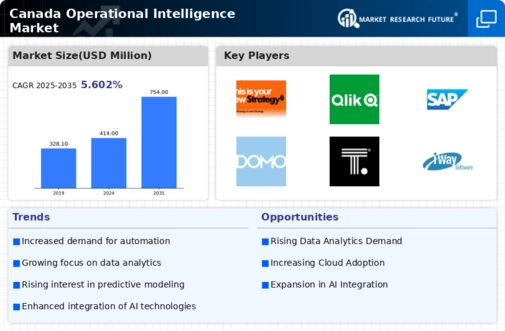
The Canada Operational Intelligence Market is expected to be valued at 414.0 million USD in 2024.

How much is the Canada Operational Intelligence Market projected to grow by 2035?

By 2035, the Canada Operational Intelligence Market is projected to reach a value of 754.0 million USD.

What is the expected CAGR for the Canada Operational Intelligence Market from 2025 to 2035?

The expected CAGR for the Canada Operational Intelligence Market from 2025 to 2035 is 5.602 percent.

Which segment of the Canada Operational Intelligence Market has the highest projected value in 2035?

By 2035, the Enterprise Operational Intelligence Software segment is projected to have the highest value at 250.0 million USD.

What is the market size of Enterprise Manufacturing in 2024 within the Canada Operational Intelligence Market?

The Enterprise Manufacturing segment is expected to be valued at 120.0 million USD in 2024.

Who are the key players in the Canada Operational Intelligence Market?

Major players in the Canada Operational Intelligence Market include MicroStrategy, Palantir Technologies, and SAP among others.

What is the anticipated market size for IT Service Intelligence in 2035?

The IT Service Intelligence segment is anticipated to reach a market size of 150.0 million USD by 2035.

What are the growth drivers for the Canada Operational Intelligence Market?

Key growth drivers include the increasing need for data-driven decision-making across various industries.

What value is projected for the Enterprise Security segment in 2024?

The Enterprise Security segment is projected to be valued at 84.0 million USD in 2024.

How is the overall market growth rate trending for the Canada Operational Intelligence Market?

The overall market growth rate is expected to follow a positive trend, growing steadily at a CAGR of 5.602 percent through 2035.

Download Free Sample

Kindly complete the form below to receive a free sample of this Report

Compare Licence

×
Features License Type
Single User Multiuser License Enterprise User
Price $4,950 $5,950 $7,250
Maximum User Access Limit 1 User Upto 10 Users Unrestricted Access Throughout the Organization
Free Customization
Direct Access to Analyst
Deliverable Format
Platform Access
Discount on Next Purchase 10% 15% 15%
Printable Versions