Emergence of 5G Technology
The rollout of 5G technology in Canada is anticipated to have a profound impact on the vcsel market. As telecommunications companies expand their networks to accommodate higher data speeds and lower latency, the demand for advanced optical components is expected to rise. Vcsel technology, with its ability to support high-speed data transmission, is well-positioned to meet the requirements of 5G infrastructure. The Canadian government has committed to investing in 5G development, with projections indicating that the 5G market could reach $40 billion by 2026. This investment is likely to drive the adoption of vcsel technology in telecommunications, thereby propelling the vcsel market to new heights.
Growth in Consumer Electronics
The consumer electronics market in Canada is witnessing a surge in demand for high-performance devices, which is positively impacting the vcsel market. With the proliferation of smart devices, including smartphones, tablets, and wearables, the need for efficient optical components is becoming more pronounced. Vcsel technology is increasingly being integrated into these devices for applications such as facial recognition and optical communication. The Canadian consumer electronics market is expected to reach a valuation of $30 billion by 2025, indicating a robust growth trajectory. This trend suggests that manufacturers are likely to invest in vcsel technology to enhance device functionality and user experience, thereby driving the vcsel market forward.
Rising Adoption of Data Centers
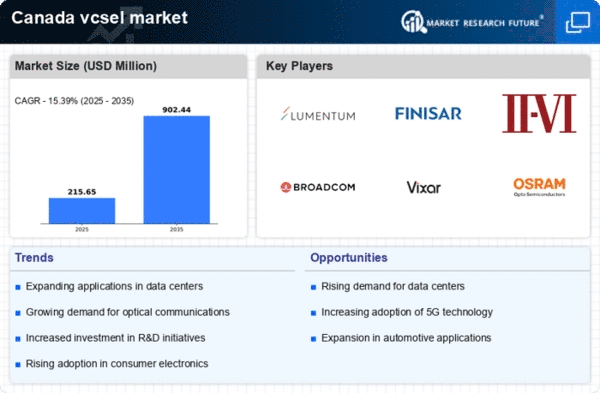
The increasing demand for data centers in Canada is driving the vcsel market. As organizations seek to enhance their data processing capabilities, the need for efficient optical communication technologies becomes paramount. Vcsel technology, known for its high-speed data transmission and low power consumption, is being integrated into data center infrastructure. Reports indicate that the Canadian data center market is projected to grow at a CAGR of approximately 10% over the next five years. This growth is likely to spur investments in vcsel technology, as companies aim to optimize their operations and reduce latency. Consequently, the vcsel market is expected to benefit from this trend, as more data centers adopt advanced optical solutions to meet the increasing data traffic demands.
Expansion of Automotive Applications
The automotive sector in Canada is undergoing a transformation, with a notable shift towards electric and autonomous vehicles. This transition is creating a burgeoning demand for advanced sensing technologies, where vcsel market plays a crucial role. Vcsel technology is utilized in LiDAR systems, which are essential for enabling autonomous driving capabilities. The Canadian automotive industry is projected to invest over $1 billion in research and development for electric vehicles by 2026. This investment is likely to drive the adoption of vcsel technology, as manufacturers seek to enhance vehicle safety and performance. As a result, the vcsel market is poised to experience significant growth, fueled by the automotive sector's increasing reliance on sophisticated optical systems.
Increased Focus on Energy Efficiency
In Canada, there is a growing emphasis on energy efficiency across various sectors, which is influencing the vcsel market. As organizations strive to reduce their carbon footprint and operational costs, the demand for energy-efficient technologies is on the rise. Vcsel technology is recognized for its low power consumption and high efficiency, making it an attractive option for businesses looking to optimize their energy usage. The Canadian government has implemented various initiatives aimed at promoting energy-efficient technologies, which could further stimulate the vcsel market. As companies increasingly prioritize sustainability, the adoption of vcsel technology is likely to accelerate, contributing to the overall growth of the market.
























Leave a Comment