Download Free Sample
Kindly complete the form below to receive a free sample of this Report
Global Cancer Supportive Care Drugs Market Research Report: Size, Share, Trend Analysis By Drug Class (Analgesics, Antiemetics, Hematopoietic Growth Factors, Antibiotics, Corticosteroids), By Administration Route (Oral, Intravenous, Subcutaneous, Transdermal, Inhalation), By Indication (Pain Management, Nausea and Vomiting, Anemia, Infection Prevention, Inflammation Control), By Distribution Channel (Hospital Pharmacies, Retail Pharmacies, Online Pharmacies, Specialty Pharmacies) andBy Regional (North America, Europe, South America, Asia Pacific, Middle East and Africa) - Growth Outlook & Industry Forecast 2025 To 2035
As per Market Research Future analysis, the Cancer Supportive Care Drugs Market was estimated at 18.42 USD Billion in 2024. The Cancer Supportive Care Drugs industry is projected to grow from 19.17 USD Billion in 2025 to 28.51 USD Billion by 2035, exhibiting a compound annual growth rate (CAGR) of 4.05% during the forecast period 2025 - 2035
The Cancer Supportive Care Drugs Market is experiencing robust growth driven by increasing demand for palliative care and advancements in drug formulations.
| 2024 Market Size | 18.42 (USD Billion) |
| 2035 Market Size | 28.51 (USD Billion) |
| CAGR (2025 - 2035) | 4.05% |
The cancer supportive care drugs market is currently experiencing a notable evolution, driven by an increasing recognition of the importance of supportive therapies in enhancing the quality of life for patients undergoing cancer treatment. This market encompasses a diverse range of pharmaceuticals aimed at alleviating symptoms associated with cancer and its treatment, such as pain, nausea, and fatigue. As the global population ages and the incidence of cancer rises, the demand for effective supportive care solutions appears to be on the rise. Furthermore, advancements in drug development and a growing emphasis on personalized medicine may contribute to the expansion of the cancer supportive care drugs market, as healthcare providers seek tailored approaches to meet the unique needs of individual patients.
In addition, the cancer supportive care drugs market is likely to benefit from increased awareness and education among healthcare professionals and patients alike. This heightened understanding may lead to more proactive management of treatment-related side effects, thereby improving patient outcomes. Moreover, collaborations between pharmaceutical companies and research institutions could foster innovation, resulting in the introduction of novel therapies that address unmet needs within the supportive care landscape. Overall, the cancer supportive care drugs market seems poised for growth, reflecting a broader shift towards comprehensive cancer care that prioritizes both treatment efficacy and patient well-being.
There is a growing recognition of the necessity for palliative care in oncology, which emphasizes symptom management and quality of life. This trend suggests that healthcare systems are increasingly integrating supportive care drugs into standard cancer treatment protocols, thereby enhancing patient experiences and supporting the growth of the cancer supportive care drugs market.
Innovations in drug formulations are emerging, with a focus on developing more effective and targeted therapies. This trend indicates a shift towards personalized medicine, where treatments are tailored to individual patient profiles, potentially improving therapeutic outcomes within the cancer supportive care drugs market.
There is an observable trend towards enhancing patient education regarding supportive care options. This focus may empower patients to engage more actively in their treatment plans, leading to better management of side effects and improved overall satisfaction with care across the cancer supportive care drugs market.
The rising incidence of cancer worldwide is a primary driver for the Cancer Supportive Care Drugs Market. As cancer cases continue to increase, the demand for supportive care drugs that alleviate symptoms and improve the quality of life for patients is likely to rise. According to recent statistics, cancer is projected to affect millions of individuals annually, necessitating effective management strategies. This trend indicates a robust market potential for drugs that address side effects associated with cancer treatments, such as chemotherapy and radiation therapy. The Cancer Supportive Care Drugs Market is thus positioned to expand as healthcare providers seek to enhance patient outcomes through innovative therapeutic options.
Rising awareness of palliative care is shaping the Cancer Supportive Care Drugs Market. As healthcare professionals and patients increasingly recognize the importance of managing symptoms and enhancing quality of life, the demand for supportive care drugs is likely to grow. Educational campaigns and advocacy efforts are contributing to a shift in perception, emphasizing that supportive care is an integral part of cancer treatment. This heightened awareness is expected to drive market growth, as more patients seek access to medications that alleviate pain and discomfort associated with cancer and its treatments. The Cancer Supportive Care Drugs Market stands to benefit from this evolving landscape.
Increased investment in cancer research is a crucial driver for the Cancer Supportive Care Drugs Market. Governments and private organizations are allocating substantial funds to explore new treatment modalities and supportive care options. This financial commitment fosters innovation and accelerates the development of drugs that can effectively manage the side effects of cancer therapies. The market is expected to benefit from this trend, as research initiatives often lead to breakthroughs in drug formulations and delivery systems. Consequently, the Cancer Supportive Care Drugs Market is poised for growth as new therapies emerge from ongoing research efforts.
Regulatory support for innovative therapies is a significant factor influencing the Cancer Supportive Care Drugs Market. Regulatory agencies are increasingly streamlining approval processes for new supportive care drugs, recognizing the urgent need for effective symptom management in cancer patients. This supportive regulatory environment encourages pharmaceutical companies to invest in research and development, leading to a wider array of treatment options. As a result, the Cancer Supportive Care Drugs Market is likely to experience accelerated growth, with new drugs entering the market more rapidly. This trend not only enhances patient access to necessary therapies but also stimulates competition among manufacturers.
Technological advancements in drug development are significantly influencing the Cancer Supportive Care Drugs Market. Innovations in biotechnology and pharmacology have led to the creation of more effective and targeted supportive care medications. These advancements not only improve the efficacy of existing drugs but also facilitate the development of new formulations that cater to specific patient needs. For instance, the introduction of biologics and personalized medicine has transformed treatment paradigms, allowing for tailored approaches to symptom management. As a result, the Cancer Supportive Care Drugs Market is likely to witness an influx of novel therapies that enhance patient care and satisfaction.
In the Cancer Supportive Care Drugs Market, the segment of Analgesics holds the largest market share, driven by the high demand for effective pain management solutions for cancer patients. This category includes a variety of opiate and non-opiate options that cater to diverse patient needs. Antiemetics, on the other hand, are quickly gaining traction as the fastest-growing segment, aiding patients in managing chemotherapy-induced nausea and vomiting, which significantly impacts their quality of life.
Analgesics (Dominant) vs. Antiemetics (Emerging)
Analgesics are pivotal in the Cancer Supportive Care Drugs Market, providing essential pain relief for patients undergoing various cancer treatments. This category includes opioids, NSAIDs, and adjuvant analgesics that are tailored for individual pain profiles. The dominant presence of analgesics reflects their critical role in enhancing patient comfort and adherence to treatment plans. Meanwhile, antiemetics have emerged as a crucial support tool, particularly as treatment regimens become more aggressive. Their rapid growth is fueled by ongoing advancements in drug formulations and increased recognition of the importance of managing treatment-related side effects. Together, these drug classes illustrate the evolving landscape of supportive cancer care.
In the Cancer Supportive Care Drugs Market, the distribution of administration routes reveals that Oral medications dominate the segment, capturing a significant portion of the market share due to their convenience and ease of use for patients. This method offers a non-invasive option, which is particularly appealing for long-term care regimens, allowing patients to manage their treatment at home effectively. Comparatively, Intravenous administration is gaining ground among newer therapies, particularly those targeting severe symptoms requiring rapid relief.
Administration Route: Oral (Dominant) vs. Intravenous (Emerging)
Oral administration stands out in the Cancer Supportive Care Drugs Market as the dominant route due to its patient-centric advantages, fostering adherence to treatment plans. These medications are often formulated in easy-to-swallow tablets or capsules, making them preferable for many cancer patients who may experience difficulties with other routes. Conversely, Intravenous administration is emerging as a vital option for acute symptom management, especially in hospital settings. Its use is growing swiftly due to advancements in targeted therapies that demand direct administration into the bloodstream for effective results, reflecting a shift in treatment protocols.
The 'Indication' segment of the Cancer Supportive Care Drugs Market showcases diverse therapeutic areas, with Pain Management holding the largest share. This segment reflects the high prevalence of pain among cancer patients, necessitating effective analgesics to enhance quality of life. Nausea and Vomiting, on the other hand, is emerging rapidly as a critical area of concern, particularly driven by antiemetic therapies, addressing the distressing side effects of chemotherapy. As healthcare providers focus on holistic cancer care, these therapeutic areas are gaining significant attention and investment. Growth trends within this segment are characterized by an increasing emphasis on personalized medicine and combination therapies. Driven by a greater understanding of patient-specific needs, innovative drug formulations are being developed to address pain and nausea more effectively. Factors such as the rise in cancer diagnoses, expansion of supportive care protocols, and heightened awareness of symptom management are contributing to the swift evolution of this sector. This dynamic landscape presents valuable opportunities for pharmaceutical companies to meet the unmet needs of cancer patients while maximizing therapeutic efficacy.
Pain Management: Dominant vs. Nausea and Vomiting: Emerging
In the Cancer Supportive Care Drugs Market, Pain Management remains the dominant segment due to the ubiquitous issue of cancer-related pain, which affects a substantial number of patients. This area includes a range of therapies, from opioids to non-opioid analgesics, each catering to various pain management needs. In contrast, Nausea and Vomiting is an emerging segment, primarily driven by the adverse effects experienced during chemotherapy. With advances in antiemetic therapies and a comprehensive understanding of chemotherapy-induced nausea, this segment is rapidly gaining traction. As healthcare systems evolve towards more patient-centric approaches, both segments are expected to expand significantly, with Pain Management leading in terms of market maturity while Nausea and Vomiting captures attention for its transformative growth potential.
In the Cancer Supportive Care Drugs Market, distribution channels play a crucial role in ensuring patient access to essential medications. Hospital pharmacies dominate this segment, accounting for the largest market share due to their direct relationship with healthcare providers and proximity to patients requiring immediate care. Retail pharmacies also contribute significantly, providing patients with convenient access to drugs that manage symptoms and side effects related to cancer therapies. Online pharmacies are growing in popularity, yet their market share remains smaller compared to traditional channels due to regulatory challenges and patient hesitancy. Growth trends in the Cancer Supportive Care Drugs Market are influenced by several factors, including an increase in cancer prevalence and improvements in treatment protocols that require supportive therapies. Specialty pharmacies are emerging rapidly as key players, primarily due to their focus on managing complex medication regimens and ensuring adherence. The ongoing shift towards personalized medicine and the advent of digital health solutions further fuel the growth of online pharmacies, which offer added convenience to patients, especially those in remote areas. Overall, the distribution channel landscape reflects a dynamic evolution driven by both patient needs and healthcare delivery innovation.
Hospital Pharmacies (Dominant) vs. Specialty Pharmacies (Emerging)
Hospital pharmacies hold a dominant position in the Cancer Supportive Care Drugs Market, primarily due to their integral role within healthcare systems, where they can quickly dispense medications to inpatient populations. Their ability to provide comprehensive care, from medication management to patient education, enhances the therapeutic experience for cancer patients. Additionally, hospital pharmacies are equipped to handle high-cost, complex medications typically used in supportive care. In contrast, specialty pharmacies are emerging as crucial players by offering tailored services specific to high-risk therapies needed for complex cancer cases. They focus on managing treatment protocols, ensuring patient adherence, and providing specialized support such as reimbursement assistance and medication management. This emerging trend underscores the evolving landscape of cancer care, as the demand for targeted therapies increases.
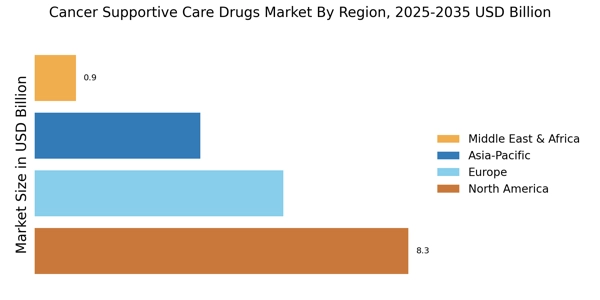
The Global Cancer Supportive Care Drugs Market experienced notable segmentation across various regions, contributing significantly to its overall revenue. In 2024, North America stood out with a market valuation of 9.21 USD Billion, dominating the landscape due to advanced healthcare infrastructure and high expenditure on cancer treatment. Europe followed with a valuation of 4.56 USD Billion, reflecting its robust pharmaceutical industry and investment in cancer care. The Asia-Pacific (APAC) region, valued at 2.95 USD Billion, was rapidly growing, primarily driven by increasing cancer incidences and expanding healthcare access.
South America and the Middle East and Africa (MEA) represented smaller shares, with market valuations of 1.28 USD Billion and 0.42 USD Billion, respectively, yet they were important as they reflected emerging market opportunities and were witnessing a gradual rise in cancer drugs adoption. Overall, North America held the majority of the market share, showcasing the region's critical role in the Global Cancer Supportive Care Drugs Market, while other regions presented diverse growth potential due to varying healthcare developments and market dynamics.
The Global Cancer Supportive Care Drugs Market is highly competitive, driven by the increasing prevalence of cancer worldwide and the growing recognition of the importance of patient support during treatment. This market encompasses a wide range of medications designed to alleviate the side effects of cancer treatments such as chemotherapy and radiotherapy, thereby enhancing patients' quality of life. Key players in this sector are constantly innovating to deliver better therapeutic options while complying with strict regulatory standards. Competitive dynamics in this market are characterized by mergers and acquisitions, strategic partnerships, and a focus on research and development to create novel supportive care drugs that meet the evolving needs of patients. As the market expands, companies are investing heavily in clinical trials and real-world evidence studies to prove the efficacy and safety of their products, which adds to the increasingly competitive landscape. Amgen has established a significant presence in the Global Cancer Supportive Care Drugs Market, primarily leveraging its expertise in biotechnology to develop targeted therapies that not only treat cancer but also provide supportive care. The company's strengths lie in its robust pipeline of innovative products, strong research capabilities, and dedication to patient-centric treatment approaches. Amgen focuses on addressing the unique challenges that cancer patients face, particularly in managing pain, nausea, and other side effects associated with cancer therapies. By combining cutting-edge science with a deep understanding of patient needs, Amgen has positioned itself as a key player in this market, known for its high-quality and effective supportive care medications that significantly improve patient outcomes. Johnson and Johnson also plays a pivotal role in the Global Cancer Supportive Care Drugs Market, benefiting from its extensive portfolio and a strong commitment to healthcare innovation. The company is known for its comprehensive range of supportive care options designed to manage the broad spectrum of symptoms experienced by cancer patients throughout their treatment journey. Johnson and Johnson's strengths include a well-established brand reputation, significant resources allocated to research and development, and a global reach that allows it to deliver its products effectively across diverse markets. Additionally, the company's emphasis on collaborative partnerships and patient engagement initiatives enhances its ability to meet the growing demands of the cancer-supportive care space. With a commitment to improving the quality of life for cancer patients, Johnson and Johnson continues to be a formidable competitor in this evolving market.



The Cancer Supportive Care Drugs Market is projected to grow at a 4.05% CAGR from 2025 to 2035, driven by increasing cancer prevalence, advancements in drug formulations, and enhanced patient care protocols.
New opportunities lie in:
By 2035, the market is expected to achieve substantial growth, reflecting evolving patient needs and innovative treatment approaches.
| MARKET SIZE 2024 | 18.42(USD Billion) |
| MARKET SIZE 2025 | 19.17(USD Billion) |
| MARKET SIZE 2035 | 28.51(USD Billion) |
| COMPOUND ANNUAL GROWTH RATE (CAGR) | 4.05% (2025 - 2035) |
| REPORT COVERAGE | Revenue Forecast, Competitive Landscape, Growth Factors, and Trends |
| BASE YEAR | 2024 |
| Market Forecast Period | 2025 - 2035 |
| Historical Data | 2019 - 2024 |
| Market Forecast Units | USD Billion |
| Key Companies Profiled | Roche (CH), Amgen (US), Bristol-Myers Squibb (US), Merck & Co. (US), Novartis (CH), Eli Lilly and Company (US), Pfizer (US), Teva Pharmaceutical Industries (IL), AstraZeneca (GB) |
| Segments Covered | Drug Class, Administration Route, Indication, Distribution Channel, Regional |
| Key Market Opportunities | Emerging biologics and personalized therapies enhance patient outcomes in the Cancer Supportive Care Drugs Market. |
| Key Market Dynamics | Rising demand for innovative therapies drives competition and regulatory scrutiny in the Cancer Supportive Care Drugs Market. |
| Countries Covered | North America, Europe, APAC, South America, MEA |
The projected market valuation for the Cancer Supportive Care Drugs Market in 2035 is 28.51 USD Billion.
The overall market valuation for the Cancer Supportive Care Drugs Market in 2024 was 18.42 USD Billion.
The expected CAGR for the Cancer Supportive Care Drugs Market during the forecast period 2025 - 2035 is 4.05%.
Corticosteroids are projected to have the highest valuation in 2035, with an expected increase from 5.42 to 9.51 USD Billion.
The valuation of analgesics is expected to increase from 3.5 USD Billion in 2024 to 5.25 USD Billion in 2035.
The projected valuation for intravenous administration of cancer supportive care drugs in 2035 is expected to rise from 5.0 USD Billion to 7.5 USD Billion.
Specialty pharmacies are anticipated to show the most growth, with a projected increase from 4.92 USD Billion to 8.51 USD Billion by 2035.
The expected valuation for nausea and vomiting indications is projected to increase from 4.0 USD Billion in 2024 to 6.0 USD Billion in 2035.
In 2035, the market for online pharmacies is projected to reach 4.5 USD Billion, while retail pharmacies are expected to grow to 6.5 USD Billion.


Kindly complete the form below to receive a free sample of this Report

“This is really good guys. Excellent work on a tight deadline. I will continue to use you going forward and recommend you to others. Nice job”


“Thanks. It’s been a pleasure working with you, please use me as reference with any other Intel employees.”


“Thanks for sending the report it gives us a good global view of the Betaïne market.”


“Thank you, this will be very helpful for OQS.”


“We found the report very insightful! we found your research firm very helpful. I'm sending this email to secure our future business.”


“I am very pleased with how market segments have been defined in a relevant way for my purposes (such as "Portable Freezers & refrigerators" and "last-mile"). In general the report is well structured. Thanks very much for your efforts.”


“I have been reading the first document or the study, ,the Global HVAC and FP market report 2021 till 2026. Must say, good info! I have not gone in depth at all parts, but got a good indication of the data inside!”


“We got the report in time, we really thank you for your support in this process. I also thank to all of your team as they did a great job.”


“The Automotive 48V ECU Components Procurement Intelligence Study” was a complex project, but the Market Research Future (MRFR) team handled it with quality, agility, and customer-centricity. They delivered all requested data on time and within the agreed scope. The team, including Shubhendra Anand and Rahul Gotadki, was always readily available to clarify questions and swiftly implement necessary adjustments, driving the project to a successful conclusion within a very demanding timeframe.
I would also like to specifically commend Akshay Agarwal for his responsiveness and support at every stage—from our initial inquiry on May 6th through to final delivery on June 18th. His dedication made the entire process seamless.”



