Car Air Purifier Market Size, Share, Industry Trend & Analysis Research Report Information by Technology (HEPA Filters, Ionizers and others), End Use (Private Cars and Commercial Cars), Distribution Channel (Store-based and Non-store-based) and Region - Forecast till 2035
Forecast Period
2025 - 2035
CAGR
11.3%
2024 Market Size
$ 2,171 Billion
2035 Market Size
$ 7,048.66 Billion
Consumer and Retail● Updated July 17, 2026Report ID: MRFR/CG/1335-CR|Pages: 128|Author: Sakshi Gupta
Car Air Purifier Market Summary
As per MRFR analysis, the Car Air Purifier Market was estimated at 2171.0 USD Billion in 2024. The Car Air Purifier industry is projected to grow from 2416.32 USD Billion in 2025 to 7048.66 USD Billion by 2035, exhibiting a compound annual growth rate (CAGR) of 11.3% during the forecast period 2025 - 2035. Asia-Pacific holds the largest share of the global Car Air Purifier Market at approximately 44%, driven by severe urban air pollution, a large and rapidly growing vehicle ownership base, and high consumer health consciousness in key markets such as China and India. China is the leading country within Asia-Pacific, capturing approximately 22% of the global Car Air Purifier Market share, fueled by its status as the world's largest automobile market, worsening air quality in major cities, and strong adoption of portable in-cabin air purification solutions. Cabin Air Purification dominates the Car Air Purifier Market as the largest application segment, accounting for approximately 48% of the global market share in 2025, driven by increasing consumer demand for healthier in-vehicle environments and growing awareness of airborne pollutants affecting driver and passenger well-being.
Key Market Trends & Highlights
The Car Air Purifier Market is experiencing a dynamic shift towards advanced technologies and eco-friendly solutions.
The market is witnessing a rise in smart technologies that enhance user experience and air quality monitoring.
There is a growing focus on eco-friendly solutions, reflecting consumer demand for sustainable products.
Cabin air purification remains the largest segment, while odor removal is emerging as the fastest-growing segment.
Increasing awareness of air quality and rising health consciousness are key drivers propelling market growth.
Enabled $4.3B Revenue Impact for Fortune 500 and Leading Multinationals
Partnering with 2000+ Global Organizations Each Year
30K+ Citations by Top-Tier Firms in the Industry
Car Air Purifier Market Trends
The Car Air Purifier Market is currently experiencing a notable transformation, driven by increasing consumer awareness regarding air quality and health implications associated with pollutants. As individuals spend considerable time in vehicles, the demand for effective air purification solutions has surged. This trend is further amplified by the growing prevalence of urbanization and the corresponding rise in vehicular emissions, which have heightened concerns about indoor air quality. Manufacturers are responding to these challenges by innovating and introducing advanced technologies that enhance the efficiency and effectiveness of air purifiers designed specifically for automotive use.\n\nMoreover, the Car Air Purifier Market is witnessing a shift towards smart technology integration. Consumers are increasingly inclined towards products that offer connectivity features, allowing for real-time monitoring and control via mobile applications. This inclination towards smart solutions suggests a broader trend of personalization and convenience in consumer electronics. As the market evolves, it appears that sustainability will also play a crucial role, with manufacturers exploring eco-friendly materials and energy-efficient designs. Overall, the Car Air Purifier Market is poised for growth, driven by technological advancements and a heightened focus on health and environmental sustainability.
Rise in Health Consciousness
There is a growing awareness among consumers regarding the impact of air quality on health. This trend is leading to increased demand for car air purifiers that can effectively remove pollutants and allergens from the vehicle's interior.
Integration of Smart Technologies
The Car Air Purifier Market is seeing a trend towards the incorporation of smart technologies. Consumers are favoring products that offer connectivity features, enabling them to monitor air quality and control purifiers through mobile applications.
Focus on Sustainability
Manufacturers are increasingly prioritizing sustainability in their product designs. This includes the use of eco-friendly materials and energy-efficient technologies, reflecting a broader consumer preference for environmentally responsible products.
Car Air Purifier Market Drivers
Rising Demand for In-Car Comfort
The Car Air Purifier Market is witnessing a rising demand for enhanced in-car comfort, which is increasingly becoming a priority for consumers. As individuals spend more time in their vehicles, the need for a pleasant and healthy environment is paramount. Air purifiers are now viewed as essential accessories that contribute to overall driving comfort. Market data indicates that the demand for car air purifiers has increased by approximately 15% in recent years, reflecting a shift in consumer preferences. This trend is likely to continue as manufacturers respond by developing more compact and efficient models that cater to the needs of modern drivers, thereby driving growth in the Car Air Purifier Market.
Increase in Air Quality Awareness
The Car Air Purifier Market experiences a notable surge in demand due to heightened awareness regarding air quality. Consumers are increasingly cognizant of the adverse effects of pollutants and allergens present in vehicle interiors. This awareness is driven by various health campaigns and studies indicating that indoor air quality can be significantly worse than outdoor air quality. As a result, individuals are seeking solutions to mitigate these risks, leading to a projected growth rate of approximately 8% annually in the Car Air Purifier Market. The emphasis on clean air is not merely a trend but a fundamental shift in consumer behavior, prompting manufacturers to innovate and enhance their product offerings.
Shift Towards Eco-Friendly Products
The Car Air Purifier Market is experiencing a shift towards eco-friendly products, driven by growing environmental consciousness among consumers. As individuals become more aware of their ecological footprint, there is a rising demand for air purifiers that utilize sustainable materials and energy-efficient technologies. Manufacturers are responding by developing products that not only purify air but also minimize environmental impact. Market analysis suggests that eco-friendly air purifiers are gaining traction, with sales expected to rise by approximately 12% in the coming years. This trend reflects a broader movement towards sustainability, positioning the Car Air Purifier Market as a key player in the green technology sector.
Regulatory Support for Air Quality Improvement
The Car Air Purifier Market benefits from increasing regulatory support aimed at improving air quality standards. Governments are implementing stricter regulations regarding vehicle emissions and indoor air quality, which indirectly boosts the demand for air purifiers in cars. Policies promoting cleaner air initiatives encourage consumers to invest in air purification solutions as a means of compliance and personal health protection. This regulatory landscape is expected to foster a favorable environment for market growth, with projections indicating a potential increase in market size by 20% over the next decade. The alignment of regulatory frameworks with consumer health priorities creates a robust foundation for the Car Air Purifier Market.
Technological Advancements in Filtration Systems
The Car Air Purifier Market is significantly influenced by rapid technological advancements in filtration systems. Innovations such as HEPA filters, activated carbon, and UV-C light technology are becoming increasingly prevalent. These advancements enhance the efficiency of air purifiers, allowing them to capture a broader range of pollutants, including fine particulate matter and volatile organic compounds. The integration of smart technologies, such as app connectivity and real-time air quality monitoring, further elevates consumer interest. As a result, the market is projected to grow, with estimates suggesting a compound annual growth rate of around 10% over the next five years. This technological evolution not only improves product performance but also aligns with consumer expectations for high-quality air purification.
Market Segment Insights
By Application: Cabin Air Purification (Largest) vs. Pollutant Filtration (Fastest-Growing)
The Car Air Purifier Market is significantly influenced by various application segments, with Cabin Air Purification holding the largest market share. This segment has become a critical selling point for car manufacturers and aftermarket suppliers, catering to consumers' rising demand for enhanced air quality within vehicles. Odor Removal, Allergen Reduction, and Smoke Elimination are also integral to the market, capturing robust interest as consumers prioritize healthier, cleaner air in their driving environments. Each segment complements the overall commitment to air quality improvement in cars, indicating a strong trend among customers toward investing in air purification solutions. Growth trends within the Car Air Purifier Market are shaped by increasing awareness of air quality issues in vehicles, especially concerning allergens and pollutants. The rapid rise in air pollution levels globally has urged consumers to seek solutions that offer efficient filtration inside their cars. Pollutant Filtration is currently recognized as the fastest-growing segment, driven by advances in filtration technologies and heightened consumer education regarding health impacts. Additionally, regulatory pressures and an increase in automotive electrification are expected to further amplify the growth of these applications in the market ahead.
Odor Removal (Dominant) vs. Smoke Elimination (Emerging)
Odor Removal is characterized as the dominant application segment within the Car Air Purifier Market, as it addresses a fundamental consumer need for pleasant in-car experiences. Products designed for odor removal are effectively marketed for their capacity to neutralize unwanted smells, making them essential in attracting customers. In contrast, Smoke Elimination has emerged as a crucial segment, driven by increasing awareness of health risks associated with cigarette smoke and airborne contaminants. This segment's growth is supported by a more health-conscious consumer base and innovations in air purification technologies. Both segments play significant roles in enhancing in-car air quality, catering to diverse consumer preferences and behaviors.
By Technology: HEPA Filter (Largest) vs. Ionizer (Fastest-Growing)
In the Car Air Purifier Market, HEPA filters hold the largest share due to their efficiency in trapping airborne particles, making them a preferred choice among consumers. Activated carbon follows closely, valued for its ability to absorb odors and harmful gases. UV light purifiers, Ionizers, and Ozone generators are also relevant players, though they occupy smaller market portions which are experiencing a gradual increase.
Technology: HEPA Filter (Dominant) vs. Ionizer (Emerging)
HEPA filters are celebrated for their performance in capturing particulate matter, such as dust and pollen, ensuring a high level of air purity within vehicles. They cater to health-conscious consumers wishing to minimize allergens and particulates. In contrast, Ionizers are emerging rapidly due to their innovative mechanism of charging particles to induce settling, thereby improving air quality without needing frequent filter replacements. As consumers seek cost-effective and lower-maintenance options, the demand for Ionizers is rising, showing promise for future market growth.
By End Use: Personal Vehicles (Largest) vs. Commercial Vehicles (Fastest-Growing)
The Car Air Purifier market has identified distinct preferences across various end-use segments. Personal vehicles dominate the market, constituting a significant share as consumers become increasingly health-conscious about air quality within their cars. In contrast, commercial vehicles are witnessing a rapid surge in adoption as organizations recognize the importance of maintaining optimal air quality for drivers and passengers, thereby enhancing the overall experience.
Personal Vehicles (Dominant) vs. Ride-Sharing Services (Emerging)
Personal vehicles represent the dominant segment in the Car Air Purifier market, driven by a growing consumer awareness of indoor air quality and its health implications. As individuals prioritize their well-being, the demand for efficient air purification systems in personal vehicles has soared. On the other hand, ride-sharing services have emerged as a significant player, gaining traction due to the increasing number of shared transportation users. Providers are equipping vehicles with air purifiers to ensure passenger comfort and safety, promoting a clean and healthy environment. As urbanization and ride-sharing models expand, these services are positioned for notable growth.
By Power Source: Battery Operated (Largest) vs. USB Powered (Fastest-Growing)
In the Car Air Purifier Market, the power source segment is characterized by various options each catering to different consumer preferences. Battery Operated purifiers hold the largest market share, appealing to users seeking portability and convenience in their vehicles. In contrast, USB Powered options are gaining momentum, particularly among tech-savvy consumers who value versatility and ease of charging.
Battery Operated (Dominant) vs. USB Powered (Emerging)
Battery Operated air purifiers are favored for their portability, enabling users to place them anywhere in the car without the need for an external power source. This segment continues to lead the market, primarily due to its convenience and adaptability to various vehicle types. On the other hand, USB Powered purifiers are emerging rapidly, driven by the increasing prevalence of USB ports in vehicles and consumer demand for energy-efficient solutions. This segment particularly appeals to younger demographics who prioritize tech integration in their lifestyle, leading to innovative designs and functionalities that enhance their user experience.
By Size: Compact (Largest) vs. Portable (Fastest-Growing)
The Car Air Purifier Market segment based on size is witnessing a diverse distribution of market shares. Currently, the Compact segment holds the largest share due to its popularity among consumers who prioritize space-saving features and ease of installation. Following closely is the Portable size, which, while not as dominant, is rapidly gaining traction as more consumers seek flexibility in air purification options that can easily be moved from one vehicle to another.
Compact (Dominant) vs. Portable (Emerging)
The Compact air purifiers are designed to efficiently clean the air in vehicles without taking up much space. They appeal to consumers who value convenience and practicality, often featuring sleek designs that blend seamlessly with vehicle interiors. In contrast, Portable air purifiers represent an emerging trend, characterized by their ease of use and adaptability. These devices allow users to enjoy clean air across multiple settings, making them increasingly popular among those who spend a significant amount of time in their cars. Their lightweight design and advanced filtration technologies are driving their rapid adoption rate in the Car Air Purifier Market.
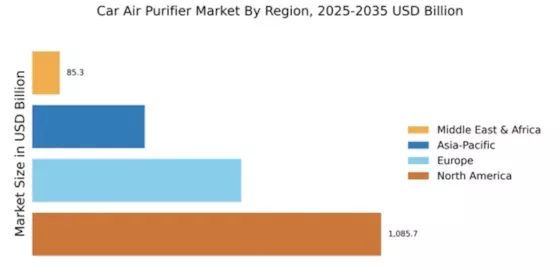
North America is poised to maintain its leadership in the car air purifier market, holding a significant market share of 1085.65. The growth is driven by increasing consumer awareness regarding air quality and health, alongside stringent regulations promoting cleaner air in vehicles. The demand for advanced filtration technologies is also on the rise, as consumers seek to mitigate pollutants and allergens in their cars. The competitive landscape is robust, with key players like Honeywell and Bissell leading the charge. The U.S. and Canada are the primary markets, showcasing a high adoption rate of air purifiers in vehicles. Companies are innovating with smart technologies and IoT integration, enhancing user experience and efficiency. The presence of established brands ensures a dynamic market, catering to diverse consumer needs.
Europe : Emerging Market with Growth Potential
Europe is witnessing a growing demand for car air purifiers, with a market size of €650.0. The region's growth is fueled by increasing environmental regulations and a rising focus on health and wellness among consumers. Countries like Germany and France are leading the charge, with consumers increasingly prioritizing air quality in their vehicles. The European market is also benefiting from innovations in technology, such as HEPA filters and smart features. The competitive landscape is characterized by a mix of established brands and emerging players. Companies like Philips and Xiaomi are making significant inroads, leveraging advanced technology to capture market share. The European Union's commitment to improving air quality standards further propels market growth, encouraging investments in cleaner technologies. "The European market is evolving rapidly, driven by consumer demand for healthier living environments," states a recent EU report.
Asia-Pacific : Rapid Growth in Emerging Markets
The Asia-Pacific region is experiencing a surge in the car air purifier market, with a market size of $350.0. This growth is primarily driven by increasing urbanization, rising pollution levels, and a growing middle class that prioritizes health and wellness. Countries like China and India are at the forefront, with consumers becoming more aware of the health impacts of poor air quality in vehicles. Regulatory support for cleaner air initiatives is also a significant driver. The competitive landscape is vibrant, with key players like Xiaomi and TCL leading the market. The presence of local manufacturers is also notable, as they cater to the unique needs of regional consumers. The market is characterized by rapid innovation, with companies focusing on smart technologies and user-friendly designs to enhance consumer appeal. The demand for affordable yet effective solutions is shaping the competitive dynamics.
Middle East and Africa : Emerging Market with Untapped Potential
The Middle East and Africa region is gradually emerging in the car air purifier market, with a market size of $85.35. The growth is driven by increasing awareness of air quality issues and a rising number of vehicle owners. Urbanization and industrialization are contributing to higher pollution levels, prompting consumers to seek solutions for cleaner air in their cars. Regulatory frameworks are also beginning to support cleaner air initiatives, albeit at a slower pace compared to other regions. Countries like South Africa and the UAE are leading the market, with a growing interest in health and wellness products. The competitive landscape is still developing, with a mix of international and local players. Companies are focusing on affordability and accessibility, aiming to capture the attention of a price-sensitive consumer base. The potential for growth in this region is significant, as awareness continues to rise.
Key Players and Competitive Insights
The Car Air Purifier Market is currently characterized by a dynamic competitive landscape, driven by increasing consumer awareness regarding air quality and health. Major players such as Philips (NL), Honeywell (US), and Xiaomi (CN) are strategically positioned to leverage innovation and technological advancements. Philips (NL) focuses on enhancing product efficiency through advanced filtration technologies, while Honeywell (US) emphasizes its strong brand reputation and extensive distribution networks. Xiaomi (CN) adopts a cost-effective approach, appealing to budget-conscious consumers with smart features integrated into its products. Collectively, these strategies contribute to a competitive environment that is both innovative and diverse, fostering growth and consumer engagement.Key business tactics within the Car Air Purifier Market include localizing manufacturing and optimizing supply chains to enhance operational efficiency. The market structure appears moderately fragmented, with several key players holding substantial market shares. This fragmentation allows for a variety of product offerings, catering to different consumer preferences and price points. The collective influence of these key players shapes market dynamics, as they continuously adapt to changing consumer demands and technological advancements.In November Honeywell (US) announced the launch of its latest line of smart air purifiers, which utilize AI technology to monitor and adjust air quality in real-time. This strategic move not only reinforces Honeywell's commitment to innovation but also positions the company as a leader in integrating smart technology into air purification solutions. The introduction of AI capabilities is likely to enhance user experience and drive sales, as consumers increasingly seek intelligent home solutions.In October Xiaomi (CN) expanded its product range by introducing a new compact car air purifier designed specifically for urban commuters. This strategic decision reflects Xiaomi's understanding of the growing demand for portable and efficient air purification solutions in densely populated areas. By targeting urban consumers, Xiaomi aims to capture a significant share of the market, potentially increasing its brand visibility and customer loyalty.In September Philips (NL) entered into a strategic partnership with a leading automotive manufacturer to integrate its air purification technology into new vehicle models. This collaboration signifies a shift towards OEM partnerships, allowing Philips to expand its reach and enhance its product offerings. Such alliances are indicative of a broader trend where companies seek to embed air purification solutions directly into vehicles, thereby addressing consumer concerns about in-car air quality.As of December the Car Air Purifier Market is witnessing trends such as digitalization, sustainability, and AI integration, which are reshaping competitive dynamics. Strategic alliances are becoming increasingly prevalent, as companies recognize the value of collaboration in enhancing product offerings and market reach. Looking ahead, competitive differentiation is likely to evolve from traditional price-based competition to a focus on innovation, technology, and supply chain reliability. This shift underscores the importance of developing unique value propositions that resonate with consumers, ultimately driving growth in the market.


Key Companies in the Car Air Purifier Market include
Industry Developments
Q2 2024: Philips launches new GoPure Style car air purifier series in Europe Philips introduced its GoPure Style series of car air purifiers, featuring advanced HEPA filtration and real-time air quality monitoring, targeting European consumers concerned about in-vehicle air pollution.
Q1 2024: Sharp announces partnership with Toyota for integrated car air purification systems Sharp Corporation entered into a partnership with Toyota to supply its Plasmacluster ion technology for integration into select Toyota vehicle models, aiming to enhance in-cabin air quality.
Q2 2024: Honeywell expands automotive air purifier production with new facility in India Honeywell opened a new manufacturing facility in Pune, India, dedicated to producing advanced car air purifiers to meet growing demand in the Asia-Pacific region.
Q3 2024: Panasonic launches nanoe X car air purifier for Southeast Asian markets Panasonic released its nanoe X car air purifier, designed for tropical climates, in several Southeast Asian countries, featuring enhanced virus and allergen removal capabilities.
Q2 2024: Blueair debuts connected car air purifier with app-based controls Blueair launched a new smart car air purifier that allows users to monitor and control air quality via a mobile app, targeting tech-savvy consumers in North America and Europe.
Q1 2025: Godrej Appliances enters car air purifier market with launch of Aeroguard Drive Godrej Appliances announced its entry into the car air purifier segment with the launch of Aeroguard Drive, aiming to capture market share in India’s rapidly growing automotive accessories sector.
Q2 2025: Xiaomi unveils next-gen Mi Car Air Purifier Market with AI-powered air quality analytics Xiaomi introduced its latest Mi Car Air Purifier Market, featuring AI-driven air quality analytics and automatic adjustment, expanding its smart device ecosystem for automotive applications.
Q1 2024: DENSO secures major contract to supply air purification modules for Hyundai vehicles DENSO Corporation won a multi-year contract to supply advanced air purification modules for Hyundai’s new line of electric vehicles, strengthening its position in the automotive air quality market.
Q3 2024: Valeo launches compact car air purifier for OEM and aftermarket channels Valeo introduced a compact, high-efficiency car air purifier designed for both original equipment manufacturers and aftermarket sales, focusing on European and Asian markets.
Q2 2024: Coway announces strategic partnership with Kia for in-car air purification solutions Coway entered a strategic partnership with Kia Motors to co-develop and supply in-car air purification solutions for upcoming Kia vehicle models.
Q4 2024: Startup Airvida raises $15M Series B to scale production of portable car air purifiers Airvida, a startup specializing in portable car air purifiers, closed a $15 million Series B funding round to expand manufacturing and accelerate international market entry.
Q1 2025: Bosch appoints new head of automotive air quality solutions division Bosch announced the appointment of Dr. Lena Fischer as the new head of its automotive air quality solutions division, signaling a renewed focus on innovation in car air purification technologies.
Future Outlook
Car Air Purifier Market Future Outlook
New opportunities lie in:
The Car Air Purifier Market is projected to grow at 11.3% CAGR from 2025 to 2035, driven by increasing consumer awareness and stringent air quality regulations.
By 2035, the Car Air Purifier Market is expected to be robust, reflecting substantial growth and innovation.
Market Segmentation
Car Air Purifier Market End Use Outlook
Personal Vehicles
Commercial Vehicles
Ride-Sharing Services
Fleet Vehicles
Luxury Vehicles
Car Air Purifier Market Technology Outlook
HEPA Filter
Activated Carbon Filter
UV Light Technology
Ionizer Technology
Ozone Generator
Car Air Purifier Market Application Outlook
Cabin Air Purification
Odor Removal
Allergen Reduction
Smoke Elimination
Virus and Bacteria Filtration
Car Air Purifier Market Power Source Outlook
Battery Operated
Cigarette Lighter Plug-In
USB Powered
Solar Powered
Car Air Purifier Market Size and Portability Outlook
Compact
Portable
Built-In
Fixed
Report Scope
MARKET SIZE 2024
2171.0(USD Billion)
MARKET SIZE 2025
2416.32(USD Billion)
MARKET SIZE 2035
7048.66(USD Billion)
COMPOUND ANNUAL GROWTH RATE (CAGR)
11.3% (2025 - 2035)
REPORT COVERAGE
Revenue Forecast, Competitive Landscape, Growth Factors, and Trends
What is the projected market valuation of the Car Air Purifier Market by 2035?
The Car Air Purifier Market is projected to reach a valuation of 7048.66 USD Billion by 2035.
What was the market valuation of the Car Air Purifier Market in 2024?
In 2024, the Car Air Purifier Market was valued at 2171.0 USD Billion.
What is the expected CAGR for the Car Air Purifier Market during the forecast period 2025 - 2035?
The expected CAGR for the Car Air Purifier Market during the forecast period 2025 - 2035 is 11.3%.
Which companies are considered key players in the Car Air Purifier Market?
Key players in the Car Air Purifier Market include Philips, Honeywell, Xiaomi, Sharp, Coway, Dyson, LG Electronics, Bissell, and TCL.
What segment of the Car Air Purifier Market had the highest valuation in 2024?
The segment for Pollutant Filtration had the highest valuation in 2024, amounting to 671.0 USD Billion.
How does the market size for personal vehicles compare to commercial vehicles in 2024?
In 2024, the market size for personal vehicles was 1000.0 USD Billion, significantly higher than the 400.0 USD Billion for commercial vehicles.
What is the valuation range for the odor removal application segment by 2035?
The valuation for the odor removal application segment is projected to range from 400.0 USD Billion to 1300.0 USD Billion by 2035.
Which technology segment is expected to grow the most by 2035?
The Activated Carbon technology segment is expected to grow significantly, with a projected valuation range of 400.0 USD Billion to 1300.0 USD Billion by 2035.
What is the projected valuation for built-in car air purifiers by 2035?
The projected valuation for built-in car air purifiers is expected to range from 500.0 USD Billion to 1500.0 USD Billion by 2035.
What power source segment had a valuation of 217.1 USD Billion in 2024?
In 2024, the power source segments, including Battery Operated, Cigarette Lighter Plug, USB Powered, Solar Powered, and AC Powered, each had a valuation of 217.1 USD Billion.
Author
Author
Sakshi Gupta
Team Lead - Research
Currently a Team Lead in consumer goods, FMCG, and F&B, she translates rigorous research into decisive strategy. She develops GTM roadmaps, pricing architectures, and competitive benchmarks for companies across Europe, the US, and APAC. She synthesize insights, align cross-functional teams, and drive execution from brief to measurable outcomes. She leads end-to-end engagements with crisp analysis, compelling storytelling, and a strong command of Power BI, Tableau, SQL, and advanced research platforms.
The secondary research process involved comprehensive analysis of regulatory databases, peer-reviewed automotive and environmental health journals, technical publications, and authoritative transportation and environmental organizations. Key sources included the US Environmental Protection Agency (EPA), National Highway Traffic Safety Administration (NHTSA), California Air Resources Board (CARB), European Environment Agency (EEA), European Commission Directorate-General for Internal Market, Industry, Entrepreneurship and SMEs (DG GROW), International Energy Agency (IEA), World Health Organization (WHO) Global Ambient Air Quality Database, US Department of Energy (DOE) Vehicle Technologies Office, National Institutes of Health (NIH) - National Institute of Environmental Health Sciences, National Center for Biotechnology Information (NCBI/PubMed), Organization for Economic Co-operation and Development (OECD) Transport Research Programme, International Transport Forum (ITF), China Ministry of Ecology and Environment, Japan Ministry of the Environment, India Central Pollution Control Board (CPCB), Korea Ministry of Environment, and automotive industry associations including Alliance for Automotive Innovation (US), European Automobile Manufacturers' Association (ACEA), Japan Automobile Manufacturers Association (JAMA), and China Association of Automobile Manufacturers (CAAM). These sources were used to collect vehicle interior air quality standards, emission regulations, health impact studies, automotive production statistics, consumer behavior trends, and competitive landscape analysis for HEPA-based purifiers, activated carbon systems, ionic filters, and emerging photocatalytic technologies.
Primary Research
During the primary research process, both supply-side and demand-side stakeholders were interviewed to gather qualitative and quantitative information. From automobile air purifier manufacturers, automotive OEMs, and Tier 1 suppliers, supply-side sources included CEOs, VPs of Product Development, heads of regulatory relations, and commercial directors. Fleet managers, automotive procurement specialists, dealership network managers, and facilities directors from automobile rental firms, ride-sharing organizations, luxury vehicle dealerships, and commercial fleet operators were all demand-side sources. Primary research established product development schedules, validated market segmentation, and acquired information on how people embrace new technologies, how they set prices, how they choose distribution channels, and how they favor aftermarket parts over OEM parts.
Primary Respondent Breakdown:
By Designation: C-level Primaries (32%), Director Level (31%), Others (37%)
By Region: North America (32%), Europe (30%), Asia-Pacific (33%), Rest of World (5%)
Market Size Estimation
Global market valuation was derived through revenue mapping and installation volume analysis. The methodology included:
Identification of 50+ key manufacturers across North America, Europe, Asia-Pacific, and Latin America
Product mapping across HEPA filters, activated carbon, ionic/ozone generators, photocatalytic oxidation, and combined/multi-stage filtration systems
Analysis of reported and modeled annual revenues specific to car air purifier portfolios
Coverage of manufacturers representing 72-78% of global market share in 2024
Extrapolation using bottom-up (installation volume × ASP by country/vehicle type) and top-down (manufacturer revenue validation) approaches to derive segment-specific valuations for OEM factory-fit, dealership add-on, and aftermarket sales channels
The percentages have been adjusted across all categories while maintaining logical distribution patterns appropriate for the automotive air quality sector.
“This is really good guys. Excellent work on a tight deadline. I will continue to use you going forward and recommend you to others. Nice job”
Noah MalgeriCo-Founder
“Thanks. It’s been a pleasure working with you, please use me as reference with any other Intel employees.”
Joseph AguayoSales Operations & Pricing Manager
“Thanks for sending the report it gives us a good global view of the Betaïne market.”
Peter Groot koerkampAccount and Business Manager
“Thank you, this will be very helpful for OQS.”
La Terria DoddProgram Support Specialist
“We found the report very insightful! we found your research firm very helpful. I'm sending this email to secure our future business.”
Younghwan ChoiSenior Retail Manager
“I am very pleased with how market segments have been defined in a relevant way for my purposes (such as "Portable Freezers & refrigerators" and "last-mile").
In general the report is well structured. Thanks very much for your efforts.”
Mark IrwinManagement Consultant
“I have been reading the first document or the study, ,the Global HVAC and FP market report 2021 till 2026. Must say, good info! I have not gone in depth at all parts, but got a good indication of the data inside!”
Rob KooikerGroup Product Manager HVAC & Fire Protection GMA
“We got the report in time, we really thank you for your support in this process. I also thank to all of your team as they did a great job.”
Akif MorogluStrategy & Business Development Director
“The Automotive 48V ECU Components Procurement Intelligence Study” was a complex project, but the Market Research Future (MRFR) team handled it with quality, agility, and customer-centricity. They delivered all requested data on time and within the agreed scope. The team, including Shubhendra Anand and Rahul Gotadki, was always readily available to clarify questions and swiftly implement necessary adjustments, driving the project to a successful conclusion within a very demanding timeframe.
I would also like to specifically commend Akshay Agarwal for his responsiveness and support at every stage—from our initial inquiry on May 6th through to final delivery on June 18th. His dedication made the entire process seamless.”
Guilherme Gomes MartinsProduct Management Director