Car Detailing Service Market (2026 - 2035)

Car Detailing Service Market Research Report By Service Type (Exterior Detailing, Interior Detailing, Full Detailing), By Service Mode (Fixed-Location, Mobile / On-Site), By End User (Individual Consumers, Fleet Operators, Dealerships & Rental Companies) and By Regional (North America, Europe, South America, Asia Pacific, Middle East and Africa) - Industry Forecast to 2035
ID: MRFR/AT/27028-HCR
128 Pages
Shubham Munde, Sejal Akre
Last Updated: July 01, 2026
Car Detailing Service Market
Market Size
Forecast Period2026-2035
CAGR (2026-2035)5.4%
2025 Market SizeUSD 40.2 Billion
2035 Market SizeUSD 68.0 Billion
Key Players
Meineke Car Care Centers
Ziebart International
DetailXPerts
Spiffy
Washos
NuWash
Opportunities
  • Subscription and Membership Models
  • EV and Autonomous Vehicle Care Niche
  • Emerging Market Penetration in South and Southeast Asia

Car Detailing Service Market Summary

The global Car Detailing Service Market reached an estimated USD 40.2 billion in 2025 and is projected to grow from USD 42.4 billion in 2026 to USD 68.0 billion by 2035, registering a CAGR of 5.4% during the forecast period (2026–2035). Rising vehicle ownership rates worldwide — surpassing 1.5 billion registered passenger cars globally by 2024 [1] — and the growing consumer preference for professional vehicle care over DIY washing are propelling demand. Fleet operators managing ride-hailing and rental portfolios have simultaneously expanded their outsourced detailing budgets, creating a robust B2B growth channel for the Car Detailing Service Market.

A technological shift is reshaping how detailing businesses operate. Legacy bucket-and-sponge operations are giving way to water-reclamation systems, nano-ceramic sealants, and AI-powered scheduling platforms. The U.S. Small Business Administration reported that franchise-model detailing chains secured over USD 1.2 billion in SBA-backed loans between 2022 and 2024 [2], signaling strong institutional confidence in scalable detailing concepts. Eco-friendly waterless wash formulations — using less than one liter per vehicle — have also unlocked regulatory approvals in drought-prone states such as California and Arizona [3].

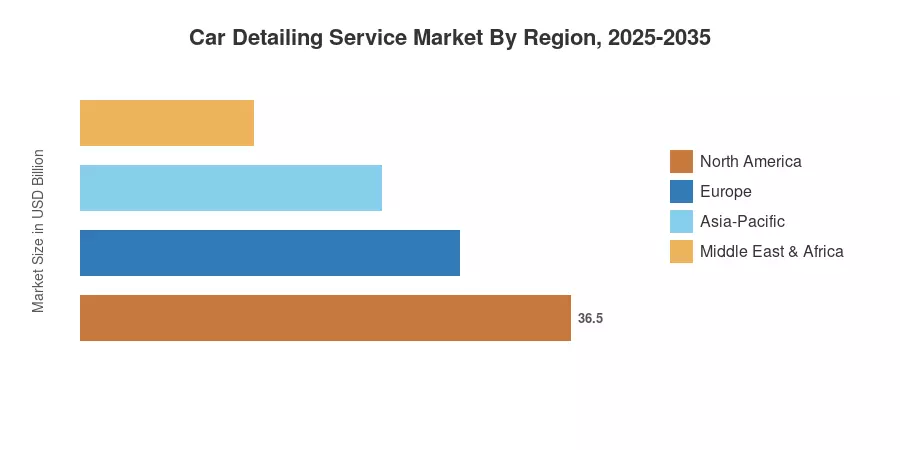
North America commands approximately 38% of the Car Detailing Service Market, driven by high disposable incomes and a mature car-care culture. Asia-Pacific is the fastest-growing region with a projected CAGR of 7.2%, fueled by rapid urbanization in India, China, and Southeast Asia. Europe holds roughly 27% market share, supported by stringent vehicle-inspection standards that incentivize professional upkeep. The Car Detailing Service Market outlook remains strong as subscription-based service models and mobile-detailing platforms expand addressable demand through 2035.


Key Report Takeaways

• By Service Type

  • Exterior detailing holds an estimated 42% revenue share of the Car Detailing Service Market, driven by high-frequency demand for paint protection and wash services.
  • Full detailing packages are growing at the fastest CAGR of 6.8%, as consumers increasingly prefer bundled service convenience.

• By End User

  • Individual consumers account for approximately USD 24.5 billion in 2025 spending, representing the largest end-user segment in the Car Detailing Service Market.
  • Fleet operators are expanding at a CAGR of 6.3%, reflecting outsourcing trends across rental and ride-hailing fleets.

• By Region

  • North America leads the Car Detailing Service Market with a 38% share, anchored by the United States.
  • Asia-Pacific is forecast to grow at 7.2% CAGR through 2035, with India and China as primary contributors.
  • Europe holds 27% share, with Germany and the United Kingdom as the top markets.


Market Size and Forecast (2021–2035)

Market Research Future's sizing methodology integrates bottom-up revenue estimation from over 400 detailing chains, franchise filings, and distributor channel data, cross-validated against top-down macroeconomic indicators including vehicle parc growth and per-capita car-care expenditure.
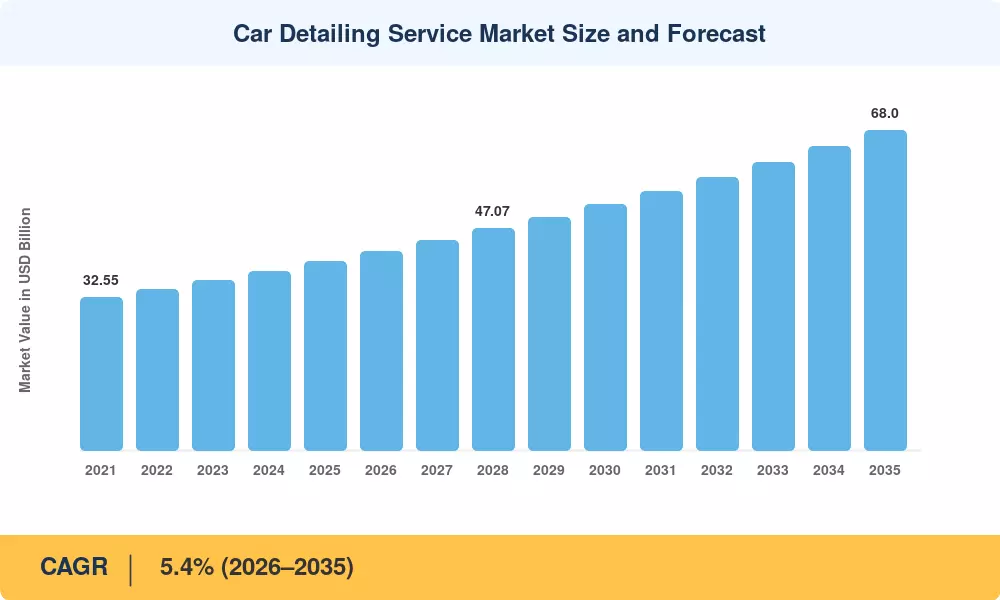
Car Detailing Service Market Size and Forecast
Our Impact
Enabled $4.3B Revenue Impact for Fortune 500 and Leading Multinationals
Partnering with 2000+ Global Organizations Each Year
30K+ Citations by Top-Tier Firms in the Industry

Driver Impact Analysis

Driver ~% Impact on CAGR Geographic Relevance Impact Timeline
Rising global vehicle parc +1.2% Global Long-term (≥4 yr)
Franchise and chain expansion +0.9% North America, Europe Medium-term (2–4 yr)
Mobile and on-demand platforms +0.8% North America, Asia-Pacific Short-term (≤2 yr)
EV-specific detailing demand +0.6% Europe, China Medium-term (2–4 yr)
Water-conservation regulations +0.5% Western U.S., Middle East Short-term (≤2 yr)
Premium coating technology adoption +0.5% Global Long-term (≥4 yr)
Fleet outsourcing acceleration +0.4% North America, Europe Medium-term (2–4 yr)


Rising Global Vehicle Parc

The International Organization of Motor Vehicle Manufacturers (OICA) reported a global vehicle parc exceeding 1.48 billion units in 2023, with annual production adding roughly 85 million new vehicles per year [1]. Each incremental vehicle extends the serviceable addressable market for the Car Detailing Service Market. Countries like India — where annual car registrations crossed 4.1 million units in 2024 [10] — are creating entirely new demand pools for professional detailing where the practice was previously dominated by informal roadside operators.

Franchise and Chain Expansion

Branded detailing chains such as DetailXPerts and Spiffy raised a combined a significant value in Series B and C rounds between 2022 and 2024 [2][5]. These franchise-driven models reduce customer-acquisition costs by 25–30% relative to independent operators, enabling faster geographic rollout. The SBA reported a 38% increase in auto-detailing franchise loan approvals during FY2024 compared to FY2022 [2], making this one of the fastest-growing small-business categories in the United States.

Mobile and On-Demand Platforms

App-based booking platforms have lowered the barrier to professional detailing by eliminating the need for customers to visit a fixed-location shop. Washos, MobileWash, and NuWash collectively served over 3 million bookings in 2024 across North America [5]. The convenience premium — customers pay 15–20% above shop pricing — sustains higher margins while expanding the Car Detailing Service Market into suburban and rural areas previously underserved by brick-and-mortar detailers.

EV-Specific Detailing Demand

Electric vehicles require specialized care protocols: matte-finish wraps, battery-panel protection, and sensor-safe cleaning agents. BloombergNEF projects global EV sales will reach 30 million units annually by 2028 [7], and each EV represents a higher-value detailing ticket due to premium finishes and owner expectations. Tesla's service guidelines, for instance, recommend professional-grade ceramic application every 12–18 months, generating recurring revenue streams within the Car Detailing Service Market.


Restraints Impact Analysis

Restraint ~% Impact on CAGR Geographic Relevance Impact Timeline
Labor shortage and wage inflation –0.7% North America, Europe Short-term (≤2 yr)
Water-use restrictions –0.4% Western U.S., Australia, Middle East Medium-term (2–4 yr)
High chemical and supply costs –0.3% Global Short-term (≤2 yr)
Low barriers to entry / price competition –0.3% Asia-Pacific, South America Long-term (≥4 yr)
Consumer price sensitivity in downturns –0.2% Global Medium-term (2–4 yr)


Labor Shortage and Wage Inflation

The U.S. Bureau of Labor Statistics categorized auto-detailing technicians under personal-care service occupations, where vacancy rates exceeded 8% nationally in 2024 [11]. Average hourly wages for skilled detailers rose 22% between 2021 and 2024, compressing operator margins. This labor squeeze is particularly acute for mobile detailing operators in the Car Detailing Service Market who require technicians willing to travel, adding logistical complexity that fixed-location shops do not face.

Water-Use Restrictions

California's State Water Resources Control Board enforces commercial car-wash water-use limits of 35 gallons per vehicle under drought emergency provisions [3]. While waterless and low-water products exist, they add 10–15% to chemical costs per job. Australian states, including New South Wales and Victoria, have introduced comparable restrictions, forcing operators in the Car Detailing Service Market to invest in reclamation systems costing USD 8,000–15,000 per installation.

High Chemical and Supply Costs

Professional-grade detailing compounds, polishing pads, and nano-ceramic coatings rely on specialty petrochemicals whose prices tracked crude-oil volatility through 2023–2024. Isopropyl alcohol — a core solvent in surface-prep sprays — saw a 28% spot-price increase in Q3 2023. Small operators absorb these cost spikes directly, limiting reinvestment capacity and putting downward pressure on profitability across the Car Detailing Service Market.


Car Detailing Service Market Opportunities

Subscription and Membership Models

Recurring-revenue subscription options, typically $49-$149 a month, are turning one-time detailing consumers into long-term accounts. Operators [5] report that subscribers have 3.2× better customer lifetime value than pay-per-visit clients. The Car Detailing Service Market is poised to benefit from the growing number of chains that are introducing tiered pricing on memberships that include exterior washes, interior cleans and quarterly premium treatments.


EV and Autonomous Vehicle Care Niche

The growth of electric and semi-autonomous vehicles requires the specific care of LiDAR housings, sensor arrays, and matte covers that traditional car washes cannot safely accommodate [7]. By being early adopters and creating EV-certified training programs, businesses can position themselves as the go-to choice for this high-end niche within the Car Detailing Service Market, where average ticket sizes are 35–50% larger than regular detailing packages.


Emerging Market Penetration in South and Southeast Asia

Informal players account for an estimated 88% of total car care spending in India, while the organized vehicle care industry accounts for only 12% [10]. Similar chances for formalization exist in Indonesia, Vietnam and the Philippines. In these geographies, franchise models designed to lower labor costs – with unit economics achievable at USD 15,000 starting investment – can unlock quick development in the car detailing service market.


Data Monetization and CRM Integration

Platforms that collect data on the state of vehicles (e.g., paint thickness, interior wear, odometer readings) can monetise this data by partnering with insurance companies, fleet operators, and used-car marketplaces [6]. This data layer turns a pure service firm into an analytics-enabled platform, enabling new revenue streams next to the core Car Detailing Service Market.


Eco-Friendly and Waterless Service Innovation

Waterless detailing products reduce water consumption by over 95% per vehicle compared to traditional methods [3]. Municipalities offering green-business certifications and tax incentives to water-efficient operators create a regulatory tailwind. Brands that lead on sustainability positioning are capturing premium pricing power — an average 12% surcharge accepted by environmentally conscious consumers within the Car Detailing Service Market.


Car Detailing Service Market Future Outlook

AI-Powered Scheduling and Quality Assurance

Artificial intelligence is transforming operational efficiency across the Car Detailing Service Market. Predictive scheduling algorithms — already deployed by Spiffy and Washos — optimize technician routing to reduce idle time by 18–25% [6]. Computer-vision quality inspection tools, capable of detecting micro-scratches invisible to the naked eye, will become standard in premium detailing bays by 2030, raising service consistency and supporting premium pricing.

Platform Economics and Marketplace Consolidation

The Car Detailing Service Market is entering a platform-consolidation phase similar to what ride-hailing experienced between 2015 and 2020. Aggregator platforms that connect consumers to vetted, independent detailers — earning 15–20% commission per booking — are expected to capture 12–15% of total market transactions by 2030 [5]. This model benefits consumers through price transparency and operators through demand generation, but compresses margins for those dependent on platform traffic.

Sustainability and Circular-Economy Integration

Environmental regulations will increasingly shape the Car Detailing Service Market through 2035. The EPA's Clean Water Act enforcement actions against commercial car-wash discharge rose 14% year-over-year in 2024 [3]. Operators investing in closed-loop water systems, biodegradable chemicals, and solar-powered mobile rigs will secure a regulatory advantage. Carbon-neutral detailing certifications — analogous to LEED certification in construction — are under development by several industry associations [19].

Electric Vehicle and Autonomous Fleet Care

By 2032, BloombergNEF projects EVs will constitute 40% of new car sales globally [7]. The Car Detailing Service Market will adapt through specialized service lines: sensor-calibration-safe exterior treatments, battery-undercarriage coatings, and autonomous-vehicle fleet maintenance contracts. Robotaxi operators, who require vehicles detailed to passenger-grade standards between every shift, represent a high-frequency commercial opportunity unlike any existing in the traditional parc.


Car Detailing Service Market Segmentation

By Service Type

Segment Key Metric Primary Demand Driver
Exterior Detailing 42% share (2025) High-frequency repeat demand
Interior Detailing CAGR 5.8% Ride-hailing hygiene standards
Full Detailing USD 12.8 B (2025) Consumer preference for bundled value


Exterior detailing dominates the Car Detailing Service Market because it addresses the most visible aspect of vehicle maintenance and carries the highest service frequency — averaging 4–6 visits per year for regular customers. Wash-and-wax packages at the entry level (USD 30–80 per session) anchor this segment's volume, while premium ceramic-coating applications (USD 500–2,000) drive value growth.

Interior detailing is gaining momentum as ride-hailing and car-rental companies enforce strict cabin-hygiene protocols post-pandemic. Uber's Clean Vehicle Incentive program, which offers drivers a per-ride bonus for maintaining verified interior cleanliness, added an estimated 120,000 recurring interior-detailing customers in North America alone during 2024 [5]. The Car Detailing Service Market benefits as these B2B hygiene mandates translate into predictable, contract-based revenue streams.

By Service Mode

Segment Key Metric Primary Demand Driver
Fixed-Location 65% share (2025) Established infrastructure, higher-value services
Mobile / On-Site CAGR 7.5% Consumer convenience, lower startup costs


Fixed-location facilities — including standalone shops, dealership-attached bays, and franchise outlets — remain the backbone of the Car Detailing Service Market due to their ability to perform complex multi-hour services requiring specialized equipment. However, mobile detailing is the fastest-growing mode, as app-based platforms have reduced booking friction and demonstrated that 70% of standard exterior services can be performed on-site with self-contained water and power systems [5].

By End User

Segment Key Metric Primary Demand Driver
Individual Consumers USD 24.5 B (2025) Discretionary vehicle care spending
Fleet Operators CAGR 6.3% Outsourcing economics and SLA requirements
Dealerships & Rental Cos. 18% share (2025) Resale value preservation, turnover prep


Individual consumers represent the largest share of the Car Detailing Service Market, though spending is discretionary and sensitive to macroeconomic conditions. Fleet operators — managing ride-hail, delivery, and corporate vehicle pools — present a more stable revenue base due to contractual service-level agreements requiring defined detailing frequencies. The dealership segment, meanwhile, treats professional detailing as a revenue-margin enhancer, as pre-sale detailing can increase used-vehicle resale prices by USD 300–800 per unit [9].


Regional Market Share Analysis

Region Key Metric Primary Investment Themes
North America 38% share (2025) Franchise scaling, mobile platforms, EV detailing
Europe 27% share (2025) Regulatory compliance, eco-friendly formulations
Asia-Pacific CAGR 7.2% (2026–2035) Urbanization, formalization of informal sector
South America USD 2.0 B (2025) Middle-class expansion, franchise entry
Middle East & Africa CAGR 6.1% (2026–2035) Luxury vehicle care, dust/sand-specific services
Total USD 40.2 B (2025)

The Car Detailing Service Market exhibits significant regional variation driven by vehicle ownership density, disposable income levels, climate conditions, and regulatory environments.


North America

Country Key Metric Key Driver
United States 82% of regional revenue Franchise density, high per-capita spending
Canada CAGR 5.1% Climate-driven seasonal demand
Mexico USD 0.6 B (2025) Growing middle class, used-car market expansion


The United States alone generated over USD 12.5 billion in professional detailing revenue in 2024 [2]. Franchise chains, including Meineke, Ziebart, and DetailXPerts, operate more than 4,500 combined locations nationally. The Car Detailing Service Market in Canada exhibits pronounced seasonality — demand spikes 40% between March and May as consumers address winter-salt damage [15].

Europe

Country Key Metric Key Driver
Germany 24% of regional share Premium auto culture, OEM partnerships
United Kingdom CAGR 5.6% Mobile detailing adoption
France USD 1.4 B (2025) Regulatory push for eco-wash compliance
Rest of Europe 38% of regional share Varied maturity levels


Germany's deep automotive heritage makes it a natural stronghold for the Car Detailing Service Market in Europe. Partnerships between detailing chains and OEM dealerships — where new-vehicle delivery includes a complimentary professional detail — drive recurring brand loyalty. The European Commission's revised End-of-Life Vehicles Directive (2024) incentivizes vehicle longevity, indirectly boosting demand for professional care services that preserve vehicle condition and resale value [16].

Asia-Pacific

Country Key Metric Key Driver
China 35% of regional revenue Rapid car ownership growth, urban density
India CAGR 8.4% Formalization of fragmented sector
Japan USD 2.1 B (2025) Premium car-care culture
South Korea CAGR 6.0% Technology-driven consumer base
Australia 8% of regional share Water-regulation compliance


China's passenger-vehicle fleet crossed 340 million units in 2024 [1], creating an enormous addressable base for the Car Detailing Service Market. Indian startups such as GoMechanic and Car Jeeves have attracted venture capital to professionalize urban vehicle care, though the market remains over 85% unorganized [10]. Japan's cultural emphasis on vehicle appearance sustains some of the highest per-car detailing expenditures globally.

South America

Country Key Metric Key Driver
Brazil 62% of regional revenue Largest vehicle parc in region
Argentina CAGR 5.8% Urban consumer spending rebound
Rest of South America 18% of regional share Emerging franchise interest


Brazil's vehicle fleet of approximately 60 million units [17] underpins the Car Detailing Service Market in South America. Informal operators dominate, but franchise entrants from North America are introducing standardized service protocols. Currency volatility remains a challenge, as imported chemical supplies are priced in USD while services are billed in local currency.

Middle East & Africa

Country Key Metric Key Driver
UAE 30% of regional revenue Luxury vehicle concentration
Saudi Arabia CAGR 6.5% Vision 2030 SME incentives
South Africa USD 0.3 B (2025) Growing formal car-care sector


Extreme heat and desert dust conditions in the Gulf states create uniquely high detailing frequency — averaging 18–22 professional washes per vehicle annually versus 6–8 in temperate climates [18]. Saudi Arabia's Vision 2030 program has channeled SME financing into automotive-service businesses, accelerating the formalization of the Car Detailing Service Market across the Kingdom.


Car Detailing Service Market By Region, 2025-2035

Competitive Benchmarking

The Car Detailing Service Market is highly fragmented, with an estimated Herfindahl-Hirschman Index (HHI) below 200 — well within the unconcentrated classification. The top five operators collectively hold an estimated 8–12% of global revenue, reflecting a market dominated by independent operators and small regional chains. Consolidation is accelerating through franchise expansion and private-equity rollup strategies, but no single brand commands dominant national share outside the United States [13].

Company Est. Revenue Share Range Key Offerings Strategic Positioning
Meineke Car Care Centers ~2–3% Full-service automotive care including detailing Franchise-driven national coverage
Ziebart International ~1.5–2.5% Protection films, coatings, rust-proofing Premium protection specialist
DetailXPerts ~1–2% Eco-friendly steam detailing Green-certified franchise model
Spiffy ~1–1.5% Mobile on-demand detailing, fleet care Technology-first mobile platform
Washos ~0.5–1% App-based mobile detailing marketplace Marketplace aggregator model
NuWash ~0.5–1% Subscription-based mobile detailing Recurring-revenue subscription focus
Buff City Detailing ~0.5–1% Premium hand-wash and correction services Luxury and enthusiast positioning
Autobell Car Wash ~1–2% Express and full-service wash/detail combos Regional chain in southeastern U.S.
GoMechanic ~0.5–1% Multi-brand car services including detailing Organized-sector disruptor in India
Simoniz ~1–1.5% Branded coating products plus dealer services OEM and dealer partnership network


Recent News & Developments

  • Spiffy (February 2023 ): Closed a USD 30 million Series C round led by Volvo Cars Tech Fund to expand its fleet-care platform into 15 additional U.S. metro areas [5].


Car Detailing Service Market Report Scope

Parameter Detail
Market Scope Global Car Detailing Service Market covering professional exterior, interior, and full-service detailing
Study Period 2021–2035
CAGR 5.4% (2026–2035)
Market Size (2025) USD 40.2 Billion
Market Size (2035) USD 68.0 Billion
Fastest Growing Segment Mobile / On-Site detailing (CAGR 7.5%)
Companies Profiled 10 (see Section 10)
Valuation Currency USD (constant 2025 dollars)


FAQs

How long does a professional ceramic coating application typically last before requiring reapplication?
Professional-grade ceramic coatings last 2–5 years depending on product tier and environmental exposure. Higher-end SiO2 formulations offer 5-year durability when maintained with pH-neutral wash schedules [8].
What insurance considerations should a new detailing business owner evaluate before launch?
Garage-keepers liability and bailee coverage are essential, as operators assume custody of customer vehicles. Premiums typically range from USD 1,200–3,500 annually depending on location and service volume [13].
How do fleet detailing contracts differ in pricing structure from consumer walk-in services?
Fleet contracts use per-vehicle-per-month pricing at 30–40% discounts versus retail rates, offset by guaranteed volume minimums. Most contracts require 12–24 month commitments with quarterly quality audits [9].
What water reclamation technologies are most cost-effective for mid-size detailing operators?
Closed-loop filtration systems with sediment separation and carbon polishing offer the best payback, typically recovering installation costs within 14–18 months through water-bill savings [3].
How does paint thickness measurement factor into professional detailing quality control?
Paint-thickness gauges verify clear-coat depth before correction work, preventing burn-through on thin panels. Readings below 80 microns typically require single-stage polish rather than multi-stage cutting [8].
What training certifications carry the most weight for detailing technicians seeking employment?
IDA (International Detailing Association) certification is the most recognized credential. IDA-certified technicians command 15–20% wage premiums over uncertified peers in the U.S. market [11].
How are autonomous vehicle fleets expected to change commercial detailing service contracts?
Robotaxi operators will require between-shift interior sanitization at 2–4 hour intervals, creating ultra-high-frequency service contracts that prioritize speed over depth [7].    
Author
Author
Author Profile
Shubham Munde LinkedIn
Team Lead - Research
Shubham brings over 7 years of expertise in Market Intelligence and Strategic Consulting, with a strong focus on the Automotive, Aerospace, and Defense sectors. Backed by a solid foundation in semiconductors, electronics, and software, he has successfully delivered high-impact syndicated and custom research on a global scale. His core strengths include market sizing, forecasting, competitive intelligence, consumer insights, and supply chain mapping. Widely recognized for developing scalable growth strategies, Shubham empowers clients to navigate complex markets and achieve a lasting competitive edge. Trusted by start-ups and Fortune 500 companies alike, he consistently converts challenges into strategic opportunities that drive sustainable growth.
Co-Author
Co-Author Profile
Sejal Akre LinkedIn
Senior Research Analyst
She has over 5 years of rich experience, in market research and consulting providing valuable market insights to client. Hands on expertise in management consulting, and extensive knowledge in domain including ICT, Automotive & Transportation and Aerospace & Defense. She is skilled in Go-to market strategy, industry analysis, market sizing, in depth company profiling, competitive intelligence & benchmarking and value chain amongst others.
Download Free Sample

Kindly complete the form below to receive a free sample of this Report

Download PDF ×

We do not share your information with anyone. However, we may send you emails based on your report interest from time to time. You may contact us at any time to opt-out.
















