Download Free Sample
Kindly complete the form below to receive a free sample of this Report
Cargo Handling and Port Services Market Research Report By End User (Shipping Companies, Freight Forwarders, Importers & Exporters, Government Agencies), By Cargo Type (Containerized, Bulk, Breakbulk, Liquid), By Technology (Automated Systems, Manual Handling, Hybrid Systems, Digital Tracking), By Service Type (Cargo Handling, Port Management, Logistics Services, Warehousing Services) And By Region (North America, Europe, Asia-Pacific, And Rest Of The World) – Market Forecast Till 2035.
As per MRFR analysis, the Cargo Handling and Port Services Market Size was estimated at 200.0 USD Billion in 2024. The Cargo Handling and Port Services industry is projected to grow from 207.5 USD Billion in 2025 to 300.0 USD Billion by 2035, exhibiting a compound annual growth rate (CAGR) of 3.75% during the forecast period 2025 - 2035.
The Cargo Handling and Port Services Market is poised for growth driven by technological advancements and sustainability initiatives.
| 2024 Market Size | 200.0 (USD Billion) |
| 2035 Market Size | 300.0 (USD Billion) |
| CAGR (2025 - 2035) | 3.75% |
A.P. Moller - Maersk (DK), DP World (AE), Hutchison Port Holdings (HK), Port of Rotterdam Authority (NL), China Merchants Port (CN), International Container Terminal Services, Inc. (PH), CMA CGM Group (FR), Evergreen Marine Corporation (TW), Hamburg Süd (DE)
Our Impact
Enabled $4.3B Revenue Impact for Fortune 500 and Leading Multinationals
Partnering with 2000+ Global Organizations Each Year
30K+ Citations by Top-Tier Firms in the Industry
The Cargo Handling and Port Services Market is currently experiencing a transformative phase, driven by advancements in technology and evolving global trade dynamics. The integration of automation and digital solutions is reshaping operational efficiencies, enabling ports to handle increasing volumes of cargo with greater speed and accuracy. Furthermore, sustainability initiatives are gaining traction, as stakeholders seek to minimize environmental impacts while enhancing service delivery. This dual focus on innovation and ecological responsibility appears to be steering the market towards a more resilient and adaptive future. In addition, the geopolitical landscape and shifting trade routes are influencing the Cargo Handling and Port Services Market. As nations reassess their supply chains, there is a growing emphasis on enhancing port infrastructure and logistics capabilities. This trend suggests that investments in modern facilities and smart technologies will likely play a crucial role in maintaining competitiveness. Overall, the market seems poised for growth, with a clear trajectory towards modernization and sustainability, reflecting the changing needs of global commerce.
The Cargo Handling and Port Services Market is witnessing a surge in the adoption of automation and digital technologies. Innovations such as automated cranes, real-time tracking systems, and data analytics are enhancing operational efficiency and reducing turnaround times. This trend indicates a shift towards smarter port operations, where technology plays a pivotal role in optimizing cargo handling processes.
There is a growing emphasis on sustainability within the Cargo Handling and Port Services Market. Stakeholders are increasingly prioritizing eco-friendly practices, such as reducing emissions and implementing green technologies. This trend suggests a collective effort to align with global environmental standards, potentially leading to more sustainable port operations and improved public perception.
The geopolitical landscape is significantly impacting the Cargo Handling and Port Services Market. As trade routes evolve and nations reassess their supply chains, ports are adapting to new demands. This trend indicates that strategic investments in infrastructure and logistics capabilities will be essential for maintaining competitiveness in a rapidly changing global environment.
The rapid growth of e-commerce is reshaping the Cargo Handling and Port Services Market. As online shopping continues to gain traction, the demand for efficient logistics and cargo handling services has intensified. Data suggests that e-commerce sales have increased by over 20% annually, leading to a corresponding rise in the volume of goods transported through ports. This trend necessitates the development of specialized cargo handling solutions tailored to the unique requirements of e-commerce, such as faster processing times and enhanced tracking capabilities. Consequently, ports are likely to invest in technology and infrastructure to better serve this burgeoning market segment.
The Cargo Handling and Port Services Market is experiencing a notable surge in trade volumes, driven by the expansion of international trade agreements and the growing demand for goods across various sectors. As economies continue to recover and develop, the volume of cargo transported by sea is projected to increase significantly. According to recent data, container throughput at major ports has risen by approximately 4% annually, indicating a robust demand for cargo handling services. This trend suggests that ports must enhance their operational efficiency and capacity to accommodate the rising volumes, thereby creating opportunities for investment in advanced cargo handling technologies and infrastructure improvements.
The Cargo Handling and Port Services Market is increasingly influenced by stringent environmental regulations aimed at reducing the carbon footprint of port operations. Governments are implementing policies that mandate the adoption of greener practices, such as the use of low-emission equipment and sustainable cargo handling methods. This shift towards sustainability is prompting ports to invest in cleaner technologies and practices, which may initially incur higher costs but are expected to yield long-term benefits. As a result, the industry is likely to see a transformation in operational practices, with a focus on minimizing environmental impact while maintaining efficiency in cargo handling.
Technological innovations are a driving force in the Cargo Handling and Port Services Market. The integration of advanced technologies, such as artificial intelligence, the Internet of Things, and blockchain, is revolutionizing cargo handling processes. These technologies enhance operational efficiency, improve safety, and provide real-time data analytics for better decision-making. Recent studies indicate that ports adopting these innovations can achieve up to a 30% increase in productivity. As the industry continues to evolve, the adoption of such technologies is expected to become a standard practice, further shaping the future landscape of cargo handling and port services.
Investment in port infrastructure is a critical driver for the Cargo Handling and Port Services Market. Governments and private entities are increasingly recognizing the need to modernize and expand port facilities to meet the demands of growing trade. Recent reports indicate that global investments in port infrastructure have reached over 100 billion dollars annually, with a significant portion allocated to enhancing cargo handling capabilities. This influx of capital is likely to facilitate the adoption of innovative technologies, such as automated cargo handling systems and improved logistics management, which can enhance operational efficiency and reduce turnaround times for vessels.
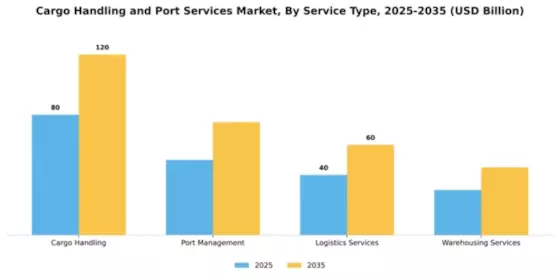
The Cargo Handling and Port Services market sees Cargo Handling as the largest segment, representing a substantial share of overall operations. This segment encompasses various activities including loading, unloading, and transferring cargo, which are critical to port efficiency and logistics planning. With operational demands steadily increasing, Cargo Handling remains the backbone of port service activities, serving both local and international shipping needs. On the other hand, Port Management is identified as the fastest-growing segment within the sector. This service type encompasses strategic planning, resource allocation, and operational management of port facilities. The rising need for efficient port infrastructures and enhanced service delivery has fueled the growth of Port Management, as port authorities seek to optimize their operations and embrace innovative technology solutions to handle greater volumes effectively.
Warehousing Services (Dominant) vs. Logistics Services (Emerging)
Warehousing Services has positioned itself as a dominant player in the Cargo Handling and Port Services market, characterized by its ability to provide comprehensive storage solutions that are crucial for inventory management. These services maintain a strategic role in supply chain operations, facilitating the seamless transfer of goods in conjunction with transportation logistics. Companies offering warehousing services are continually investing in technology and infrastructure to enhance operational efficiencies and accommodate diverse cargo needs. In contrast, Logistics Services is emerging rapidly due to the increased demand for integrated supply chain solutions. This service focuses on the planning, execution, and management of the flow of goods, emphasizing the importance of coordination between storage and transportation. With globalization and e-commerce expansion driving complexity in logistics operations, this segment is gaining traction as businesses seek to streamline processes and minimize delivery times.
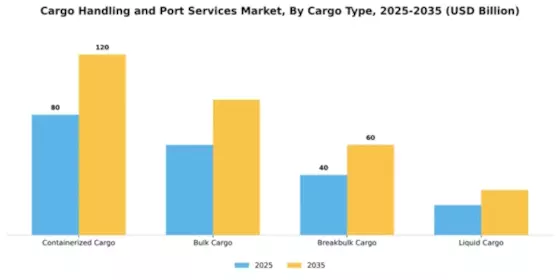
The Cargo Handling and Port Services Market is predominantly driven by containerized cargo, which commands a substantial share due to its efficiency and versatility in transportation. This segment is critical for international trade, allowing for faster handling and reduced logistics costs. Following closely, bulk cargo is experiencing impressive growth, fueled by rising demand in sectors such as agriculture and mining, indicating a shifting focus in cargo handling methodologies. Growth trends in the cargo handling sector show that while containerized cargo remains a vital component, bulk cargo is rapidly gaining traction. Factors contributing to this growth include an increase in global trade activities, advancements in handling technologies, and a surge in commodity prices. Additionally, the ongoing development of port infrastructure is enabling more efficient handling of larger volumes of bulk goods.
Containerized Cargo (Dominant) vs. Bulk Cargo (Emerging)
Containerized cargo has established itself as the dominant force in the Cargo Handling and Port Services Market, characterized by standardized containers that facilitate easy management and transport across various modes of shipping. Its efficiency and reliability in supplying global supply chains make it essential for multinational corporations. Conversely, bulk cargo is considered an emerging segment, reflecting a shift towards handling more commodities like grains and minerals, which present unique challenges in storage and logistics. The adaptability of ports in accommodating specialized bulk handling equipment is pivotal for this segment's growth, showcasing its potential to deliver high-volume transport solutions alongside traditional container methods.
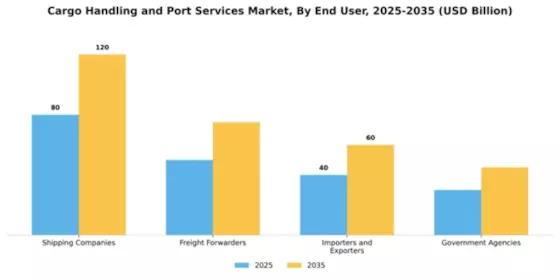
In the Cargo Handling and Port Services Market, Shipping Companies hold a commanding position with a substantial market share, driven by their pivotal role in facilitating global trade. Their established networks and extensive fleet capabilities enable them to dominate cargo handling operations, making them essential players in the industry. Meanwhile, Freight Forwarders are experiencing rapid growth, as increasing demand for efficient logistics solutions and global supply chain management drives their expansion. Their ability to streamline the shipping process positions them as key contributors to market dynamics. Growth trends indicate that while Shipping Companies continue to benefit from their foundational market presence, Freight Forwarders are emerging as the fastest-growing segment due to the rise of e-commerce and globalization. Factors such as technological advancements, including automated cargo handling systems, and the increasing emphasis on supply chain efficiency are propelling the growth of Freight Forwarders. As businesses look for flexibility and reliability, this segment is becoming increasingly vital to cargo handling operations.
Shipping Companies (Dominant) vs. Government Agencies (Emerging)
Shipping Companies dominate the cargo handling and port services market due to their extensive operational capabilities and established market presence. They offer comprehensive logistics solutions, ensuring timely and efficient movement of goods across borders. This segment benefits from robust infrastructure investment, enabling them to streamline cargo operations. On the other hand, Government Agencies are emerging as a vital segment in this market as they ensure regulatory compliance, enhance port security, and support infrastructure development. Their role in setting standards and facilitating trade is becoming increasingly important, particularly in developing regions where they contribute to improving logistics frameworks. As the market evolves, the collaboration between Shipping Companies and Government Agencies may enhance operational efficiency and regulatory compliance.
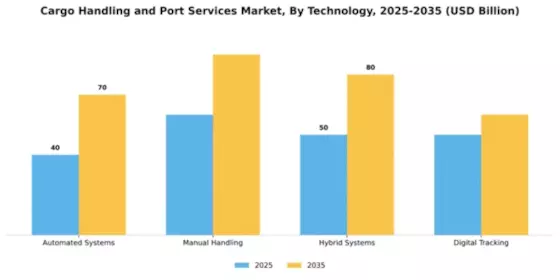
In the Cargo Handling and Port Services Market, the distribution of market share among different technology segments reveals a clear leader in Automated Systems. This segment commands a significant share due to the growing adoption of advanced machinery and robotics in cargo handling processes. Following closely, Manual Handling still holds a valuable part of the market, but its relevance is declining as more operators turn toward automation and digital solutions. Hybrid Systems are also present, carving a niche for mixed approaches in handling cargo, while Digital Tracking gains traction among modern ports focusing on efficiency and transparency.
Technology: Automated Systems (Dominant) vs. Digital Tracking (Emerging)
Automated Systems stand as the dominant technology in the cargo handling landscape, characterized by cutting-edge machinery and robotics that enhance operational efficiency, reduce labor costs, and minimize human error. This segment is supported by significant investments in automation technologies, which allow ports to handle larger volumes of cargo with swift turnaround times. Conversely, Digital Tracking is emerging as a crucial technology, offering real-time data that improves the visibility of cargo throughout the supply chain. This technology appeals to port operators and shipping companies seeking to leverage digital solutions for better decision-making and enhanced service delivery. The integration of Digital Tracking with existing systems is expected to foster further innovations in operational capabilities.
Get more detailed insights about Cargo Handling and Port Services Market Request Free Sample
North America is witnessing a steady growth trajectory in the Cargo Handling and Port Services Market, driven by increasing trade volumes and infrastructure investments. The region holds a market share of 40.0, supported by regulatory frameworks that promote efficiency and sustainability in port operations. The demand for advanced cargo handling technologies is also on the rise, as stakeholders seek to enhance operational efficiency and reduce turnaround times. Leading countries such as the United States and Canada dominate the market landscape, with major ports like Los Angeles and New York serving as critical hubs. Key players, including A.P. Moller - Maersk and DP World, are actively investing in innovative solutions to improve service delivery. The competitive landscape is characterized by strategic partnerships and collaborations aimed at optimizing supply chain logistics and enhancing customer satisfaction.
Europe's Cargo Handling and Port Services Market is characterized by a strong emphasis on innovation and sustainability, holding a market share of 35.0. Regulatory initiatives aimed at reducing carbon emissions and enhancing operational efficiency are driving demand for eco-friendly technologies. The region's strategic location facilitates trade with both Asia and North America, further boosting market growth as stakeholders adapt to evolving logistics demands. Countries like the Netherlands, Germany, and France are at the forefront, with the Port of Rotterdam being a key player in the global shipping industry. Major companies, including Hutchison Port Holdings and CMA CGM Group, are investing in digital transformation and automation to streamline operations. The competitive landscape is marked by a focus on collaboration among port authorities and private operators to enhance service offerings and meet customer expectations.
Asia-Pacific is the largest market for Cargo Handling and Port Services, commanding a significant share of 100.0. The region's rapid economic growth, coupled with increasing trade activities, is driving demand for advanced port services. Government initiatives aimed at enhancing port infrastructure and logistics capabilities are further catalyzing market expansion, as countries strive to improve their global trade competitiveness. China, Japan, and India are leading players in this market, with major ports like Shanghai and Singapore serving as critical nodes in global supply chains. Key players such as China Merchants Port and International Container Terminal Services, Inc. are investing heavily in technology and infrastructure to meet the growing demand. The competitive landscape is dynamic, with a focus on innovation and efficiency to cater to the evolving needs of the shipping industry.
The Middle East and Africa region is emerging as a significant player in the Cargo Handling and Port Services Market, with a market share of 25.0. The growth is driven by increasing trade activities and investments in port infrastructure, supported by government initiatives aimed at enhancing logistics capabilities. The region's strategic location as a trade corridor between Europe, Asia, and Africa further boosts its market potential. Countries like the United Arab Emirates and South Africa are leading the charge, with key ports such as Jebel Ali and Durban playing pivotal roles in regional trade. Major players like DP World are focusing on expanding their operations and enhancing service offerings to capture market share. The competitive landscape is evolving, with a growing emphasis on technology adoption and sustainability in port operations.
The Cargo Handling and Port Services Market is characterized by a dynamic competitive landscape, driven by factors such as globalization, technological advancements, and increasing trade volumes. Major players are actively pursuing strategies that enhance operational efficiency and customer service. For instance, A.P. Moller - Maersk (DK) has been focusing on digital transformation and sustainability initiatives, aiming to reduce carbon emissions by 50% by 2030. Similarly, DP World (AE) is investing in automation and smart port technologies to streamline operations and improve turnaround times, thereby enhancing its competitive positioning in the market.The market structure appears moderately fragmented, with several key players exerting substantial influence. Companies are increasingly localizing their operations and optimizing supply chains to respond to regional demands effectively. This trend suggests a shift towards more agile and responsive business models, allowing firms to adapt to changing market conditions while maintaining competitive advantages.In November Hutchison Port Holdings (HK) announced a strategic partnership with a leading technology firm to implement AI-driven logistics solutions at its terminals. This move is expected to enhance operational efficiency and reduce costs, positioning Hutchison as a frontrunner in the adoption of innovative technologies within the sector. The integration of AI into cargo handling processes may significantly improve decision-making and resource allocation.In October the Port of Rotterdam Authority (NL) unveiled its ambitious plan to become the world's first fully sustainable port by 2030. This initiative includes investments in renewable energy sources and the development of green logistics solutions. The strategic importance of this move lies in its potential to attract environmentally conscious shipping companies, thereby enhancing the port's competitive edge in a market increasingly focused on sustainability.In September China Merchants Port (CN) expanded its operations by acquiring a stake in a major logistics company in Southeast Asia. This acquisition is likely to bolster its presence in the region and enhance its service offerings, reflecting a broader trend of consolidation within the market. Such strategic actions may enable China Merchants to leverage synergies and optimize its supply chain capabilities.As of December the competitive trends in the Cargo Handling and Port Services Market are increasingly defined by digitalization, sustainability, and the integration of AI technologies. Strategic alliances are becoming more prevalent, allowing companies to pool resources and expertise to navigate the complexities of the market. Looking ahead, competitive differentiation is expected to evolve, with a pronounced shift from price-based competition to a focus on innovation, technology, and supply chain reliability. This transition may redefine the parameters of success in the industry, emphasizing the importance of adaptability and forward-thinking strategies.






The Cargo Handling and Port Services Market is projected to grow at a 3.75% CAGR from 2025 to 2035, driven by technological advancements, increased global trade, and infrastructure investments.
New opportunities lie in:
By 2035, the market is expected to be robust, reflecting growth and innovation.
| MARKET SIZE 2024 | 200.0(USD Billion) |
| MARKET SIZE 2025 | 207.5(USD Billion) |
| MARKET SIZE 2035 | 300.0(USD Billion) |
| COMPOUND ANNUAL GROWTH RATE (CAGR) | 3.75% (2025 - 2035) |
| REPORT COVERAGE | Revenue Forecast, Competitive Landscape, Growth Factors, and Trends |
| BASE YEAR | 2024 |
| Market Forecast Period | 2025 - 2035 |
| Historical Data | 2019 - 2024 |
| Market Forecast Units | USD Billion |
| Key Companies Profiled | A.P. Moller - Maersk (DK), DP World (AE), Hutchison Port Holdings (HK), Port of Rotterdam Authority (NL), China Merchants Port (CN), International Container Terminal Services, Inc. (PH), CMA CGM Group (FR), Evergreen Marine Corporation (TW), Hamburg Süd (DE) |
| Segments Covered | Service Type, Cargo Type, End User, Technology |
| Key Market Opportunities | Integration of automation and digitalization enhances efficiency in the Cargo Handling and Port Services Market. |
| Key Market Dynamics | Technological advancements and regulatory changes are reshaping competitive dynamics in the cargo handling and port services market. |
| Countries Covered | North America, Europe, APAC, South America, MEA |
The Cargo Handling and Port Services Market was valued at 200.0 USD Billion in 2024.
The market is projected to reach a valuation of 300.0 USD Billion by 2035.
The expected CAGR for the market during the forecast period 2025 - 2035 is 3.75%.
The Cargo Handling service type segment holds the highest valuation, ranging from 80.0 to 120.0 USD Billion.
The Port Management segment is projected to reach valuations between 50.0 and 75.0 USD Billion.
The Containerized Cargo segment is expected to grow the most, with projected valuations between 80.0 and 120.0 USD Billion.
Key players include A.P. Moller - Maersk, DP World, and Hutchison Port Holdings, among others.
The Logistics Services segment is expected to have a valuation range of 40.0 to 60.0 USD Billion.
The Liquid Cargo segment has a lower valuation range of 20.0 to 30.0 USD Billion compared to other cargo types.
Technological advancements such as Automated Systems and Digital Tracking are influencing the market, with valuations ranging from 40.0 to 70.0 USD Billion and 50.0 to 60.0 USD Billion, respectively.


Kindly complete the form below to receive a free sample of this Report

“This is really good guys. Excellent work on a tight deadline. I will continue to use you going forward and recommend you to others. Nice job”


“Thanks. It’s been a pleasure working with you, please use me as reference with any other Intel employees.”


“Thanks for sending the report it gives us a good global view of the Betaïne market.”


“Thank you, this will be very helpful for OQS.”


“We found the report very insightful! we found your research firm very helpful. I'm sending this email to secure our future business.”


“I am very pleased with how market segments have been defined in a relevant way for my purposes (such as "Portable Freezers & refrigerators" and "last-mile"). In general the report is well structured. Thanks very much for your efforts.”


“I have been reading the first document or the study, ,the Global HVAC and FP market report 2021 till 2026. Must say, good info! I have not gone in depth at all parts, but got a good indication of the data inside!”


“We got the report in time, we really thank you for your support in this process. I also thank to all of your team as they did a great job.”


“The Automotive 48V ECU Components Procurement Intelligence Study” was a complex project, but the Market Research Future (MRFR) team handled it with quality, agility, and customer-centricity. They delivered all requested data on time and within the agreed scope. The team, including Shubhendra Anand and Rahul Gotadki, was always readily available to clarify questions and swiftly implement necessary adjustments, driving the project to a successful conclusion within a very demanding timeframe.
I would also like to specifically commend Akshay Agarwal for his responsiveness and support at every stage—from our initial inquiry on May 6th through to final delivery on June 18th. His dedication made the entire process seamless.”



