Cast Films Market
Cast Films Market Summary
As per Market Research Future analysis, the Cast Films Market Size was estimated at 17.23 USD Billion in 2024. The Cast Films industry is projected to grow from 18.01 USD Billion in 2025 to 28.08 USD Billion by 2035, exhibiting a compound annual growth rate (CAGR) of 4.54% during the forecast period 2025 - 2035
Key Market Trends & Highlights
The Cast Films Market is experiencing a dynamic shift towards sustainability and technological innovation.
- North America remains the largest market for cast films, driven by robust demand across various industries.
- Asia-Pacific is emerging as the fastest-growing region, fueled by increasing investments in manufacturing and packaging.
- Polyethylene (PE) continues to dominate the market, while Polypropylene (PP) is witnessing rapid growth due to its versatility.
- The rising demand for flexible packaging and sustainability initiatives are key drivers propelling market expansion.
Market Size & Forecast
| 2024 Market Size | 17.23 (USD Billion) |
| 2035 Market Size | 28.08 (USD Billion) |
| CAGR (2025 - 2035) | 4.54% |
Major Players
BASF SE (DE), DuPont de Nemours Inc (US), 3M Company (US), Mitsubishi Chemical Corporation (JP), SABIC (SA), Toray Industries Inc (JP), Kraton Corporation (US), Clariant AG (CH), Eastman Chemical Company (US)
Cast Films Market Trends
The Cast Films Market is currently experiencing a dynamic evolution, driven by various factors that influence its growth trajectory. The increasing demand for flexible packaging solutions across multiple industries, including food, pharmaceuticals, and consumer goods, appears to be a primary catalyst. This shift towards sustainable and efficient packaging options suggests a growing awareness among manufacturers and consumers alike regarding environmental impacts. Furthermore, advancements in technology and material science are likely enhancing the performance characteristics of cast films, making them more appealing for diverse applications. As a result, the market is witnessing a surge in innovation, with companies striving to develop products that meet stringent regulatory standards while also addressing consumer preferences for eco-friendly materials. In addition to the aforementioned factors, The Cast Films. This trend indicates a potential shift in consumer behavior, as individuals increasingly prioritize products that align with their values. Moreover, the rise of e-commerce and online retailing is reshaping packaging requirements, leading to a heightened focus on durability and protection during transit. Overall, the Cast Films Market appears poised for continued growth, driven by a confluence of technological advancements, changing consumer preferences, and a commitment to sustainability.
Sustainability Initiatives
The Cast Films Market is witnessing a notable trend towards sustainability, with manufacturers increasingly focusing on eco-friendly materials and production processes. This shift reflects a broader societal movement towards reducing environmental impact, as stakeholders seek to align their products with consumer values.
Technological Advancements
Innovations in material science and production techniques are significantly influencing the Cast Films Market. Enhanced performance characteristics, such as improved barrier properties and flexibility, are emerging as key differentiators, enabling companies to cater to diverse industry needs.
E-commerce Packaging Solutions
The rise of online shopping is reshaping packaging demands within the Cast Films Market. As e-commerce continues to expand, there is a growing emphasis on developing durable and protective packaging solutions that ensure product integrity during transit.
Cast Films Market Drivers
Rising Demand for Flexible Packaging
The Cast Films Market is experiencing a notable increase in demand for flexible packaging solutions. This trend is largely driven by the growing consumer preference for lightweight and easy-to-handle packaging options. Flexible packaging not only enhances product shelf life but also reduces material waste, aligning with sustainability goals. According to recent data, the flexible packaging segment is projected to grow at a compound annual growth rate of approximately 4.5% over the next five years. This growth is indicative of a broader shift towards more adaptable packaging solutions across various sectors, including food and beverage, pharmaceuticals, and personal care. As manufacturers seek to meet these evolving consumer preferences, the Cast Films Market is likely to see a corresponding rise in the production and innovation of flexible film products.
Growth of E-commerce and Online Retail
The rapid expansion of e-commerce and online retail is significantly influencing the Cast Films Market. As more consumers turn to online shopping, the demand for efficient and protective packaging solutions has surged. Cast films are increasingly utilized in e-commerce packaging due to their lightweight nature and ability to safeguard products during transit. Recent statistics indicate that e-commerce sales have seen a substantial increase, with projections suggesting a continued upward trajectory. This shift necessitates innovative packaging solutions that not only protect goods but also enhance the unboxing experience for consumers. Consequently, the Cast Films Market is likely to benefit from this trend, as companies seek to develop packaging that meets the unique challenges posed by online retail.
Sustainability and Eco-friendly Materials
Sustainability has emerged as a pivotal driver within the Cast Films Market. With growing environmental concerns, there is an increasing demand for eco-friendly packaging solutions. Manufacturers are exploring biodegradable and recyclable materials to meet consumer expectations for sustainable products. This shift is not merely a trend but appears to be a fundamental change in how packaging is perceived and utilized. Data suggests that the market for sustainable packaging is expected to grow significantly, with a projected increase of around 5% annually. As companies strive to reduce their carbon footprint and enhance their brand image, the Cast Films Market is likely to see a rise in the adoption of sustainable practices and materials, fostering innovation and new product development.
Regulatory Compliance and Safety Standards
The Cast Films Market is also influenced by the increasing emphasis on regulatory compliance and safety standards. Governments and regulatory bodies are implementing stricter guidelines regarding packaging materials, particularly in sectors such as food and pharmaceuticals. These regulations aim to ensure consumer safety and environmental protection, compelling manufacturers to adapt their processes and materials accordingly. Compliance with these standards often requires investment in new technologies and materials, which can drive innovation within the industry. As companies navigate these regulatory landscapes, the Cast Films Market may witness a shift towards safer, more compliant packaging solutions that not only meet legal requirements but also enhance consumer trust and brand loyalty.
Technological Innovations in Film Production
Technological advancements play a crucial role in shaping the Cast Films Market. Innovations in film production processes, such as the development of advanced extrusion techniques and the use of high-performance polymers, are enhancing the quality and functionality of cast films. These technologies enable manufacturers to produce films with superior barrier properties, improved clarity, and enhanced durability. Furthermore, the integration of automation and smart manufacturing practices is streamlining production, reducing costs, and increasing efficiency. As a result, companies are better positioned to respond to market demands and customize products to meet specific client needs. The ongoing investment in research and development within the Cast Films Market suggests a promising future, with potential for further breakthroughs that could redefine industry standards.
Market Segment Insights
By Resin Type: Polyethylene (PE) (Largest) vs. Polypropylene (PP) (Fastest-Growing)
In the Cast Films Market, Polyethylene (PE) currently holds the largest market share among the various resin types. Its widespread adoption across industries such as packaging, agriculture, and consumer goods has solidified its position as the preferred choice for many applications. Polypropylene (PP), however, is rapidly gaining ground due to its excellent chemical resistance and strength, making it an increasingly popular alternative in sectors focusing on sustainability and innovation. While PE remains dominant, the growth trajectory of PP appears promising, with an increasing number of manufacturers adopting this resin type in response to evolving consumer preferences and regulatory pressures favoring eco-friendly solutions. Innovations in processing techniques and product formulations are also propelling the growth of PP, which is estimated to expand its footprint in the market significantly over the coming years.
Polyethylene (PE): Dominant vs. Polypropylene (PP): Emerging
Polyethylene (PE) is recognized for its versatility and durability, widely used in packaging due to its moisture resistance and lightweight properties. It offers excellent clarity and sealability, making it a staple in the food and beverage industry. Conversely, Polypropylene (PP) is gaining momentum as an emerging choice, especially in applications that require higher temperature tolerance and barrier properties. Its higher rigidity and toughness make it suitable for more demanding uses such as in automotive and medical sectors. The increasing concern over plastic waste and the push towards recyclability also positions PP as a favorable option among environmentally-conscious manufacturers, potentially driving its market share upward in the Cast Films Market.
By Application: Packaging (Largest) vs. Agriculture (Fastest-Growing)
In the Cast Films Market, the application segment is dominated by Packaging, which holds the largest share due to its extensive use in various consumer goods. This segment benefits from the shift towards sustainable and lightweight materials, which are preferred by manufacturers looking to reduce costs and environmental impact. Following Packaging, Agriculture is rapidly gaining traction as a key application area, driven by the increasing demand for innovative packaging solutions like mulch films and greenhouse covers that enhance crop yield and protect against elements.
Packaging (Dominant) vs. Agriculture (Emerging)
The Packaging segment stands out as the dominant force in the Cast Films Market, characterized by its extensive applications in food and consumer product packaging. This segment emphasizes durability, moisture barrier properties, and aesthetic appeal, making it a preferred choice for manufacturers. On the other hand, the Agriculture segment is emerging as a pivotal area, leveraging advancements in film technology to create products that improve efficiency in crop production and protection. This includes the use of biodegradable films that align with global sustainability trends, positioning Agriculture as a fast-growing segment that complements the established dominance of Packaging.
By Thickness: 50-100 Microns (Largest) vs. Below 50 Microns (Fastest-Growing)
The thickness segment of the Cast Films Market is characterized by four main categories: Below 50 Microns, 50-100 Microns, 100-150 Microns, and Above 150 Microns. In this landscape, the 50-100 Microns category commands the largest market share, reflecting its widespread application across various industries including packaging and manufacturing. Conversely, the Below 50 Microns segment is emerging rapidly, appealing to demands for lightweight and flexible solutions.
50-100 Microns: Dominant vs. Below 50 Microns: Emerging
The 50-100 Microns thickness segment stands as the dominant player in the Cast Films Market, primarily due to its versatility and compatibility with a wide range of applications, from food packaging to industrial uses. This thickness offers a favorable balance of strength and flexibility, making it a preferred choice for many manufacturers. In contrast, the Below 50 Microns segment is gaining traction as an emerging category, driven by the rising need for lighter materials that can offer better efficiency and sustainability. The growth in this segment is particularly notable in niche markets seeking innovative packaging solutions that prioritize both performance and environmental impact.
By End-Use Industry: Food and Beverage (Largest) vs. Personal Care and Hygiene (Fastest-Growing)
Within the Cast Films Market, the end-use industry segment displays a diverse distribution of market share. The Food and Beverage sector commands the largest share, driven by the high demand for flexible packaging solutions that preserve freshness and enhance shelf life. Personal Care and Hygiene follows closely as an emerging market, capitalizing on the growing consumer consciousness surrounding hygiene products and environmentally friendly packaging options. Pharmaceuticals and Agriculture are also notable segments, showcasing potential in niche applications, while Electronics offers unique opportunities, particularly in protective packaging technologies. The growth trends in this segment are being propelled by increased consumer preference for convenient and sustainable packaging solutions. The Food and Beverage industry continues to lead due to its vast consumption patterns and innovations in packaging technologies that align with sustainability trends. Personal Care and Hygiene is witnessing rapid growth, fueled by the rising demand for eco-friendly packaging and greater investment in product quality. The Pharmaceuticals sector remains stable, focused on regulatory compliance and product integrity, while Agriculture's demand hinges on the necessity for protective films. Electronics is carving out a niche with specialized protective films as e-commerce and technology trends accelerate.
Food and Beverage (Dominant) vs. Personal Care and Hygiene (Emerging)
In the Cast Films Market, the Food and Beverage segment stands as the dominant force, characterized by significant demand for flexible packaging solutions that meet the needs of modern consumers. This sector leverages advanced film technologies to create packaging that not only preserves product quality but also enhances aesthetic appeal. The focus is on lightweight and durable films that contribute to sustainability efforts. On the other hand, the Personal Care and Hygiene segment is rapidly emerging, driven by increasing consumer awareness about health and hygiene. Innovations in biodegradable films and sustainable materials are pivotal in this sector, enabling brands to meet environmentally conscious consumer demands. This growing segment showcases a shift towards multifunctionality in packaging, catering to a market that values both product integrity and environmental responsibility.
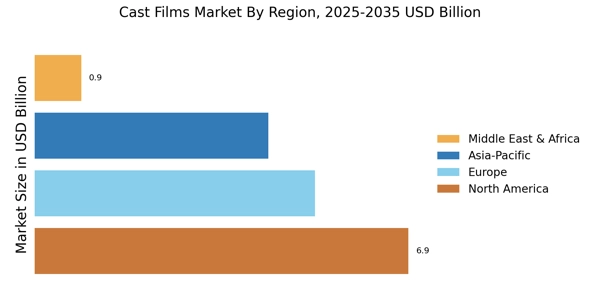
Regional Insights
North America : Innovation and Demand Surge
North America is witnessing robust growth in the cast films market, driven by increasing demand from packaging, automotive, and electronics sectors. The region holds approximately 40% of the global market share, making it the largest market. Regulatory support for sustainable materials and innovations in film technology are key growth catalysts, enhancing production efficiency and reducing environmental impact. The United States leads the market, followed by Canada, with major players like DuPont, 3M, and BASF driving competition. The presence of advanced manufacturing facilities and a focus on R&D further strengthen the competitive landscape. Companies are increasingly investing in eco-friendly solutions, aligning with consumer preferences for sustainable products, which is expected to boost market growth in the coming years.
Europe : Sustainability and Innovation Focus
Europe is emerging as a significant player in the cast films market, with a market share of around 30%. The region's growth is propelled by stringent regulations promoting sustainability and the adoption of innovative materials. The European Union's Green Deal and various national initiatives are driving demand for biodegradable and recyclable films, positioning Europe as a leader in eco-friendly solutions. Germany and France are the leading countries in this market, with key players like BASF and Clariant at the forefront. The competitive landscape is characterized by a strong emphasis on research and development, with companies investing in advanced technologies to enhance product performance. The focus on sustainability is reshaping market dynamics, encouraging collaboration among industry stakeholders to meet regulatory requirements and consumer expectations.
Asia-Pacific : Rapid Growth and Expansion
Asia-Pacific is rapidly becoming a powerhouse in the cast films market, holding approximately 25% of the global share. The region's growth is driven by increasing industrialization, urbanization, and rising disposable incomes, leading to higher demand for packaging solutions. Countries like China and India are at the forefront, supported by favorable government policies and investments in manufacturing capabilities. China is the largest market in the region, with significant contributions from India and Japan. The competitive landscape is marked by the presence of major players such as Mitsubishi Chemical and Toray Industries. Companies are focusing on expanding their production capacities and enhancing product offerings to cater to the growing demand. The emphasis on innovation and sustainability is also shaping the market, as businesses strive to meet evolving consumer preferences and regulatory standards.

Middle East and Africa : Emerging Opportunities and Growth
The Middle East and Africa region is witnessing gradual growth in the cast films market, holding about 5% of the global share. The growth is primarily driven by increasing demand in packaging and construction sectors, alongside government initiatives to diversify economies. Countries like South Africa and the UAE are leading the market, supported by investments in infrastructure and manufacturing capabilities. South Africa is the largest market in the region, with the UAE following closely. The competitive landscape is characterized by a mix of local and international players, with companies focusing on expanding their product portfolios to meet regional demands. The presence of key players like SABIC and Kraton Corporation is enhancing market dynamics, as they invest in innovative solutions to capture emerging opportunities in the region.
Key Players and Competitive Insights
Key Companies in the Cast Films Market include
Industry Developments
The growing demand for flexible packaging solutions, advancements in printing technologies, and increasing use of cast films in the healthcare and automotive industries are key factors driving market growth.Recent developments include the launch of new products, such as biodegradable and recyclable cast films, and strategic partnerships between market players to expand their geographic reach. For instance, in 2023, Amcor announced the acquisition of Bemis Company, Inc., a leading provider of flexible packaging solutions, to strengthen its position in the cast films market.
Future Outlook
Cast Films Market Future Outlook
The Cast Films Market is projected to grow at a 4.54% CAGR from 2025 to 2035, driven by increasing demand in packaging, automotive, and electronics sectors.
New opportunities lie in:
- Expansion into biodegradable cast films for sustainable packaging solutions.
- Development of high-performance cast films for advanced electronics applications.
- Investment in automated production technologies to enhance efficiency and reduce costs.
By 2035, the Cast Films Market is expected to achieve robust growth, driven by innovation and sustainability.
Market Segmentation
Cast Films Market Thickness Outlook
- Below 50 Microns
- 50-100 Microns
- 100-150 Microns
- Above 150 Microns
Cast Films Market Resin Type Outlook
- Polyethylene (PE)
- Polypropylene (PP)
- Polyethylene Terephthalate (PET)
- Polyvinyl Chloride (PVC)
Cast Films Market Application Outlook
- Packaging
- Agriculture
- Automotive
- Electronics
- Building and Construction
Cast Films Market End-Use Industry Outlook
- Food and Beverage
- Personal Care and Hygiene
- Pharmaceuticals
- Agriculture
- Electronics
Report Scope
| MARKET SIZE 2024 | 17.23(USD Billion) |
| MARKET SIZE 2025 | 18.01(USD Billion) |
| MARKET SIZE 2035 | 28.08(USD Billion) |
| COMPOUND ANNUAL GROWTH RATE (CAGR) | 4.54% (2025 - 2035) |
| REPORT COVERAGE | Revenue Forecast, Competitive Landscape, Growth Factors, and Trends |
| BASE YEAR | 2024 |
| Market Forecast Period | 2025 - 2035 |
| Historical Data | 2019 - 2024 |
| Market Forecast Units | USD Billion |
| Key Companies Profiled | BASF SE (DE), DuPont de Nemours Inc (US), 3M Company (US), Mitsubishi Chemical Corporation (JP), SABIC (SA), Toray Industries Inc (JP), Kraton Corporation (US), Clariant AG (CH), Eastman Chemical Company (US) |
| Segments Covered | Resin Type, Application, Thickness, End-Use Industry, Regional |
| Key Market Opportunities | Integration of sustainable materials in the Cast Films Market enhances eco-friendly packaging solutions. |
| Key Market Dynamics | Rising demand for sustainable packaging drives innovation and competition in the cast films market. |
| Countries Covered | North America, Europe, APAC, South America, MEA |
FAQs
What is the projected market valuation of the Cast Films Market by 2035?
The Cast Films Market is projected to reach a valuation of 28.08 USD Billion by 2035.
What was the market valuation of the Cast Films Market in 2024?
In 2024, the overall market valuation of the Cast Films Market was 17.23 USD Billion.
What is the expected CAGR for the Cast Films Market during the forecast period 2025 - 2035?
The expected CAGR for the Cast Films Market during the forecast period 2025 - 2035 is 4.54%.
Which resin type segment is projected to have the highest valuation by 2035?
The Polyethylene Terephthalate (PET) segment is projected to reach 8.0 USD Billion by 2035.
What are the key applications driving the Cast Films Market?
Key applications include Packaging, Agriculture, Automotive, Electronics, and Building and Construction.
Which company is a leading player in the Cast Films Market?
BASF SE is one of the leading players in the Cast Films Market.
What thickness segment is expected to show significant growth by 2035?
The 50-100 Microns thickness segment is expected to grow to 8.0 USD Billion by 2035.
How does the Food and Beverage end-use industry segment perform in the Cast Films Market?
The Food and Beverage end-use industry segment is projected to reach 5.5 USD Billion by 2035.
What is the projected valuation for the Packaging application segment by 2035?
The Packaging application segment is projected to reach 9.5 USD Billion by 2035.
Which company is known for its innovation in the Cast Films Market?
Kindly complete the form below to receive a free sample of this Report
Customer Stories
“This is really good guys. Excellent work on a tight deadline. I will continue to use you going forward and recommend you to others. Nice job”
“Thanks. It’s been a pleasure working with you, please use me as reference with any other Intel employees.”
“Thanks for sending the report it gives us a good global view of the Betaïne market.”
“Thank you, this will be very helpful for OQS.”
“We found the report very insightful! we found your research firm very helpful. I'm sending this email to secure our future business.”
“I am very pleased with how market segments have been defined in a relevant way for my purposes (such as "Portable Freezers & refrigerators" and "last-mile"). In general the report is well structured. Thanks very much for your efforts.”
“I have been reading the first document or the study, ,the Global HVAC and FP market report 2021 till 2026. Must say, good info! I have not gone in depth at all parts, but got a good indication of the data inside!”
“We got the report in time, we really thank you for your support in this process. I also thank to all of your team as they did a great job.”