×
Request Free Sample ×

Kindly complete the form below to receive a free sample of this Report

* Please use a valid business email

Leading companies partner with us for data-driven Insights

clients tt-cursor
Hero Background

CBRN Defense Market

ID: MRFR/AD/0788-CR
110 Pages
Swapnil Palwe
November 2022

CBRN Defense Market Research Report Information by Type (Chemical, Biological, Radiological and Nuclear) System (Protective Wearable Systems, Respiratory Systems, Detection and Monitoring Systems, Decontamination Systems, Simulators, Information Management Software and Colpro System), Application (Military and Civil Law Enforcement), Function (Protection, Detection, Decontamination and Simulation & Training) and Region (North America, Europe, Asia-Pacific, Middle East & Africa, and South America)-Forecast Till 2030

Share:
Download PDF ×

We do not share your information with anyone. However, we may send you emails based on your report interest from time to time. You may contact us at any time to opt-out.

CBRN Defense Market Infographic
Purchase Options

CBRN Defense Market Summary

As per MRFR analysis, the CBRN Defense Market Size was estimated at 7.5 USD Million in 2024. The CBRN Defense industry is projected to grow from 7.9 in 2025 to 13.8 by 2035, exhibiting a compound annual growth rate (CAGR) of 5.74 during the forecast period 2025 - 2035.

Key Market Trends & Highlights

The CBRN Defense Market is poised for substantial growth driven by technological advancements and rising geopolitical tensions.

  • Technological integration is reshaping the CBRN Defense landscape, enhancing response capabilities across various sectors.
  • Increased collaboration among nations and organizations is fostering a more unified approach to CBRN threats, particularly in North America.
  • A heightened focus on training and preparedness is evident, especially within the military segment, which remains the largest in the market.
  • Rising geopolitical tensions and growing awareness of biological threats are key drivers propelling the market forward, particularly in the Asia-Pacific region.

Market Size & Forecast

2024 Market Size 7.5 (USD Million)
2035 Market Size 13.8 (USD Million)
CAGR (2025 - 2035) 5.74%

Major Players

artificial intelligence (US), Raytheon Technologies (US), BAE Systems (GB), Thales Group (FR), L3Harris Technologies (US), General Dynamics (US), Lockheed Martin (US), Chemring Group (GB), AeroVironment (US)

CBRN Defense Market Trends

The CBRN Defense Market is currently experiencing a dynamic evolution, driven by a confluence of geopolitical tensions, technological advancements, and an increasing emphasis on national security. Nations across the globe are prioritizing the development and procurement of advanced capabilities to counter chemical, biological, radiological, and nuclear threats. This heightened focus is reflected in the growing investments in research and development, as well as in the establishment of strategic partnerships among defense contractors and government entities. Furthermore, the integration of innovative technologies, such as artificial intelligence and robotics, is reshaping the landscape of CBRN defense solutions, enhancing their effectiveness and operational readiness. In addition to technological advancements, the CBRN Defense Market is also influenced by evolving regulatory frameworks and international cooperation. Countries are increasingly collaborating to establish standards and protocols for CBRN preparedness and response, which may lead to a more unified approach to addressing these threats. The market appears poised for continued growth, as stakeholders recognize the necessity of robust defense mechanisms in an unpredictable global environment. As the landscape evolves, the emphasis on comprehensive training and simulation exercises is likely to gain traction, ensuring that personnel are adequately prepared to respond to potential CBRN incidents.

Technological Integration

The integration of cutting-edge technologies into CBRN defense systems is becoming increasingly prevalent. Innovations such as artificial intelligence, machine learning, and advanced sensor technologies are enhancing detection, identification, and response capabilities. This trend suggests a shift towards more automated and efficient systems, which may improve overall operational effectiveness.

Increased Collaboration

There is a noticeable trend towards enhanced collaboration among nations and organizations in the CBRN defense sector. Joint exercises, information sharing, and collaborative research initiatives are fostering a more cohesive approach to addressing CBRN threats. This cooperation may lead to the development of standardized protocols and best practices.

Focus on Training and Preparedness

The emphasis on training and preparedness is gaining momentum within the CBRN Defense Market. Organizations are recognizing the importance of comprehensive training programs and simulation exercises to ensure personnel are well-equipped to handle potential CBRN incidents. This focus on readiness may enhance response capabilities and mitigate risks.

CBRN Defense Market Drivers

Increased Defense Budgets

Rising defense budgets across various nations contribute significantly to the Global CBRN Defense Industry. Governments are allocating more resources to enhance their defense capabilities, particularly in response to emerging threats. This trend is evident in countries that prioritize national security and invest in advanced CBRN defense systems. For example, nations are increasingly funding research and development initiatives aimed at improving detection, protection, and response technologies. The commitment to enhancing defense capabilities is reflected in the market's projected growth, with an expected value of 5.82 USD Billion in 2024. As defense budgets continue to rise, the demand for CBRN defense solutions is likely to expand.

Increasing Global Threats

The Global CBRN Defense Industry is experiencing growth due to escalating threats from chemical, biological, radiological, and nuclear agents. Governments worldwide are increasingly aware of the potential risks posed by these agents, leading to enhanced investment in defense capabilities. For instance, the rise in geopolitical tensions and the proliferation of weapons of mass destruction have prompted nations to bolster their CBRN defense strategies. This heightened awareness is reflected in the projected market value of 5.82 USD Billion in 2024, indicating a robust commitment to addressing these threats. As nations prioritize security, the demand for advanced CBRN defense technologies is expected to rise significantly.

Market Growth Projections

The Global CBRN Defense Industry is poised for substantial growth, with projections indicating a market value of 5.82 USD Billion in 2024 and an anticipated increase to 23.1 USD Billion by 2035. This growth trajectory suggests a compound annual growth rate (CAGR) of 13.36% from 2025 to 2035. Such projections reflect the increasing recognition of the need for robust CBRN defense capabilities in response to evolving threats. The market's expansion is likely to be driven by advancements in technology, regulatory frameworks, and increased defense spending. As nations prioritize security and preparedness, the demand for innovative CBRN defense solutions is expected to rise significantly.

Technological Advancements

Technological innovation plays a pivotal role in shaping the Global CBRN Defense Industry. The development of advanced detection systems, protective gear, and decontamination technologies is crucial for effective response to CBRN incidents. For example, the integration of artificial intelligence and machine learning in detection systems enhances the accuracy and speed of identifying threats. This trend is likely to drive market growth, as governments and defense organizations seek to adopt cutting-edge technologies to improve their CBRN capabilities. The anticipated growth trajectory, with a projected market size of 23.1 USD Billion by 2035, underscores the importance of technological advancements in ensuring national and global security.

Growing Awareness and Training

The Global CBRN Defense Industry is also driven by the increasing awareness and training initiatives aimed at preparing personnel for potential CBRN incidents. Governments and organizations are recognizing the importance of training first responders and military personnel in CBRN defense protocols. This focus on education and preparedness is crucial for effective response to CBRN threats. Training programs are being developed to enhance skills in detection, decontamination, and emergency response. As awareness grows, the demand for training solutions and related technologies is expected to rise. This trend aligns with the overall market growth, which is projected to reach 23.1 USD Billion by 2035, highlighting the importance of preparedness in CBRN defense.

Regulatory Frameworks and Policies

The establishment of stringent regulatory frameworks and policies is a significant driver for the Global CBRN Defense Industry. Governments are implementing comprehensive policies to enhance preparedness and response capabilities against CBRN threats. For instance, international agreements and national regulations mandate the development of robust defense systems. This regulatory environment fosters collaboration among nations and encourages investment in CBRN defense technologies. As a result, organizations are compelled to comply with these regulations, leading to increased demand for innovative solutions. The market's growth is further supported by the projected CAGR of 13.36% from 2025 to 2035, reflecting the ongoing commitment to enhancing CBRN defense capabilities.
Market Segment Insights

By Application: Chemical Defense (Largest) vs. Biological Defense (Fastest-Growing)

The CBRN Defense Market is characterized by a diverse array of applications including Chemical Defense, Biological Defense, Radiological Defense, and Nuclear Defense. Among these, Chemical Defense holds the largest market share, reflecting a mature segment supported by established technologies and extensive demand from military and civil environments. Conversely, Biological Defense is emerging as the fastest-growing segment, driven by increasing concerns over bioterrorism and the rapid development of new biological threats, highlighting the shifting focus towards preventative measures.

Chemical Defense: (Dominant) vs. Biological Defense (Emerging)

Chemical Defense remains the dominant force in the CBRN Defense Market, characterized by an extensive array of systems and technologies designed to detect, protect against, and mitigate chemical threats. This segment benefits from a robust historical presence and significant investments in research and development, leading to advanced protective gear and detection systems. On the other hand, Biological Defense is rapidly emerging, reacting to the evolving landscape of biological threats and an increased emphasis on biodefense. This segment is marked by innovative approaches, including the integration of biotech advancements and a proactive stance on emerging pathogens, making it a critical area of focus for defense entities and public health organizations.

By End Use: Military (Largest) vs. Civil Defense (Fastest-Growing)

In the CBRN Defense Market, the end-use segment distribution reveals that the military sector accounts for the largest share, driven by increased defense budgets and heightened global security concerns. Meanwhile, civil defense emerges as the fastest-growing segment, reflecting a growing awareness of the need for preparedness against chemical, biological, radiological, and nuclear threats in civilian populations. This shifting focus underscores the broader implications of CBRN incidents on public safety and security.

Civil Defense: Dominant vs. Healthcare: Emerging

The military sector remains the dominant force in the CBRN Defense Market, with a robust demand for advanced protective equipment and technologies to ensure the safety of personnel in various operational scenarios. Conversely, the civil defense market is emerging as a key player, characterized by initiatives aimed at enhancing the resilience of communities against potential CBRN attacks. This sector is rapidly evolving, driven by governmental policies and public health concerns, thereby fostering innovations tailored to civilian applications. Healthcare is also becoming increasingly significant, particularly concerning bioterrorism and pandemic preparedness, thus complementing the broader CBRN defense efforts and spearheading advancements in medical responses.

By Product Type: Detection Equipment (Largest) vs. Protective Equipment (Fastest-Growing)

In the CBRN Defense Market, the product type segment showcases a varied distribution among its core components. Detection Equipment holds the largest share, primarily due to the increasing need for early warning systems in both military and civilian applications. Protective Equipment follows closely, driven by growing awareness and regulatory requirements for personal safety in hazardous environments, thereby reflecting a substantial portion of the market share. In contrast, Decontamination and Simulation Equipment significantly contribute to the overall dynamics, although they represent smaller shares, catering to specific requirements in response and training scenarios.

Detection Equipment (Dominant) vs. Protective Equipment (Emerging)

Detection Equipment is recognized as the dominant force in the CBRN Defense Market, characterized by advanced technologies such as chemical, biological, radiological, and nuclear detection systems. It plays a crucial role by enabling swift identification of threats, which is essential for timely response strategies. On the other hand, Protective Equipment is emerging rapidly, reflecting heightened demand for personal protective gear, including masks and body armor. This segment's growth is spurred by heightened awareness of CBRN threats and ongoing technological advancements. As industries and governments prioritize worker safety and preparedness, the demand for both segments continues to evolve, with Protective Equipment rapidly gaining traction in recent years.

By Technology: Sensor Technology (Largest) vs. Filtration Technology (Fastest-Growing)

The CBRN Defense Market's technology segment is primarily dominated by sensor technology, which plays a crucial role in detection and identification of chemical, biological, radiological, and nuclear threats. Sensor technology accounts for a significant portion of the market as it integrates advanced detectors and analytics to ensure rapid response capabilities. Following closely is filtration technology, which, while not as dominant, is experiencing rapid growth as the need for effective air and liquid filtration systems for civilian and military use increases. Growth within the technology segment is driven by advancements in sensor accuracy and efficiency that facilitate better threat assessment, alongside rising investment in filtration solutions for safety against hazardous materials. The ongoing geopolitical tensions and increased defense spending further stimulate the demand for sophisticated technologies that can effectively counter CBRN threats.

Technology: Sensor Technology (Dominant) vs. Decontamination Technology (Emerging)

Sensor technology stands out as the dominant force within the CBRN Defense Market, providing critical capabilities for threat detection and monitoring. Its advanced methodologies allow for real-time analysis and prompt action, making it indispensable to military and first responder units. Conversely, decontamination technology is emerging as an important segment, gaining traction due to increased awareness of chemical and biological agents. The development of more effective decontamination methods is crucial in minimizing risks associated with such threats. Both technologies are vital; sensor technology offers proactive defense, while decontamination supports mitigation efforts, ensuring a robust strategy against CBRN challenges.

By Service Type: Training Services (Largest) vs. Consulting Services (Fastest-Growing)

The CBRN Defense Market showcases a diverse landscape of service types, with training services holding the largest market share. Organizations emphasize the importance of comprehensive training programs to ensure personnel are equipped to handle chemical, biological, radiological, and nuclear threats effectively. Meanwhile, consulting services are gaining traction as more entities seek expert guidance on compliance, risk management, and technological integration into their defense strategies. As the geopolitical landscape evolves, the demand for consulting services is on the rise, making it one of the fastest-growing segments within the CBRN Defense Market. Factors driving growth include the increasing frequency of CBRN incidents and the need for enhanced preparedness measures across various sectors. Additionally, the push for modernization in defense strategies further propels the need for expert consulting.

Training Services (Dominant) vs. Logistics Services (Emerging)

Training services serve as the backbone of the CBRN Defense Market, establishing a dominant position by equipping personnel with vital skills to mitigate CBRN threats. This segment is characterized by comprehensive curriculum offerings that include practical drills and simulations tailored to specific CBRN scenarios. On the other hand, logistics services are emerging as a crucial component of the CBRN defense ecosystem. They focus on the efficient movement and storage of critical equipment, ensuring rapid response capabilities. The growing recognition of the importance of logistics in overall preparedness strategies positions this segment to experience significant growth, driven by advancements in supply chain management and the increasing complexity of defense operations.

Get more detailed insights about CBRN Defense Market

Regional Insights

North America : Market Leader in CBRN Defense

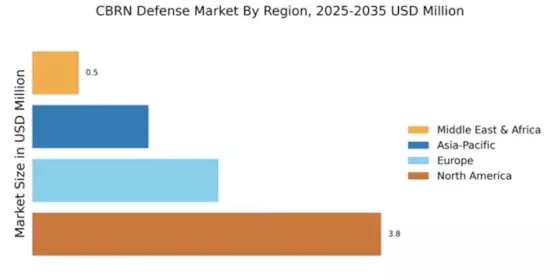
North America continues to lead the CBRN defense market, holding a significant share of 3.75 billion in 2024. The region's growth is driven by increasing defense budgets, heightened security concerns, and advancements in technology. Regulatory support from government agencies enhances the demand for innovative solutions, ensuring robust market expansion. The focus on homeland security and counter-terrorism initiatives further propels the market forward. The United States stands as the primary player in this sector, with key companies like Northrop Grumman, Raytheon Technologies, and Lockheed Martin leading the charge. The competitive landscape is characterized by continuous innovation and strategic partnerships among major defense contractors. This dynamic environment fosters a strong presence of advanced CBRN defense technologies, ensuring the region remains at the forefront of global defense capabilities.

Europe : Emerging CBRN Defense Hub

Europe's CBRN defense market is poised for growth, with a market size of 2.25 billion in 2024. The region is witnessing increased investments in defense and security, driven by geopolitical tensions and regulatory frameworks aimed at enhancing national security. Collaborative efforts among EU member states to bolster defense capabilities are also contributing to market expansion. The focus on research and development in CBRN technologies is expected to further stimulate demand. Leading countries in this market include the UK, France, and Germany, where companies like BAE Systems and Thales Group are prominent. The competitive landscape is marked by a mix of established players and emerging startups, fostering innovation. The European market is characterized by stringent regulations that ensure high standards for CBRN defense solutions, enhancing the overall market environment.

Asia-Pacific : Growing Demand in Asia-Pacific

The Asia-Pacific region is witnessing a growing demand for CBRN defense solutions, with a market size of 1.5 billion in 2024. Factors such as increasing military expenditure, regional conflicts, and the need for enhanced security measures are driving this growth. Governments are prioritizing investments in CBRN capabilities to address potential threats, supported by regulatory frameworks that encourage technological advancements in defense. Countries like Japan, India, and Australia are leading the charge in CBRN defense initiatives. The competitive landscape features both local and international players, with companies like L3Harris Technologies and Chemring Group making significant contributions. The region's focus on collaboration and knowledge sharing among nations is expected to further enhance the development of CBRN defense technologies, positioning Asia-Pacific as a key player in the global market.

Middle East and Africa : Untapped CBRN Defense Potential

The Middle East and Africa region currently shows limited activity in the CBRN defense market, with a market size of 0.0 billion in 2024. This stagnation is primarily due to political instability, economic challenges, and insufficient regulatory frameworks that hinder investment in defense capabilities. However, the growing awareness of CBRN threats is beginning to shift focus towards enhancing security measures, albeit slowly. Countries in this region are gradually recognizing the importance of CBRN defense, with nations like South Africa and the UAE starting to invest in relevant technologies. The competitive landscape remains underdeveloped, with few key players actively participating. As regional governments begin to prioritize defense spending, there is potential for growth in CBRN defense capabilities, but significant challenges remain.

Key Players and Competitive Insights

The CBRN Defense Market is characterized by a dynamic competitive landscape, driven by increasing geopolitical tensions and the rising threat of chemical, biological, radiological, and nuclear incidents. Key players such as Northrop Grumman (US), Raytheon Technologies (US), and BAE Systems (GB) are strategically positioned to leverage their technological expertise and extensive portfolios. Northrop Grumman (US) focuses on innovation in detection and protection systems, while Raytheon Technologies (US) emphasizes advanced sensor technologies and integrated solutions. BAE Systems (GB) is enhancing its capabilities through strategic partnerships and investments in R&D, collectively shaping a competitive environment that prioritizes technological advancement and operational readiness.

In terms of business tactics, companies are increasingly localizing manufacturing to enhance supply chain resilience and reduce lead times. The market appears moderately fragmented, with a mix of established players and emerging firms. The collective influence of these key players is significant, as they engage in strategic collaborations and mergers to consolidate their market positions and expand their operational footprints.

In November 2025, Northrop Grumman (US) announced a partnership with a leading biotechnology firm to develop next-generation biological threat detection systems. This collaboration is poised to enhance Northrop Grumman's capabilities in rapid response and situational awareness, addressing the growing demand for advanced detection technologies in the CBRN sector. The strategic importance of this move lies in its potential to position Northrop Grumman as a frontrunner in the biological defense domain, aligning with current market needs.

In October 2025, Raytheon Technologies (US) unveiled a new line of portable CBRN detection devices designed for rapid deployment in emergency situations. This product launch reflects Raytheon's commitment to innovation and responsiveness to market demands. By enhancing its product offerings, Raytheon Technologies aims to capture a larger share of the market, particularly among first responders and military applications, thereby reinforcing its competitive stance.

In September 2025, BAE Systems (GB) completed the acquisition of a small tech firm specializing in AI-driven analytics for CBRN threat assessment. This acquisition is strategically significant as it enables BAE Systems to integrate cutting-edge AI capabilities into its existing systems, enhancing decision-making processes and operational efficiency. The move underscores BAE's focus on leveraging technology to improve its service offerings and maintain a competitive edge in the market.

As of December 2025, current trends in the CBRN Defense Market include a pronounced shift towards digitalization, sustainability, and AI integration. Strategic alliances are increasingly shaping the competitive landscape, fostering innovation and collaboration among key players. Looking ahead, competitive differentiation is likely to evolve, with a greater emphasis on technological innovation and supply chain reliability rather than solely on price. This shift suggests that companies that prioritize R&D and strategic partnerships will be better positioned to navigate the complexities of the CBRN Defense Market.

Key Companies in the CBRN Defense Market market include

Industry Developments

 Avon Protection launched its portable CBRN protection device, CH15, an ultra-thin escape device that offers 15 minutes of protection against vision, respiratory, and facial protection from CBRN coercions.

In July 2022 :Argon Electronics (UK) Ltd. announced that its Radiation Field Training Simulator (RaFTS) would be featured in the INMM & ESARDA virtual joint annual meeting that will be conducted in Vienna, Austria, between 23rd August and 1st September 2021.

  • Q4 2024: U.S. Department of Defense and Japan Ministry of Defense launch CBRN Defense Market Policy Dialogue In December 2024, the U.S. Department of Defense and Japan Ministry of Defense initiated a bilateral CBRN Defense Market Policy Dialogue to enhance cooperation and develop comprehensive strategies for CBRN defense capabilities, reflecting growing international collaboration in response to unconventional threats.
  • Q4 2024: Buckley Space Force Base showcases CHAPPIE, a quadrupedal unmanned ground vehicle for CBRN operations In November 2024, Buckley Space Force Base demonstrated CHAPPIE, one of the Defense Department's new quadrupedal unmanned ground vehicles designed for chemical, biological, radiological, and nuclear operations, integrating remote sensing with existing detectors to enhance field operations.
  • Q4 2024: BARDA supports development of medical countermeasures for chemical threats In late 2024, BARDA, part of the U.S. Department of Health and Human Services, increased funding and public-private partnerships to accelerate the development and stockpiling of medical countermeasures for chemical threats, strengthening national biosecurity preparedness.

Future Outlook

CBRN Defense Market Future Outlook

The CBRN Defense Market is projected to grow at 5.74% CAGR from 2024 to 2035, driven by increasing geopolitical tensions, technological advancements, and heightened regulatory frameworks.

New opportunities lie in:

  • Development of advanced detection systems for real-time threat assessment.
  • Integration of AI-driven analytics for predictive maintenance solutions.
  • Expansion of training programs for emergency response personnel in CBRN scenarios.

By 2035, the CBRN Defense Market is expected to be robust, reflecting substantial growth and innovation.

Market Segmentation

CBRN Defense Market End Use Outlook

  • Military
  • Civil Defense
  • Industrial
  • Healthcare

CBRN Defense Market Technology Outlook

  • Sensor Technology
  • Filtration Technology
  • Decontamination Technology
  • Surveillance Technology

CBRN Defense Market Application Outlook

  • Chemical Defense
  • Biological Defense
  • Radiological Defense
  • Nuclear Defense

CBRN Defense Market Product Type Outlook

  • Detection Equipment
  • Protective Equipment
  • Decontamination Equipment
  • Simulation Equipment

CBRN Defense Market Service Type Outlook

  • Training Services
  • Maintenance Services
  • Consulting Services
  • Logistics Services

Report Scope

MARKET SIZE 2024 7.5(USD Million)
MARKET SIZE 2025 7.9(USD Million)
MARKET SIZE 2035 13.8(USD Million)
COMPOUND ANNUAL GROWTH RATE (CAGR) 5.74% (2024 - 2035)
REPORT COVERAGE Revenue Forecast, Competitive Landscape, Growth Factors, and Trends
BASE YEAR 2024
Market Forecast Period 2025 - 2035
Historical Data 2019 - 2024
Market Forecast Units USD Million
Key Companies Profiled Northrop Grumman (US), Raytheon Technologies (US), BAE Systems (GB), Thales Group (FR), L3Harris Technologies (US), General Dynamics (US), Lockheed Martin (US), Chemring Group (GB), AeroVironment (US)
Segments Covered Application, End Use, Product Type, Technology, Service Type
Key Market Opportunities Advancements in detection technologies enhance capabilities in the CBRN Defense Market.
Key Market Dynamics Rising geopolitical tensions drive demand for advanced CBRN defense technologies and enhanced protective measures.
Countries Covered North America, Europe, APAC, South America, MEA

Market Highlights

Author
Swapnil Palwe
Team Lead - Research

With a technical background as Bachelor's in Mechanical Engineering, with MBA in Operations Management , Swapnil has 6+ years of experience in market research, consulting and analytics with the tasks of data mining, analysis, and project execution. He is the POC for our clients, for their consulting projects running under the Automotive/A&D domain. Swapnil has worked on major projects in verticals such as Aerospace & Defense, Automotive and many other domain projects. He has worked on projects for fortune 500 companies' syndicate and consulting projects along with several government projects.

Leave a Comment

FAQs

What is the CAGR of the CBRN Defense Market in the upcoming period?

At 5.72% CAGR is expected to transform the market.

Which region is a major driver in the CBRN Defense market?

The North America regional market is projected to be the major driver of the market.

What segments are utilized for better understanding the CBRN Defense market?

The segments in the market are type, system, application and function

What reason will broaden the development of the CBRN defense market?

The greater than ever usage of nuclear energy is estimated to spur the market.

Who are the contenders in the CBRN Defense market?

The key contenders in the market are MSA Safety, Inc., Smiths Group Plc, Teledyne FLIR LLC, Chemring Group Plc, Leidos, Inc., Avon Protection, Blücher GmbH, Argon Electronics (UK) Ltd., Seyntex , Saab AB. FLIR Systems, Inc.

Download Free Sample

Kindly complete the form below to receive a free sample of this Report

Compare Licence

×
Features License Type
Single User Multiuser License Enterprise User
Price $4,950 $5,950 $7,250
Maximum User Access Limit 1 User Upto 10 Users Unrestricted Access Throughout the Organization
Free Customization
Direct Access to Analyst
Deliverable Format
Platform Access
Discount on Next Purchase 10% 15% 15%
Printable Versions