×
Hero Background
English
Chinese
French
Japanese
Korean
German
Spanish

Ceiling Tiles Market Analysis

ID: MRFR/PCM/3349-HCR
100 Pages
Tejas Chaudhary
October 2025

Ceiling Tiles Market Research Report Information Report By Product (Mineral Wool, Metal, Gypsum, Wood and Others), By Installation Type (Drop In, and Glue Up), By Application (Residential and Non-residential) and By Region - Forecast To 2035

Share:
Download PDF ×

We do not share your information with anyone. However, we may send you emails based on your report interest from time to time. You may contact us at any time to opt-out.

Ceiling Tiles Market Infographic
Purchase Options

Market Analysis

In-depth Analysis of Ceiling Tiles Market Industry Landscape

Styles in architecture and interior design have a huge effect on how markets work. Different builders, designers, and end users have different tastes that affect the demand for different ceiling tile styles, materials, and finishes. This makes the market more open to new ideas and flexible. New ceiling tile materials and ongoing innovation help to change the market. When new materials come out, they improve the sound quality, and when new design options come out, they change what people choose, which forces companies to stay on top of material research and product development. Increasing focus on safety and environmental issues is a market driver. To meet the needs of customers who care about the environment, companies that make ceiling tiles need to use recovered materials and sustainable production methods. Regulatory rules and legal requirements shape how markets work. Following rules about safety, quality, and the environment is very important. Changing standards can affect how things are made, what they are made of, and how the market works as a whole. The increase in business building projects is very important to the way the market works. Many businesses, like offices, shops, and restaurants, use ceiling tiles. Changes in the activity in commercial buildings have a direct effect on the market. Connecting technologies and using Industry 4.0 methods change how markets work. A lot of changes are happening in the ceiling tile business because of automation, digitization, and smart technologies. These technologies are making the supply chain management and manufacturing processes more efficient and quick to respond. Price changes for raw materials affect how the market works. Changes in the prices of materials like gypsum, mineral fiber, or metal have a direct effect on the costs of making ceiling tiles. This has an effect on their prices and how competitive they are in the market. The way the market works is affected by how important sound performance is becoming in building design. Building goals are changing quickly, as more sound-absorbing ceiling tiles are in high demand in a wide range of settings, such as businesses, schools, and hospitals. Adopting digital marketing and making a web footprint are big changes in the market. When businesses use digital media for marketing and sales properly, they reach more customers and get more publicity, which changes the way markets work in the digital age.
Author
Tejas Chaudhary
Research Analyst Level II

I have a degree in Engineering (Civil), with masters in Business Administration (Marketing). With more than 4 years of experience in market research and consulting, I am involved in end-to-end process of market research, proposals, project kickoffs and delivery. I have research knowledge and expertise in consumer goods/packaging domain. Also I have worked for various other domains like construction & equipment. Effectively managed and delivered more than 60 report studies for regional as well as global clientele.

Leave a Comment

FAQs

What will be the total worth of the global Ceiling Tiles Market by the end of the year 2035?

Ceiling Tiles Market is projected to be worth USD 30890.78 Million by 2035

Which region is anticipated to grow at a rigorous rate in the global Ceiling Tiles Market throughout the forecast?

Asia-Pacific (ASPAC) region will be growing tremendously throughout the forecasted period owing to the increase in residential as well as non-residential construction activities.

At what rate global Ceiling Tiles Market is expected to grow throughout the forecasted period?

Ceiling Tiles Market is projected to grow at a CAGR of 8.17% during the forecast period, 2025-2035

Who all are the end-users of the global Ceiling Tiles industry?

Ceiling tiles are widely used in the commercial sector for the construction of offices, retail stores, hospitals, cinema halls, multiplexes, educational institutions, etc.

Market Summary

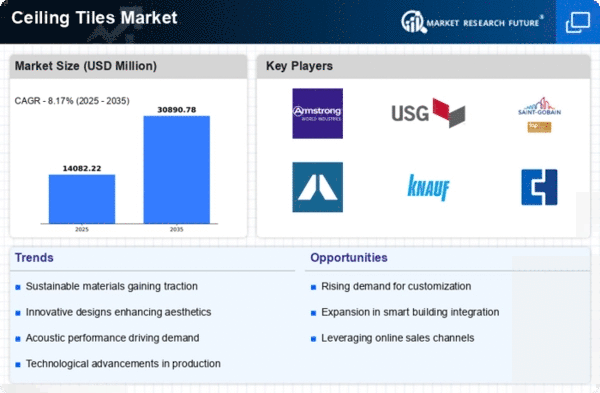
As per MRFR analysis, the Ceiling Tiles Market Size was estimated at 13018.6 USD Million in 2024. The Ceiling Tiles industry is projected to grow from 14082.48 USD Million in 2025 to 30890.78 USD Million by 2035, exhibiting a compound annual growth rate (CAGR) of 8.17 during the forecast period 2025 - 2035.

Key Market Trends & Highlights

The Ceiling Tiles Market is experiencing a dynamic shift towards sustainability and technological integration.

  • North America remains the largest market for ceiling tiles, driven by robust commercial construction activities.
  • Asia-Pacific is identified as the fastest-growing region, reflecting increasing urbanization and infrastructure development.
  • The residential segment continues to dominate, while the commercial segment is rapidly expanding due to evolving design preferences.
  • Rising demand for energy efficiency and regulatory support for sustainable building practices are key drivers influencing market growth.

Market Size & Forecast

2024 Market Size 13018.6 (USD Million)
2035 Market Size 30890.78 (USD Million)
CAGR (2025 - 2035) 8.17%
Largest Regional Market Share in 2024 North America

Major Players

<p>Armstrong World Industries (US), USG Corporation (US), Saint-Gobain (FR), Rockfon (DK), Knauf (DE), CertainTeed (US), Owa (DE), Ecophon (SE), Gyptech (CA)</p>

Market Trends

The Ceiling Tiles Market is currently experiencing a dynamic evolution, driven by various factors including aesthetic preferences, sustainability concerns, and technological advancements. As consumers increasingly prioritize interior design and functionality, the demand for innovative ceiling solutions appears to be on the rise. This market encompasses a diverse range of materials, including mineral fiber, metal, and wood, each offering unique benefits and applications. Furthermore, the growing emphasis on energy efficiency and sound absorption in commercial and residential spaces suggests a shift towards products that not only enhance visual appeal but also contribute to overall environmental sustainability. In addition, the Ceiling Tiles Market is likely influenced by the ongoing trends in construction and renovation activities. As urbanization continues to expand, there is a notable increase in the construction of commercial buildings, which may further propel the demand for ceiling tiles. Moreover, advancements in manufacturing processes and the introduction of smart ceiling solutions could redefine market dynamics. Overall, the Ceiling Tiles Market appears poised for growth, with a focus on innovation and sustainability shaping its future trajectory.

Sustainability Initiatives

The trend towards sustainability in the Ceiling Tiles Market is becoming increasingly pronounced. Manufacturers are exploring eco-friendly materials and production methods, aiming to reduce environmental impact. This shift not only aligns with consumer preferences for greener products but also complies with regulatory standards promoting sustainability.

Technological Integration

Technological advancements are playing a pivotal role in transforming the Ceiling Tiles Market. Innovations such as smart ceiling tiles equipped with integrated lighting and sound systems are emerging. These products offer enhanced functionality and convenience, appealing to modern consumers seeking multifunctional solutions.

Aesthetic Customization

The demand for aesthetic customization in the Ceiling Tiles Market is on the rise. Consumers are increasingly seeking unique designs and finishes that reflect personal style and enhance interior spaces. This trend encourages manufacturers to offer a wider variety of textures, colors, and patterns, catering to diverse consumer tastes.

Ceiling Tiles Market Market Drivers

Rising Demand for Aesthetic Interiors

The Global Ceiling Tiles Market Industry experiences a notable increase in demand driven by the growing emphasis on aesthetic interiors across residential and commercial spaces. As consumers prioritize design and ambiance, ceiling tiles are increasingly viewed as essential components of interior decoration. This trend is particularly evident in urban areas where modern architecture and interior design are prevalent. The market is projected to reach 13.0 USD Billion in 2024, reflecting the importance of aesthetics in driving consumer choices. Consequently, manufacturers are innovating with various materials and designs to cater to this evolving consumer preference.

Regulatory Support for Building Materials

Regulatory support for building materials is a crucial driver in the Global Ceiling Tiles Market Industry. Governments worldwide are implementing regulations that promote the use of high-quality, safe, and sustainable building materials. These regulations not only enhance safety standards but also encourage the adoption of innovative ceiling tile solutions. As compliance with these regulations becomes mandatory, manufacturers are likely to invest in research and development to meet the new standards. This regulatory environment is expected to foster growth within the industry, contributing to the anticipated market value of 13.0 USD Billion in 2024.

Sustainability and Eco-Friendly Materials

Sustainability is becoming a pivotal driver in the Global Ceiling Tiles Market Industry as consumers and businesses alike seek eco-friendly materials. The increasing awareness of environmental issues has led to a demand for ceiling tiles made from recycled or sustainable materials. This shift not only aligns with global sustainability goals but also attracts environmentally conscious consumers. Manufacturers are responding by developing products that meet these criteria, thereby enhancing their market appeal. The anticipated growth of the market to 30.9 USD Billion by 2035 underscores the potential of sustainable practices in shaping industry dynamics.

Technological Advancements in Manufacturing

Technological advancements are significantly influencing the Global Ceiling Tiles Market Industry, enhancing production efficiency and product quality. Innovations such as automated manufacturing processes and advanced materials are enabling manufacturers to produce ceiling tiles that are not only aesthetically pleasing but also durable and functional. These advancements contribute to cost reductions and improved product offerings, which can attract a broader customer base. As the market evolves, the integration of technology is likely to play a crucial role in meeting the diverse needs of consumers, thereby supporting the projected CAGR of 8.17% from 2025 to 2035.

Growth in Construction and Renovation Activities

The Global Ceiling Tiles Market Industry is poised for growth due to the surge in construction and renovation activities worldwide. As urbanization accelerates and populations grow, there is an increasing need for new residential and commercial buildings. Additionally, renovation projects in existing structures are becoming more common as property owners seek to modernize their spaces. This trend is expected to drive demand for ceiling tiles, which are integral to both new constructions and renovations. The market's expansion is reflected in the projected increase to 30.9 USD Billion by 2035, highlighting the critical role of construction activities in shaping industry growth.

Market Segment Insights

By Application: Residential (Largest) vs. Commercial (Fastest-Growing)

<p>The Ceiling Tiles Market is segmented into four main applications: Residential, Commercial, Industrial, and Institutional. Among these, the Residential segment holds the largest market share, largely driven by housing trends and increased renovation activities. Homeowners prioritize aesthetics and acoustics, fueling demand for stylish and functional ceiling solutions. The Commercial segment, on the other hand, is witnessing rapid growth as businesses invest in modernizing their spaces. Factors such as urbanization and the rise of co-working spaces contribute significantly to this upward trend.</p>

<p>Commercial (Dominant) vs. Industrial (Emerging)</p>

<p>The Commercial application in the Ceiling Tiles Market is characterized by its essential role in office interiors, retail spaces, and educational institutions. This segment dominates due to a sustained trend towards open office designs and innovative workspace solutions. In contrast, the Industrial application, while emerging, is gaining traction with manufacturers seeking to enhance acoustic performance and aesthetics in operational settings. Industrial ceiling tiles typically emphasize durability and easy maintenance, setting them apart from the decorative focus seen in commercial tiles. Market players are increasingly targeting the Industrial sector with tailored ceiling solutions that address these specific functional needs.</p>

By Material Type: Mineral Fiber (Largest) vs. Gypsum (Fastest-Growing)

<p>The material type segment of the ceiling tiles market showcases a diverse distribution of market shares. Mineral fiber ceiling tiles dominate the landscape, primarily due to their sound absorption properties and cost-effectiveness. Gypsum tiles, while holding a smaller share, are emerging as a popular choice due to their fire resistance and aesthetic versatility. Metal and wood ceiling options cater to niche markets, focusing on design and durability, thereby contributing to a varied market structure that appeals to different consumer preferences. Growth trends indicate a significant trajectory for gypsum and metal ceiling tiles, driven by an increase in construction and renovation projects. The green building movement, promoting materials with sustainable properties, is reshaping consumer preferences, making gypsum tiles particularly appealing in this context. Additionally, technological advancements in manufacturing processes are reducing costs and enhancing product performance, thus expanding the utility of these materials in both residential and commercial sectors.</p>

<p>Mineral Fiber (Dominant) vs. Metal (Emerging)</p>

<p>Mineral fiber ceiling tiles are widely recognized as the dominant choice in the ceiling tiles market due to their excellent sound insulation and economic viability, making them a staple in schools, offices, and commercial buildings. They are typically lightweight and easy to install, contributing to their popularity. In contrast, metal ceiling tiles are gaining traction as an emerging segment, particularly in contemporary architectural designs. Known for their sleek appearance and durability, metal tiles offer a modern aesthetic that appeals to high-end renovations and commercial applications. Their resilience against moisture and pests makes them ideal for environments where hygiene is critical, such as healthcare facilities. The increasing demand for stylish, long-lasting materials is bolstering the market presence of metal ceiling tiles.</p>

By Installation Type: Suspended (Largest) vs. Acoustic (Fastest-Growing)

<p>The Ceiling Tiles Market's Installation Type segment presents a diverse landscape, with Suspended ceiling tiles holding the largest market share. This segment benefits from widespread adoption due to their versatility in commercial spaces, offering both aesthetic appeal and functional advantages such as sound attenuation and ease of installation. Direct Mount and Grid System ceilings also contribute significantly but with comparatively smaller shares. Acoustic ceiling tiles are gaining traction, driven by increased demand for improved acoustics in educational and office environments. Growth trends in the Installation Type segment are strongly influenced by architectural trends that favor open and flexible spaces. The shift towards sustainable and energy-efficient building materials further propels the adoption of acoustic tiles, as these products often meet environmental standards and enhance indoor climate. Innovation in design and the introduction of new textures and colors are also crucial drivers of growth, attracting a broader customer base seeking specialized ceiling solutions.</p>

<p>Suspended (Dominant) vs. Acoustic (Emerging)</p>

<p>Suspended ceiling tiles dominate the Ceiling Tiles Market due to their adaptability and broad application across various sectors, including education, healthcare, and commercial offices. These tiles not only offer a clean aesthetic finish but also provide crucial benefits such as sound insulation, which is essential in busy environments. On the other hand, Acoustic ceiling tiles are emerging rapidly in the market. Their focus on sound absorption makes them highly sought after in spaces requiring quiet atmospheres, such as recording studios and conference rooms. The rising trend of incorporating acoustic treatments in interior design is driving this segment's growth, as clients increasingly prioritize both aesthetics and functionality, leading to a dynamic interplay between these two installation types.</p>

By End Use: New Construction (Largest) vs. Renovation (Fastest-Growing)

<p>In the Ceiling Tiles Market, the segment distribution shows that New Construction holds a significant share, fueled by the rising demand for modern infrastructure and aesthetic ceiling designs. This segment has been historically supported by continuous investments in commercial and residential projects, solidifying its status as the largest contributor to the market overall. Conversely, the Renovation segment has emerged as the fastest-growing area within the industry, driven by a trend towards upgrading existing spaces and enhancing energy efficiency. As older buildings are being remodeled for better functionality and style, this segment is expanding rapidly, highlighting consumer preferences for eco-friendly and aesthetically pleasing solutions in renovation projects.</p>

<p>New Construction (Dominant) vs. Renovation (Emerging)</p>

<p>The New Construction segment of the Ceiling Tiles Market is characterized by substantial investments in infrastructure development across various sectors, including commercial, residential, and institutional. This segment benefits from new technologies and materials that enhance performance and aesthetics. On the other hand, the Renovation segment represents a growing niche, where customers seek to modernize and improve existing structures. It is increasingly influenced by sustainability trends, pushing demand for innovative ceiling solutions that not only enhance visual appeal but also contribute to energy efficiency. Both segments reflect distinct consumer needs and preferences, with New Construction dominating the market landscape while Renovation is swiftly gaining traction as an appealing option.</p>

Get more detailed insights about Ceiling Tiles Market Research Report- Global Forecast 2035

Regional Insights

North America : Market Leader in Ceiling Tiles

North America is poised to maintain its leadership in the ceiling tiles market, holding a significant share of 6500.0. The region's growth is driven by increasing construction activities, particularly in commercial and residential sectors, alongside a rising demand for energy-efficient building materials. Regulatory support for sustainable construction practices further fuels this trend, enhancing market dynamics. The competitive landscape in North America is robust, featuring key players such as Armstrong World Industries, USG Corporation, and CertainTeed. These companies are leveraging innovative technologies and sustainable practices to capture market share. The U.S. remains the largest market, with Canada also showing promising growth. The presence of established manufacturers ensures a steady supply of high-quality products, catering to diverse consumer needs.

Europe : Emerging Market with Growth Potential

Europe's ceiling tiles market is valued at 3500.0, reflecting a growing demand driven by urbanization and renovation projects. The region is witnessing a shift towards eco-friendly materials, supported by stringent regulations aimed at reducing carbon footprints. This regulatory environment is a key catalyst for market growth, as it encourages innovation and the adoption of sustainable practices in construction. Leading countries in this market include Germany, France, and the UK, where major players like Saint-Gobain and Knauf are actively expanding their product lines. The competitive landscape is characterized by a mix of established brands and emerging companies, fostering innovation. The European market is expected to continue its upward trajectory, driven by increasing investments in infrastructure and sustainable building solutions.

Asia-Pacific : Rapid Growth in Emerging Economies

The Asia-Pacific ceiling tiles market, valued at 2500.0, is experiencing rapid growth, primarily driven by urbanization and increasing disposable incomes. Countries like China and India are at the forefront, with significant investments in infrastructure and commercial projects. The demand for aesthetically pleasing and functional ceiling solutions is on the rise, supported by favorable government policies promoting construction and renovation activities. The competitive landscape is evolving, with both local and international players vying for market share. Key companies such as Rockfon and Ecophon are expanding their presence in the region, focusing on innovative designs and sustainable materials. As the market matures, the emphasis on quality and performance will shape the competitive dynamics, making it a vibrant space for growth.

Middle East and Africa : Emerging Market with Unique Challenges

The Middle East and Africa ceiling tiles market, valued at 518.6, is gradually emerging, driven by urban development and infrastructure projects. The region faces unique challenges, including economic fluctuations and varying regulatory environments. However, the demand for ceiling tiles is expected to grow as governments invest in housing and commercial developments, supported by initiatives aimed at improving living standards. Leading countries in this region include the UAE and South Africa, where key players like Gyptech are establishing a foothold. The competitive landscape is characterized by a mix of local manufacturers and international brands, each adapting to regional demands. As the market evolves, the focus on quality and sustainability will be crucial for success, paving the way for future growth.

Key Players and Competitive Insights

The Ceiling Tiles Market is currently characterized by a dynamic competitive landscape, driven by factors such as increasing demand for aesthetic and functional ceiling solutions, alongside a growing emphasis on sustainability. Major players like Armstrong World Industries (US), USG Corporation (US), and Saint-Gobain (FR) are strategically positioned to leverage innovation and regional expansion to enhance their market presence. Armstrong World Industries (US) focuses on product innovation, particularly in eco-friendly materials, while USG Corporation (US) emphasizes digital transformation in its operations, enhancing customer engagement through advanced technologies. Saint-Gobain (FR) is actively pursuing mergers and acquisitions to broaden its product portfolio, thereby shaping a competitive environment that is increasingly focused on sustainability and technological advancement.

Key business tactics within the market include localizing manufacturing and optimizing supply chains to enhance efficiency and reduce costs. The competitive structure appears moderately fragmented, with several key players exerting influence over market dynamics. This fragmentation allows for niche players to thrive, while larger companies consolidate their positions through strategic initiatives. The collective influence of these key players fosters a competitive atmosphere where innovation and operational efficiency are paramount.

In November 2025, Armstrong World Industries (US) announced the launch of a new line of acoustic ceiling tiles made from 100% recycled materials. This strategic move not only aligns with the growing consumer preference for sustainable products but also positions the company as a leader in eco-friendly solutions within the market. The introduction of these tiles is expected to enhance Armstrong's market share and appeal to environmentally conscious consumers.

In October 2025, USG Corporation (US) unveiled a digital platform aimed at streamlining the customer experience by providing real-time access to product information and installation resources. This initiative reflects a broader trend towards digitalization in the industry, allowing USG to enhance customer engagement and operational efficiency. By integrating technology into its business model, USG is likely to strengthen its competitive edge in a rapidly evolving market.

In September 2025, Saint-Gobain (FR) completed the acquisition of a regional ceiling tile manufacturer, which is anticipated to expand its market reach and diversify its product offerings. This acquisition underscores Saint-Gobain's commitment to growth through strategic partnerships, enabling the company to leverage local expertise and enhance its competitive positioning in various regions.

As of December 2025, current competitive trends in the Ceiling Tiles Market are increasingly defined by digitalization, sustainability, and the integration of AI technologies. Strategic alliances among key players are shaping the landscape, fostering innovation and collaboration. The shift from price-based competition to a focus on technological advancement and supply chain reliability is evident, suggesting that future competitive differentiation will hinge on the ability to innovate and respond to evolving consumer preferences.

Key Companies in the Ceiling Tiles Market market include

Industry Developments

March 8, 2023: Armstrong World Industries, Inc. announced that it has acquired the assets of Architectural Elements, Inc., a leading manufacturer of acoustical ceiling tiles and panels. This acquisition will expand Armstrong's product portfolio and strengthen its position in the ceiling tiles market.

April 12, 2023: USG Corporation announced that it has launched a new line of acoustical ceiling tiles called QuietSpace®. These tiles are designed to provide superior sound absorption and reduce noise levels in commercial spaces.

May 2, 2023: Ecophon announced that it has opened a new manufacturing plant in India. This plant will produce Ecophon's award-winning acoustical ceiling tiles for the Indian market.

June 6, 2023: Siniat Corporation announced that it has acquired the assets of CertainTeed's ceiling tiles business. This acquisition will expand Siniat's product portfolio and strengthen its position in the ceiling tiles market in North America.

Market Dynamics

Drivers

The construction of green buildings is driving the market of ceiling tiles. The major key players are focusing on manufacturing products that are environment-friendly as well as give an aesthetic look to your interior. The use of Eco-friendly gypsum in manufacturing has boosted the demand for ceiling tiles.

Opportunities

People are readily investing a large chunk of their incomes in an aesthetic home with tasteful architecture. Ceiling tiles are highly in demand as they are used to create a false ceiling. These ceilings provide thermal insulation as well as enhance the acoustic capabilities of a room. 

Restraints

Manufacturing lightweight ceiling tiles require expensive raw materials. The major challenge faced by the global market is its high cost of installation. Also, the processed material is discharged into the environment without any treatment.

Value Chain Analysis

Ceiling tiles are popularly used in the commercial sector for the construction of offices, retail stores, hospitals, cinema halls, multiplexes, educational institutions, etc. these are cost-effective, durable, and flexible. These ceilings give an elegant and decorative look to the ambiance. Drop ceilings tiles and planks are mostly used in the construction of commercial buildings. Various multinational companies are working together in mergers or joint ventures to manufacture new products that will cause less harm to the environment and also are pocket-friendly to the consumer. 

Future Outlook

Ceiling Tiles Market Future Outlook

<p>The Ceiling Tiles Market is projected to grow at an 8.17% CAGR from 2024 to 2035, driven by urbanization, sustainability trends, and technological advancements.</p>

New opportunities lie in:

  • <p>Expansion into eco-friendly ceiling tile production</p>
  • <p>Development of smart ceiling tiles with integrated technology</p>
  • <p>Partnerships with construction firms for large-scale projects</p>

<p>By 2035, the market is expected to achieve robust growth, driven by innovation and strategic partnerships.</p>

Market Segmentation

Ceiling Tiles Market End Use Outlook

  • New Construction
  • Renovation
  • Repair

Ceiling Tiles Market Application Outlook

  • Residential
  • Commercial
  • Industrial
  • Institutional

Ceiling Tiles Market Material Type Outlook

  • Mineral Fiber
  • Metal
  • Gypsum
  • Wood
  • Plastic

Ceiling Tiles Market Installation Type Outlook

  • Suspended
  • Direct Mount
  • Grid System
  • Acoustic

Report Scope

MARKET SIZE 202413018.6(USD Million)
MARKET SIZE 202514082.48(USD Million)
MARKET SIZE 203530890.78(USD Million)
COMPOUND ANNUAL GROWTH RATE (CAGR)8.17% (2024 - 2035)
REPORT COVERAGERevenue Forecast, Competitive Landscape, Growth Factors, and Trends
BASE YEAR2024
Market Forecast Period2025 - 2035
Historical Data2019 - 2024
Market Forecast UnitsUSD Million
Key Companies ProfiledArmstrong World Industries (US), USG Corporation (US), Saint-Gobain (FR), Rockfon (DK), Knauf (DE), CertainTeed (US), Owa (DE), Ecophon (SE), Gyptech (CA)
Segments CoveredApplication, Material Type, Installation Type, End Use
Key Market OpportunitiesGrowing demand for sustainable materials in the Ceiling Tiles Market presents significant opportunities for innovation.
Key Market DynamicsRising demand for sustainable materials drives innovation and competition in the ceiling tiles market.
Countries CoveredNorth America, Europe, APAC, South America, MEA

FAQs

What will be the total worth of the global Ceiling Tiles Market by the end of the year 2035?

Ceiling Tiles Market is projected to be worth USD 30890.78 Million by 2035

Which region is anticipated to grow at a rigorous rate in the global Ceiling Tiles Market throughout the forecast?

Asia-Pacific (ASPAC) region will be growing tremendously throughout the forecasted period owing to the increase in residential as well as non-residential construction activities.

At what rate global Ceiling Tiles Market is expected to grow throughout the forecasted period?

Ceiling Tiles Market is projected to grow at a CAGR of 8.17% during the forecast period, 2025-2035

Who all are the end-users of the global Ceiling Tiles industry?

Ceiling tiles are widely used in the commercial sector for the construction of offices, retail stores, hospitals, cinema halls, multiplexes, educational institutions, etc.

  1. Research Methodology
    1. Scope of the Study
      1. Definition
      2. Research Objective
      3. Assumptions
      4. Limitations
    2. Research Process
      1. Primary Research
      2. Secondary Research
    3. Market size Estimation
    4. Forecast Model
    5. 3... Market Dynamics
    6. Market Drivers
    7. Market Inhibitors
    8. Supply/Value Chain Analysis
    9. Porter’s Five Forces Analysis
  2. Global Ceiling Tiles Market, By Product
    1. Introduction
    2. Mineral Wool
    3. Metal
    4. Gypsum
    5. Woods
    6. Others
  3. Global s Market, By Installation Type
    1. Introduction
    2. Drop In
    3. Glue Up
  4. Global Ceiling Tiles Market, By Application
    1. Introduction
    2. Residential
    3. Non-residential
  5. Regional Market Analysis
    1. Introduction
    2. North America
      1. U.S.
      2. Canada
    3. Europe
      1. U.K.
      2. Germany
      3. France
      4. Spain
      5. Rest of Europe
    4. Asia Pacific
      1. China
      2. Japn
      3. India
      4. Rest of Asia Pacific
    5. Rest of the World
    6. 8... Competitive Analysis
    7. Introduction
    8. Competitive Scenario
      1. Market Share Analysis
      2. Market Development Analysis
      3. Product offering/Service Benchmarking
    9. Armstrong World Industries, Inc.
      1. Overview
      2. Product offering/Service Offering
      3. Strategy
    10. Knauf
      1. Overview
      2. Product offering/Service Offering
      3. Strategy
    11. Grenzebach BSH GmbH
      1. Overview
      2. Product offering/Service Offering
      3. Strategy
    12. Rockfon
      1. Overview
      2. Product offering/Service Offering
      3. Strategy
    13. USG Corporation
      1. Overview
      2. Product offering/Service Offering
      3. Strategy
    14. Saint Gobain S.A.
      1. Overview
      2. Product offering/Service Offering
      3. Strategy
    15. SAS International
      1. Overview
      2. Product offering/Service Offering
      3. Strategy
    16. Odenwald Faserplattenwerk GmbH
      1. Overview
      2. Product offering/Service Offering
      3. Strategy
    17. Hunter Douglas
      1. Overview
      2. Product offering/Service Offering
      3. Strategy
    18. Burgess CEP
      1. Overview
      2. Product offering/Service offering
      3. Strategy
    19. Decorative Ceiling Tiles, Inc.
      1. Overview
      2. Product offering/Service Offering
      3. Strategy
    20. VANS Gypsum Pvt Ltd.
      1. Overview
      2. Product offering/Service Offering
      3. Strategy
    21. The ReWall Company, LLC
      1. Overview
      2. Product offering/Service offering
      3. Strategy

Ceiling Tiles Market Segmentation

Market Segmentation Overview

  • Detailed segmentation data will be available in the full report
  • Comprehensive analysis by multiple parameters
  • Regional and country-level breakdowns
  • Market size forecasts by segment
Infographic

Free Sample Request

Kindly complete the form below to receive a free sample of this Report

Get Free Sample

Customer Strories

Compare Licence

×
Features License Type
Single User Multiuser License Enterprise User
Price $4,950 $5,950 $7,250
Maximum User Access Limit 1 User Upto 10 Users Unrestricted Access Throughout the Organization
Free Customization
Direct Access to Analyst
Deliverable Format
Platform Access
Discount on Next Purchase 10% 15% 15%
Printable Versions