×
Request Free Sample ×

Kindly complete the form below to receive a free sample of this Report

* Please use a valid business email

Leading companies partner with us for data-driven Insights

clients tt-cursor
Hero Background

Central Pv Inverter Market

ID: MRFR/EnP/28702-HCR
128 Pages
Priya Nagrale
October 2025

Central Pv Inverter Market Research Report By Power Rating (0-1 MW, 1-5 MW, 5-10 MW, 10 MW and above), By Application (Utility-Scale Solar Plants, Commercial and Industrial Installations, Residential Solar Systems), By Topology (Transformerless, Transformer-based), By Cooling System (Natural Air-Cooled, Liquid-Cooled) and By Regional (North America, Europe, South America, Asia Pacific, Middle East and Africa) - Forecast to 2035

Share:
Download PDF ×

We do not share your information with anyone. However, we may send you emails based on your report interest from time to time. You may contact us at any time to opt-out.

Central Pv Inverter Market Infographic
Purchase Options

Central Pv Inverter Market Summary

As per MRFR analysis, the Central PV Inverter Market Size was estimated at 5.999 USD Billion in 2024. The Central PV Inverter industry is projected to grow from 6.662 USD Billion in 2025 to 19.0 USD Billion by 2035, exhibiting a compound annual growth rate (CAGR) of 11.05 during the forecast period 2025 - 2035.

Key Market Trends & Highlights

The Central PV Inverter Market is experiencing robust growth driven by technological advancements and increasing demand for renewable energy.

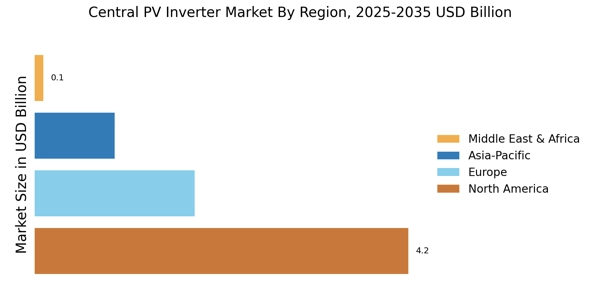
  • North America remains the largest market for central PV inverters, driven by substantial investments in solar infrastructure.
  • The Asia-Pacific region is emerging as the fastest-growing market, fueled by rising energy needs and supportive government policies.
  • The 5-10 MW segment continues to dominate the market, while the 1-5 MW segment is witnessing rapid growth due to increasing adoption in commercial applications.
  • Technological advancements and regulatory support are key drivers propelling the market forward, alongside cost reductions in solar technology.

Market Size & Forecast

2024 Market Size 5.999 (USD Billion)
2035 Market Size 19.0 (USD Billion)
CAGR (2025 - 2035) 11.05%

Major Players

SMA Solar Technology AG (DE), Fronius International GmbH (AT), Schneider Electric SE (FR), Huawei Technologies Co., Ltd. (CN), ABB Ltd. (CH), Siemens AG (DE), TMEIC Corporation (JP), KACO new energy GmbH (DE), Ingeteam Power Technology, S.A. (ES)

Central Pv Inverter Market Trends

The Central PV Inverter Market is currently experiencing a transformative phase, driven by the increasing demand for renewable energy solutions. As nations strive to meet their sustainability goals, the adoption of solar energy technologies has surged. Central PV inverters, which play a crucial role in converting direct current generated by solar panels into alternating current for grid use, are becoming essential components in large-scale solar installations. This market is characterized by rapid technological advancements, with manufacturers focusing on enhancing efficiency and reliability. Furthermore, the integration of smart technologies into inverters is likely to optimize performance and facilitate better energy management. In addition to technological innovations, regulatory frameworks and government incentives are shaping the landscape of the Central PV Inverter Market. Many countries are implementing policies that promote the use of solar energy, thereby creating a favorable environment for market growth. The increasing awareness of climate change and the need for energy independence are further propelling investments in solar infrastructure. As the market evolves, it appears that the focus will shift towards developing more efficient, cost-effective, and user-friendly inverter solutions, which could potentially redefine energy generation and consumption patterns in the coming years.

Technological Advancements

The Central PV Inverter Market is witnessing rapid technological innovations aimed at improving efficiency and performance. Manufacturers are increasingly integrating smart technologies, such as IoT and AI, into their products. This trend enhances monitoring capabilities and optimizes energy management, potentially leading to higher energy yields.

Regulatory Support

Government policies and incentives are playing a pivotal role in shaping the Central PV Inverter Market. Many nations are implementing supportive regulations that encourage solar energy adoption. This regulatory environment fosters investment in solar infrastructure, which may lead to increased demand for central inverters.

Growing Demand for Renewable Energy

The Central PV Inverter. As countries prioritize sustainability and energy independence, the demand for solar energy solutions is rising. This trend is likely to drive the growth of central inverters, as they are essential for large-scale solar projects.

Central Pv Inverter Market Drivers

Regulatory Support

Regulatory support plays a crucial role in shaping the Central PV Inverter Market. Governments worldwide are implementing policies and incentives to promote renewable energy adoption, which directly benefits the solar sector. For instance, feed-in tariffs and tax credits encourage investments in solar infrastructure, including central inverters. In many regions, regulatory frameworks are becoming more favorable, with streamlined permitting processes and interconnection standards that facilitate the deployment of solar projects. This supportive environment is reflected in the increasing number of solar installations, which reached over 200 GW in the last year alone. As regulations continue to evolve, the Central PV Inverter Market is poised for growth, driven by favorable policies that encourage the transition to renewable energy.

Technological Advancements

The Central PV Inverter Market is experiencing rapid technological advancements that enhance efficiency and performance. Innovations such as multi-MPPT (Maximum Power Point Tracking) technology allow for better energy harvesting from solar panels, leading to increased energy output. Furthermore, the integration of smart grid technology enables real-time monitoring and management of energy production and consumption. According to recent data, the efficiency of central inverters has improved significantly, with some models achieving over 98% efficiency. This trend not only boosts the attractiveness of central inverters but also aligns with the growing emphasis on energy efficiency in the renewable sector. As technology continues to evolve, the Central PV Inverter Market is likely to see further enhancements that could redefine operational standards.

Cost Reductions in Solar Technology

Cost reductions in solar technology are significantly influencing the Central PV Inverter Market. The price of solar panels has decreased dramatically over the past decade, making solar energy more accessible and economically viable. This trend has a cascading effect on the inverter market, as lower overall system costs encourage more installations. Recent reports indicate that the cost of solar energy has fallen by over 80% since 2010, leading to a surge in demand for central inverters that can efficiently manage larger solar arrays. As the cost of solar technology continues to decline, the Central PV Inverter Market is expected to expand, driven by increased adoption of solar energy solutions across various sectors.

Growing Demand for Renewable Energy

The demand for renewable energy sources is surging, significantly impacting the Central PV Inverter Market. As concerns over climate change and energy security intensify, countries are setting ambitious renewable energy targets. This shift is evident in the increasing investments in solar energy, which accounted for nearly 30% of new power generation capacity in the past year. Central inverters are essential components in large-scale solar installations, and their demand is expected to rise in tandem with the growth of solar projects. The Central PV Inverter Market is likely to benefit from this trend, as more utilities and commercial entities seek to integrate solar energy into their portfolios, thereby driving the need for efficient and reliable inverter solutions.

Increased Investment in Solar Infrastructure

Increased investment in solar infrastructure is a key driver for the Central PV Inverter Market. As countries prioritize renewable energy development, substantial funding is being allocated to solar projects. This influx of capital is not only facilitating the construction of solar farms but also enhancing the deployment of advanced inverter technologies. Recent data suggests that investments in solar infrastructure have reached unprecedented levels, with billions of dollars committed to new projects. This trend is likely to continue, as both public and private sectors recognize the long-term benefits of solar energy. Consequently, the Central PV Inverter Market stands to gain from this investment surge, as the demand for efficient and reliable inverters grows in tandem with the expansion of solar capacity.

Market Segment Insights

By Power Rating: 5-10 MW (Largest) vs. 1-5 MW (Fastest-Growing)

In the Central PV Inverter Market, the distribution of market share among power rating segments shows that the 5-10 MW category holds the largest share, reflecting the growing demand for mid-sized installations. Following closely, the 1-5 MW segment is gaining traction, particularly in residential and small commercial projects, which contributes significantly to its increasing market presence.

Power Rating: 5-10 MW (Dominant) vs. 1-5 MW (Emerging)

The 5-10 MW segment is characterized by its dominance in larger installations where efficiency and power output are critical. This segment caters primarily to utility-scale projects that require robust and reliable inverter systems to handle substantial energy loads. In contrast, the 1-5 MW segment represents an emerging market with rapid growth potential, driven by the rising adoption of decentralized energy systems and renewable energy policies. This segment is increasingly favored for its flexibility and cost-effectiveness, particularly appealing to commercial and industrial customers aiming for sustainable energy solutions.

By Application: Utility-Scale Solar Plants (Largest) vs. Commercial and Industrial Installations (Fastest-Growing)

The Central PV Inverter Market is primarily driven by the utility-scale solar plants, which currently hold the largest market share among the application segments. This segment represents a significant portion of total installations due to the increasing demand for renewable energy in large-scale operations. Additionally, commercial and industrial installations are gaining traction, showing a notable rise in market share as businesses seek to reduce energy costs and enhance sustainability practices in their operations. Over the past few years, the growth trends in the central PV inverter market have seen a shift toward commercial and industrial installations, which are now considered the fastest-growing segment. This is driven by supportive government policies, incentives for solar adoption, and the increasing priority placed on sustainability and carbon neutrality by businesses worldwide. The residential segment, while growing, remains smaller compared to the utility-scale and commercial sectors, largely due to the higher initial investment and the varying adoption rates across regions.

Utility-Scale Solar Plants (Dominant) vs. Commercial and Industrial Installations (Emerging)

Utility-scale solar plants are recognized as the dominant application in the Central PV Inverter Market due to their extensive infrastructure and ability to generate large amounts of power efficiently. These plants often feature advanced inverter technology that optimizes energy conversion and management, catering to grid needs. Furthermore, commercial and industrial installations represent an emerging segment, characterized by businesses' increasing need to harness renewable energy. These installations vary significantly in scale and complexity, allowing for customized solutions that meet specific energy requirements while also benefiting from potential cost savings and sustainability advantages. Together, these two segments highlight the evolution of the solar market and its responsiveness to energy demands.

By Topology: Transformerless (Largest) vs. Transformer-based (Fastest-Growing)

In the Central PV Inverter Market, the topology segment is predominantly led by transformerless inverters, which have gained significant traction due to their compact design and higher efficiency levels. Transformer-based inverters, however, are witnessing a rapid gain in market share, especially in applications demanding robust performance in varying conditions. This dual structure highlights the increasingly diversified preferences among consumers, reflecting evolving technological advancements and regulatory shifts. The growth trends within this segment showcase the shifting dynamics of energy generation technologies. Transformerless inverters are favored in residential and commercial applications driven by the demand for lightweight and cost-effective solutions. Conversely, the rise of transformer-based inverters can be attributed to their perceived reliability and enhanced performance in larger-scale industrial settings, thus solidifying their position as a strong competitor.

Topology: Transformerless (Dominant) vs. Transformer-based (Emerging)

Within the Central PV Inverter Market, transformerless inverters are recognized for their streamlined design, offering improved efficiency and reduced weight, which makes them an appealing choice for many users aiming for space-saving solutions. Conversely, transformer-based inverters, characterized by their robustness and capability to manage high voltage inputs, are emerging as a popular option for utility-scale operations. The decision between the two often hinges on the specific needs of applications; transformerless designs are usually preferred for residential installations, ensuring ease of use and maintenance. In contrast, transformer-based inverters, with their ability to handle demanding environments, are gaining traction among large commercial users. This evolution reflects a broader trend in the industry, with both segments strengthening their foothold under varying market demands.

By Cooling System: Natural Air-Cooled (Largest) vs. Liquid-Cooled (Fastest-Growing)

In the Central PV Inverter Market, the cooling system segment reveals a dynamic distribution between two primary types: Natural Air-Cooled and Liquid-Cooled. The Natural Air-Cooled systems constitute the majority share, owing to their cost-effectiveness and reliability for large-scale solar installations. In contrast, Liquid-Cooled systems, while currently smaller in market share, are catching up rapidly due to their enhanced efficiency and suitability for high-power applications.

Cooling System: Natural Air-Cooled (Dominant) vs. Liquid-Cooled (Emerging)

Natural Air-Cooled systems dominate the Central PV Inverter Market due to their straightforward design, low maintenance needs, and effectiveness in various environmental conditions. They are suitable for numerous applications, especially where space and cost efficiencies are critical. On the other hand, Liquid-Cooled systems, recognized as the emerging option in this market, offer superior thermal management capabilities that lead to better performance in high-load situations. This makes them increasingly popular among large-scale solar energy producers aiming for maximum output and efficiency in their PV inverter operations.

Get more detailed insights about Central Pv Inverter Market

Regional Insights

North America : Renewable Energy Leader

North America is witnessing robust growth in the Central PV Inverter market, driven by increasing investments in renewable energy and supportive government policies. The U.S. holds the largest market share at approximately 70%, followed by Canada at around 15%. Regulatory incentives, such as the Investment Tax Credit (ITC), are propelling demand for solar technologies, including central inverters, as states aim for ambitious renewable energy targets. The competitive landscape is dominated by key players like SMA Solar Technology AG, Fronius International GmbH, and Schneider Electric SE. The U.S. market is characterized by a mix of established companies and emerging startups, fostering innovation and technological advancements. As the demand for solar energy solutions continues to rise, these companies are well-positioned to capitalize on the growing market opportunities.

Europe : Sustainable Energy Transition

Europe is rapidly advancing in the Central PV Inverter market, driven by stringent climate policies and a strong commitment to renewable energy. Germany leads the market with a share of approximately 30%, followed by Spain at around 20%. The European Union's Green Deal and national initiatives are significant catalysts, aiming to reduce carbon emissions and enhance energy efficiency across member states. Leading countries like Germany, Spain, and France are home to major players such as ABB Ltd. and Siemens AG. The competitive landscape is marked by innovation and collaboration among manufacturers, utilities, and research institutions. As Europe transitions to a sustainable energy future, the demand for efficient and reliable central inverters is expected to surge, providing ample opportunities for growth.

Asia-Pacific : Emerging Market Potential

The Asia-Pacific region is emerging as a powerhouse in the Central PV Inverter market, driven by rapid industrialization and increasing energy demands. China dominates the market with a staggering share of approximately 60%, followed by Japan at around 15%. Government initiatives promoting solar energy adoption and investments in infrastructure are key growth drivers, as countries strive to meet their renewable energy targets and reduce reliance on fossil fuels. China, Japan, and India are leading the charge, with significant contributions from companies like Huawei Technologies Co., Ltd. and TMEIC Corporation. The competitive landscape is characterized by aggressive pricing strategies and technological advancements, as manufacturers seek to enhance efficiency and reduce costs. As the region continues to invest in solar energy, the demand for central inverters is set to rise significantly, creating a vibrant market environment.

Middle East and Africa : Resource-Rich Opportunities

The Middle East and Africa region is witnessing a growing interest in the Central PV Inverter market, driven by abundant solar resources and increasing energy needs. Countries like South Africa and the UAE are leading the market, with South Africa holding approximately 25% and the UAE around 20%. Government initiatives aimed at diversifying energy sources and enhancing energy security are pivotal in driving solar energy adoption across the region. South Africa, the UAE, and Morocco are key players in this market, with significant investments in solar projects. The competitive landscape includes both local and international companies, fostering innovation and collaboration. As the region seeks to harness its solar potential, the demand for efficient central inverters is expected to grow, presenting lucrative opportunities for market participants.

Central Pv Inverter Market Regional Image

Key Players and Competitive Insights

Major players in the Central Pv Inverter Market industry are focusing on developing innovative products to meet the evolving needs of customers. Leading Central Pv Inverter Market players are also expanding their presence to tap into new markets. The Central Pv Inverter Market is expected to witness significant development in the coming years, driven by the increasing demand for renewable energy sources.

Schneider Electric is a leading player in the Central Pv Inverter Market. The company offers a wide range of central inverters for various applications, including utility-scale solar power plants, commercial buildings, and residential properties. Schneider Electric's central inverters are known for their high efficiency, reliability, and durability. The company has a strong presence in Europe, North America, and Asia-Pacific.

Huawei is another major player in the Central Pv Inverter Market. The company offers a comprehensive portfolio of central inverters, including string inverters, central inverters, and hybrid inverters. Huawei's central inverters are known for their high efficiency, compact design, and easy installation. The company has a strong presence in China, Europe, and the Middle East.

Key Companies in the Central Pv Inverter Market market include

Industry Developments

The central PV inverter market is projected to grow from USD 6.66 billion in 2025 to USD 17.11 billion by 2034, at a CAGR of 11.05% during the forecast period. The growth of the market is attributed to the increasing adoption of solar photovoltaic (PV) systems, rising demand for renewable energy sources, and government incentives and policies promoting the use of solar energy.

Recent developments in the market include the launch of new products with higher efficiency and lower costs, strategic partnerships and collaborations between key players, and the expansion of manufacturing facilities. For instance, in 2023, Sungrow announced the launch of its new central inverter solution, the SG350HX, which offers a maximum efficiency of 99% and is designed for large-scale solar PV plants. Key players in the market include Sungrow, Huawei, SMA, ABB, and Danfoss. These companies are focusing on innovation and product development to meet the growing demand for efficient and reliable central PV inverters.

Future Outlook

Central Pv Inverter Market Future Outlook

The Central PV Inverter Market is projected to grow at 11.05% CAGR from 2024 to 2035, driven by increasing renewable energy adoption, technological advancements, and supportive government policies.

New opportunities lie in:

  • Expansion into emerging markets with tailored inverter solutions.
  • Development of smart grid integration technologies for enhanced efficiency.
  • Investment in R&D for next-generation inverter technologies to improve performance.

By 2035, the Central PV Inverter Market is expected to be robust, reflecting substantial growth and innovation.

Market Segmentation

Central Pv Inverter Market Topology Outlook

  • Transformerless
  • Transformer-based

Central Pv Inverter Market Application Outlook

  • Utility-Scale Solar Plants
  • Commercial and Industrial Installations
  • Residential Solar Systems

Central Pv Inverter Market Power Rating Outlook

  • 0-1 MW
  • 1-5 MW
  • 5-10 MW
  • 10 MW and above

Central Pv Inverter Market Cooling System Outlook

  • Natural Air-Cooled
  • Liquid-Cooled

Report Scope

MARKET SIZE 20245.999(USD Billion)
MARKET SIZE 20256.662(USD Billion)
MARKET SIZE 203519.0(USD Billion)
COMPOUND ANNUAL GROWTH RATE (CAGR)11.05% (2024 - 2035)
REPORT COVERAGERevenue Forecast, Competitive Landscape, Growth Factors, and Trends
BASE YEAR2024
Market Forecast Period2025 - 2035
Historical Data2019 - 2024
Market Forecast UnitsUSD Billion
Key Companies ProfiledMarket analysis in progress
Segments CoveredMarket segmentation analysis in progress
Key Market OpportunitiesIntegration of advanced energy storage solutions enhances efficiency in the Central PV Inverter Market.
Key Market DynamicsTechnological advancements and regulatory shifts drive competitive dynamics in the Central PV Inverter Market.
Countries CoveredNorth America, Europe, APAC, South America, MEA

Leave a Comment

FAQs

What is the projected market valuation of the Central PV Inverter Market by 2035?

The Central PV Inverter Market is projected to reach a valuation of 19.0 USD Billion by 2035.

What was the market valuation of the Central PV Inverter Market in 2024?

In 2024, the market valuation of the Central PV Inverter Market was 5.999 USD Billion.

What is the expected CAGR for the Central PV Inverter Market during the forecast period 2025 - 2035?

The expected CAGR for the Central PV Inverter Market during the forecast period 2025 - 2035 is 11.05%.

Which companies are considered key players in the Central PV Inverter Market?

Key players in the Central PV Inverter Market include SMA Solar Technology AG, Fronius International GmbH, Schneider Electric SE, Huawei Technologies Co., Ltd., ABB Ltd., Siemens AG, TMEIC Corporation, KACO new energy GmbH, and Ingeteam Power Technology, S.A.

What are the market segments based on power rating in the Central PV Inverter Market?

The market segments based on power rating include 0-1 MW, 1-5 MW, 5-10 MW, and 10 MW and above.

What is the valuation of the Utility-Scale Solar Plants segment in the Central PV Inverter Market?

The Utility-Scale Solar Plants segment was valued at 2.999 USD Billion in 2024 and is projected to reach 9.5 USD Billion.

How does the Transformerless topology segment perform in the Central PV Inverter Market?

The Transformerless topology segment was valued at 3.599 USD Billion in 2024 and is expected to grow to 11.4 USD Billion.

What is the valuation of the Liquid-Cooled cooling system segment in the Central PV Inverter Market?

The Liquid-Cooled cooling system segment was valued at 3.9995 USD Billion in 2024 and is projected to reach 9.5 USD Billion.

What are the projected valuations for the Commercial and Industrial Installations segment?

The Commercial and Industrial Installations segment was valued at 1.5 USD Billion in 2024 and is expected to grow to 5.0 USD Billion.

What is the expected growth trend for the Central PV Inverter Market in the coming years?

The Central PV Inverter Market is likely to experience robust growth, driven by an expected CAGR of 11.05% from 2025 to 2035.

Download Free Sample

Kindly complete the form below to receive a free sample of this Report

Compare Licence

×
Features License Type
Single User Multiuser License Enterprise User
Price $4,950 $5,950 $7,250
Maximum User Access Limit 1 User Upto 10 Users Unrestricted Access Throughout the Organization
Free Customization
Direct Access to Analyst
Deliverable Format
Platform Access
Discount on Next Purchase 10% 15% 15%
Printable Versions