×
Request Free Sample ×

Kindly complete the form below to receive a free sample of this Report

* Please use a valid business email

Leading companies partner with us for data-driven Insights

clients tt-cursor
Hero Background

China Biostimulants Market

ID: MRFR/Agri/44801-HCR
128 Pages
Harshita Gorade
October 2025

China Biostimulants Market Research Report: By Active Ingredients (Humic Substances, Humic Acid, Microbial Amendments, Fulvic Acid, Trace Minerals, Seaweed Extracts, Amino Acids, Other Active Ingredients), By Mode of Application (Foliar Treatment, Soil Treatment, Seed Treatment), By Form (Liquid, Dry) and By Crop Type (Cereals Grains, Oilseeds Pulses, Fruits Vegetables, Turfs Ornamentals, Others) - Forecast to 2035

Share:
Download PDF ×

We do not share your information with anyone. However, we may send you emails based on your report interest from time to time. You may contact us at any time to opt-out.

China Biostimulants Market Infographic
Purchase Options

China Biostimulants Market Summary

As per analysis, the China biostimulants market is projected to grow from USD 349.85 Billion in 2024 to USD 399.47 Billion in 2025, exhibiting a compound annual growth rate (CAGR) of 14.18% during the forecast period (2025 - 2035).

Key Market Trends & Highlights

The China biostimulants market is experiencing robust growth driven by increasing demand for sustainable agricultural practices.

  • The soil application segment remains the largest, reflecting a strong preference among farmers for enhancing soil health.
  • Microbial biostimulants dominate the market, indicating a significant shift towards biological solutions in agriculture.
  • Foliar application is the fastest-growing segment, showcasing the rising interest in targeted nutrient delivery methods.
  • Key market drivers include increasing agricultural productivity and government policies promoting biostimulant use.

Market Size & Forecast

2024 Market Size 349.85 (USD Billion)
2035 Market Size 1504.73 (USD Billion)
CAGR (2025 - 2035) 14.18%

Major Players

BASF (CN), Syngenta (CN), Yara International (CN), FMC Corporation (CN), Nufarm (CN), Valagro (CN), BioWorks (CN), Koppert Biological Systems (CN), AgriLife (CN)

China Biostimulants Market Trends

The China biostimulants market is currently experiencing a notable transformation, driven by increasing agricultural demands and a growing emphasis on sustainable practices. Farmers and agricultural stakeholders are increasingly recognizing the potential of biostimulants to enhance crop productivity and resilience. This shift is largely influenced by government policies promoting environmentally friendly farming techniques, which aim to reduce chemical inputs and improve soil health. As a result, the market is witnessing a surge in the adoption of biostimulant products, which are perceived as viable alternatives to traditional fertilizers and pesticides. Moreover, the regulatory landscape in China is evolving to support the development and commercialization of biostimulants. The government is actively encouraging research and innovation in this sector, leading to the emergence of new formulations and applications. This trend is further bolstered by the increasing awareness among consumers regarding food safety and quality, prompting farmers to seek out biostimulants that can enhance the nutritional value of crops. Overall, the China biostimulants market appears poised for substantial growth, as stakeholders align their practices with the principles of sustainability and efficiency in agriculture.

Rising Demand for Organic Products

There is a growing consumer preference for organic produce in China, which is driving farmers to adopt biostimulants. These products are perceived as essential for maintaining organic certification and enhancing crop quality, thus aligning with market trends favoring health-conscious choices.

Government Support and Regulation

The Chinese government is increasingly implementing policies that support the development of biostimulants. This includes funding for research initiatives and the establishment of regulatory frameworks that facilitate the approval and use of biostimulant products in agriculture.

Technological Advancements in Biostimulant Formulations

Innovations in biostimulant formulations are emerging, with a focus on improving efficacy and application methods. This trend is likely to enhance the performance of biostimulants in various agricultural settings, making them more appealing to farmers.

Market Segment Insights

By Application: Soil Application (Largest) vs. Foliar Application (Fastest-Growing)

In the China biostimulants market, the application segment is evolving with distinct distribution trends among its subcategories. Soil Application currently holds the largest market share, attributed to its long-standing acceptance and effectiveness in enhancing soil fertility and plant health. Foliar Application, while smaller in share, is gaining traction due to its ability to deliver nutrients directly to plant leaves, resulting in quicker absorption and visible results for growers seeking value in crop productivity.

Soil Application: Dominant vs. Foliar Application: Emerging

Soil Application remains the dominant force in the biostimulants market, driven by traditional agricultural practices favoring soil enhancement methods. Farmers appreciate its ability to support root development and overall plant vitality over extended periods. On the other hand, Foliar Application is emerging rapidly as an innovative alternative, providing targeted feeding options to crops at critical growth stages. This method's appeal lies in its versatility and effectiveness in addressing nutrient deficiencies post-planting, showing promise for rapid adoption as farmers seek to improve yield efficiency and quality.

By Type: Microbial Biostimulants (Largest) vs. Plant Extracts (Fastest-Growing)

In the China biostimulants market, the segment of microbial biostimulants stands out as the largest contributor to market share, driven by their effectiveness in enhancing soil health and crop productivity. Following closely are plant extracts, which are gaining ground rapidly due to their natural origin and rising consumer preference for organic farming practices. The demand for both segments reflects the broader trend toward sustainable agricultural solutions, where farmers prioritize environmentally friendly inputs. Growth trends in the segment are fueled by increasing awareness of sustainable agriculture coupled with governmental support for organic farming initiatives. Moreover, innovations in formulation techniques are enhancing the efficacy of both microbial biostimulants and plant extracts, positioning them as vital components of modern farming practices in China. With the ongoing emphasis on food security and the push towards organic production, these segments are expected to witness substantial growth in the coming years.

Microbial Biostimulants (Dominant) vs. Seaweed Extracts (Emerging)

Microbial biostimulants are currently the dominant segment within the China biostimulants market, owing to their ability to improve nutrient uptake and resilience against biotic stresses in crops. They encompass a range of products derived from natural microorganisms, which not only enhance crop yields but also promote soil health. In contrast, seaweed extracts are considered an emerging segment, gaining traction due to their high richness in bioactive compounds that stimulate plant growth and stress tolerance. The growing interest in sustainable practices is benefiting seaweed extracts, as they are viewed as effective natural alternatives. Both segments demonstrate unique advantages—microbial biostimulants provide robust solutions to enhance agricultural productivity, while seaweed extracts offer a resource-efficient approach to managing crop stress within various environmental conditions.

By Crop Type: Fruits and Vegetables (Largest) vs. Cereals and Grains (Fastest-Growing)

In the China biostimulants market, the crop type segment is characterized by distinct shares, with Fruits and Vegetables leading the category due to increasing demand for fresh produce and organic farming practices. This segment benefits from growing consumer awareness regarding sustainable agriculture and the positive impacts of biostimulants on crop quality and yield. Conversely, Cereals and Grains, while currently the fastest-growing segment, are gaining traction as farmers seek to enhance productivity and resilience against climate variations.

Fruits and Vegetables (Dominant) vs. Cereals and Grains (Emerging)

Fruits and Vegetables represent the dominant segment in the China biostimulants market, driven by a surge in health-conscious consumers and a preference for organic produce. These crops benefit significantly from biostimulants, which enhance their quality and nutritional content. On the other hand, Cereals and Grains are emerging rapidly, fueled by the need for food security and the increasing challenges posed by changing climatic conditions. Farmers are increasingly adopting biostimulants to improve soil health and crop resilience, marking a trend towards more sustainable agricultural practices.

By Formulation: Liquid (Largest) vs. Granular (Fastest-Growing)

In the China biostimulants market, the formulation segment is characterized by a diverse range of products including liquid, granular, powder, and suspension forms. Liquid formulations dominate the market share due to their ease of application and quick absorption by plants. Meanwhile, granular formulations, although smaller in share, are witnessing remarkable growth as they offer extended release and convenience for farmers in various agricultural practices. The growth trends in this segment are driven by increasing awareness of sustainable farming practices and the need for high-yield crops. Liquid formulations are favored for their immediate effects, while granular formulations are gaining traction due to their improving technology and efficiency in nutrient delivery, making them a preferred choice for long-term soil health management.

Granular (Dominant) vs. Powder (Emerging)

Granular biostimulants are well-established in the China market, known for their user-friendliness and effectiveness in delivering nutrients over time, thus enhancing soil health and plant growth. They cater to a broad range of crops and are especially popular among large-scale farmers for their ability to be applied in various agricultural setups. On the other hand, powder formulations, though relatively new and emerging, are gaining popularity due to their versatility and support for organic farming practices. They can be easily mixed with other inputs, providing flexibility for farmers looking for customized solutions. The competitive landscape is evolving as formulators innovate to enhance the efficacy and application methods of powder biostimulants.

Get more detailed insights about China Biostimulants Market

Key Players and Competitive Insights

The biostimulants market in China is characterized by a dynamic competitive landscape, driven by increasing agricultural productivity demands and a growing emphasis on sustainable farming practices. Key players such as BASF (CN), Syngenta (CN), and Yara International (CN) are strategically positioned to leverage innovation and regional expansion to enhance their market presence. BASF (CN) focuses on developing advanced biostimulant formulations that cater to local crop needs, while Syngenta (CN) emphasizes partnerships with local agricultural cooperatives to facilitate product adoption. Yara International (CN) is actively pursuing digital transformation initiatives to optimize its supply chain and improve customer engagement, collectively shaping a competitive environment that prioritizes sustainability and technological advancement.

The market structure appears moderately fragmented, with several players vying for market share through localized manufacturing and supply chain optimization. This fragmentation allows for diverse product offerings, catering to the specific needs of various agricultural sectors. The collective influence of key players fosters a competitive atmosphere where innovation and customer-centric strategies are paramount, enabling companies to differentiate themselves in a crowded marketplace.

In November 2025, BASF (CN) announced the launch of a new biostimulant product specifically designed for rice cultivation, aimed at enhancing yield and resilience against climate variability. This strategic move underscores BASF's commitment to addressing local agricultural challenges and reflects a broader trend towards crop-specific solutions that align with regional farming practices. The introduction of this product is likely to strengthen BASF's foothold in the Chinese market, particularly in regions heavily reliant on rice production.

In October 2025, Syngenta (CN) entered into a strategic partnership with a leading Chinese agricultural technology firm to develop AI-driven biostimulant applications. This collaboration is poised to revolutionize how farmers utilize biostimulants, providing data-driven insights that optimize application rates and timing. The integration of AI into biostimulant usage not only enhances product efficacy but also positions Syngenta as a frontrunner in the digital agriculture space, potentially reshaping competitive dynamics in the market.

In September 2025, Yara International (CN) expanded its biostimulant portfolio by acquiring a local startup specializing in microbial solutions. This acquisition is indicative of Yara's strategy to diversify its offerings and tap into the growing demand for biological products in agriculture. By integrating microbial technologies into its existing product lines, Yara is likely to enhance its competitive edge and respond effectively to the increasing consumer preference for sustainable agricultural practices.

As of December 2025, the competitive trends in the biostimulants market are increasingly defined by digitalization, sustainability, and the integration of advanced technologies such as AI. Strategic alliances are becoming more prevalent, enabling companies to pool resources and expertise to drive innovation. The competitive landscape is shifting from traditional price-based competition towards a focus on technological differentiation, product innovation, and supply chain reliability. This evolution suggests that companies that prioritize these aspects will likely emerge as leaders in the biostimulants market, adapting to the changing needs of the agricultural sector.


Key Companies in the China Biostimulants Market market include

Industry Developments

The China Biostimulants Market has seen significant developments recently, reflecting a growing focus on sustainable agriculture practices. Companies such as AgBiome, UPL Limited, Biolchim, and Yara International are increasingly investing in Research and Development and forming collaborations to enhance their product portfolios. A notable market trend is the surge in demand for biostimulants, driven by the need to improve crop yield and quality amidst environmental challenges. As of August 2023, Valagro expanded its operations in China, demonstrating a commitment to providing innovative solutions to local farmers.

Furthermore, in June 2023, Novozymes announced a strategic partnership with a local Chinese firm to expedite its biostimulant offerings in the region. Over the past two years, the market has experienced an uptick in valuation, attributed to increased awareness of sustainable farming practices and regulatory support from the Chinese government promoting the use of biopesticides and biostimulants. In terms of mergers and acquisitions, recent months have not highlighted any publicly known transactions involving the specified companies, indicating a period of solidifying existing partnerships and emphasizing product development efforts within the sector.

Future Outlook

China Biostimulants Market Future Outlook

The China biostimulants market is poised for growth at a 14.18% CAGR from 2024 to 2035, driven by increasing agricultural productivity and sustainable farming practices.

New opportunities lie in:

  • Development of customized biostimulant formulations for specific crops
  • Expansion of distribution networks in rural areas
  • Investment in R&D for innovative biostimulant technologies

By 2035, the market is expected to achieve substantial growth, reflecting evolving agricultural demands.

Market Segmentation

China Biostimulants Market Type Outlook

  • Microbial Biostimulants
  • Plant Extracts
  • Seaweed Extracts
  • Humic Substances

China Biostimulants Market Crop Type Outlook

  • Fruits and Vegetables
  • Cereals and Grains
  • Oilseeds
  • Turf and Ornamentals

China Biostimulants Market Application Outlook

  • Soil Application
  • Foliar Application
  • Seed Treatment
  • Hydroponics

China Biostimulants Market Formulation Outlook

  • Liquid
  • Granular
  • Powder
  • Suspension

Report Scope

MARKET SIZE 2024349.85(USD Billion)
MARKET SIZE 2025399.47(USD Billion)
MARKET SIZE 20351504.73(USD Billion)
COMPOUND ANNUAL GROWTH RATE (CAGR)14.18% (2024 - 2035)
REPORT COVERAGERevenue Forecast, Competitive Landscape, Growth Factors, and Trends
BASE YEAR2024
Market Forecast Period2025 - 2035
Historical Data2019 - 2024
Market Forecast UnitsUSD Billion
Key Companies ProfiledBASF (CN), Syngenta (CN), Yara International (CN), FMC Corporation (CN), Nufarm (CN), Valagro (CN), BioWorks (CN), Koppert Biological Systems (CN), AgriLife (CN)
Segments CoveredApplication, Type, Crop Type, Formulation
Key Market OpportunitiesGrowing demand for sustainable agriculture practices drives innovation in the China biostimulants market.
Key Market DynamicsRising demand for sustainable agriculture drives growth in China's biostimulants market amid regulatory support.
Countries CoveredChina

Leave a Comment

FAQs

What is the expected market size of the China Biostimulants Market in 2024?

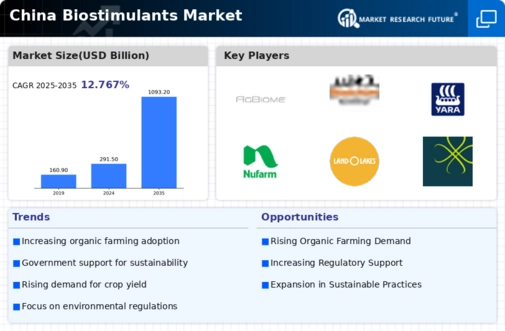
The China Biostimulants Market is expected to be valued at 291.54 billion USD in 2024.

What is the projected market value of the China Biostimulants Market in 2035?

By 2035, the market is anticipated to reach a valuation of 1,093.22 billion USD.

What is the expected compound annual growth rate (CAGR) for the China Biostimulants Market from 2025 to 2035?

The market is projected to grow at a CAGR of 12.767% from 2025 to 2035.

Which active ingredient in the China Biostimulants Market is expected to have the largest value in 2024?

Humic Substances are expected to dominate the market with a value of 58.12 billion USD in 2024.

What is the forecasted market size for Microbial Amendments in the China Biostimulants Market by 2035?

Microbial Amendments are projected to reach a market size of 263.77 billion USD by 2035.

Who are the key players in the China Biostimulants Market?

Major players include AgBiome, UPL Limited, Biolchim, Yara International, and Syngenta among others.

What is the projected market value for Humic Acid in the China Biostimulants Market in 2035?

The market for Humic Acid is expected to reach approximately 171.29 billion USD by 2035.

What challenges are currently impacting the growth of the China Biostimulants Market?

Challenges include regulatory hurdles and competition among key players.

What is the estimated market size for Trace Minerals in the China Biostimulants Market by 2024?

Trace Minerals are expected to hold a market size of 67.2 billion USD in 2024.

What are the growth drivers for the China Biostimulants Market during the forecast period?

Growth drivers include increasing agricultural demand and the focus on sustainable practices.

Download Free Sample

Kindly complete the form below to receive a free sample of this Report

Compare Licence

×
Features License Type
Single User Multiuser License Enterprise User
Price $4,950 $5,950 $7,250
Maximum User Access Limit 1 User Upto 10 Users Unrestricted Access Throughout the Organization
Free Customization
Direct Access to Analyst
Deliverable Format
Platform Access
Discount on Next Purchase 10% 15% 15%
Printable Versions