Download Free Sample
Kindly complete the form below to receive a free sample of this Report
China Electric Vehicle EV Insurance Market Size, Share and Research Report By Coverage (First Party Liability Coverage, Third Party Liability Coverage, Comprehensive), By Distribution Channel (Insurance Companies, Banks, Insurance Agents/ Brokers, Others), By Vehicle Age (New Vehicle, Used Vehicle), By Vehicle Category (Passenger Cars, Commercial Vehicles) and By EV propulsion (Battery Operated, Hybrid)- Industry Forecast Till 2035
As per Market Research Future analysis, the China electric vehicle insurance market size was estimated at 8.1 USD Billion in 2024. The China electric vehicle-ev-insurance market is projected to grow from 9.86 USD Billion in 2025 to 71.03 USD Billion by 2035, exhibiting a compound annual growth rate (CAGR) of 21.8% during the forecast period 2025 - 2035
The China electric vehicle-ev-insurance market is experiencing dynamic growth driven by technological integration and evolving consumer needs.
| 2024 Market Size | 8.1 (USD Billion) |
| 2035 Market Size | 71.03 (USD Billion) |
| CAGR (2025 - 2035) | 21.82% |
Allianz (DE), AXA (FR), State Farm (US), Progressive (US), Liberty Mutual (US), Geico (US), Zurich Insurance (CH), MetLife (US), Chubb (US)
Our Impact
Enabled $4.3B Revenue Impact for Fortune 500 and Leading Multinationals
Partnering with 2000+ Global Organizations Each Year
30K+ Citations by Top-Tier Firms in the Industry
The electric vehicle-ev-insurance market is currently experiencing a transformative phase, driven by the rapid adoption of electric vehicles (EVs) across various segments. This shift is largely influenced by government policies aimed at promoting sustainable transportation and reducing carbon emissions. As more consumers opt for EVs, the demand for tailored insurance products that address the unique risks associated with these vehicles is increasing. Insurers are adapting their offerings to include coverage for battery damage, charging infrastructure, and potential software malfunctions, which are not typically covered in traditional auto insurance policies. Moreover, the competitive landscape is evolving, with both established insurers and new entrants vying for market share. Insurers are leveraging technology to enhance customer experience, streamline claims processing, and offer personalized policies. The integration of telematics and data analytics is enabling insurers to assess risk more accurately, potentially leading to more competitive pricing models. As the electric vehicle-ev-insurance market continues to mature, it is likely to witness further innovations and partnerships that will shape its future.
Insurers are focusing on creating customized insurance products that cater specifically to the needs of electric vehicle owners. This trend reflects a growing recognition of the distinct risks associated with EVs, such as battery performance and charging-related incidents. By offering tailored coverage options, insurers aim to enhance customer satisfaction and retention.
The adoption of advanced technologies, including telematics and artificial intelligence, is becoming prevalent in the electric vehicle-ev-insurance market. These technologies facilitate better risk assessment and enable insurers to provide more accurate pricing. Additionally, they enhance the claims process, making it more efficient and user-friendly.
Insurers are increasingly forming partnerships with electric vehicle manufacturers to develop specialized insurance products. This collaboration allows for a better understanding of the vehicles' unique features and risks, leading to more effective coverage solutions. Such partnerships may also include bundled offerings that combine vehicle purchase and insurance.
In recent years, there has been a marked increase in environmental awareness among Chinese consumers, which has positively impacted the electric vehicle-ev-insurance market. As more individuals recognize the environmental benefits of EVs, the demand for electric vehicles has surged. This shift in consumer behavior is reflected in the growing market share of EVs, which is expected to reach 25% by 2025. Insurers are responding to this trend by offering eco-friendly insurance policies that align with the values of environmentally conscious consumers. These policies may include incentives for low-emission vehicles and discounts for sustainable driving practices. As a result, the electric vehicle-ev-insurance market is likely to expand, catering to a demographic that prioritizes sustainability in their purchasing decisions.
The electric vehicle-ev-insurance market is being shaped by rapid technological advancements in electric vehicles. Innovations such as improved battery technology, autonomous driving features, and enhanced safety systems are making EVs more appealing to consumers. In 2025, it is anticipated that the average range of electric vehicles will exceed 500 km on a single charge, addressing one of the primary concerns of potential buyers. As these technologies evolve, insurance providers must adapt their offerings to cover new risks associated with advanced features. This may include policies that account for the complexities of autonomous driving and the potential for cyber threats. Thus, the electric vehicle-ev-insurance market is likely to see an increase in demand for specialized coverage that reflects the changing landscape of vehicle technology.
The electric vehicle-ev-insurance market is witnessing increased competition among insurers as they seek to capture a share of the growing EV market. With the rise in electric vehicle sales, numerous insurance companies are developing innovative products tailored specifically for EV owners. This competitive landscape encourages insurers to enhance their offerings, potentially leading to lower premiums and improved customer service. In 2025, it is expected that the number of insurers providing specialized EV policies will increase by 40%, reflecting the market's expansion. As competition intensifies, consumers may benefit from a wider range of options, prompting insurers to invest in technology and customer engagement strategies. Thus, the electric vehicle-ev-insurance market is likely to evolve rapidly, driven by the need for differentiation in a crowded marketplace.
The electric vehicle-ev-insurance market in China is significantly influenced by government incentives aimed at promoting electric vehicle (EV) adoption. The Chinese government has implemented various subsidies and tax exemptions, which have led to a substantial increase in EV sales. In 2025, EV sales in China are projected to account for approximately 30% of total vehicle sales, creating a larger customer base for insurance providers. This surge in EV ownership necessitates tailored insurance products that address the unique risks associated with electric vehicles, such as battery damage and charging infrastructure. Consequently, the electric vehicle-ev-insurance market is likely to experience growth as insurers develop specialized policies to meet the evolving needs of consumers, driven by these government initiatives.
Urbanization in China is driving the growth of the electric vehicle-ev-insurance market. As cities expand and populations increase, the demand for sustainable transportation solutions becomes more pressing. The Chinese government is investing heavily in EV infrastructure, including charging stations and smart grid technology. By 2025, it is projected that the number of public charging stations will exceed 1 million, facilitating the adoption of electric vehicles. This infrastructure development not only supports EV sales but also creates opportunities for insurance providers to offer products that cater to urban drivers. Policies may include coverage for charging station-related incidents and urban driving risks. Consequently, the electric vehicle-ev-insurance market is poised for growth as urbanization continues to reshape transportation dynamics.
In the China electric vehicle-ev-insurance market, the market share distribution shows that First Party Liability Coverage holds a significant portion, reflecting its essential role in protecting individuals against legal claims stemming from vehicular accidents. Third Party Liability Coverage follows closely, providing essential protection against liabilities from third-party claims. Comprehensive Coverage, while currently smaller, exhibits robust growth, revealing a shift in consumer preferences towards all-inclusive protection options. Growth trends in this segment are driven by increasing vehicle registrations and rising awareness among consumers about the importance of adequate coverage. The evolving landscape of electric vehicles in China further amplifies the demand for specialized insurance products. Factors such as regulatory changes and the growing trend of online insurance purchases are also contributing to the accelerating growth and competition within the coverage segment.
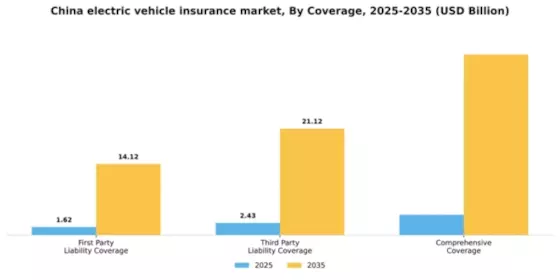
First Party Liability Coverage (Dominant) vs. Comprehensive Coverage (Emerging)
First Party Liability Coverage stands out as the dominant segment in the China electric vehicle-ev-insurance market, underlined by its necessity for legal compliance and consumer protection. This coverage ensures protection against damages to third parties, making it a must-have for all drivers. On the other hand, Comprehensive Coverage is emerging as a strong contender, appealing to consumers seeking broader protection that includes damages to their own vehicles, theft, and unforeseen incidents. As the market matures, the emergence of Comprehensive Coverage reflects a growing consumer preference for more extensive coverage options, driven by increased awareness and the availability of tailored insurance products.
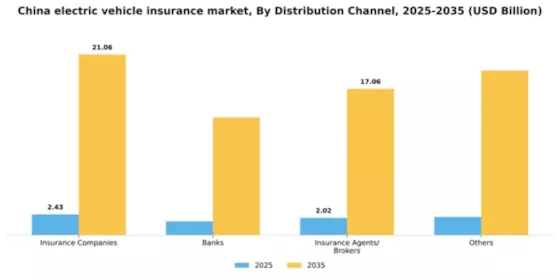
In the China electric vehicle-ev-insurance market, distribution channels are diversifying, with Insurance Companies holding the largest market share, driven by established networks and brand trust. This sector dominates due to significant customer reliance on traditional insurance providers for vehicle coverage, contributing to its prominent position. Conversely, Insurance Agents/Brokers are emerging as the fastest-growing channel, appealing to a young demographic that prefers personalized services and competitive pricing options. The growth in distribution channels is primarily fueled by the increasing consumer interest in electric vehicles and the need for tailored insurance products that meet unique risks associated with them. Digital transformation is also playing a key role, allowing brokers to leverage technology to reach potential clients more effectively. This trend indicates a shift towards more accessible and flexible insurance solutions as the market continues to mature.
Insurance Companies (Dominant) vs. Insurance Agents/ Brokers (Emerging)
Insurance Companies stand as the dominant players in the distribution channel segment, characterized by their stability, extensive customer base, and established infrastructure. They benefit from customer trust, which drives continuous premium growth. On the other hand, Insurance Agents/Brokers represent an emerging force in the market, capitalizing on changing consumer behavior towards electric vehicles. These agents are increasingly sought after due to their ability to provide customized advice and comprehensive insurance options tailored to the needs of EV owners. With agility in adapting to consumer insights and a focus on personalized service, they are poised to capture significant market share in the upcoming years as the demand for electric vehicles rises.
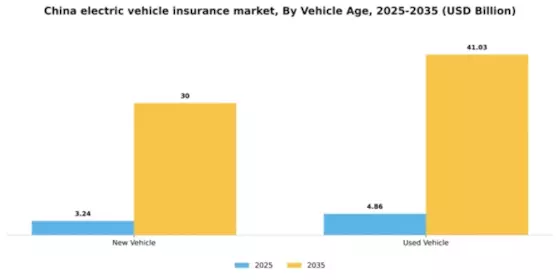
In the China electric vehicle-ev-insurance market, the distribution among the vehicle age segment indicates a significant leaning towards new vehicles, which constitute the largest share of the market. This segment benefits from governmental incentives and consumer perceptions that favor new technology, driving adoption rates. In contrast, the used vehicle segment, while smaller, is rapidly gaining traction as economic factors push consumers towards more budget-friendly options with insurance innovations catering to this demographic. Growth trends within this segment highlight the increasing acceptance and sales of used electric vehicles as a viable option for consumers. Factors driving this trend include the rising awareness of environmental issues and the cost-effectiveness of used vehicles. Additionally, advancements in battery technology and improved insurance products are making used vehicles more appealing to a broader audience, ensuring that they emerge as a significant player in the market.
New Vehicle (Dominant) vs. Used Vehicle (Emerging)
The new vehicle segment stands as the dominant force in the China electric vehicle-ev-insurance market, characterized by strong brand loyalty, advanced technology features, and consumer interest in the latest models. Manufacturers are heavily promoting these vehicles, benefiting from the support of government policies aimed at boosting green energy. On the other hand, the used vehicle segment is emerging notably, appealing to budget-conscious customers who seek electric vehicles for their affordability. This segment is becoming increasingly competitive, as more high-quality used electric vehicles enter the market, aided by innovations in insurance that provide consumers with confidence in their purchase decisions.
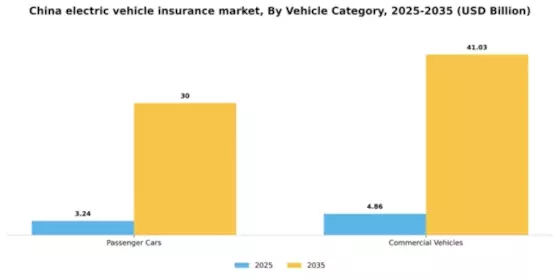
The distribution of market share among the vehicle categories in the China electric vehicle-ev-insurance market shows passenger cars dominating with a significant portion due to their widespread adoption among consumers. In contrast, commercial vehicles are rapidly increasing their share as businesses increasingly adopt electric solutions to meet sustainability goals, presenting growth opportunities in this segment. Growth trends indicate that while passenger cars continue to lead the market, commercial vehicles are emerging as a strong competitor, driven by government incentives and a push towards electrification in logistics and transportation. The COVID-19 pandemic has further accelerated the demand for efficient and cost-effective electric vehicles in commercial use, marking a shift in industry dynamics that favors electric options.
Passenger Cars (Dominant) vs. Commercial Vehicles (Emerging)
Passenger cars are characterized by their higher penetration in the China electric vehicle-ev-insurance market, with a variety of models appealing to different consumer preferences. These vehicles are typically used for personal transport and have seen significant innovation in battery technology and features to enhance user experience. On the other hand, commercial vehicles, which include electric delivery vans and trucks, are gaining traction due to their potential for lower operational costs and reduced emissions. As regulations tighten around emissions and sustainability, both segments are poised for growth, but the commercial vehicle segment represents an emerging opportunity with rising demand in sectors like logistics and public transport.
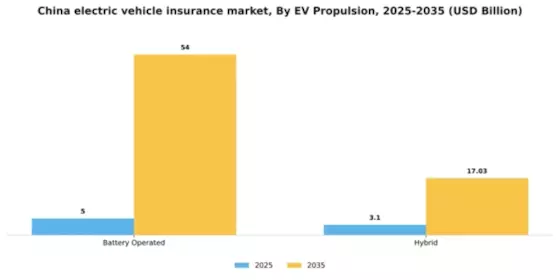
In the China electric vehicle-ev-insurance market, the distribution of market share is heavily skewed towards battery-operated electric vehicles, which hold a significant majority. These vehicles benefit from advancements in battery technology and a substantial push from government policies promoting electric mobility. Hybrid vehicles, while growing at an impressive rate, currently represent a smaller portion of the market, primarily appealing to consumers interested in flexibility and lower initial costs. Growth trends in this segment indicate a robust trajectory, particularly for hybrid vehicles, which are capturing the interest of environmentally conscious consumers looking for alternatives to full electric systems. Factors driving this trend include rising fuel prices and increased awareness of environmental issues. Additionally, the expanding charging infrastructure in China is further fostering the acceptance of hybrid technology, making it an appealing choice for a wider audience.
Battery Operated (Dominant) vs. Hybrid (Emerging)
Battery operated electric vehicles dominate the market due to their higher energy efficiency and lower long-term running costs compared to traditional combustion engines. They are equipped with advanced battery management systems, enabling longer ranges and faster charging times. In contrast, hybrid vehicles are viewed as an emerging solution, combining the benefits of electric propulsion with traditional engines. This segment is appealing to consumers who may have range anxiety associated with fully electric vehicles. While battery operated vehicles are widely recognized for their sustainability and performance, hybrid vehicles are rapidly gaining traction due to their versatile nature and the growing shift towards eco-friendly transportation.
Get more detailed insights about China Electric Vehicle (EV) Insurance Market Request Free Sample
The electric vehicle-ev-insurance market in China is currently characterized by a dynamic competitive landscape, driven by rapid technological advancements and increasing consumer demand for sustainable transportation solutions. Key players such as Allianz (DE), AXA (FR), and State Farm (US) are actively positioning themselves through innovative insurance products tailored for electric vehicles (EVs). Allianz (DE) has focused on integrating digital platforms to enhance customer engagement, while AXA (FR) emphasizes partnerships with EV manufacturers to offer bundled insurance solutions. State Farm (US) is leveraging data analytics to refine risk assessment models, thereby enhancing their competitive edge. Collectively, these strategies contribute to a market environment that is increasingly competitive, with a strong emphasis on innovation and customer-centric offerings. In terms of business tactics, companies are increasingly localizing their operations to better serve the Chinese market. This includes optimizing supply chains and establishing regional partnerships to enhance service delivery. The market structure appears moderately fragmented, with several players vying for market share, yet the influence of major companies remains substantial. The collective actions of these key players shape the competitive dynamics, as they strive to differentiate themselves through unique value propositions and tailored services. In October 2025, Allianz (DE) announced a strategic partnership with a leading Chinese EV manufacturer to develop a comprehensive insurance package that includes coverage for battery replacement and charging infrastructure. This move is significant as it not only enhances Allianz's product offerings but also aligns with the growing consumer preference for integrated solutions that address the unique needs of EV owners. By collaborating with manufacturers, Allianz is likely to strengthen its market position and attract a broader customer base. In September 2025, AXA (FR) launched a new digital platform specifically designed for EV insurance, which utilizes AI to provide personalized quotes and coverage options. This initiative reflects AXA's commitment to digital transformation and customer experience enhancement. The platform's ability to analyze user data and offer tailored solutions may significantly improve customer satisfaction and retention, positioning AXA as a leader in the digital insurance space. In November 2025, State Farm (US) introduced a new telematics-based insurance product that rewards EV owners for eco-friendly driving habits. This innovative approach not only incentivizes sustainable behavior but also aligns with the broader trend of promoting environmental responsibility among consumers. By integrating telematics into their offerings, State Farm is likely to attract environmentally conscious customers, thereby enhancing its competitive positioning in the market. As of November 2025, the electric vehicle-ev-insurance market is witnessing trends such as digitalization, sustainability, and the integration of AI technologies. Strategic alliances are increasingly shaping the competitive landscape, as companies seek to leverage each other's strengths to enhance their offerings. Looking ahead, it appears that competitive differentiation will evolve from traditional price-based strategies to a focus on innovation, technology integration, and supply chain reliability. This shift may redefine how companies engage with consumers, emphasizing the importance of tailored solutions and enhanced customer experiences.






Recent developments in the China Electric Vehicle (EV) Insurance Market reflect a growing trend and increasing competition among leading insurers. Notably, companies such as Evergrande Group and Ping An Insurance have expanded their offerings to cater specifically to the rising number of electric vehicle users. In 2022, the introduction of tailored insurance products specifically designed for EVs was a significant step, improving coverage and affordability for consumers. With an increase in market valuation, firms like AIG and China Pacific Insurance are actively investing in Research and Development to enhance their EV insurance policies.
Recent months have seen discussions regarding strategic collaborations among industry players, including China Taiping Insurance and Generali, aimed at leveraging technology and data analytics for better risk assessment.
This competitive landscape is further reinforced by public initiatives supporting EV adoption in China, aligning with the government’s clean energy goals. The market has witnessed consistent growth attributed to increased EV sales, with manufacturers being encouraged to offer insurance solutions alongside vehicle purchases. As the sector continues to evolve, further consolidation or partnerships among major companies, including Bohai Insurance and Trustec Insurance, may take place, shaping the future of the EV insurance landscape in China.
The electric vehicle-ev-insurance market is projected to grow at 21.82% CAGR from 2025 to 2035, driven by technological advancements, regulatory support, and increasing consumer adoption.
New opportunities lie in:
By 2035, the market is expected to be robust, reflecting substantial growth and innovation.
| MARKET SIZE 2024 | 8.1(USD Billion) |
| MARKET SIZE 2025 | 9.86(USD Billion) |
| MARKET SIZE 2035 | 71.03(USD Billion) |
| COMPOUND ANNUAL GROWTH RATE (CAGR) | 21.82% (2025 - 2035) |
| REPORT COVERAGE | Revenue Forecast, Competitive Landscape, Growth Factors, and Trends |
| BASE YEAR | 2024 |
| Market Forecast Period | 2025 - 2035 |
| Historical Data | 2019 - 2024 |
| Market Forecast Units | USD Billion |
| Key Companies Profiled | Allianz (DE), AXA (FR), State Farm (US), Progressive (US), Liberty Mutual (US), Geico (US), Zurich Insurance (CH), MetLife (US), Chubb (US) |
| Segments Covered | Coverage, Distribution Channel, Vehicle Age, Vehicle Category, EV Propulsion |
| Key Market Opportunities | Integration of telematics and AI in electric vehicle-ev-insurance market enhances risk assessment and customer engagement. |
| Key Market Dynamics | Rising regulatory pressures and technological advancements drive innovation in electric vehicle insurance solutions. |
| Countries Covered | China |
The market valuation was $8.1 Billion in 2024.
The market is projected to reach $71.03 Billion by 2035.
The expected CAGR is 21.82% during the forecast period 2025 - 2035.
The highest valuation was for Insurance Companies, at $2.43 Billion.
Comprehensive Coverage had the largest market size at $4.05 Billion in 2024.
Used Vehicles had a valuation of $4.86 Billion, surpassing New Vehicles at $3.24 Billion.
Battery Operated vehicles had a valuation of $5.0 Billion.
Allianz is one of the key players in the market.
Third Party Liability Coverage was valued at $2.43 Billion in 2024.
The Commercial Vehicles segment is projected to grow to $4.86 Billion by 2035.



Kindly complete the form below to receive a free sample of this Report

“This is really good guys. Excellent work on a tight deadline. I will continue to use you going forward and recommend you to others. Nice job”


“Thanks. It’s been a pleasure working with you, please use me as reference with any other Intel employees.”


“Thanks for sending the report it gives us a good global view of the Betaïne market.”


“Thank you, this will be very helpful for OQS.”


“We found the report very insightful! we found your research firm very helpful. I'm sending this email to secure our future business.”


“I am very pleased with how market segments have been defined in a relevant way for my purposes (such as "Portable Freezers & refrigerators" and "last-mile"). In general the report is well structured. Thanks very much for your efforts.”


“I have been reading the first document or the study, ,the Global HVAC and FP market report 2021 till 2026. Must say, good info! I have not gone in depth at all parts, but got a good indication of the data inside!”


“We got the report in time, we really thank you for your support in this process. I also thank to all of your team as they did a great job.”


“The Automotive 48V ECU Components Procurement Intelligence Study” was a complex project, but the Market Research Future (MRFR) team handled it with quality, agility, and customer-centricity. They delivered all requested data on time and within the agreed scope. The team, including Shubhendra Anand and Rahul Gotadki, was always readily available to clarify questions and swiftly implement necessary adjustments, driving the project to a successful conclusion within a very demanding timeframe.
I would also like to specifically commend Akshay Agarwal for his responsiveness and support at every stage—from our initial inquiry on May 6th through to final delivery on June 18th. His dedication made the entire process seamless.”



