Increased Mobile Device Penetration
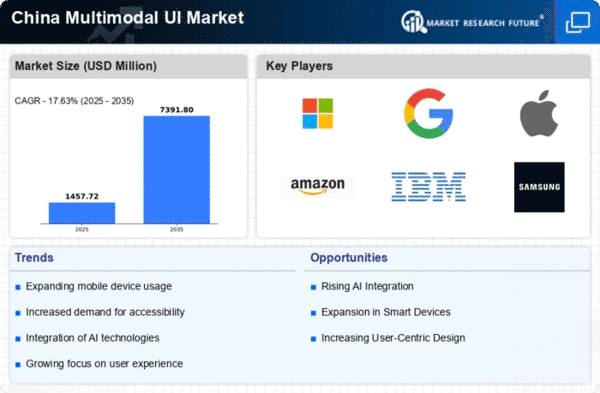
The proliferation of mobile devices in China is a significant driver for the multimodal ui market. With over 1 billion smartphone users, the demand for versatile and user-friendly interfaces is at an all-time high. Mobile applications that utilize multimodal interactions are becoming increasingly popular, as they cater to diverse user preferences and enhance accessibility. Market data suggests that mobile app usage is expected to grow by 20% annually, further emphasizing the need for innovative user interfaces. This trend indicates that the multimodal ui market must adapt to the mobile-first approach, ensuring that applications are designed to leverage various input methods for optimal user engagement.
Focus on Personalization and Customization
The trend towards personalization in technology is a crucial driver for the multimodal ui market in China. Consumers are increasingly seeking tailored experiences that cater to their individual preferences and needs. This shift is prompting companies to develop multimodal interfaces that allow for greater customization, enabling users to interact with technology in ways that feel more personal and intuitive. Market analysis indicates that personalized user experiences can lead to a 30% increase in customer engagement, underscoring the importance of this trend. As a result, the multimodal ui market is likely to see a surge in demand for solutions that prioritize user-centric design and adaptability.
Rising Demand for Enhanced User Experience
The increasing expectation for superior user experiences drives the multimodal ui market in China. As consumers become more tech-savvy, they seek interfaces that are intuitive and engaging. This demand is reflected in the growing adoption of multimodal interfaces that combine voice, touch, and gesture inputs. According to recent data, the user experience sector is projected to grow by 15% annually, indicating a robust market for innovative solutions. Companies are investing heavily in research and development to create seamless interactions across devices, which is likely to enhance customer satisfaction and loyalty. The multimodal ui market is thus positioned to benefit from this trend, as businesses strive to meet the evolving preferences of their users.
Growing Interest in Voice-Activated Technologies
The rise of voice-activated technologies is reshaping the multimodal ui market landscape in China. As consumers increasingly adopt smart speakers and voice assistants, the demand for interfaces that integrate voice recognition with other modalities is likely to surge. Recent statistics indicate that the voice recognition market in China is projected to reach $10 billion by 2026, highlighting the potential for multimodal applications that combine voice with visual and tactile inputs. This trend suggests that the multimodal ui market must prioritize the development of solutions that enhance voice interaction capabilities, thereby catering to the evolving preferences of tech-savvy consumers.
Government Initiatives Supporting Digital Transformation
The Chinese government is actively promoting digital transformation across various sectors, which significantly impacts the multimodal ui market. Initiatives aimed at enhancing technological infrastructure and fostering innovation are likely to create a conducive environment for the growth of multimodal interfaces. For instance, the government's investment in smart city projects and digital economy initiatives is expected to reach approximately $1 trillion by 2025. This financial backing encourages companies to adopt advanced technologies, including multimodal interfaces, to improve service delivery and operational efficiency. Consequently, the multimodal ui market stands to gain from these supportive policies, as they facilitate the integration of cutting-edge solutions into everyday applications.























Leave a Comment