×
Request Free Sample ×

Kindly complete the form below to receive a free sample of this Report

* Please use a valid business email

Leading companies partner with us for data-driven Insights

clients tt-cursor
Hero Background

China Solar Panel Recycling Market

ID: MRFR/EnP/52964-HCR
128 Pages
Snehal Singh
February 2026

China Solar Panel Recycling Market Research Report By Type (Monocrystalline, Polycrystalline, Thin Film), By Process (Thermal, Mechanical, Laser) and By Application (Solar Panel Manufacturing, Construction, Metal Industry, Electronics & Semiconductor industry) - Forecast to 2035

Share:
Download PDF ×

We do not share your information with anyone. However, we may send you emails based on your report interest from time to time. You may contact us at any time to opt-out.

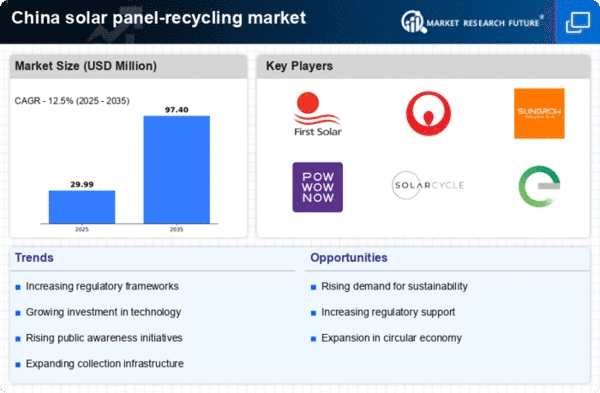
China Solar Panel Recycling Market Infographic
Purchase Options

China Solar Panel Recycling Market Summary

As per Market Research Future analysis, the China Solar Panel Recycling Market size was estimated at 26.66 USD Million in 2024. The Solar Panel-recycling market is projected to grow from 29.99 USD Million in 2025 to 97.4 USD Million by 2035, exhibiting a compound annual growth rate (CAGR) of 12% during the forecast period 2025 - 2035

Key Market Trends & Highlights

The China solar panel-recycling market is poised for substantial growth driven by regulatory support and technological advancements.

  • Regulatory support is enhancing the framework for solar panel recycling, fostering industry growth.
  • Technological advancements in recycling processes are improving efficiency and reducing costs in the sector.
  • Increased public awareness regarding environmental sustainability is driving demand for effective recycling solutions.
  • Rising demand for renewable energy and government incentives are key drivers propelling the market forward.

Market Size & Forecast

2024 Market Size 26.66 (USD Million)
2035 Market Size 97.4 (USD Million)
CAGR (2025 - 2035) 12.5%

Major Players

First Solar (US), Veolia (FR), Sungrow (CN), Recycling Technologies (GB), SolarCycle (US), Enel Green Power (IT), Canadian Solar (CA), Ecolomondo (CA)

Our Impact
Enabled $4.3B Revenue Impact for Fortune 500 and Leading Multinationals
Partnering with 2000+ Global Organizations Each Year
30K+ Citations by Top-Tier Firms in the Industry

China Solar Panel Recycling Market Trends

The China Solar Panel Recycling Market is experiencing notable growth, driven by increasing awareness of environmental sustainability and the need for efficient waste management. As the demand for solar energy continues to rise, the volume of end-of-life solar panels is also expected to increase significantly. This situation presents both challenges and opportunities for the recycling sector. The Chinese government has implemented various policies aimed at promoting renewable energy and enhancing recycling processes, which may further stimulate market development. Additionally, advancements in recycling technologies are likely to improve recovery rates of valuable materials, thereby making the recycling process more economically viable. In recent years, the emphasis on circular economy principles has gained traction, encouraging manufacturers and consumers to consider the lifecycle of solar panels. This shift in perspective may lead to increased collaboration among stakeholders, including manufacturers, recyclers, and policymakers. The solar panel-recycling market appears poised for expansion, as stakeholders recognize the importance of sustainable practices in the energy sector. Furthermore, public awareness campaigns and educational initiatives may play a crucial role in fostering a culture of recycling and responsible disposal of solar panels, ultimately contributing to a more sustainable future.

Regulatory Support

The Chinese government is actively promoting policies that support the recycling of solar panels. This regulatory framework aims to enhance the sustainability of the solar energy sector by establishing guidelines for the proper disposal and recycling of end-of-life panels. Such initiatives may encourage investment in recycling facilities and technologies, thereby fostering market growth.

Technological Advancements

Innovations in recycling technologies are likely to enhance the efficiency and effectiveness of solar panel recycling processes. These advancements may lead to higher recovery rates of valuable materials, such as silicon and metals, which could improve the economic feasibility of recycling operations. As technology evolves, the market may witness a shift towards more sustainable practices.

Increased Public Awareness

There is a growing awareness among the public regarding the importance of recycling solar panels. Educational campaigns and initiatives aimed at informing consumers about the environmental impact of improper disposal may drive demand for recycling services. This heightened awareness could lead to increased participation in recycling programs, ultimately benefiting the solar panel-recycling market.

China Solar Panel Recycling Market Drivers

Circular Economy Initiatives

The push towards a circular economy in China is a significant driver for the solar panel-recycling market. This economic model emphasizes the importance of reusing and recycling materials to reduce waste and conserve resources. In recent years, various industries, including solar energy, have begun to adopt circular economy principles. The Chinese government has set targets for increasing the recycling rate of solar panels, aiming for 50% by 2030. This commitment not only supports the solar panel-recycling market but also encourages collaboration among manufacturers, recyclers, and policymakers to create a more sustainable ecosystem for solar energy production and waste management.

Growing Environmental Concerns

Increasing environmental concerns among the Chinese populace are propelling the solar panel-recycling market forward. As awareness of pollution and waste management issues rises, consumers and businesses alike are advocating for sustainable practices. The environmental impact of discarded solar panels, which can contain hazardous materials, has prompted calls for responsible recycling solutions. In response, companies are investing in recycling technologies and processes to address these concerns. The solar panel-recycling market is thus likely to expand as stakeholders recognize the importance of minimizing ecological footprints and adhering to sustainable development goals.

Government Incentives and Policies

The Chinese government has implemented various incentives and policies to promote the recycling of solar panels, which serves as a crucial driver for the solar panel-recycling market. Initiatives such as subsidies for recycling facilities and tax breaks for companies engaged in sustainable practices encourage investment in recycling technologies. In 2024, the government introduced a policy mandating the recycling of solar panels, which is expected to increase the recycling rate significantly. This regulatory framework not only supports the growth of the recycling market but also aligns with China's broader environmental objectives, fostering a circular economy within the renewable energy sector.

Rising Demand for Renewable Energy

The increasing demand for renewable energy sources in China is a primary driver for the solar panel-recycling market. As the country aims to achieve its ambitious carbon neutrality goals by 2060, the deployment of solar energy systems has surged. In 2023, China accounted for approximately 50% of the world's solar installations, leading to a significant rise in the number of end-of-life solar panels. This growing volume of waste necessitates effective recycling solutions to recover valuable materials such as silicon, silver, and glass. The solar panel-recycling market is thus positioned to benefit from this trend, as stakeholders seek sustainable methods to manage the lifecycle of solar products and minimize environmental impact.

Technological Innovations in Recycling Processes

Technological advancements in recycling processes are transforming the solar panel-recycling market in China. Innovations such as hydrometallurgical and pyrometallurgical methods enhance the efficiency of material recovery from solar panels. These processes allow for the extraction of valuable metals with higher purity levels, which is essential for reintroducing materials into the manufacturing cycle. As of 2025, the recycling rate for solar panels in China is projected to reach 30%, driven by these technological improvements. The ability to recover materials effectively not only reduces waste but also lowers the costs associated with raw material procurement, making recycling an economically viable option for manufacturers.


Market Segment Insights

By Type: Monocrystalline (Largest) vs. Thin Film (Fastest-Growing)

In the China solar panel-recycling market, Monocrystalline panels represent the largest segment by market share, driven by their widespread adoption in solar installations. Polycrystalline panels follow closely, capturing a significant share, while Thin Film technology is rapidly emerging and expanding its footprint in the market. The growing demand for recycling in these categories is substantially influenced by environmental regulations and the increasing number of end-of-life panels in the market. The growth trends within this segment indicate a robust drive towards Monocrystalline solutions, further propelled by advancements in recycling techniques that enhance recovery rates. Meanwhile, Thin Film technology is witnessing rapid growth as manufacturers seek cost-effective and lightweight solutions for solar installations. Factors like technological innovation, favorable government policies, and enhanced recycling processes are driving the expansion of these segment values in the market.

Monocrystalline (Dominant) vs. Thin Film (Emerging)

Monocrystalline solar panels dominate the China solar panel-recycling market due to their high efficiency and longer lifespan, making them the preferred choice for many consumers and businesses. This segment is recognized for its superior energy conversion capabilities, though it tends to be more expensive to manufacture compared to its counterparts. On the other hand, Thin Film technology is emerging as a viable option, appealing to cost-sensitive segments of the market. While less efficient than Monocrystalline, Thin Film panels are lightweight, flexible, and can be produced at a lower cost, making them attractive for various applications. The shifting consumer preferences and increasing investment in recycling initiatives for these technologies highlight their significance in the evolving energy landscape.

By Process: Mechanical (Largest) vs. Thermal (Fastest-Growing)

In the China solar panel-recycling market, the market share distribution among the key processes is notable. Mechanical recycling currently holds the largest share, capitalizing on its established technologies and infrastructure. This method involves physically breaking down the panels, ensuring efficient recovery of valuable materials. In contrast, thermal recycling is emerging rapidly, gaining traction due to its ability to handle complex materials and recycle silicon more effectively, thereby providing a significant boost in sustainability and resource recovery. The growth trends in this segment indicate a shift towards more advanced recycling techniques. The rising demand for sustainable practices in the solar industry drives interest in thermal methods, particularly as regulations tighten on waste management. Furthermore, innovations in laser recycling technology are also contributing to enhanced efficiency and recovery rates, positioning this method as an essential player in the market's evolution, thus pointing towards a more sustainable future for solar panel recycling.

Mechanical (Dominant) vs. Thermal (Emerging)

Mechanical recycling methods dominate the process segment, owing to their robustness and reliability. This approach focuses on the physical dismantling of solar panels, enabling easy extraction of metals and glass while minimizing environmental impact. Its established methodologies lend mechanical recycling a competitive edge in terms of operational scalability and cost-effectiveness. On the other hand, thermal recycling is positioned as an emerging technology with significant potential. This method utilizes heat to break down materials, allowing for more efficient recovery of silicon and other valuable substances. As the solar market pushes for higher recycling rates and compliance with stricter regulations, the role of thermal recycling in complementing mechanical processes will become increasingly vital, setting the stage for innovative breakthroughs in material recovery.

By Application: Solar Panel Manufacturing (Largest) vs. Electronics & Semiconductor industry (Fastest-Growing)

In the China solar panel-recycling market, the application segments reveal a diverse distribution. The Solar Panel Manufacturing sector commands a significant share, owing to the high volume of end-of-life panels requiring recycling. The Construction sector follows closely, motivated by the increasing emphasis on sustainable building practices. Meanwhile, the Metal Industry plays a crucial role in recovering valuable materials, while the Electronics & Semiconductor industry emerges as a vital segment driven by technological advancements and electronic waste management needs. Growth trends in this market are largely influenced by stringent environmental regulations and government initiatives promoting recycling. The Solar Panel Manufacturing segment benefits from a substantial push towards renewable energy, while the Electronics & Semiconductor industry experiences rapid growth due to innovation in tech and the rising demand for electronic waste processing. As sustainability becomes a central theme, these sectors are set to drive notable transformations in the recycling landscape.

Solar Panel Manufacturing (Dominant) vs. Electronics & Semiconductor industry (Emerging)

The Solar Panel Manufacturing segment is characterized by its established position in the recycling landscape, driven by the extensive deployment of solar energy systems across urban and rural areas. This dominance stems from the large volume of panels reaching the end of their life cycle, thus necessitating efficient recycling solutions. Conversely, the Electronics & Semiconductor industry, while still emerging, shows a promising trajectory, primarily due to the series of innovations in electronic devices. This segment is rapidly adapting to the sustainable practices in recycling, addressing both regulatory demands and increasing consumer awareness about e-waste. Together, these segments illustrate the evolving dynamics of the China solar panel-recycling market.

Get more detailed insights about China Solar Panel Recycling Market

Key Players and Competitive Insights

The solar panel-recycling market is currently characterized by a dynamic competitive landscape, driven by increasing regulatory pressures and a growing emphasis on sustainability. Key players are actively positioning themselves through innovative strategies, partnerships, and regional expansions. For instance, First Solar (US) has focused on enhancing its recycling capabilities, aiming to recover up to 90% of materials from decommissioned panels. Meanwhile, Sungrow (CN) is leveraging its technological expertise to develop advanced recycling processes, which could potentially set new industry standards. These strategic initiatives collectively contribute to a more competitive environment, as companies strive to differentiate themselves through operational efficiency and sustainability.
In terms of business tactics, localizing manufacturing and optimizing supply chains appear to be critical for success in this market. The competitive structure is moderately fragmented, with several players vying for market share. However, the influence of major companies like Veolia (FR) and Canadian Solar (CA) is notable, as they continue to expand their operational footprints and enhance their recycling technologies. This collective presence of key players fosters a competitive atmosphere that encourages innovation and efficiency.
In October 2025, Veolia (FR) announced a strategic partnership with a leading Chinese solar manufacturer to establish a state-of-the-art recycling facility in China. This move is significant as it not only enhances Veolia's operational capacity but also aligns with China's stringent environmental regulations, positioning the company as a leader in sustainable practices within the region. The partnership is expected to facilitate the recycling of millions of solar panels annually, thereby contributing to a circular economy.
In September 2025, Canadian Solar (CA) unveiled a new initiative aimed at increasing the recovery rate of valuable materials from end-of-life solar panels. This initiative is particularly important as it underscores the company's commitment to sustainability and resource efficiency. By investing in advanced recycling technologies, Canadian Solar is likely to enhance its competitive edge, appealing to environmentally conscious consumers and investors alike.
Moreover, in August 2025, SolarCycle (US) launched a pilot program focused on the recycling of solar panels in urban areas, which is expected to streamline the collection and processing of used panels. This initiative reflects a growing trend towards urban sustainability and could potentially reshape the logistics of solar panel recycling, making it more accessible and efficient.
As of November 2025, current trends in the solar panel-recycling market indicate a strong shift towards digitalization, sustainability, and the integration of AI technologies. Strategic alliances are increasingly shaping the competitive landscape, as companies recognize the value of collaboration in enhancing operational capabilities. Looking ahead, it seems that competitive differentiation will evolve from traditional price-based competition to a focus on innovation, technological advancements, and supply chain reliability. This shift may redefine market dynamics, compelling companies to invest in cutting-edge solutions that not only meet regulatory requirements but also resonate with the growing demand for sustainable practices.

Key Companies in the China Solar Panel Recycling Market include

Industry Developments

The China Solar Panel Recycling Market has seen significant recent developments with a focus on sustainable practices and regulations aimed at improving recycling rates. In September 2023, Trina Solar announced its enhanced recycling initiative, aimed at reducing environmental impact and promoting circular economy principles. 

Moreover, JA Solar Technology and LONGi Green Energy Technology are collaborating with local authorities to establish recycling facilities, demonstrating a collective effort to address the waste management challenge posed by end-of-life solar panels. Current affairs indicate that the Chinese government is implementing stricter regulations to enhance the recycling landscape, reflecting a strong commitment to sustainability. 

The market has also witnessed a notable growth in valuation, fueled by an increase in demand for cleaner energy solutions. Companies like Yingli Green Energy and GCLPoly Energy are ramping up investments in technology to bolster their recycling capacities. In recent months, directly related mergers or acquisitions remain sparse, but the ongoing strategic partnerships and investments in recycling capabilities signal a growing focus on enhancing the sustainability of the solar sector in China. Overall, the evolving regulatory framework and industry collaborations are pivotal in shaping the future of the solar panel recycling market in China.

Future Outlook

China Solar Panel Recycling Market Future Outlook

The Solar Panel Recycling Market is projected to grow at a 12.5% CAGR from 2025 to 2035, driven by regulatory support, technological advancements, and increasing waste management needs.

New opportunities lie in:

  • Development of automated recycling facilities for efficiency gains.
  • Partnerships with solar manufacturers for end-of-life take-back programs.
  • Investment in R&D for innovative recycling technologies to enhance material recovery.

By 2035, the market is expected to be robust, driven by sustainable practices and increased recycling capacity.

Market Segmentation

China Solar Panel Recycling Market Type Outlook

  • Monocrystalline
  • Polycrystalline
  • Thin Film

China Solar Panel Recycling Market Process Outlook

  • Thermal
  • Mechanical
  • Laser

China Solar Panel Recycling Market Application Outlook

  • Solar Panel Manufacturing
  • Construction
  • Metal Industry
  • Electronics & Semiconductor industry

Report Scope

MARKET SIZE 2024 26.66(USD Million)
MARKET SIZE 2025 29.99(USD Million)
MARKET SIZE 2035 97.4(USD Million)
COMPOUND ANNUAL GROWTH RATE (CAGR) 12.5% (2025 - 2035)
REPORT COVERAGE Revenue Forecast, Competitive Landscape, Growth Factors, and Trends
BASE YEAR 2024
Market Forecast Period 2025 - 2035
Historical Data 2019 - 2024
Market Forecast Units USD Million
Key Companies Profiled First Solar (US), Veolia (FR), Sungrow (CN), Recycling Technologies (GB), SolarCycle (US), Enel Green Power (IT), Canadian Solar (CA), Ecolomondo (CA)
Segments Covered Type, Process, Application
Key Market Opportunities Emerging technologies enhance efficiency in the solar panel-recycling market, addressing sustainability and regulatory demands.
Key Market Dynamics Regulatory pressures and technological advancements drive growth in the solar panel-recycling market.
Countries Covered China
Leave a Comment

FAQs

What is the estimated market value of the China Solar Panel Recycling Market in 2024?

The estimated market value of the China Solar Panel Recycling Market in 2024 is 26.47 million USD.

What is the projected market value of the China Solar Panel Recycling Market by 2035?

The projected market value of the China Solar Panel Recycling Market by 2035 is 99.46 million USD.

What is the expected CAGR for the China Solar Panel Recycling Market from 2025 to 2035?

The expected CAGR for the China Solar Panel Recycling Market from 2025 to 2035 is 12.788 percent.

What type of solar panels hold the largest market share in the recycling market?

Monocrystalline and Polycrystalline solar panels hold the largest market shares in the recycling market.

What is the market value of Monocrystalline solar panel recycling in 2024?

The market value of Monocrystalline solar panel recycling in 2024 is 9.92 million USD.

What will be the market value of Polycrystalline solar panel recycling by 2035?

The market value of Polycrystalline solar panel recycling is projected to be 39.1 million USD by 2035.

What challenges are currently faced by the China Solar Panel Recycling Market?

The China Solar Panel Recycling Market faces challenges regarding technological advancements and efficient recycling processes.

Which companies are regarded as key players in the China Solar Panel Recycling Market?

Key players in the China Solar Panel Recycling Market include Yingli Green Energy, Trina Solar, and First Solar.

What is the projected market value for Thin Film solar panel recycling by 2035?

The projected market value for Thin Film solar panel recycling by 2035 is 22.73 million USD.

How is the China Solar Panel Recycling Market expected to evolve in the coming years?

The China Solar Panel Recycling Market is expected to grow significantly due to increasing environmental concerns and government regulations.

Download Free Sample

Kindly complete the form below to receive a free sample of this Report

Compare Licence

×
Features License Type
Single User Multiuser License Enterprise User
Price $4,950 $5,950 $7,250
Maximum User Access Limit 1 User Upto 10 Users Unrestricted Access Throughout the Organization
Free Customization
Direct Access to Analyst
Deliverable Format
Platform Access
Discount on Next Purchase 10% 15% 15%
Printable Versions