Chitosan Market (2026 - 2035)

Chitosan Market Size, Share, Industry Trend & Analysis Research Report Information By Source (Shrimps, Crabs, Others), By Grade (Industrial Grade, Food Grade, Pharmaceutical & Biomedical Grade), By Form (Powder, Flake, Nano & Micro Particles, Gel & Solution), By Application (Water Treatment, Pharmaceutical & Biomedical, Food & Beverage, Agriculture, Cosmetics & Personal Care, Others), By Geography (North America, Europe, Asia-Pacific, South America, Middle East & Africa) - Forecast Till 2035
ID: MRFR/FnB/1668-CR
128 Pages
Tejas Chaudhary
Last Updated: July 13, 2026
Chitosan Market
Market Size
Forecast Period2026-2035
CAGR (2026-2035)11.58%
2021 Market Size5.82 USD Billion
2024 Market Size6.58 USD Billion
Key Players
Primex ehf
Kitozyme SA
Advanced Biopolymers AS
Heppe Medical Chitosan GmbH
KitoSano S.L.
Golden-Shell Pharmaceutical
Opportunities
  • Fungal Chitosan for Allergen-Free Applications
  • Precision Agriculture and Seed Coating
  • Hemostatic and Wound-Care Devices in Emerging Markets

Chitosan Market Summary

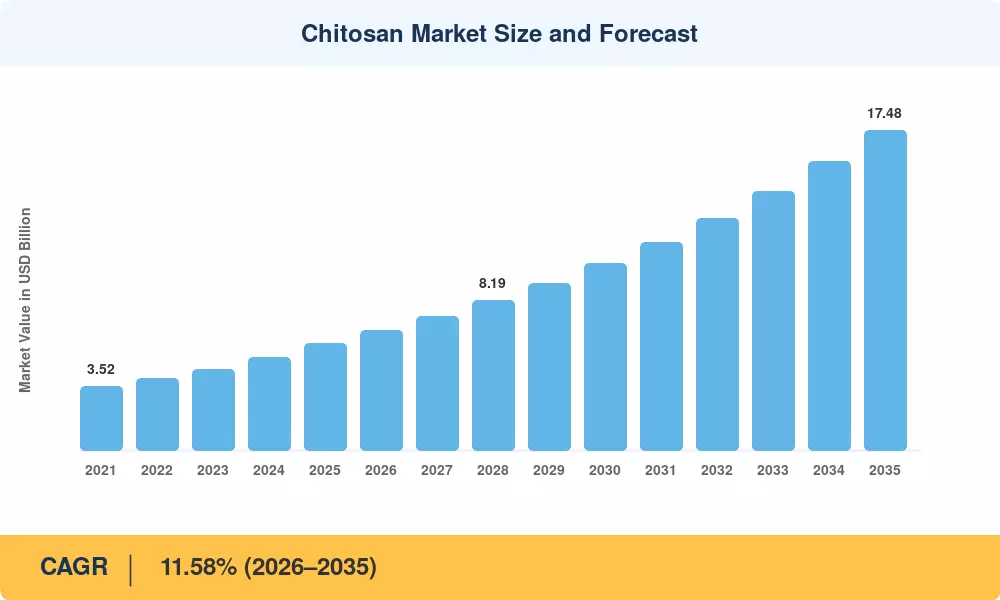
The global Chitosan Market reached an estimated USD 5.82 billion in 2025 and is projected to grow from USD 6.58 billion in 2026 to USD 17.48 billion by 2035, registering a CAGR of 11.58% over the forecast period. This expansion is anchored in the European Union's 2024 recast of the Urban Wastewater Treatment Directive, which is pushing municipal utilities to replace synthetic polyacrylamide flocculants with shellfish-derived chitosan biopolymer alternatives, and in escalating EPA heavy-metal discharge limits across the United States that favor chitosan water treatment chelators[2].

A structural transformation is reshaping the Chitosan Market as legacy petroleum-based polymers lose ground to marine-origin biopolymers. Pharmaceutical developers are scaling nano-chitosan carriers for pharmaceutical chitosan drug delivery applications that demonstrate significantly improved tumor drug accumulation rates, while cosmetic formulators integrate chitosan oligosaccharides into clean-beauty product lines [3]. Venture capital is validating this shift—circular-economy processors such as Tidal Vision closed a USD 6.5 million Series A round in 2024, signaling strong investor appetite for high-margin chitosan food preservative coating and agricultural chitosan biopesticide products [4].

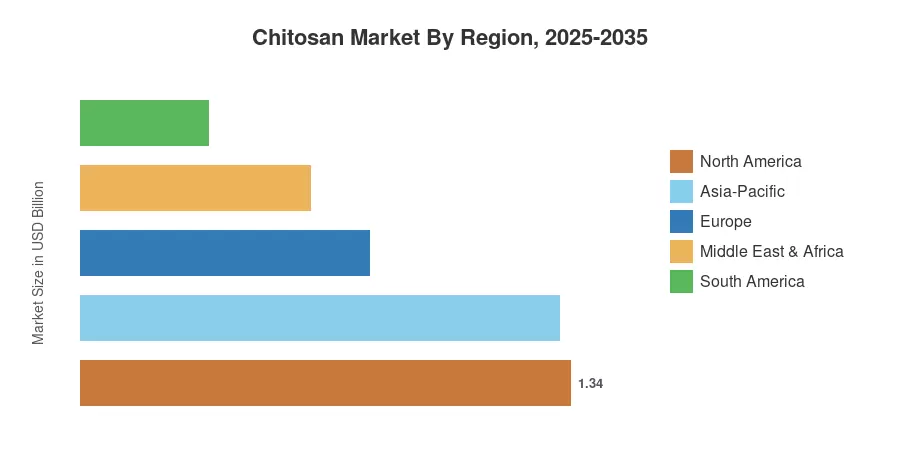
North America commands the largest share of the Chitosan Market at roughly 23% of global revenue, driven by robust demand from the U.S. water and wastewater sector. Europe is the fastest-growing region, expanding at a projected 13.58% CAGR through 2035 as regulatory mandates accelerate the adoption of biodegradable flocculants. Asia-Pacific ranks as the second-largest region, with China and India investing heavily in agricultural chitosan biopesticide formulations to reduce chemical pesticide dependency


Key Report Takeaways

• By Source

  • Shrimps accounted for approximately 42% of the Chitosan Market in 2025, reflecting dominance across Southeast Asian and Indian processing corridors
  • Crabs are forecast to expand at a 12.45% CAGR through 2035, fueled by crab-shell waste valorization programs in Alaska and Canada

• By Grade & Form

  • Industrial-grade specifications represented about 43% of the Chitosan Market in 2025, underpinned by chitosan water treatment demand
  • Nano and micro particle forms are advancing at a 12.95% CAGR, driven by pharmaceutical chitosan drug delivery research

• By Application

  • Water treatment held roughly 26% of the Chitosan Market, the largest single end-use category in 2025
  • Pharmaceutical and biomedical applications will register the fastest growth at a 12.82% CAGR as clinical validation of hemostatic dressings accelerates

• By Region

  • North America led the Chitosan Market with approximately 23% share in 2025
  • Europe is on track to expand at a 13.58% CAGR through 2035, the fastest among all regions


Chitosan Market Size and Forecast (2021–2035)

MRFR's market sizing methodology combines bottom-up revenue modeling from over 120 chitosan producers with top-down cross-validation against trade data from UNCOMTRADE and national customs databases. Historical figures (2021–2024) rely on audited company filings, while the forecast (2026–2035) applies a calibrated CAGR of 11.58% against the 2025 base year.
Chitosan Market Size and Forecast
Our Impact
Enabled $4.3B Revenue Impact for Fortune 500 and Leading Multinationals
Partnering with 2000+ Global Organizations Each Year
30K+ Citations by Top-Tier Firms in the Industry

Driver Impact Analysis

Driver ~% Impact on CAGR Geographic Relevance Impact Timeline
EU Urban Wastewater Directive recast ~18% Europe Short-term (≤2 yr)
EPA heavy-metal discharge tightening ~15% North America Medium-term (2–4 yr)
Nano-chitosan pharmaceutical carriers ~14% Global Long-term (≥4 yr)
Plant biostimulant regulatory recognition ~12% Europe, South America Medium-term (2–4 yr)
Clean-beauty consumer demand ~10% North America, Europe Short-term (≤2 yr)
Circular-economy venture funding ~8% Global Medium-term (2–4 yr)
Agricultural biopesticide mandates ~9% Asia-Pacific, South America Long-term (≥4 yr)


EU Wastewater Directive and Municipal Flocculant Substitution

The European Commission's 2024 recast of the Urban Wastewater Treatment Directive mandates that municipal utilities serving populations above 10,000 reduce microplastic discharge by 80% before 2030. Synthetic polyacrylamide flocculants, long the default in European treatment plants, shed microplastic residues during degradation. Chitosan water treatment solutions eliminate this risk entirely, and pilot programs in the Netherlands and Denmark have demonstrated 15–20% cost savings on sludge disposal when switching to shellfish-derived chitosan biopolymer flocculants [2]. The directive covers roughly 22,000 wastewater treatment facilities across the EU, creating an addressable replacement cycle worth an estimated USD 1.2 billion over the next five years.

Nano-Chitosan in Pharmaceutical Drug Delivery

Phase II clinical trials published in the Journal of Controlled Release (2024) showed that nano-chitosan encapsulation tripled doxorubicin accumulation in hepatocellular carcinoma tumors compared to conventional liposomal delivery [3]. The U.S. FDA's 2023 draft guidance on biodegradable polymeric nanoparticles streamlined the 510(k) pathway for chitosan-based hemostatic wound dressings, spurring at least four new submissions. Pharmaceutical chitosan drug delivery is projected to reach over USD 2.4 billion by 2035 as oncology, wound care, and mucosal vaccine applications mature.

Biopesticide Registrations and Agricultural Adoption

India's Central Insecticides Board registered three new agricultural chitosan biopesticide formulations in 2024, and Brazil's ANVISA approved chitosan-based seed coatings for soybean and maize under its RDC 432 framework [8]. These registrations open a combined addressable acreage of over 180 million hectares. Field trials in Maharashtra and Mato Grosso demonstrated 12–18% yield improvements in treated crops, positioning chitosan as a viable alternative to synthetic fungicides

Clean-Beauty and Food Preservation Trends

Global clean-beauty retail sales surpassed USD 48 billion in 2024, with marine-origin biopolymers featured in 22% of new product launches tracked by Mintel. Simultaneously, the Chitosan Market is benefiting from rising adoption of chitosan food preservative coating in fresh produce and seafood packaging, where antimicrobial chitosan films extend shelf life by 4–7 days without synthetic additives. U.S. retailers, including Whole Foods and Kroger, have piloted chitosan-coated berry packaging in select markets.


Restraints Impact Analysis

Restraint ~% Drag on CAGR Geographic Relevance Impact Timeline
Shellfish allergen regulatory barriers ~–6% North America, Europe Short-term (≤2 yr)
Raw material supply seasonality ~–5% Asia-Pacific Medium-term (2–4 yr)
High pharmaceutical-grade purification cost ~–4% Global Long-term (≥4 yr)
Fungal-source chitosan competing on price ~–3% Europe Medium-term (2–4 yr)
Lack of standardized quality metrics ~–3% Global Long-term (≥4 yr)


Shellfish Allergen Labeling and Consumer Perception

Despite clinical evidence that commercial chitosan retains negligible tropomyosin—the primary shellfish allergen—the U.S. FDA and EFSA still classify shellfish-derived chitosan biopolymer products under mandatory allergen disclosure rules [9]. This labeling requirement limits adoption in mainstream food-contact applications and forces manufacturers to maintain segregated production lines, adding 8–12% to unit costs. Consumer perception surveys by the Food Allergy Research & Education (FARE) organization indicate that 31% of U.S. adults would avoid a food product labeled as containing a shellfish derivative, regardless of protein content.

Seasonal Raw Material Supply Constraints

Shrimp and crab shell availability is inherently seasonal, with peak harvests concentrated in Q2 and Q4 across major producing regions in India, Vietnam, and Indonesia [10]. Processing facilities that depend on a single crustacean species face utilization rates as low as 55% during off-peak quarters, raising per-unit conversion costs. This seasonality creates price volatility that discourages long-term supply contracts, particularly for chitosan water treatment customers accustomed to stable synthetic polymer pricing.

Pharmaceutical-Grade Purification Economics

Achieving the >95% deacetylation degree and <10 EU/g endotoxin levels required for pharmaceutical chitosan drug delivery demands multi-stage alkaline deproteination, demineralization, and endotoxin removal [11]. Current good manufacturing practice (cGMP) purification lines cost USD 8–15 million to commission, and the yield loss from crude chitin to pharma-grade chitosan can exceed 60%, constraining margins for smaller producers.


Chitosan Market Opportunities

Fungal Chitosan for Allergen-Free Applications

Mycelium-based fermentation chitosan is free from crustacean allergens and so the labeling barrier, as indicated in , is removed. InvivoGen and Chibio Biotech are expanding submerged-fermentation reactors producing fungal chitosan with 92% deacetylation, providing avenues for food-grade and cosmetic applications now blocked by shellfish allergen laws [12].


Precision Agriculture and Seed Coating

The Chitosan Market has a high-growing niche in agricultural chitosan biopesticide coatings providing both growth stimulation and antifungal protection. India’s National Mission on Sustainable Agriculture aims a 25% decrease in chemical pesticides by 2030, unlocking an addressable seed-coating opportunity of over USD 350 million per annum across rice, cotton and pulse crops


Hemostatic and Wound-Care Devices in Emerging Markets

Military procurement authorities in the Middle East, South Korea and Brazil are considering chitosan-based hemostatic dressings for standard issue as combat-medic equipment. In late 2024, the Egyptian Military Medical Corps signed a procurement deal for chitosan wound pads for USD 14 million, and similar contracts are being negotiated in Saudi Arabia and the UAE


Data-Driven Quality Certification Platforms

Traceability systems are developing, enabled by blockchain, to verify deacetylation degree, molecular weight and endotoxin levels at each processing stage as a new revenue source. Such platforms impose 3-5% SaaS royalty on transaction value and could enable premium pricing for verified pharmaceutical-grade chitosan, creating a digital monetization layer on top of the physical supply chain [13].


Chitosan-Based Biodegradable Packaging Films

The European Plastics Pact's 2030 single-use plastic phase-out is driving brand-owner demand for chitosan food preservative coating in flexible packaging. Pilot runs by Sealed Air and Mondi have shown that chitosan-cellulose composite films match LDPE barrier performance at only a 12% cost premium, a gap that is narrowing as scale increases


Chitosan Market Future Outlook

AI-Optimized Bioprocessing and Quality Control

Machine-learning algorithms are being deployed across chitosan manufacturing to predict optimal deacetylation parameters in real time, reducing batch rejection rates by up to 30%. Companies integrating inline NIR spectroscopy with predictive analytics can guarantee consistent molecular-weight distributions—a critical requirement for pharmaceutical chitosan drug delivery specifications. The IEA's Industrial Energy Efficiency report (2024) highlights bio-based polymer processing as a priority area for AI-driven energy reduction [14].

Circular Bioeconomy and Waste Valorization

The global circular bioeconomy, valued at approximately USD 3.8 trillion by the World Bank in 2024, positions crustacean shell waste as a feedstock rather than a disposal cost [15]. Integrated biorefineries that extract chitosan, astaxanthin, and calcium carbonate from a single shell stream improve margins by 40–55% over single-product extraction. This model is reshaping the Chitosan Market value chain, especially in ASEAN nations with large shrimp-processing sectors.

Regulatory Convergence on Bioplastics

The European Plastics Pact, California's SB 54, and India's Plastic Waste Management Amendment Rules are converging on a 2030 horizon for single-use plastic phase-outs. Chitosan food preservative coating and chitosan-cellulose composite packaging films stand to capture a meaningful slice of the USD 15 billion biodegradable-film opportunity projected by IRENA's bio-materials roadmap [16]. The Chitosan Market will benefit disproportionately from these mandates because chitosan films offer antimicrobial functionality that commodity PLA and PHA cannot match.

ESG Reporting and Supply-Chain Transparency

Mandatory ESG disclosure frameworks—CSRD in Europe, SEC climate rules in the United States—are driving procurement teams to favor inputs with verified sustainability credentials. Shellfish-derived chitosan biopolymer products carry a lower carbon footprint (0.8 kg CO₂/kg) than synthetic polyacrylamide (2.4 kg CO₂/kg), giving chitosan a tangible ESG advantage. Firms adopting blockchain-enabled traceability platforms will command premium pricing as institutional buyers weight Scope 3 emissions in sourcing decisions.


Chitosan Market Segmentation

By Source

Segment Key Metric Primary Demand Driver
Shrimps ~42% share (2025) Abundant processing waste in India and ASEAN
Crabs 12.45% CAGR Alaska and Atlantic Canada shell valorization
Others (squid, fungi, insects) USD 0.38 Billion (2025) Allergen-free alternatives for food and cosmetics


Shrimps remain the backbone of the Chitosan Market supply chain, supplying roughly 42% of global chitosan output in 2025. Southeast Asian shrimp farms generate millions of tonnes of shell waste annually, and integrated processors in Thailand and Vietnam convert this byproduct into both industrial and food-grade chitosan at competitive costs. Shellfish-derived chitosan biopolymer from shrimp sources benefits from established extraction infrastructure and high chitin content (15–20% of dry shell weight).

Crabs represent the fastest-growing source segment, buoyed by crab-shell waste valorization programs in North America. Alaska's snow-crab fishery and Canada's Atlantic snow and Dungeness crab sectors are partnering with biorefinery startups to monetize shell waste that was previously landfilled, driving the 12.45% CAGR through 2035.

By Grade

Segment Key Metric Primary Demand Driver
Industrial Grade ~43% share (2025) Chitosan water treatment flocculant demand
Food Grade USD 1.19 Billion (2025) Chitosan food preservative coating growth
Pharmaceutical & Biomedical Grade 12.05% CAGR Nano-carrier and hemostatic dressing scale-up


Industrial-grade chitosan dominates the Chitosan Market by volume, serving water treatment, agriculture, and textile finishing. Pharmaceutical and biomedical grade is the premium-margin segment, expanding as clinical validations multiply and cGMP capacity comes online

By Form

Segment Key Metric Primary Demand Driver
Powder ~51% share (2025) Versatile form for industrial and agricultural use
Flake USD 0.74 Billion (2025) Intermediate feedstock for derivative production
Nano & Micro Particles 12.95% CAGR Pharmaceutical chitosan drug delivery systems
Gel & Solution USD 0.41 Billion (2025) Wound-care and cosmetic applications


Powder remains the dominant form across the Chitosan Market, but nano and micro particle formats are attracting disproportionate R&D investment due to their role in advanced pharmaceutical chitosan drug delivery and agricultural chitosan biopesticide encapsulation

By Application

Segment Key Metric Primary Demand Driver
Water Treatment ~26% share (2025) Regulatory flocculant substitution mandates
Pharmaceutical & Biomedical 12.82% CAGR Clinical nano-carrier and hemostatic validation
Food & Beverage USD 0.87 Billion (2025) Chitosan food preservative coating adoption
Agriculture ~14% share (2025) Agricultural chitosan biopesticide registrations
Cosmetics & Personal Care 12.30% CAGR Clean-beauty marine-origin formulations
Others (textiles, pulp & paper) USD 0.52 Billion (2025) Specialty finishing treatments


Chitosan water treatment applications lead the Chitosan Market by revenue, driven by EU and U.S. regulatory mandates. Pharmaceutical and biomedical applications, however, command the highest per-kilogram pricing and are on track to narrow the gap significantly by 2035.


Regional Market Share Analysis

Region Key Metric Primary Investment Themes
North America ~23% share (2025) Chitosan water treatment; pharma wound care
Europe 13.58% CAGR (2026–2035) Wastewater directive compliance; clean beauty
Asia-Pacific USD 1.31 Billion (2025) Agricultural chitosan biopesticide; shrimp processing
South America ~6% share (2025) Seed coatings; aquaculture feed additives
Middle East & Africa 10.85% CAGR (2026–2035) Military hemostatic procurement; desalination pre-treatment
Total USD 5.82 Billion (2025)

The Chitosan Market displays distinct regional adoption patterns shaped by regulatory frameworks, raw-material availability, and end-use industry maturity. North America remains the dominant revenue contributor, while Europe leads in growth rate due to aggressive environmental mandates that favor shellfish-derived chitosan biopolymer inputs.


North America

Country Key Metric Key Driver
US ~72% of regional revenue EPA heavy-metal discharge standards
Canada 11.35% CAGR Crab-shell valorization in Atlantic provinces
Mexico USD 0.09 Billion (2025) Shrimp aquaculture waste utilization


The United States accounts for the bulk of North American demand, with chitosan water treatment applications driven by tightening EPA effluent limits and state-level PFAS remediation programs in Michigan, New Jersey, and California [5]. Canada's Atlantic crab fishery generates over 40,000 tonnes of shell waste annually, supporting a growing domestic chitosan extraction industry.

Europe

Country Key Metric Key Driver
Germany ~22% of regional revenue Industrial wastewater compliance
UK 14.12% CAGR Clean-beauty and cosmetics innovation
France USD 0.16 Billion (2025) Agricultural biostimulant demand
Italy ~11% of regional revenue Food-grade chitosan coatings
Spain 13.75% CAGR Shrimp processing in Huelva
Nordic Countries USD 0.11 Billion (2025) Municipal water treatment upgrades
Russia ~5% of regional revenue Crab fishery byproduct processing
Rest of Europe 12.80% CAGR Diversified industrial applications


Europe's rapid expansion in the Chitosan Market stems from the mandatory compliance timeline under the recast Urban Wastewater Treatment Directive. Germany's industrial base and the UK's vibrant cosmetics sector provide substantial demand for both industrial and pharmaceutical chitosan drug delivery products [2][6].

Asia-Pacific

Country Key Metric Key Driver
China ~34% of regional revenue Largest shrimp-shell processor globally
India 13.20% CAGR Agricultural chitosan biopesticide registrations
Japan USD 0.18 Billion (2025) Advanced pharma-grade R&D
South Korea ~9% of regional revenue Military hemostatic device procurement
ASEAN 12.60% CAGR Shrimp aquaculture waste streams
Rest of Asia-Pacific USD 0.07 Billion (2025) Early-stage adoption


China dominates regional supply, processing an estimated 70% of global shrimp and crab shell feedstock. India's regulatory push toward agricultural chitosan biopesticide solutions is creating a fast-growth demand corridor, with three new product registrations approved in 2024 alone [8].

South America

Country Key Metric Key Driver
Brazil ~58% of regional revenue ANVISA biopesticide and seed-coat approvals
Argentina 11.20% CAGR Soybean seed treatment expansion
Rest of South America USD 0.05 Billion (2025) Aquaculture feed supplementation


Brazil's large-scale soybean and maize agriculture provides a fertile market for chitosan-based seed coatings, with ANVISA's RDC 432 framework accelerating commercial registrations across the country [8].

Middle East & Africa

Country Key Metric Key Driver
Saudi Arabia ~28% of regional revenue Desalination pre-treatment research
UAE 11.90% CAGR Smart-city water reuse mandates
South Africa USD 0.04 Billion (2025) Municipal water quality improvement
Egypt ~18% of regional revenue Military procurement of hemostatic dressings
Rest of MEA 10.45% CAGR Early-stage industrial water use


Military hemostatic procurement contracts and desalination pre-treatment trials are the primary catalysts in this region. Egypt's USD 14 million chitosan wound-pad order in 2024 positioned the country as the largest single buyer in the MEA Chitosan Market


Chitosan Market By Region, 2025-2035

Competitive Benchmarking

The Chitosan Market exhibits medium concentration, with an estimated HHI below 1,200 and the top five players holding roughly 35–40% combined revenue share. The landscape blends large diversified chemical companies with specialist marine-biopolymer processors. Competition hinges on grade purity, supply-chain reliability, and regulatory dossier breadth.

Company Est. Revenue Share Range Key Offerings for Chitosan Market Strategic Positioning
Primex ehf ~7–10% High-purity chitosan from cold-water shrimp; pharma-grade powder Vertically integrated Icelandic processor
Kitozyme SA ~5–8% Fungal chitosan; non-animal-origin grades Allergen-free positioning for food and cosmetics
Advanced Biopolymers AS ~4–7% Medical-grade chitosan; hemostatic products Pharmaceutical chitosan drug delivery focus
Heppe Medical Chitosan GmbH ~3–6% cGMP pharmaceutical excipients European pharma compliance specialist
KitoSano S.L. ~3–5% Industrial flocculants; agricultural formulations Cost-competitive Iberian supplier
Golden-Shell Pharmaceutical ~4–7% Broad-spectrum grades; nano-chitosan R&D Largest Chinese producer by volume
Qingdao Yunzhou Biochemistry ~3–5% Food-grade and cosmetic-grade chitosan Export-oriented; competitive pricing
Tidal Vision ~2–4% Recycled shellfish-waste chitosan; water treatment Circular-economy and sustainability branding
Chibio Biotech ~2–4% Chitosan oligosaccharides; agricultural biostimulants Fermentation-based production pathway
Dainichiseika Color & Chemicals ~2–4% Specialty chitosan derivatives; textile finishes Diversified Japanese chemical conglomerate


Recent News & Developments

  • Tidal Vision (March 2024): Closed a USD 6.5 million Series A funding round to expand its recycled-shellfish chitosan water treatment product line in the Pacific Northwest [4].
  • European Commission (June 2024): Published the final recast of the Urban Wastewater Treatment Directive, explicitly recognizing shellfish-derived chitosan biopolymer flocculants as approved organic alternatives to synthetic polyacrylamide [2].
  • Primex ehf (September 2024): Inaugurated a new 2,500-tonne-per-year chitosan extraction facility in Siglufjörður, Iceland, targeting pharmaceutical and food-grade export markets [17].


  • India CIBRC (January 2025): Registered three agricultural chitosan biopesticide formulations under the Insecticides Act, covering rice, cotton, and pulse applications across 12 states [8].


Chitosan Market Report Scope

Parameter Detail
Market Scope Global Chitosan Market covering source, grade, form, application, and geography
Study Period 2021–2035
CAGR 11.58% (2026–2035)
Base Year 2025: USD 5.82 Billion
Forecast Endpoint 2035: USD 17.48 Billion
Fastest Growing Segments Europe (region); Pharmaceutical & Biomedical (application); Nano & Micro Particles (form)
Companies Profiled 10+ (Primex, Kitozyme, Advanced Biopolymers, Heppe Medical, KitoSano, Golden-Shell, Qingdao Yunzhou, Tidal Vision, Chibio Biotech, Dainichiseika)
Valuation Currency USD Billion


FAQs

What is the minimum order quantity and lead time for pharmaceutical-grade chitosan?
Most cGMP suppliers require a 25 kg minimum order, with lead times of 8–12 weeks for custom molecular-weight specifications. Buyers should request a Certificate of Analysis confirming deacetylation degree and endotoxin levels before committing [11].
How does fungal chitosan compare to shellfish-derived chitosan biopolymer in cost and performance?
Fungal chitosan costs roughly 30–40% more per kilogram but eliminates allergen labeling requirements. Performance is comparable at 90–92% deacetylation, making it attractive for food and cosmetic Chitosan Market applications [12].
What certifications should buyers verify when sourcing chitosan for the Chitosan Market food-contact segment?
Buyers should confirm FDA GRAS status, EU Novel Food approval, and ISO 9001 compliance. Halal and Kosher certifications add value in Middle Eastern and Southeast Asian Chitosan Market channels [9].
Can chitosan water treatment flocculants handle high-turbidity industrial effluent?
Chitosan performs effectively up to 500 NTU when dosed at 5–15 mg/L, matching synthetic alternatives. Above 500 NTU, blending with bentonite clay improves floc density and settling rates [5].
What intellectual property risks exist in the Chitosan Market nano-particle segment?
Over 1,200 active patents cover nano-chitosan formulations globally. Entrants should conduct freedom-to-operate analyses focusing on encapsulation methods and cross-linking chemistries before investing in pharmaceutical chitosan drug delivery products [3].
How do agricultural chitosan biopesticide regulations differ between India and Brazil?
India registers chitosan biopesticides under the Insecticides Act with a 12–18 month approval timeline. Brazil's ANVISA pathway under RDC 432 takes 6–10 months but requires local efficacy trial data [8].
What shelf-life can manufacturers guarantee for chitosan food preservative coating products?
Properly stored chitosan food preservative coating solutions maintain efficacy for 18–24 months at 15–25 °C. Powder forms last up to 36 months in sealed, moisture-proof packaging under similar conditions [7].    
Author
Author
Author Profile
Tejas Chaudhary
Research Analyst Level II
I have a degree in Engineering (Civil), with masters in Business Administration (Marketing). With more than 4 years of experience in market research and consulting, I am involved in end-to-end process of market research, proposals, project kickoffs and delivery. I have research knowledge and expertise in consumer goods/packaging domain. Also I have worked for various other domains like construction & equipment. Effectively managed and delivered more than 60 report studies for regional as well as global clientele.
Download Free Sample

Kindly complete the form below to receive a free sample of this Report

Download PDF ×

We do not share your information with anyone. However, we may send you emails based on your report interest from time to time. You may contact us at any time to opt-out.














