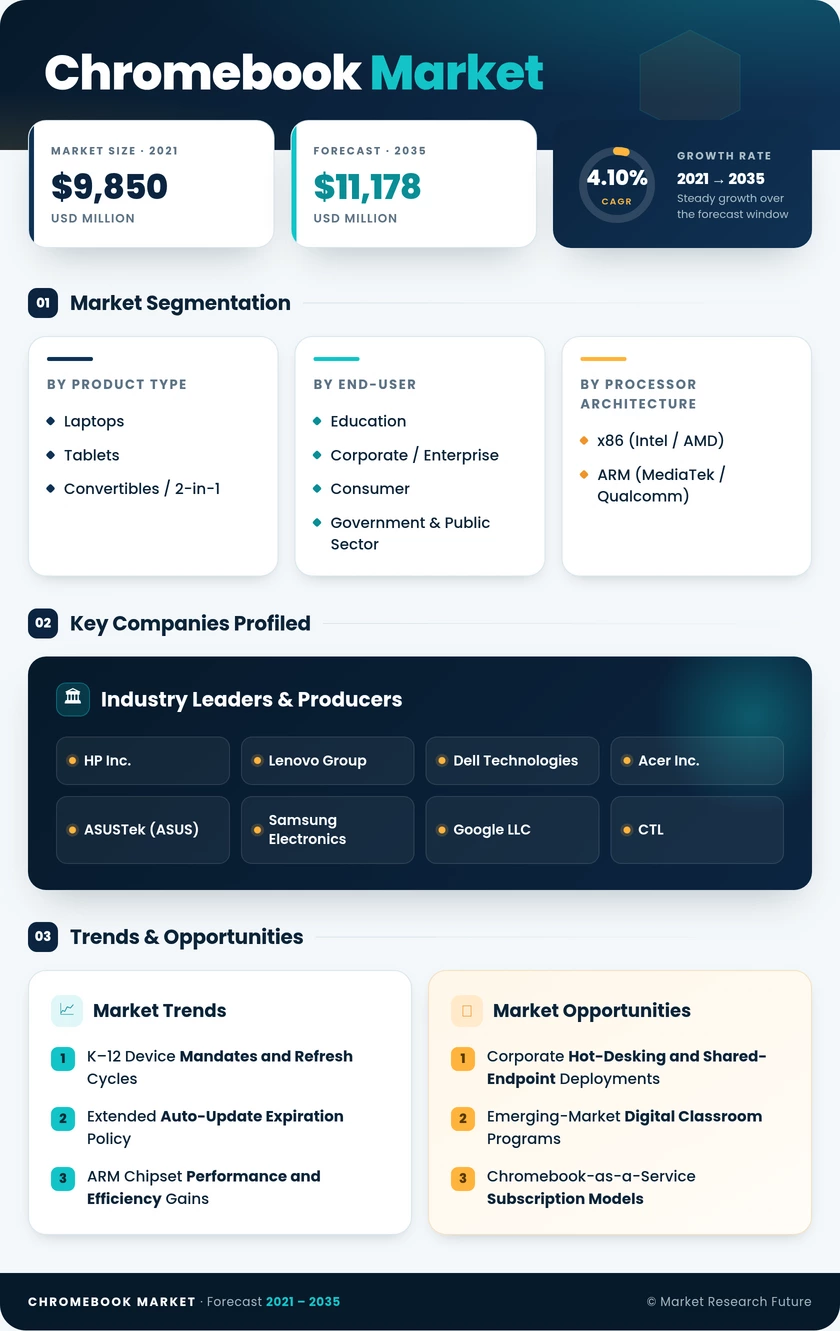
Chromebook Market (2026 - 2035)

ID: MRFR/ICT/30149-HCR
100 Pages
Nirmit Biswas
Last Updated: July 13, 2026
Chromebook Market Research Report: By Product Type (Standard Chromebooks, Convertible Chromebooks, Detachable Chromebooks), By Screen Size (Less than 11 inches, 11 to 14 inches, More than 14 inches), By Processor Type (Intel Processors, ARM Processors, AMD Processors), By Usage Segment (Education, Business, Personal Use), By Storage Capacity (Less than 32 GB, 32 GB to 64 GB, More than 64 GB) and By Regional (North America, Europe, South America, Asia Pacific, Middle East and Africa) - Forecast to 20354
Chromebook Market
Market Size
Forecast Period2026-2035
CAGR (2026-2035)4.10%
2025 Market SizeUSD 7,480 Million
2035 Market SizeUSD 11,178 Million
Key Players
HP Inc.
Lenovo Group
Dell Technologies
Acer Inc.
ASUSTek
Samsung Electronics
Opportunities
  • Corporate Hot-Desking and Shared-Endpoint Deployments
  • Emerging-Market Digital Classroom Programs
  • Chromebook-as-a-Service Subscription Models
  1. 1 Market Overview |
    1. 1.1 Study Assumptions & Market Definition |
    2. 1.2 Scope of the Study |
    3. 1.3 Research Methodology
  2. 2 Market Summary & Key Takeaways
  3. 3 Market Dynamics |
    1. 3.1 Market Drivers Analysis | |
      1. 3.1.1 K–12 1:1 Device Mandates and Refresh Cycles | |
      2. 3.1.2 Extended Auto-Update Expiration Policy | |
      3. 3.1.3 ARM Chipset Performance and Efficiency Gains | |
      4. 3.1.4 Enterprise Zero-Trust Endpoint Migration | |
      5. 3.1.5 On-Device Generative-AI Integration | |
      6. 3.1.6 Tariff-Driven Supply-Chain Diversification | |
      7. 3.1.7 Government Digital-Literacy Programs |
    2. 3.2 Market Restraints Analysis | |
      1. 3.2.1 Windows and macOS Ecosystem Lock-In | |
      2. 3.2.2 Limited Offline Application Depth | |
      3. 3.2.3 Tariff and Trade-Policy Volatility | |
      4. 3.2.4 Component Cost Inflation (DRAM, NAND) | |
      5. 3.2.5 Perception Gap in Enterprise IT |
    3. 3.3 Market Opportunity Analysis | |
      1. 3.3.1 Corporate Hot-Desking and Shared-Endpoint Deployments | |
      2. 3.3.2 Emerging-Market Digital Classroom Programs | |
      3. 3.3.3 Chromebook-as-a-Service Subscription Models | |
      4. 3.3.4 Generative-AI On-Device Workloads | |
      5. 3.3.5 Data-Driven Fleet Analytics and Monetization |
    4. 3.4 Industry Value Chain Analysis |
    5. 3.5 Porter's Five Forces Analysis
  4. 4 Global Chromebook Market Size & Forecast (2021–2035) |
    1. 4.1 Historical Market Size (2021–2025) |
    2. 4.2 Current & Forecast Market Size (2026–2035) |
    3. 4.3 Market Size by Revenue (USD Million) |
    4. 4.4 Year-over-Year Growth Analysis
  5. 5 Segmentation Analysis |
    1. 5.1 By Product Type | |
      1. 5.1.1 Laptops | |
      2. 5.1.2 Tablets | |
      3. 5.1.3 Convertibles / 2-in-1 |
    2. 5.2 By End-User | |
      1. 5.2.1 Education | |
      2. 5.2.2 Corporate / Enterprise | |
      3. 5.2.3 Consumer | |
      4. 5.2.4 Government & Public Sector |
    3. 5.3 By Processor Architecture | |
      1. 5.3.1 x86 (Intel / AMD) | |
      2. 5.3.2 ARM (MediaTek / Qualcomm) |
    4. 5.4 By Distribution Channel | |
      1. 5.4.1 Online Retail | |
      2. 5.4.2 Institutional Contracts | |
      3. 5.4.3 Offline Retail | |
      4. 5.4.4 VARs / Systems Integrators
  6. 6 Regional Analysis |
    1. 6.1 North America | |
      1. 6.1.1 United States | |
      2. 6.1.2 Canada | |
      3. 6.1.3 Mexico |
    2. 6.2 Europe | |
      1. 6.2.1 Germany | |
      2. 6.2.2 United Kingdom | |
      3. 6.2.3 France | |
      4. 6.2.4 Italy | |
      5. 6.2.5 Spain | |
      6. 6.2.6 Nordic Countries | |
      7. 6.2.7 Russia | |
      8. 6.2.8 Rest of Europe |
    3. 6.3 Asia-Pacific | |
      1. 6.3.1 China | |
      2. 6.3.2 India | |
      3. 6.3.3 Japan | |
      4. 6.3.4 South Korea | |
      5. 6.3.5 ASEAN | |
      6. 6.3.6 Rest of Asia-Pacific |
    4. 6.4 South America | |
      1. 6.4.1 Brazil | |
      2. 6.4.2 Argentina | |
      3. 6.4.3 Rest of South America |
    5. 6.5 Middle East & Africa | |
      1. 6.5.1 Saudi Arabia | |
      2. 6.5.2 UAE | |
      3. 6.5.3 South Africa | |
      4. 6.5.4 Egypt | |
      5. 6.5.5 Rest of MEA
  7. 7 Competitive Landscape |
    1. 7.1 Market Share Analysis (2025) |
    2. 7.2 Competitive Benchmarking Matrix |
    3. 7.3 Company Profiles | |
      1. 7.3.1 HP Inc. | |
      2. 7.3.2 Lenovo Group | |
      3. 7.3.3 Dell Technologies | |
      4. 7.3.4 Acer Inc. | |
      5. 7.3.5 ASUSTek (ASUS) | |
      6. 7.3.6 Samsung Electronics | |
      7. 7.3.7 Google LLC | |
      8. 7.3.8 CTL | |
      9. 7.3.9 Dynabook (Sharp) | |
      10. 7.3.10 Framework Computer
  8. 8 Future Outlook & Strategic Recommendations (2026–2035) |
    1. 8.1 On-Device AI and Intelligent Endpoints |
    2. 8.2 ChromeOS–Android Platform Convergence |
    3. 8.3 Sustainability and Circular-Economy Mandates |
    4. 8.4 Supply-Chain Regionalization and Near-Shoring
  9. 9 Recent Developments & News
  10. 10 Frequently Asked Questions (FAQs)
  11. 11 Report Scope & Methodology |
    1. 11.1 Study Period & Base Year |
    2. 11.2 Data Sources & Citations |
    3. 11.3 Abbreviations
  12. 12 LIST OF TABLES |
  13. TABLE 1 Global Chromebook Market Size & Forecast, by Revenue (USD Million), 2021–2035 |
  14. TABLE 2 Global Chromebook Market — Year-over-Year Growth Analysis, 2021–2035 |
  15. TABLE 3 Global Chromebook Market — Driver Impact Analysis, 2026–2035 |
  16. TABLE 4 Global Chromebook Market — Restraint Impact Analysis, 2026–2035 |
  17. TABLE 5 Global Chromebook Market Size, by Product Type, 2021–2035 (USD Million) |
  18. TABLE 6 Global Chromebook Market Size, by End-User, 2021–2035 (USD Million) |
  19. TABLE 7 Global Chromebook Market Size, by Processor Architecture, 2021–2035 (USD Million) |
  20. TABLE 8 Global Chromebook Market Size, by Distribution Channel, 2021–2035 (USD Million) |
  21. TABLE 9 Global Chromebook Market Size, by Region, 2021–2035 (USD Million) |
  22. TABLE 10 Regional Summary — Key Metrics and Investment Themes, 2025 |
  23. TABLE 11 North America Chromebook Market Size, by Country, 2021–2035 (USD Million) |
  24. TABLE 12 Europe Chromebook Market Size, by Country, 2021–2035 (USD Million) |
  25. TABLE 13 Asia-Pacific Chromebook Market Size, by Country, 2021–2035 (USD Million) |
  26. TABLE 14 South America Chromebook Market Size, by Country, 2021–2035 (USD Million) |
  27. TABLE 15 Middle East & Africa Chromebook Market Size, by Country, 2021–2035 (USD Million) |
  28. TABLE 16 Competitive Benchmarking Matrix — Global Chromebook Market, 2025 |
  29. TABLE 17 Company Profiles — Key Players, Global Chromebook Market |
  30. TABLE 18 Recent Developments & Strategic Announcements, 2024–2025 |
  31. TABLE 19 Report Scope & Methodology Summary |
  32. TABLE 20 Detailed Sources and Citations
  33. 13 LIST OF FIGURES |
  34. FIGURE 1 Global Chromebook Market Dynamics — Drivers, Restraints, and Opportunities |
  35. FIGURE 2 Industry Value Chain Analysis — Chromebook Market |
  36. FIGURE 3 Porter's Five Forces Analysis — Chromebook Market |
  37. FIGURE 4 Global Chromebook Market Size Trend (USD Million), 2021–2035 |
  38. FIGURE 5 Global Chromebook Market Share, by Product Type, 2025 (%) |
  39. FIGURE 6 Global Chromebook Market Share, by End-User, 2025 (%) |
  40. FIGURE 7 Global Chromebook Market Share, by Processor Architecture, 2025 (%) |
  41. FIGURE 8 Global Chromebook Market Share, by Distribution Channel, 2025 (%) |
  42. FIGURE 9 Global Chromebook Market Share, by Region, 2025 (%) |
  43. FIGURE 10 North America Chromebook Market Size, by Country, 2021–2035 (USD Million) |
  44. FIGURE 11 Europe Chromebook Market Size, by Country, 2021–2035 (USD Million) |
  45. FIGURE 12 Asia-Pacific Chromebook Market Size, by Country, 2021–2035 (USD Million) |
  46. FIGURE 13 South America Chromebook Market Size, by Country, 2021–2035 (USD Million) |
  47. FIGURE 14 Middle East & Africa Chromebook Market Size, by Country, 2021–2035 (USD Million) |
  48. FIGURE 15 Competitive Landscape — Market Share Analysis, 2025 (%)

SEGMENTATION QUICK REFERENCE

DimensionSub-SegmentsDominant SegmentFastest Growing Segment
Product TypeLaptops, Tablets, Convertibles / 2-in-1LaptopsTablets
End-UserEducation, Corporate / Enterprise, Consumer, Government & Public SectorEducationCorporate / Enterprise
Processor Architecturex86 (Intel / AMD), ARM (MediaTek / Qualcomm)x86ARM
Distribution ChannelOnline Retail, Institutional Contracts, Offline Retail, VARs / Systems IntegratorsOnline RetailInstitutional Contracts
GeographyNorth America, Europe, Asia-Pacific, South America, Middle East & AfricaNorth AmericaAsia-Pacific


MARKET SEGMENTATION OVERVIEW

By Product Type

Sub-SegmentKey Trend
LaptopsClamshell designs dominate education carts; fleet standardization drives volume
TabletsRugged ChromeOS tablets replacing aging iPad fleets in early-learner classrooms
Convertibles / 2-in-1Stylus-enabled designs gaining traction in STEM curricula and field-service roles


Laptops anchor the chromebook market through institutional fleet procurement, while tablets represent the fastest-growing form factor as pre-K and early-elementary programs shift toward touch-first, rugged endpoints.

By End-User

Sub-SegmentKey Trend
Education1:1 device mandates and E-Rate funding sustain structural demand
Corporate / EnterpriseZero-trust migration and DaaS subscription models accelerate adoption
ConsumerBudget secondary-device positioning for browsing and streaming
Government & Public SectorSmart-government endpoint programs expanding in UAE and South Korea


Education remains the dominant buyer segment, though corporate and enterprise deployments are gaining momentum as ChromeOS matures into a managed-endpoint platform with Active Directory bridging and SAML integration.

By Processor Architecture

Sub-SegmentKey Trend
x86 (Intel / AMD)Legacy compatibility and enterprise peripheral certification maintain share
ARM (MediaTek / Qualcomm)3 nm fabrication delivers superior battery life at lower bill-of-materials cost


x86 retains a strong share advantage, but ARM architectures are steadily converting cost-sensitive education and emerging-market volume.

By Distribution Channel

Sub-SegmentKey Trend
Online RetailAmazon, Best Buy online, and OEM direct stores capture consumer purchases
Institutional ContractsMulti-year framework tenders consolidating school-district procurement
Offline RetailWalk-in consumer purchases in electronics retail chains
VARs / Systems IntegratorsManaged enterprise deployments with lifecycle and support bundling


Online retail leads in transaction volume, while institutional contracts represent the fastest-growing channel as government and education buyers standardize procurement through multi-year agreements.


Download PDF ×

We do not share your information with anyone. However, we may send you emails based on your report interest from time to time. You may contact us at any time to opt-out.