×
Request Free Sample ×

Kindly complete the form below to receive a free sample of this Report

* Please use a valid business email

Leading companies partner with us for data-driven Insights

clients tt-cursor
Hero Background

Circular Weaving Machine Market

ID: MRFR/PCM/30262-HCR
111 Pages
Snehal Singh
October 2025

Circular Weaving Machine Market Research Report By Machine Type (Single Circular Weaving Machines, Double Circular Weaving Machines, Multi-Layer Circular Weaving Machines), By Fabric Type (Technical Textiles, Non-Woven Fabrics, Knitted Fabrics), By Application (Apparel, Automotive Textiles, Home Textiles, Industrial Applications), By Control System (Manual Control, Semi-Automatic Control, Fully Automatic Control), By End User Industry (Textile Manufacturers, Automotive Industry, Home Furnishing, Aerospace Industry) and By Regional (North Am... read more

Share:
Download PDF ×

We do not share your information with anyone. However, we may send you emails based on your report interest from time to time. You may contact us at any time to opt-out.

Circular Weaving Machine Market Infographic
Purchase Options

Circular Weaving Machine Market Summary

As per MRFR analysis, the Circular Weaving Machine Market Size was estimated at 1.756 USD Billion in 2024. The Circular Weaving Machine industry is projected to grow from 1.847 in 2025 to 3.055 by 2035, exhibiting a compound annual growth rate (CAGR) of 5.16 during the forecast period 2025 - 2035.

Key Market Trends & Highlights

The Circular Weaving Machine Market is poised for growth driven by technological advancements and sustainability initiatives.

  • Technological advancements are reshaping the Circular Weaving Machine Market, enhancing efficiency and production capabilities.
  • North America remains the largest market, while Asia-Pacific is emerging as the fastest-growing region in this sector.
  • Single Circular Weaving Machines dominate the market, whereas Multi-Layer Circular Weaving Machines are witnessing rapid growth.
  • Rising demand for technical textiles and sustainability practices are key drivers propelling market expansion.

Market Size & Forecast

2024 Market Size 1.756 (USD Billion)
2035 Market Size 3.055 (USD Billion)
CAGR (2025 - 2035) 5.16%

Major Players

Picanol (BE), Itema (IT), Saurer (CH), Dornier (DE), Tsudakoma (JP), Toyota Industries (JP), Lindauer DORNIER (DE), Shuttleless Weaving Machine (IN), Benninger (DE)

Circular Weaving Machine Market Trends

The Circular Weaving Machine Market is currently experiencing a transformative phase, driven by advancements in technology and increasing demand for high-quality textile products. Manufacturers are focusing on enhancing the efficiency and versatility of weaving machines, which appears to be a response to the evolving needs of the textile industry. Innovations such as automation and smart technology integration are becoming prevalent, allowing for greater precision and reduced operational costs. Furthermore, sustainability is emerging as a critical factor, with companies striving to develop eco-friendly machines that minimize waste and energy consumption. This shift towards sustainable practices may not only appeal to environmentally conscious consumers but also align with global regulatory trends aimed at reducing the carbon footprint of manufacturing processes. In addition, the Circular Weaving Machine Market is witnessing a growing trend towards customization and flexibility in production. As consumer preferences shift towards unique and personalized textile products, manufacturers are adapting their machinery to accommodate smaller production runs and diverse fabric designs. This adaptability could potentially enhance competitiveness in a market characterized by rapid changes in fashion and design trends. Overall, the Circular Weaving Machine Market seems poised for growth, with technological advancements and a focus on sustainability likely to shape its future trajectory.

Technological Advancements

The Circular Weaving Machine Market is increasingly influenced by technological innovations. Automation and smart technologies are being integrated into weaving machines, enhancing efficiency and precision. These advancements may lead to reduced operational costs and improved product quality, making manufacturers more competitive.

Sustainability Initiatives

Sustainability is becoming a pivotal concern within the Circular Weaving Machine Market. Manufacturers are focusing on developing eco-friendly machines that minimize waste and energy consumption. This trend not only caters to environmentally conscious consumers but also aligns with global regulatory efforts aimed at reducing industrial carbon footprints.

Customization and Flexibility

The demand for unique and personalized textile products is driving a trend towards customization in the Circular Weaving Machine Market. Manufacturers are adapting their machinery to support smaller production runs and diverse fabric designs, which could enhance their competitiveness in a rapidly changing market.

Circular Weaving Machine Market Drivers

Growth in the Apparel Sector

The Circular Weaving Machine Market is significantly influenced by the growth of the apparel sector, which continues to expand due to changing consumer preferences and fashion trends. The Circular Weaving Machine Market is expected to reach a valuation of over 1.5 trillion dollars by 2025, creating a substantial opportunity for circular weaving machine manufacturers. These machines are essential for producing a variety of fabrics used in clothing, and their efficiency in production processes is increasingly valued. As brands focus on sustainability and quality, the demand for advanced circular weaving technologies is likely to rise, further propelling the market forward. This trend indicates a robust future for the Circular Weaving Machine Market.

Customization and Consumer Demand

The Circular Weaving Machine Market is witnessing a shift towards customization, driven by changing consumer demands for unique and personalized products. As consumers seek distinct fabrics that reflect their individual styles, manufacturers are compelled to adapt their production processes. Circular weaving machines that offer flexibility in design and production capabilities are becoming essential. This trend is particularly evident in niche markets, where bespoke textiles are gaining popularity. The ability to quickly switch between different fabric types and patterns enhances competitiveness and responsiveness to market trends. Consequently, the Circular Weaving Machine Market is likely to benefit from this growing emphasis on customization, fostering innovation and growth.

Rising Demand for Technical Textiles

The Circular Weaving Machine Market is experiencing a notable increase in demand for technical textiles, which are utilized in various applications such as automotive, aerospace, and medical sectors. This surge is driven by the need for high-performance materials that offer durability and functionality. According to recent data, the technical textile segment is projected to grow at a compound annual growth rate of approximately 5.5% over the next few years. As industries seek innovative solutions, manufacturers of circular weaving machines are adapting their technologies to meet these evolving requirements, thereby enhancing their market presence. The ability to produce specialized fabrics efficiently positions the Circular Weaving Machine Market favorably in a competitive landscape.

Technological Innovations in Machinery

Technological innovations play a crucial role in shaping the Circular Weaving Machine Market. The introduction of automation, artificial intelligence, and IoT-enabled machines is transforming production capabilities, enhancing efficiency, and reducing operational costs. These advancements allow manufacturers to produce complex fabric structures with precision and speed. For instance, the integration of smart technologies enables real-time monitoring and predictive maintenance, which can significantly minimize downtime. As the industry embraces these innovations, the demand for modern circular weaving machines is expected to increase, reflecting a shift towards more sophisticated manufacturing processes. This evolution suggests a promising trajectory for the Circular Weaving Machine Market.

Sustainability and Eco-Friendly Practices

Sustainability has emerged as a pivotal driver in the Circular Weaving Machine Market, as manufacturers and consumers alike prioritize eco-friendly practices. The textile industry is under pressure to reduce its environmental footprint, leading to a growing preference for machines that utilize sustainable materials and processes. Circular weaving machines that minimize waste and energy consumption are becoming increasingly sought after. Reports indicate that the market for sustainable textiles is projected to grow significantly, with consumers willing to pay a premium for environmentally friendly products. This shift towards sustainability not only aligns with The Circular Weaving Machine Industry as a leader in responsible manufacturing.
Market Segment Insights

By Machine Type: Single Circular Weaving Machines (Largest) vs. Multi-Layer Circular Weaving Machines (Fastest-Growing)

In the Circular Weaving Machine Market, Single Circular Weaving Machines dominate the market share, attributed to their versatility and efficiency in producing a variety of fabrics. These machines are favored by manufacturers for their reliability and ease of use, leading to their prominent position in the market. In contrast, Multi-Layer Circular Weaving Machines are gaining traction due to the rising demand for complex fabric structures and multi-dimensional textile applications. Their innovative design allows for greater material efficiency and reduced production times, making them increasingly popular among textile manufacturers.

Single Circular Weaving Machines (Dominant) vs. Multi-Layer Circular Weaving Machines (Emerging)

Single Circular Weaving Machines are recognized for their longstanding presence in the market, providing manufacturers with robust solutions for basic to intricate fabric production. They excel in speed and quality, making them a go-to choice for textile producers who prioritize reliability. On the other hand, Multi-Layer Circular Weaving Machines represent an emerging trend, capitalizing on the growing need for innovative textile solutions. These machines facilitate the creation of multi-layered fabrics that meet modern consumer demands for specialized textiles. As the industry shifts towards customization and advanced fabric functionalities, Multi-Layer Machines are positioned for significant growth, increasingly attracting investments and adoption by manufacturers looking to stay competitive.

By Fabric Type: Technical Textiles (Largest) vs. Knitted Fabrics (Fastest-Growing)

The Circular Weaving Machine Market showcases a diverse range of fabric types, with Technical Textiles holding the largest share due to their extensive applications across various industries. This segment's dominance can be attributed to the increasing demand for advanced performance materials in sectors such as automotive, aerospace, and medical. In contrast, Knitted Fabrics have emerged as the fastest-growing segment, driven by their versatility and comfort in fashion and sportswear applications, catering to a rising trend towards athleisure wear.

Fabric Type: Technical Textiles (Dominant) vs. Knitted Fabrics (Emerging)

Technical Textiles are characterized by their innovative properties, including strength, durability, and functionality, making them pivotal in specialized applications. They are often integrated into high-performance clothing, geotextiles, and protective gear, thus fulfilling critical industrial needs. Conversely, Knitted Fabrics are quickly gaining traction in the market due to their stretchability and breathability, appealing to fashion-conscious consumers. This emerging segment is experiencing a surge in demand from the fabric retail sector, particularly in casual and activewear, as companies pivot towards consumer preferences for comfort and flexibility.

By Application: Apparel (Largest) vs. Home Textiles (Fastest-Growing)

In the Circular Weaving Machine Market, the application segment showcases a diverse distribution of market share among various areas. Apparel takes the lead as the largest segment, driven by the ever-increasing demand for versatile and high-quality fabrics in fashion. Following closely, home textiles are rapidly gaining traction, owing to rising consumer interest in home decor and furnishings that leverage innovative weaving techniques for enhanced durability and aesthetics. The growth trends reveal that apparel remains a cornerstone of the market, supported by continuous innovation and customization trends in clothing. Meanwhile, the home textiles sector is emerging as the fastest-growing segment, propelled by the global rise in home improvement projects and an increasing preference for unique, artisanal, and eco-friendly textile solutions. These dynamics create a robust landscape for circular weaving technology to thrive across applications.

Apparel: Dominant vs. Home Textiles: Emerging

In the Circular Weaving Machine Market, the apparel segment is characterized by its dominant position, reflecting a long-standing commitment to quality and innovation in fabric production. This segment benefits from ongoing trends in customization, fast fashion, and sustainability, allowing manufacturers to cater to a broad spectrum of consumer needs. Conversely, the home textiles segment is emerging rapidly, propelled by a shift towards unique interior designs and an increased focus on sustainability. Fabrics woven through circular methods not only showcase enhanced quality but also allow for intricate designs catering to discerning consumers. Both segments demonstrate their unique strengths, but the home textiles sector is carving out significant opportunities through innovative applications and responsive market strategies.

By Control System: Fully Automatic Control (Largest) vs. Semi-Automatic Control (Fastest-Growing)

In the Circular Weaving Machine Market, the control system segment is predominantly led by fully automatic control systems, which capture the largest share due to their efficiency and precision. Semi-automatic control systems also hold a significant position, appealing to mid-range textile manufacturers seeking a balance between automation and manual intervention. Meanwhile, manual control systems, though having a smaller share, cater to niche markets requiring hands-on operation.

Control System: Fully Automatic (Dominant) vs. Semi-Automatic (Emerging)

Fully automatic control systems are characterized by their sophisticated technology, enabling seamless production with minimal human intervention. They enhance operational efficiency and reduce labor costs, making them a preferred choice for large-scale manufacturers. In contrast, semi-automatic control systems are increasingly gaining traction in the market as they provide flexibility and a cost-effective solution to companies looking to transition toward automation without a complete overhaul of their existing systems. This segment is particularly appealing to emerging markets where the demand for balanced solutions is on the rise.

By End User Industry: Textile Manufacturers (Largest) vs. Automotive Industry (Fastest-Growing)

The Circular Weaving Machine Market is primarily driven by the textile manufacturing sector, which holds the largest market share. This segment's dominance can be attributed to the continuous demand for innovative textile production methods that enhance competitiveness and production efficiency. Key players in this segment include both large manufacturers and smaller companies looking to modernize their operations with advanced weaving technology. The automotive industry follows closely, leveraging circular weaving machines for producing specialized fabrics and components, thus capturing a significant share of the market.

Textile Manufacturers (Dominant) vs. Automotive Industry (Emerging)

The Textile Manufacturing segment stands as the dominant force in the Circular Weaving Machine Market, characterized by its extensive application in producing a variety of fabrics, from apparel to industrial textiles. This segment benefits from ongoing technological advancements and high production demand, establishing a robust market position. Conversely, the Automotive Industry represents an emerging segment, increasing its use of circular weaving machines to create lightweight, durable materials for vehicle interiors and components. This shift reflects the industry's focus on innovation and adaptability, indicating its potential for rapid growth as manufacturers seek to improve sustainability and performance.

Get more detailed insights about Circular Weaving Machine Market

Regional Insights

North America : Innovation and Technology Hub

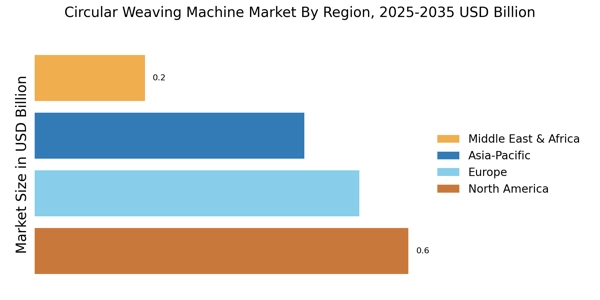
North America is witnessing significant growth in the circular weaving machine market, driven by technological advancements and increasing demand for high-quality textiles. The region holds approximately 35% of the global market share, making it the largest market. Regulatory support for sustainable manufacturing practices further fuels this growth, encouraging investments in innovative weaving technologies. The United States and Canada are the leading countries in this market, with a strong presence of key players such as Picanol and Toyota Industries. The competitive landscape is characterized by a focus on automation and efficiency, with companies investing heavily in R&D to enhance product offerings. This dynamic environment positions North America as a leader in the circular weaving machine sector.

Europe : Manufacturing Powerhouse

Europe is a manufacturing powerhouse in the circular weaving machine market, accounting for approximately 30% of the global share, making it the second-largest market. The region's growth is propelled by stringent regulations promoting sustainability and innovation in textile production. Countries like Germany and Italy are at the forefront, with increasing investments in eco-friendly technologies and practices. Germany, Italy, and Switzerland are leading players in this market, hosting major manufacturers such as Saurer and Itema. The competitive landscape is marked by a strong emphasis on quality and efficiency, with companies focusing on advanced weaving technologies. The presence of established players and a robust supply chain further enhance Europe's position in the global market.

Asia-Pacific : Emerging Market Potential

Asia-Pacific is emerging as a significant player in the circular weaving machine market, driven by rapid industrialization and increasing textile production. The region holds about 25% of the global market share, with countries like China and India leading the charge. The demand for cost-effective and efficient weaving solutions is a key growth driver, supported by favorable government policies and investments in manufacturing infrastructure. China is the largest market in the region, followed by India, where local manufacturers are increasingly adopting advanced technologies. The competitive landscape is evolving, with both established players and new entrants vying for market share. Companies like Tsudakoma and Shuttleless Weaving Machine are expanding their footprint, contributing to the region's dynamic growth in the weaving sector.

Middle East and Africa : Resource-Rich Frontier

The Middle East and Africa region is witnessing a gradual increase in demand for circular weaving machines, driven by the growing textile industry and investments in manufacturing capabilities. This region holds approximately 10% of the global market share. Countries like South Africa and Turkey are leading the way, with government initiatives aimed at boosting local production and reducing imports, thus fostering market growth. Turkey is a key player in the region, with a strong textile manufacturing base and a growing number of local manufacturers. The competitive landscape is characterized by a mix of established companies and emerging players, focusing on quality and innovation. As the region continues to develop its textile sector, the demand for advanced weaving technologies is expected to rise significantly.

Circular Weaving Machine Market Regional Image

Key Players and Competitive Insights

The Circular Weaving Machine Market is currently characterized by a dynamic competitive landscape, driven by technological advancements and increasing demand for high-quality textile products. Key players such as Picanol (Belgium), Itema (Italy), and Saurer (Switzerland) are strategically positioned to leverage innovation and regional expansion to enhance their market presence. Picanol (Belgium) focuses on developing advanced weaving technologies, while Itema (Italy) emphasizes partnerships with textile manufacturers to tailor solutions that meet specific market needs. Saurer (Switzerland) is investing in digital transformation initiatives, which collectively shape a competitive environment that prioritizes efficiency and customization.

The market structure appears moderately fragmented, with several players vying for market share through localized manufacturing and supply chain optimization. This fragmentation allows for a diverse range of products and services, catering to various customer segments. The collective influence of these key players fosters a competitive atmosphere where innovation and operational efficiency are paramount, enabling companies to respond swiftly to market demands.

In August 2025, Picanol (Belgium) announced the launch of its latest weaving machine model, which integrates AI-driven technology to enhance production efficiency. This strategic move is significant as it positions Picanol at the forefront of technological innovation, potentially attracting customers seeking advanced solutions that improve productivity and reduce operational costs. The introduction of AI capabilities may also set a new standard in the industry, compelling competitors to accelerate their own technological advancements.

In September 2025, Itema (Italy) entered into a strategic partnership with a leading textile manufacturer to co-develop sustainable weaving solutions. This collaboration underscores Itema's commitment to sustainability, aligning with global trends towards eco-friendly production practices. By focusing on sustainable technologies, Itema not only enhances its product offerings but also strengthens its brand reputation in an increasingly environmentally conscious market.

In July 2025, Saurer (Switzerland) expanded its manufacturing capabilities by establishing a new facility in Asia, aimed at optimizing its supply chain and reducing lead times. This expansion is crucial as it allows Saurer to better serve the growing demand in the Asian market, while also enhancing its operational efficiency. The strategic establishment of local manufacturing facilities may provide Saurer with a competitive edge, enabling quicker responses to customer needs and market fluctuations.

As of October 2025, the Circular Weaving Machine Market is witnessing trends such as digitalization, sustainability, and AI integration, which are redefining competitive dynamics. Strategic alliances are increasingly shaping the landscape, as companies recognize the value of collaboration in driving innovation. Moving forward, competitive differentiation is likely to evolve from traditional price-based competition to a focus on technological innovation, supply chain reliability, and sustainable practices, reflecting the changing priorities of the textile industry.

Key Companies in the Circular Weaving Machine Market market include

Industry Developments

Recent developments in the Circular Weaving Machine Market indicate a growing interest in technological advancements that enhance operational efficiency and sustainability. Major manufacturers are increasingly adopting automation and smart technologies to meet the rising demand for high-quality textiles while minimizing waste and energy consumption.

The market is also witnessing a shift towards eco-friendly practices, with an emphasis on organic and recycled materials in the production processes. Innovations in machine design, such as modular systems and improved weaving technology, are enabling faster production cycles. Additionally, collaborations between key players and academic institutions are fostering research and development initiatives to create advanced weaving solutions.

The economic recovery post-pandemic has contributed to a resurgence in the textile sector, further fueling investments in weaving machinery. Overall, the market is positioned for consistent growth as industries adapt to evolving consumer preferences and environmental regulations. This dynamic environment is expected to shape the competitive landscape, with companies increasingly focusing on product differentiation and technological upgrades to secure a better market foothold.

Future Outlook

Circular Weaving Machine Market Future Outlook

The Circular Weaving Machine Market is projected to grow at a 5.16% CAGR from 2024 to 2035, driven by technological advancements, increasing demand for textiles, and sustainable manufacturing practices.

New opportunities lie in:

  • Integration of IoT for real-time monitoring and predictive maintenance.
  • Development of eco-friendly materials for machine components.
  • Expansion into emerging markets with tailored product offerings.

By 2035, the market is expected to achieve robust growth, positioning itself as a leader in textile manufacturing technology.

Market Segmentation

Circular Weaving Machine Market Application Outlook

  • Apparel
  • Automotive Textiles
  • Home Textiles
  • Industrial Applications

Circular Weaving Machine Market Fabric Type Outlook

  • Technical Textiles
  • Non-Woven Fabrics
  • Knitted Fabrics

Circular Weaving Machine Market Machine Type Outlook

  • Single Circular Weaving Machines
  • Double Circular Weaving Machines
  • Multi-Layer Circular Weaving Machines

Circular Weaving Machine Market Control System Outlook

  • Manual Control
  • Semi-Automatic Control
  • Fully Automatic Control

Circular Weaving Machine Market End User Industry Outlook

  • Textile Manufacturers
  • Automotive Industry
  • Home Furnishing
  • Aerospace Industry

Report Scope

MARKET SIZE 20241.756(USD Billion)
MARKET SIZE 20251.847(USD Billion)
MARKET SIZE 20353.055(USD Billion)
COMPOUND ANNUAL GROWTH RATE (CAGR)5.16% (2024 - 2035)
REPORT COVERAGERevenue Forecast, Competitive Landscape, Growth Factors, and Trends
BASE YEAR2024
Market Forecast Period2025 - 2035
Historical Data2019 - 2024
Market Forecast UnitsUSD Billion
Key Companies ProfiledMarket analysis in progress
Segments CoveredMarket segmentation analysis in progress
Key Market OpportunitiesIntegration of automation and smart technology enhances efficiency in the Circular Weaving Machine Market.
Key Market DynamicsTechnological advancements and sustainability concerns drive innovation and competition in the Circular Weaving Machine Market.
Countries CoveredNorth America, Europe, APAC, South America, MEA

Leave a Comment

FAQs

What is the projected market valuation of the Circular Weaving Machine Market by 2035?

The Circular Weaving Machine Market is projected to reach a valuation of 3.055 USD Billion by 2035.

What was the market valuation of the Circular Weaving Machine Market in 2024?

In 2024, the market valuation of the Circular Weaving Machine Market was 1.756 USD Billion.

What is the expected CAGR for the Circular Weaving Machine Market during the forecast period 2025 - 2035?

The expected CAGR for the Circular Weaving Machine Market during the forecast period 2025 - 2035 is 5.16%.

Which company is a key player in the Circular Weaving Machine Market?

Key players in the Circular Weaving Machine Market include Picanol, Itema, and Saurer.

What are the projected revenues for Single Circular Weaving Machines by 2035?

The projected revenue for Single Circular Weaving Machines is expected to reach 1.188 USD Billion by 2035.

How do Double Circular Weaving Machines perform in terms of market valuation?

Double Circular Weaving Machines had a market valuation of 0.526 USD Billion in 2024, projected to grow to 0.883 USD Billion by 2035.

What is the market outlook for Technical Textiles in the Circular Weaving Machine Market?

Technical Textiles are projected to grow from 0.526 USD Billion in 2024 to 0.883 USD Billion by 2035.

What applications are driving growth in the Circular Weaving Machine Market?

Applications such as Apparel and Automotive Textiles are driving growth, with Apparel projected to reach 1.195 USD Billion by 2035.

What is the expected market size for Fully Automatic Control systems by 2035?

The market size for Fully Automatic Control systems is expected to reach 1.12 USD Billion by 2035.

Download Free Sample

Kindly complete the form below to receive a free sample of this Report

Compare Licence

×
Features License Type
Single User Multiuser License Enterprise User
Price $4,950 $ $7,250
Maximum User Access Limit 1 User Upto 10 Users Unrestricted Access Throughout the Organization
Free Customization
Direct Access to Analyst
Deliverable Format
Platform Access
Discount on Next Purchase 10% 15% 15%
Printable Versions