×
Request Free Sample ×

Kindly complete the form below to receive a free sample of this Report

* Please use a valid business email

Leading companies partner with us for data-driven Insights

clients tt-cursor
Hero Background

Cloud Based PLM Market

ID: MRFR/ICT/1026-HCR
110 Pages
Shubham Munde
February 2026

Cloud Based PLM Market Research Report Information By Component (Software and Services), By Organization Size (Small & Medium Enterprises and Large Enterprises), By Technology (Radio-Frequency Identification, Near Field Communication, and Others), By Application (Portfolio Management, Product Data Management, Collaborative Design and Engineering, Customer Management, Compliance Management, and Others), – Market Forecast Till 2035.

Share:
Download PDF ×

We do not share your information with anyone. However, we may send you emails based on your report interest from time to time. You may contact us at any time to opt-out.

Cloud Based PLM Market Infographic
Purchase Options

Cloud Based PLM Market Summary

As per Market Research Future analysis, the Cloud Based PLM Market Size was estimated at 49.49 USD Billion in 2024. The Cloud Based PLM industry is projected to grow from 57.9 USD Billion in 2025 to 278.34 USD Billion by 2035, exhibiting a compound annual growth rate (CAGR) of 17.0% during the forecast period 2025 - 2035

Key Market Trends & Highlights

The Cloud Based PLM Market is experiencing robust growth driven by technological advancements and increasing demand for collaborative solutions.

  • The market is witnessing increased adoption of cloud solutions, particularly in North America, which remains the largest market.
  • Data security and compliance are becoming paramount as organizations in the Asia-Pacific region rapidly embrace cloud technologies.
  • Integration of advanced technologies is reshaping the software segment, which currently holds the largest share of the market.
  • Enhanced collaboration and communication, along with cost efficiency and scalability, are key drivers propelling growth in the services segment, especially among large enterprises.

Market Size & Forecast

2024 Market Size 49.49 (USD Billion)
2035 Market Size 278.34 (USD Billion)
CAGR (2025 - 2035) 17.0%

Major Players

Siemens (DE), PTC (US), Dassault Systemes (FR), Autodesk (US), Oracle (US), SAP (DE), Arena Solutions (US), Infor (US), Sierra Wireless (CA)

Our Impact
Enabled $4.3B Revenue Impact for Fortune 500 and Leading Multinationals
Partnering with 2000+ Global Organizations Each Year
30K+ Citations by Top-Tier Firms in the Industry

Cloud Based PLM Market Trends

The Cloud Based PLM Market is currently experiencing a transformative phase, driven by the increasing demand for efficient product lifecycle management solutions. Organizations are increasingly recognizing the advantages of cloud technology, which offers flexibility, scalability, and enhanced collaboration across teams. This shift towards cloud-based systems appears to be a strategic response to the complexities of modern product development, where rapid innovation and market responsiveness are paramount. As companies seek to streamline operations and reduce time-to-market, the adoption of cloud-based PLM solutions is likely to accelerate, fostering a more integrated approach to managing product data and processes. Moreover, the Cloud Based PLM Market is characterized by a growing emphasis on data security and compliance. As organizations migrate sensitive information to cloud platforms, concerns regarding data protection and regulatory adherence have become more pronounced. This trend suggests that providers are increasingly focusing on robust security measures and compliance frameworks to instill confidence among users. Additionally, the integration of advanced technologies such as artificial intelligence and machine learning into cloud PLM solutions is anticipated to enhance decision-making capabilities and predictive analytics, further driving market growth. Overall, the Cloud Based PLM Market is poised for continued evolution, shaped by technological advancements and shifting organizational priorities.

Increased Adoption of Cloud Solutions

Organizations are progressively embracing cloud-based PLM systems to enhance collaboration and streamline workflows. This trend indicates a shift from traditional on-premises solutions to more flexible, scalable options that facilitate real-time data access and sharing among teams.

Focus on Data Security and Compliance

As companies transition to cloud environments, there is a heightened focus on ensuring data security and meeting regulatory requirements. This trend suggests that PLM providers are prioritizing the implementation of advanced security protocols and compliance measures to protect sensitive information.

Integration of Advanced Technologies

The incorporation of technologies such as artificial intelligence and machine learning into cloud PLM solutions is becoming more prevalent. This trend indicates a move towards smarter systems that can provide predictive insights and enhance overall decision-making processes.

Cloud Based PLM Market Drivers

Cost Efficiency and Scalability

Cost efficiency remains a critical driver in the Cloud Based PLM Market. Organizations are increasingly drawn to cloud solutions due to their lower upfront costs and reduced need for extensive IT infrastructure. The subscription-based model of cloud PLM allows companies to scale their usage according to their needs, providing flexibility that traditional on-premise solutions cannot match. Market analysis indicates that businesses can save up to 25% on operational costs by transitioning to cloud-based PLM systems. This financial advantage, combined with the ability to quickly adapt to changing market demands, positions cloud PLM as a favorable option for many enterprises.

Rapid Technological Advancements

The Cloud Based PLM Market is significantly influenced by rapid technological advancements. Innovations in artificial intelligence, machine learning, and the Internet of Things are being integrated into cloud PLM solutions, enhancing their capabilities. These technologies enable predictive analytics, which can forecast product performance and streamline development processes. As a result, organizations are better equipped to respond to market changes and consumer demands. The integration of such advanced technologies is projected to increase the market size of cloud PLM solutions by approximately 15% over the next five years, highlighting the transformative potential of these innovations.

Growing Demand for Sustainability

Sustainability is becoming an essential focus within the Cloud Based PLM Market. Companies are increasingly prioritizing eco-friendly practices and seeking solutions that support sustainable product development. Cloud PLM systems facilitate the tracking of materials and processes, enabling organizations to minimize waste and optimize resource usage. This shift towards sustainability is not only driven by regulatory requirements but also by consumer preferences for environmentally responsible products. As a result, the demand for cloud PLM solutions that incorporate sustainability features is expected to rise, potentially increasing market penetration by 20% in the coming years.

Increased Focus on Data Analytics

The Cloud Based PLM Market is experiencing a heightened focus on data analytics capabilities. Organizations are recognizing the value of data-driven decision-making in enhancing product development and lifecycle management. Cloud PLM solutions equipped with advanced analytics tools allow companies to gather insights from various data sources, leading to improved product quality and market responsiveness. This trend is supported by research indicating that businesses leveraging data analytics in their PLM processes can achieve a 40% reduction in time-to-market. Consequently, the integration of robust analytics features is becoming a key differentiator in the competitive landscape of cloud PLM solutions.

Enhanced Collaboration and Communication

The Cloud Based PLM Market is witnessing a surge in demand for enhanced collaboration tools. As organizations increasingly operate in distributed environments, the need for seamless communication across teams becomes paramount. Cloud-based PLM solutions facilitate real-time collaboration, allowing stakeholders to access and share product data from anywhere. This capability not only accelerates decision-making processes but also fosters innovation by enabling cross-functional teams to work together more effectively. According to recent data, companies utilizing cloud PLM solutions report a 30% increase in project efficiency, underscoring the importance of collaboration in product lifecycle management.

Market Segment Insights

Cloud Based PLM Market Component Insights

The Cloud Based PLM Market segmentation, based on component, includes software and services. Software segment dominated the market in 2022. With the use of cloud-based product life cycle management software, a business may effectively and efficiently manage information across the whole lifecycle of a product. It comprises procedures for the product's design, production, and disposal across a range of sectors, including retail, IT & telecom, and the automobile industry, among others.

Cloud Based PLM Market Organization Size Insights

The Cloud Based PLM Market segmentation, based on organization size, includes small & medium enterprises and large enterprises. The small & medium enterprises segment dominated the market in 2022. The segment's expansion is linked to mid-sized businesses' growing use of cloud-based PLM. Collaboration across all teams is made simpler, quicker, and more authentic thanks to cloud product lifecycle management.

Figure 2: Cloud Based PLM Market, by Organization Size, 2022 & 2032 (USD Billion)

Source: Secondary Research, Primary Research, Market Research Future Database and Analyst Review

Cloud Based PLM Market Technology Insights

The Cloud Based PLM Market segmentation, based on technology, includes radio-frequency identification, near field communication, and others. Radio-frequency identification segment dominated the Cloud Based PLM Market in 2022. The demand for radio-frequency identification is being helped by the rising use of Industrial IoT (IIoT) in the manufacturing process.

Cloud Based PLM Market Application Insights

The Cloud Based PLM Market segmentation, based on application, includes portfolio management, product data management, collaborative design and engineering, customer management, compliance management, and others. Customer management segment dominated the Cloud Based PLM Market in 2022. A growing emphasis on customer satisfaction and the need for customer management in many industries are both factors contributing to the segment's rise.

Cloud Based PLM Market End User Insights

The Cloud Based PLM Market segmentation, based on end user, includes aerospace & defense, healthcare & life sciences, retail & consumer goods, energy & utilities, industrial machinery & heavy equipment, telecommunication & IT, automotive & transportation, semiconductor & electronics, and others. The automotive & transportation segment dominated the Cloud Based PLM Market in 2022. The two main trends anticipated to propel the market expansion in the automotive industry are the rising use of digital manufacturing and the rising incorporation of IoT in the creation of smart autos.

As an illustration, Siemens' cloud-based PLM software provides a complete range of smart car solutions for all important technical domains, from chip design to complete vehicle certification.

Get more detailed insights about Cloud Based PLM Market

Regional Insights

North America : Innovation and Adoption Leader

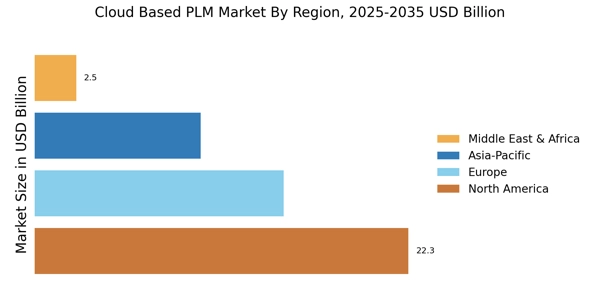
North America is the largest market for Cloud Based PLM Market, holding approximately 45% of the global share. The region's growth is driven by rapid technological advancements, increasing demand for digital transformation, and supportive regulatory frameworks. Companies are increasingly adopting cloud solutions to enhance collaboration and streamline operations, which is further fueled by the rise of remote work and the need for agile product development. The United States and Canada are the leading countries in this market, with major players like Siemens, PTC, and Autodesk establishing a strong presence. The competitive landscape is characterized by continuous innovation and strategic partnerships among key players. The focus on integrating AI and IoT into PLM solutions is expected to drive further growth, making North America a hub for cutting-edge developments in the Cloud PLM space.

Europe : Regulatory Support and Growth

Europe is the second-largest market for Cloud Based PLM Market, accounting for around 30% of the global share. The region benefits from stringent regulations promoting digitalization and sustainability, which drive demand for cloud-based solutions. The European Union's initiatives to enhance digital infrastructure and support innovation are key catalysts for market growth, encouraging companies to adopt advanced PLM systems for better compliance and efficiency. Germany, France, and the UK are the leading countries in this market, with significant contributions from companies like Dassault Systemes and SAP. The competitive landscape is marked by a mix of established players and emerging startups, all vying for market share. The focus on sustainability and circular economy principles is shaping product development strategies, making Europe a dynamic player in the Cloud PLM market.

Asia-Pacific : Emerging Market with Potential

Asia-Pacific is witnessing rapid growth in the Cloud Based PLM Market, holding approximately 20% of the global share. The region's expansion is driven by increasing industrialization, a growing manufacturing sector, and rising investments in technology. Countries are implementing favorable policies to encourage digital transformation, which is expected to further boost demand for cloud-based PLM solutions in various industries, including automotive and electronics. China, Japan, and India are the leading countries in this market, with a mix of local and international players competing for dominance. Companies like Oracle and Infor are expanding their footprint in the region, focusing on tailored solutions to meet local needs. The competitive landscape is evolving, with a strong emphasis on innovation and customer-centric approaches, positioning Asia-Pacific as a key player in The Cloud Based PLM Market.

Middle East and Africa : Growing Adoption and Awareness

The Middle East and Africa region is gradually emerging in the Cloud Based PLM Market, currently holding about 5% of the global share. The growth is primarily driven by increasing awareness of digital solutions among businesses and the need for efficient product lifecycle management. Governments in the region are promoting technology adoption through various initiatives, which is expected to enhance market penetration and drive future growth in this sector. Countries like South Africa and the UAE are leading the way in adopting cloud-based PLM solutions, with a growing number of local and international players entering the market. The competitive landscape is characterized by a mix of established firms and new entrants, focusing on providing customized solutions to meet the unique challenges of the region. As businesses recognize the benefits of cloud PLM, the market is poised for significant growth in the coming years.

Cloud Based PLM Market Regional Image

Key Players and Competitive Insights

The Cloud Based Product Lifecycle Management (PLM) Market is currently characterized by a dynamic competitive landscape, driven by rapid technological advancements and increasing demand for integrated solutions. Key players such as Siemens (DE), PTC (US), and Dassault Systemes (FR) are strategically positioning themselves through innovation and partnerships, thereby enhancing their operational focus. Siemens (DE) emphasizes digital transformation, leveraging its extensive portfolio to integrate IoT capabilities into its PLM solutions. PTC (US) is concentrating on expanding its market share through strategic acquisitions and enhancing its cloud offerings, while Dassault Systemes (FR) is focusing on sustainability and collaborative platforms, which collectively shape a competitive environment that is increasingly reliant on technological integration and customer-centric solutions.
The business tactics employed by these companies reflect a concerted effort to optimize supply chains and localize manufacturing processes. The market structure appears moderately fragmented, with a mix of established players and emerging startups. This fragmentation allows for diverse offerings, yet the collective influence of major players like Oracle (US) and SAP (DE) ensures that competition remains robust. These companies are not only competing on product features but also on the ability to provide comprehensive solutions that address the evolving needs of their clients.
In August 2025, Siemens (DE) announced a strategic partnership with a leading cloud service provider to enhance its PLM capabilities. This collaboration aims to integrate advanced analytics and machine learning into its existing platforms, thereby improving product development cycles and customer engagement. The strategic importance of this partnership lies in Siemens' commitment to staying at the forefront of digital transformation, which is essential for maintaining competitive advantage in a rapidly evolving market.
In September 2025, PTC (US) launched a new version of its Windchill PLM software, which incorporates AI-driven insights for better decision-making. This release is significant as it reflects PTC's focus on leveraging artificial intelligence to enhance user experience and operational efficiency. By integrating AI capabilities, PTC positions itself as a leader in innovation, potentially attracting a broader customer base seeking advanced technological solutions.
In July 2025, Dassault Systemes (FR) unveiled its new sustainability initiative aimed at reducing the carbon footprint of product development processes. This initiative is crucial as it aligns with the growing emphasis on sustainability within the industry. By prioritizing eco-friendly practices, Dassault Systemes not only enhances its brand reputation but also meets the increasing demand from consumers and businesses for sustainable solutions.
As of October 2025, the competitive trends in the Cloud Based PLM Market are increasingly defined by digitalization, sustainability, and the integration of artificial intelligence. Strategic alliances are becoming pivotal in shaping the landscape, as companies seek to combine their strengths to deliver comprehensive solutions. Looking ahead, competitive differentiation is likely to evolve from traditional price-based competition to a focus on innovation, technological advancements, and supply chain reliability, underscoring the necessity for companies to adapt and innovate continuously.

Key Companies in the Cloud Based PLM Market include

Industry Developments

April 2022: In order to accelerate client digital transformation activities and further their 20-year cooperation, PTC and ITC Infotech have agreed to deploy PTC's Windchill PLM software as a service (SaaS).

Future Outlook

Cloud Based PLM Market Future Outlook

The Cloud Based PLM Market is projected to grow at a 17.0% CAGR from 2025 to 2035, driven by digital transformation, increased collaboration, and demand for innovation.

New opportunities lie in:

  • Integration of AI-driven analytics for enhanced decision-making
  • Development of industry-specific PLM solutions for niche markets
  • Expansion of subscription-based pricing models to attract SMEs

By 2035, the Cloud Based PLM Market is expected to be robust, reflecting substantial growth and innovation.

Market Segmentation

Cloud Based PLM Market End User Outlook

  • Aerospace & Defense
  • Healthcare & Life Sciences
  • Retail & Consumer Goods
  • Energy & Utilities
  • Industrial Machinery & Heavy Equipment
  • Telecommunication & IT
  • Automotive & Transportation
  • Semiconductor & Electronics
  • Others

Cloud Based PLM Market Component Outlook

  • Software
  • Services

Cloud Based PLM Market Technology Outlook

  • Radio-Frequency Identification
  • Near Field Communication
  • Others

Cloud Based PLM Market Application Outlook

  • Portfolio Management
  • Product Data Management
  • Collaborative Design and Engineering
  • Customer Management
  • Compliance Management
  • Others

Cloud Based PLM Market Organization Size Outlook

  • Small & Medium Enterprises
  • Large Enterprises

Report Scope

MARKET SIZE 2024 49.49(USD Billion)
MARKET SIZE 2025 57.9(USD Billion)
MARKET SIZE 2035 278.34(USD Billion)
COMPOUND ANNUAL GROWTH RATE (CAGR) 17.0% (2025 - 2035)
REPORT COVERAGE Revenue Forecast, Competitive Landscape, Growth Factors, and Trends
BASE YEAR 2024
Market Forecast Period 2025 - 2035
Historical Data 2019 - 2024
Market Forecast Units USD Billion
Key Companies Profiled Siemens (DE), PTC (US), Dassault Systemes (FR), Autodesk (US), Oracle (US), SAP (DE), Arena Solutions (US), Infor (US), Sierra Wireless (CA)
Segments Covered Component, Organization Size, Technology, Application
Key Market Opportunities Integration of artificial intelligence enhances efficiency in the Cloud Based PLM Market.
Key Market Dynamics Rising demand for integrated solutions drives competition and innovation in the Cloud Based Product Lifecycle Management market.
Countries Covered North America, Europe, APAC, South America, MEA

Market Highlights

Author
Shubham Munde
Research Analyst Level II

With a technical background in information technology & semiconductors, Shubham has 4.5+ years of experience in market research and analytics with the tasks of data mining, analysis, and project execution. He is the POC for our clients, for their consulting projects running under the ICT/Semiconductor domain. Shubham holds a Bachelor’s in Information and Technology and a Master of Business Administration (MBA). Shubham has executed over 150 research projects for our clients under the brand name Market Research Future in the last 2 years. His core skill is building the research respondent relation for gathering the primary information from industry and market estimation for niche markets. He is having expertise in conducting secondary & primary research, market estimations, market projections, competitive analysis, analysing current market trends and market dynamics, deep-dive analysis on market scenarios, consumer behaviour, technological impact analysis, consulting, analytics, etc. He has worked on fortune 500 companies' syndicate and consulting projects along with several government projects. He has worked on the projects of top tech brands such as IBM, Google, Microsoft, AWS, Meta, Oracle, Cisco Systems, Samsung, Accenture, VMware, Schneider Electric, Dell, HP, Ericsson, and so many others. He has worked on Metaverse, Web 3.0, Zero-Trust security, cyber-security, blockchain, quantum computing, robotics, 5G technology, High-Performance computing, data centers, AI, automation, IT equipment, sensors, semiconductors, consumer electronics and so many tech domain projects.

Leave a Comment

FAQs

What is the current valuation of the Cloud Based PLM Market as of 2024?

The Cloud Based PLM Market was valued at 49.49 USD Billion in 2024.

What is the projected market size for the Cloud Based PLM Market by 2035?

The market is projected to reach 278.34 USD Billion by 2035.

What is the expected CAGR for the Cloud Based PLM Market during the forecast period 2025 - 2035?

The expected CAGR for the Cloud Based PLM Market during 2025 - 2035 is 17.0%.

Which companies are considered key players in the Cloud Based PLM Market?

Key players include Siemens, PTC, Dassault Systemes, Autodesk, Oracle, SAP, Arena Solutions, Infor, and Sierra Wireless.

How does the market valuation for software compare to services in the Cloud Based PLM Market?

In 2024, software was valued at 19.79 USD Billion, while services reached 29.7 USD Billion.

What is the market size for small and medium enterprises in the Cloud Based PLM Market?

The market size for small and medium enterprises was 14.74 USD Billion in 2024 and is projected to grow to 82.0 USD Billion by 2035.

Research Approach

Research Methodology on Cloud Based PLM Market

Research Background

Product lifecycle management (PLM) is an information management process used to manage the entire production lifecycle of a product. Cloud based PLM provides an automated platform for organizations to manage the changes taking place in the product design, development, and production processes. For instance, it enables design teams to securely share mechanical design data, CAD data, schematics, product structure, and other 3D design data.

The global cloud-based product lifecycle management market is anticipated to register a healthy CAGR between 2023 and 2030. The United Nations also estimates that the global population reached 7.9 billion as of 2022, which is expected to further drive market growth, in terms of the increasing need for enhanced product life cycle management solutions in various industries.

Scope of the Study

The study aims to analyze the overall cloud based product life cycle management market and provide insights into various technological innovations, as well as the opportunities present therein. The research study will cover the market segmentation of the global cloud based product life cycle management market based on components, deployment type, organization size, end-user, and region.

Research Objective

The research objective is to understand the overall cloud based PLM market in terms of the trends and developments shaping the market globally. The research study also seeks to present a comprehensive insight into the various investments, and vendor’s strategic initiatives, such as mergers and acquisitions (M&A). Additionally, the study aims to provide key insights into the current and emerging dynamics of the global cloud based PLM market.

Research Methodology

The research methodology involves the collection and analysis of data from the primary and secondary sources on the cloud based PLM market. The secondary sources include directories and databases available online including but not limited to press releases, factsheets, and other published materials. Furthermore, primary data from recognized industry experts, customers, and others were gathered through focus groups and interviews.

A mix-based approach was used to analyze the primary and secondary data by comparing them. The bottom-up approach was used to build an understanding of the competitive landscape. Factor analysis was also used to examine the various factors linked to increasing investments in the market. This ground-up approach assists in providing a better overall view of the market.

In addition, data triangulation was used to validate, compare, and contrast the primary research results with the secondary research. The data-triangulation process helps to organize quantitative market data collected through secondary research and demonstrates consistency over multiple sources of qualitative information obtained through primary research.

Information Procurement Process

Information procurement was divided into two primary processes - primary and secondary research. The primary research was conducted through a series of interviews and questionnaires of key players and customers. The secondary research was conducted through Google Scholar, online databases, research papers, company websites, and other available resources.

Primary Research

The primary research was conducted with the help of focus groups, surveys, and group interviews. The primary participants for this research were key players in the market, customer-facing personnel in the industry, and other stakeholders.

Secondary Research

The secondary research included company databases, previous literature reviews, periodicals, press releases, databases, reports, and surveys. The secondary sources were used to get an overall understanding of the market size and scope, as well as the competitive landscape, and to analyze the historical data and existing market trends. The basis of secondary research was:

• Online & Offline Databases: Global Market Insights, Factiva, Moody’s, Reuters, LexisNexis, Bureau of Labor Statistics, Economic Research Institute, and other global databases

• Relevant Magazines and newspapers: New York Times, Business Insider, Los Angeles Times, Wall Street Journal, Bloomberg, and other relevant magazines and newspapers

• Company & Industry Websites: The Company and industry websites of the major market players were analyzed to analyse the products and strategies that they are currently offering

• Government/ regulatory websites: The U.S. Small Business Administration and other government websites were consulted for accessing the details of the trends and market dynamics.

• White Papers: Various sources of reliable industry white papers were looked up to understand the current market updates and trends

Data Triangulation

Data triangulation was carried out to ensure that the market size and forecasts for the total market were accurate and reliable. This process included analyzing data from various sources to arrive at a consolidated market size and forecasts for the total cloud based PLM market.

The data triangulation process is broadly divided into two parts – Demand Side and Supply Side. The demand side includes demand for cloud based PLM in different end-user industries and regions, while the supply side is composed of various technological advancements and product developments. The demand-side data was collected through surveys and focus group discussions with industry experts and customers. Following this, the supply-side data was gathered from interviews with technology vendors and manufacturers.

Factor Analysis

For a better understanding and comprehensive evaluation of the market trends and conditions, several factors governing the market dynamics were analysed for a detailed assessment. This process is broadly divided into five parts – market drivers, restraints, opportunities, PESTEL analysis, and Porter’s five analysis.

Market drivers involve the various factors that influence the growth of the market. The market drivers that make a significant contribution towards the growth of the market include:

• Increasing demand for cloud based PLM globally

• Increased efficiency due to cloud based PLM

• Growing demand for improved product quality

Market restraints include the various aspects that hinder the growth of the market. The primary market restraints that should be taken into consideration while evaluating the market are:

• High initial costs associated with cloud based PLM

• Difficulty in setting up due to complexities of cloud technologies

Market opportunities include the various aspects that may serve as a potential source of growth for the market. The primary factors to look out for while evaluating the market are:

• Adoption of cloud based PLM solutions in manufacturing industries

• Increasing demand for cloud based PLM in the automotive industry

PESTEL Analysis

PESTEL analysis is used to evaluate the macro environment factors that may impact the growth of the market. The key factors that should be taken into consideration while performing the PESTEL analysis are political, economic, social-cultural, environmental, legal, and technological.

Political: Political factors influencing the market that should be considered are the government regulations in the region, government subsidies, and the incentives available.

Economic:  Economic factors include the region's economic growth and development, exchange rate fluctuations, inflation rate, and any other macroeconomic variables.

Social & Cultural: The social & cultural factors include the region’s population growth, trends and activities, consumer preferences, and other social & cultural aspects.

Environmental: The environmental factors include the region’s climate, natural resources, pollution, and any other environmental aspects that could affect the market.

Legal: The legal factors include the laws & regulations related to the industry, such as environmental protection laws, health & safety regulations, and other legal aspects.

Technological: The technological aspects include the technological advancements in the region, technological trends, and investments in technology.

Porter’s Five Force Analysis

Porter’s five forces analysis is a strategic analysis tool that helps to evaluate the strength of the different elements that impact the market. The five factors to consider are competitive rivalry, supplier power, buyer power, threat of new entrants, and threat of substitute products.

• Competitive Rivalry: This factor evaluates the level of competition in the market, and the barriers to entry.

• Supplier Power: This factor identifies the supplier’s power to increase or lower prices, and how this affects the competition in the market.

• Buyer Power: This factor analyzes the buyer's power to set prices and the buyer’s ability to switch suppliers.

• Threat of New Entrants: This factor evaluates the potential of new competitors entering the market and the barriers to entry.

• Threat of Substitute Products: This factor evaluates the alternatives or substitutes to the industry and the impact on the competitive environment.

Time-Series Analysis

Time-series analysis is an important tool used to identify and assess market trends and conditions over a specific period of time. This method helps to predict the future growth and outlook of the market. The historical data compiled from secondary sources was used to analyze the historical trends and conditions that influenced the current state of the market and to forecast the future rate of growth of the market for 2023 to 2030.

The time-series analysis is divided into three phases – pre-assessment, forecasting, and post-assessment. The pre-assessment phase involves analyzing the current market conditions and trends. The forecasting phase involves forecasting the future market conditions and trends. The post-assessment phase involves evaluating the accuracy of the forecast and assessing the underlying factors influencing the market during the forecast period 2023 to 2030. 
Download Free Sample

Kindly complete the form below to receive a free sample of this Report

Compare Licence

×
Features License Type
Single User Multiuser License Enterprise User
Price $4,950 $5,950 $7,250
Maximum User Access Limit 1 User Upto 10 Users Unrestricted Access Throughout the Organization
Free Customization
Direct Access to Analyst
Deliverable Format
Platform Access
Discount on Next Purchase 10% 15% 15%
Printable Versions