Download Free Sample
Kindly complete the form below to receive a free sample of this Report
Cloud Computing Platform Maintenance Services Market Research Report By End Use (SMEs, Large Enterprises, Government Organizations), By Service Type (Technical Support, Software Updates, Performance Monitoring, Backup & Recovery), By Deployment Model (Public Cloud, Private Cloud, Hybrid Cloud), By Industry Vertical (Healthcare, Finance, Retail, Education) And By Region (North America, Europe, Asia-Pacific, And Rest Of The World) – Market Forecast Till 2035.
As per MRFR analysis, the Cloud Computing Platform Maintenance Services Market was estimated at 50.0 USD Billion in 2024. The Cloud Computing Platform Maintenance Services industry is projected to grow from 54.14 USD Billion in 2025 to 120.0 USD Billion by 2035, exhibiting a compound annual growth rate (CAGR) of 8.28% during the forecast period 2025 - 2035.
The Cloud Computing Platform Maintenance Services Market is experiencing robust growth driven by technological advancements and evolving customer needs.
| 2024 Market Size | 50.0 (USD Billion) |
| 2035 Market Size | 120.0 (USD Billion) |
| CAGR (2025 - 2035) | 8.28% |
Amazon Web Services (US), Microsoft Corporation (US), Google Cloud (US), IBM Corporation (US), Oracle Corporation (US), Alibaba Cloud (CN), Salesforce.com (US), SAP SE (DE), DigitalOcean (US), VMware, Inc. (US)
Our Impact
Enabled $4.3B Revenue Impact for Fortune 500 and Leading Multinationals
Partnering with 2000+ Global Organizations Each Year
30K+ Citations by Top-Tier Firms in the Industry
The Cloud Computing Platform Maintenance Services Market is currently experiencing a transformative phase, characterized by an increasing reliance on cloud infrastructure across various sectors. Organizations are progressively recognizing the necessity of maintaining robust cloud environments to ensure operational efficiency and data integrity. This trend is driven by the growing complexity of cloud architectures and the need for continuous updates and security enhancements. As businesses migrate more critical applications to the cloud, the demand for specialized maintenance services is likely to rise, suggesting a shift towards more proactive management strategies. Moreover, the market appears to be influenced by advancements in automation and artificial intelligence, which may streamline maintenance processes and reduce operational costs. Companies are exploring innovative solutions that leverage these technologies to enhance service delivery and improve customer satisfaction. The emphasis on compliance and regulatory requirements further complicates the landscape, as organizations seek to align their maintenance practices with industry standards. Overall, the Cloud Computing Platform Maintenance Services Market is poised for growth, driven by technological evolution and the increasing importance of cloud reliability.
Organizations are increasingly shifting towards proactive maintenance strategies to mitigate risks associated with cloud operations. This trend emphasizes the importance of regular updates and monitoring to prevent potential issues before they escalate.
The incorporation of artificial intelligence and automation tools is transforming maintenance practices within the market. These technologies facilitate more efficient service delivery, enabling organizations to optimize their cloud environments effectively.
As regulatory frameworks evolve, there is a heightened focus on compliance and security within the Cloud Computing Platform Maintenance Services Market. Companies are prioritizing maintenance services that align with industry standards to safeguard sensitive data.
The Cloud Computing Platform Maintenance Services Market is significantly influenced by the rising concerns surrounding cybersecurity. As organizations increasingly migrate sensitive data to cloud platforms, the potential for cyber threats escalates. Maintenance services play a crucial role in ensuring that cloud environments are secure and compliant with regulatory standards. Recent statistics indicate that cyberattacks on cloud services have increased by over 50 percent in the past year, underscoring the urgent need for robust maintenance solutions. By investing in maintenance services, organizations can enhance their security posture, thereby protecting their data and maintaining customer trust. This growing emphasis on cybersecurity is expected to drive the Cloud Computing Platform Maintenance Services Market forward as businesses seek to safeguard their cloud infrastructures.
Cost efficiency remains a pivotal driver in the Cloud Computing Platform Maintenance Services Market. Organizations are increasingly seeking ways to optimize their IT expenditures while maintaining high service levels. The adoption of maintenance services can lead to significant cost savings by reducing the likelihood of system failures and minimizing downtime. According to industry estimates, companies can save up to 30 percent on operational costs by implementing proactive maintenance strategies. This trend is particularly relevant as businesses strive to allocate resources more effectively in a competitive landscape. As a result, the Cloud Computing Platform Maintenance Services Market is likely to expand as organizations prioritize cost-effective solutions that enhance their overall operational efficiency.
Technological advancements are driving innovation within the Cloud Computing Platform Maintenance Services Market. The integration of advanced tools and technologies, such as artificial intelligence and machine learning, is transforming maintenance practices. These technologies enable predictive maintenance, allowing organizations to anticipate and address issues before they impact operations. As a result, companies can achieve higher efficiency and reduced downtime. The market for AI-driven maintenance solutions is projected to grow significantly, with estimates suggesting a compound annual growth rate of over 25 percent in the coming years. This technological evolution is likely to propel the Cloud Computing Platform Maintenance Services Market as organizations seek to leverage cutting-edge solutions for their maintenance needs.
The Cloud Computing Platform Maintenance Services Market is experiencing a surge in demand due to the increasing complexity of IT environments. Organizations are adopting multi-cloud strategies, which involve using multiple cloud services from different providers. This complexity necessitates specialized maintenance services to ensure seamless integration and optimal performance. As per recent data, approximately 85 percent of enterprises are expected to adopt a multi-cloud strategy by 2025, which highlights the need for robust maintenance solutions. The intricacies involved in managing diverse cloud platforms can lead to potential downtimes and inefficiencies, making maintenance services essential for operational continuity. Consequently, the Cloud Computing Platform Maintenance Services Market is poised for growth as businesses seek to mitigate risks associated with complex IT infrastructures.
The demand for enhanced performance and reliability is a key driver in the Cloud Computing Platform Maintenance Services Market. Organizations are increasingly reliant on cloud services for critical operations, necessitating high levels of performance and uptime. Maintenance services are essential in identifying and resolving potential issues before they escalate into significant problems. Data suggests that businesses experience an average of 14 hours of downtime per year due to unaddressed maintenance issues, which can lead to substantial financial losses. As companies strive to improve their operational resilience, the need for reliable maintenance services becomes paramount. This trend indicates a robust growth trajectory for the Cloud Computing Platform Maintenance Services Market as organizations prioritize performance and reliability in their cloud operations.
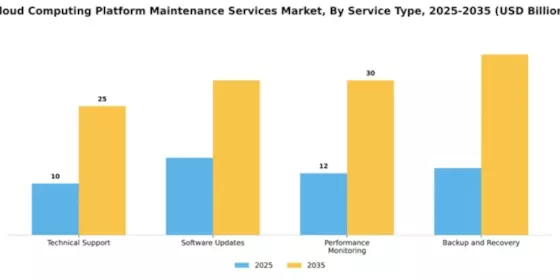
Within the Cloud Computing Platform Maintenance Services Market, the segment of Technical Support holds the largest share, reflecting the critical need for reliable assistance in handling cloud-based infrastructure. On the other hand, Backup and Recovery services are gaining momentum rapidly due to the increasing frequency of data breaches and the heightened emphasis on disaster recovery. Organizations are prioritizing these services to ensure data integrity and operational continuity.
Technical Support: Dominant vs. Backup and Recovery: Emerging
Technical Support services are characterized by their comprehensive offerings, including troubleshooting, proactive system monitoring, and user assistance, establishing them as the dominant force in the market. Their role is pivotal in maintaining operational continuity and optimizing cloud performance. Meanwhile, Backup and Recovery services are emerging as a competitive segment, driven by the rising need for data protection against cyber threats and system failures. As businesses become more reliant on cloud solutions, the demand for efficient backup strategies and robust recovery options is expected to surge, positioning them as key players in the maintenance services landscape.
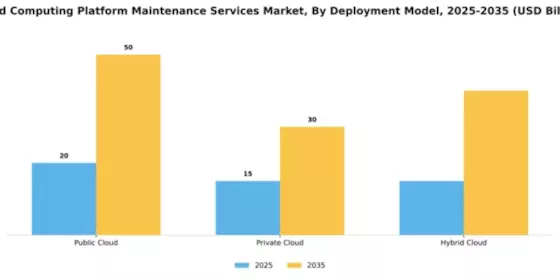
In the Cloud Computing Platform Maintenance Services Market, the deployment model plays a critical role in shaping the service landscape. Public cloud services have established themselves as the dominant model, catering to a wide range of organizations by offering flexible, scalable solutions. In contrast, the private cloud is gaining rapidly in popularity, focusing on customized solutions for specific enterprises, reflecting a growing trend toward enhanced data privacy and compliance requirements. As organizations increasingly move towards digital transformations, the demand for efficient maintenance services tailored to each deployment model is on the rise. The public cloud's extensive reach appeals to businesses seeking cost-effective solutions, while the private cloud's rapid growth is driven by sectors that require secure, dedicated environments. The hybrid cloud model continues to emerge as a strategic choice for many, facilitating a balanced approach between these two models, leveraging their respective advantages.
Public Cloud (Dominant) vs. Private Cloud (Emerging)
Public cloud services have long dominated the market, primarily due to their inherent characteristics of scalability, cost-effectiveness, and accessibility. These services enable organizations to rapidly deploy and manage applications with minimal upfront investment, making them particularly attractive for startups and rapidly scaling businesses. On the other hand, the private cloud is emerging as a significant contender, especially among enterprises that prioritize data security, regulatory compliance, and customized infrastructure. Private cloud solutions provide the necessary control and flexibility, catering to sectors such as finance and healthcare, where data protection is paramount. Together, these deployment models illustrate a diverse marketplace catering to various organizational needs, with each model holding specific strengths in the Cloud Computing Platform Maintenance Services Market.
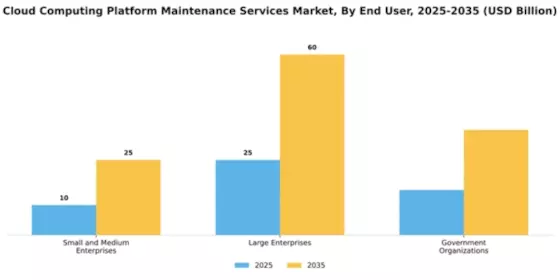
In the Cloud Computing Platform Maintenance Services Market, the distribution of market share among end users showcases a distinct trend. Large Enterprises hold a significant portion of the market, leveraging extensive resources to adopt and maintain cloud services effectively. This dominant position allows them to implement advanced solutions that enhance operational efficiency and productivity. Conversely, Small and Medium Enterprises (SMEs) are rapidly gaining momentum, driven by their increasing need to digitalize operations and access cost-effective IT solutions. As businesses increasingly recognize the importance of cloud computing, SMEs are emerging as the fastest-growing segment. Factors contributing to this growth include the accessibility of scalable solutions that address specific business needs and the flexibility offered by cloud services. This digital transformation is empowering SMEs to compete more effectively with larger organizations, underscoring their vital role in the cloud services ecosystem.
Large Enterprises: Dominant vs. Small and Medium Enterprises: Emerging
Large Enterprises maintain a dominant position in the cloud computing platform maintenance services market due to their substantial resources, comprehensive IT infrastructure, and strategic ability to integrate advanced cloud solutions into their operations. They leverage economies of scale and robust cybersecurity measures to ensure data protection and operational continuity, which are essential for their vast networks. On the other hand, Small and Medium Enterprises are emerging as a dynamic segment within the market, thanks to their agility and willingness to embrace innovative IT solutions. SME leaders are increasingly recognizing the importance of cloud services in scaling operations and enhancing service delivery. Their demand for tailored, affordable solutions is driving vendors to innovate continuously, making the cloud more accessible and beneficial for smaller organizations.
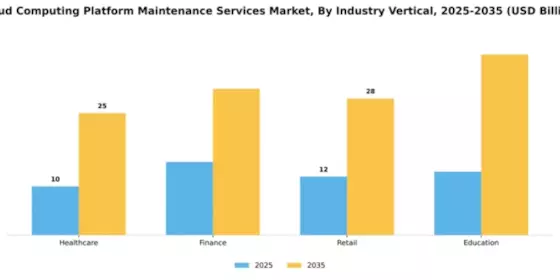
The distribution of market share among the industry verticals in the Cloud Computing Platform Maintenance Services Market is quite telling. Healthcare retains the largest share, driven by the vital role of data management and compliance in patient care and administration. Following close behind is the finance sector, which is gaining momentum in its adoption of cloud services for enhanced security and efficiency, thus reflecting a significant portion of the market share. As organizations in the finance sector ramp up their digital transformation initiatives, the growth trend is unmistakable. The need for real-time data processing, risk management in transactions, and regulatory compliance are major drivers propelling finance forward in the market. Meanwhile, healthcare continues to lead but must innovate to keep pace with rapidly evolving technologies and the demands of digital health solutions.
Healthcare: Established (Dominant) vs. Finance (Emerging)
The healthcare sector stands out as a dominant player in the Cloud Computing Platform Maintenance Services Market, largely owing to its established infrastructure and regulatory requirements that necessitate robust cloud solutions. This sector requires scalable, secure, and compliant cloud services to handle sensitive patient data, contributing to its strong market position. On the other hand, the finance sector is considered an emerging player, rapidly adapting to cloud technologies to enhance operational efficiency and customer experiences. Financial institutions are increasingly onboarding cloud services for real-time data analytics, security enhancements, and innovative financial products, making them a significant force in the market's growth trajectory.
Get more detailed insights about Cloud Computing Platform Maintenance Services Market Request Free Sample
North America continues to lead the Cloud Computing Platform Maintenance Services Market, holding a significant 30.0% share as of December 2025. The region's growth is driven by rapid digital transformation, increased cloud adoption, and a robust regulatory framework that encourages innovation. Major investments in technology infrastructure and a skilled workforce further bolster demand for maintenance services, ensuring compliance with evolving standards and security protocols. The competitive landscape is characterized by the presence of key players such as Amazon Web Services, Microsoft, and Google Cloud, which dominate the market. The U.S. stands out as a leader, supported by a strong ecosystem of startups and established firms. This concentration of resources and expertise fosters a dynamic environment for cloud service maintenance, ensuring that North America remains at the forefront of technological advancements in the sector.
Europe is witnessing a burgeoning Cloud Computing Platform Maintenance Services Market, with a market size of 10.0% as of December 2025. The region's growth is fueled by stringent data protection regulations, such as GDPR, which necessitate robust cloud maintenance solutions. Additionally, the increasing reliance on cloud technologies across various sectors, including finance and healthcare, is driving demand for specialized maintenance services to ensure compliance and operational efficiency. Leading countries like Germany, the UK, and France are at the forefront of this growth, hosting numerous cloud service providers and tech startups. The competitive landscape is marked by a mix of established players and emerging firms, fostering innovation and collaboration. Key players such as SAP and IBM are actively enhancing their service offerings to meet the evolving needs of European businesses, ensuring a vibrant market landscape.
The Asia-Pacific region is rapidly emerging in the Cloud Computing Platform Maintenance Services Market, with a market share of 7.5% as of December 2025. This growth is primarily driven by increasing internet penetration, a surge in mobile device usage, and the rising demand for scalable cloud solutions among businesses. Governments in the region are also promoting digital initiatives, which further catalyze the adoption of cloud services and maintenance solutions to support these transformations. Countries like China, India, and Japan are leading the charge, with significant investments in cloud infrastructure and services. The competitive landscape features both global giants like Alibaba Cloud and local players, creating a diverse ecosystem. This dynamic environment encourages innovation and the development of tailored maintenance services to meet the unique needs of various industries across the region.
The Middle East and Africa region is gradually establishing itself in the Cloud Computing Platform Maintenance Services Market, with a market size of 2.5% as of December 2025. The growth is driven by increasing digital transformation initiatives and government support for technology adoption. Countries are investing in cloud infrastructure to enhance service delivery across sectors such as finance, healthcare, and education, creating a demand for reliable maintenance services to ensure operational continuity and compliance with local regulations. Leading countries like the UAE and South Africa are at the forefront of this transformation, with a growing number of cloud service providers entering the market. The competitive landscape is evolving, with both international and local players vying for market share. This presents significant opportunities for innovation and collaboration in cloud maintenance services, catering to the unique needs of the region.
The Cloud Computing Platform Maintenance Services Market is characterized by a dynamic competitive landscape, driven by rapid technological advancements and increasing demand for efficient cloud solutions. Major players such as Amazon Web Services (US), Microsoft Corporation (US), and Google Cloud (US) are at the forefront, each adopting distinct strategies to enhance their market positioning. Amazon Web Services (US) continues to focus on innovation, particularly in artificial intelligence and machine learning, which appears to be a critical area for maintaining competitive advantage. Meanwhile, Microsoft Corporation (US) emphasizes partnerships and integrations, particularly with enterprise software, to bolster its service offerings. Google Cloud (US) is also making strides in regional expansion, targeting emerging markets to capture a broader customer base. Collectively, these strategies contribute to a competitive environment that is increasingly focused on technological differentiation and customer-centric solutions.In terms of business tactics, companies are increasingly localizing their services to better meet regional demands, which may enhance customer satisfaction and operational efficiency. The market structure appears moderately fragmented, with several key players exerting substantial influence. This fragmentation allows for a variety of service offerings, yet the presence of dominant players like Amazon Web Services (US) and Microsoft Corporation (US) suggests a competitive hierarchy that shapes market dynamics.In November Amazon Web Services (US) announced the launch of its new AI-driven maintenance tool designed to optimize cloud resource management. This strategic move is likely to enhance operational efficiency for clients, allowing them to reduce costs and improve service reliability. The introduction of such innovative tools may solidify Amazon's leadership position in the market, as it aligns with the growing trend of integrating AI into cloud services.In October Microsoft Corporation (US) expanded its partnership with SAP SE (DE) to enhance cloud integration capabilities for enterprise customers. This collaboration is significant as it not only broadens Microsoft's service portfolio but also strengthens its foothold in the enterprise sector, where demand for seamless cloud solutions is surging. Such strategic alliances are indicative of a broader trend towards collaborative innovation in the cloud maintenance space.In September Google Cloud (US) launched a new initiative aimed at improving sustainability in cloud operations, focusing on energy-efficient data centers. This initiative reflects a growing emphasis on environmental responsibility within the industry, which could resonate well with eco-conscious consumers and businesses. By prioritizing sustainability, Google Cloud (US) positions itself as a forward-thinking leader, potentially attracting a new segment of clients who value corporate responsibility.As of December the competitive trends in the Cloud Computing Platform Maintenance Services Market are increasingly defined by digitalization, sustainability, and the integration of AI technologies. Strategic alliances among key players are shaping the landscape, fostering innovation and enhancing service offerings. Looking ahead, it appears that competitive differentiation will increasingly pivot from price-based strategies to a focus on technological innovation, reliability, and sustainable practices. This shift may redefine how companies compete, emphasizing the importance of advanced technology and robust supply chains in maintaining market relevance.






The Cloud Computing Platform Maintenance Services Market is projected to grow at an 8.28% CAGR from 2025 to 2035, driven by increasing demand for cloud solutions and enhanced service reliability.
New opportunities lie in:
By 2035, the market is expected to be robust, reflecting substantial growth and innovation.
| MARKET SIZE 2024 | 50.0(USD Billion) |
| MARKET SIZE 2025 | 54.14(USD Billion) |
| MARKET SIZE 2035 | 120.0(USD Billion) |
| COMPOUND ANNUAL GROWTH RATE (CAGR) | 8.28% (2025 - 2035) |
| REPORT COVERAGE | Revenue Forecast, Competitive Landscape, Growth Factors, and Trends |
| BASE YEAR | 2024 |
| Market Forecast Period | 2025 - 2035 |
| Historical Data | 2019 - 2024 |
| Market Forecast Units | USD Billion |
| Key Companies Profiled | Amazon Web Services (US), Microsoft Corporation (US), Google Cloud (US), IBM Corporation (US), Oracle Corporation (US), Alibaba Cloud (CN), Salesforce.com (US), SAP SE (DE), DigitalOcean (US), VMware, Inc. (US) |
| Segments Covered | Service Type, Deployment Model, End User, Industry Vertical |
| Key Market Opportunities | Integration of artificial intelligence enhances efficiency in Cloud Computing Platform Maintenance Services Market. |
| Key Market Dynamics | Rising demand for automated maintenance solutions drives innovation and competition in the Cloud Computing Platform Maintenance Services market. |
| Countries Covered | North America, Europe, APAC, South America, MEA |
The projected market valuation for the Cloud Computing Platform Maintenance Services Market in 2035 is 120.0 USD Billion.
The overall market valuation for the Cloud Computing Platform Maintenance Services Market in 2024 was 50.0 USD Billion.
The expected CAGR for the Cloud Computing Platform Maintenance Services Market during the forecast period 2025 - 2035 is 8.28%.
Key players in the market include Amazon Web Services, Microsoft Corporation, Google Cloud, IBM Corporation, and Oracle Corporation.
The main service types include Technical Support, Software Updates, Performance Monitoring, and Backup and Recovery.
The Technical Support segment is projected to grow from 10.0 USD Billion in 2024 to 25.0 USD Billion by 2035.
The market size for the Private Cloud segment in 2024 was 15.0 USD Billion.
The Large Enterprises segment is expected to dominate the market, growing from 25.0 USD Billion in 2024 to 60.0 USD Billion by 2035.
The Healthcare industry vertical is projected to grow from 10.0 USD Billion in 2024 to 25.0 USD Billion by 2035.
The Hybrid Cloud segment is projected to grow from 15.0 USD Billion in 2024 to 40.0 USD Billion by 2035, indicating robust growth compared to other deployment models.



Kindly complete the form below to receive a free sample of this Report

“This is really good guys. Excellent work on a tight deadline. I will continue to use you going forward and recommend you to others. Nice job”


“Thanks. It’s been a pleasure working with you, please use me as reference with any other Intel employees.”


“Thanks for sending the report it gives us a good global view of the Betaïne market.”


“Thank you, this will be very helpful for OQS.”


“We found the report very insightful! we found your research firm very helpful. I'm sending this email to secure our future business.”


“I am very pleased with how market segments have been defined in a relevant way for my purposes (such as "Portable Freezers & refrigerators" and "last-mile"). In general the report is well structured. Thanks very much for your efforts.”


“I have been reading the first document or the study, ,the Global HVAC and FP market report 2021 till 2026. Must say, good info! I have not gone in depth at all parts, but got a good indication of the data inside!”


“We got the report in time, we really thank you for your support in this process. I also thank to all of your team as they did a great job.”


“The Automotive 48V ECU Components Procurement Intelligence Study” was a complex project, but the Market Research Future (MRFR) team handled it with quality, agility, and customer-centricity. They delivered all requested data on time and within the agreed scope. The team, including Shubhendra Anand and Rahul Gotadki, was always readily available to clarify questions and swiftly implement necessary adjustments, driving the project to a successful conclusion within a very demanding timeframe.
I would also like to specifically commend Akshay Agarwal for his responsiveness and support at every stage—from our initial inquiry on May 6th through to final delivery on June 18th. His dedication made the entire process seamless.”



