Download Free Sample
Kindly complete the form below to receive a free sample of this Report
Cloud Security Consulting Services Market Size, Share and Trends Analysis Research Report Information By End User (Small and Medium Enterprises, Large Enterprises, Government Organizations, and Healthcare Institutions), By Service Type (Risk Assessment, Compliance Management, Incident Response, Security Architecture, and Cloud Security Posture Management), By Deployment Model (Public Cloud, Private Cloud, Hybrid Cloud, and Multi-Cloud), By Industry Vertical (Financial Services, Retail, Telecommunications, and Manufacturing), By Consulting Approach (Advisory Services, Implementation Services, Managed Services, and Training and Awareness), And By Region (North America, Europe, Asia-Pacific, And Rest Of The World) – Market Forecast Till 2035.
As per MRFR analysis, the Cloud Security Consulting Services Market Size was estimated at 25.0 USD Billion in 2024. The Cloud Security Consulting Services industry is projected to grow from 27.45 USD Billion in 2025 to 70.0 USD Billion by 2035, exhibiting a compound annual growth rate (CAGR) of 9.81% during the forecast period 2025 - 2035.
The Cloud Security Consulting Services Market is experiencing robust growth driven by evolving security needs and regulatory pressures.
| 2024 Market Size | 25.0 (USD Billion) |
| 2035 Market Size | 70.0 (USD Billion) |
| CAGR (2025 - 2035) | 9.81% |
IBM (US), Deloitte (US), Accenture (IE), PwC (GB), KPMG (GB), Cisco (US), McKinsey & Company (US), Bain & Company (US), EY (GB)
Our Impact
Enabled $4.3B Revenue Impact for Fortune 500 and Leading Multinationals
Partnering with 2000+ Global Organizations Each Year
30K+ Citations by Top-Tier Firms in the Industry
The Cloud Security Consulting Services Market is currently experiencing a transformative phase, driven by the increasing reliance on cloud technologies across various sectors. Organizations are increasingly recognizing the necessity of robust security measures to protect sensitive data and maintain compliance with regulatory standards. This heightened awareness has led to a surge in demand for specialized consulting services that can provide tailored security solutions. As businesses migrate to cloud environments, they face unique challenges that require expert guidance to navigate effectively. The evolving threat landscape further complicates these challenges, necessitating a proactive approach to security that anticipates potential vulnerabilities. In December 2025, the Cloud Security Consulting Services Market appears poised for continued growth, as more enterprises seek to enhance their security postures. The integration of advanced technologies, such as artificial intelligence and machine learning, into security frameworks is likely to play a pivotal role in shaping service offerings. Additionally, the emphasis on data privacy and protection is expected to drive innovation within the consulting sector. As organizations strive to achieve a balance between operational efficiency and security, the demand for expert consulting services will likely remain strong, indicating a dynamic and evolving market landscape.
Organizations are placing greater emphasis on adhering to compliance requirements and regulatory standards. This trend is driven by the need to protect sensitive information and avoid potential penalties. Consulting services that specialize in compliance are becoming essential for businesses navigating complex legal landscapes.
The integration of advanced technologies, such as artificial intelligence and machine learning, is transforming the Cloud Security Consulting Services Market. These technologies enhance threat detection and response capabilities, allowing organizations to proactively address security challenges and improve overall resilience.
As businesses migrate to cloud environments, the need for customized security solutions is increasing. Consulting services that offer personalized strategies to address specific organizational needs are gaining traction, reflecting a shift towards more individualized approaches in security management.
The Cloud Security Consulting Services Market is experiencing a surge in demand due to the increasing frequency and sophistication of cyber threats. Organizations are recognizing the necessity of robust security measures to protect sensitive data stored in the cloud. According to recent data, cyberattacks have escalated, with a notable rise in ransomware incidents. This alarming trend compels businesses to seek expert consulting services to fortify their cloud security posture. As a result, the market for cloud security consulting is projected to grow significantly, with estimates suggesting a compound annual growth rate of over 15% in the coming years. The urgency to mitigate risks associated with data breaches and unauthorized access drives organizations to invest in specialized consulting services, thereby propelling the Cloud Security Consulting Services Market forward.
The Cloud Security Consulting Services Market is experiencing heightened demand due to the growing awareness of data privacy issues among consumers and businesses alike. As data breaches and privacy violations become more prevalent, organizations are compelled to prioritize the protection of personal information. This shift in consumer expectations drives businesses to seek cloud security consulting services that can help them implement effective data protection strategies. Market analysis suggests that companies investing in comprehensive data privacy measures are likely to see a 25% increase in customer trust and loyalty. This trend underscores the critical role of consulting services in assisting organizations to navigate the complexities of data privacy regulations and best practices. As awareness continues to rise, the Cloud Security Consulting Services Market is expected to expand, reflecting the increasing importance of data privacy in the digital age.
The Cloud Security Consulting Services Market is heavily influenced by the stringent regulatory landscape that organizations must navigate. Compliance with regulations such as GDPR, HIPAA, and PCI DSS is paramount for businesses operating in various sectors. These regulations mandate the implementation of comprehensive security measures to protect customer data and ensure privacy. As organizations strive to meet these compliance requirements, the demand for cloud security consulting services intensifies. Consulting firms provide essential guidance on best practices, risk assessments, and compliance audits, enabling businesses to align their cloud security strategies with regulatory standards. The market is expected to witness substantial growth as companies prioritize compliance, with projections indicating a potential increase in consulting service adoption by over 20% in the next few years.
The Cloud Security Consulting Services Market is witnessing a transformative phase driven by the integration of advanced technologies such as artificial intelligence, machine learning, and automation. These technologies enhance the capabilities of cloud security solutions, enabling organizations to detect and respond to threats more effectively. As businesses increasingly adopt these innovations, the demand for consulting services that specialize in implementing and optimizing these technologies is on the rise. Market data indicates that organizations leveraging AI-driven security solutions experience a reduction in incident response times by up to 30%. This trend highlights the necessity for expert guidance in navigating the complexities of advanced security technologies, thereby fueling the growth of the Cloud Security Consulting Services Market. The potential for improved security outcomes positions consulting services as a vital component of modern cloud security strategies.
The Cloud Security Consulting Services Market is significantly impacted by the ongoing shift towards remote work and digital transformation initiatives. As organizations increasingly adopt cloud-based solutions to facilitate remote operations, the need for secure cloud environments becomes critical. This transition has led to a heightened awareness of potential vulnerabilities associated with remote access and data sharing. Consequently, businesses are turning to cloud security consulting services to develop tailored security frameworks that address these challenges. The market is poised for growth, with estimates suggesting that the demand for consulting services could rise by approximately 18% as companies seek to enhance their security measures in response to evolving work environments. This trend underscores the importance of proactive security strategies in safeguarding sensitive information in the cloud.
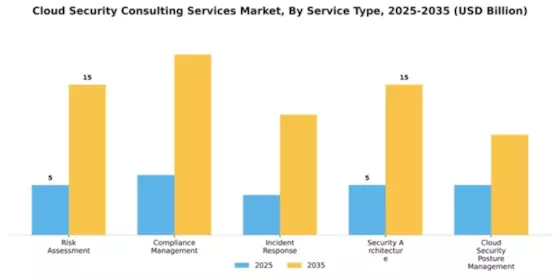
In the Cloud Security Consulting Services Market, Incident Response holds the largest market share among the service types, driven by the increasing frequency of security breaches and the rising demand for immediate response strategies. Compliance Management, while currently smaller in share, is rapidly gaining traction, reflecting businesses' growing emphasis on adhering to regulatory standards and the complexities of managing compliance in cloud environments. Growth within the segment is influenced by the accelerating migration to cloud services, which heightens the need for robust security frameworks and immediate incident handling capabilities. The rise in cyber threats amplifies the urgency for Incident Response solutions, while Compliance Management benefits from heightened regulatory scrutiny and evolving guidelines that encourage businesses to invest in specialized consulting services for safeguarding their cloud operations.
Incident Response (Dominant) vs. Compliance Management (Emerging)
Incident Response is a dominant aspect of the Cloud Security Consulting Services Market, characterized by its crucial role in quickly mitigating the impact of security incidents. Organizations prioritize this service due to the immediate need for handling breaches effectively, making it a central component of their security strategy. On the other hand, Compliance Management is emerging as a vital service, spurred by the complex regulatory landscape that companies navigate in cloud environments. It involves ensuring adherence to various standards and regulations, thus fostering trust and transparency with stakeholders. As organizations increasingly navigate issues related to data protection and legal compliance, the emphasis on Compliance Management services is expected to grow, enhancing its importance in the market.
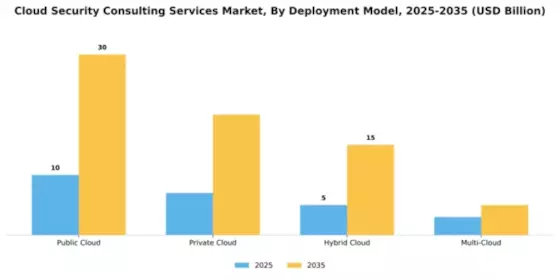
In the Cloud Security Consulting Services Market, public cloud deployment is currently the largest segment, capturing a significant share due to its scalability and cost-effective nature. Organizations worldwide are increasingly adopting public cloud services for their flexibility and wide range of features, outpacing private cloud and hybrid models in popularity. Private cloud, while essential for certain privacy-focused organizations, occupies a smaller share, but it still plays a crucial role, especially among regulated industries that require enhanced security controls. On the other hand, multi-cloud strategies are emerging rapidly as organizations realize the need for flexibility and risk mitigation by using services from various providers. This deployment model is anticipated to grow the fastest due to its holistic approach to leveraging the best features of different cloud platforms. Factors driving this growth include the increasing complexity of IT architectures and the demand for optimized cloud solutions across industries.
Public Cloud (Dominant) vs. Private Cloud (Emerging)
The public cloud deployment model is characterized by its wide accessibility and cost-effectiveness, allowing businesses of all sizes to utilize cloud resources without heavy upfront investments. This model offers extensive scalability, making it highly attractive for companies looking for flexible solutions that can easily adjust to fluctuating workloads. Conversely, the private cloud serves organizations that require a dedicated environment, often due to regulatory or compliance demands. While it is less popular than the public option, it is emerging as a critical solution for enterprises focused on security and control over their data. The growing interest in both models underscores the diverse needs of businesses, compelling providers to enhance their offerings.
In the Cloud Security Consulting Services Market, Large Enterprises hold the largest share among the end user segments, benefiting from extensive resources and critical infrastructure requiring robust security measures. Their emphasis on comprehensive security strategies to protect sensitive data is pivotal, resulting in a significant market presence. Small and Medium Enterprises (SMEs), although smaller in market share, are rapidly gaining traction, driven by increasing awareness of cybersecurity imperatives and the need for scalable solutions as they embrace digital transformation.
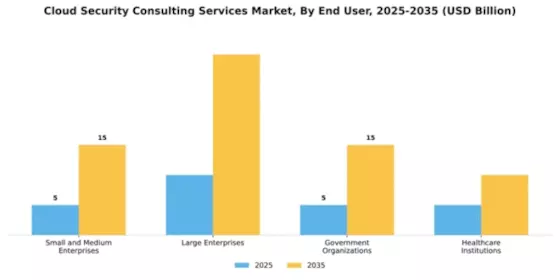
Cloud Security: Large Enterprises (Dominant) vs. Small and Medium Enterprises (Emerging)
Large Enterprises dominate the Cloud Security Consulting Services Market due to their substantial IT budgets, complex security needs, and regulatory requirements. These organizations typically have in-house resources that engage with consulting firms for tailored security solutions, ensuring a comprehensive defense against evolving threats. On the other hand, Small and Medium Enterprises represent an emerging segment, increasingly recognizing the importance of cloud security as cyber threats become more pervasive. SMEs are turning to cost-effective consulting services to enhance their cybersecurity posture, making this segment the fastest-growing in the market. Their agility and adaptability allow them to quickly implement new cloud security measures, positioning them to leverage cloud technology effectively.
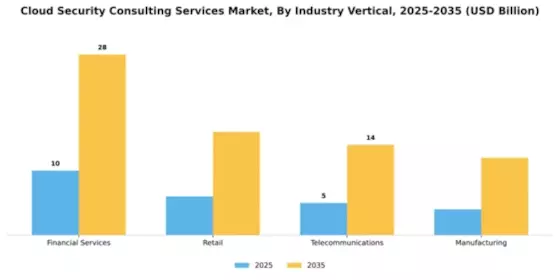
In the Cloud Security Consulting Services Market, Financial Services holds the largest market share among various industry verticals, benefiting from stringent regulatory requirements and the high value of sensitive financial data. This sector is increasingly adopting cloud solutions to enhance security, streamline operations, and reduce risks associated with cyber threats. In contrast, the Retail sector is witnessing rapid growth due to digital transformation and the rising trend of e-commerce, which necessitates improved security solutions to protect customer information and transactional data. As the reliance on cloud technology deepens across sectors, the growth trends indicate that Financial Services will continue to rely heavily on comprehensive cloud security consulting to navigate compliance complexities. Meanwhile, the Retail sector's expansion is propelled by robust consumer demand for online shopping, leading to increased investments in cloud security services to safeguard payment information and enhance customer trust in digital platforms.
Financial Services (Dominant) vs. Retail (Emerging)
In the Cloud Security Consulting Services market, Financial Services is characterized by its robust regulatory framework and high-stakes data protection needs. This sector often prioritizes advanced cloud security solutions that ensure compliance with legislation and protect sensitive financial information from cyber threats. Major players here invest heavily in consulting services to deploy sophisticated threat detection systems and secure cloud architectures. Conversely, the Retail sector, which has emerged as one of the fastest-growing verticals within this market, is adapting rapidly to the digitalization of shopping experiences. This sector is increasingly pressured to adopt cloud security solutions that can efficiently manage consumer data and enhance online transaction security, leading to a heightened demand for specialized consulting services that can provide tailored security strategies.
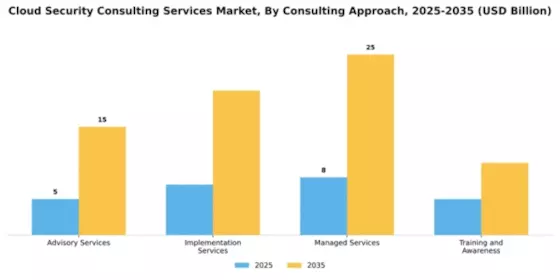
The Cloud Security Consulting Services market is witnessing a diverse range of consulting approaches, with Advisory Services holding the largest market share. This segment encompasses strategic guidance and risk assessment, ensuring organizations align their cloud security posture with business objectives. Conversely, Managed Services is rapidly gaining traction as more businesses seek outsourced expertise to handle evolving security challenges, hinting towards a significant shift in operational preferences among enterprises. Moreover, the growth of Managed Services is driven by increasing cybersecurity threats and the need for continuous compliance with regulations. Organizations are transitioning towards a more proactive approach, emphasizing the necessity of having dedicated security partners. This reflects a broader trend where companies value specialized support to enhance their cloud security capabilities over traditional internal resources, positioning managed services at the forefront of market evolution.
Advisory Services (Dominant) vs. Training and Awareness (Emerging)
Advisory Services emerges as the dominant segment within the Cloud Security Consulting Services Market, characterized by its strategic orientation in guiding organizations through the complexities of cloud security. These services focus on risk assessment, compliance, and aligning security strategies with business objectives. As the market leaders, they capitalize on the increasing demand for expert insights amidst evolving cyber threats. In contrast, Training and Awareness represents an emerging segment that underscores the need for workforce education on security best practices. Organizations are investing in personnel development to foster a security-conscious culture, making training programs not only vital for compliance but also essential for empowering employees against potential security breaches. This dynamic interplay reflects current priorities in the market, balancing strategic consultancy with grassroots security education.
Get more detailed insights about Cloud Security Consulting Services Market Request Free Sample
North America continues to lead the Cloud Security Consulting Services market, holding a significant share of 12.5 in 2024. The region's growth is driven by increasing cyber threats, regulatory compliance demands, and a shift towards digital transformation. Companies are investing heavily in cloud security solutions to protect sensitive data and maintain customer trust. The presence of advanced technologies and a skilled workforce further catalyze this growth. The competitive landscape in North America is robust, featuring key players like IBM, Deloitte, and Accenture. These firms leverage their expertise to offer comprehensive security solutions tailored to various industries. The U.S. remains the largest market, followed by Canada, where government initiatives promote cybersecurity awareness and investment. This dynamic environment fosters innovation and collaboration among leading firms, ensuring continued market expansion.
Europe's Cloud Security Consulting Services market is projected to reach 7.5 by 2025, driven by stringent regulatory frameworks such as GDPR and the NIS Directive. These regulations compel organizations to enhance their cybersecurity measures, creating a robust demand for consulting services. The increasing frequency of cyberattacks further emphasizes the need for comprehensive security strategies, pushing businesses to invest in cloud security solutions. Leading countries in this region include the UK, Germany, and France, where major players like PwC and KPMG are actively expanding their services. The competitive landscape is characterized by a mix of established firms and emerging startups, all vying to meet the growing demand for cloud security. The European market is also witnessing collaborations between public and private sectors to enhance cybersecurity resilience, ensuring a secure digital environment for businesses.
The Asia-Pacific region is experiencing rapid growth in the Cloud Security Consulting Services market, projected to reach 4.5 by 2025. This growth is fueled by the increasing adoption of cloud technologies and the rising awareness of cybersecurity threats. Governments in countries like India and Australia are implementing policies to promote digital security, further driving demand for consulting services. The region's diverse market landscape presents both challenges and opportunities for service providers. Key players in Asia-Pacific include Cisco and local firms that are adapting to the unique needs of the market. Countries such as Japan and South Korea are at the forefront of technological advancements, leading to increased investments in cloud security. The competitive environment is evolving, with a focus on innovative solutions tailored to local regulations and customer requirements, positioning the region for significant growth in the coming years.
The Middle East and Africa (MEA) region is gradually emerging in the Cloud Security Consulting Services market, with a projected size of 0.5 by 2025. The growth is primarily driven by increasing digitalization and the need for enhanced cybersecurity measures. Governments are recognizing the importance of securing digital infrastructures, leading to investments in cloud security solutions. The region's unique challenges, including geopolitical tensions, necessitate robust security frameworks. Countries like the UAE and South Africa are leading the charge in adopting cloud security services, with local firms and international players establishing a presence. The competitive landscape is characterized by a mix of established companies and new entrants, all aiming to address the growing demand for security consulting. As awareness of cybersecurity threats increases, the MEA region is poised for gradual growth in cloud security services.
The Cloud Security Consulting Services Market is currently characterized by a dynamic competitive landscape, driven by the increasing demand for robust security solutions amid rising cyber threats. Major players such as IBM (US), Deloitte (US), and Accenture (IE) are strategically positioning themselves through innovation and partnerships, thereby enhancing their operational focus. IBM (US) emphasizes its cloud-native security solutions, while Deloitte (US) leverages its extensive consulting expertise to offer tailored security frameworks. Accenture (IE) is actively pursuing digital transformation initiatives, which collectively shape a competitive environment that is increasingly reliant on advanced technological solutions and strategic collaborations.The market structure appears moderately fragmented, with key players employing various business tactics to optimize their operations. Localizing services and enhancing supply chain efficiencies are common strategies among these firms. The collective influence of these major players fosters a competitive atmosphere where agility and responsiveness to market demands are paramount. This fragmentation allows for niche players to emerge, although the dominance of established firms remains significant.In November IBM (US) announced a strategic partnership with a leading AI firm to enhance its cloud security offerings. This collaboration aims to integrate advanced AI capabilities into IBM's security solutions, potentially revolutionizing threat detection and response mechanisms. The strategic importance of this move lies in IBM's commitment to staying at the forefront of technological advancements, thereby reinforcing its competitive edge in the market.In October Deloitte (US) launched a new suite of cloud security services tailored for small and medium-sized enterprises (SMEs). This initiative reflects Deloitte's recognition of the growing need for accessible security solutions among SMEs, which are often vulnerable to cyber threats. By addressing this market segment, Deloitte not only expands its client base but also positions itself as a leader in providing comprehensive security frameworks that cater to diverse organizational needs.In September Accenture (IE) unveiled a new cybersecurity innovation lab aimed at developing next-generation security solutions. This lab is expected to focus on emerging technologies such as blockchain and quantum computing, which could redefine security protocols in the cloud. The establishment of this lab underscores Accenture's commitment to innovation and its proactive approach to addressing future security challenges, thereby enhancing its market positioning.As of December current competitive trends in the Cloud Security Consulting Services Market are heavily influenced by digitalization, sustainability, and AI integration. Strategic alliances are increasingly shaping the landscape, allowing firms to pool resources and expertise to tackle complex security challenges. Looking ahead, competitive differentiation is likely to evolve, with a pronounced shift from price-based competition to a focus on innovation, technology, and supply chain reliability. This evolution suggests that firms that prioritize technological advancements and strategic partnerships will be better positioned to thrive in an increasingly complex market.






The Cloud Security Consulting Services Market is projected to grow at a 9.81% CAGR from 2025 to 2035, driven by increasing cyber threats, regulatory compliance, and digital transformation initiatives.
New opportunities lie in:
By 2035, the market is expected to be robust, reflecting substantial growth and innovation.
| MARKET SIZE 2024 | 25.0(USD Billion) |
| MARKET SIZE 2025 | 27.45(USD Billion) |
| MARKET SIZE 2035 | 70.0(USD Billion) |
| COMPOUND ANNUAL GROWTH RATE (CAGR) | 9.81% (2025 - 2035) |
| REPORT COVERAGE | Revenue Forecast, Competitive Landscape, Growth Factors, and Trends |
| BASE YEAR | 2024 |
| Market Forecast Period | 2025 - 2035 |
| Historical Data | 2019 - 2024 |
| Market Forecast Units | USD Billion |
| Key Companies Profiled | IBM (US), Deloitte (US), Accenture (IE), PwC (GB), KPMG (GB), Cisco (US), McKinsey & Company (US), Bain & Company (US), EY (GB) |
| Segments Covered | Service Type, Deployment Model, End User, Industry Vertical, Consulting Approach |
| Key Market Opportunities | Growing demand for advanced threat detection and compliance solutions in the Cloud Security Consulting Services Market. |
| Key Market Dynamics | Rising demand for advanced security solutions drives competition among cloud security consulting service providers. |
| Countries Covered | North America, Europe, APAC, South America, MEA |
The market valuation stands at 25.0 USD Billion as of 2024.
The market is expected to reach a valuation of 70.0 USD Billion by 2035.
The anticipated CAGR for the market is 9.81% from 2025 to 2035.
Key players include IBM, Deloitte, Accenture, PwC, KPMG, Cisco, McKinsey & Company, Bain & Company, and EY.
Service types include Risk Assessment, Compliance Management, Incident Response, Security Architecture, and Cloud Security Posture Management.
The market segments by deployment model into Public Cloud, Private Cloud, Hybrid Cloud, and Multi-Cloud.
End users include Small and Medium Enterprises, Large Enterprises, Government Organizations, and Healthcare Institutions.
Prominent industry verticals include Financial Services, Retail, Telecommunications, and Manufacturing.
Consulting approaches encompass Advisory Services, Implementation Services, Managed Services, and Training and Awareness.
The market is likely to experience robust growth, driven by increasing demand for security solutions across various sectors.


Kindly complete the form below to receive a free sample of this Report

“This is really good guys. Excellent work on a tight deadline. I will continue to use you going forward and recommend you to others. Nice job”


“Thanks. It’s been a pleasure working with you, please use me as reference with any other Intel employees.”


“Thanks for sending the report it gives us a good global view of the Betaïne market.”


“Thank you, this will be very helpful for OQS.”


“We found the report very insightful! we found your research firm very helpful. I'm sending this email to secure our future business.”


“I am very pleased with how market segments have been defined in a relevant way for my purposes (such as "Portable Freezers & refrigerators" and "last-mile"). In general the report is well structured. Thanks very much for your efforts.”


“I have been reading the first document or the study, ,the Global HVAC and FP market report 2021 till 2026. Must say, good info! I have not gone in depth at all parts, but got a good indication of the data inside!”


“We got the report in time, we really thank you for your support in this process. I also thank to all of your team as they did a great job.”


“The Automotive 48V ECU Components Procurement Intelligence Study” was a complex project, but the Market Research Future (MRFR) team handled it with quality, agility, and customer-centricity. They delivered all requested data on time and within the agreed scope. The team, including Shubhendra Anand and Rahul Gotadki, was always readily available to clarify questions and swiftly implement necessary adjustments, driving the project to a successful conclusion within a very demanding timeframe.
I would also like to specifically commend Akshay Agarwal for his responsiveness and support at every stage—from our initial inquiry on May 6th through to final delivery on June 18th. His dedication made the entire process seamless.”



