Cloud Storage Market (2026 - 2035)

Cloud Storage Market Size, Share and Research Report By Component (Software and Services), By PoS Type (Fixed PoS and Mobile/MPoS), By Deployment Model (Public Cloud, Private Cloud, and Hybrid Cloud), By Organization Size (Small and Medium Enterprises (SMEs) and Large Enterprises), By End-User Industry (Retail and Consumer Goods, Hospitality and Restaurants, Healthcare, Entertainment and Leisure, Transportation and Logistics, and Others), And By Region (North America, Europe, Asia-Pacific, And Rest Of The World) โ€“ Industry Forecast Till 2035
ID: MRFR/ICT/2210-HCR
100 Pages
Apoorva Priyadarshi, Shubham Munde
Last Updated: August 24, 2026
Cloud Storage Market
Market Size
Forecast Period2026-2035
CAGR (2026-2035)21.5%
2025 Market SizeUSD 156.5 Billion
2035 Market SizeUSD 1,097.2 Billion
Key Players
Amazon Web Services
Microsoft Azure
Google Cloud
Alibaba Cloud
IBM
Dell Technologies
Opportunities
  • AI-Optimized Storage Tiers
  • Emerging-Market Cloud Adoption
  • Data Monetization and Storage-as-a-Service Platforms

Cloud Storage Market Summary

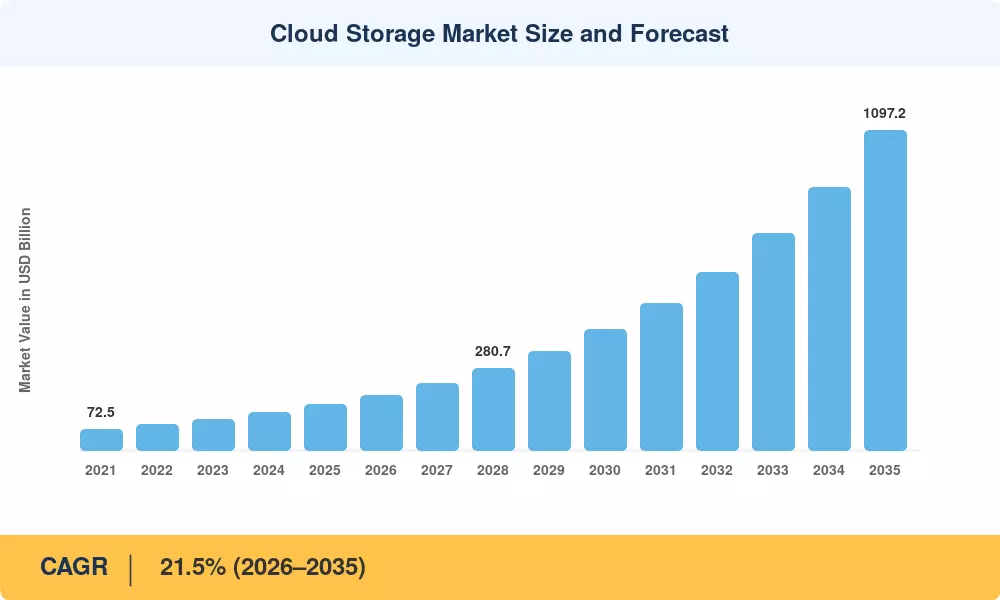
The Cloud Storage Market reached an estimated USD 156.5 Billion in 2025 and is projected to grow from USD 190.1 Billion in 2026 to USD 1,097.2 Billion by 2035, registering a CAGR of 21.5% during 2026โ€“2035. Generative-AI training pipelines have fundamentally reframed storage from a passive cost center into a strategic asset, while sovereign-cloud mandates across the European Union and Canada are channeling public-sector data toward in-country infrastructure [1]. Enterprise spending accelerated sharply after the U.S. CHIPS and Science Act directed over USD 52 billion toward semiconductor and digital infrastructure buildout, indirectly expanding hyperscale data center capacity [2].

Legacy on-premises SAN and NAS deployments are giving way to software-defined, API-driven cloud architectures that decouple storage management from hardware. Edge-to-cloud data workflows in manufacturing, media production, and autonomous vehicles demand sub-10-millisecond retrieval latencies, compelling enterprises to adopt hybrid topologies that co-locate active data near the point of ingestion [3]. A recent source estimates that the global datasphere will exceed 180 zettabytes by 2025, with more than 30% requiring real-time or near-real-time access โ€” a structural tailwind for the Cloud Storage Market [4].

North America commands roughly 34.8% of global revenue, anchored by hyperscaler capital expenditure that exceeded USD 160 billion collectively in 2024 [5]. Asia-Pacific is the fastest-growing region at a projected 25.7% CAGR, driven by India's Digital India programme and China's East Data West Computing initiative [6]. Europe holds the second-largest share, propelled by GDPR-driven data localization and the EU Data Act. Over the next decade, the Cloud Storage Market will increasingly bifurcate between commodity bulk storage and high-performance AI-ready tiers.

ย 

Key Report Takeaways

โ€ข By Storage Type

  • Object storage commanded approximately 49.3% of the Cloud Storage Market in 2025, reflecting enterprise migration toward unstructured-data lakes.
  • Hybrid cloud storage is set to expand at the fastest CAGR through 2035, as organizations balance on-premises control with elastic public-cloud capacity.

โ€ข By Application

  • Backup and recovery represented the largest application segment of the Cloud Storage Market, accounting for around 38.4% revenue share in 2025.
  • Business analytics and AI training workloads are forecast to grow at a 28.2% CAGR, the highest among all application segments.

ย 

โ€ข By End-User

ย 

  • Healthcare and life sciences will register the fastest end-user industry CAGR at 28.4% through 2035.

โ€ข By Region

  • North America led the Cloud Storage Market with a 34.8% share in 2025, followed by Europe and Asia-Pacific.
  • Asia-Pacific is on track for a 25.7% CAGR, the highest among all regions, driven by public-cloud adoption in India and Southeast Asia.

ย 

Cloud Storage Market Size and Forecast (2021โ€“2035)

Market Research Future's sizing methodology integrates a bottom-up survey of enterprise cloud-storage spend across 42 countries with top-down validation from hyperscaler revenue disclosures, IT-spend databases, and storage tracker data [4][7]. Historical figures (2021โ€“2024) reflect actual reported revenues adjusted for currency fluctuations; the forecast (2026โ€“2035) applies a compound-growth model anchored to the 2025 base year.
Cloud Storage Market Size and Forecast
Our Impact
Enabled $4.3B Revenue Impact for Fortune 500 and Leading Multinationals
Partnering with 2000+ Global Organizations Each Year
30K+ Citations by Top-Tier Firms in the Industry

Driver Impact Analysis

Driver ~% Impact on CAGR Geographic Relevance Impact Timeline
Generative-AI data pipeline expansion +4.2% Global Short-term (โ‰ค2 yr)
Sovereign-cloud & data-localization mandates +3.1% EU, Canada, India Medium-term (2โ€“4 yr)
Hyperscaler capex supercycle +3.5% North America, APAC Short-term (โ‰ค2 yr)
Edge-to-cloud latency optimization +2.4% Manufacturing, media Medium-term (2โ€“4 yr)
Digital health record digitization +2.0% Global Long-term (โ‰ฅ4 yr)
Egress-fee transparency & flat-rate pricing +1.5% North America, Europe Medium-term (2โ€“4 yr)
Carbon-aware workload scheduling +1.2% Nordics, Western Europe Long-term (โ‰ฅ4 yr)

ย 

Generative-AI Data Pipeline Expansion

Training large language models now routinely consumes petabytes of tokenized datasets, checkpoints, and embedding vectors, boosting AI-related storage spend to an expected USD 18 billion globally in 2024 [9]. NVIDIAโ€™s DGX Cloud agreements with AWS, Azure, and Oracle include high-throughput object storage in the GPU-cluster architectures themselves, compressing the time between ingesting data and training models. The single biggest short-term booster of the Cloud Storage Market is this structural requirement.

ย 

Sovereign-Cloud and Data-Localization Mandates

The EU Data Act, effective September 2025, mandates that non-personal industrial data generated within the bloc remain accessible from EU-hosted infrastructure [1]. Canada's Critical Cyber Systems Protection Act imposes similar in-country storage obligations on federally regulated industries. These regulations force hyperscalers to build region-locked availability zones, expanding total addressable capacity and creating procurement opportunities for domestic cloud providers.

Hyperscaler Capital Expenditure Supercycle

Amazon, Microsoft, and Google collectively committed over USD 160 billion in data center capex during 2024, with 2025 guidance exceeding USD 200 Billion [5]. Much of that spend goes toward storage arrays, SSD fleets, and custom silicon for intelligent data tiering. This capex cycle directly enlarges the infrastructure layer of the Cloud Storage Market, lowering per-gigabyte costs and stimulating downstream enterprise adoption.

Edge-to-Cloud Latency Optimization

Manufacturing execution systems and autonomous-vehicle telemetry create data at speeds surpassing 1 TB/h per site [3]. The acceptable retrieval delay for real-time quality inspection has decreased to less than 10 milliseconds. Pure public-cloud round-trips cannot meet that reliably. Hybrid architectures that cache hot datasets at the edge and replicate cold copies to centralized object storage are becoming the de facto architecture for data-intensive sectors.

ย 

ย 

Restraints Impact Analysis

The restraint impacts below are estimated separately from the driver impacts and should not be netted against them. Each represents a friction that slows adoption or compresses margins within the Cloud Storage Market.

Restraint ~% Impact on CAGR Geographic Relevance Impact Timeline
Data egress and vendor lock-in costs โ€“1.8% Global Short-term (โ‰ค2 yr)
Cybersecurity and ransomware exposure โ€“1.5% North America, Europe Medium-term (2โ€“4 yr)
Regulatory fragmentation across jurisdictions โ€“1.2% Global Long-term (โ‰ฅ4 yr)
Skilled talent shortage in cloud architecture โ€“0.9% Global Medium-term (2โ€“4 yr)
Energy cost volatility for data centers โ€“0.7% Europe, Asia-Pacific Long-term (โ‰ฅ4 yr)

ย 

Data Egress and Vendor Lock-In Costs

Egress fees โ€” charges levied when data leaves a provider's network โ€” remain the most cited procurement frustration among enterprise IT leaders. A 2024 Uptime Institute survey found that 43% of multi-cloud users identified unpredictable egress billing as their top barrier to workload mobility [17]. While some providers have begun bundling ingress, storage, and retrieval into flat-rate packages, the absence of an industry-wide pricing standard continues to suppress migration activity and slow expansion of the Cloud Storage Market among cost-conscious mid-market buyers.

Cybersecurity and Ransomware Exposure

The average cost of a cloud-related data breach rose to USD 4.88 million in 2024, according to IBM's Cost of a Data Breach report [18]. Ransomware gangs increasingly target backup repositories, exploiting immutable-storage gaps in legacy configurations. These security incidents dampen executive confidence in accelerating cloud-storage migrations, particularly in regulated verticals such as financial services and government.

Regulatory Fragmentation

Divergent data-residency, retention, and classification rules across 140+ national frameworks create compliance complexity that delays cross-border cloud deployments [1]. A multinational enterprise operating across the EU, India, and Brazil must reconcile GDPR, the Digital Personal Data Protection Act, and LGPD โ€” each with distinct consent, localization, and deletion timelines. This fragmentation inflates legal and architectural overhead for the Cloud Storage Market.

ย 

Cloud Storage Market Opportunities

AI-Optimized Storage Tiers

The migration of foundation-model training datasets from terabytes to petabytes creates an addressable market of USD 30 billion by 2030 for purpose-built storage tiers that enable GPU-direct access and RDMA-over-fabric protocols [9]. Providers who offer combined compute-storage bundles optimized for AI pipelines can command premium margins well above commodity object-storage prices.

ย 

Emerging-Market Cloud Adoption

India's MeitY cloud-first policy and Indonesia's Government Cloud (GovCloud) program are directing billions of dollars in public-sector IT spend toward domestic cloud infrastructure [6]. Southeast Asia's cloud storage penetration remains below 25%, creating a greenfield runway for hyperscalers and regional players alike. This geographic gap offers the Cloud Storage Market a decade-long expansion vector.

Data Monetization and Storage-as-a-Service Platforms

Enterprises sitting on exabytes of underutilized telemetry, IoT, and transactional data are exploring data marketplace platforms that require scalable, governed storage backends [20]. Storage-as-a-service models that embed cataloging, lineage tracking, and role-based access controls unlock recurring-revenue streams beyond raw capacity sales.

Carbon-Aware Cold-Data Migration

Sustainability procurement mandates from the Science Based Targets initiative (SBTi) are rewarding cloud providers that publish region-level emissions data and automate cold-data migration to renewables-powered facilities [13]. Operators that achieve Scope 3 transparency across their storage footprint will win share in the Cloud Storage Market among ESG-conscious buyers.

Healthcare Data Digitization

Global electronic health record spending is forecast to exceed USD 40 billion by 2028 [16]. Medical imaging โ€” particularly genomic sequencing and radiology DICOM archives โ€” generates enormous data volumes that exceed on-premises capacity. Cloud-native PACS and VNA platforms represent a high-growth vertical for the Cloud Storage Market.

ย 

Cloud Storage Market Future Outlook

AI-Native Storage Architectures

By 2030, over half of all new enterprise storage provisioned will be classified as "AI-ready," incorporating GPU-direct data paths, vector-index caching, and retrieval-augmented generation (RAG) stores [10]. The Cloud Storage Market will see a structural premium for tiers that support sub-millisecond embeddings retrieval, creating a new performance class between today's hot and warm tiers.

Platform Economics and Multi-Cloud Orchestration

Multi-cloud management platforms โ€” Terraform, Pulumi, Crossplane โ€” are abstracting storage provisioning into policy-as-code, reducing provider lock-in and enabling workload-aware placement [17]. As portability matures, the Cloud Storage Market will shift competition from raw capacity pricing toward value-added services: automated compliance tagging, intelligent lifecycle policies, and integrated analytics.

Sustainability-Linked Storage Procurement

According to a recent source, by 2027, Scope 3 carbon-accounting criteria will weigh in on 45% of large company IT purchase choices [13]. For the Cloud Storage Market, this translates to demand for providers that disclose PUE metrics by availability zone, automate data transfer to low-carbon countries, and offer carbon-credit offsets connected to storage consumption. โ€œOperators in the Nordics and Pacific Northwest have a natural advantage.

ย 

Quantum-Safe Encryption and Zero-Trust Data Fabrics

NIST's post-quantum cryptographic standards, finalized in 2024, will require cloud providers to retrofit encryption layers across stored and in-transit data by 2030 [14]. The Cloud Storage Market will absorb incremental demand for quantum-safe key management, hardware security modules (HSMs), and zero-trust data-fabric architectures that enforce attribute-based access at the object level.

ย 

Cloud Storage Market Segmentation

By Storage Type

Segment Key Metric Primary Demand Driver
Object Storage 49.3% share (2025) Unstructured data lakes, AI training datasets
File Storage USD 37.2 Billion (2025) Collaboration platforms, document management
Block Storage CAGR 20.1% (2026โ€“2035) High-IOPS database workloads, containers
Hybrid Cloud Storage CAGR 25.8% (2026โ€“2035) Edge-cloud tiering, sovereign-cloud compliance

ย 

Object storage remains the backbone of the Cloud Storage Market, handling the vast majority of unstructured data โ€” images, video streams, log files, and ML training corpora. Amazon S3, Azure Blob, and Google Cloud Storage collectively operate exabyte-scale object stores with eleven-nines durability guarantees, making object storage the default tier for write-once, read-many workloads. Hybrid cloud storage is the fastest-growing type, as enterprises deploy unified management planes that span on-premises arrays and public-cloud buckets to satisfy both latency and compliance requirements.

By Storage Class

Segment Key Metric Primary Demand Driver
Hot (Primary) Storage 44.5% share (2025) Real-time transaction processing, active databases
Warm Storage USD 29.8 Billion (2025) Infrequent-access analytics, staging
Cold Storage CAGR 25.6% (2026โ€“2035) Archival compliance, disaster recovery
Archive Storage CAGR 22.9% (2026โ€“2035) Regulatory retention mandates (7โ€“10 years)

ย 

Hot storage captures the largest revenue share in the Cloud Storage Market because mission-critical applications โ€” ERP, CRM, real-time analytics โ€” require single-digit-millisecond access times. Cold storage, however, is growing fastest as automated lifecycle policies push aging data into cheaper tiers, driven by regulatory retention windows in financial services and healthcare that span seven to ten years.

By Enterprise Size

Segment Key Metric Primary Demand Driver
Large Enterprises 60.2% share (2025) Digital transformation, multi-cloud mandates
SMEs CAGR 28.1% (2026โ€“2035) Cloud-native-first architecture, SaaS proliferation

ย 

Large enterprises dominate current spending in the Cloud Storage Market, running petabyte-scale environments across private and public clouds. SMEs, however, are the fastest-growing segment because managed storage services and pay-as-you-go models eliminate upfront capital requirements, allowing small firms to access enterprise-grade durability and encryption without maintaining in-house storage infrastructure.

By Application

Segment Key Metric Primary Demand Driver
Backup and Recovery 38.4% share (2025) Ransomware protection, business continuity
Content Management & Collaboration USD 28.6 Billion (2025) Remote work, SaaS document platforms
Business Analytics & AI Training CAGR 28.2% (2026โ€“2035) LLM dataset storage, feature stores
Compliance & Archiving CAGR 22.4% (2026โ€“2035) GDPR, HIPAA, SEC 17a-4 retention

ย 

Backup and recovery is the largest application within the Cloud Storage Market, driven by increasing ransomware sophistication and board-level emphasis on business continuity planning [18]. Business analytics and AI training is the fastest-growing application as enterprises invest in centralized data lakes that unify training corpora, inference logs, and model artifacts under a single storage namespace.

By End-User Industry

Segment Key Metric Primary Demand Driver
IT & Telecom 24.6% share (2025) 5G data volumes, SaaS provider backend
BFSI USD 27.5 Billion (2025) Regulatory archiving, real-time fraud analytics
Healthcare & Life Sciences CAGR 28.4% (2026โ€“2035) Genomics, DICOM imaging, EHR migration
Government & Public Sector CAGR 24.8% (2026โ€“2035) Sovereign-cloud mandates, digital ID
Media & Entertainment 9.3% share (2025) 4K/8K streaming assets, gaming CDN
Manufacturing CAGR 23.6% (2026โ€“2035) IoT telemetry, digital twins

ย 

IT and telecom commands the largest industry share in the Cloud Storage Market, as SaaS providers, CDN operators, and telecom carriers consume massive volumes of object and block storage for subscriber data, network logs, and content delivery caches. Healthcare and life sciences is the fastest-growing vertical, powered by medical imaging archives that can exceed 1 PB per large hospital network and by genomic sequencing datasets that double in volume every 12โ€“18 months [16].

ย 

Regional Market Share Analysis

Region Key Metric Primary Investment Themes
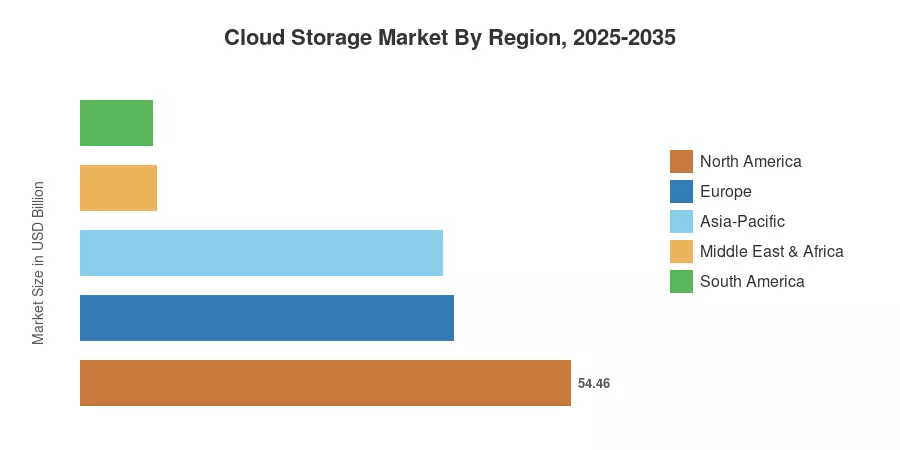
North America 34.8% revenue share (2025) Hyperscaler capex, GenAI data centers
Europe 26.5% revenue share (2025) GDPR, EU Data Act, sovereign cloud
Asia-Pacific 25.7% CAGR (2026โ€“2035) Digital India, East Data West Computing
South America USD 8.0 Billion (2025) Financial-sector digitization, GovTech
Middle East & Africa USD 8.4 Billion (2025) Vision 2030, smart-city programs
Total USD 156.5 Billion (2025) โ€”

The Cloud Storage Market exhibits a three-tier regional structure: a mature, hyperscaler-dominated North American base; a fast-expanding Asia-Pacific frontier; and a regulation-driven European core. South America and the Middle East & Africa are emerging contributors with above-average growth trajectories.

ย 

North America

Country Key Metric Key Driver
United States 78.2% of regional share Hyperscaler headquarters, federal FedRAMP mandates [21]
Canada 13.8% of regional share Sovereign-cloud legislation, Critical Cyber Systems Act [1]
Mexico CAGR 23.4% (2026โ€“2035) Nearshoring data center build-outs [22]

ย 

The United States anchors the Cloud Storage Market in North America, with AWS, Azure, and Google Cloud operating over 60 hyperscale data centers domestically. Canada's federal cloud-first directive and Mexico's expanding nearshoring ecosystem are adding incremental capacity, while FedRAMP High authorization requirements push government agencies toward certified storage providers [21].

Europe

Country Key Metric Key Driver
Germany 22.1% of regional share Gaia-X federation, industrial IoT storage [23]
United Kingdom USD 9.8 Billion (2025) Financial-services cloud migration [24]
France CAGR 22.8% (2026โ€“2035) Trusted Cloud certification, health data hub [25]
Italy 8.5% of regional share PNRR digital infrastructure funding [26]
Spain CAGR 22.3% (2026โ€“2035) Public-sector digitization [26]
Nordic Countries USD 4.2 Billion (2025) Renewables-powered data centers [13]
Russia 4.1% of regional share Domestic cloud substitution mandates
Rest of Europe 12.6% of regional share Varied national digitization programs

ย 

Europe's regulatory environment is the primary differentiator shaping the Cloud Storage Market regionally. The EU Data Act and Gaia-X interoperability framework are driving demand for federated storage architectures that allow data to move between certified providers without egress penalties [23]. The United Kingdom's post-Brexit data-adequacy regime maintains alignment with EU standards, keeping London a major financial-services cloud hub [24].

Asia-Pacific

Country Key Metric Key Driver
China 38.6% of regional share East Data West Computing, Alibaba/Tencent/Huawei expansion [6]
India CAGR 27.8% (2026โ€“2035) Digital India, UPI-linked data volumes [6]
Japan USD 7.1 Billion (2025) Enterprise DX transformation, 5G edge [27]
South Korea 10.4% of regional share K-Cloud government strategy [28]
ASEAN CAGR 26.5% (2026โ€“2035) Indonesia GovCloud, Singapore data center moratorium lift [6]
Rest of Asia-Pacific 7.3% of regional share Australia, New Zealand cloud mandates

ย 

Asia-Pacific is the fastest-growing region in the Cloud Storage Market, propelled by China's national computing-power network and India's projected addition of 700 million internet users by 2030 [6]. Japan's Digital Transformation (DX) initiative is migrating government records to cloud-native platforms, while Singapore's decision to lift its data center construction moratorium in 2024 unlocked 80 MW of new capacity [27].

South America

Country Key Metric Key Driver
Brazil 58.3% of regional share PIX payment data volumes, LGPD compliance [29]
Argentina CAGR 24.1% (2026โ€“2035) Fintech cloud adoption [29]
Rest of South America 18.9% of regional share Chile, Colombia data center corridors

ย 

Brazil dominates South America's Cloud Storage Market, supported by rapidly expanding fintech infrastructure tied to the PIX instant-payment system and LGPD-driven data governance requirements [29]. Chile's Santiago metro area has emerged as a regional data center hub, attracting investments from Google and Huawei.

Middle East & Africa

Country Key Metric Key Driver
Saudi Arabia 28.7% of regional share Vision 2030, NEOM smart-city data layer [30]
UAE USD 2.3 Billion (2025) Dubai Internet City, financial free zones [30]
South Africa CAGR 23.9% (2026โ€“2035) Africa's largest data center cluster in Johannesburg [31]
Egypt 8.6% of regional share New Administrative Capital digital backbone
Rest of MEA 24.8% of regional share Kenya, Nigeria mobile-first cloud

ย 

Saudi Arabia and the UAE drive the Middle East & Africa segment of the Cloud Storage Market, leveraging sovereign-wealth-funded smart-city projects and financial free-zone incentives [30]. South Africa's Johannesburgโ€“Cape Town corridor hosts Africa's densest carrier-neutral data center ecosystem, serving as a gateway for Sub-Saharan cloud expansion [31].

ย 

Cloud Storage Market By Region, 2025-2035

Competitive Benchmarking

The Cloud Storage Market exhibits medium concentration, with the top five vendors capturing an estimated 55โ€“62% of global revenue. The Herfindahl-Hirschman Index (HHI) sits in the moderate range (~1,200โ€“1,500), reflecting three dominant hyperscalers surrounded by a competitive fringe of specialized and regional providers. Competition centers on pricing, performance SLAs, compliance certifications, and AI-integrated storage services.

Company Est. Revenue Share Range Key Offerings for Cloud Storage Market Strategic Positioning
Amazon Web Services (AWS) ~18โ€“22% S3, EBS, Glacier, FSx Broadest object-storage ecosystem, deep AI/ML integration
Microsoft Azure ~15โ€“19% Azure Blob, Azure Files, Azure NetApp Files Enterprise hybrid via Azure Arc, Microsoft 365 synergy
Google Cloud ~8โ€“11% Cloud Storage, Filestore, BigLake Analytics-optimized, competitive egress pricing
Alibaba Cloud ~5โ€“8% Object Storage Service (OSS), NAS, CPFS Dominant in China, expanding APAC footprint
IBM ~3โ€“5% IBM Cloud Object Storage, Spectrum Scale Hybrid multi-cloud, regulated-industry focus
Dell Technologies ~3โ€“5% APEX Cloud Storage, ECS, PowerScale On-premises-to-cloud bridge, APEX as-a-service
Hewlett Packard Enterprise ~2โ€“4% HPE GreenLake, Alletra Storage MP Consumption-based on-prem, GreenLake platform
Oracle Cloud ~2โ€“4% OCI Object Storage, OCI Block Volumes Database-centric cloud, sovereign-cloud partnerships
NetApp ~2โ€“3% Cloud Volumes ONTAP, BlueXP, StorageGRID Multi-cloud data management, unified control plane
Huawei Cloud ~2โ€“3% OBS, SFS Turbo, Data Lake Governance Government and telecom verticals, MEA/APAC expansion

ย 

ย 

Recent News & Developments

ย 

ย 

  • Google Cloud (November 2024): Eliminated egress fees for data transfers between Google Cloud Storage and BigQuery within the same region, directly addressing enterprise lock-in complaints in the Cloud Storage Market [17].

ย 

  • Oracle Cloud (July 2024): Announced OCI Sovereign Cloud partnerships with Telefรณnica in Spain and NTT Data in Japan, enabling local-entity-controlled storage infrastructure [26].
  • Dell Technologies (April 2024): Released APEX Cloud Storage for Azure, integrating Dell PowerFlex arrays with Azure hybrid management planes for on-premises-to-cloud tiering [22].
  • Alibaba Cloud (February 2024): Opened three new data center availability zones in Malaysia, Thailand, and South Korea, expanding its international object-storage presence [6].
  • NIST (August 2024): Finalized FIPS 203, 204, and 205 post-quantum cryptographic standards, setting a five-year migration timeline for cloud providers to adopt quantum-safe encryption at the storage layer [14].

ย 

ย 

ย 

Cloud Storage Market Report Scope

Parameter Detail
Market Scope Global Cloud Storage Market covering storage type, storage class, deployment mode, enterprise size, application, end-user industry, and geography
Study Period 2021โ€“2035
CAGR (Forecast) 21.5% (2026โ€“2035)
Base Year Market Size USD 156.5 Billion (2025)
Forecast Endpoint USD 1,097.2 Billion (2035)
Fastest Growing Segments Hybrid cloud storage (by type); SMEs (by enterprise size); Healthcare & life sciences (by end-user)
Companies Profiled 10 (AWS, Microsoft, Google, Alibaba, IBM, Dell, HPE, Oracle, NetApp, Huawei)
Valuation Currency USD Billion

FAQs

How does egress-fee structuring affect total cost of ownership for multi-cloud storage deployments?
Egress fees can add 15โ€“30% to baseline storage costs when organizations replicate data across two or more providers [17]. Choosing vendors that offer zero-egress tiers or flat-rate bundles significantly compresses TCO over a three-year contract cycle.
What role do immutable backup snapshots play in ransomware resilience strategies?
Immutable snapshots prevent attackers from encrypting or deleting backup copies, reducing average ransomware recovery time from weeks to hours [18]. Most major providers now offer object-lock features that enforce write-once-read-many retention policies at the API level.
How should enterprises evaluate storage SLAs when comparing cloud providers?
Focus on three metrics: durability (target eleven nines), availability (99.95%+ for production tiers), and first-byte latency under load [11]. Request provider-specific incident history rather than relying solely on published SLA documents.
What procurement criteria matter most when selecting a sovereign-cloud storage provider?
Verify the provider's in-country legal-entity status, data-residency certification, and alignment with national encryption standards [1]. Operational sovereignty โ€” local staff with local clearances managing local keys โ€” matters as much as physical data location.
How does intelligent tiering reduce cloud storage waste?
Automated lifecycle policies analyze access-frequency patterns and migrate objects to cheaper tiers after configurable idle periods [11]. Organizations that enable intelligent tiering typically cut storage costs by 25โ€“40% within the first year.
What integration challenges arise when deploying cloud storage alongside on-premises Kubernetes environments?
Container storage interfaces (CSI) standardize provisioning, but latency-sensitive stateful workloads often require local persistent volumes with asynchronous cloud replication [3]. Network bandwidth between edge clusters and cloud endpoints must be pre-provisioned to avoid replication lag.
How will post-quantum cryptographic standards affect cloud storage encryption timelines?
NIST's finalized FIPS 203/204/205 standards require providers to begin hybrid classical-quantum key exchanges by 2028 [14]. Enterprises should audit current encryption schemes now and budget for certificate migration within existing contract renewal cycles. ย  ย 
Author
Author
Author Profile
Apoorva Priyadarshi LinkedIn
Research Analyst
With 4+ years of experience in Market Intelligence and Strategic Research, Apoorv specializes in ICT, Semiconductor, and BFSI markets. Combining strong analytical capabilities with a deep understanding of technology-driven industries, he focuses on delivering data-driven insights that support strategic decision-making. With a background in technology and business research, Apoorv has contributed to numerous global market studies, competitive landscape analyses, and opportunity assessments across sectors such as semiconductors, digital banking, cybersecurity, and telecommunications.
Co-Author
Co-Author Profile
Shubham Munde LinkedIn
Team Lead - Research
Shubham brings over 7 years of expertise in Market Intelligence and Strategic Consulting, with a strong focus on the Automotive, Aerospace, and Defense sectors. Backed by a solid foundation in semiconductors, electronics, and software, he has successfully delivered high-impact syndicated and custom research on a global scale. His core strengths include market sizing, forecasting, competitive intelligence, consumer insights, and supply chain mapping. Widely recognized for developing scalable growth strategies, Shubham empowers clients to navigate complex markets and achieve a lasting competitive edge. Trusted by start-ups and Fortune 500 companies alike, he consistently converts challenges into strategic opportunities that drive sustainable growth.

Research Approach

Research Methodology on Cloud Storage Market

Introduction

The aim of this research is to analyze the major drivers, constraints, opportunities and challenges of the cloud storage market. The research report on this topic provides insights into the market dynamics, market trends and key stakeholders and is focused on assessing the market size and value of the global cloud storage market from 2023 to 2032.

Market Research Methodology

In order to accurately analyze the market drivers, constraints, opportunities and challenges of the cloud storage market, Market Research Future (MRFR) has employed an in-depth primary and secondary research technique. First, a comprehensive literature review is conducted to acquire a clear understanding of the research topic and related concepts. Experts in the field of cloud storage were personally interviewed to acquire a deeper understanding of the market dynamics. Extensive secondary research has been carried out to identify the key players in the market and their current strategies.

Data Collection

Data is collected from internet sources, journals, newspapers, magazines, books, case studies, government policies, market reports, and other documents. Data collected usually falls into two main categories: quantitative and qualitative. Quantitative data is derived from methods like surveys, opinion polls, and structured questionnaires. Qualitative data is collected through focus group interviews, group discussions, and literary reviews.

Market Estimation and Forecasting

The market size is derived through secondary sources and verified from primary sources. Revenues from different manufacturers are studied to gain an understanding of the market value. Further, historical data from various sources is looked at for analysis and is then compared against existing economic trends.

Analysis Tools

The data collected is analyzed carefully by using different analytical tools like Porterโ€™s Five Forces analysis, SWOT analysis, opportunity assessment analysis, benchmarking analysis etc. These analysis tools are used to determine the market size, competitive landscape, market trends, and opportunities.

Market Segmentation

The global cloud storage market is segmented into four categories based on type, services, deployment and end user. The types of cloud storage under consideration are public, private, hybrid and multitenant. Furthermore, the services segment is divided into backup and recovery, storage, data protection and others. On the basis of deployment, the market is divided into on-premises and cloud. Likewise, the end-user segment is divided into small and medium businesses and large enterprises.

Download Free Sample

Kindly complete the form below to receive a free sample of this Report

* Please use a valid business email

Download PDF ×

We do not share your information with anyone. However, we may send you emails based on your report interest from time to time. You may contact us at any time to opt-out.