×
Request Free Sample ×

Kindly complete the form below to receive a free sample of this Report

* Please use a valid business email

Leading companies partner with us for data-driven Insights

clients tt-cursor
Hero Background

Coal Based Activated Carbon Market

ID: MRFR/CnM/7992-HCR
111 Pages
Chitranshi Jaiswal
October 2025

Coal-Based Activated Carbon Market Research Report By Application (Air Purification, Water Treatment, Industrial Processes, Food and Beverage, Pharmaceuticals), By Type (Powdered Activated Carbon, Granular Activated Carbon, Cylindrical Activated Carbon), By End Use Industry (Environmental Protection, Chemical Manufacturing, Electronics, Mining, Healthcare), By Form (Pellets, Powder, Spherical) and By Regional (North America, Europe, South America, Asia Pacific, Middle East and Africa) - Forecast to 2035

Share:
Download PDF ×

We do not share your information with anyone. However, we may send you emails based on your report interest from time to time. You may contact us at any time to opt-out.

Coal Based Activated Carbon Market Infographic
Purchase Options

Coal Based Activated Carbon Market Summary

As per MRFR analysis, the Coal Based Activated Carbon Market Size was estimated at 4826.1 USD Million in 2024. The Coal Based Activated Carbon industry is projected to grow from 5011.52 USD Million in 2025 to 7306.36 USD Million by 2035, exhibiting a compound annual growth rate (CAGR) of 3.84 during the forecast period 2025 - 2035.

Key Market Trends & Highlights

The Coal Based Activated Carbon Market is experiencing robust growth driven by increasing demand across various applications.

  • The North American region remains the largest market for coal based activated carbon, primarily due to its extensive industrial applications.
  • The Asia-Pacific region is identified as the fastest-growing market, fueled by rapid urbanization and industrialization.
  • The air treatment segment holds the largest share, while the water treatment segment is witnessing the fastest growth due to rising environmental concerns.
  • Key market drivers include increasing industrial applications and regulatory support for environmental standards, which are propelling market expansion.

Market Size & Forecast

2024 Market Size 4826.1 (USD Million)
2035 Market Size 7306.36 (USD Million)
CAGR (2025 - 2035) 3.84%

Major Players

Cabot Corporation (US), Calgon Carbon Corporation (US), Kuraray Co Ltd (JP), Carbotech AC GmbH (DE), Haycarb PLC (LK), Activated Carbon Technologies (US), Ingevity Corporation (US), Evoqua Water Technologies (US), Desotec (BE)

Coal Based Activated Carbon Market Trends

The Coal Based Activated Carbon Market is currently experiencing a dynamic phase characterized by evolving applications and increasing demand across various sectors. Industries such as water treatment, air purification, and food processing are driving the need for high-quality activated carbon products. This growth is likely influenced by heightened awareness regarding environmental sustainability and the necessity for effective filtration solutions. As regulations become more stringent, companies are compelled to adopt advanced technologies, which may further propel market expansion. Moreover, the market landscape appears to be shifting towards innovation, with manufacturers focusing on developing specialized products tailored to specific applications. This trend suggests a potential for enhanced performance and efficiency in activated carbon solutions. The ongoing research and development efforts indicate a commitment to improving the quality and functionality of coal-based activated carbon, which could lead to new opportunities in emerging markets. Overall, the Coal Based Activated Carbon Market seems poised for continued growth, driven by both technological advancements and increasing consumer awareness of environmental issues.

Rising Demand in Water Treatment

The demand for coal based activated carbon in water treatment applications is on the rise. This trend is largely attributed to the growing need for clean and safe drinking water, as well as the treatment of industrial wastewater. Activated carbon is recognized for its effectiveness in removing contaminants, which makes it a preferred choice for water purification processes.

Focus on Air Quality Improvement

There is an increasing emphasis on air quality improvement, leading to a surge in the use of coal based activated carbon in air purification systems. This trend is driven by urbanization and industrial activities that contribute to air pollution. Activated carbon's ability to adsorb harmful gases and volatile organic compounds positions it as a vital component in air filtration technologies.

Technological Advancements in Production

Technological advancements in the production of coal based activated carbon are shaping the market landscape. Innovations in manufacturing processes are enhancing the efficiency and effectiveness of activated carbon products. This trend indicates a potential for improved performance, which may attract new applications and expand market reach.

Coal Based Activated Carbon Market Drivers

Growth in Air Pollution Control Initiatives

The Global Coal-Based Activated Carbon Market Industry is significantly influenced by the escalating need for air pollution control measures. Governments worldwide are implementing stringent regulations to combat air quality deterioration, which has led to increased adoption of activated carbon in air filtration systems. This material effectively adsorbs harmful gases and particulates, making it essential for industries such as power generation and manufacturing. As environmental regulations tighten, the market is expected to expand, with projections indicating a growth to 7.31 USD Billion by 2035. This growth is indicative of a broader commitment to improving air quality and public health.

Rising Demand for Water Treatment Solutions

The Global Coal-Based Activated Carbon Market Industry experiences a notable surge in demand for water treatment solutions. This trend is largely driven by increasing concerns regarding water quality and the necessity for effective filtration systems. Activated carbon is widely recognized for its ability to remove contaminants, including chlorine, volatile organic compounds, and heavy metals from water. As urbanization progresses and industrial activities expand, the need for advanced water purification technologies intensifies. The market is projected to reach 4.83 USD Billion in 2024, reflecting a robust growth trajectory as municipalities and industries invest in sustainable water treatment solutions.

Expanding Applications in Pharmaceutical Industry

The Global Coal-Based Activated Carbon Market Industry is witnessing an expansion in applications within the pharmaceutical sector. Activated carbon is utilized for drug purification and as an excipient in various formulations, enhancing the efficacy and safety of pharmaceutical products. The increasing focus on drug quality and patient safety drives the demand for high-purity activated carbon. As pharmaceutical companies strive to meet regulatory standards and consumer expectations, the market is likely to benefit from this trend. The anticipated compound annual growth rate of 3.84% from 2025 to 2035 suggests a sustained interest in activated carbon solutions within this critical industry.

Technological Advancements in Production Processes

The Global Coal-Based Activated Carbon Market Industry is positively impacted by technological advancements in production processes. Innovations in activation methods and material sourcing have led to enhanced performance characteristics of activated carbon, making it more effective for various applications. These advancements not only improve the efficiency of activated carbon but also reduce production costs, thereby increasing its accessibility to a broader range of industries. As manufacturers adopt these new technologies, the market is poised for growth, with a projected increase in demand across sectors such as water treatment, air purification, and industrial applications.

Increasing Awareness of Environmental Sustainability

The Global Coal-Based Activated Carbon Market Industry is significantly shaped by the growing awareness of environmental sustainability. As consumers and businesses alike prioritize eco-friendly practices, the demand for sustainable materials, including activated carbon, is on the rise. This shift is particularly evident in industries such as food and beverage, where activated carbon is used for decolorization and purification processes. The emphasis on sustainability is likely to drive innovation and investment in activated carbon technologies, contributing to market growth. The industry's responsiveness to these trends may enhance its reputation and market share in the coming years.
Market Segment Insights

By Application: Air Treatment (Largest) vs. Water Treatment (Fastest-Growing)

In the Coal Based Activated Carbon Market, air treatment holds the largest share among application segments, attributed to increasing air pollution levels worldwide and stringent regulations aimed at improving air quality. Following closely is the water treatment segment, which is rapidly gaining traction as industries seek effective solutions to manage wastewater and remove contaminants, showcasing significant market expansion in recent years. The growth of air treatment can be attributed to the rising awareness of air pollution and health hazards associated with it, prompting industries and governments to adopt activated carbon technologies. On the other hand, the water treatment segment's growth is driven by its vital role in providing safe drinking water and treating industrial wastewater, making it one of the fastest-growing segments in the market as environmental concerns increase and technologies advance.

Air Treatment: (Dominant) vs. Water Treatment (Emerging)

The air treatment segment dominates the Coal Based Activated Carbon Market due to its essential role in removing harmful airborne pollutants. This segment includes applications in air purification systems, industrial ventilation, and emission control from power plants. Meanwhile, water treatment represents an emerging segment that is gaining momentum due to escalating global water scarcity and contamination issues. The need for sustainable water management solutions has spurred innovation in activated carbon technologies that enhance the efficiency of removing toxins from water, positioning it as a crucial competitor to air treatment in the near future.

By End Use Industry: Chemical (Largest) vs. Environmental (Fastest-Growing)

In the Coal Based Activated Carbon Market, the end use industry shows a diverse landscape with various segments contributing to the overall demand. The chemical industry stands out as the largest consumer, leveraging activated carbon for applications such as purification and filtration processes. Environmental applications also play a significant role, particularly in air and water treatment, contributing to the overall market dynamics.

Food and Beverage (Dominant) vs. Pharmaceutical (Emerging)

In the context of the Coal Based Activated Carbon Market, the Food and Beverage sector is seen as a dominant force, utilizing activated carbon for decolorization and purification of liquids. This sustainable approach is vital for maintaining product quality and safety. Conversely, the Pharmaceutical industry is emerging as a growing segment, recognizing the importance of activated carbon in drug formulation and manufacturing processes, especially for its adsorption properties. Together, these sectors illustrate the adaptability and essential role of activated carbon across varied applications.

By Form: Granular Activated Carbon (Largest) vs. Powdered Activated Carbon (Fastest-Growing)

In the Coal Based Activated Carbon market, Granular Activated Carbon (GAC) holds the largest market share among the form segments due to its widespread applicability in water treatment, air filtration, and industrial processes. Conversely, Powdered Activated Carbon (PAC) is emerging rapidly, capturing an increasing share as industries recognize its advantages in processes such as wastewater treatment and chemical purification, where finer particles enhance adsorption efficiency. The growth in these segments is driven by escalating demand for environmental remediation and industrial applications. Furthermore, stringent regulations regarding air and water quality are propelling the adoption of activated carbon forms. As industries continue to innovate and seek sustainable solutions, both GAC and PAC are expected to sustain their growth trajectories, reflecting the dynamic nature of the market.

Granular Activated Carbon (Dominant) vs. Extruded Activated Carbon (Emerging)

Granular Activated Carbon (GAC) remains the dominant player in the Coal Based Activated Carbon market, primarily due to its superior adsorption capabilities and versatility across various applications, including air and water purification. Its robust presence in major industries, such as pharmaceuticals and food processing, underlines its established market position. On the other hand, Extruded Activated Carbon is emerging as a notable alternative due to its structural integrity and improved flow characteristics, making it advantageous for specific applications, particularly in gas-phase adsorption and catalytic processes. As industries optimize their operations for better efficiency, both GAC and Extruded Activated Carbon will likely co-exist, each catering to distinct market needs.

By Production Method: Physical Activation (Largest) vs. Chemical Activation (Fastest-Growing)

In the Coal Based Activated Carbon Market, the production method segment is primarily dominated by Physical Activation processes, which command a significant market share due to their established techniques and broad applicability. Chemical Activation follows as a robust contender, gaining traction as emerging technologies and environmental regulations shape the market landscape, allowing it to carve out a notable segment share. While Steam Activation also holds its ground, it plays more of a supplementary role compared to the dominant methods. Growth trends indicate that Chemical Activation is on a steep rise, driven by increasing demand for high-efficiency adsorption and the ability to tailor properties to specific applications. Advances in technology and shifts towards greener processes are key factors facilitating this growth. Physical Activation remains popular due to lower operational costs and simplicity, while Steam Activation benefits from niche applications that require specific properties, ensuring its sustained presence in the market.

Physical Activation (Dominant) vs. Steam Activation (Emerging)

Physical Activation stands as the dominant method in the coal-based activated carbon market, known for its cost-effectiveness and efficiency in manufacturing. This method utilizes thermal treatments to produce activated carbon, making it favorable for various applications, particularly in air and water purification. As industries prioritize sustainable production methods, Physical Activation’s established processes maintain its strong market position. Conversely, Steam Activation is emerging due to its ability to generate activated carbon with tailored pore structures and specific adsorption capacities. Though historically lagging behind, its growing recognition in specialized applications and advancements in steam activation technology indicate a promising future, appealing to markets that require enhanced performance from activated carbons.

By Adsorption Capacity: High Capacity (Largest) vs. Medium Capacity (Fastest-Growing)

In the Coal Based Activated Carbon Market, the adsorption capacity segment is characterized by three primary categories: Low Capacity, Medium Capacity, and High Capacity. Among these, the High Capacity segment holds the largest market share, favored for its superior performance in various applications. Conversely, the Medium Capacity segment has emerged as the fastest-growing category, driven by increasing demand across industrial sectors for cost-effective solutions without compromising on quality. As industries continue to prioritize environmental sustainability, the shift towards higher adsorption capacity products is becoming evident. Growth trends within the adsorption capacity segment are influenced by regulatory changes and advancements in carbon manufacturing technologies. High Capacity activated carbons are gaining traction due to their efficient pollutant removal capabilities, making them suitable for air and water treatment applications. Meanwhile, the Medium Capacity segment is witnessing rapid expansion, particularly in small to medium enterprises requiring affordable yet effective adsorption materials. Consumer awareness surrounding environmental impacts is also propelling demand for these products, leading to enhanced research and development initiatives aimed at optimizing performance and application versatility.

High Capacity (Dominant) vs. Medium Capacity (Emerging)

In the Coal Based Activated Carbon Market, High Capacity activated carbons are recognized as the dominant player, revered for their exceptional efficiency in adsorbing a wide range of pollutants. They are heavily utilized in industries requiring stringent purification standards such as pharmaceuticals, water treatment, and air filtration. Their robust performance characteristics ensure that they remain the preferred choice for applications demanding high levels of purity. On the other hand, the Medium Capacity segment is emerging as a promising alternative, offering a balanced solution for businesses seeking efficiency without the associated costs of high capacity products. This segment is rapidly gaining traction among smaller industries that require reliable yet economically viable options, thus expanding its footprint in niche markets. Overall, the interplay between these segment values reflects a dynamic market landscape, catering to a diverse range of industrial needs.

Get more detailed insights about Coal Based Activated Carbon Market

Regional Insights

North America : Established Market with Growth Potential

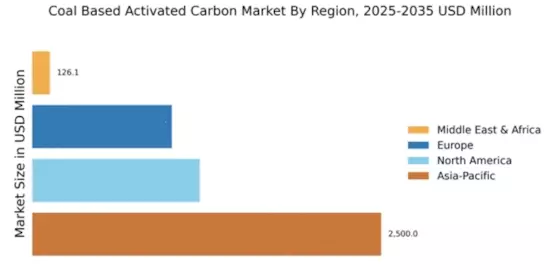
The North American coal-based activated carbon market is projected to reach $1450.0 million by December 2025. Key growth drivers include stringent environmental regulations and increasing demand from water treatment and air purification sectors. The region's focus on sustainability and pollution control is expected to further boost market growth, with a notable shift towards innovative applications in various industries. Leading countries such as the US and Canada dominate the market, supported by major players like Cabot Corporation and Calgon Carbon Corporation. The competitive landscape is characterized by a mix of established firms and emerging companies, all vying for market share. The presence of advanced manufacturing facilities and R&D initiatives enhances the region's position as a leader in activated carbon production.

Europe : Regulatory-Driven Market Dynamics

The European coal-based activated carbon market is expected to reach $1200.0 million by December 2025, driven by regulatory frameworks aimed at reducing emissions and enhancing water quality. The EU's commitment to environmental sustainability and circular economy principles is catalyzing demand for activated carbon in various applications, including air and water purification, which are critical for meeting stringent EU regulations. Germany, France, and the UK are leading countries in this market, with significant contributions from companies like Carbotech AC GmbH and Haycarb PLC. The competitive landscape is marked by innovation and collaboration among key players, focusing on developing eco-friendly products. The region's emphasis on sustainability is shaping the future of the activated carbon market, ensuring compliance with evolving regulations.

Asia-Pacific : Emerging Powerhouse in Activated Carbon

The Asia-Pacific region is projected to dominate the coal-based activated carbon market, reaching $2500.0 million by December 2025. Rapid industrialization, urbanization, and increasing environmental concerns are key drivers of market growth. The demand for activated carbon in air and water treatment applications is surging, supported by government initiatives aimed at improving environmental quality and public health. China, Japan, and India are the leading countries in this market, with significant contributions from key players like Kuraray Co Ltd and Activated Carbon Technologies. The competitive landscape is characterized by a mix of local and international firms, all striving to capture market share. The region's robust manufacturing capabilities and investment in R&D are enhancing its position as a global leader in activated carbon production.

Middle East and Africa : Growing Market with Untapped Potential

The Middle East and Africa coal-based activated carbon market is expected to reach $676.1 million by December 2025. The region is witnessing a gradual increase in demand driven by industrial growth and rising awareness of environmental issues. Key sectors such as water treatment and air purification are beginning to adopt activated carbon solutions, spurred by regulatory changes and a focus on sustainability. Countries like South Africa and the UAE are at the forefront of this emerging market, with a growing presence of international players. The competitive landscape is evolving, with local companies beginning to invest in activated carbon production. As the region continues to develop, the potential for market expansion remains significant, particularly in sectors focused on environmental protection and public health.

Key Players and Competitive Insights

The Coal Based Activated Carbon Market is currently characterized by a dynamic competitive landscape, driven by increasing demand across various sectors such as water treatment, air purification, and industrial processes. Key players are actively engaging in strategies that emphasize innovation, sustainability, and regional expansion. For instance, in November 2025, Ingevity Corporation (US) announced a new initiative aimed at enhancing its production capabilities through advanced manufacturing technologies, which is likely to bolster its market position. Similarly, Calgon Carbon Corporation (US) has been focusing on strategic partnerships to expand its footprint in emerging markets, thereby enhancing its competitive edge.

The market structure appears moderately fragmented, with several players vying for market share. Companies are increasingly localizing manufacturing to optimize supply chains and reduce operational costs. This tactic not only enhances responsiveness to regional demands but also mitigates risks associated with global supply chain disruptions. The collective influence of these key players shapes a competitive environment where agility and innovation are paramount.

In October 2025, Cabot Corporation (US) unveiled a new line of eco-friendly activated carbon products, reflecting a growing trend towards sustainability in the industry. This strategic move is indicative of the company's commitment to environmental stewardship and positions it favorably among environmentally conscious consumers. Furthermore, Haycarb PLC (LK) has recently invested in expanding its production facilities, which is expected to increase its output capacity by 20%, thereby enhancing its ability to meet rising global demand.

Moreover, in September 2025, Kuraray Co Ltd (JP) entered into a joint venture with a local firm in Southeast Asia, aimed at tapping into the rapidly growing market for activated carbon in that region. This collaboration is anticipated to leverage local expertise and distribution networks, potentially accelerating Kuraray's market penetration and enhancing its competitive positioning.

As of December 2025, the Coal Based Activated Carbon Market is witnessing trends that emphasize digitalization, sustainability, and the integration of advanced technologies such as AI. Strategic alliances are becoming increasingly vital, as companies seek to pool resources and expertise to navigate the complexities of the market. The competitive differentiation is likely to evolve from traditional price-based competition towards a focus on innovation, technological advancements, and supply chain reliability, suggesting a transformative shift in how companies position themselves in the market.

Key Companies in the Coal Based Activated Carbon Market market include

Industry Developments

The Coal-Based Activated Carbon Market is currently witnessing significant developments as companies like Kureha Corporation, Jacobi Carbons, and Calgon Carbon Corporation adapt to increasing environmental regulations and demand for sustainable solutions. Recent investments in technology by Advent Technologies and Ingevity Corporation have paved the way for heightened efficiency in production processes, enhancing the performance of activated carbon products. Haycarb PLC and Silcarbon Aktivkohle GmbH are also focusing on expanding their capacities to meet the surging demand in various industries, including water treatment and air purification.

Moreover, reports of merger activities highlight the strategic movements within the market, with companies seeking to consolidate their positions. These shifts appear to be fostering a more competitive landscape, as demonstrated by potential synergies among players such as Merck KGaA and Cabot Carbon Limited. The overall market valuation is gradually increasing, attributed to rising end-user applications and continuous innovation, which is impacting both pricing strategies and supply chain dynamics across the sector. As evolving environmental concerns drive demand, organizations are actively reshaping their approaches to maintain relevance and meet market expectations.

Future Outlook

Coal Based Activated Carbon Market Future Outlook

The Coal Based Activated Carbon Market is projected to grow at a 3.84% CAGR from 2024 to 2035, driven by increasing environmental regulations and demand for air and water purification.

New opportunities lie in:

  • Expansion into emerging markets with tailored product offerings.
  • Development of innovative recycling processes for activated carbon.
  • Strategic partnerships with water treatment facilities for bulk supply contracts.

By 2035, the market is expected to solidify its position as a key player in environmental solutions.

Market Segmentation

Coal Based Activated Carbon Market Form Outlook

  • Granular Activated Carbon
  • Powdered Activated Carbon
  • Pelletized Activated Carbon
  • Extruded Activated Carbon

Coal Based Activated Carbon Market Application Outlook

  • Air Treatment
  • Water Treatment
  • Industrial Processes
  • Food and Beverage
  • Pharmaceuticals

Coal Based Activated Carbon Market End Use Industry Outlook

  • Chemical
  • Mining
  • Environmental
  • Food and Beverage
  • Pharmaceutical

Coal Based Activated Carbon Market Production Method Outlook

  • Physical Activation
  • Chemical Activation
  • Steam Activation

Coal Based Activated Carbon Market Adsorption Capacity Outlook

  • Low Capacity
  • Medium Capacity
  • High Capacity

Report Scope

MARKET SIZE 20244826.1(USD Million)
MARKET SIZE 20255011.52(USD Million)
MARKET SIZE 20357306.36(USD Million)
COMPOUND ANNUAL GROWTH RATE (CAGR)3.84% (2024 - 2035)
REPORT COVERAGERevenue Forecast, Competitive Landscape, Growth Factors, and Trends
BASE YEAR2024
Market Forecast Period2025 - 2035
Historical Data2019 - 2024
Market Forecast UnitsUSD Million
Key Companies ProfiledCabot Corporation (US), Calgon Carbon Corporation (US), Kuraray Co Ltd (JP), Carbotech AC GmbH (DE), Haycarb PLC (LK), Activated Carbon Technologies (US), Ingevity Corporation (US), Evoqua Water Technologies (US), Desotec (BE)
Segments CoveredApplication, End Use Industry, Form, Production Method, Adsorption Capacity
Key Market OpportunitiesGrowing demand for sustainable water treatment solutions drives innovation in the Coal Based Activated Carbon Market.
Key Market DynamicsRising demand for coal based activated carbon driven by stringent environmental regulations and industrial applications.
Countries CoveredNorth America, Europe, APAC, South America, MEA

Leave a Comment

FAQs

What is the compound annual growth rate (CAGR) for the Global Coal-Based Activated Carbon Market from 2025 to 2034?

Coal Based Activated Carbon Market is projected to register a CAGR of 3.84% from 2025-2035

Which application has the highest market value in the Global Coal-Based Activated Carbon Market in 2024?

The Air Purification segment holds the highest market value at 1.5 USD Billion in 2024.

How is the Global Coal-Based Activated Carbon Market segmented by region in 2024?

In 2024, the market sizes by region are North America at 1.2 USD Billion, Europe at 1.1 USD Billion, APAC at 1.4 USD Billion, South America at 0.5 USD Billion, and MEA at 0.28 USD Billion.

What is the projected market value for the Water Treatment application in 2035?

The Water Treatment application is projected to reach a value of 1.8 USD Billion by 2035.

Who are the key players in the Global Coal-Based Activated Carbon Market?

Some major players include Kureha Corporation, Jacobi Carbons, Haycarb PLC, and Calgon Carbon Corporation.

What is the expected market value for the Industrial Processes segment in 2035?

The Industrial Processes segment is expected to reach 1.0 USD Billion in 2035.

What is the projected market growth for North America by 2035?

The North American market is projected to grow to 1.7 USD Billion by 2035.

Which market segment is expected to grow the fastest from 2025 to 2035?

The Air Purification segment is expected to witness significant growth during the forecast period.

What is the anticipated market size for the Pharmaceuticals application in 2035?

The Pharmaceuticals application is expected to be valued at 0.58 USD Billion in 2035.

Download Free Sample

Kindly complete the form below to receive a free sample of this Report

Compare Licence

×
Features License Type
Single User Multiuser License Enterprise User
Price $4,950 $5,950 $7,250
Maximum User Access Limit 1 User Upto 10 Users Unrestricted Access Throughout the Organization
Free Customization
Direct Access to Analyst
Deliverable Format
Platform Access
Discount on Next Purchase 10% 15% 15%
Printable Versions