×
Request Free Sample ×

Kindly complete the form below to receive a free sample of this Report

* Please use a valid business email

Leading companies partner with us for data-driven Insights

clients tt-cursor
Hero Background

Coal Gasification Market

ID: MRFR/EnP/8550-HCR
128 Pages
Priya Nagrale
October 2025

Coal Gasification Market Research Report By Technology (Fixed Bed Gasification, Fluidized Bed Gasification, Entrained Flow Gasification, Partial Oxidation), By Feedstock Type (Bituminous Coal, Sub-Bituminous Coal, Lignite, Petroleum Coke), By Application (Electricity Generation, Chemical Production, Fuel Production, Syngas Production), By End Use (Power Plants, Industrial Applications, Transportation Fuels, Chemical Manufacturing) and By Regional (North America, Europe, South America, Asia Pacific, Middle East and Africa) - Forecast to 2035

Share:
Download PDF ×

We do not share your information with anyone. However, we may send you emails based on your report interest from time to time. You may contact us at any time to opt-out.

Coal Gasification Market Infographic
Purchase Options

Coal Gasification Market Summary

As per MRFR analysis, the Coal Gasification Market Size was estimated at 24.62 USD Billion in 2024. The Coal Gasification industry is projected to grow from 25.89 USD Billion in 2025 to 42.83 USD Billion by 2035, exhibiting a compound annual growth rate (CAGR) of 5.16 during the forecast period 2025 - 2035.

Key Market Trends & Highlights

The Coal Gasification Market is poised for substantial growth driven by technological advancements and a focus on sustainability.

  • Technological advancements in gasification processes are enhancing efficiency and reducing emissions.
  • North America remains the largest market, while Asia-Pacific is emerging as the fastest-growing region for coal gasification.
  • Electricity generation is the largest segment, whereas hydrogen production is rapidly gaining traction as a key growth area.
  • Rising demand for clean energy solutions and supportive government policies are significant drivers propelling market expansion.

Market Size & Forecast

2024 Market Size 24.62 (USD Billion)
2035 Market Size 42.83 (USD Billion)
CAGR (2025 - 2035) 5.16%

Major Players

Air Products (US), Shell (GB), Siemens (DE), GE (US), Sasol (ZA), Linde (DE), Thyssenkrupp (DE), KBR (US), Mitsubishi Heavy Industries (JP)

Coal Gasification Market Trends

The Coal Gasification Market is currently experiencing a transformative phase, driven by the increasing demand for cleaner energy sources and the need for sustainable industrial processes. This market appears to be gaining traction as industries seek alternatives to traditional fossil fuels, which are often associated with higher emissions. The technology involved in coal gasification is evolving, with advancements that enhance efficiency and reduce environmental impact. As a result, stakeholders are likely to invest in innovative solutions that align with global sustainability goals. Furthermore, the integration of carbon capture and storage technologies within coal gasification processes suggests a potential pathway for mitigating greenhouse gas emissions, thereby appealing to environmentally conscious investors and policymakers alike. In addition, the geopolitical landscape and energy security concerns are influencing the Coal Gasification Market. Countries rich in coal resources are exploring gasification as a means to diversify their energy portfolios and reduce reliance on imported fuels. This trend indicates a shift towards domestic energy production, which may bolster local economies and create job opportunities. As the market continues to evolve, it is essential for industry participants to remain agile and responsive to regulatory changes and technological advancements that could shape the future of coal gasification. Overall, the Coal Gasification Market appears poised for growth, driven by a confluence of environmental, economic, and technological factors.

Technological Advancements

Recent innovations in coal gasification technology are enhancing efficiency and reducing emissions. These advancements may lead to more cost-effective processes, making coal gasification a more attractive option for energy production.

Sustainability Focus

There is a growing emphasis on sustainability within the Coal Gasification Market. Companies are increasingly adopting practices that align with environmental regulations, which could drive the development of cleaner gasification methods.

Energy Security Initiatives

Nations are prioritizing energy security by investing in coal gasification as a means to utilize domestic resources. This trend may reduce dependence on foreign energy supplies and promote local economic growth.

Coal Gasification Market Drivers

Diverse Applications

The Global Coal Gasification Market Industry benefits from the diverse applications of syngas produced through coal gasification. Syngas can be utilized for electricity generation, production of chemicals, and as a feedstock for synthetic fuels. This versatility enhances the market's attractiveness, as it caters to various sectors, including power generation, transportation, and manufacturing. The increasing demand for cleaner fuels and chemicals is expected to drive the adoption of coal gasification technologies. As industries seek sustainable alternatives, the potential for syngas to replace conventional fossil fuels may further bolster the market's growth.

Rising Energy Demand

The Global Coal Gasification Market Industry is experiencing a surge in demand for energy, driven by population growth and industrialization. As countries strive to meet their energy needs, coal gasification presents a viable solution, converting coal into syngas for electricity generation and chemical production. In 2024, the market is projected to reach 22.5 USD Billion, reflecting the increasing reliance on coal gasification technologies. This trend is particularly evident in emerging economies, where energy consumption is rising rapidly. The ability of coal gasification to provide a stable energy supply positions it as a crucial player in the global energy landscape.

Environmental Regulations

The Global Coal Gasification Market Industry is influenced by stringent environmental regulations aimed at reducing greenhouse gas emissions. Governments worldwide are implementing policies that encourage cleaner energy production methods, including coal gasification, which can capture and utilize carbon dioxide emissions. This shift is expected to enhance the market's appeal, as coal gasification technologies can potentially reduce emissions compared to traditional coal combustion. As a result, investments in cleaner technologies are likely to increase, fostering growth in the market. The alignment of coal gasification with environmental goals may lead to a more sustainable energy future.

Technological Advancements

Technological advancements in coal gasification processes are significantly impacting the Global Coal Gasification Market Industry. Innovations such as integrated gasification combined cycle (IGCC) systems and improvements in gas cleaning technologies are enhancing efficiency and reducing costs. These advancements enable the conversion of coal into cleaner fuels and chemicals, making coal gasification more competitive against other energy sources. As the industry evolves, it is anticipated that the market will grow at a CAGR of 5.55% from 2025 to 2035, potentially reaching 40.7 USD Billion by 2035. This growth underscores the importance of continuous innovation in maintaining market relevance.

Government Support and Investments

Government support and investments play a pivotal role in shaping the Global Coal Gasification Market Industry. Many countries are recognizing the strategic importance of coal gasification in achieving energy security and economic growth. As a result, governments are providing financial incentives, subsidies, and research funding to promote the development of coal gasification technologies. This support is crucial for attracting private investments and fostering public-private partnerships. The collaborative efforts between governments and industry stakeholders are likely to accelerate the deployment of coal gasification projects, thereby enhancing the market's growth prospects.

Market Segment Insights

By Application: Electricity Generation (Largest) vs. Hydrogen Production (Fastest-Growing)

The coal gasification market is witnessing a diverse distribution in its application segment, with Electricity Generation holding the largest share. This segment leverages the technology to produce syngas, which can be converted into electricity, catering to the energy demands of various industries. Following closely are Chemical Production and Synthetic Fuels, which utilize the syngas as a fundamental feedstock for creating chemicals and fuel products. Hydrogen Production is also gaining traction but, it represents a smaller yet rapidly expanding portion of the market.

Electricity Generation (Dominant) vs. Hydrogen Production (Emerging)

Electricity Generation remains the dominant application within the coal gasification market, capitalizing on the substantial demand for clean energy solutions. The process transforms coal into syngas, enabling power plants to generate electricity with reduced emissions compared to traditional coal combustion. As environmental regulations tighten, the sector is adapting using advanced gasification technologies. In contrast, Hydrogen Production is emerging as a key growth area, driven by the global pivot towards hydrogen as a clean energy carrier. Investments in clean hydrogen technologies are escalating, positioning this application as a crucial player in the future energy landscape.

By Feedstock: Coal (Largest) vs. Biomass (Fastest-Growing)

In the Coal Gasification Market, the feedstock segment is predominantly occupied by coal, which holds the largest market share among various feedstock types. Biomass, on the other hand, is emerging as a significant player, driven by increasing environmental consciousness and the push for renewable energy sources. Petroleum coke and waste materials make up smaller portions of the market, yet they play critical roles in specific applications, especially in industries focusing on energy diversification.

Coal (Dominant) vs. Biomass (Emerging)

Coal remains the dominant feedstock in the Coal Gasification Market due to its abundance and established technology for gasification. It is widely utilized in power generation and industrial processes, often seen as the backbone of energy supply. Conversely, biomass is rapidly gaining attention as an emerging feedstock, driven by advancements in technology and strong government support for green initiatives. Biomass feedstock, derived from organic materials, offers a renewable alternative that minimizes carbon emissions and aligns with global sustainability goals. As stakeholders increasingly shift towards greener solutions, biomass is anticipated to grow at a remarkable pace, complementing traditional coal usage.

By Technology: Entrained Flow Gasification (Largest) vs. Fluidized Bed Gasification (Fastest-Growing)

The Coal Gasification Market's technology segment exhibits a diverse distribution of gasification methods. Entrained Flow Gasification holds the largest market share, owing to its efficiency and effectiveness for large-scale operations. In contrast, Fluidized Bed Gasification is recognized as the fastest-growing technology, driven by its flexibility and adaptability for handling various feedstocks. Both technologies reflect significant advancements aimed at enhancing environmental sustainability in the coal sector. Growth trends within the technology segment are primarily influenced by innovations and the push toward cleaner energy solutions. Increasing environmental regulations and a shift toward sustainable practices are propelling interest in technologies like Fluidized Bed Gasification. Meanwhile, Entrained Flow Gasification remains a preferred choice for large industrial applications, maintaining its dominance amid evolving market dynamics that favor eco-friendly processes.

Entrained Flow Gasification (Dominant) vs. Fluidized Bed Gasification (Emerging)

Entrained Flow Gasification is characterized by its ability to convert coal into syngas at high temperatures and pressures, making it suitable for large-scale production. This technology excels in efficiency, often achieving higher carbon conversion rates compared to other methods. On the other hand, Fluidized Bed Gasification is becoming increasingly popular due to its versatility and lower capital costs, positioning it as an emerging player in the market. This method allows for the use of diverse feedstocks, facilitating its acceptance in new markets focused on sustainable energy. The ongoing research and development in both technologies reflect a competitive landscape that emphasizes innovation, energy efficiency, and reduced environmental impact.

By End Use: Power Plants (Largest) vs. Industrial Applications (Fastest-Growing)

In the Coal Gasification Market, Power Plants dominate the end-use segment due to their significant demand for energy generation. This sector benefits from the increasing need for cleaner energy alternatives, leading to a higher adoption rate of gasification technologies. On the other hand, Industrial Applications are rapidly gaining market share as industries seek cleaner and more efficient fuel sources to meet stringent environmental regulations and optimize production processes.

Power Plants (Dominant) vs. Industrial Applications (Emerging)

Power Plants play a critical role in the coal gasification market, utilizing the technology to convert coal into syngas for electricity generation. This segment is characterized by its established infrastructure and large-scale operations, ensuring a steady demand for gasification products. Conversely, Industrial Applications represent an emerging segment that is witnessing a surge in interest, particularly in sectors such as manufacturing and chemical production. These applications prioritize sustainability and efficiency, driving the adoption of gasification as a means to generate high-quality fuel while reducing carbon emissions.

Get more detailed insights about Coal Gasification Market

Regional Insights

North America : Innovation and Sustainability Focus

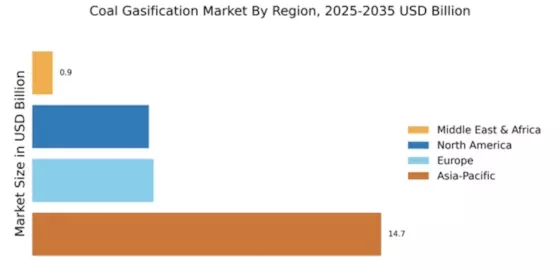
North America is witnessing a significant shift towards sustainable energy solutions, with coal gasification emerging as a key player in this transition. The regional market size is projected at $4.92 billion, driven by increasing demand for cleaner energy sources and stringent environmental regulations. Government initiatives aimed at reducing carbon emissions are catalyzing investments in advanced gasification technologies, enhancing market growth and adoption rates. The United States leads the North American market, with major players like Air Products and GE spearheading innovations in coal gasification. The competitive landscape is characterized by collaborations and partnerships aimed at enhancing technology and efficiency. As the region focuses on reducing its carbon footprint, the presence of established companies and their commitment to R&D will play a crucial role in shaping the future of coal gasification.

Europe : Regulatory Support and Innovation

Europe's coal gasification market is poised for growth, with a market size of $5.12 billion. The region is driven by regulatory frameworks that promote cleaner energy solutions and reduce reliance on fossil fuels. The European Union's Green Deal and various national policies are encouraging investments in coal gasification technologies, making it a focal point for energy transition strategies across member states. Germany and the UK are at the forefront of this market, with key players like Siemens and Shell leading the charge. The competitive landscape is marked by a strong emphasis on innovation and sustainability, with companies investing heavily in R&D to develop efficient gasification processes. As Europe aims for carbon neutrality, the coal gasification sector is expected to play a vital role in achieving these ambitious targets.

Asia-Pacific : Emerging Powerhouse in Gasification

Asia-Pacific is the largest market for coal gasification, with a remarkable size of $14.72 billion. The region's growth is fueled by rapid industrialization, urbanization, and increasing energy demands. Countries are investing in coal gasification as a means to ensure energy security while transitioning to cleaner energy sources. Regulatory support and government initiatives are further driving the adoption of gasification technologies across the region. China and India are the leading countries in this market, with significant investments from major players like Mitsubishi Heavy Industries and Sasol. The competitive landscape is characterized by a mix of domestic and international companies, all vying for market share. As the region continues to expand its energy infrastructure, coal gasification is expected to play a crucial role in meeting future energy needs while addressing environmental concerns.

Middle East and Africa : Resource-Rich Frontier for Gasification

The Middle East and Africa region is emerging as a potential market for coal gasification, with a market size of $0.86 billion. The growth is driven by the need for energy diversification and the utilization of local coal resources. Governments are increasingly recognizing the importance of coal gasification in achieving energy security and reducing dependence on oil and gas. Regulatory frameworks are being developed to support this transition, fostering a conducive environment for investment. South Africa is a key player in this market, with companies like Sasol leading the way in coal gasification projects. The competitive landscape is still developing, with opportunities for both local and international players to enter the market. As the region seeks to enhance its energy mix, coal gasification is expected to gain traction, supported by favorable policies and investment incentives.

Key Players and Competitive Insights

The Coal Gasification Market is currently characterized by a dynamic competitive landscape, driven by the increasing demand for cleaner energy solutions and the need for efficient carbon management. Major players such as Air Products (US), Shell (GB), and Sasol (ZA) are strategically positioning themselves through innovation and partnerships to enhance their operational capabilities. Air Products (US) has focused on expanding its hydrogen production capabilities, which aligns with the global shift towards hydrogen as a clean energy carrier. Meanwhile, Shell (GB) is investing in integrated gasification technologies to optimize its energy portfolio, indicating a commitment to sustainability and efficiency. Sasol (ZA) is also enhancing its coal-to-liquids technology, which reflects a broader trend of integrating traditional coal gasification with modern environmental standards.

In terms of business tactics, companies are increasingly localizing manufacturing and optimizing supply chains to enhance operational efficiency. The market appears moderately fragmented, with key players exerting considerable influence over pricing and technology standards. This competitive structure allows for a diverse range of innovations, as companies strive to differentiate themselves through advanced technologies and sustainable practices.

In November 2025, Air Products (US) announced a strategic partnership with a leading renewable energy firm to develop a new hydrogen production facility utilizing coal gasification technology. This move is significant as it not only expands Air Products' footprint in the hydrogen market but also underscores the importance of integrating renewable sources into traditional gasification processes. Such partnerships are likely to enhance the company's competitive edge in a rapidly evolving energy landscape.

In October 2025, Shell (GB) unveiled its plans to invest €500 million in a new gasification plant in Europe, aimed at producing low-carbon fuels. This investment is pivotal as it demonstrates Shell's commitment to transitioning towards more sustainable energy solutions while leveraging its existing gasification technologies. The strategic focus on low-carbon fuels positions Shell favorably in a market increasingly driven by environmental considerations.

In September 2025, Sasol (ZA) completed the commissioning of a new coal gasification unit that incorporates advanced carbon capture and storage (CCS) technology. This development is crucial as it not only enhances Sasol's production capabilities but also aligns with global efforts to reduce greenhouse gas emissions. The integration of CCS technology into coal gasification processes may set a new standard for environmental responsibility in the industry.

As of December 2025, the competitive trends in the Coal Gasification Market are increasingly defined by digitalization, sustainability, and the integration of artificial intelligence (AI) in operational processes. Strategic alliances are becoming more prevalent, as companies recognize the need to collaborate in order to innovate and meet regulatory demands. The competitive differentiation is likely to evolve from traditional price-based competition towards a focus on technological advancements, sustainability initiatives, and supply chain reliability. This shift suggests that companies that prioritize innovation and environmental stewardship will be better positioned to thrive in the future.

Key Companies in the Coal Gasification Market market include

Industry Developments

Recent developments in the Coal Gasification Market reveal a significant focus on technological advancements and collaborations among key industry players. Companies like Linde AG, SASOL, and Mitsubishi Heavy Industries are actively investing in innovative gasification technologies to enhance efficiency and reduce emissions. Longyuan Power Group aims to integrate renewable energy sources into existing coal gasification processes, highlighting a shift towards sustainable practices. Current affairs also emphasize the growing demand for syngas as an alternative feedstock, driven by global energy transitions. In terms of mergers and acquisitions, several companies are exploring strategic partnerships to strengthen their market positions.

For instance, Air Products and Chemicals has expanded its footprint through acquisitions aimed at enhancing their gasification technology offerings. China's National Coal Group continues to adapt its services in response to changing regulatory landscapes, maintaining a strong market presence. The overall market valuation is experiencing growth, with major players like General Electric and Bechtel working on large-scale projects that promise innovations in gasification, fundamentally impacting supply chains and energy production strategies. Ongoing investments are anticipated to boost competition and technological progress within the sector.

Future Outlook

Coal Gasification Market Future Outlook

The Coal Gasification Market is projected to grow at a 5.16% CAGR from 2024 to 2035, driven by increasing energy demands and environmental regulations.

New opportunities lie in:

  • Development of integrated gasification combined cycle (IGCC) plants
  • Expansion into emerging markets with coal resources
  • Investment in carbon capture and storage technologies

By 2035, the market is expected to solidify its role in sustainable energy solutions.

Market Segmentation

Coal Gasification Market End Use Outlook

  • Power Plants
  • Industrial Applications
  • Transportation Fuels
  • Residential Heating

Coal Gasification Market Feedstock Outlook

  • Coal
  • Biomass
  • Petroleum Coke
  • Waste Materials

Coal Gasification Market Technology Outlook

  • Fixed Bed Gasification
  • Fluidized Bed Gasification
  • Entrained Flow Gasification
  • Plasma Gasification

Coal Gasification Market Application Outlook

  • Electricity Generation
  • Chemical Production
  • Synthetic Fuels
  • Hydrogen Production

Report Scope

MARKET SIZE 202424.62(USD Billion)
MARKET SIZE 202525.89(USD Billion)
MARKET SIZE 203542.83(USD Billion)
COMPOUND ANNUAL GROWTH RATE (CAGR)5.16% (2024 - 2035)
REPORT COVERAGERevenue Forecast, Competitive Landscape, Growth Factors, and Trends
BASE YEAR2024
Market Forecast Period2025 - 2035
Historical Data2019 - 2024
Market Forecast UnitsUSD Billion
Key Companies ProfiledAir Products (US), Shell (GB), Siemens (DE), GE (US), Sasol (ZA), Linde (DE), Thyssenkrupp (DE), KBR (US), Mitsubishi Heavy Industries (JP)
Segments CoveredApplication, Feedstock, Technology, End Use
Key Market OpportunitiesAdvancements in carbon capture technologies enhance sustainability in the Coal Gasification Market.
Key Market DynamicsTechnological advancements and regulatory shifts drive innovation and competition in the coal gasification market.
Countries CoveredNorth America, Europe, APAC, South America, MEA

Leave a Comment

FAQs

What is the estimated market size of the Coal Gasification Market by 2032?

The Coal Gasification Market is expected to be valued at 35.0 USD Billion by 2032.

What is the projected CAGR for the Coal Gasification Market from 2024 to 2032?

The expected CAGR for the Coal Gasification Market from 2024 to 2032 is 5.16%.

Which region is projected to have the largest market share by 2032?

The Asia-Pacific region is projected to have the largest market share, anticipated to reach 13.5 USD Billion by 2032.

What is the expected market value for Fixed Bed Gasification technology by 2032?

The Fixed Bed Gasification technology is expected to be valued at 7.8 USD Billion by 2032.

Who are the major players in the Coal Gasification Market?

Major players include Linde AG, Longyuan Power Group, SASOL, and Royal Dutch Shell among others.

What will be the market value of Fluidized Bed Gasification technology in 2032?

Fluidized Bed Gasification technology is anticipated to reach a market value of 9.4 USD Billion by 2032.

What is the estimated market size for the Coal Gasification Market in North America by 2032?

The market size for the Coal Gasification Market in North America is expected to be 9.75 USD Billion by 2032.

What is the expected growth rate for Entrained Flow Gasification technology from 2024 to 2032?

Entrained Flow Gasification technology is projected to grow to 11.0 USD Billion by 2032.

What is the market value of the Coal Gasification Market in Europe by 2032?

The market value in Europe is expected to reach 8.0 USD Billion by 2032.

What is the growth potential of the Partial Oxidation technology segment by 2032?

The Partial Oxidation technology segment is anticipated to achieve a market value of 6.8 USD Billion by 2032.

Download Free Sample

Kindly complete the form below to receive a free sample of this Report

Compare Licence

×
Features License Type
Single User Multiuser License Enterprise User
Price $4,950 $5,950 $7,250
Maximum User Access Limit 1 User Upto 10 Users Unrestricted Access Throughout the Organization
Free Customization
Direct Access to Analyst
Deliverable Format
Platform Access
Discount on Next Purchase 10% 15% 15%
Printable Versions