×
Request Free Sample ×

Kindly complete the form below to receive a free sample of this Report

* Please use a valid business email

Leading companies partner with us for data-driven Insights

clients tt-cursor
Hero Background

Collaborative Whiteboard Software Market

ID: MRFR/ICT/40141-HCR
200 Pages
Garvit Vyas
October 2025

Collaborative Whiteboard Software Market Research Report: By Deployment Type (Cloud-Based, On-Premises, Hybrid), By Application (Education, Business Collaboration, Design, Brainstorming, Remote Team Meetings), By End User (Educational Institutions, Corporate Sector, Freelancers, Non-Profit Organizations), By Features (Real-Time Collaboration, Interactive Tools, Integration with Other Software, Document Sharing) and By Regional (North America, Europe, South America, Asia-Pacific, Middle East and Africa) - Forecast to 2035

Share:
Download PDF ×

We do not share your information with anyone. However, we may send you emails based on your report interest from time to time. You may contact us at any time to opt-out.

Collaborative Whiteboard Software Market Infographic
Purchase Options

Collaborative Whiteboard Software Market Summary

As per MRFR analysis, the Collaborative Whiteboard Software Market Size was estimated at 3500.9 USD Million in 2024. The Collaborative Whiteboard Software industry is projected to grow from 3915.76 USD Million in 2025 to 11999.86 USD Million by 2035, exhibiting a compound annual growth rate (CAGR) of 11.85 during the forecast period 2025 - 2035.

Key Market Trends & Highlights

The Collaborative Whiteboard Software Market is experiencing robust growth driven by technological advancements and evolving user needs.

  • The integration of AI and machine learning is enhancing the functionality of collaborative whiteboard software, particularly in North America.
  • User experience remains a focal point, with software developers prioritizing intuitive interfaces to cater to diverse user bases.
  • The rise of hybrid work solutions is propelling demand for collaborative tools, especially in the fast-growing Asia-Pacific region.
  • Increased demand for remote collaboration tools and a growing emphasis on visual communication are key drivers shaping the market landscape.

Market Size & Forecast

2024 Market Size 3500.9 (USD Million)
2035 Market Size 11999.86 (USD Million)
CAGR (2025 - 2035) 11.85%

Major Players

Miro (US), Microsoft (US), Lucidspark (US), Jamboard (US), Stormboard (US), Conceptboard (DE), Ziteboard (US), Mural (US), Collaboard (DE)

Collaborative Whiteboard Software Market Trends

The Collaborative Whiteboard Software Market is currently experiencing a notable evolution, driven by the increasing demand for remote collaboration tools. Organizations across various sectors are recognizing the value of visual communication and interactive brainstorming, which these platforms facilitate. As teams become more dispersed, the need for effective digital collaboration solutions has intensified. This market appears to be expanding as businesses seek to enhance productivity and foster creativity through shared digital spaces. Furthermore, the integration of advanced technologies such as artificial intelligence and machine learning into these platforms is likely to enhance user experience and functionality, making them more appealing to a broader audience. In addition, the rise of hybrid work models is influencing the Collaborative Whiteboard Software Market. Companies are adapting to new work environments that blend in-person and remote interactions, necessitating tools that can bridge the gap between different working styles. This shift suggests a growing emphasis on user-friendly interfaces and seamless integration with existing workflows. As organizations continue to prioritize collaboration and innovation, the demand for sophisticated whiteboard solutions is expected to persist, potentially leading to further advancements in features and capabilities.

Integration of AI and Machine Learning

The incorporation of artificial intelligence and machine learning technologies into collaborative whiteboard software is becoming increasingly prevalent. These advancements may enhance functionalities such as real-time feedback, automated organization of ideas, and personalized user experiences, thereby improving overall efficiency.

Focus on User Experience

There is a noticeable trend towards prioritizing user experience in the design of collaborative whiteboard platforms. Developers are likely to emphasize intuitive interfaces and streamlined workflows, ensuring that users can easily navigate and utilize the software, which could lead to higher adoption rates.

Rise of Hybrid Work Solutions

The shift towards hybrid work environments is driving demand for collaborative whiteboard software that accommodates both remote and in-person collaboration. This trend suggests that organizations are seeking tools that facilitate seamless interaction among team members, regardless of their physical location.

Collaborative Whiteboard Software Market Drivers

Increasing Adoption of Remote Work Solutions

The Global Collaborative Whiteboard Software Market Industry experiences a notable surge in demand due to the increasing adoption of remote work solutions. Organizations are increasingly recognizing the need for effective collaboration tools that facilitate seamless communication among distributed teams. As of 2024, the market is valued at approximately 3.5 USD Billion, reflecting a growing trend towards digital collaboration. Companies are investing in collaborative whiteboard software to enhance productivity and engagement, which is crucial in a remote work environment. This shift is expected to drive the market further as businesses seek innovative solutions to maintain team cohesion and creativity.

Market Segment Insights

By Application: Education (Largest) vs. Business Collaboration (Fastest-Growing)

The Collaborative Whiteboard Software Market features a diverse application landscape, with Education emerging as the largest segment due to its critical role in modern learning environments. This application segment significantly benefits from the increasing integration of technology in classrooms, fostering an interactive learning experience. Conversely, Business Collaboration is identified as the fastest-growing segment. The demand for effective virtual teamwork tools has surged, driven by the rise of remote work cultures and the need for seamless communication solutions. Businesses are increasingly adopting collaborative platforms to enhance productivity and simplify project management, contributing to this rapid growth trend.

Education (Dominant) vs. Business Collaboration (Emerging)

The Education segment of the Collaborative Whiteboard Software Market is distinguished by its focus on interactive and engaging learning experiences. Educational institutions leverage these tools to facilitate enhanced student participation, collaborative learning, and real-time feedback from teachers. As schools continue to adopt digital strategies, this segment remains robust, enhancing the learning process across all academic levels. In contrast, the Business Collaboration segment has emerged as a vital player amid the shifting dynamics of workplace interactions. This application focuses on fostering teamwork among remote employees through efficient brainstorming, planning, and project management capabilities. With organizations adopting hybrid work models, the demand for collaborative software tools is surging, allowing businesses to streamline communication and drive innovation.

By End Use: Small Enterprises (Largest) vs. Educational Institutions (Fastest-Growing)

The segmentation analysis of the Collaborative Whiteboard Software Market illustrates a diverse distribution among different end-use sectors. Small Enterprises hold a significant share, benefiting from the increasing demand for efficient collaboration tools that enhance remote communication and project management. Medium and Large Enterprises also show notable engagement, leveraging whiteboard solutions to foster teamwork and innovation on a larger scale. Educational Institutions and Government Organizations, while currently representing smaller segments, are progressively adopting collaborative technologies to improve learning and operational efficiency. In terms of growth trends, Educational Institutions are emerging as the fastest-growing end-use segment in the Collaborative Whiteboard Software Market. The shift towards digital classrooms and hybrid learning environments has accelerated the adoption of collaborative tools in educational settings. Furthermore, government organizations are also gaining traction, seeking innovation in public services and improved inter-agency communication that collaborative platforms can provide.

Small Enterprises: Dominant vs. Government Organizations: Emerging

Small Enterprises dominate the Collaborative Whiteboard Software Market, driven by their need for cost-effective and scalable collaboration solutions. These businesses often thrive in dynamic environments where agile communication leads to better project outcomes. Collaborative whiteboards empower them to streamline workflows and improve stakeholder engagement, making them essential tools for everyday operations. In contrast, Government Organizations represent an emerging sector, increasingly integrating collaborative whiteboard solutions to enhance communication and collaboration across various departments. Their adoption is facilitated by the demand for transparency and efficiency in public service delivery, coupled with the necessity for real-time collaboration in policy-making and public engagement initiatives. As both segments evolve, their distinctive needs drive innovation in collaborative software offerings.

By Deployment Type: Cloud-Based (Largest) vs. Hybrid (Fastest-Growing)

In the Collaborative Whiteboard Software Market, the deployment type segmentation reveals a significant leaning towards cloud-based solutions, which have become the dominant form of deployment. This segment captures the largest market share due to its scalability, accessibility, and the increasing shift towards remote collaboration. On-premises solutions, while still relevant, occupy a smaller slice of the market as more businesses acknowledge the advantages of cloud infrastructure. Hybrid deployment, which combines both cloud and on-premises solutions, is gaining traction but is not yet as widely adopted as its cloud counterpart. The growth trends within this segment continue to show a strong inclination towards cloud-based offerings, driven by increased demand for flexible and remote collaboration tools. Hybrid solutions are emerging rapidly, catering to organizations that seek a balance between control and flexibility. Factors such as the rise in remote work, increasing digital transformation across industries, and the need for real-time collaboration are propelling this growth, making hybrid deployment the fastest-growing option in the market.

Cloud-Based (Dominant) vs. Hybrid (Emerging)

Cloud-based deployment is the most dominant option within the Collaborative Whiteboard Software Market, offering unparalleled convenience and scalability for users. Organizations favor cloud solutions for their flexibility and ease of access, enabling teams to collaborate seamlessly regardless of their location. In contrast, hybrid deployment is seen as an emerging option, gaining popularity among businesses that require a flexible approach to data management and collaboration. Hybrid solutions allow organizations to leverage both on-premises and cloud capabilities, effectively accommodating unique business needs while enhancing security. This increasing preference for hybrid models indicates a shift towards adaptive collaboration environments that can evolve with changing organizational demands.

By User Type: Team Users (Largest) vs. Individual Users (Fastest-Growing)

In the Collaborative Whiteboard Software Market, Team Users account for the largest share due to their widespread adoption in organizations aiming to enhance collaboration and productivity. These users typically consist of small to medium-sized teams that utilize the software for brainstorming, project management, and team meetings. In contrast, Individual Users, while smaller in market share, are growing rapidly as more professionals seek efficient tools for personal projects and freelance work. This segment is particularly appealing to solo entrepreneurs and remote workers who prioritize flexibility and usability.

Team Users (Dominant) vs. Individual Users (Emerging)

Team Users in the Collaborative Whiteboard Software Market are characterized by their robust functionalities that cater to collaborative needs in diverse environments. Organizations leverage these tools for real-time editing, brainstorming sessions, and strategic planning, making them integral to modern teamwork. In contrast, Individual Users represent an emerging segment that is capitalizing on the rise of remote work and freelance opportunities. They are drawn to platforms that combine simplicity with powerful features, as they seek to streamline personal workflows and enhance productivity. The growing availability of affordable and user-friendly solutions has also facilitated this segment's growth, showcasing a trend towards personalized use of collaborative technologies.

By Features: Real-Time Collaboration (Largest) vs. Integration with Other Tools (Fastest-Growing)

In the Collaborative Whiteboard Software Market, Real-Time Collaboration is the largest segment, capturing significant attention due to the increased demand for teamwork and remote interaction. This feature enables users to brainstorm simultaneously, fostering real-time idea generation and discussion, which is essential in today’s fast-paced work environment. Integration with Other Tools, while currently smaller, is swiftly gaining traction as organizations seek solutions that streamline their workflow and enhance productivity through interconnected applications.

Real-Time Collaboration (Dominant) vs. Integration with Other Tools (Emerging)

Real-Time Collaboration stands out as the dominant feature in the Collaborative Whiteboard Software Market, primarily driven by the shift towards remote work and digital collaboration. Users benefit from instant updates, allowing seamless communication and engagement. On the other hand, Integration with Other Tools is emerging as a critical feature that not only enhances user experience but also aligns with organizational needs for efficiency. This feature allows whiteboards to connect with project management, communication, and various productivity tools, thus streamlining workflows and fostering collaboration across platforms. As companies adopt multi-tool environments, the relevance and demand for integration capabilities will continue to grow.

Get more detailed insights about Collaborative Whiteboard Software Market

Regional Insights

North America : Innovation Hub for Collaboration

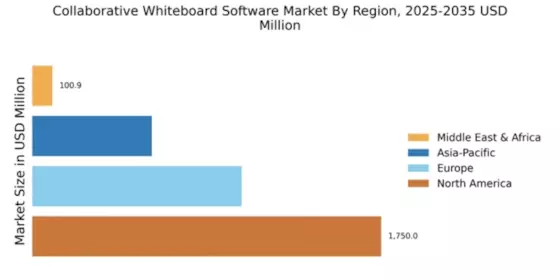
North America dominates the Collaborative Whiteboard Software Market, holding a significant share of 1750.0M in 2024. The region's growth is driven by increasing remote work trends, technological advancements, and a strong emphasis on digital collaboration tools. Regulatory support for digital transformation initiatives further fuels demand, making it a key player in the global market. The competitive landscape in North America is robust, featuring major players like Miro, Microsoft, and Lucidspark. These companies are continuously innovating to enhance user experience and functionality. The presence of a tech-savvy workforce and high adoption rates of cloud-based solutions contribute to the region's leadership in the market, ensuring sustained growth and investment in collaborative technologies.

Europe : Emerging Powerhouse in Collaboration

Europe is witnessing a significant rise in the Collaborative Whiteboard Software Market, with a market size of 1050.0M. The region's growth is propelled by increasing digitalization across various sectors, coupled with a strong focus on remote collaboration tools. Regulatory frameworks promoting digital innovation and sustainability are also key drivers, enhancing the market's appeal to businesses. Leading countries such as Germany and the UK are at the forefront of this growth, with companies like Conceptboard and Collaboard making notable contributions. The competitive landscape is characterized by a mix of established players and emerging startups, fostering innovation and diverse offerings. As organizations prioritize collaboration, Europe is poised for continued expansion in this sector.

Asia-Pacific : Rapidly Growing Market Segment

The Asia-Pacific region is rapidly emerging in the Collaborative Whiteboard Software Market, with a market size of 600.0M. The growth is driven by increasing internet penetration, a surge in remote work, and a growing emphasis on digital collaboration tools. Governments in the region are also promoting digital initiatives, which serve as catalysts for market expansion. Countries like Japan and Australia are leading the charge, with a growing number of local and international players entering the market. The competitive landscape is diverse, featuring both established companies and innovative startups. As businesses increasingly adopt collaborative technologies, the Asia-Pacific market is set for significant growth in the coming years.

Middle East and Africa : Resource-Rich Frontier for Innovation

The Middle East and Africa region is gradually emerging in the Collaborative Whiteboard Software Market, with a market size of 100.9M. The growth is driven by increasing investments in technology and digital infrastructure, alongside a rising demand for collaborative solutions in various sectors. Regulatory support for digital transformation initiatives is also fostering market growth, making it an attractive region for investment. Countries like South Africa and the UAE are leading the way, with a growing number of local and international players entering the market. The competitive landscape is evolving, characterized by a mix of established companies and new entrants. As organizations prioritize collaboration, the Middle East and Africa are poised for growth in this sector.

Key Players and Competitive Insights

The Collaborative Whiteboard Software Market is currently characterized by a dynamic competitive landscape, driven by the increasing demand for remote collaboration tools and digital transformation across various sectors. Major players such as Miro (US), Microsoft (US), and Mural (US) are strategically positioned to leverage their technological capabilities and extensive user bases. Miro (US) focuses on continuous innovation, enhancing user experience through regular feature updates and integrations with other productivity tools. Microsoft (US), with its robust ecosystem, emphasizes seamless integration of its whiteboard solutions with Microsoft Teams, thereby reinforcing its market presence. Mural (US) adopts a community-driven approach, fostering user engagement and feedback to refine its offerings, which collectively shapes a competitive environment that prioritizes user-centric solutions and technological advancements.

In terms of business tactics, companies are increasingly localizing their operations and optimizing supply chains to enhance service delivery and responsiveness to market demands. The market structure appears moderately fragmented, with several players vying for market share, yet the influence of key players remains substantial. This competitive structure encourages innovation and differentiation, as companies strive to establish unique value propositions in a crowded marketplace.

In November 2025, Miro (US) announced a strategic partnership with a leading project management software provider, aiming to integrate their platforms for enhanced workflow efficiency. This collaboration is likely to expand Miro's user base and solidify its position as a go-to solution for teams seeking comprehensive project management and collaboration tools. The strategic importance of this partnership lies in its potential to create a more cohesive user experience, thereby attracting organizations looking for integrated solutions.

In October 2025, Microsoft (US) unveiled a new AI-driven feature within its whiteboard application, designed to facilitate real-time brainstorming sessions by suggesting content and layouts based on user input. This innovation not only enhances user engagement but also positions Microsoft at the forefront of technological advancement in the collaborative software space. The introduction of AI capabilities indicates a shift towards more intelligent and adaptive tools that cater to the evolving needs of users.

In September 2025, Mural (US) launched a new initiative aimed at promoting sustainability within its operations and product offerings. By incorporating eco-friendly practices and materials, Mural seeks to appeal to environmentally conscious consumers and organizations. This strategic move reflects a growing trend among companies to align their business practices with sustainability goals, which may enhance brand loyalty and attract a broader customer base.

As of December 2025, the competitive trends in the Collaborative Whiteboard Software Market are increasingly defined by digitalization, sustainability, and AI integration. Strategic alliances are becoming pivotal in shaping the landscape, as companies recognize the value of collaboration in enhancing their offerings. Looking ahead, competitive differentiation is likely to evolve from traditional price-based competition to a focus on innovation, technology, and supply chain reliability. This shift underscores the importance of adaptability and forward-thinking strategies in maintaining a competitive edge in a rapidly changing market.

Key Companies in the Collaborative Whiteboard Software Market market include

Industry Developments

Recent developments in the Global Collaborative Whiteboard Software Market highlight significant advancements and competitive dynamics among key players such as Google, Miro, Microsoft, and Cisco. These companies are consistently enhancing their offerings to cater to the increasing remote work and online collaboration demands. Notably, Miro launched new integration features that streamline workflows, while Microsoft introduced updates to its Whiteboard tool, enhancing functionality for team interaction. In terms of mergers and acquisitions, Cisco has made strategic moves to strengthen its collaboration portfolio, reinforcing its Webex platform and expanding its market reach.

The valuation of companies in this sector demonstrates substantial growth, particularly as organizations embrace digital transformation strategies, driving investment in collaborative technologies

Additionally, Figma has been gaining traction in creative collaboration as its platform evolves to combine visual design with whiteboarding capabilities. The overall market atmosphere reflects heightened competition and innovation, contributing to a rapidly evolving landscape characterized by an ongoing pursuit of enhanced user experiences and cooperative functionalities. As businesses continue to adapt to hybrid and remote environments, the demand for such technologies is expected to persist, shaping the future of collaboration tools.

Future Outlook

Collaborative Whiteboard Software Market Future Outlook

The Collaborative Whiteboard Software Market is projected to grow at 11.85% CAGR from 2024 to 2035, driven by remote collaboration needs, technological advancements, and increasing digital transformation.

New opportunities lie in:

  • Integration with AI-driven analytics tools for enhanced user insights.
  • Development of industry-specific whiteboard solutions for targeted sectors.
  • Expansion into emerging markets with localized software offerings.

By 2035, the market is expected to be robust, reflecting substantial growth and innovation.

Market Segmentation

Collaborative Whiteboard Software Market End Use Outlook

  • Small Enterprises
  • Medium Enterprises
  • Large Enterprises
  • Educational Institutions
  • Government Organizations

Collaborative Whiteboard Software Market Features Outlook

  • Real-Time Collaboration
  • Integration with Other Tools
  • User-Friendly Interface
  • Security Features
  • Customizable Templates

Collaborative Whiteboard Software Market User Type Outlook

  • Individual Users
  • Team Users
  • Enterprise Users

Collaborative Whiteboard Software Market Application Outlook

  • Education
  • Business Collaboration
  • Creative Design
  • Remote Work
  • Brainstorming

Collaborative Whiteboard Software Market Deployment Type Outlook

  • Cloud-Based
  • On-Premises
  • Hybrid

Report Scope

MARKET SIZE 20243500.9(USD Million)
MARKET SIZE 20253915.76(USD Million)
MARKET SIZE 203511999.86(USD Million)
COMPOUND ANNUAL GROWTH RATE (CAGR)11.85% (2024 - 2035)
REPORT COVERAGERevenue Forecast, Competitive Landscape, Growth Factors, and Trends
BASE YEAR2024
Market Forecast Period2025 - 2035
Historical Data2019 - 2024
Market Forecast UnitsUSD Million
Key Companies ProfiledMiro (US), Microsoft (US), Lucidspark (US), Jamboard (US), Stormboard (US), Conceptboard (DE), Ziteboard (US), Mural (US), Collaboard (DE)
Segments CoveredApplication, End Use, Deployment Type, User Type, Features
Key Market OpportunitiesIntegration of artificial intelligence enhances user collaboration in the Collaborative Whiteboard Software Market.
Key Market DynamicsRising demand for remote collaboration tools drives innovation and competition in the Collaborative Whiteboard Software market.
Countries CoveredNorth America, Europe, APAC, South America, MEA

Leave a Comment

FAQs

What is the expected market size of the Global Collaborative Whiteboard Software Market in 2024?

The Global Collaborative Whiteboard Software Market is expected to be valued at 3.5 USD Billion in 2024.

What is the projected market size for the Global Collaborative Whiteboard Software Market by 2035?

The market is projected to reach a value of 12.0 USD Billion by the year 2035.

What is the expected compound annual growth rate (CAGR) for the Global Collaborative Whiteboard Software Market from 2025 to 2035?

The expected CAGR for the market during this forecast period is 11.85%.

Which region is expected to have the highest market value in 2024 for the Global Collaborative Whiteboard Software Market?

North America is expected to hold the highest market value at 1.4 USD Billion in 2024.

What will be the market value for the Global Collaborative Whiteboard Software Market in the APAC region by 2035?

The APAC region is projected to reach a market value of 2.7 USD Billion by 2035.

Who are the major players in the Global Collaborative Whiteboard Software Market?

Key players in the market include Google, Cisco, Miro, Microsoft, and Zoom Video Communications.

What is the expected market size for cloud-based deployment of the Global Collaborative Whiteboard Software Market in 2024?

Cloud-based deployment is expected to be valued at 1.4 USD Billion in 2024.

How much will the hybrid deployment segment be valued at in 2035?

The hybrid deployment segment is projected to be valued at 3.0 USD Billion by 2035.

What is driving the growth of the Global Collaborative Whiteboard Software Market?

The growth is driven by increased remote collaboration and demand for digital workspace solutions.

Which region is anticipated to experience significant growth from 2024 to 2035?

Europe is anticipated to experience significant growth, with a market value increasing from 1.0 USD Billion in 2024 to 3.5 USD Billion in 2035.

Download Free Sample

Kindly complete the form below to receive a free sample of this Report

Compare Licence

×
Features License Type
Single User Multiuser License Enterprise User
Price $4,950 $5,950 $7,250
Maximum User Access Limit 1 User Upto 10 Users Unrestricted Access Throughout the Organization
Free Customization
Direct Access to Analyst
Deliverable Format
Platform Access
Discount on Next Purchase 10% 15% 15%
Printable Versions