Commercial Aircraft Landing Gear Market (2026 - 2035)

Commercial Aircraft Landing Gear Market Size, Share, Industry Trend & Analysis Report Information By Landing Gear Type (Main Landing Gear, Nose Landing Gear), By Aircraft Type (Narrowbody, Widebody, Regional Jet), By End User (Original Equipment Manufacturer (OEM), Aftermarket), By Sub-System (Structural, Actuation System, Steering System, Others), By Geography (North America, Europe, Asia-Pacific, South America, Middle East & Africa) - Forecast to 2035
ID: MRFR/AD/0918-CR
103 Pages
Shubham Munde, Sejal Akre
Last Updated: June 24, 2026
Commercial Aircraft Landing Gear Market
Market Size
Forecast Period2026-2035
CAGR (2026-2035)10.33%
2025 Market SizeUSD 5.08 Billion
2035 Market SizeUSD 13.35 Billion
Key Players
Safran Landing Systems
Collins Aerospace
Héroux-Devtek
Liebherr Aerospace
Triumph Group
Sumitomo Precision Products
Opportunities
  • Additive Manufacturing for Structural Components
  • Health-Monitoring and Predictive-Maintenance Platforms
  • Emerging-Market MRO Expansion

Commercial Aircraft Landing Gear Market Summary

The Commercial Aircraft Landing Gear Market was valued at USD 5.08 billion in 2025 and is projected to reach USD 5.60 billion in 2026 before expanding to USD 13.35 billion by 2035, registering a compound annual growth rate of 10.14% during the 2026–2035 forecast window. Record-high single-aisle order backlogs — exceeding 14,000 aircraft across major OEMs — have locked in multi-year production schedules that translate directly into landing-gear procurement commitments [1]. Airlines face regulatory pressure to cut per-seat emissions under ICAO's Carbon Offsetting and Reduction Scheme for International Aviation (CORSIA), incentivizing fleet renewal with lighter, more efficient airframes that require next-generation gear systems [2].

The transformation of technology in the Commercial Aircraft Landing Gear Market is driven towards the replacement of traditional hydraulic actuation with electro-mechanical and electro-hydrostatic. Safran Landing Systems committed approximately EUR 250 million between 2022 and 2024 on additive-manufactured titanium components and electric taxi systems, providing weight savings of more than 280 kilograms per shipset on narrowbody platforms [3]. The uptake of carbon-ceramic brakes has moved from widebody flagships down into narrowbody fleets, leading to a reduction in brake system mass of almost 40% with improved repair intervals from 1500 to over 3000 landings [4].


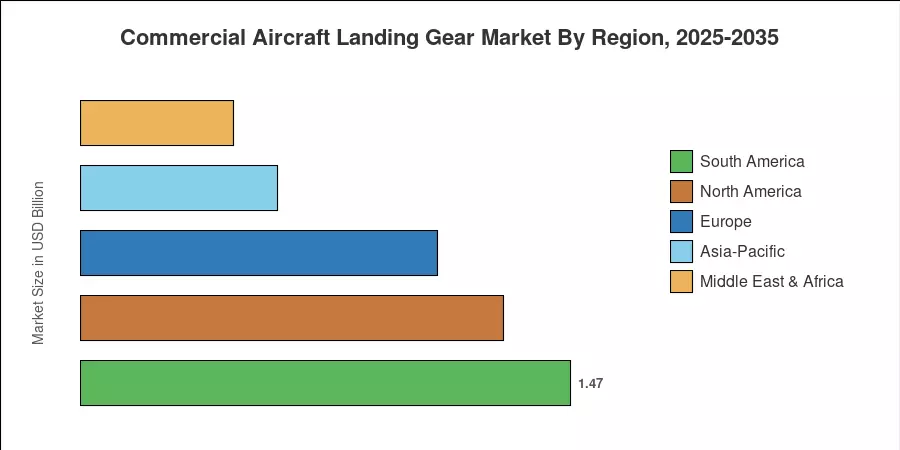
South America is the largest region with about 29% of worldwide revenue, supported by clustered MRO activity in Brazil and major fleet-replacement projects among Latin carriers. The Asia-Pacific area is the fastest-expanding region with a predicted CAGR of 11.64%. The growth is spurred by fleet development in China and India. North America is the second-largest market and is driven by the OEM production facilities and the aftermarket scale. The Commercial Aircraft Landing Gear Market is at an inflection point where the convergence of manufacturing rate increases, material innovation and sustainability standards is reshaping demand through the future decade.


Key Report Takeaways

• By Landing Gear Type

  • Main landing gear assemblies accounted for 80.1% of the Commercial Aircraft Landing Gear Market revenue in 2025, reflecting the structural complexity and premium pricing of multi-wheel bogie systems on narrowbody and widebody platforms.
  • Nose landing gear is forecast to grow at a 10.33% CAGR through 2035, driven by electric nose-wheel taxi integration and steerable nose-gear electronics upgrades across next-generation single-aisle programs.

• By Aircraft Type

  • Narrowbody platforms captured 70.1% share of the Commercial Aircraft Landing Gear Market in 2025, as A320neo-family and B737 MAX production ramp-ups dominated OEM procurement.
  • Widebody landing-gear systems are projected to expand at an 11.04% CAGR through 2035, supported by long-haul fleet renewals and twin-aisle new-program launches.

• By Geography

  • South America led the Commercial Aircraft Landing Gear Market with a 29% regional share in 2025, anchored by large-scale MRO operations and fleet modernization cycles.
  • Asia-Pacific is forecast to advance at an 11.64% CAGR, driven by the expansion of indigenous aircraft programs and growing passenger traffic across China, India, and ASEAN nations.


Market Size and Forecast (2021–2035)

The historical and predicted numbers below are a mix of primary research and OEM delivery dates, airline fleet planning and MRO spending trends. Historical figures (2021–2024) are derived from reported revenue of the five main landing-gear suppliers, and forecast-period projections are developed using a calibrated growth model using production-rate trajectories and aftermarket lifetime assumptions.
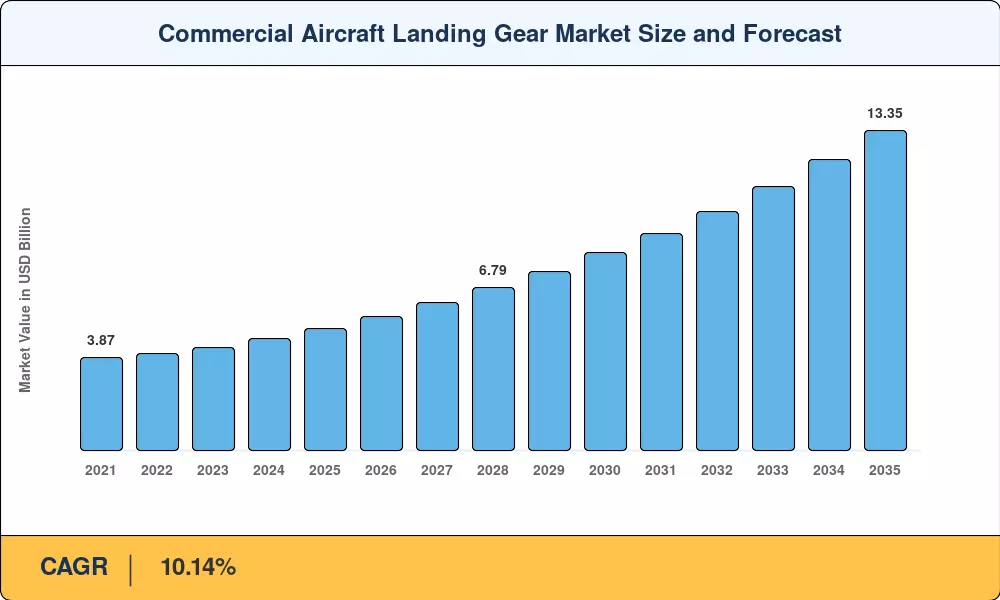
Commercial Aircraft Landing Gear Market Size and Forecast
Our Impact
Enabled $4.3B Revenue Impact for Fortune 500 and Leading Multinationals
Partnering with 2000+ Global Organizations Each Year
30K+ Citations by Top-Tier Firms in the Industry

Driver Impact Analysis

Driver ~% Impact on CAGR Geographic Relevance Impact Timeline
Single-aisle production rate increases +2.8% Global Short-term (≤2 yr)
Carbon-brake and lightweight material adoption +1.9% North America, Europe Medium-term (2–4 yr)
Electric taxi and e-actuation integration +1.5% Europe, Asia-Pacific Medium-term (2–4 yr)
Aftermarket MRO demand from aging narrowbody fleets +1.4% South America, Asia-Pacific Long-term (≥4 yr)
CORSIA-driven fleet renewal mandates +1.2% Global Long-term (≥4 yr)
Widebody new-program launches +0.9% North America, Europe Long-term (≥4 yr)
Additive manufacturing cost reduction +0.7% Europe, North America Medium-term (2–4 yr)


Single-Aisle Production Rate Increases

Airbus publicly targets 75 A320neo-family deliveries per month by 2026, while Boeing plans 38 B737 MAX units monthly despite ongoing quality remediation [1]. Each narrowbody shipset requires one nose and two main landing-gear assemblies priced between USD 1.2 million and USD 1.8 million at the OEM level. The sheer volume of single-aisle output over the next three years represents the single largest demand driver for the Commercial Aircraft Landing Gear Market, as tier-one suppliers have committed over USD 600 million in capacity expansions since 2023 to match airframer schedules [8].

Carbon-Brake and Lightweight Material Adoption

Carbon-ceramic brakes reduce brake-system weight by roughly 40% compared to steel equivalents and extend overhaul intervals beyond 3,000 landing cycles [4]. Airlines operating A320ceo and B737NG fleets are retrofitting carbon brakes to lower direct operating costs, generating a parallel revenue stream within the Commercial Aircraft Landing Gear Market that complements OEM installations. Safran's Messier-Bugatti-Dowty division reported that carbon-brake penetration on narrowbody platforms exceeded 65% of new deliveries in 2024 [3].

Electric Taxi and Electro-Mechanical Actuation

Electric green-taxi systems, which use motor-driven nose or main wheels to enable gate-to-runway movement without engine power, can save airlines between 2% and 4% of block fuel per cycle [9]. EASA issued supplemental type certificate guidance for nose-wheel electric taxi retrofits in 2024, opening the European narrowbody fleet to aftermarket installations [12]. Electro-hydrostatic actuators are simultaneously replacing centralized hydraulic networks on next-generation gear designs, cutting hydraulic fluid volume by up to 60% and simplifying maintenance scheduling.

Aftermarket MRO Demand from Aging Narrowbody Fleets

Over 8,500 A320ceo and B737NG aircraft remain in active service globally, and the average fleet age is approaching 14 years [10]. Landing-gear overhaul intervals typically fall between 10 and 12 years, positioning a large share of this installed base for heavy maintenance visits before 2030. Independent MRO providers in South America and Asia-Pacific are expanding gear-overhaul capacity to capture volume that Tier-1 OEMs cannot fully absorb under existing power-by-the-hour contract structures.


Restraints Impact Analysis

The restraint impacts below follow the same directional-estimation methodology as Section 4. Negative values represent estimated drag on headline growth; actual outcomes depend on mitigation strategies and macroeconomic conditions.

Restraint ~% Impact on CAGR Geographic Relevance Impact Timeline
Titanium and specialty-alloy supply constraints –1.4% Global Short-term (≤2 yr)
OEM production-rate delays and quality audits –1.1% North America Short-term (≤2 yr)
High certification costs for new gear architectures –0.7% Global Medium-term (2–4 yr)
Skilled-labor shortages in precision machining –0.6% Europe, North America Long-term (≥4 yr)
Foreign-exchange volatility on cross-border contracts –0.4% South America, MEA Medium-term (2–4 yr)


Titanium and Specialty-Alloy Supply Constraints

Landing-gear structural forgings rely heavily on Ti-6Al-4V and high-strength steel alloys such as 300M. Post-2022 sanctions and export restrictions reduced available titanium sponge supply by an estimated 12%, driving spot prices up 35% between 2022 and 2024 [13]. Suppliers have pursued vertical integration — Safran acquired a titanium-forging facility in 2023 — but new capacity typically requires 18–24 months to reach full qualification, creating a near-term bottleneck that weighs on the Commercial Aircraft Landing Gear Market.

OEM Production-Rate Delays and Quality Audits

Boeing's 2024 quality-review program slowed B737 MAX deliveries to approximately 25 per month against a target of 38, directly reducing landing-gear pull-through demand [14]. Certification hold-ups on the B737 MAX 7 and MAX 10 variants further compressed the order-to-delivery pipeline. While these delays defer rather than destroy demand within the Commercial Aircraft Landing Gear Market, they introduce revenue-timing uncertainty for tier-one gear suppliers that have already invested in rate-ready capacity.

High Certification Costs for New Gear Architectures

Introducing a new landing-gear design to an existing or new aircraft program involves FAA and EASA structural certification testing that can span 36 months and cost USD 80–120 million per program [12]. The certification burden discourages incremental innovation on legacy platforms and concentrates R&D spending on clean-sheet programs where return horizons justify the investment.


Commercial Aircraft Landing Gear Market Opportunities

Additive Manufacturing for Structural Components

Metal additive manufacturing enables topology-optimized gear brackets and hydraulic manifolds that weigh 30–50% less than conventionally machined equivalents [3]. Safran demonstrated a selectively laser-melted hydraulic manifold in 2024 that halved part weight and consolidated eight subcomponents into one. Scaling additive production to serial rates represents a USD 400–600 million incremental opportunity within the Commercial Aircraft Landing Gear Market by 2032.

Health-Monitoring and Predictive-Maintenance Platforms

Sensor-equipped landing gear that streams vibration, temperature, and load data to ground systems enables condition-based maintenance and extends overhaul intervals by 15–20% [17]. Airlines adopting digital gear-health platforms reduce unscheduled removals and capture significant savings on spare parts inventory. Data-monetization models — where gear OEMs sell analytics subscriptions alongside hardware — could generate recurring revenue streams exceeding USD 200 million annually by 2030 across the installed fleet.

Emerging-Market MRO Expansion

India's Directorate General of Civil Aviation approved three new dedicated landing-gear MRO facilities between 2023 and 2025 as the country's commercial fleet surpassed 750 aircraft [18]. Southeast Asian carriers are similarly seeking in-region overhaul alternatives to reduce turnaround times currently averaging 45–60 days when gear sets are shipped to European facilities. This geographic redistribution of aftermarket capacity creates entry points for both established suppliers and regional independents.

Electric Nose-Wheel Taxi Systems as a Retrofit Opportunity

Retrofit electric taxi kits for A320ceo and B737NG fleets address a serviceable installed base of over 8,500 aircraft [9]. Airlines operating short-haul networks with high taxi times — particularly in congested Asian and European hubs — stand to recover fuel savings of USD 150,000–250,000 per aircraft annually, creating strong business cases for third-party STC installations that expand the addressable Commercial Aircraft Landing Gear Market beyond traditional gear hardware.

Next-Generation Widebody Program Gear Selections

Anticipated clean-sheet widebody programs from both Airbus and Boeing in the late 2020s will trigger competitive gear-system selections worth USD 3–5 billion in lifetime program value [11]. Tier-one suppliers that demonstrate integrated electro-mechanical actuation, advanced composite structures, and certified additive components will hold a significant competitive advantage in these winner-take-all contract awards.


Commercial Aircraft Landing Gear Market Future Outlook

Electrification and Electric-Actuation Supercycle

As of mid-2026, the narrowbody market remains the primary driver of landing-gear demand. Airbus continues to manage high production volumes, though actual delivery rates are influenced by supply chain stabilization rather than static monthly targets. Boeing has successfully navigated a challenging 2024–2025 period following intensive FAA oversight; having achieved a production rate of 47 aircraft per month by mid-2026, the company is now focused on reaching 52 per month to support long-term order backlogs. Tier-one suppliers are currently prioritizing "rate-ready" capacity, with significant capital expenditure directed toward maintaining output consistency in an increasingly complex regulatory environment.


Predictive Analytics and Digital-Twin Integration

Digital-twin models that simulate gear fatigue, brake wear, and actuator health in real time are moving from R&D demonstration to fleet deployment. Boeing's AnalytX division and Safran's CASSIOPÉE platform both commercialized gear-health monitoring suites in 2024, offering airlines 15–20% reductions in unscheduled gear removals [17]. By 2030, sensor-equipped gear legs are expected to generate enough operational data to enable on-condition maintenance approvals from regulators, fundamentally altering the Commercial Aircraft Landing Gear Market aftermarket model.

Sustainability-Driven Material Innovation

The global narrowbody fleet (A320ceo and B737NG) remains the backbone of commercial aviation, with an average age now exceeding 14 years. This aging fleet, coupled with the growth of emerging aviation markets—notably India, which is projected to see its fleet triple to 2,250 aircraft by 2035—has created a surge in aftermarket MRO demand. Regional MRO facilities in Asia-Pacific are increasingly competing with traditional European and North American providers, aiming to capture volume by reducing the logistical turnaround times that currently average 45–60 days for heavy landing-gear overhauls.


Autonomous Ground Operations and Smart Landing Systems

Autonomous taxiing, automated gear-extension sequencing, and vision-based runway-condition assessment represent the longer-term frontier for the Commercial Aircraft Landing Gear Market. Airbus's UpNext technology demonstrator completed autonomous taxi trials at Toulouse-Blagnac in 2024, integrating nose-wheel steering with sensor-fusion navigation [22]. While full commercial deployment remains beyond 2030, the integration of AI-driven controls into gear management systems will influence next-generation gear-selection requirements for clean-sheet programs.


Commercial Aircraft Landing Gear Market Segmentation

By Landing Gear Type

Segment Key Metric Primary Demand Driver
Main Landing Gear 80.1% share (2025) Multi-wheel bogie complexity on narrowbody/widebody platforms
Nose Landing Gear 10.33% CAGR (2026–2035) Electric nose-wheel taxi integration; steerable electronics upgrades


Main landing gear dominates the Commercial Aircraft Landing Gear Market because each aircraft requires two main assemblies that combine high-load structural forgings, multi-disc brake stacks, and retraction actuators into shipsets priced at several times the cost of a single nose unit. Carbon-brake adoption and electric-actuation retrofits further elevate main-gear revenue per unit.

Nose landing gear, while smaller by revenue, represents the fastest-growing segment as electric taxi systems mount drive motors on the nose wheels. Airlines evaluating fuel savings of USD 150,000–250,000 per aircraft annually on short-haul routes are accelerating nose-gear retrofit demand [9].

By Aircraft Type

Segment Key Metric Primary Demand Driver
Narrowbody 70.1% share (2025) A320neo and B737 MAX production ramp-ups
Widebody 11.04% CAGR (2026–2035) Long-haul fleet renewal; new twin-aisle programs
Regional Jet USD 0.36 Billion (2025) Embraer E2 and Mitsubishi SpaceJet successor programs


Narrowbody platforms underpin the Commercial Aircraft Landing Gear Market through sheer production volume. At combined A320neo and B737 MAX delivery targets exceeding 110 units per month by 2027, narrowbody gear procurement will remain the dominant revenue driver across both OEM and aftermarket channels.

Widebody gear systems carry the highest per-unit value, with twin-aisle main-gear assemblies priced 2.5–3× above narrowbody equivalents. Fleet-renewal decisions by Gulf carriers and Asian long-haul operators will push widebody gear demand growth above the market average through 2035.

By End User

Segment Key Metric Primary Demand Driver
Original Equipment Manufacturer (OEM) 61.0% share (2025) New-aircraft production backlogs exceeding 14,000 units
Aftermarket 10.98% CAGR (2026–2035) Aging A320ceo/B737NG fleets entering heavy-maintenance cycles


OEM contracts dominate current revenue in the Commercial Aircraft Landing Gear Market, reflecting the unprecedented production ramp currently underway. Tier-one suppliers sign long-term agreements tied to aircraft-delivery milestones, providing revenue visibility but compressing margins relative to aftermarket work.

The aftermarket segment is growing faster as over 8,500 previous-generation narrowbodies approach 10–12-year overhaul intervals simultaneously [10]. Power-by-the-hour contracts enable OEMs to capture lifecycle value, while independent MROs compete on turnaround time and regional proximity.

By Sub-System

Segment Key Metric Primary Demand Driver
Structural 47.2% share (2025) Titanium and steel forgings for main-gear legs and bogie beams
Actuation System CAGR of 11.52% (2026–2035) Electro-mechanical actuator transition
Steering System USD 0.53 Billion (2025) Electronic nose-wheel steering upgrades
Others (Brakes, Wheels, Sensors) 17.4% share (2025) Carbon-brake retrofit demand; health-monitoring sensors


Structural sub-systems command the largest share because landing-gear legs, trunnions, and bogie beams are the heaviest and most material-intensive components. Titanium-alloy price fluctuations directly impact this sub-system's cost structure [13].

Actuation systems represent the fastest-growing sub-system as the industry shifts from centralized hydraulic architectures to distributed electric actuators. Programs that certify electro-hydrostatic retraction and extension systems will capture premium pricing while reducing airline maintenance burden.


Regional Market Share Analysis

Region Key Metric Primary Investment Themes
South America 29% share (2025) MRO cluster expansion; fleet renewal among Latin carriers
North America 25% share (2025) OEM production hubs; aftermarket scale
Europe 21% share (2025) Airbus supply-chain integration; electric-actuation R&D
Asia-Pacific 11.64% CAGR (2026–2035) Fleet growth in China and India; in-region MRO build-out
Middle East & Africa USD 0.46 Billion (2025) Widebody-heavy fleets; MRO hub development in the UAE
Total USD 5.08 Billion (2025)

The Commercial Aircraft Landing Gear Market spans five major regions, each shaped by distinct combinations of OEM production, airline fleet composition, and aftermarket infrastructure.


North America

Country Key Metric Key Driver
United States 78% of regional share Boeing production complex; Collins Aerospace gear facilities
Canada 14% of regional share Héroux-Devtek headquarters; landing-gear overhaul capacity
Mexico 8% of regional share Tier-2 component manufacturing for OEM supply chains


The United States anchors North American demand through Boeing's B737 MAX production in Renton and a dense aftermarket ecosystem supporting over 7,800 commercial aircraft in domestic service [14]. Canada's Héroux-Devtek remains the only North American independent landing-gear OEM, supplying gear sets for the Boeing 777 and several regional-jet platforms. Mexico's aerospace corridor in Querétaro has attracted precision-machining investments from European Tier-2 suppliers feeding into Safran and Liebherr gear programs.

Europe

Country Key Metric Key Driver
Germany CAGR of 10.48% Liebherr Aerospace gear-system production
United Kingdom 24% of regional share Safran and Collins MRO centers
France USD 0.24 Billion (2025) Safran Landing Systems headquarters; Airbus integration
Italy 9% of regional share Leonardo Aerostructures landing-gear subcontracting
Spain CAGR of 9.87% Airbus final-assembly facility in Seville
Nordic Countries 5% of regional share Specialty-alloy forging supply base
Russia CAGR of 7.20% Domestic program requirements under import-substitution policies
Rest of Europe 8% of regional share Distributed Tier-3 component suppliers


Europe's position in the Commercial Aircraft Landing Gear Market reflects the continent's role as home to Airbus and two of the three largest gear-system integrators. Safran Landing Systems in Vélizy-Villacoublay, France, and Liebherr-Aerospace in Lindenberg, Germany, together supply gear for more than 70% of Airbus production. The UK houses major MRO operations at Gloucester and Wolverhampton, while Spain's Seville facility handles A400M and widebody final-assembly work that pulls through landing-gear installation volumes.

Asia-Pacific

Country Key Metric Key Driver
China 34% of the regional share COMAC C919 program; domestic fleet expansion
India CAGR of 12.37% Fleet growth above 750 aircraft; new MRO facilities [18]
Japan USD 0.11 Billion (2025) Sumitomo Precision Products gear manufacturing
South Korea 8% of regional share Korean Air Aerospace Division component supply
ASEAN CAGR of 11.80% Low-cost carrier fleet expansion across Southeast Asia
Rest of Asia-Pacific 7% of regional share Regional-jet replacement cycles in Australia and New Zealand


Asia-Pacific is the fastest-growing region in the Commercial Aircraft Landing Gear Market, propelled by annual passenger-traffic growth rates exceeding 6% across China and India [18]. China's COMAC C919 program has generated domestic demand for landing-gear content, although Liebherr-Aerospace supplies current gear sets under a technology-transfer framework. India's civil aviation authority approved dedicated gear-overhaul shops in Hyderabad, Bengaluru, and Nagpur between 2023 and 2025 to reduce dependence on overseas MRO turnaround cycles.

South America

Country Key Metric Key Driver
Brazil 72% of regional share Embraer production; large independent MRO clusters
Argentina CAGR of 9.15% Aerolíneas Argentinas fleet modernization
Rest of South America 11% of regional share Regional-carrier gear overhaul demand


South America holds the largest regional share of the Commercial Aircraft Landing Gear Market, driven overwhelmingly by Brazil's aerospace ecosystem. Embraer's E-Jet E2 family production in São José dos Campos generates direct OEM gear demand, while independent MRO providers in the São Paulo industrial belt service Latin American, African, and European airline gear sets. Power-by-the-hour contracts from GOL and LATAM Airlines provide predictable aftermarket volumes that sustain investment in regional overhaul infrastructure.

Middle East & Africa

Country Key Metric Key Driver
Saudi Arabia CAGR of 10.90% Riyadh Air fleet launch; Saudi Vision 2030 aerospace
UAE 38% of regional share Emirates/Etihad widebody fleets; Dubai MRO hub
South Africa USD 0.04 Billion (2025) SAA fleet restructuring
Egypt 9% of regional share EgyptAir fleet renewal; regional connectivity growth
Rest of MEA 17% of the regional share Carrier start-ups and regional-jet deployments


Middle East carriers operate among the youngest and most widebody-intensive fleets globally, concentrating landing-gear spend on high-value twin-aisle systems. The UAE's Joramco and Etihad Engineering have expanded gear-overhaul capabilities to capture flows previously routed to European facilities. Saudi Arabia's launch of Riyadh Air, with an initial order book of 72 widebody aircraft, will introduce significant new Commercial Aircraft Landing Gear Market demand from 2026 onward [19].


Commercial Aircraft Landing Gear Market By Region, 2025-2035

Competitive Benchmarking

The Commercial Aircraft Landing Gear Market is somewhat concentrated, with the top five companies projected to account for 68-74% of the market revenue share. The Herfindahl-Hirschman Index is in the 1,200-1,600 range, which indicates an oligopolistic structure with three dominant players, Safran, Collins Aerospace and Héroux-Devtek, in the new-aircraft gear-system award space and a wider range of specialists in the sub-system and aftermarket award space. Certification processes, qualification fees and long-standing OEM partnerships mean substantial barriers to entry exist.

Company Est. Revenue Share Range Key Offerings for Commercial Aircraft Landing Gear Market Strategic Positioning
Safran Landing Systems ~22–26% Main/nose gear for A320neo, A350, B737; carbon brakes; electric taxi Vertically integrated Tier-1; largest global gear OEM
Collins Aerospace (RTX) ~16–20% Gear systems for B787, B777X; actuation; wheels and brakes Full-spectrum provider backed by RTX defense scale
Héroux-Devtek ~8–11% B777, B787 main gear; F-18 military crossover Only independent North American gear-system integrator
Liebherr Aerospace ~7–10% A380, A350 nose gear; COMAC C919 gear systems European Tier-1 with technology-transfer presence in China
Triumph Group ~4–6% Gear structures, actuation components Restructured portfolio focused on structures and systems
Sumitomo Precision Products ~3–5% B777 main gear components; Japanese OEM partnerships Niche precision-forging specialist
Parker Hannifin (Aerospace) ~3–5% Hydraulic and electro-hydraulic actuation; fuel and fluid systems Actuation and fluid-power subsystem specialist
Curtiss-Wright ~2–4% Actuation and motion-control systems for gear retraction Defense-crossover actuation technology
AAR Corp ~2–3% Landing-gear MRO; component repair and overhaul Independent aftermarket leader
Honeywell Aerospace ~2–3% Wheels, brakes, and brake-control systems Premium brake system and avionics integration


Recent News & Developments


  • Collins Aerospace (May 2026): Japan Airlines signed a 10-year avionics support agreement with GE Aerospace.


  • Airbus (April 2024): Announced UpNext autonomous-taxi demonstration flights at Toulouse-Blagnac using an A320 test aircraft equipped with sensor-integrated nose-gear steering systems [22].


  • Boeing (January 2024): Reduced B737 MAX monthly delivery guidance from 38 to approximately 25 units pending completion of quality-improvement audit, affecting near-term gear pull-through volumes [14].


Commercial Aircraft Landing Gear Market Report Scope

Parameter Detail
Market Scope Commercial aircraft landing-gear systems: main gear, nose gear, sub-systems (structural, actuation, steering, brakes/wheels/sensors); OEM and aftermarket channels
Study Period 2021–2035
Historical Period 2021–2024
Base Year 2025
Forecast Period 2026–2035
CAGR Window 2026–2035
Market Size (2025) USD 5.08 Billion
Market Size (2035) USD 13.35 Billion
CAGR 10.14%
Fastest Growing Segment Actuation System (by sub-system); Nose Landing Gear (by type)
Companies Profiled 10 (Safran, Collins Aerospace, Héroux-Devtek, Liebherr, Triumph, Sumitomo, Parker Hannifin, Curtiss-Wright, AAR Corp, Honeywell)
Valuation Currency USD Billion


FAQs

How do power-by-the-hour contracts affect independent MRO providers in this space?
PBH agreements shift gear-overhaul revenue toward OEMs, compressing independent MRO margins by 10–15% on contracted fleets [10]. Independents compete by offering faster turnaround and regional proximity for non-contracted operators.
What qualification timeline should procurement teams expect for a new gear-system supplier?
Full qualification of a new Tier-1 landing-gear supplier takes 36–48 months, including fatigue testing, drop testing, and EASA/FAA certification [12]. Dual-sourcing strategies can mitigate schedule risk.
How does titanium price volatility affect long-term gear procurement contracts?
Most OEM contracts include raw-material escalation clauses tied to titanium index prices, passing 60–80% of commodity risk to the airframer [13]. Fixed-price agreements without escalation expose suppliers to margin erosion.
What role does the Commercial Aircraft Landing Gear Market play in aircraft residual-value calculations?
Landing-gear condition accounts for 8–12% of a narrowbody aircraft's residual value at the 12-year mark [10]. Freshly overhauled gear sets can add USD 1.5–2.5 million to resale pricing.
Are carbon brakes cost-effective for regional-jet operators in the Commercial Aircraft Landing Gear Market?
Carbon brakes deliver net savings only above approximately 1,200 annual cycles due to the higher upfront cost [4]. Regional-jet operators with lower utilization often find steel brakes more economical.
How will the Commercial Aircraft Landing Gear Market be affected by next-generation single-aisle programs?
New single-aisle programs expected in the early 2030s will trigger competitive gear-system selections worth USD 2–4 billion in lifetime value [11]. Incumbent suppliers hold an advantage but face disruptive bids from new entrants.
What cybersecurity risks emerge from sensor-equipped smart landing gear?
Connected gear-health systems introduce data integrity and network-access risks that fall under DO-326A airborne cybersecurity standards [17]. Airlines must validate sensor-data pipelines against tampering during certification.    
Author
Author
Author Profile
Shubham Munde LinkedIn
Team Lead - Research
Shubham brings over 7 years of expertise in Market Intelligence and Strategic Consulting, with a strong focus on the Automotive, Aerospace, and Defense sectors. Backed by a solid foundation in semiconductors, electronics, and software, he has successfully delivered high-impact syndicated and custom research on a global scale. His core strengths include market sizing, forecasting, competitive intelligence, consumer insights, and supply chain mapping. Widely recognized for developing scalable growth strategies, Shubham empowers clients to navigate complex markets and achieve a lasting competitive edge. Trusted by start-ups and Fortune 500 companies alike, he consistently converts challenges into strategic opportunities that drive sustainable growth.
Co-Author
Co-Author Profile
Sejal Akre LinkedIn
Senior Research Analyst
She has over 5 years of rich experience, in market research and consulting providing valuable market insights to client. Hands on expertise in management consulting, and extensive knowledge in domain including ICT, Automotive & Transportation and Aerospace & Defense. She is skilled in Go-to market strategy, industry analysis, market sizing, in depth company profiling, competitive intelligence & benchmarking and value chain amongst others.
Download Free Sample

Kindly complete the form below to receive a free sample of this Report

Download PDF ×

We do not share your information with anyone. However, we may send you emails based on your report interest from time to time. You may contact us at any time to opt-out.
















