×
Hero Background
English
Chinese
French
Japanese
Korean
German
Spanish

Commercial Aircraft Landing Gear Market Analysis

ID: MRFR/AD/0918-CR
103 Pages
Sejal Akre
September 2016

Commercial Aircraft Landing Gear Market Report Information by Type (Main Landing Gear, Nose Landing Gear), Aircraft Type (Fixed-wing, Rotary-wing), by Platform (Commercial Aviation, Military Aviation, Business & General Aviation), & by Region - Forecast to 2035

Share:
Download PDF ×

We do not share your information with anyone. However, we may send you emails based on your report interest from time to time. You may contact us at any time to opt-out.

Commercial Aircraft Landing Gear Market Infographic
Purchase Options

Market Analysis

Commercial Aircraft Landing Gear Market (Global, 2024)

Introduction

The Commercial Aircraft Landing Gear Market is a critical segment of the aerospace industry, encompassing the design, manufacturing, and maintenance of landing gear systems that ensure the safe and efficient operation of commercial aircraft. As the aviation sector continues to evolve, driven by advancements in technology and increasing demand for air travel, the landing gear market is experiencing significant transformations. Innovations in materials and engineering practices are enhancing the performance and reliability of landing gear systems, while regulatory standards are becoming more stringent, necessitating ongoing improvements in safety and efficiency. Additionally, the growing emphasis on sustainability is prompting manufacturers to explore eco-friendly materials and practices, further shaping the landscape of the market. This report delves into the various factors influencing the Commercial Aircraft Landing Gear Market, including technological advancements, competitive dynamics, and emerging trends that are poised to redefine the future of landing gear systems in the commercial aviation sector.

PESTLE Analysis

Political
In 2024, the commercial aircraft landing gear market is influenced by various political factors, including government regulations and international trade agreements. The Federal Aviation Administration (FAA) has implemented new safety regulations that require all landing gear systems to undergo rigorous testing, with a compliance cost estimated at $2 million per aircraft. Additionally, geopolitical tensions have led to increased scrutiny on defense contracts, with the U.S. Department of Defense allocating $1.5 billion for the modernization of military aircraft, which indirectly impacts the commercial sector by driving innovation and safety standards.
Economic
The economic landscape for the commercial aircraft landing gear market in 2024 is shaped by fluctuating fuel prices and the overall health of the aviation industry. As of early 2024, the average price of jet fuel is approximately $3.50 per gallon, which has increased operational costs for airlines. This has led to a projected reduction in flight frequencies by 5% across major airlines, impacting demand for new aircraft and their components, including landing gear. Furthermore, the global airline industry is expected to generate revenues of around $800 billion in 2024, which influences investment in new technologies and upgrades in landing gear systems.
Social
Social factors affecting the commercial aircraft landing gear market in 2024 include changing consumer preferences towards sustainability and safety. A survey conducted in early 2024 revealed that 78% of travelers prioritize airlines that invest in environmentally friendly technologies, prompting manufacturers to innovate in lightweight materials for landing gear. Additionally, the aviation industry is facing a workforce shortage, with an estimated 20,000 skilled workers needed in the next five years to meet the growing demand for aircraft maintenance and manufacturing, which directly impacts the production capabilities of landing gear suppliers.
Technological
Technological advancements are rapidly transforming the commercial aircraft landing gear market in 2024. The integration of smart technologies, such as predictive maintenance systems, is becoming standard practice, with an estimated 30% of new aircraft featuring these innovations. These systems utilize data analytics to predict potential failures, reducing maintenance costs by approximately 15%. Furthermore, the development of advanced composite materials is expected to enhance the performance and durability of landing gear, with research indicating that these materials can reduce weight by up to 20%, leading to improved fuel efficiency.
Legal
Legal factors in 2024 are heavily influenced by stringent aviation safety regulations and compliance requirements. The European Union Aviation Safety Agency (EASA) has introduced new directives mandating that all landing gear components must meet specific environmental standards, with penalties for non-compliance reaching up to €500,000. Additionally, intellectual property laws are becoming increasingly important, as companies invest heavily in R&D, with an estimated $1 billion spent on patent filings related to landing gear technologies in 2024, ensuring protection against infringement and fostering innovation.
Environmental
Environmental considerations are becoming paramount in the commercial aircraft landing gear market in 2024, driven by global initiatives to reduce carbon emissions. The International Air Transport Association (IATA) has set a target for the aviation industry to achieve net-zero carbon emissions by 2050, prompting manufacturers to focus on sustainable practices. In 2024, approximately 25% of landing gear systems are expected to incorporate recycled materials, contributing to a reduction in carbon footprint. Additionally, the implementation of eco-friendly manufacturing processes is projected to decrease waste by 30%, aligning with global sustainability goals.

Porter's Five Forces

Threat of New Entrants
Medium - The commercial aircraft landing gear market has significant barriers to entry, including high capital requirements, stringent regulatory standards, and the need for advanced technological expertise. However, the growing demand for fuel-efficient and lightweight landing gear systems may attract new players, particularly those with innovative technologies or niche offerings.
Bargaining Power of Suppliers
High - The suppliers in the commercial aircraft landing gear market are limited and often specialized, which gives them substantial bargaining power. The reliance on high-quality materials and advanced manufacturing processes means that manufacturers may have to accept higher prices or unfavorable terms from suppliers, especially for critical components.
Bargaining Power of Buyers
Medium - Buyers in this market, primarily aircraft manufacturers and airlines, have moderate bargaining power due to the limited number of suppliers and the high switching costs associated with changing landing gear systems. However, as competition increases and more suppliers enter the market, buyers may gain more leverage in negotiations.
Threat of Substitutes
Low - The threat of substitutes in the commercial aircraft landing gear market is low, as there are no direct alternatives that can replace the functionality and safety provided by traditional landing gear systems. Innovations may lead to improvements in design and materials, but they will not replace the need for landing gear in commercial aviation.
Competitive Rivalry
High - The competitive rivalry in the commercial aircraft landing gear market is high, driven by the presence of several established players and the constant need for innovation. Companies are competing on technology, quality, and price, which intensifies the competition. Additionally, the market is characterized by long-term contracts and relationships, further fueling rivalry among existing firms.

SWOT Analysis

Strengths

  • Technological advancements in landing gear design improving safety and performance.
  • Strong demand from the growing commercial aviation sector post-pandemic.
  • Established relationships with major aircraft manufacturers enhancing market position.

Weaknesses

  • High manufacturing costs associated with advanced materials and technologies.
  • Limited number of suppliers leading to potential supply chain vulnerabilities.
  • Regulatory compliance challenges that can delay product development.

Opportunities

  • Increasing focus on fuel efficiency and lightweight materials driving innovation.
  • Expansion of the aerospace market in emerging economies creating new customer bases.
  • Potential for retrofitting existing aircraft with advanced landing gear systems.

Threats

  • Intense competition from alternative landing gear technologies.
  • Economic downturns affecting airline profitability and aircraft orders.
  • Geopolitical tensions impacting global supply chains and trade.

Summary

The Commercial Aircraft Landing Gear Market in 2024 is characterized by strong technological advancements and a recovering demand from the aviation sector, positioning it favorably for growth. However, high manufacturing costs and regulatory challenges present significant weaknesses. Opportunities lie in the push for innovation and expansion into emerging markets, while threats from competition and economic fluctuations could impact market stability. Strategic focus on cost management and supply chain resilience will be crucial for stakeholders.


Author
Sejal Akre
Senior Research Analyst

She has over 5 years of rich experience, in market research and consulting providing valuable market insights to client. Hands on expertise in management consulting, and extensive knowledge in domain including ICT, Automotive & Transportation and Aerospace & Defense. She is skilled in Go-to market strategy, industry analysis, market sizing, in depth company profiling, competitive intelligence & benchmarking and value chain amongst others.

Leave a Comment

FAQs

How Commercial Aircraft Landing Gear Market Growth Globally?

The global commercial aircraft landing gear market is anticipated to acquire a CAGR of 11.01% during 2025-2035.

which are Top 10 Key Driver in commercial aircraft landing gear market?

AAR (US),Liebherr Group (Switzerland),CIRCOR AEROSPACE (US),Safran (France),Heroux-Devtek (Canada),United Technologies Corporation (US),Magellan Aerospace Corporation (Canada),Honeywell International (US),GKN Aerospace (UK),Triumph Group (US)

What is the market segmentation of the commercial aircraft landing gear market?

The commercial aircraft landing gear market is segmented into aircraft type, aircraft model, and landing gear.

Why are Europe and MEA region projected to be an essential market for aircraft landing gear market?

The booming aviation sector, massive air traffic, and growth in the airline industry are expected to be significant causes for developing the aircraft landing gear market.

Who are the most eminent players of the global commercial aircraft landing gear market?

UTC Aerospace Systems, Merrill Technologies Group, Triumph Group, and Heroux-devtek are some of the most eminent players in the global commercial aircraft landing gear market.

Market Summary

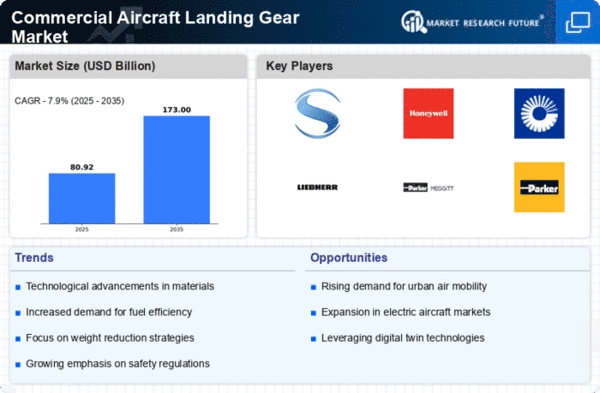
As per MRFR analysis, the Commercial Aircraft Landing Gear Market Size was estimated at 75.0 USD Billion in 2024. The Commercial Aircraft Landing Gear industry is projected to grow from 80.9 USD Billion in 2025 to 173.0 USD Billion by 2035, exhibiting a compound annual growth rate (CAGR) of 7.9 during the forecast period 2025 - 2035.

Key Market Trends & Highlights

The Commercial Aircraft Landing Gear Market is poised for growth driven by technological advancements and increasing demand for regional aircraft.

  • Technological advancements are reshaping the design and functionality of landing gear systems.
  • Sustainability initiatives are becoming increasingly critical in the development of landing gear technologies.
  • North America remains the largest market, while the Asia-Pacific region is recognized as the fastest-growing area for landing gear solutions.
  • Rising air travel demand and a focus on fuel efficiency are key drivers propelling the market forward.

Market Size & Forecast

2024 Market Size 75.0 (USD Billion)
2035 Market Size 173.0 (USD Billion)
CAGR (2025 - 2035) 7.9%
Largest Regional Market Share in 2024 North America

Major Players

<p>Safran (FR), Honeywell (US), UTC Aerospace Systems (US), Liebherr (DE), Meggitt (GB), Boeing (US), Rockwell Collins (US), Goodrich (US), Parker Hannifin (US), AAR Corp (US)</p>

Market Trends

The Commercial Aircraft Landing Gear Market is currently experiencing a transformative phase, driven by advancements in technology and increasing demand for fuel-efficient aircraft. Manufacturers are focusing on developing lightweight materials and innovative designs to enhance performance and reduce operational costs. This shift towards modernization is not only aimed at improving safety and reliability but also at meeting stringent environmental regulations. As airlines seek to optimize their fleets, the emphasis on landing gear systems that can withstand diverse operational conditions is becoming more pronounced. Moreover, the market is witnessing a growing trend towards the integration of smart technologies within landing gear systems. These technologies are expected to provide real-time data analytics, predictive maintenance capabilities, and enhanced monitoring systems. Such innovations could potentially lead to improved lifecycle management and reduced downtime for aircraft. As the industry evolves, collaboration between manufacturers and airlines is likely to intensify, fostering a more dynamic and responsive market environment.

Technological Advancements

The Commercial Aircraft Landing Gear Market is increasingly influenced by technological innovations. Manufacturers are investing in research and development to create advanced landing gear systems that incorporate lightweight materials and smart technologies. These advancements aim to enhance performance, safety, and efficiency.

Sustainability Initiatives

There is a notable shift towards sustainability within the Commercial Aircraft Landing Gear Market. Companies are focusing on eco-friendly materials and processes to reduce the environmental impact of landing gear production. This trend aligns with the broader aviation industry's commitment to reducing carbon emissions.

Increased Demand for Regional Aircraft

The demand for regional aircraft is rising, which is impacting the Commercial Aircraft Landing Gear Market. As airlines expand their operations to include more regional routes, the need for specialized landing gear systems tailored to smaller aircraft is becoming more critical.

Commercial Aircraft Landing Gear Market Market Drivers

Increasing Air Travel Demand

The Global Commercial Aircraft Landing Gear Industry is experiencing growth driven by the rising demand for air travel. As more passengers opt for air transportation, airlines are expanding their fleets to accommodate this surge. The International Air Transport Association projects that global air passenger numbers will reach 8.2 billion by 2037, necessitating more aircraft and, consequently, more landing gear systems. This expansion is expected to contribute to the market's valuation, projected to reach 7.11 USD Billion in 2024 and potentially 22.4 USD Billion by 2035, reflecting a compound annual growth rate of 11.01% from 2025 to 2035.

Market Trends and Growth Projections

The Global Commercial Aircraft Landing Gear Industry is poised for substantial growth, with projections indicating a market size of 7.11 USD Billion in 2024 and an anticipated increase to 22.4 USD Billion by 2035. The compound annual growth rate is expected to be 11.01% from 2025 to 2035. This growth trajectory reflects the convergence of various factors, including rising air travel demand, technological advancements, and regulatory pressures. The market dynamics suggest a robust future for landing gear systems, driven by both established and emerging players in the aviation sector.

Emerging Markets and Regional Expansion

The Global Commercial Aircraft Landing Gear Industry is witnessing growth fueled by the expansion of emerging markets. Countries in Asia-Pacific and the Middle East are investing heavily in their aviation infrastructure, leading to an increase in aircraft orders. For example, the Asia-Pacific region is projected to account for a substantial share of new aircraft deliveries over the next decade. This regional expansion is likely to stimulate demand for landing gear systems, as airlines in these markets seek to modernize their fleets. The growing middle-class population in these regions further supports the demand for air travel, thereby enhancing market prospects.

Regulatory Compliance and Safety Standards

The Global Commercial Aircraft Landing Gear Industry is significantly influenced by stringent regulatory compliance and safety standards imposed by aviation authorities. Organizations such as the Federal Aviation Administration and the European Union Aviation Safety Agency enforce rigorous safety protocols that landing gear systems must meet. Compliance with these regulations often necessitates upgrades and innovations in landing gear technology, thereby driving demand. As safety remains a paramount concern in aviation, manufacturers are compelled to invest in research and development to ensure their products meet evolving standards, which in turn supports market expansion.

Focus on Fuel Efficiency and Sustainability

The Global Commercial Aircraft Landing Gear Industry is increasingly aligned with the aviation sector's focus on fuel efficiency and sustainability. Airlines are under pressure to reduce carbon emissions and operational costs, prompting a shift towards more efficient aircraft designs. Landing gear systems play a crucial role in this transition, as advancements in design and materials can lead to significant weight reductions and improved aerodynamics. Consequently, manufacturers are innovating to produce landing gear that not only meets performance standards but also aligns with sustainability goals, thus driving market growth in the coming years.

Technological Advancements in Landing Gear Systems

Technological innovations are pivotal in shaping the Global Commercial Aircraft Landing Gear Industry. The integration of advanced materials and smart technologies enhances the performance and reliability of landing gear systems. For instance, the use of lightweight composite materials reduces overall aircraft weight, improving fuel efficiency and operational costs. Furthermore, the implementation of predictive maintenance technologies allows for timely interventions, reducing downtime and enhancing safety. As airlines increasingly prioritize efficiency and safety, the demand for technologically advanced landing gear systems is likely to rise, further propelling market growth.

Market Segment Insights

By Application: Commercial Aircraft (Largest) vs. Military Aircraft (Fastest-Growing)

<p>The Commercial Aircraft application is projected to dominate the landing gear market, accounting for the majority of market share due to the rising demand for new aircraft and the ongoing replacement of aging fleets. With a strong focus on passenger transportation, this segment remains the key driver for technological advancements in landing gear, which are essential for improved safety, performance, and efficiency. In contrast, the Military Aircraft segment, while currently smaller, is exhibiting the fastest growth. This surge is fuelled by increased defense spending and modernization programs across various nations, leading to significant investments in advanced landing gear systems that enhance performance in diverse operational environments.</p>

<p>Commercial Aircraft: Dominant vs. Military Aircraft: Emerging</p>

<p>The Commercial Aircraft segment stands as the dominant force in the landing gear market, characterized by a robust demand for enhanced safety and performance in commercial aviation. This preference drives innovation in design and materials, leading to the implementation of lighter yet stronger components that improve fuel efficiency. Furthermore, the segment benefits from the growing trend of sustainability within the aviation industry, where manufacturers strive to develop eco-friendly solutions. Meanwhile, the Military Aircraft segment, marked as an emerging player, demonstrates rapid growth owing to geopolitical tensions and increasing defense budgets. Military landing gear designs focus on versatility and durability, catering to diverse mission requirements, thereby positioning themselves as critical components in modern defense strategies.</p>

By Landing Gear Type: Tricycle Landing Gear (Largest) vs. Tailwheel Landing Gear (Fastest-Growing)

<p>In the Commercial Aircraft Landing Gear Market, the distribution of market share is predominantly led by Tricycle Landing Gear, which has established itself as the go-to choice for modern aircraft configurations due to its efficiency and stability during takeoff and landing. Tailwheel Landing Gear, while traditionally less common, is gaining traction, particularly among vintage and bush aircraft users who appreciate its advantages in specific operational environments.</p>

<p>Landing Gear Type: Tricycle (Dominant) vs. Tailwheel (Emerging)</p>

<p>Tricycle Landing Gear remains the dominant type in the market, favored for its superior aerodynamic performance and ease of landing maneuvers. This design supports a more streamlined fuselage and enables enhanced handling characteristics, making it a preferred choice for commercial and passenger aircraft. Conversely, Tailwheel Landing Gear, while considered an emerging option, has seen rejuvenated interest due to its unique suitability for off-airport operations and short takeoff distances. It appeals to niche markets, including light sport and specialty aircraft, as manufacturers innovate to meet the needs of specific flight operations.</p>

By Material Type: Aluminum (Largest) vs. Composite (Fastest-Growing)

<p>In the Commercial Aircraft Landing Gear Market, the material type segment showcases a diverse distribution, with Aluminum being the predominant choice among manufacturers due to its favorable strength-to-weight ratio and cost-effectiveness. Steel follows closely, known for its robustness in high-stress applications. Composite materials, although currently a smaller percentage of the market, are gaining traction for their lightweight properties and potential for reduced maintenance costs. Titanium, despite its higher price point, offers unique advantages in corrosion resistance and lightweight structures, appealing to niche applications in advanced aircraft designs. As the market evolves, growth trends indicate a significant shift towards Composite materials, recognized as the fastest-growing segment. Innovations in manufacturing techniques and the demand for fuel-efficient designs are propelling operators to adopt advanced materials. Additionally, the push for lighter and more durable landing gear systems is expected to enhance the adoption of Titanium as manufacturers seek to optimize performance. Overall, the combination of material innovations and regulatory pressures towards sustainability will likely shape the future of the segment.</p>

<p>Material: Aluminum (Dominant) vs. Titanium (Emerging)</p>

<p>Aluminum is the dominant material in the Commercial Aircraft Landing Gear market due to its excellent balance of weight, strength, and cost, making it ideal for traditional aircraft designs. Its extensive use is supported by established manufacturing processes and a wealth of historical data on performance and reliability. On the other hand, Titanium, although currently considered an emerging material, is gaining attention for its remarkable strength-to-weight ratio and superior corrosion resistance. As aircraft manufacturers look to innovate and improve efficiency, Titanium’s potential benefits are leading to increased research and development efforts to integrate it into landing gear systems. The versatility and durability of Titanium could soon position it as a significant player, particularly in the context of next-generation aircraft initiatives.</p>

By Actuation System: Hydraulic Actuation System (Largest) vs. Electric Actuation System (Fastest-Growing)

<p>The Commercial Aircraft Landing Gear Market sees a notable distribution among actuation systems, primarily with Hydraulic Actuation System leading in market share due to its proven reliability and effective performance. This system is predominantly employed in large and medium-sized aircraft, making it the preferred choice for many manufacturers. Meanwhile, Mechanical Actuation Systems hold a smaller share, catering mainly to specific aircraft types where simplicity and weight reduction are priorities. This diversification enhances the overall market dynamics, allowing for tailored solutions based on aircraft design requirements. In recent years, the Electric Actuation System has emerged as a significant player, recognized for its potential to enhance operational efficiency and reduce environmental impact. The demand for electric systems is gaining traction among manufacturers focusing on innovation and sustainability. Growth is driven by advancements in technology, along with regulatory pressures to improve fuel efficiency. The push for more electric aircraft further highlights the emerging position of electric systems, with manufacturers exploring hybrid models to bridge traditional hydraulic frameworks and electric innovations.</p>

<p>Hydraulic Actuation System (Dominant) vs. Electric Actuation System (Emerging)</p>

<p>The Hydraulic Actuation System remains the dominant force in the Commercial Aircraft Landing Gear Market, favored for its robustness and reliability in various operational scenarios. Widely adopted in both commercial and military applications, it exhibits superior performance under high-load conditions, making it a staple in traditional aircraft designs. However, the Electric Actuation System is rapidly emerging, characterized by its lightweight construction and the ability to integrate seamlessly with modern aircraft technologies aimed at sustainability. As manufacturers increasingly focus on reducing carbon footprints, the electric systems are gaining traction, driven by innovations that enhance their performance and efficiency. Balancing these two actuation systems within the market showcases a shift as industry leaders adapt to evolving demands while ensuring safety and reliability.</p>

By Maintenance Type: Routine Maintenance (Largest) vs. Overhaul Maintenance (Fastest-Growing)

<p>In the Commercial Aircraft Landing Gear Market, routine maintenance holds the largest market share among the maintenance types. It is essential for ensuring aircraft safety and reliability, attracting significant investments from airlines focused on operational efficiency. Routine maintenance encompasses various scheduled services that are vital for prolonging the lifespan of landing gear components and is performed at regular intervals based on flight hours or cycles. On the other hand, overhaul maintenance is the fastest-growing segment within this category. The increase in aircraft operations globally and the rising focus on maintaining aging fleets are driving this growth. Regulatory requirements for safety checks and the need to optimize performance further enhance the demand for overhaul maintenance, thus creating a robust growth trajectory for this segment in the coming years.</p>

<p>Routine Maintenance (Dominant) vs. Repair Maintenance (Emerging)</p>

<p>Routine maintenance is characterized by planned inspections, adjustments, and component replacements, aimed at preventing unexpected failures and ensuring aircraft operational readiness. Its dominant position in the Commercial Aircraft Landing Gear Market reflects the industry's commitment to safety and compliance with aviation regulations. In contrast, repair maintenance, while currently emerging, plays a critical role in addressing unexpected failures or damages. It encompasses corrective actions taken when issues are detected, offering airlines a way to minimize downtime. As more airlines adopt predictive maintenance technologies, repair maintenance will evolve, focusing more on precise diagnostics and targeted repairs, which in turn could enhance operational efficiency and reduce costs.</p>

Get more detailed insights about Commercial Aircraft Landing Gear Market Research Report – Global Forecast to 2035

Regional Insights

North America : Market Leader in Innovation

North America holds a commanding 40.0% share of the Commercial Aircraft Landing Gear Market, driven by robust demand from major airlines and a strong focus on technological advancements. Regulatory support from agencies like the FAA fosters innovation, ensuring safety and efficiency in aircraft operations. The region's growth is further propelled by increasing air travel and the need for modernized fleets, which necessitate advanced landing gear systems. The competitive landscape is characterized by key players such as Boeing, Honeywell, and UTC Aerospace Systems, which are at the forefront of innovation. The U.S. leads the market, with Canada also contributing significantly. The presence of established manufacturers and a strong supply chain enhances the region's market position, making it a hub for landing gear technology and development.

Europe : Emerging Market with Growth Potential

Europe accounts for a 20.0% share of the Commercial Aircraft Landing Gear Market, driven by increasing investments in aviation infrastructure and a growing emphasis on sustainability. Regulatory frameworks from the European Union promote eco-friendly technologies, pushing manufacturers to innovate. The demand for efficient landing gear systems is rising as airlines modernize their fleets to meet environmental standards and enhance operational efficiency. Leading countries like Germany, France, and the UK are pivotal in this market, hosting major players such as Safran and Liebherr. The competitive landscape is evolving, with a focus on partnerships and collaborations to enhance technological capabilities. The presence of established aerospace firms and a skilled workforce positions Europe as a significant player in the global market.

Asia-Pacific : Rapid Growth and Investment

The Asia-Pacific region holds a 10.0% share of the Commercial Aircraft Landing Gear Market, fueled by increasing air travel demand and significant investments in aviation infrastructure. Countries like China and India are experiencing rapid growth in their aviation sectors, leading to a surge in demand for advanced landing gear systems. Regulatory bodies are also enhancing safety standards, which further drives market growth as airlines seek compliance with international regulations. China is the leading country in this region, with a growing number of domestic airlines and aircraft manufacturers. The competitive landscape includes both local and international players, with companies like Boeing and Rockwell Collins establishing a strong presence. The region's focus on modernization and expansion of its aviation capabilities positions it as a key player in the global market.

Middle East and Africa : Emerging Market with Unique Challenges

The Middle East and Africa region represents a 5.0% share of the Commercial Aircraft Landing Gear Market, characterized by emerging aviation markets and unique challenges. The growth is driven by increasing air travel and investments in airport infrastructure, particularly in the Gulf states. Regulatory bodies are working to enhance safety and operational standards, which is crucial for attracting international airlines and fostering regional connectivity. Countries like the UAE and South Africa are leading the market, with significant investments in aviation projects. The competitive landscape is evolving, with both local and international players vying for market share. The presence of key players such as AAR Corp and Meggitt highlights the region's potential, despite challenges like regulatory hurdles and economic fluctuations.

Key Players and Competitive Insights

The Commercial Aircraft Landing Gear Market is characterized by a competitive landscape that is increasingly shaped by innovation, strategic partnerships, and a focus on sustainability. Key players such as Safran (FR), Honeywell (US), and Liebherr (DE) are actively pursuing strategies that enhance their market positioning. Safran (FR) emphasizes technological advancements in landing gear systems, aiming to improve performance and reduce weight, which is crucial for fuel efficiency. Meanwhile, Honeywell (US) focuses on integrating digital solutions into their landing gear systems, enhancing predictive maintenance capabilities and operational efficiency. Liebherr (DE) is also investing in research and development to create more sustainable landing gear solutions, reflecting a broader industry trend towards environmental responsibility.

The market structure appears moderately fragmented, with several players vying for market share through localized manufacturing and optimized supply chains. Companies are increasingly localizing their production to reduce lead times and costs, which may enhance their competitive edge. This strategy, combined with the collective influence of major players, suggests a dynamic environment where agility and responsiveness to market demands are paramount.

In November 2025, Safran (FR) announced a partnership with a leading aerospace manufacturer to co-develop next-generation landing gear systems that leverage advanced materials and smart technologies. This collaboration is expected to enhance the performance and reliability of landing gear, positioning Safran as a frontrunner in innovation within the market. The strategic importance of this partnership lies in its potential to set new industry standards and drive competitive differentiation.

In October 2025, Honeywell (US) launched a new predictive maintenance platform specifically designed for landing gear systems. This platform utilizes AI and machine learning to analyze data from landing gear components, allowing airlines to anticipate maintenance needs and reduce downtime. The introduction of this technology underscores Honeywell's commitment to digital transformation and positions the company to capitalize on the growing demand for smart aviation solutions.

In September 2025, Liebherr (DE) unveiled a new eco-friendly landing gear system that utilizes lightweight composite materials, significantly reducing the overall weight of the aircraft. This innovation not only enhances fuel efficiency but also aligns with the industry's shift towards sustainability. The strategic importance of this development is profound, as it addresses both regulatory pressures and market demand for greener aviation solutions.

As of December 2025, the competitive trends in the Commercial Aircraft Landing Gear Market are increasingly defined by digitalization, sustainability, and the integration of AI technologies. Strategic alliances are becoming more prevalent, as companies recognize the need to collaborate in order to innovate effectively. Looking ahead, competitive differentiation is likely to evolve from traditional price-based competition to a focus on technological innovation, reliability in supply chains, and sustainable practices. This shift may redefine the competitive landscape, compelling companies to invest in R&D and partnerships that foster long-term growth.

Key Companies in the Commercial Aircraft Landing Gear Market market include

Industry Developments

  • Q2 2024: Safran Landing Systems inaugurates new carbon brake manufacturing facility in France Safran Landing Systems opened a new state-of-the-art carbon brake manufacturing plant in Villeurbanne, France, to expand production capacity for commercial aircraft landing gear components and meet rising global demand.
  • Q2 2024: Collins Aerospace secures multi-year contract with Boeing for 737 MAX landing gear systems Collins Aerospace announced a multi-year agreement to supply landing gear systems for Boeing's 737 MAX program, strengthening its position as a key supplier for commercial aircraft landing gear.
  • Q3 2024: Heroux-Devtek acquires CESA from Airbus to expand landing gear portfolio Heroux-Devtek completed the acquisition of CESA, an Airbus subsidiary specializing in landing gear and hydraulic systems, enhancing its capabilities and market reach in the commercial aircraft landing gear sector.
  • Q3 2024: Airbus selects Liebherr-Aerospace for A321XLR main landing gear contract Airbus awarded Liebherr-Aerospace a contract to supply the main landing gear for the new A321XLR, marking a significant business win for Liebherr in the commercial aircraft landing gear market.
  • Q4 2024: GKN Aerospace announces $100M investment in new landing gear R&D center in the UK GKN Aerospace revealed plans to invest $100 million in a new research and development center focused on advanced landing gear technologies for commercial aircraft, aiming to accelerate innovation and sustainability.
  • Q4 2024: Triumph Group wins contract to supply landing gear for Embraer E2 jets Triumph Group secured a contract to manufacture and supply landing gear systems for Embraer's E2 series of commercial jets, expanding its footprint in the global landing gear market.
  • Q1 2025: Safran and Boeing sign partnership for next-generation landing gear development Safran Landing Systems and Boeing entered a strategic partnership to co-develop next-generation landing gear systems, focusing on lightweight materials and digital integration for future commercial aircraft.
  • Q1 2025: Collins Aerospace launches new electric actuation landing gear for narrow-body aircraft Collins Aerospace introduced an electric actuation landing gear system designed for narrow-body commercial aircraft, aiming to improve efficiency and reduce maintenance costs.
  • Q2 2025: Heroux-Devtek secures contract with Mitsubishi Aircraft for SpaceJet landing gear Heroux-Devtek announced a contract win to supply landing gear systems for Mitsubishi Aircraft's SpaceJet program, further expanding its commercial aircraft landing gear business.
  • Q2 2025: Airbus appoints new Head of Landing Gear Procurement Airbus named a new executive to lead its landing gear procurement division, signaling a renewed focus on supply chain optimization and strategic sourcing for commercial aircraft programs.
  • Q3 2025: Liebherr-Aerospace opens new landing gear service center in Singapore Liebherr-Aerospace inaugurated a new service center in Singapore dedicated to maintenance, repair, and overhaul of commercial aircraft landing gear, enhancing support for Asia-Pacific operators.
  • Q3 2025: GKN Aerospace wins contract for landing gear components on COMAC C919 GKN Aerospace secured a contract to supply landing gear components for China's COMAC C919 commercial aircraft, marking a significant entry into the Chinese aviation market.

Future Outlook

Commercial Aircraft Landing Gear Market Future Outlook

<p>The Commercial Aircraft Landing Gear Market is projected to grow at a 7.9% CAGR from 2024 to 2035, driven by increasing air travel demand, technological advancements, and regulatory requirements.</p>

New opportunities lie in:

  • <p>Development of lightweight composite landing gear systems</p>
  • <p>Integration of smart sensors for predictive maintenance</p>
  • <p>Expansion into emerging markets with tailored landing gear solutions</p>

<p>By 2035, the market is expected to be robust, driven by innovation and strategic expansions.</p>

Market Segmentation

Commercial Aircraft Landing Gear Market Application Outlook

  • Commercial Aircraft
  • Military Aircraft
  • Cargo Aircraft
  • Business Jets

Commercial Aircraft Landing Gear Market Material Type Outlook

  • Aluminum
  • Steel
  • Composite
  • Titanium

Commercial Aircraft Landing Gear Market Actuation System Outlook

  • Hydraulic Actuation System
  • Mechanical Actuation System
  • Electric Actuation System

Commercial Aircraft Landing Gear Market Maintenance Type Outlook

  • Routine Maintenance
  • Overhaul Maintenance
  • Repair Maintenance

Commercial Aircraft Landing Gear Market Landing Gear Type Outlook

  • Tricycle Landing Gear
  • Tailwheel Landing Gear
  • Quadricycle Landing Gear

Report Scope

MARKET SIZE 202475.0(USD Billion)
MARKET SIZE 202580.9(USD Billion)
MARKET SIZE 2035173.0(USD Billion)
COMPOUND ANNUAL GROWTH RATE (CAGR)7.9% (2024 - 2035)
REPORT COVERAGERevenue Forecast, Competitive Landscape, Growth Factors, and Trends
BASE YEAR2024
Market Forecast Period2025 - 2035
Historical Data2019 - 2024
Market Forecast UnitsUSD Billion
Key Companies ProfiledSafran (FR), Honeywell (US), UTC Aerospace Systems (US), Liebherr (DE), Meggitt (GB), Boeing (US), Rockwell Collins (US), Goodrich (US), Parker Hannifin (US), AAR Corp (US)
Segments CoveredApplication, Landing Gear Type, Material Type, Actuation System, Maintenance Type
Key Market OpportunitiesIntegration of advanced materials and automation technologies in the Commercial Aircraft Landing Gear Market.
Key Market DynamicsTechnological advancements and regulatory changes drive innovation and competition in the Commercial Aircraft Landing Gear Market.
Countries CoveredNorth America, Europe, APAC, South America, MEA

FAQs

How Commercial Aircraft Landing Gear Market Growth Globally?

The global commercial aircraft landing gear market is anticipated to acquire a CAGR of 11.01% during 2025-2035.

which are Top 10 Key Driver in commercial aircraft landing gear market?

AAR (US),Liebherr Group (Switzerland),CIRCOR AEROSPACE (US),Safran (France),Heroux-Devtek (Canada),United Technologies Corporation (US),Magellan Aerospace Corporation (Canada),Honeywell International (US),GKN Aerospace (UK),Triumph Group (US)

What is the market segmentation of the commercial aircraft landing gear market?

The commercial aircraft landing gear market is segmented into aircraft type, aircraft model, and landing gear.

Why are Europe and MEA region projected to be an essential market for aircraft landing gear market?

The booming aviation sector, massive air traffic, and growth in the airline industry are expected to be significant causes for developing the aircraft landing gear market.

Who are the most eminent players of the global commercial aircraft landing gear market?

UTC Aerospace Systems, Merrill Technologies Group, Triumph Group, and Heroux-devtek are some of the most eminent players in the global commercial aircraft landing gear market.

  1. Executive Summary
  2. Scope Of The Report
    1. Market Definition
    2. Scope Of The Study
    3. Market Structure
    4. Key Takeaways
    5. Key Buying Criteria
  3. Research Methodology
    1. Research Process
    2. Primary Research
    3. Secondary Research
    4. Market Size Estimation
    5. Forecast Model
    6. List Of Assumptions
  4. Market Landscape
    1. Porter’s Five Forces Analysis
      1. Threat Of New Entrants
      2. Bargaining Power Of Buyers
      3. Threat Of Substitutes
      4. Segment Rivalry
      5. Bargaining Power Of Suppliers
    2. Supply Chain Analysis
  5. Market Dynamics
    1. Introduction
    2. Market Drivers
    3. Market Restraints
    4. Market Opportunities
    5. Technological Trends
    6. Patent Analysis
    7. Regulatory Landscape
  6. Global Commercial Aircraft Landing Gear Market, By Type
    1. Introduction
    2. Main Landing Gear
      1. Market Estimates & Forecast, 2020-2030
      2. Market Estimates & Forecast, By Region, 2020-2030
    3. Nose Landing Gear
      1. Market Estimates & Forecast, 2020-2030
      2. Market Estimates & Forecast, By Region, 2020-2030
  7. Global Commercial Aircraft Landing Gear Market, By Aircraft Type
    1. Introduction
    2. Fixed-Wing
      1. Market Estimates & Forecast, 2020-2030
      2. Market Estimates & Forecast, By Region, 2020-2030
    3. Rotary-Wing
      1. Market Estimates & Forecast, 2020-2030
      2. Market Estimates & Forecast, By Region, 2020-2030
  8. Global Commercial Aircraft Landing Gear Market, By Platform
    1. Introduction
    2. Commercial Aviation
      1. Market Estimates & Forecast, 2020-2030
      2. Market Estimates & Forecast, By Region, 2020-2030
    3. Military Aviation
      1. Market Estimates & Forecast, 2020-2030
      2. Market Estimates & Forecast, By Region, 2020-2030
    4. Business & General Aviation
      1. Market Estimates & Forecast, 2020-2030
      2. Market Estimates & Forecast, By Region, 2020-2030
  9. Global Commercial Aircraft Landing Gear Market, By Region
    1. Introduction
    2. North America
      1. Market Estimates & Forecast, By Country, 2020-2030
      2. Market Estimates & Forecast, By Type, 2020-2030
      3. Market Estimates & Forecast, By Aircraft Type, 2020-2030
      4. Market Estimates & Forecast, By Platform, 2020-2030
      5. US
      6. Canada
    3. Europe
      1. Market Estimates & Forecast, By Country, 2020-2030
      2. Market Estimates & Forecast, By Type, 2020-2030
      3. Market Estimates & Forecast, By Aircraft Type, 2020-2030
      4. Market Estimates & Forecast, By Platform, 2020-2030
      5. UK
      6. Russia
      7. Germany
      8. France
      9. Italy
      10. Rest Of Europe
    4. Asia-Pacific
      1. Market Estimates & Forecast, By Country, 2020-2030
      2. Market Estimates & Forecast, By Type, 2020-2030
      3. Market Estimates & Forecast, By Aircraft Type, 2020-2030
      4. Market Estimates & Forecast, By Platform, 2020-2030
      5. China
      6. Japan
      7. India
      8. South Korea
      9. Australia
      10. Rest Of Asia-Pacific
    5. Middle East & Africa
      1. Market Estimates & Forecast, By Country, 2020-2030
      2. Market Estimates & Forecast, By Type, 2020-2030
      3. Market Estimates & Forecast, By Aircraft Type, 2020-2030
      4. Market Estimates & Forecast, By Platform, 2020-2030
      5. UAE
      6. Saudi Arabia
      7. Israel
      8. Rest Of Middle East & Africa
    6. Latin America
      1. Market Estimates & Forecast, By Country, 2020-2030
      2. Market Estimates & Forecast, By Type, 2020-2030
      3. Market Estimates & Forecast, By Aircraft Type, 2020-2030
      4. Market Estimates & Forecast, By Platform, 2020-2030
      5. Brazil
      6. Mexico
      7. Rest Of Latin America
  10. Competitive Landscape
    1. Competitive Scenario
    2. Competitive Benchmarking
    3. Market Share Analysis
    4. Mergers & Acquisitions
    5. Company Mapping
  11. Company Profiles
    1. CIRCOR AEROSPACE
      1. Company Overview
      2. Product Offering
      3. Financial Overview
      4. Key Developments
      5. Swot Analysis
      6. Strategy
    2. Heroux-Devtek
      1. Company Overview
      2. Product Offering
      3. Financial Overview
      4. Key Developments
      5. Swot Analysis
      6. Strategy
    3. Liebherr Group
      1. Company Overview
      2. Product Offering
      3. Financial Overview
      4. Key Developments
      5. Swot Analysis
      6. Strategy
    4. Safran
      1. Company Overview
      2. Product Offering
      3. Financial Overview
      4. Key Developments
      5. Swot Analysis
      6. Strategy
    5. United Technologies Corporation
      1. Company Overview
      2. Product Offering
      3. Financial Overview
      4. Key Developments
      5. Swot Analysis
      6. Strategy
    6. AAR
      1. Company Overview
      2. Product Offering
      3. Financial Overview
      4. Key Developments
      5. Swot Analysis
      6. Strategy
    7. Magellan Aerospace Corporation
      1. Company Overview
      2. Product Offering
      3. Financial Overview
      4. Key Developments
      5. Swot Analysis
      6. Strategy
    8. GKN Aerospace
      1. Company Overview
      2. Product Offering
      3. Financial Overview
      4. Key Developments
      5. Swot Analysis
      6. Strategy
    9. Triumph Group
      1. Company Overview
      2. Product Offering
      3. Financial Overview
      4. Key Developments
      5. Swot Analysis
      6. Strategy
    10. Honeywell International
      1. Company Overview
      2. Product Offering
      3. Financial Overview
      4. Key Developments
      5. Swot Analysis
      6. Strategy 
  12. List Of Tables
  13. Global Commercial Aircraft Landing Gear Market, By Region, 2020-2030
  14. North America: Commercial Aircraft Landing Gear Market, By Country, 2020-2030
  15. Europe: Commercial Aircraft Landing Gear Market, By Country, 2020-2030
  16. Asia-Pacific: Commercial Aircraft Landing Gear Market, By Country, 2020-2030
  17. Middle East & Africa: Commercial Aircraft Landing Gear Market, By Country, 2020-2030
  18. Latin America: Commercial Aircraft Landing Gear Market, By Country, 2020-2030
  19. Global Commercial Aircraft Landing Gear Market, By Type, 2020-2030
  20. North America: Commercial Aircraft Landing Gear Market, By Type, 2020-2030
  21. Europe: Commercial Aircraft Landing Gear Market, By Type, 2020-2030
  22. Asia-Pacific: Commercial Aircraft Landing Gear Market, By Type, 2020-2030
  23. Middle East & Africa: Commercial Aircraft Landing Gear Market, By Type, 2020-2030
  24. Latin America: Commercial Aircraft Landing Gear Market, By Type, 2020-2030
  25. Global Commercial Aircraft Landing Gear Market, By Aircraft Type, 2020-2030
  26. North America: Commercial Aircraft Landing Gear Market, By Aircraft Type, 2020-2030
  27. Europe: Commercial Aircraft Landing Gear Market, By Aircraft Type, 2020-2030
  28. Asia-Pacific: Commercial Aircraft Landing Gear Market, By Aircraft Type, 2020-2030
  29. Middle East & Africa: Commercial Aircraft Landing Gear Market, By Aircraft Type, 2020-2030
  30. Latin America: Commercial Aircraft Landing Gear Market, By Aircraft Type, 2020-2030
  31. Global Commercial Aircraft Landing Gear Market, By Platform, 2020-2030
  32. North America: Commercial Aircraft Landing Gear Market, By Platform, 2020-2030
  33. Europe: Commercial Aircraft Landing Gear Market, By Platform, 2020-2030
  34. Asia-Pacific: Commercial Aircraft Landing Gear Market, By Platform, 2020-2030
  35. Middle East & Africa: Commercial Aircraft Landing Gear Market, By Platform, 2020-2030
  36. Latin America: Commercial Aircraft Landing Gear Market, By Platform, 2020-2030
  37. List Of Figures
  38. Research Process Of MRFR
  39. Top-Down & Bottom-Up Approaches
  40. Market Dynamics
  41. Impact Analysis: Market Drivers
  42. Impact Analysis: Market Restraints
  43. Porter's Five Forces Analysis
  44. Supply Chain Analysis
  45. Global Commercial Aircraft Landing Gear Market Share, By Type, 2020 (%)
  46. Global Commercial Aircraft Landing Gear Market, By Type, 2020-2030 (USD Million)
  47. Global Commercial Aircraft Landing Gear Market Share, By Aircraft Type, 2020 (%)
  48. Global Commercial Aircraft Landing Gear Market, By Aircraft Type, 2020-2030 (USD Million)
  49. Global Commercial Aircraft Landing Gear Market Share, By Platform, 2020 (%)
  50. Global Commercial Aircraft Landing Gear Market, By Platform, 2020-2030 (USD Million)
  51. Global Commercial Aircraft Landing Gear Market Share (%), By Region, 2020
  52. Global Commercial Aircraft Landing Gear Market, By Region, 2020-2030 (USD Million)
  53. North America: Commercial Aircraft Landing Gear Market Share (%), 2020
  54. North America: Commercial Aircraft Landing Gear Market By Country, 2020-2030 (USD Million)
  55. Europe: Commercial Aircraft Landing Gear Market Share (%), 2020
  56. Europe: Commercial Aircraft Landing Gear Market By Country, 2020-2030 (USD Million)
  57. Asia-Pacific: Commercial Aircraft Landing Gear Market Share (%), 2020
  58. Asia-Pacific: Commercial Aircraft Landing Gear Market By Country, 2020-2030 (USD Million)
  59. Middle East & Africa: Commercial Aircraft Landing Gear Market Share (%), 2020
  60. Middle East & Africa: Commercial Aircraft Landing Gear Market By Country, 2020-2030 (USD Million)
  61. Latin America: Commercial Aircraft Landing Gear Market Share (%), 2020
  62. Latin America: Commercial Aircraft Landing Gear Market By Country, 2020-2030 (USD Million)

Commercial Aircraft Landing Gear Market Segmentation

Market Segmentation Overview

  • Detailed segmentation data will be available in the full report
  • Comprehensive analysis by multiple parameters
  • Regional and country-level breakdowns
  • Market size forecasts by segment
Infographic

Free Sample Request

Kindly complete the form below to receive a free sample of this Report

Get Free Sample

Customer Strories

Compare Licence

×
Features License Type
Single User Multiuser License Enterprise User
Price $4,950 $5,950 $7,250
Maximum User Access Limit 1 User Upto 10 Users Unrestricted Access Throughout the Organization
Free Customization
Direct Access to Analyst
Deliverable Format
Platform Access
Discount on Next Purchase 10% 15% 15%
Printable Versions