Author

Pradeep Nandi

Commercial Combi Ovens Market Size, Share, Industry Trend & Analysis Research Report: By Application (Baking, Grilling, Steaming, Roasting), By End Use (Restaurants, Catering Services, Institutional Kitchens, Hospitality), By Product Type (Countertop Ovens, Floor-Standing Ovens, Compact Ovens), By Cooking Method (Convection, Combination, Steaming) and By Regional (North America, Europe, South America, Asia Pacific, Middle East and Africa) - Forecast to 2035
As per Market Research Future analysis, the Commercial Combi Ovens Market Size was estimated at 3.143 USD Billion in 2024. The Commercial Combi Ovens industry is projected to grow from USD 3.31 Billion in 2025 to USD 5.558 Billion by 2035, exhibiting a compound annual growth rate (CAGR) of 5.32% during the forecast period 2025 - 2035
The Commercial Combi Ovens Market is experiencing a dynamic shift towards versatility and technological integration.
| 2024 Market Size | 3.143 (USD Billion) |
| 2035 Market Size | 5.558 (USD Billion) |
| CAGR (2025 - 2035) | 5.32% |
Rational AG (DE), Alto-Shaam Inc. (US), Merrychef (UK), Convotherm (DE), Hobart Corporation (US), Electrolux Professional (SE), Fagor Industrial (ES), Bertazzoni (IT), Cleveland Range (US)
Our Impact
Enabled $4.3B Revenue Impact for Fortune 500 and Leading Multinationals
Partnering with 2000+ Global Organizations Each Year
30K+ Citations by Top-Tier Firms in the Industry
The Commercial Combi Ovens Market is currently experiencing a notable transformation, driven by evolving consumer preferences and advancements in culinary technology. As establishments seek to enhance operational efficiency and food quality, the demand for versatile cooking equipment has surged. These ovens, which combine steam and convection cooking methods, offer significant advantages in terms of energy efficiency and cooking precision. This trend appears to be particularly pronounced in the foodservice sector, where restaurants and catering businesses are increasingly adopting these multifunctional appliances to streamline their operations and meet diverse culinary demands. Moreover, sustainability concerns are influencing purchasing decisions within the Commercial Combi Ovens Market. Operators are increasingly prioritizing energy-efficient models that minimize environmental impact while maintaining high performance. This shift towards eco-friendly solutions suggests a growing awareness of the need for responsible consumption in the food industry. As manufacturers innovate to meet these demands, the market is likely to witness the introduction of advanced features, such as smart technology integration and enhanced user interfaces, further driving growth and adoption across various segments of the foodservice industry.
The Commercial Combi Ovens Market is witnessing a rising preference for equipment that offers multiple cooking methods. This versatility allows operators to prepare a wide range of dishes, catering to diverse customer preferences and dietary requirements. As culinary creativity expands, the ability to steam, roast, and bake within a single unit becomes increasingly appealing.
Sustainability is becoming a central theme in the Commercial Combi Ovens Market. Operators are actively seeking energy-efficient models that reduce operational costs and environmental impact. This trend indicates a shift towards more responsible practices within the foodservice sector, as businesses aim to align with global sustainability goals.
The incorporation of smart technology into commercial cooking equipment is gaining traction. Features such as remote monitoring, automated cooking programs, and user-friendly interfaces are enhancing operational efficiency. This trend suggests that the Commercial Combi Ovens Market is evolving to meet the demands of a tech-savvy workforce, ultimately improving productivity and consistency in food preparation.
The commercial combi ovens Market is influenced by stringent health and safety regulations that govern food preparation and cooking processes. As food safety becomes a paramount concern, operators are increasingly turning to combi ovens that ensure precise temperature control and consistent cooking results. These ovens are designed to meet various health standards, which is crucial for establishments such as hospitals, schools, and restaurants. The rising awareness of foodborne illnesses and the need for compliance with health codes are likely to propel the demand for reliable cooking equipment. Furthermore, the ability of combi ovens to minimize the risk of cross-contamination through their multifunctional capabilities aligns with regulatory requirements, thus enhancing their appeal in the market.
The Commercial combi ovens Market is experiencing a notable increase in adoption within the foodservice sector. This trend is driven by the need for efficient cooking solutions that can handle diverse menu items. As restaurants and catering services seek to enhance their operational efficiency, combi ovens offer a versatile solution that combines steaming, baking, and roasting capabilities. According to industry reports, the foodservice sector is projected to grow at a compound annual growth rate of approximately 4.5% over the next few years, further fueling the demand for advanced cooking equipment. The ability of combi ovens to reduce cooking times while maintaining food quality positions them as a preferred choice among chefs and operators, thereby driving growth in the commercial combi ovens Market.
The Commercial Combi Ovens Market is benefiting from the expansion of quick-service restaurants (QSRs) that prioritize speed and efficiency in food preparation. As consumer preferences shift towards fast and convenient dining options, QSRs are increasingly investing in advanced cooking technologies that can deliver high-quality meals in shorter timeframes. Combi ovens, with their multifunctional capabilities, enable these establishments to streamline operations and enhance menu offerings. The QSR segment is projected to grow at a robust rate, which is likely to drive the demand for combi ovens that can meet the high-volume cooking needs of these businesses. This trend underscores the potential for growth within the Commercial Combi Ovens Market.
The Commercial Combi Ovens Market is witnessing a shift towards sustainable cooking practices, driven by both consumer preferences and regulatory pressures. As environmental concerns gain prominence, foodservice operators are increasingly adopting energy-efficient equipment that reduces carbon footprints. Combi ovens, known for their ability to conserve energy and water, align well with these sustainability goals. Reports indicate that energy-efficient appliances can reduce energy consumption by up to 30%, making them an attractive option for businesses aiming to lower operational costs while adhering to eco-friendly standards. This trend not only enhances the marketability of establishments but also contributes to the overall growth of the Commercial Combi Ovens Market.
The Commercial Combi Ovens Market is significantly impacted by ongoing technological advancements in cooking equipment. Innovations such as touch-screen controls, programmable settings, and remote monitoring capabilities are enhancing the functionality and user-friendliness of combi ovens. These advancements allow operators to optimize cooking processes, reduce labor costs, and improve food consistency. The integration of smart technology into combi ovens is particularly appealing to modern kitchens that prioritize efficiency and precision. As the market evolves, the demand for technologically advanced cooking solutions is expected to rise, further propelling the growth of the Commercial Combi Ovens Market.
In the Commercial Combi Ovens Market, the application segment is primarily dominated by Baking, which claims the largest market share due to its widespread use in various food establishments. Other applications such as Grilling, Steaming, and Roasting also contribute significantly to the market. Grilling, in particular, is gaining traction among food service operators seeking versatility and efficiency, thus influencing the balance of market share distributions across these applications. As food trends evolve towards healthier and more convenient cooking options, the focus on steaming and roasting is expected to rise. The demand for innovative and technologically advanced ovens that can combine multiple functions enhances growth in the Grilling and Steaming segments. Additionally, the surge in specialty food preparation and culinary experimentation drives the performance of these cooking applications.
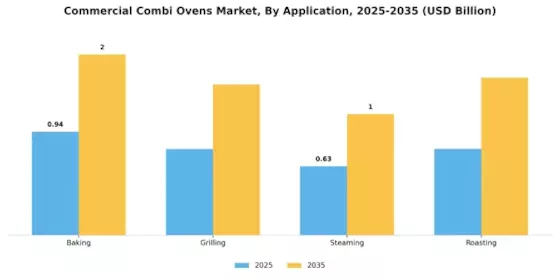
Baking (Dominant) vs. Grilling (Emerging)
Baking is the dominant application in the Commercial Combi Ovens Market, as it caters to a wide variety of culinary needs, making it essential in bakeries, hotels, and restaurants. Its versatility allows for the preparation of bread, pastries, and desserts, driving consistent demand. On the other hand, Grilling is emerging rapidly, appealing to establishments that prioritize quick-service and varied menu offerings. This application benefits from the growing popularity of grilled foods, aligning with health-conscious trends. The efficiency of modern combi ovens allows for faster cooking times, making Grilling an attractive option for operators looking to enhance service speed while maintaining quality. The competitive landscape sees manufacturers innovating to improve the functionality of grills within these ovens.
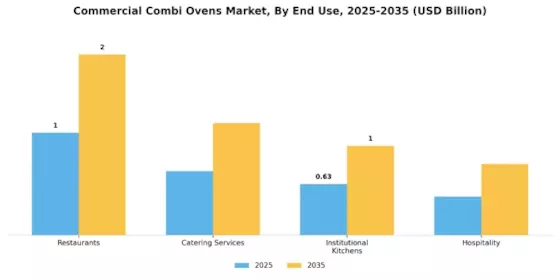
In the Commercial Combi Ovens Market, the end use segments are particularly diverse, with restaurants holding the largest market share due to the extensive adoption of these ovens for their versatility and efficiency in cooking. Additionally, catering services are emerging rapidly, reflecting a growing demand for high-quality food preparation in off-site locations, leading to an increase in the implementation of combi ovens tailored for catering needs.
Restaurants (Dominant) vs. Catering Services (Emerging)
Restaurants have established themselves as the dominant segment in the Commercial Combi Ovens Market, leveraging these appliances to enhance food quality and streamline cooking processes. Their need for high capacity, consistency, and adaptability drives their reliance on combi ovens. Conversely, catering services, as an emerging segment, are witnessing increased adoption due to trends favoring off-premise dining and events. The versatility and ease of transport of commercial combi ovens cater specifically to this segment, positioning them as essential tools to meet growing consumer expectations for diverse and high-quality meal offerings.
In the Commercial Combi Ovens Market, the product type segment consists of diverse options, notably Countertop Ovens, Floor-Standing Ovens, and Compact Ovens. Countertop Ovens command a significant share, appealing to businesses with limited space and a need for efficient cooking solutions. Meanwhile, Floor-Standing Ovens are witnessing rapid growth as more commercial kitchens seek robust systems that cater to high-volume cooking demands. The Compact Ovens segment, while valuable, is slower to penetrate the market compared to its counterparts. An analysis of growth trends within this segment reveals that the demand for efficiency, versatility, and space-saving designs is driving adoption rates. Countertop Ovens remain the preferred choice for small-scale operations, while Floor-Standing Ovens are increasingly favored for their capacity and capabilities. The market witnesses a shift towards innovative features, enhancing the appeal of these ovens for various culinary applications.
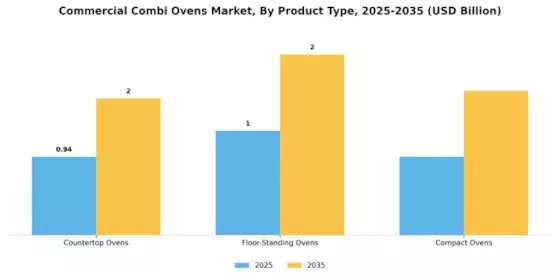
Countertop Ovens (Dominant) vs. Floor-Standing Ovens (Emerging)
Countertop Ovens are a dominant force in the Commercial Combi Ovens Market, favored for their efficient use of space and versatility, making them ideal for restaurants with limited kitchen areas. These ovens cater to a wide array of culinary needs, allowing operators to bake, steam, and roast with precision. In contrast, Floor-Standing Ovens are emerging as an appealing option for larger commercial operations. They offer superior capacity, durability, and advanced cooking technologies, accommodating high-volume meal preparation. Both types serve their distinct market segments effectively, yet the growing trend toward larger kitchen technologies positions Floor-Standing Ovens as a compelling alternative for businesses targeting increased productivity and efficiency.
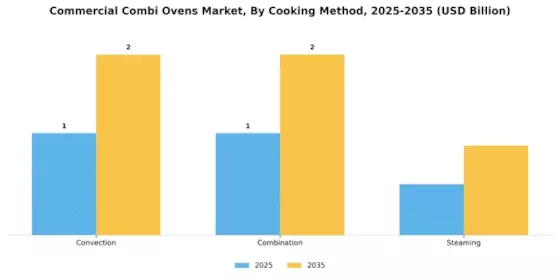
The Commercial Combi Ovens Market has been significantly shaped by various cooking methods, with Convection ovens currently commanding the largest market share due to their versatility in cooking and energy efficiency. Convection ovens utilize a fan and exhaust system to circulate hot air, ensuring even cooking and browning, making them a staple in many commercial kitchens. Meanwhile, Steaming ovens have gained traction, catering to health-conscious consumers who value nutrient retention and flavor preservation. Their market share, while smaller, is rapidly increasing, driven by a rising demand for healthier cooking options.
Convection (Dominant) vs. Steaming (Emerging)
Convection ovens are recognized as the dominant player in the Commercial Combi Ovens Market, appealing to a broad array of food service operations, from restaurants to catering services. Their efficient cooking process allows for a quicker turnaround of meals, making them a valuable asset in high-volume settings. In contrast, Steaming ovens present themselves as an emerging option, particularly among establishments focusing on health-oriented menus. Although their adoption is still growing, the demand for steaming technology aligns well with trends toward low-fat cooking and increased vegetable preparation. Both methods offer unique advantages that cater to different culinary preferences and business models.
Get more detailed insights about Commercial Combi Ovens Market Request Free Sample
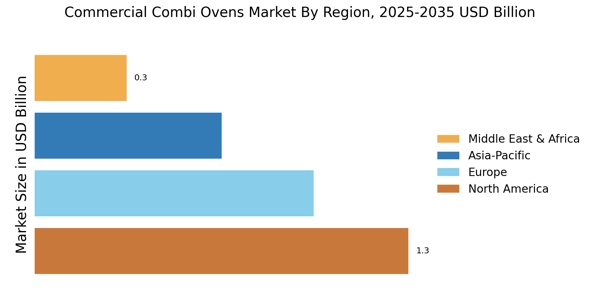
North America is the largest market for commercial combi ovens, holding approximately 40% of the global market share. The region's growth is driven by increasing demand for energy-efficient cooking solutions and the rising trend of automation in commercial kitchens. Regulatory support for energy efficiency standards further catalyzes market expansion, encouraging restaurants and food service providers to invest in advanced cooking technologies. The United States is the leading country in this region, with significant contributions from Canada. Key players such as Alto-Shaam Inc. and Hobart Corporation dominate the competitive landscape, focusing on innovation and customer service. The presence of established brands and a growing number of food service establishments are expected to sustain market growth in the coming years.
Europe is the second-largest market for commercial combi ovens, accounting for approximately 30% of the global market share. The region's growth is fueled by stringent regulations aimed at energy efficiency and sustainability, prompting food service operators to adopt advanced cooking technologies. The European Union's initiatives to reduce carbon footprints and promote energy-efficient appliances are significant drivers of market demand. Germany and the UK are the leading countries in this market, with a strong presence of key players like Rational AG and Merrychef. The competitive landscape is characterized by innovation and a focus on sustainability, with manufacturers investing in research and development to meet regulatory standards. The market is expected to grow as operators seek to enhance operational efficiency and reduce energy costs.
Asia-Pacific is witnessing rapid growth in the commercial combi ovens market, holding approximately 20% of the global market share. The region's expansion is driven by increasing urbanization, a growing middle class, and rising demand for diverse culinary options in restaurants and hotels. Additionally, government initiatives to modernize food service operations are propelling market growth, particularly in countries like China and India. China is the largest market in this region, followed by Japan and India. The competitive landscape is becoming increasingly dynamic, with both local and international players vying for market share. Companies like Electrolux Professional and Fagor Industrial are focusing on product innovation and customer-centric solutions to capture the growing demand in this diverse market. The trend towards automation and energy efficiency is expected to shape the future of the market.
The Middle East and Africa region is emerging as a significant market for commercial combi ovens, accounting for approximately 10% of the global market share. The growth is driven by increasing investments in the hospitality sector and a rising demand for high-quality food preparation equipment. Regulatory frameworks promoting food safety and quality standards are also contributing to market expansion, particularly in the Gulf Cooperation Council (GCC) countries. Countries like the UAE and South Africa are leading the market, with a growing number of restaurants and catering services. The competitive landscape features both established brands and new entrants, with companies like Bertazzoni and Cleveland Range focusing on meeting the unique needs of the region. As the food service industry continues to evolve, the demand for advanced cooking solutions is expected to rise significantly.
The competitive landscape of the Commercial Combi Ovens Market is characterized by a dynamic interplay of innovation, technological advancements, and strategic collaborations among key players. The market has witnessed significant growth due to the rising demand for versatile cooking solutions in the foodservice industry, which has prompted manufacturers to enhance the functionality and efficiency of their products. As commercial kitchens prioritize space-saving equipment and energy efficiency, combi ovens have emerged as a preferred choice for operators seeking to optimize their cooking processes. The competition has intensified as companies strive to differentiate their offerings through advanced features such as smart technology, programmable settings, and improved energy consumption metrics. The ability to provide tailored solutions for various culinary applications has become essential for capturing market share in this evolving landscape.TurboChef stands out in the Commercial Combi Ovens Market due to its commitment to innovation and quality. Known for its technologically advanced cooking solutions, TurboChef has carved a niche with its rapid cook technology that significantly reduces cooking times while maintaining food quality. The company's focus on designing user-friendly interfaces and energy-efficient models has further solidified its presence within the market. TurboChef’s skilled engineering team continuously works on groundbreaking technologies that enhance the versatility of its ovens, meeting the diverse needs of chefs and foodservice operators. The robustness and reliability of TurboChef products, combined with extensive support and training services, allow the company to maintain a loyal consumer base and thrive amidst the competitive environment.Convotherm, another prominent player in the Commercial Combi Ovens Market, is recognized for its high-performance cooking appliances that cater to various industry segments, including restaurants, catering services, and institutional kitchens. The brand is particularly celebrated for its intuitive user interface and the unique EasyDial control feature, which simplifies operation while maximizing cooking efficiency. Convotherm's rigorous testing and quality control processes ensure that their ovens provide consistent results, an essential requirement for professional kitchens. Moreover, the company places a strong emphasis on energy efficiency and sustainability, offering products that help operators reduce their environmental impact while lowering operational costs. This approach not only enhances customer satisfaction but also positions Convotherm as a leader in the market, capable of meeting the evolving demands of the foodservice industry effectively.





The Commercial Combi Ovens Market is experiencing notable developments, with key players like Rational, Convotherm, and Electrolux Professional leading the charge in innovation and product offerings. Recent investments in cutting-edge technologies to enhance energy efficiency and cooking performance are shaping industry dynamics. The market is also witnessing a surge in demand for multifunctional kitchen solutions that can streamline operations in fast-paced environments such as restaurants and catering services. Companies like TurboChef and Vulcan are expanding their portfolios to cater to these needs, indicating a shift towards more versatile cooking equipment.
Additionally, mergers and acquisitions are prevalent, with companies seeking to strengthen their market presence. For instance, recent acquisitions by Henny Penny have been aimed at expanding their market cap and enhancing product variety. Moreover, companies like Pitco and Bloomfield are focusing on sustainability and incorporating eco-friendly practices into their manufacturing processes, which is increasingly influencing consumer preferences. Overall, these factors are driving growth in market valuation and presenting opportunities for innovation within the Commercial Combi Ovens Market.
The Commercial Combi Ovens Market is projected to grow at a 5.32% CAGR from 2025 to 2035, driven by technological advancements, increasing demand for energy efficiency, and evolving consumer preferences.
New opportunities lie in:
By 2035, the market is expected to achieve robust growth, positioning itself as a leader in culinary technology.
| MARKET SIZE 2024 | 3.143(USD Billion) |
| MARKET SIZE 2025 | 3.31(USD Billion) |
| MARKET SIZE 2035 | 5.558(USD Billion) |
| COMPOUND ANNUAL GROWTH RATE (CAGR) | 5.32% (2025 - 2035) |
| REPORT COVERAGE | Revenue Forecast, Competitive Landscape, Growth Factors, and Trends |
| BASE YEAR | 2024 |
| Market Forecast Period | 2025 - 2035 |
| Historical Data | 2019 - 2024 |
| Market Forecast Units | USD Billion |
| Key Companies Profiled | Rational AG (DE), Alto-Shaam Inc. (US), Merrychef (UK), Convotherm (DE), Hobart Corporation (US), Electrolux Professional (SE), Fagor Industrial (ES), Bertazzoni (IT), Cleveland Range (US) |
| Segments Covered | Application, End Use, Product Type, Cooking Method, Regional |
| Key Market Opportunities | Integration of smart technology enhances efficiency and customization in the Commercial Combi Ovens Market. |
| Key Market Dynamics | Rising demand for energy-efficient cooking solutions drives innovation and competition in the Commercial Combi Ovens Market. |
| Countries Covered | North America, Europe, APAC, South America, MEA |
The projected market valuation for the Commercial Combi Ovens Market is expected to reach 5.558 USD Billion by 2035.
The overall market valuation of the Commercial Combi Ovens Market was 3.143 USD Billion in 2024.
The expected CAGR for the Commercial Combi Ovens Market during the forecast period 2025 - 2035 is 5.32%.
The Baking application segment is projected to reach a valuation of 1.646 USD Billion by 2035.
Key players in the market include Rational AG, Alto-Shaam Inc., Merrychef, Convotherm, Hobart Corporation, Electrolux Professional, Fagor Industrial, Bertazzoni, and Cleveland Range.
The Restaurants segment is expected to reach a valuation of 2.215 USD Billion by 2035, surpassing other end-use segments such as Catering Services and Institutional Kitchens.
The projected valuation for Floor-Standing Ovens is anticipated to be 2.174 USD Billion by 2035.
The Combination cooking method segment is expected to reach a valuation of 2.227 USD Billion by 2035, indicating substantial growth.
The Grilling application segment had a valuation of 0.785 USD Billion in 2024.
The Compact Ovens segment is projected to reach 1.738 USD Billion by 2035, indicating a competitive growth trajectory compared to Countertop Ovens.


The secondary research process involved comprehensive analysis of foodservice industry databases, regulatory standards, commercial kitchen equipment publications, and authoritative hospitality organizations. Key sources included the US Food & Drug Administration (FDA) for food equipment safety standards, Occupational Safety and Health Administration (OSHA) for workplace safety compliance, National Sanitation Foundation (NSF International) for food equipment certification standards, Underwriters Laboratories (UL) for electrical safety certifications, European Committee for Standardization (CEN) for EN standards on food machinery, US Department of Energy (DOE) for commercial kitchen equipment energy efficiency data, Energy Star Program (EPA) for certified energy-efficient equipment listings, National Restaurant Association (NRA) for foodservice industry statistics and trends, American Hotel & Lodging Association (AHLA) for hospitality sector equipment procurement data, Foodservice Equipment Distributors Association (FEDA) for distribution channel analysis, Commercial Food Equipment Service Association (CFESA) for maintenance and service trends, International Foodservice Manufacturers Association (IFMA) for manufacturer revenue and shipment data, Eurostat for European hospitality sector statistics, Bureau of Labor Statistics (BLS) for foodservice employment and wage trends affecting equipment investment, US Census Bureau for foodservice establishment counts, National Association of Convenience Stores (NACS) for convenience store foodservice equipment trends, Technomic Inc. for foodservice industry research, International Labour Organization (ILO) for global hospitality workforce data, and national health department regulations from key markets. These sources were used to collect equipment shipment statistics, regulatory compliance requirements, energy efficiency standards, foodservice establishment growth trends, and market landscape analysis for electric combi ovens, gas combi ovens, boiler-based models, and boilerless/injection models across full-size and compact configurations.
Supply-side and demand-side stakeholders were interviewed during the primary research phase in order to gather both qualitative and quantitative information. CEOs, VPs of Product Development, engineering directors, and commercial directors from OEMs, component suppliers, and commercial combi oven manufacturers were examples of supply-side sources. Executive chefs, foodservice directors, procurement managers from chain restaurants, hotels, hospitals, schools, and contract foodservice operators, as well as kitchen design consultants and equipment dealers, were among the demand-side sources. In addition to gathering information on pricing tactics, service contract structures, energy efficiency decision factors, and adoption trends of smart/connected ovens, primary research verified product development timetables and validated market segmentation.
Primary Respondent Breakdown:
By Designation: C-level Primaries (32%), Director Level (31%), Others (37%)
By Region: North America (32%), Europe (30%), Asia-Pacific (28%), Rest of World (10%)
Global market valuation was derived through revenue mapping and equipment shipment volume analysis. The methodology included:
Identification of 40+ key manufacturers across North America, Europe, Asia-Pacific, and Latin America
Product mapping across electric combi ovens, gas combi ovens, boiler-based systems, and boilerless/injection systems in full-size and compact configurations
Analysis of reported and modeled annual revenues specific to commercial combi oven portfolios
Coverage of manufacturers representing 72-78% of global market share in 2024
Extrapolation using bottom-up (unit shipments × ASP by country/segment) and top-down (manufacturer revenue validation) approaches to derive segment-specific valuations, incorporating foodservice establishment growth rates, replacement cycles, and penetration rates of combi technology versus conventional ovens
Kindly complete the form below to receive a free sample of this Report

“This is really good guys. Excellent work on a tight deadline. I will continue to use you going forward and recommend you to others. Nice job”


“Thanks. It’s been a pleasure working with you, please use me as reference with any other Intel employees.”


“Thanks for sending the report it gives us a good global view of the Betaïne market.”


“Thank you, this will be very helpful for OQS.”


“We found the report very insightful! we found your research firm very helpful. I'm sending this email to secure our future business.”


“I am very pleased with how market segments have been defined in a relevant way for my purposes (such as "Portable Freezers & refrigerators" and "last-mile"). In general the report is well structured. Thanks very much for your efforts.”


“I have been reading the first document or the study, ,the Global HVAC and FP market report 2021 till 2026. Must say, good info! I have not gone in depth at all parts, but got a good indication of the data inside!”


“We got the report in time, we really thank you for your support in this process. I also thank to all of your team as they did a great job.”


“The Automotive 48V ECU Components Procurement Intelligence Study” was a complex project, but the Market Research Future (MRFR) team handled it with quality, agility, and customer-centricity. They delivered all requested data on time and within the agreed scope. The team, including Shubhendra Anand and Rahul Gotadki, was always readily available to clarify questions and swiftly implement necessary adjustments, driving the project to a successful conclusion within a very demanding timeframe.
I would also like to specifically commend Akshay Agarwal for his responsiveness and support at every stage—from our initial inquiry on May 6th through to final delivery on June 18th. His dedication made the entire process seamless.”



